Made by :- navneet
Of class – 11
School – kv khanapara
Batch – 2015-16
State -assam
Made by :- navneet
Of class – 11
School – kv khanapara
Batch – 2015-16
State -assam
Sets : sets are the well defined collection of objects.
• The objects in a set are called its members or elements.
• We denote sets by capital letters A, B, C,X, Y, Z, etc.
• If a is an element of a set A, we write, aA, which mens
that a belongs to A or that a is an element of A.
• If a does not belong to A, we write, aA.
“Standard” Sets:
• Natural numbers N = {0, 1, 2, 3, …}
• Integers Z = {…, -2, -1, 0, 1, 2, …}
• Positive Integers Z+ = {1, 2, 3, 4, …}
• Real Numbers R = {47.3, -12, , …}
• Rational Numbers Q = {1.5, 2.6, -3.8, 15, …}
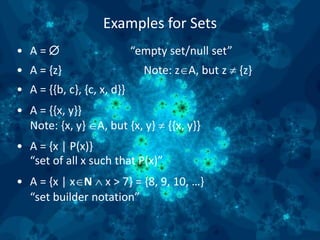
Examples for Sets
• A =  “empty set/null set”
• A = {z} Note: zA, but z  {z}
• A = {{b, c}, {c, x, d}}
• A = {{x, y}}
Note: {x, y} A, but {x, y}  {{x, y}}
• A = {x | P(x)}
“set of all x such that P(x)”
• A = {x | xN  x > 7} = {8, 9, 10, …}
“set builder notation”
Examples for Sets
•We are now able to define the set of rational numbers
Q:
•Q = {a/b | aZ  bZ+}
•or
•Q = {a/b | aZ  bZ  b0}
•And how about the set of real numbers R?
•R = {r | r is a real number}
That is the best we can do.
7
•A  B “A is a subset of B”
•A  B if and only if every element of A is also
an element of B.
•We can completely formalize this:
•A  B  x (xA  xB)
• Useful rules:
• A = B  (A  B)  (B  A)
• (A  B)  (B  C)  A  C (see Venn Diagram)
U
A
B
C
•If a set S contains n distinct elements, nN,
we call S a finite set with cardinality n.
•Examples:
•A = {Mercedes, BMW, Porsche}, |A| = 3
B = {1, {2, 3}, {4, 5}, 6} |B| = 4
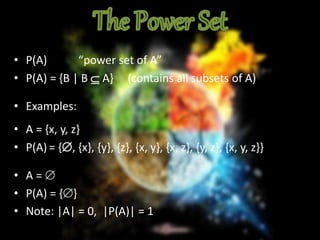
• P(A) “power set of A”
• P(A) = {B | B  A} (contains all subsets of A)
• Examples:
• A = {x, y, z}
• P(A) = {, {x}, {y}, {z}, {x, y}, {x, z}, {y, z}, {x, y, z}}
• A = 
• P(A) = {}
• Note: |A| = 0, |P(A)| = 1
The Power Set
• Cardinality of power sets:
• | P(A) | = 2|A|
• Imagine each element in A has an “on/off” switch
• Each possible switch configuration in A corresponds to
one element in 2A
zzzzzzzzz
yyyyyyyyy
xxxxxxxxx
87654321A
•The ordered n-tuple (a1, a2, a3, …, an) is an ordered
collection of objects.
•Two ordered n-tuples (a1, a2, a3, …, an) and
(b1, b2, b3, …, bn) are equal if and only if they contain
exactly the same elements in the same order, i.e. ai = bi
for 1  i  n.
•The Cartesian product of two sets is defined as:
•AB = {(a, b) | aA  bB}
•Example: A = {x, y}, B = {a, b, c}
AB = {(x, a), (x, b), (x, c), (y, a), (y, b), (y, c)}
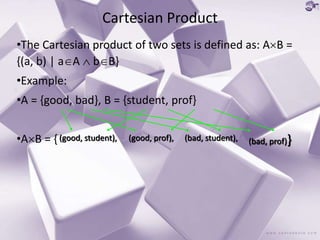
Cartesian Product
•The Cartesian product of two sets is defined as: AB =
{(a, b) | aA  bB}
•Example:
•A = {good, bad}, B = {student, prof}
•AB = {(good, student), (good, prof), (bad, student), (bad, prof)}
Cartesian Product
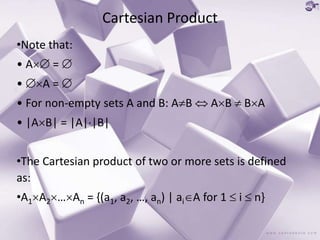
•Note that:
• A = 
• A = 
• For non-empty sets A and B: AB  AB  BA
• |AB| = |A||B|
•The Cartesian product of two or more sets is defined
as:
•A1A2…An = {(a1, a2, …, an) | aiA for 1  i  n}
• Union: AB = {x | xA  xB}
• Example: A = {a, b}, B = {b, c, d}
• AB = {a, b, c, d}
• Intersection: AB = {x | xA  xB}
• Example: A = {a, b}, B = {b, c, d}
• AB = {b}
Set Operations
•Two sets are called disjoint if their intersection is
empty, that is, they share no elements:
•AB = 
•The difference between two sets A and B contains
exactly those elements of A that are not in B:
•A-B = {x | xA  xB}
Example: A = {a, b}, B = {b, c, d}, A-B = {a}
Set Operations
•The complement of a set A contains exactly those
elements under consideration that are not in A:
•Ac = U-A
•Example: U = N, B = {250, 251, 252, …}
• Bc = {0, 1, 2, …, 248, 249}
Set Operations
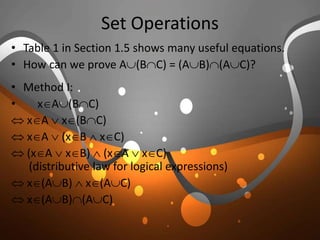
• Table 1 in Section 1.5 shows many useful equations.
• How can we prove A(BC) = (AB)(AC)?
• Method I:
• xA(BC)
 xA  x(BC)
 xA  (xB  xC)
 (xA  xB)  (xA  xC)
(distributive law for logical expressions)
 x(AB)  x(AC)
 x(AB)(AC)
Set Operations
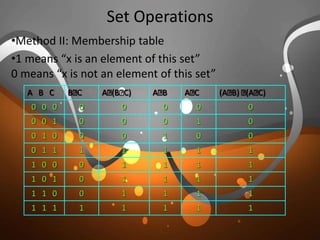
•Method II: Membership table
•1 means “x is an element of this set”
0 means “x is not an element of this set”
111111 1 1
111101 1 0
111101 0 1
111101 0 0
111110 1 1
001000 1 0
010000 0 1
000000 0 0
(A B) (A C)A CA BA (B C)B CA B C
Set Operations
•Every logical expression can be transformed into an
equivalent expression in set theory and vice versa.
CLICK HERE TO BEGIN
Made by :- navneet
Of class – 11
School – kv khanapara
Batch – 2015-16
State -assam

sets by navneet

  • 1.
    Made by :-navneet Of class – 11 School – kv khanapara Batch – 2015-16 State -assam
  • 2.
    Made by :-navneet Of class – 11 School – kv khanapara Batch – 2015-16 State -assam
  • 3.
    Sets : setsare the well defined collection of objects. • The objects in a set are called its members or elements. • We denote sets by capital letters A, B, C,X, Y, Z, etc. • If a is an element of a set A, we write, aA, which mens that a belongs to A or that a is an element of A. • If a does not belong to A, we write, aA.
  • 4.
    “Standard” Sets: • Naturalnumbers N = {0, 1, 2, 3, …} • Integers Z = {…, -2, -1, 0, 1, 2, …} • Positive Integers Z+ = {1, 2, 3, 4, …} • Real Numbers R = {47.3, -12, , …} • Rational Numbers Q = {1.5, 2.6, -3.8, 15, …}
  • 5.
    Examples for Sets •A =  “empty set/null set” • A = {z} Note: zA, but z  {z} • A = {{b, c}, {c, x, d}} • A = {{x, y}} Note: {x, y} A, but {x, y}  {{x, y}} • A = {x | P(x)} “set of all x such that P(x)” • A = {x | xN  x > 7} = {8, 9, 10, …} “set builder notation”
  • 6.
    Examples for Sets •Weare now able to define the set of rational numbers Q: •Q = {a/b | aZ  bZ+} •or •Q = {a/b | aZ  bZ  b0} •And how about the set of real numbers R? •R = {r | r is a real number} That is the best we can do.
  • 7.
    7 •A  B“A is a subset of B” •A  B if and only if every element of A is also an element of B. •We can completely formalize this: •A  B  x (xA  xB)
  • 8.
    • Useful rules: •A = B  (A  B)  (B  A) • (A  B)  (B  C)  A  C (see Venn Diagram) U A B C
  • 9.
    •If a setS contains n distinct elements, nN, we call S a finite set with cardinality n. •Examples: •A = {Mercedes, BMW, Porsche}, |A| = 3 B = {1, {2, 3}, {4, 5}, 6} |B| = 4
  • 10.
    • P(A) “powerset of A” • P(A) = {B | B  A} (contains all subsets of A) • Examples: • A = {x, y, z} • P(A) = {, {x}, {y}, {z}, {x, y}, {x, z}, {y, z}, {x, y, z}} • A =  • P(A) = {} • Note: |A| = 0, |P(A)| = 1
  • 11.
    The Power Set •Cardinality of power sets: • | P(A) | = 2|A| • Imagine each element in A has an “on/off” switch • Each possible switch configuration in A corresponds to one element in 2A zzzzzzzzz yyyyyyyyy xxxxxxxxx 87654321A
  • 12.
    •The ordered n-tuple(a1, a2, a3, …, an) is an ordered collection of objects. •Two ordered n-tuples (a1, a2, a3, …, an) and (b1, b2, b3, …, bn) are equal if and only if they contain exactly the same elements in the same order, i.e. ai = bi for 1  i  n. •The Cartesian product of two sets is defined as: •AB = {(a, b) | aA  bB} •Example: A = {x, y}, B = {a, b, c} AB = {(x, a), (x, b), (x, c), (y, a), (y, b), (y, c)}
  • 13.
    Cartesian Product •The Cartesianproduct of two sets is defined as: AB = {(a, b) | aA  bB} •Example: •A = {good, bad}, B = {student, prof} •AB = {(good, student), (good, prof), (bad, student), (bad, prof)}
  • 14.
    Cartesian Product •Note that: •A =  • A =  • For non-empty sets A and B: AB  AB  BA • |AB| = |A||B| •The Cartesian product of two or more sets is defined as: •A1A2…An = {(a1, a2, …, an) | aiA for 1  i  n}
  • 15.
    • Union: AB= {x | xA  xB} • Example: A = {a, b}, B = {b, c, d} • AB = {a, b, c, d} • Intersection: AB = {x | xA  xB} • Example: A = {a, b}, B = {b, c, d} • AB = {b}
  • 16.
    Set Operations •Two setsare called disjoint if their intersection is empty, that is, they share no elements: •AB =  •The difference between two sets A and B contains exactly those elements of A that are not in B: •A-B = {x | xA  xB} Example: A = {a, b}, B = {b, c, d}, A-B = {a}
  • 17.
    Set Operations •The complementof a set A contains exactly those elements under consideration that are not in A: •Ac = U-A •Example: U = N, B = {250, 251, 252, …} • Bc = {0, 1, 2, …, 248, 249}
  • 18.
    Set Operations • Table1 in Section 1.5 shows many useful equations. • How can we prove A(BC) = (AB)(AC)? • Method I: • xA(BC)  xA  x(BC)  xA  (xB  xC)  (xA  xB)  (xA  xC) (distributive law for logical expressions)  x(AB)  x(AC)  x(AB)(AC)
  • 19.
    Set Operations •Method II:Membership table •1 means “x is an element of this set” 0 means “x is not an element of this set” 111111 1 1 111101 1 0 111101 0 1 111101 0 0 111110 1 1 001000 1 0 010000 0 1 000000 0 0 (A B) (A C)A CA BA (B C)B CA B C
  • 20.
    Set Operations •Every logicalexpression can be transformed into an equivalent expression in set theory and vice versa.
  • 21.
  • 22.
    Made by :-navneet Of class – 11 School – kv khanapara Batch – 2015-16 State -assam