1
Set Operations
CS/APMA 202, Spring 2005
Rosen, section 1.7
Aaron Bloomfield
2
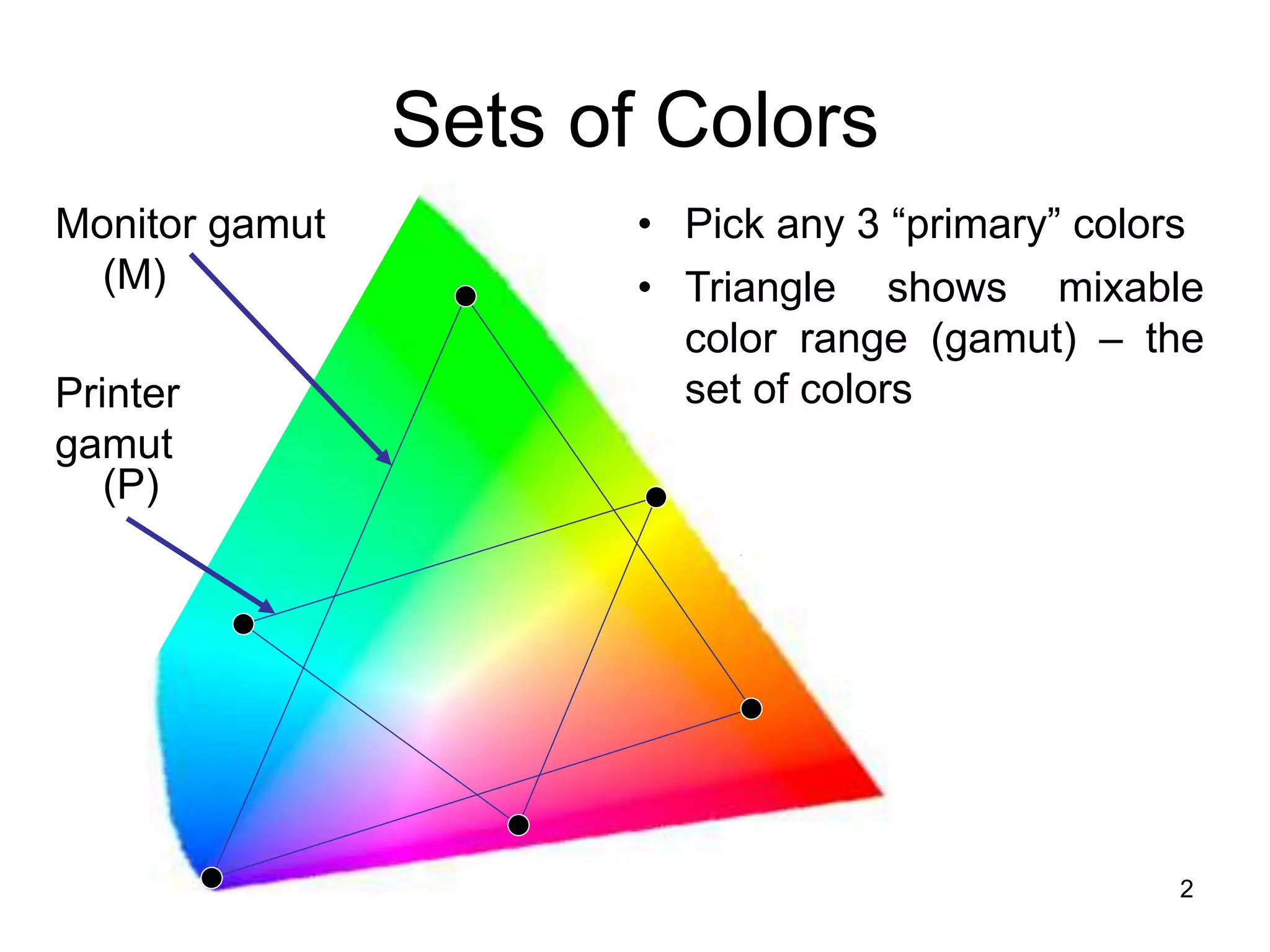
• Triangle shows mixable
color range (gamut) – the
set of colors
Sets of Colors
Monitor gamut
(M)
Printer
gamut
(P)
• Pick any 3 “primary” colors
3
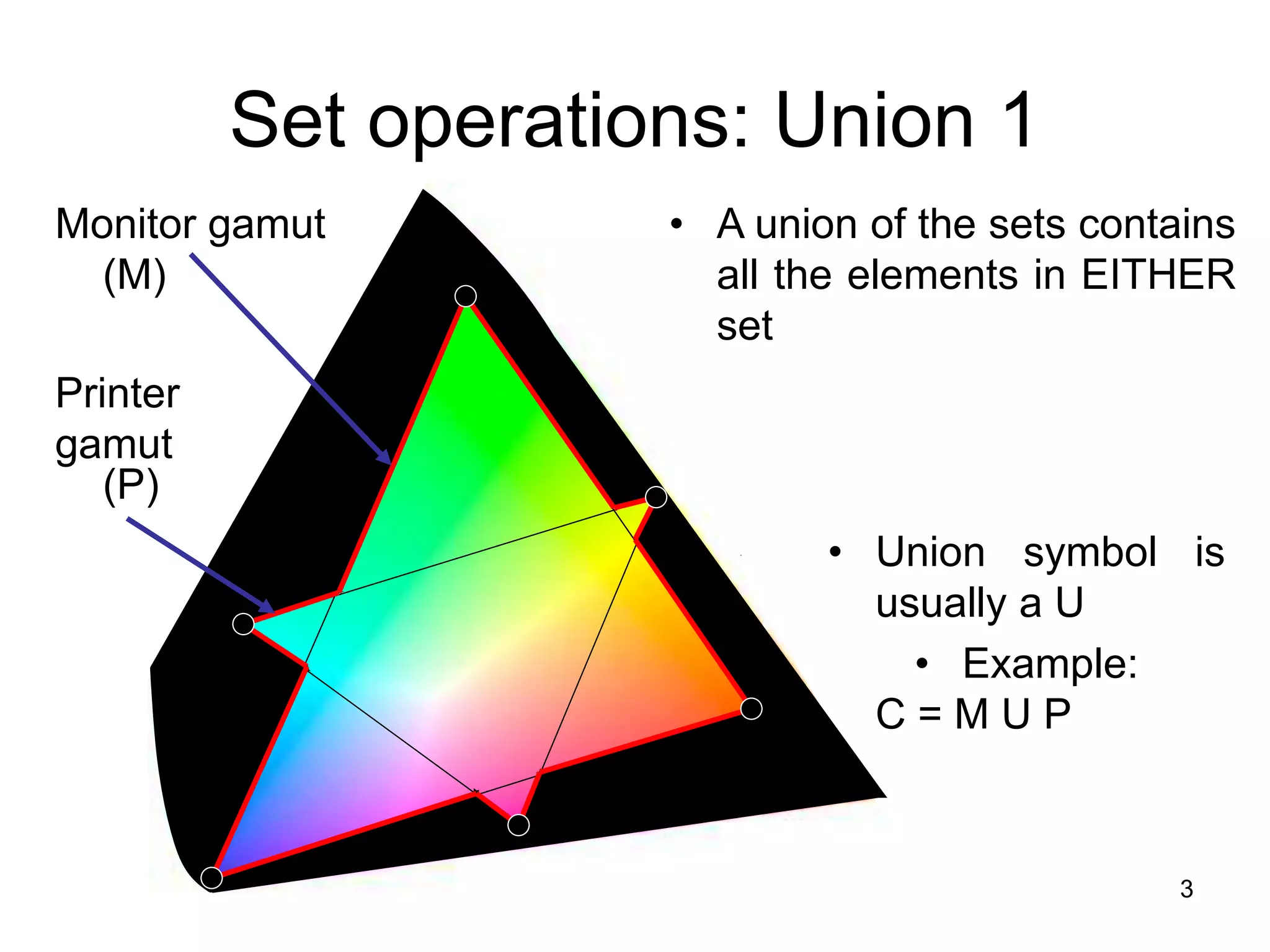
• A union of the sets contains
all the elements in EITHER
set
• Union symbol is
usually a U
• Example:
C = M U P
Monitor gamut
(M)
Printer
gamut
(P)
Set operations: Union 1
4
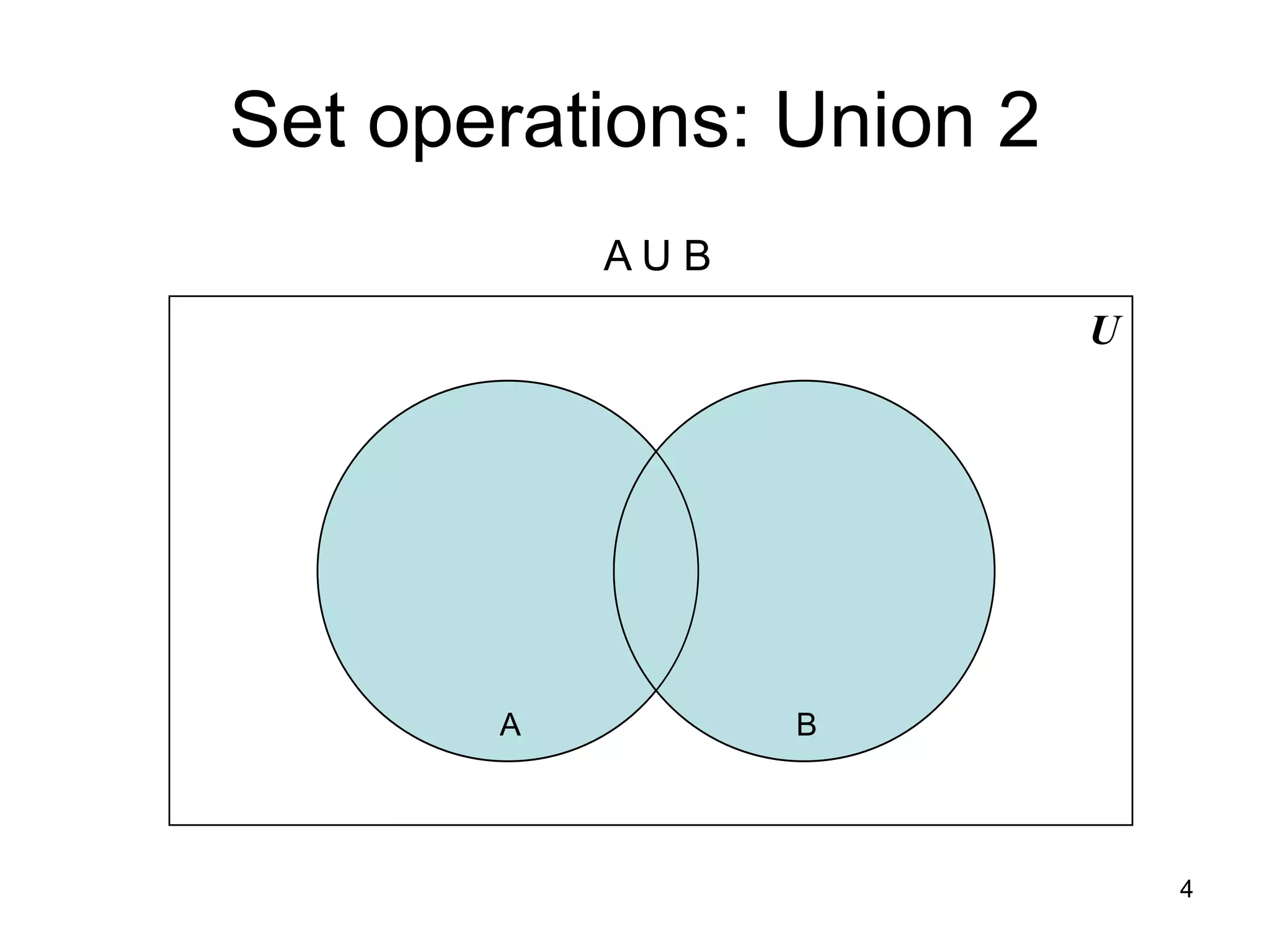
Set operations: Union 2
U
A B
A U B
5
Set operations: Union 3
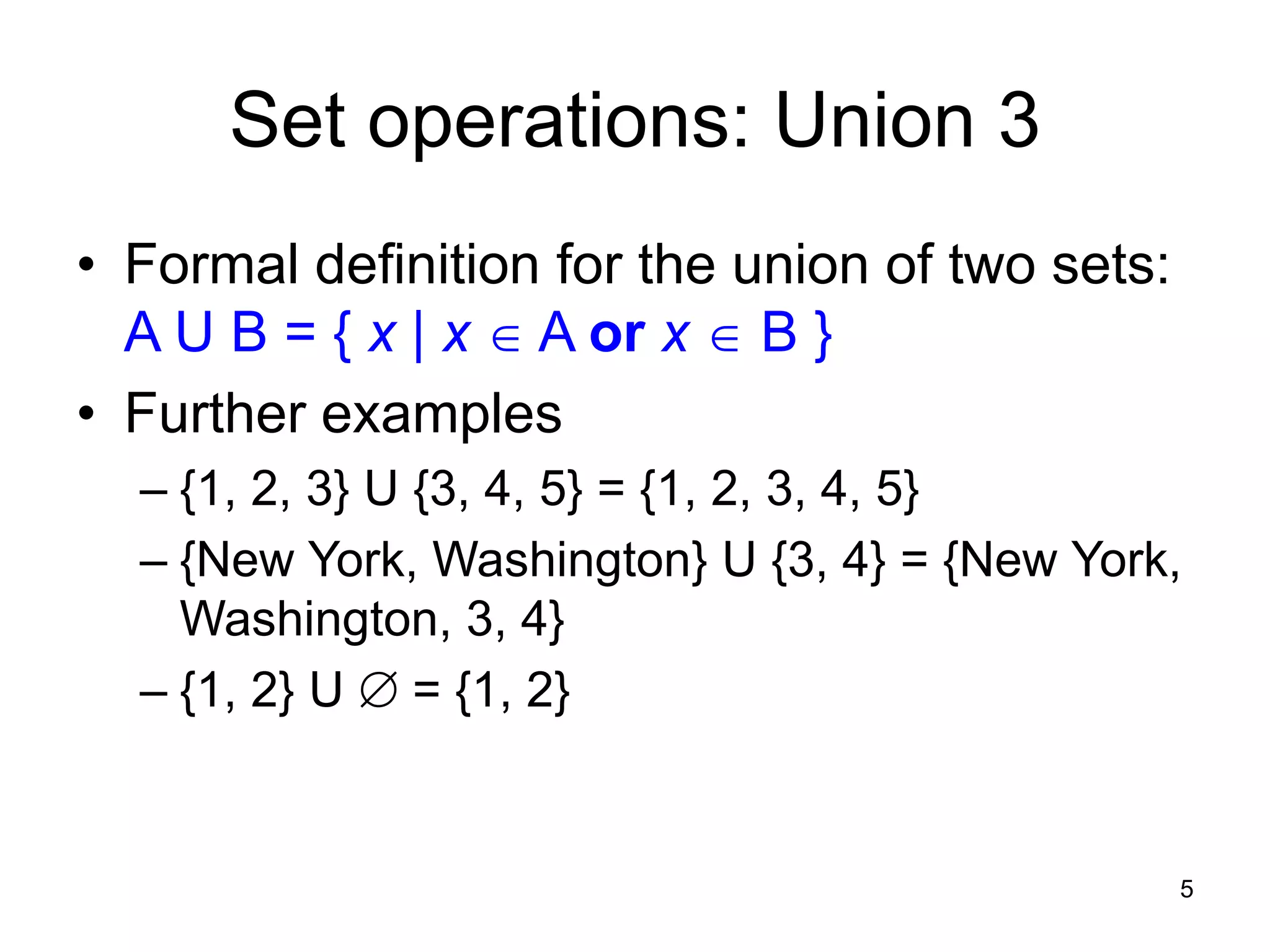
• Formal definition for the union of two sets:
A U B = { x | x  A or x  B }
• Further examples
– {1, 2, 3} U {3, 4, 5} = {1, 2, 3, 4, 5}
– {New York, Washington} U {3, 4} = {New York,
Washington, 3, 4}
– {1, 2} U  = {1, 2}
6
Set operations: Union 4
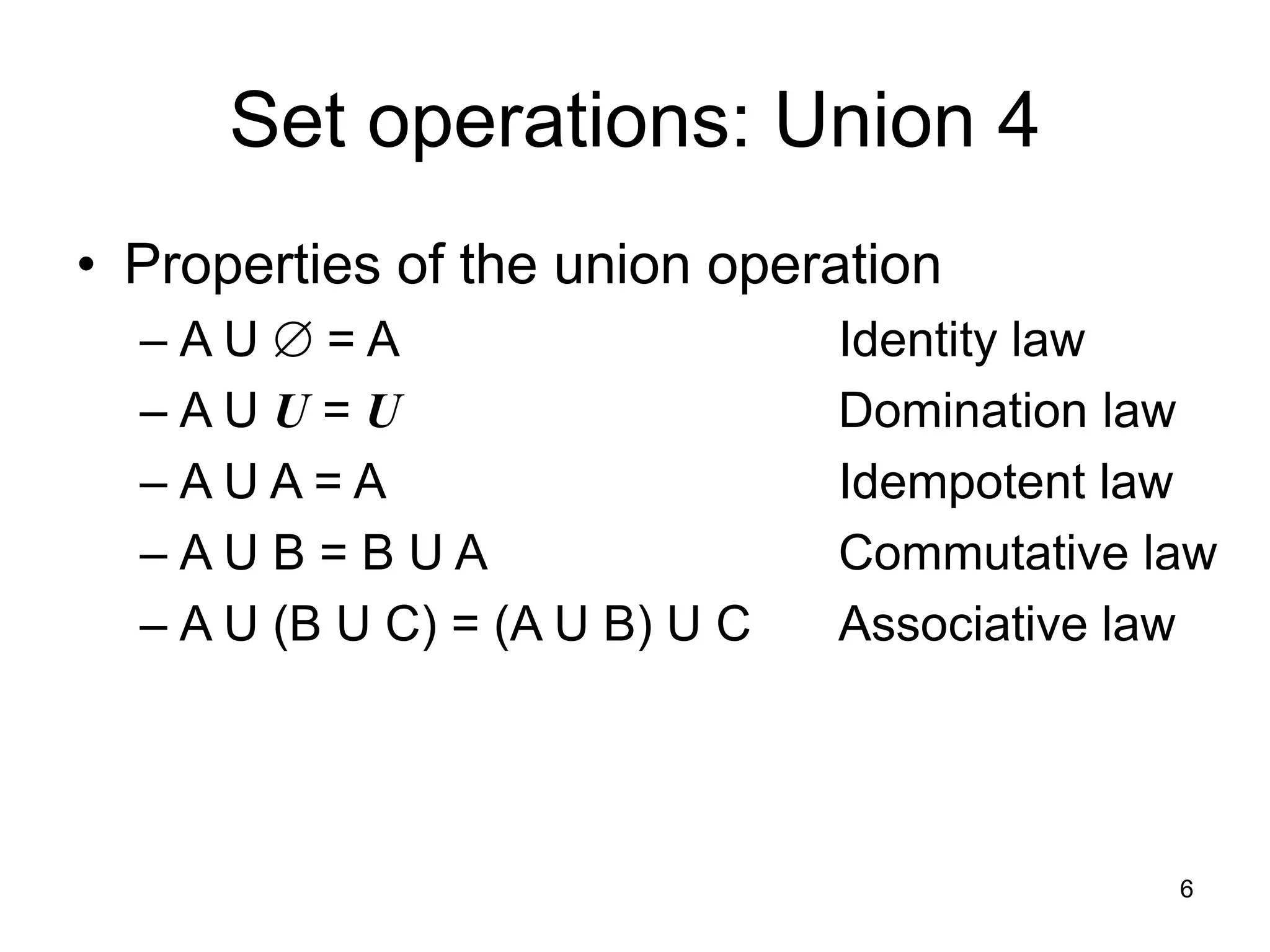
• Properties of the union operation
– A U  = A Identity law
– A U U = U Domination law
– A U A = A Idempotent law
– A U B = B U A Commutative law
– A U (B U C) = (A U B) U C Associative law
7
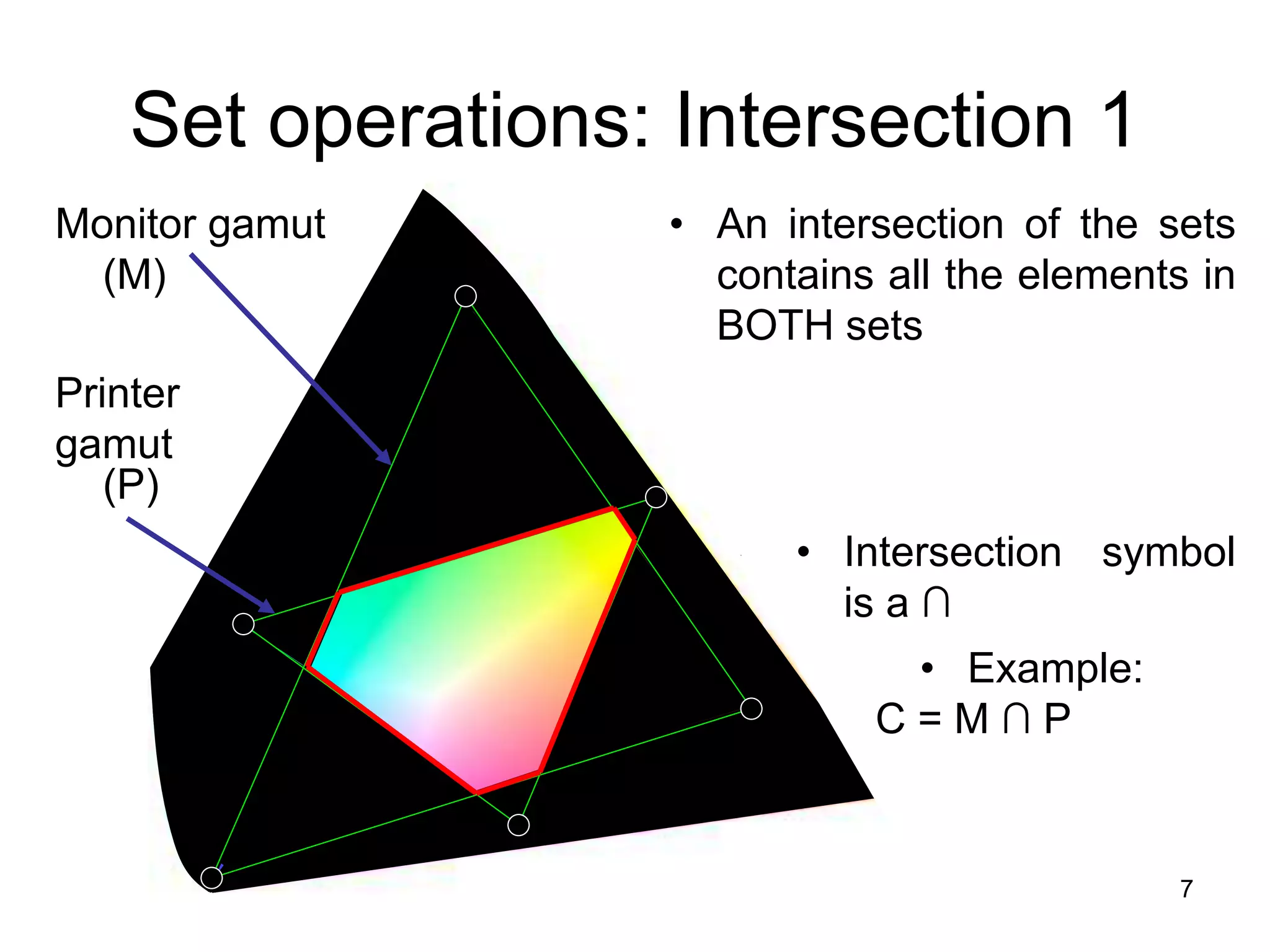
• An intersection of the sets
contains all the elements in
BOTH sets
• Intersection symbol
is a ∩
• Example:
C = M ∩ P
Monitor gamut
(M)
Printer
gamut
(P)
Set operations: Intersection 1
8
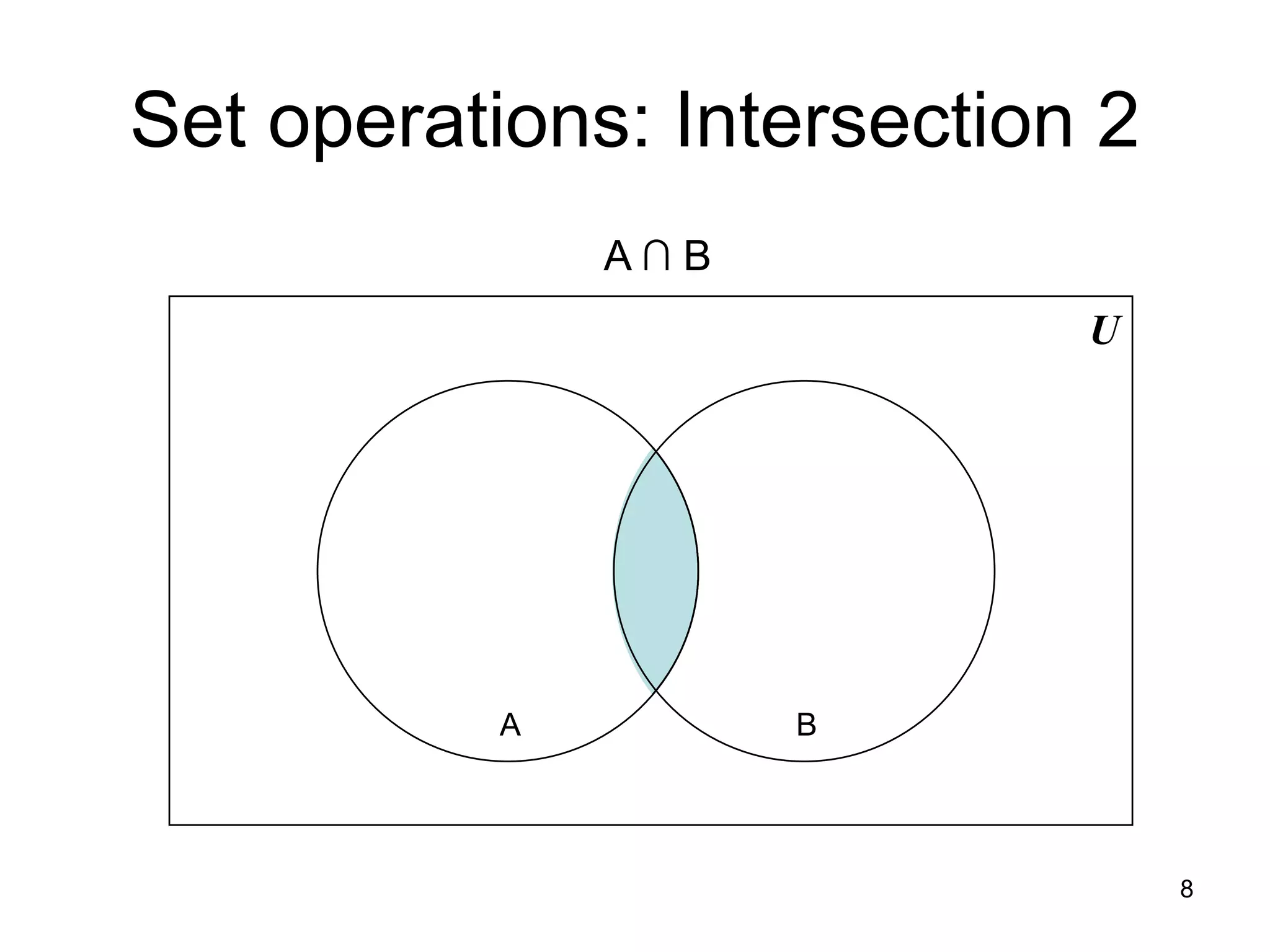
Set operations: Intersection 2
U
B
A
A ∩ B
9
Set operations: Intersection 3
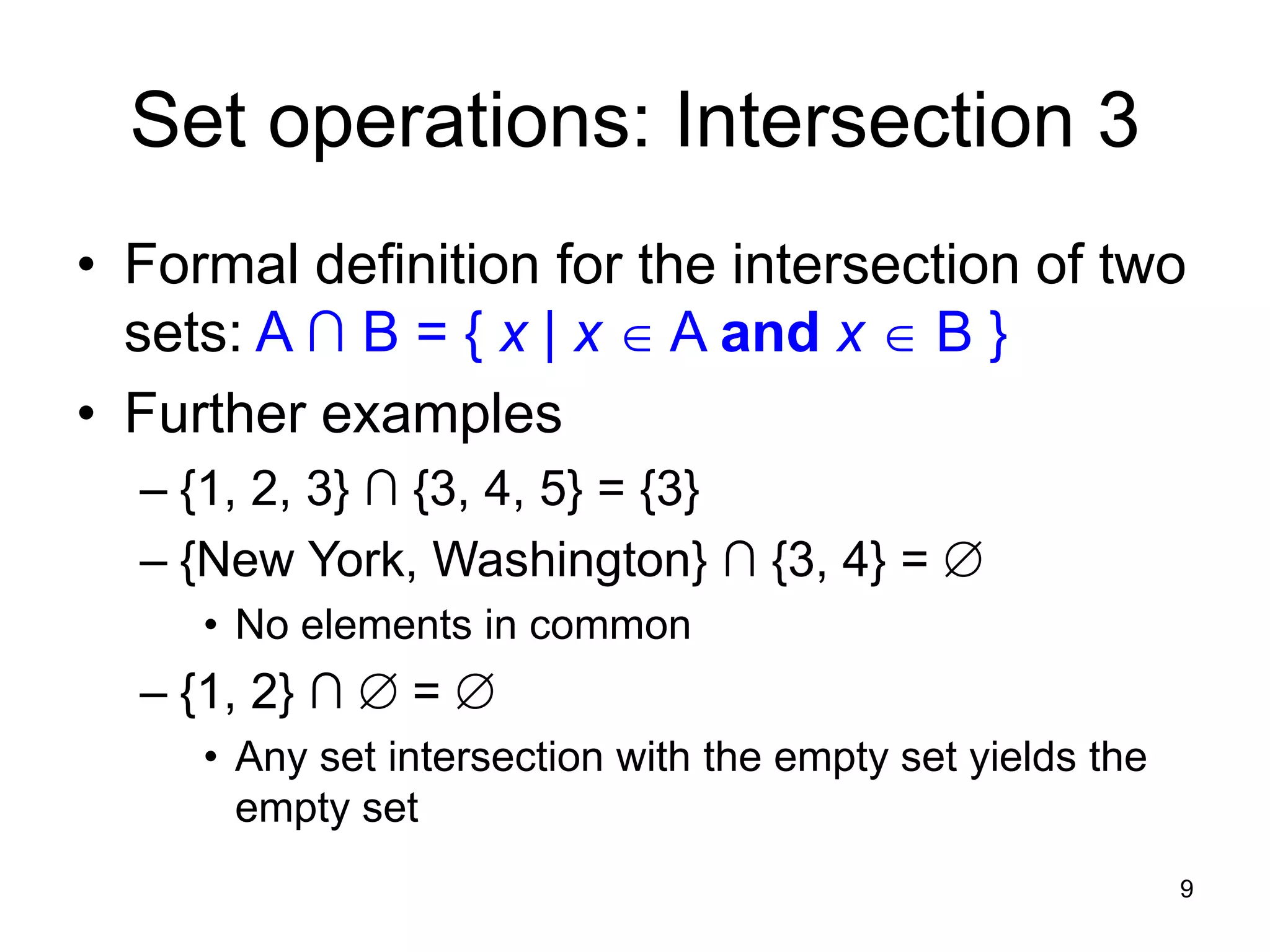
• Formal definition for the intersection of two
sets: A ∩ B = { x | x  A and x  B }
• Further examples
– {1, 2, 3} ∩ {3, 4, 5} = {3}
– {New York, Washington} ∩ {3, 4} = 
• No elements in common
– {1, 2} ∩  = 
• Any set intersection with the empty set yields the
empty set
11
Set operations: Intersection 4
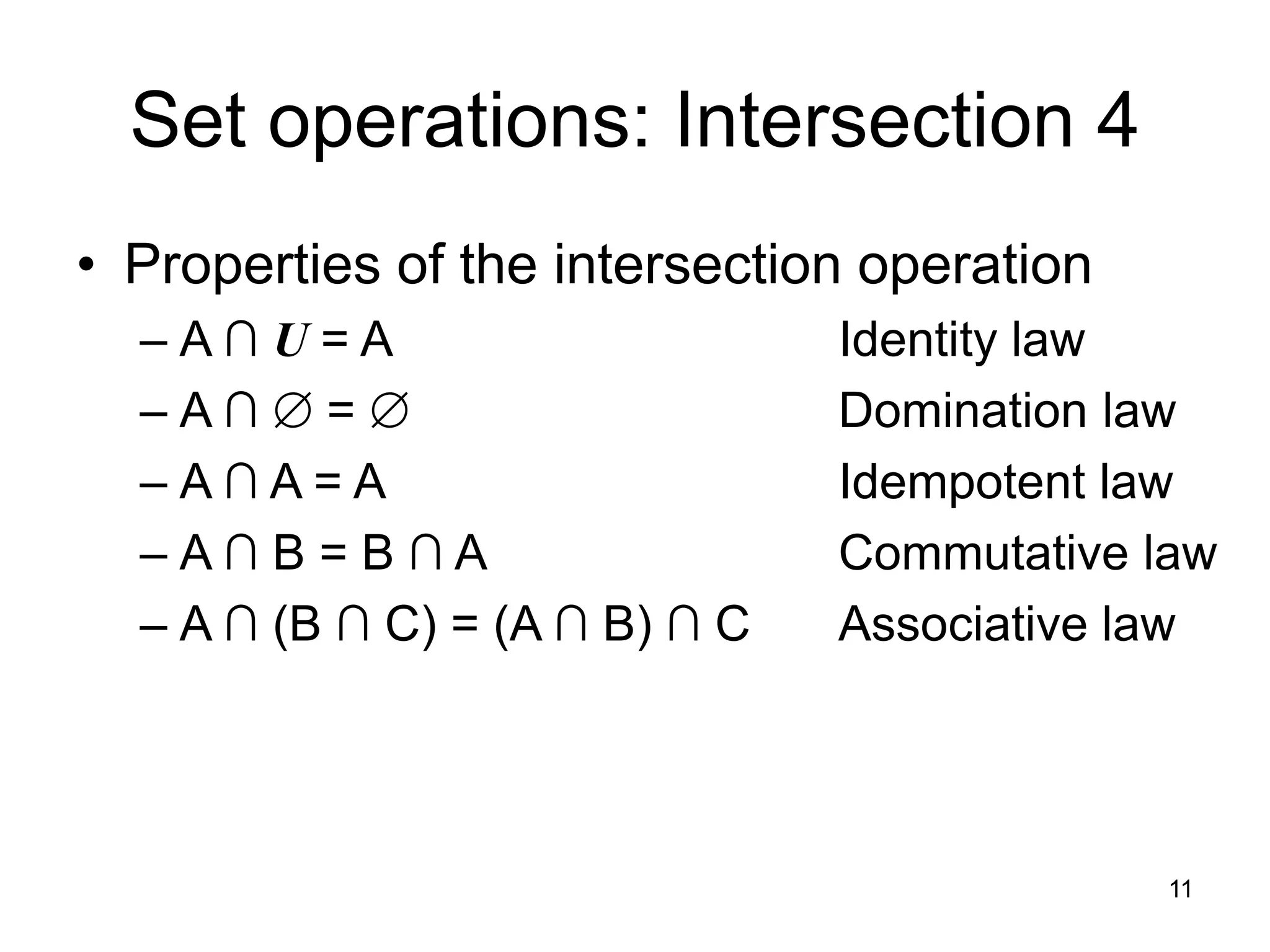
• Properties of the intersection operation
– A ∩ U = A Identity law
– A ∩  =  Domination law
– A ∩ A = A Idempotent law
– A ∩ B = B ∩ A Commutative law
– A ∩ (B ∩ C) = (A ∩ B) ∩ C Associative law
12
Disjoint sets 1
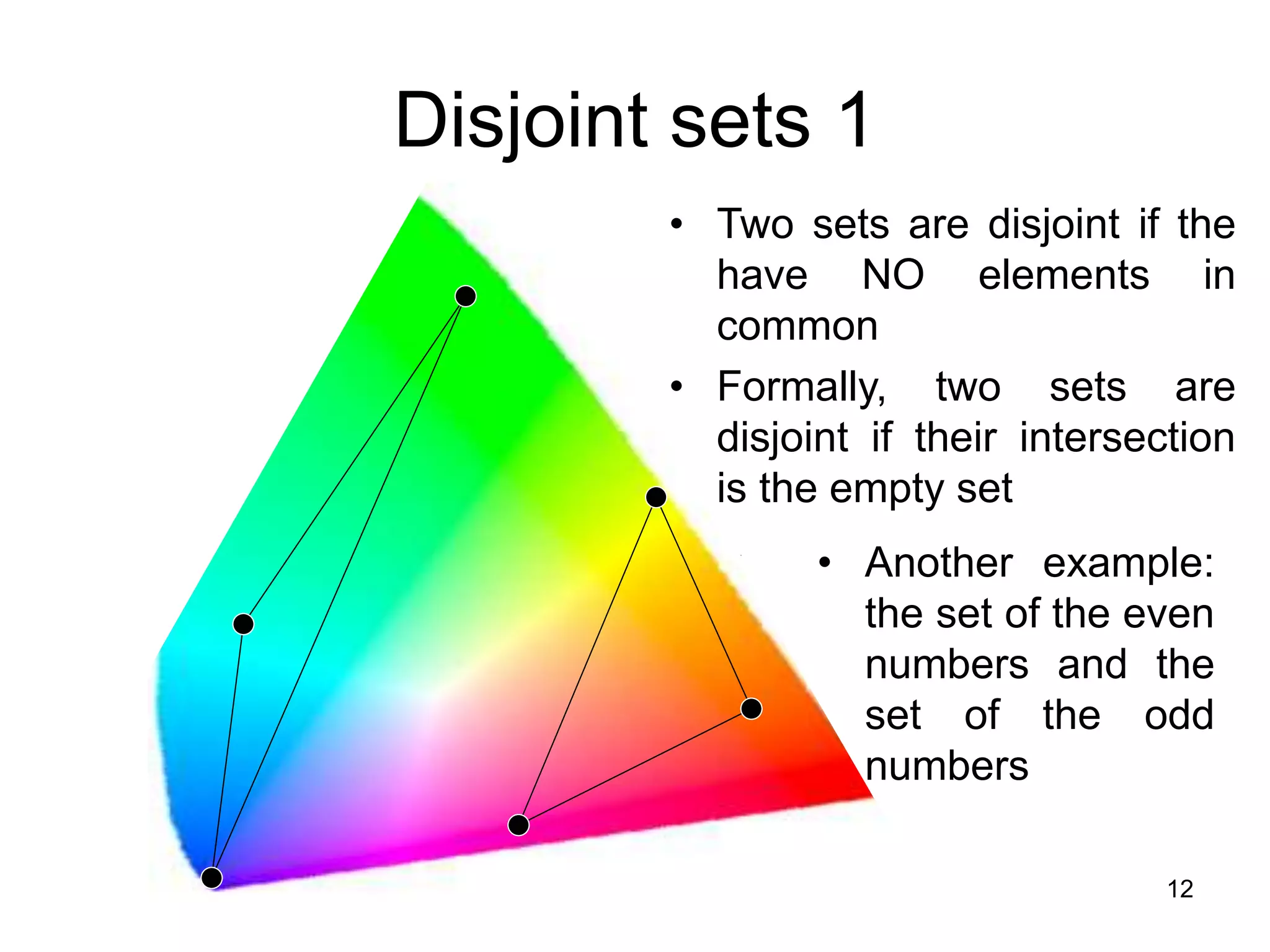
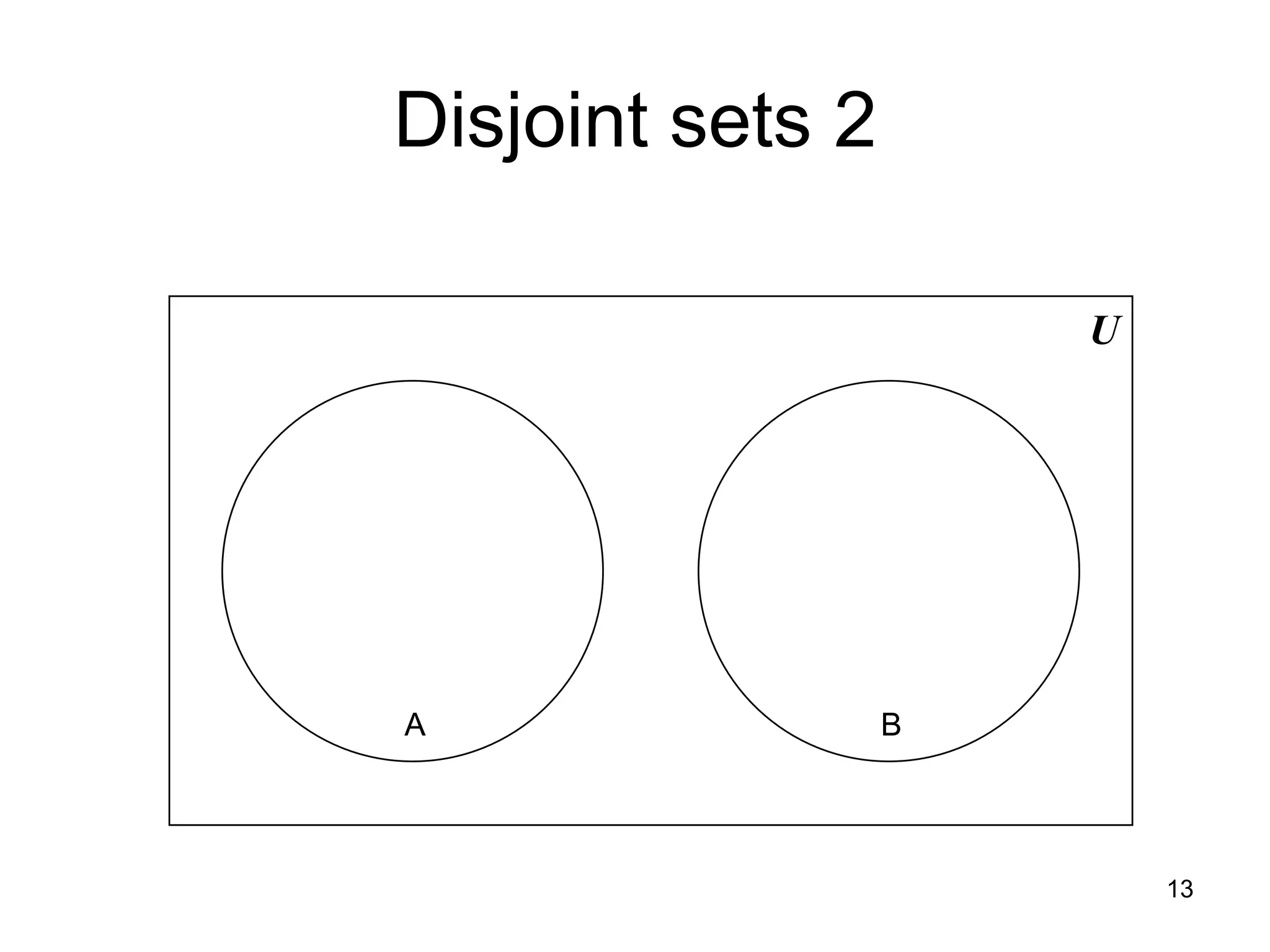
• Two sets are disjoint if the
have NO elements in
common
• Formally, two sets are
disjoint if their intersection
is the empty set
• Another example:
the set of the even
numbers and the
set of the odd
numbers
13
Disjoint sets 2
U
A B
14
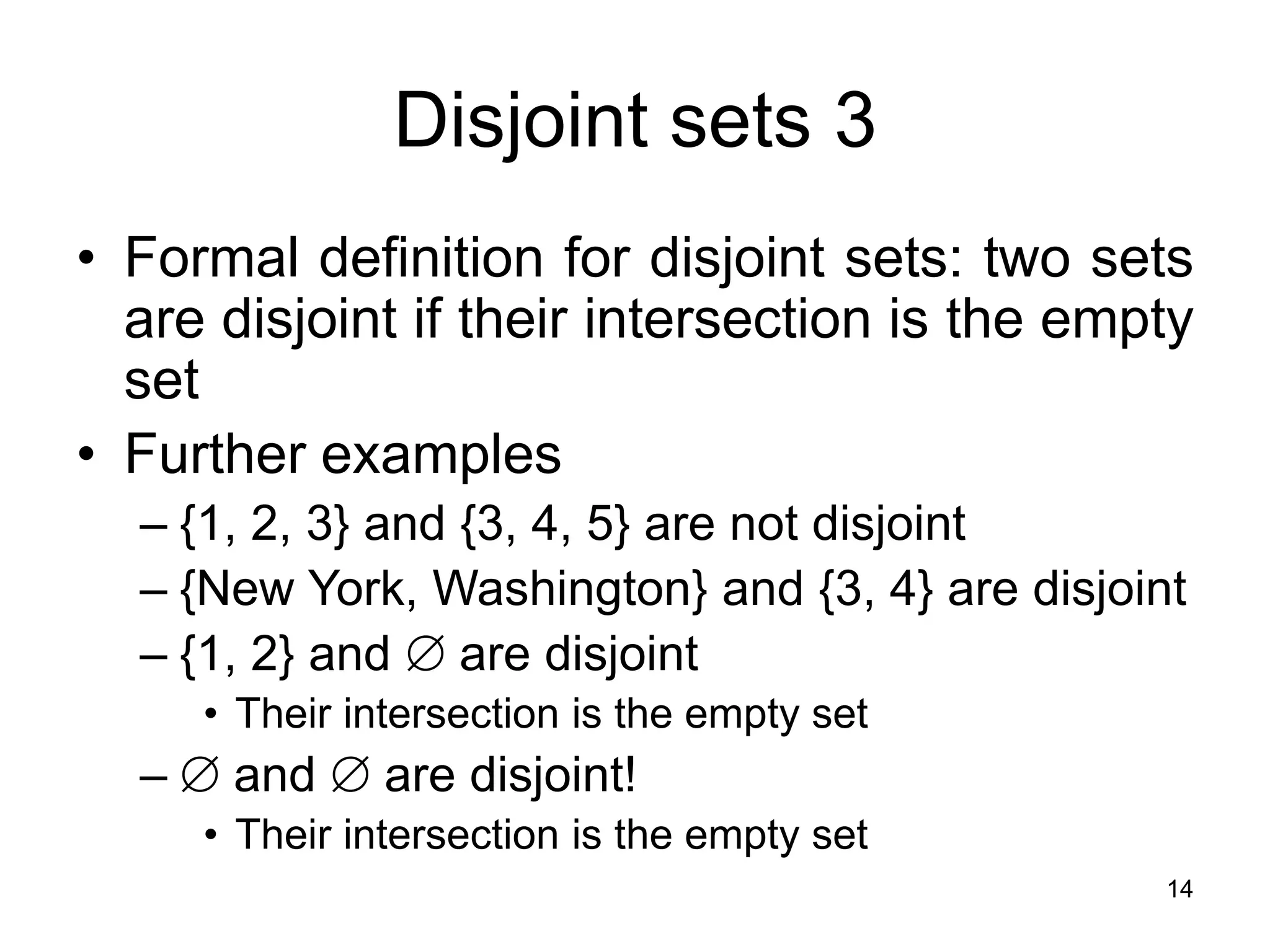
Disjoint sets 3
• Formal definition for disjoint sets: two sets
are disjoint if their intersection is the empty
set
• Further examples
– {1, 2, 3} and {3, 4, 5} are not disjoint
– {New York, Washington} and {3, 4} are disjoint
– {1, 2} and  are disjoint
• Their intersection is the empty set
–  and  are disjoint!
• Their intersection is the empty set
15
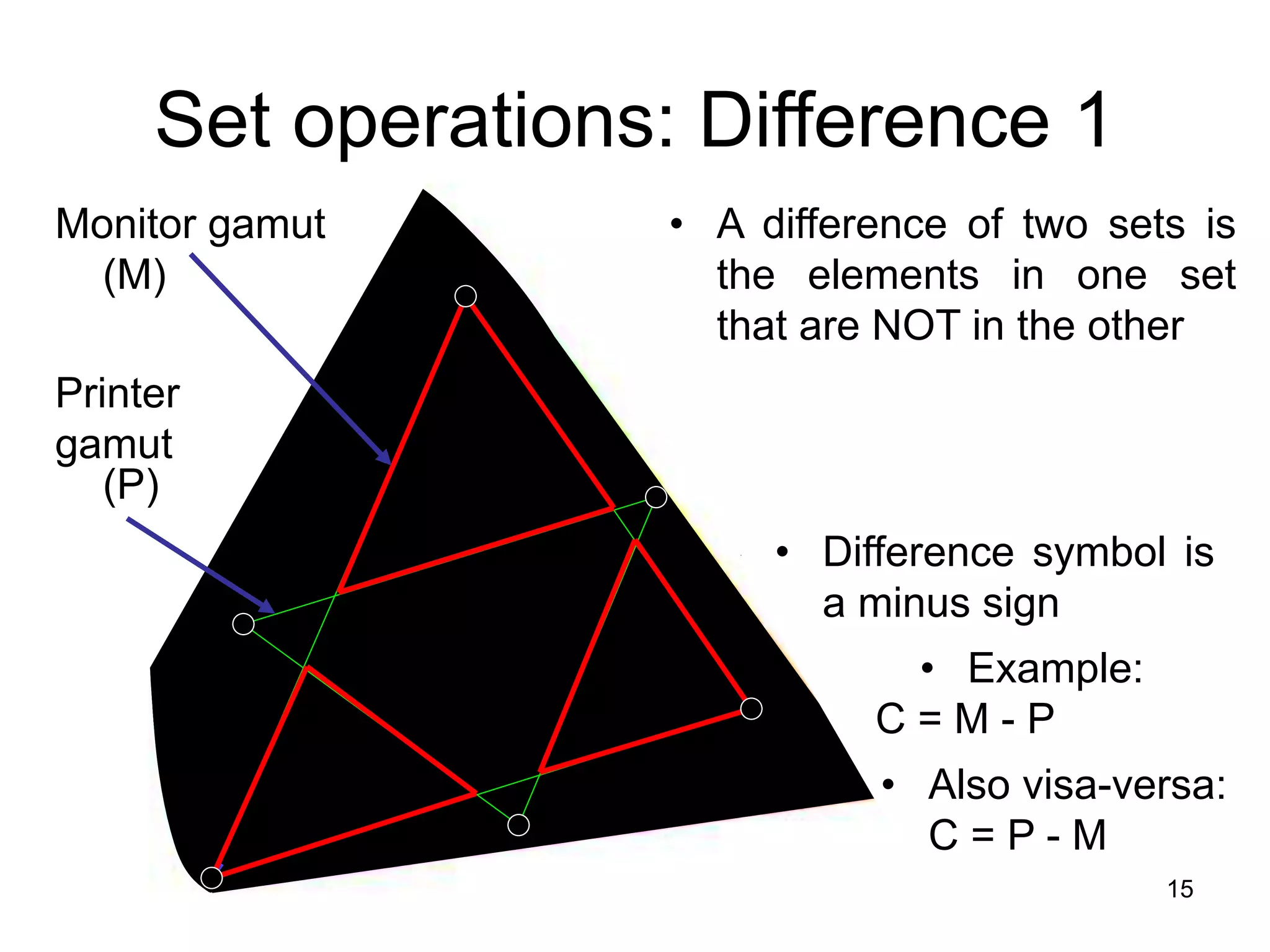
Set operations: Difference 1
• A difference of two sets is
the elements in one set
that are NOT in the other
• Difference symbol is
a minus sign
• Example:
C = M - P
Monitor gamut
(M)
Printer
gamut
(P)
• Also visa-versa:
C = P - M
16
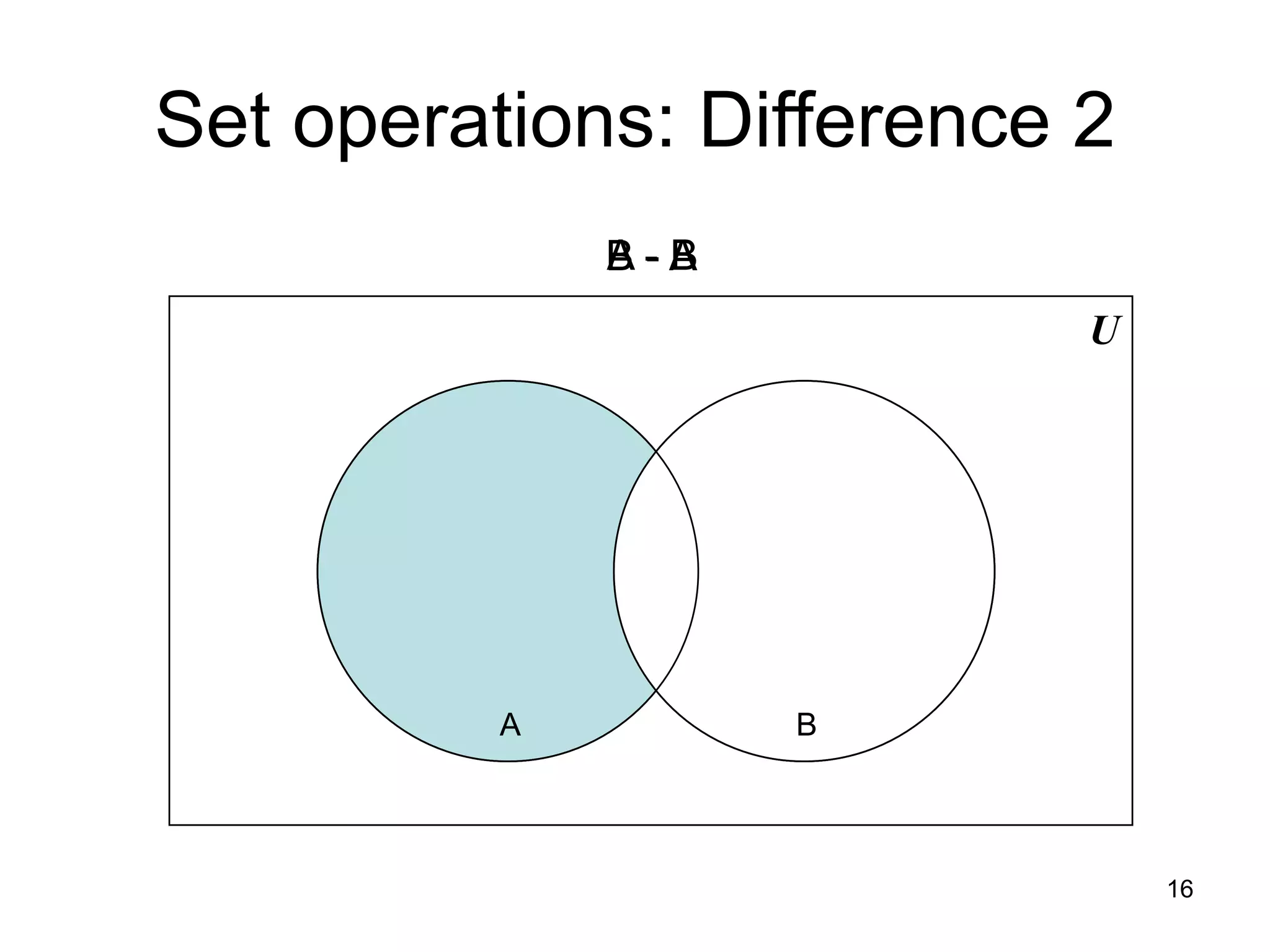
Set operations: Difference 2
U
A B
B - A
A - B
17
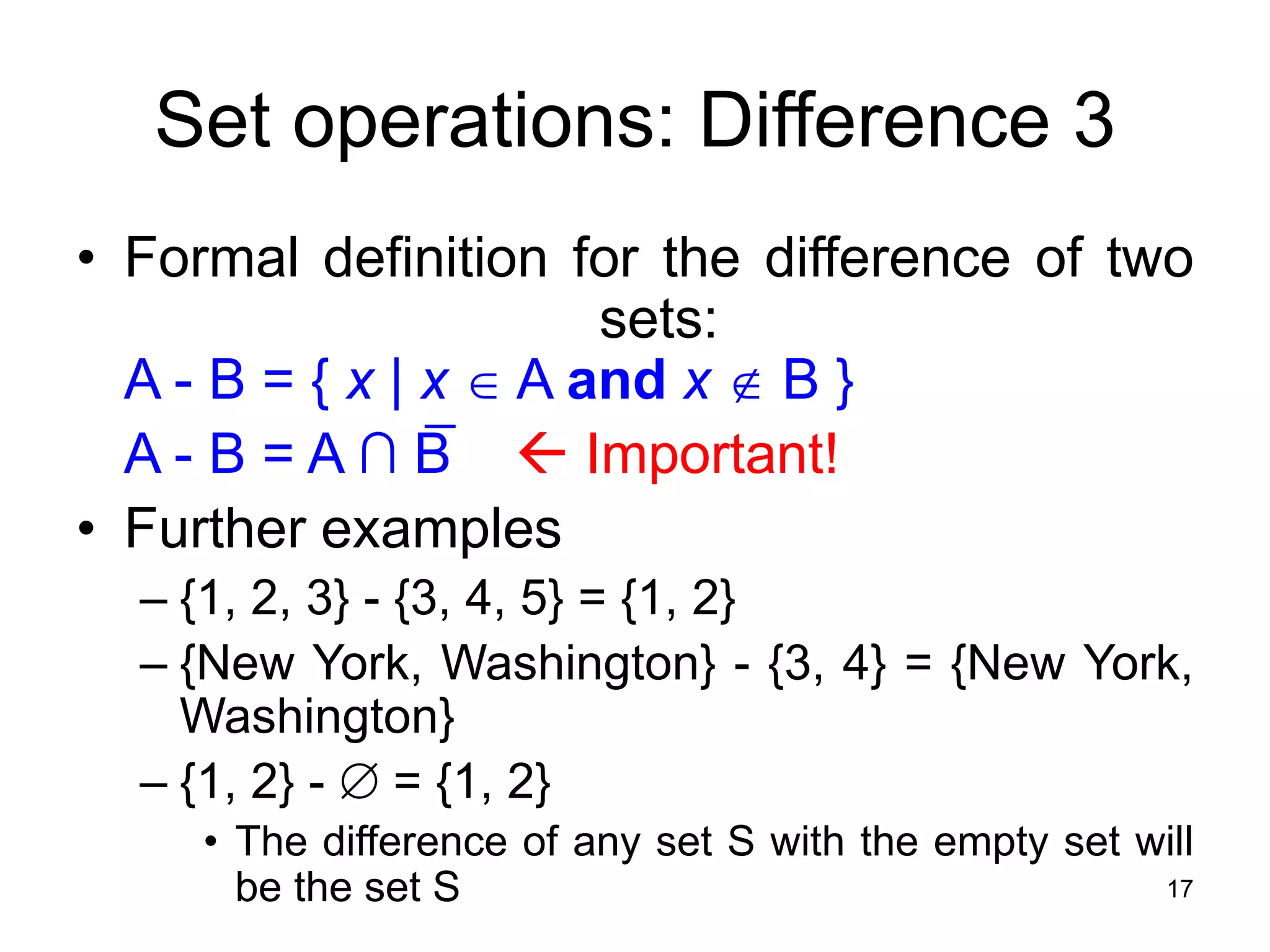
• Formal definition for the difference of two
sets:
A - B = { x | x  A and x  B }
A - B = A ∩ B  Important!
• Further examples
– {1, 2, 3} - {3, 4, 5} = {1, 2}
– {New York, Washington} - {3, 4} = {New York,
Washington}
– {1, 2} -  = {1, 2}
• The difference of any set S with the empty set will
be the set S
Set operations: Difference 3
_
18
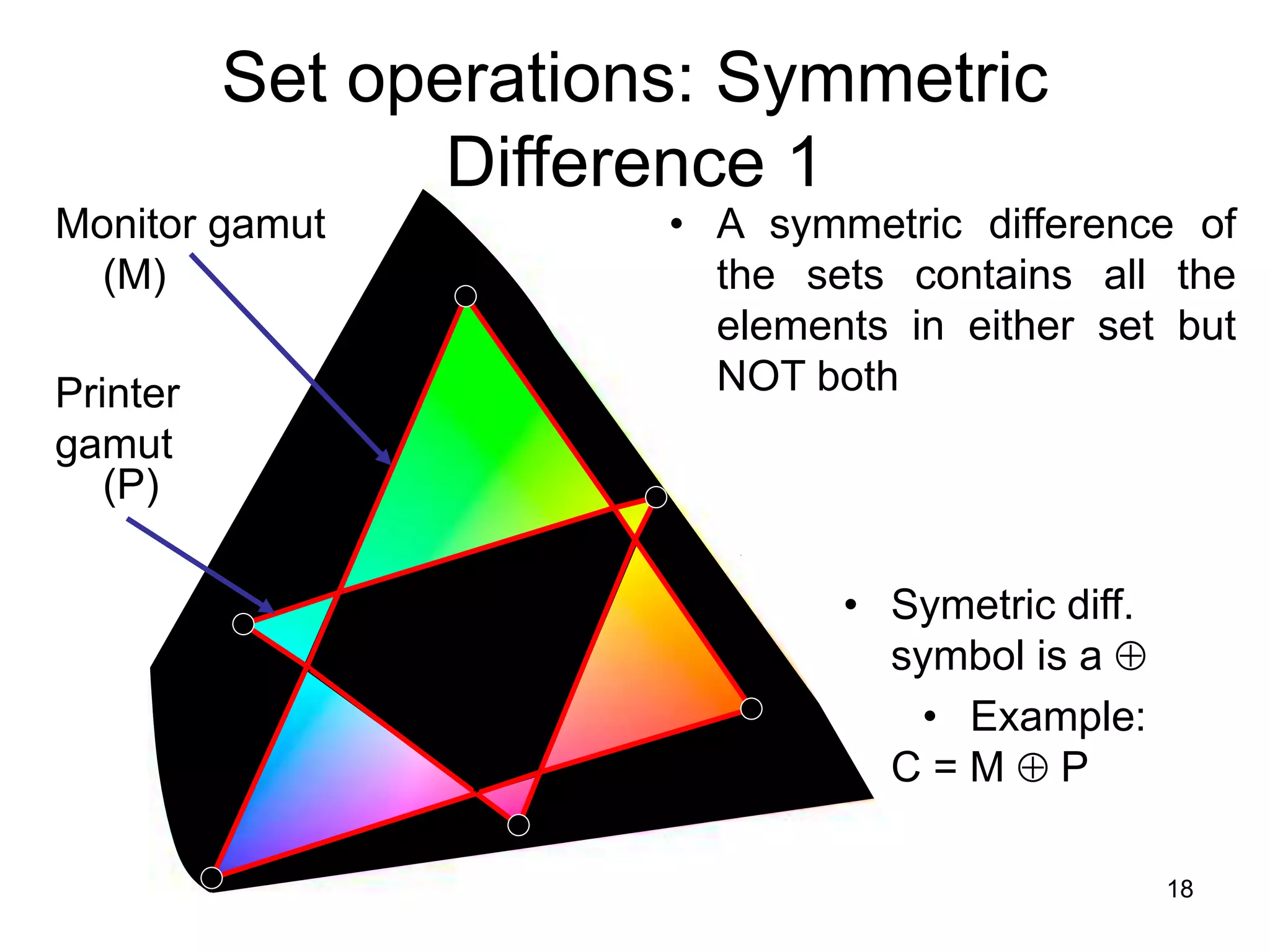
• A symmetric difference of
the sets contains all the
elements in either set but
NOT both
• Symetric diff.
symbol is a 
• Example:
C = M  P
Monitor gamut
(M)
Printer
gamut
(P)
Set operations: Symmetric
Difference 1
19
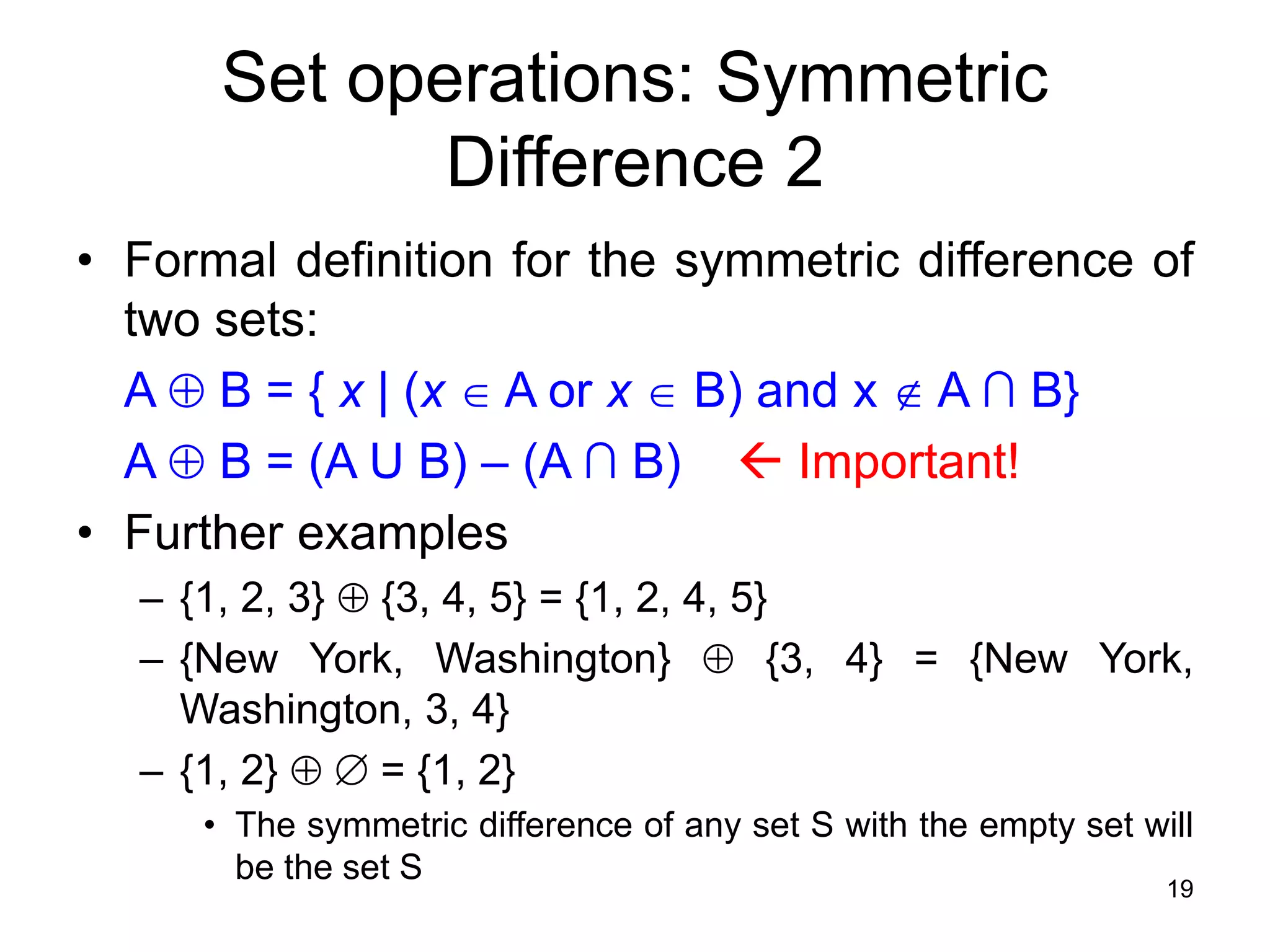
• Formal definition for the symmetric difference of
two sets:
A  B = { x | (x  A or x  B) and x  A ∩ B}
A  B = (A U B) – (A ∩ B)  Important!
• Further examples
– {1, 2, 3}  {3, 4, 5} = {1, 2, 4, 5}
– {New York, Washington}  {3, 4} = {New York,
Washington, 3, 4}
– {1, 2}   = {1, 2}
• The symmetric difference of any set S with the empty set will
be the set S
Set operations: Symmetric
Difference 2
20
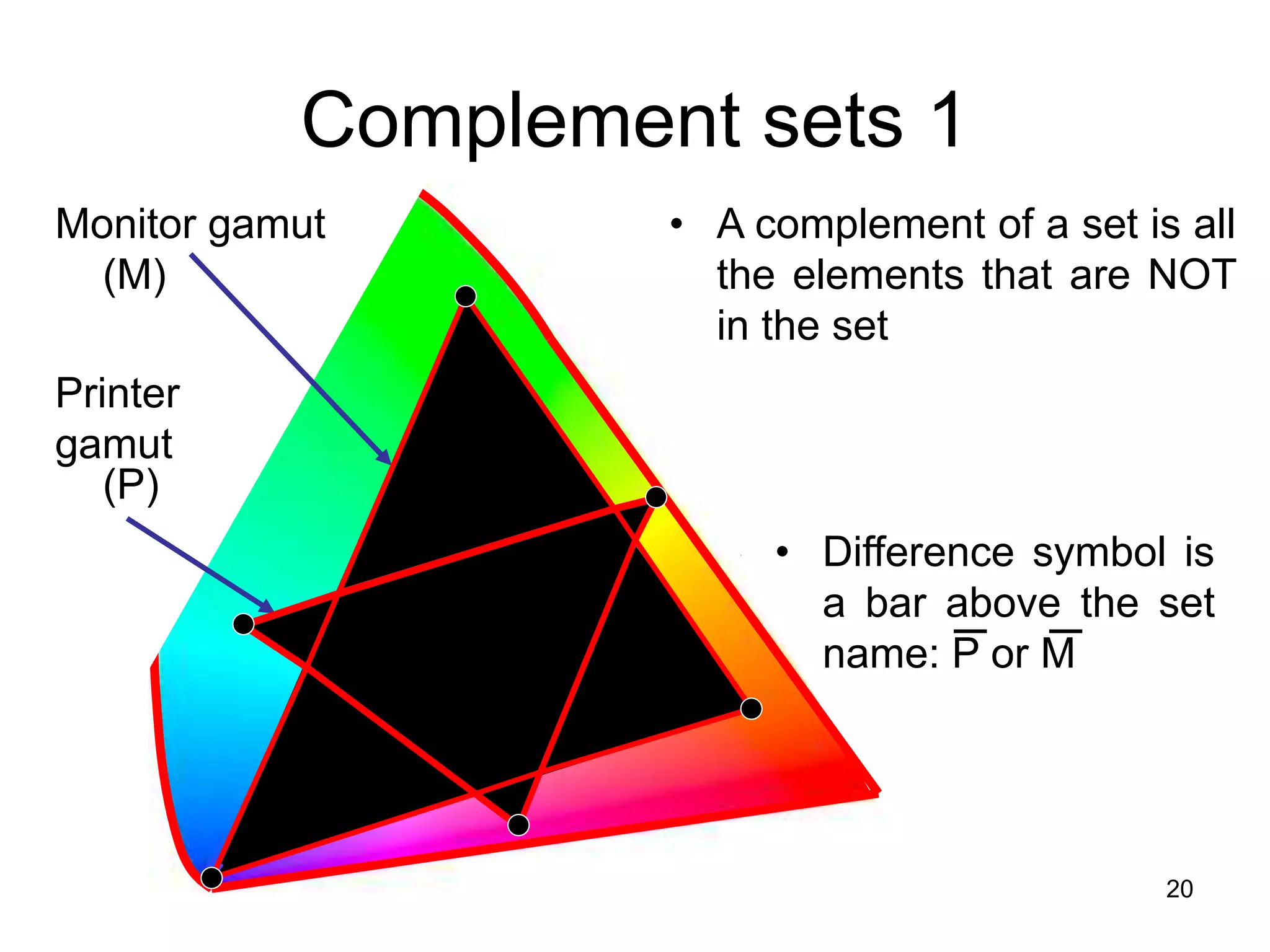
• A complement of a set is all
the elements that are NOT
in the set
• Difference symbol is
a bar above the set
name: P or M
_
_
Monitor gamut
(M)
Printer
gamut
(P)
Complement sets 1
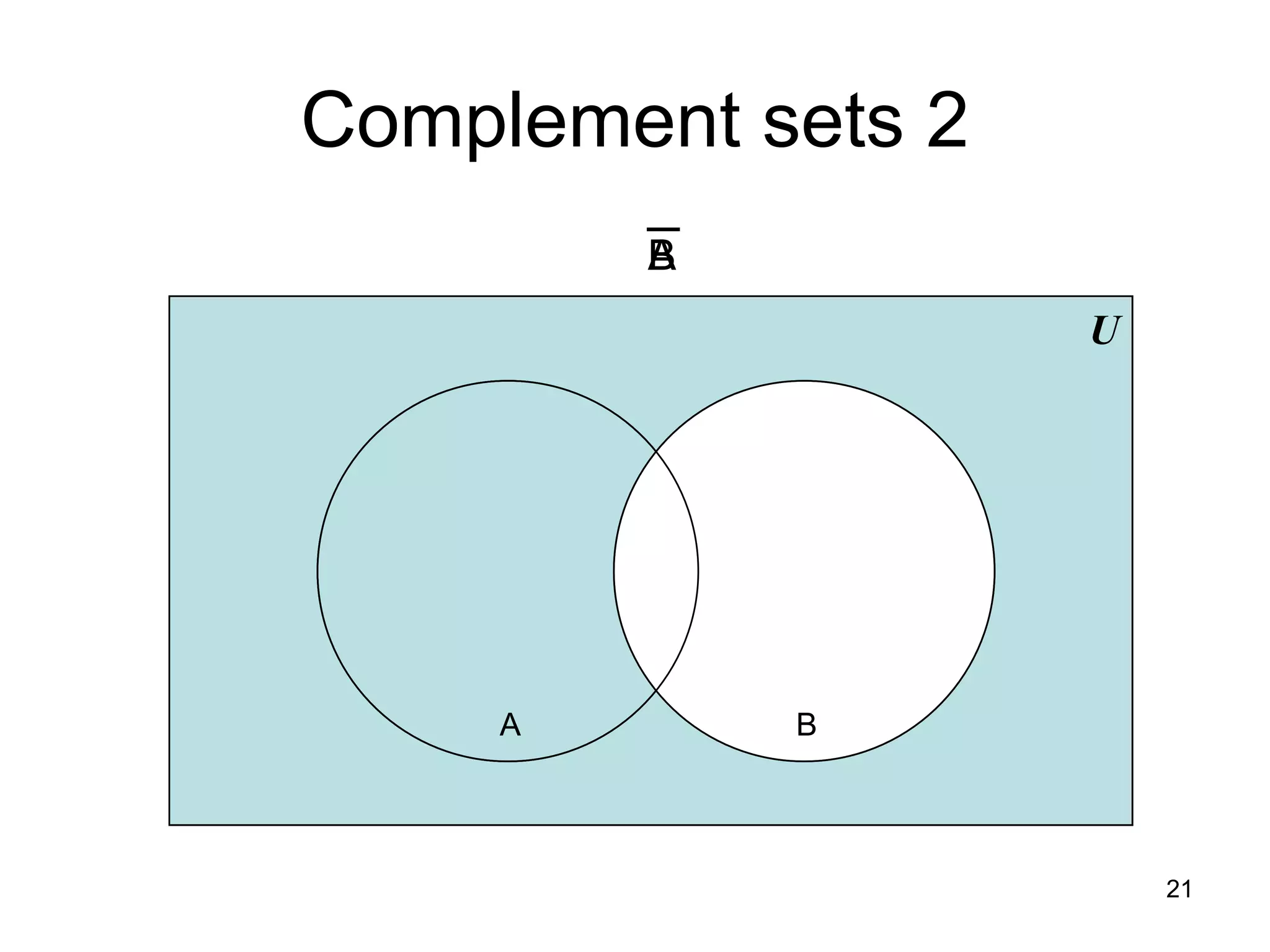
21
Complement sets 2
U
A
A
B
B
_
22
Complement sets 3
• Formal definition for the complement of a
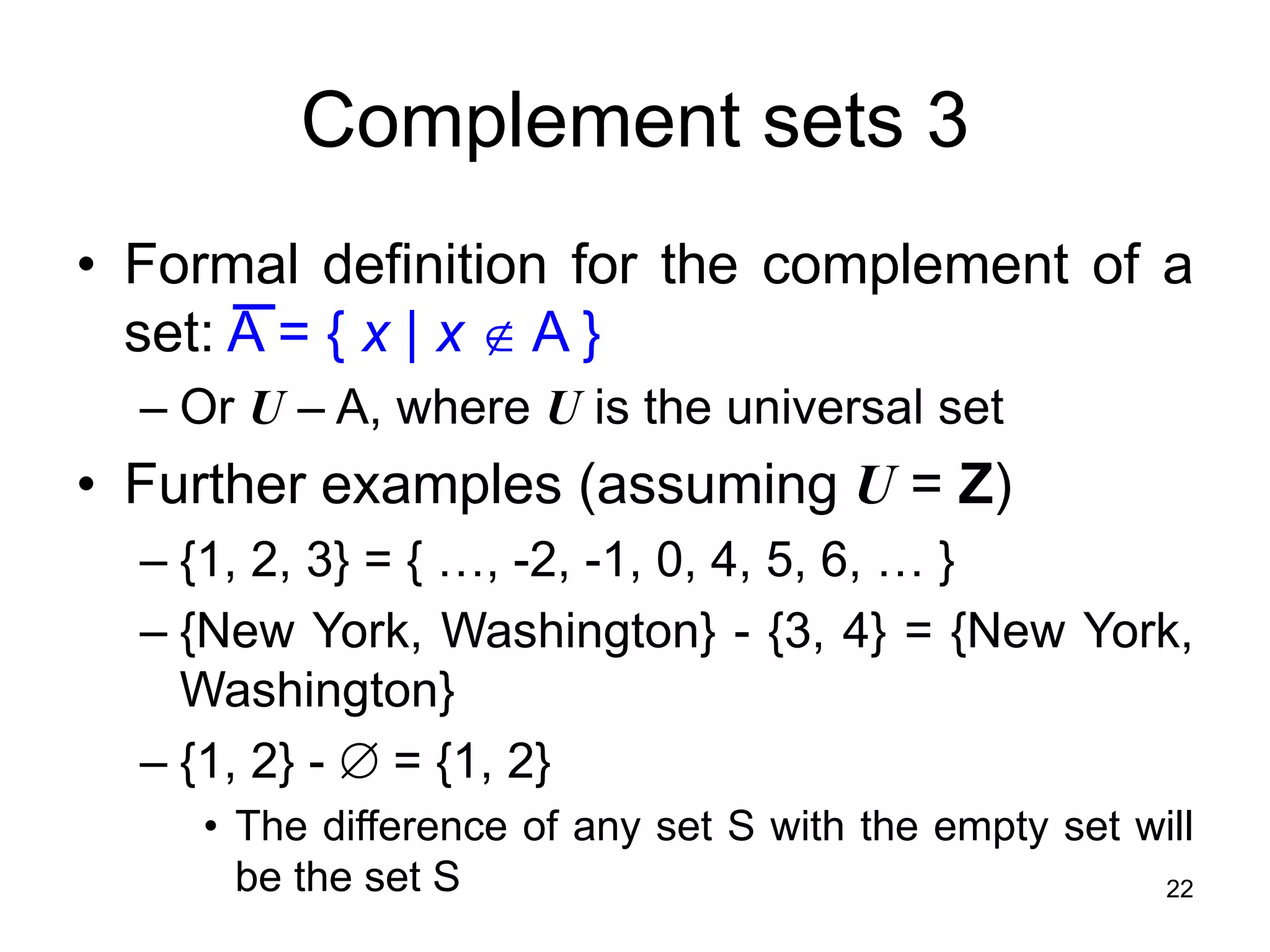
set: A = { x | x  A }
– Or U – A, where U is the universal set
• Further examples (assuming U = Z)
– {1, 2, 3} = { …, -2, -1, 0, 4, 5, 6, … }
– {New York, Washington} - {3, 4} = {New York,
Washington}
– {1, 2} -  = {1, 2}
• The difference of any set S with the empty set will
be the set S
23
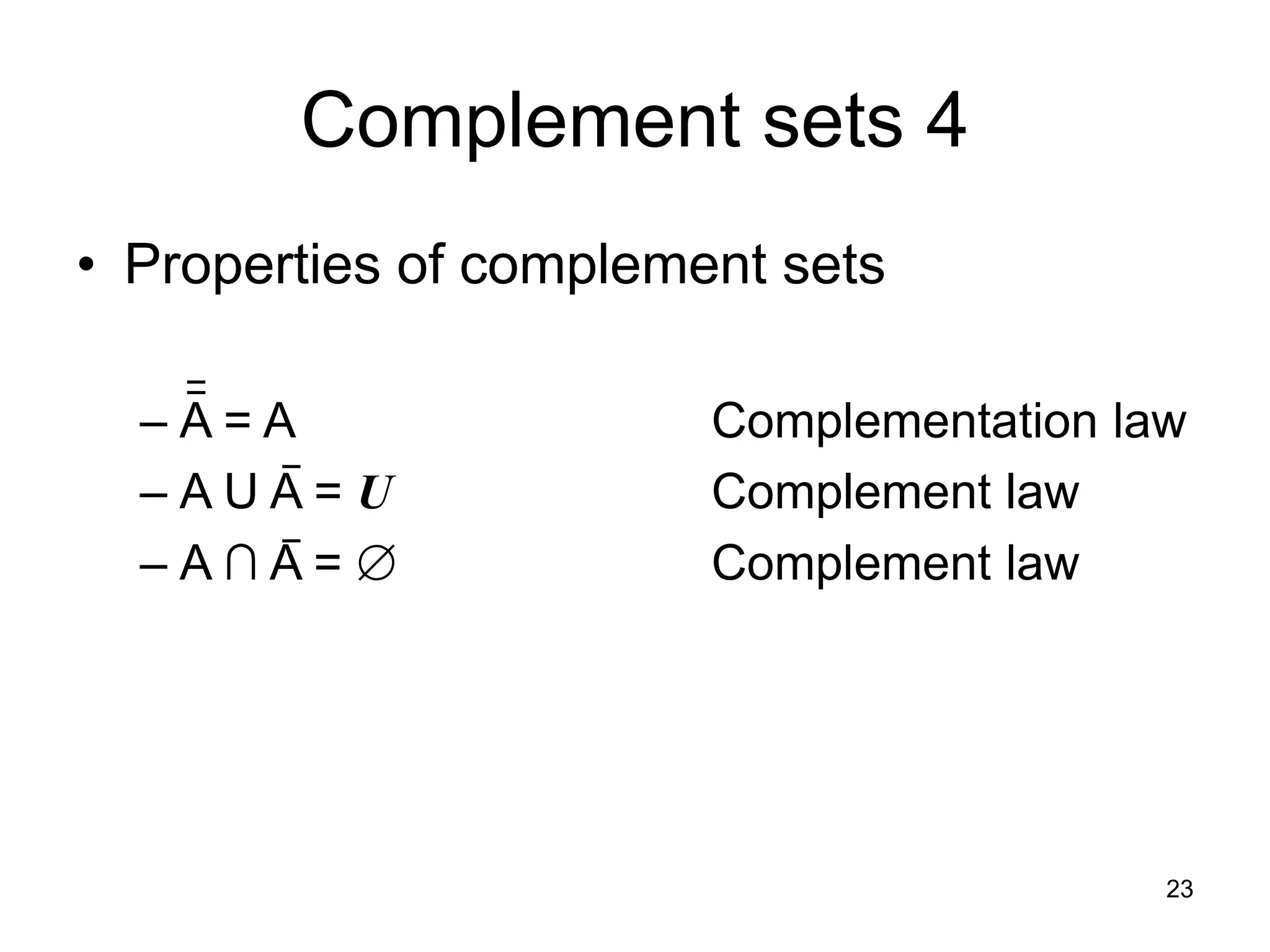
• Properties of complement sets
– A = A Complementation law
– A U A = U Complement law
– A ∩ A =  Complement law
Complement sets 4
¯
¯
¯
¯
24
Quick survey
 I understand the various set operations
a) Very well
b) With some review, I’ll be good
c) Not really
d) Not at all
25
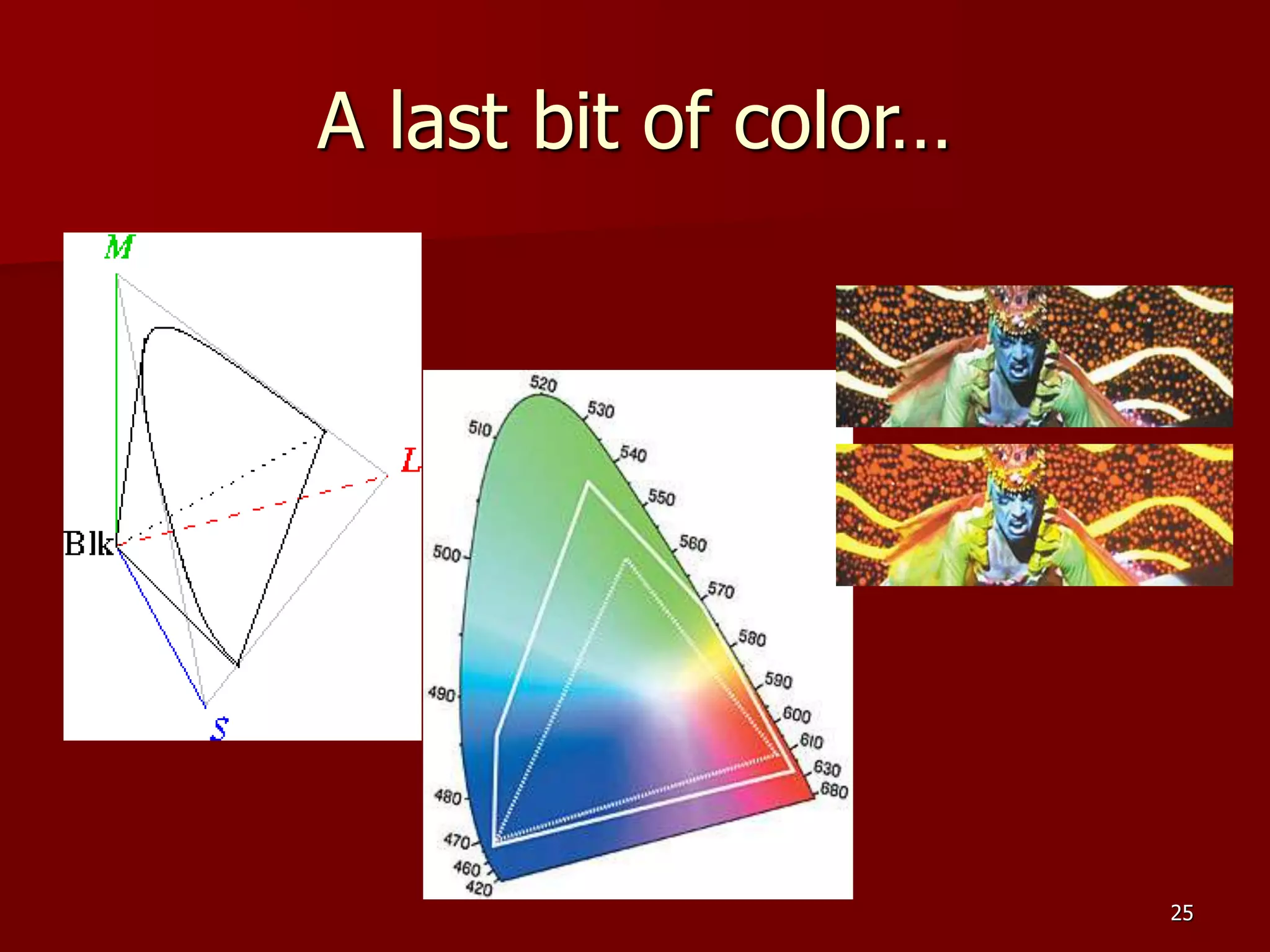
A last bit of color…
26
Set identities
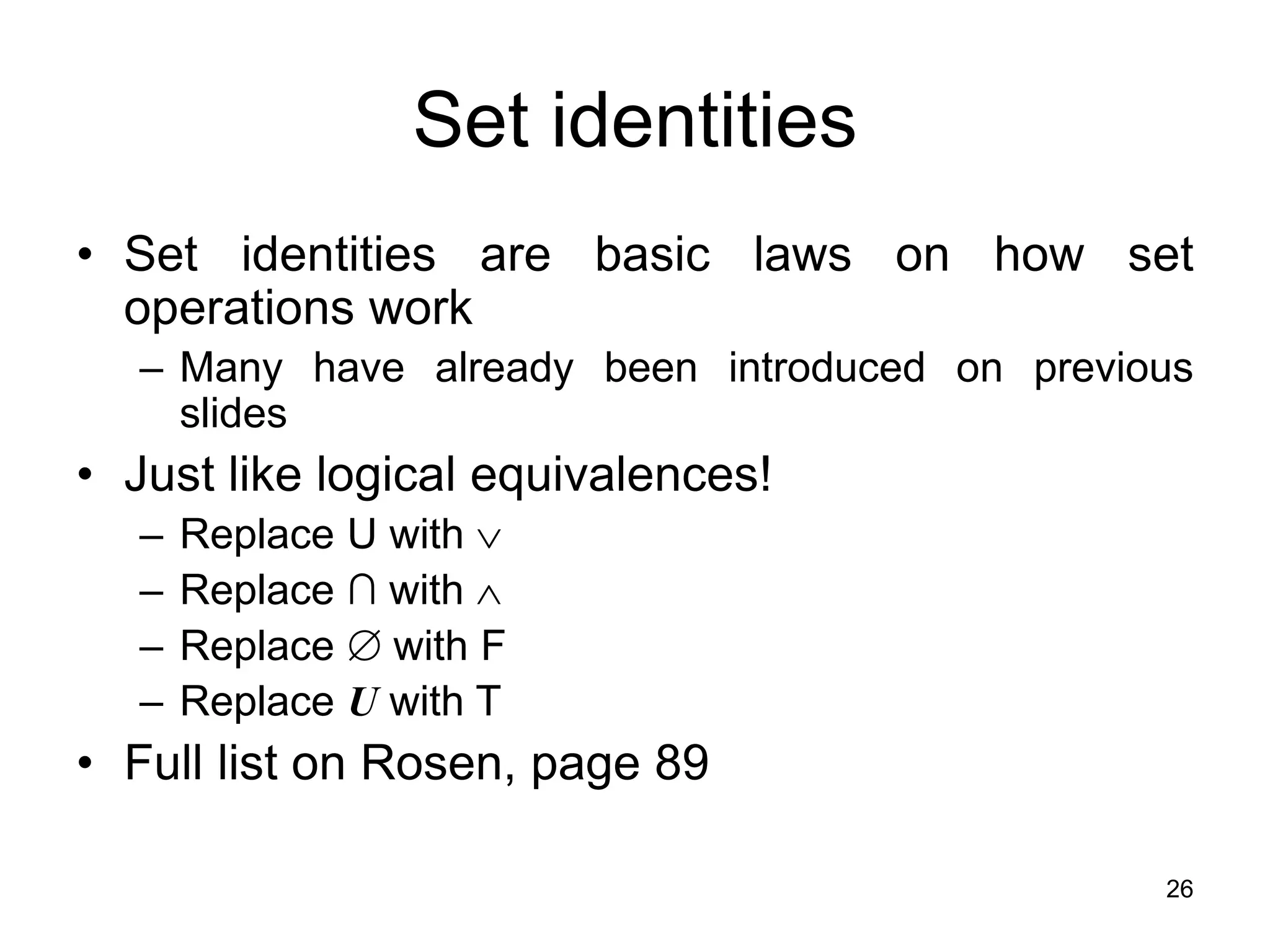
• Set identities are basic laws on how set
operations work
– Many have already been introduced on previous
slides
• Just like logical equivalences!
– Replace U with 
– Replace ∩ with 
– Replace  with F
– Replace U with T
• Full list on Rosen, page 89
27
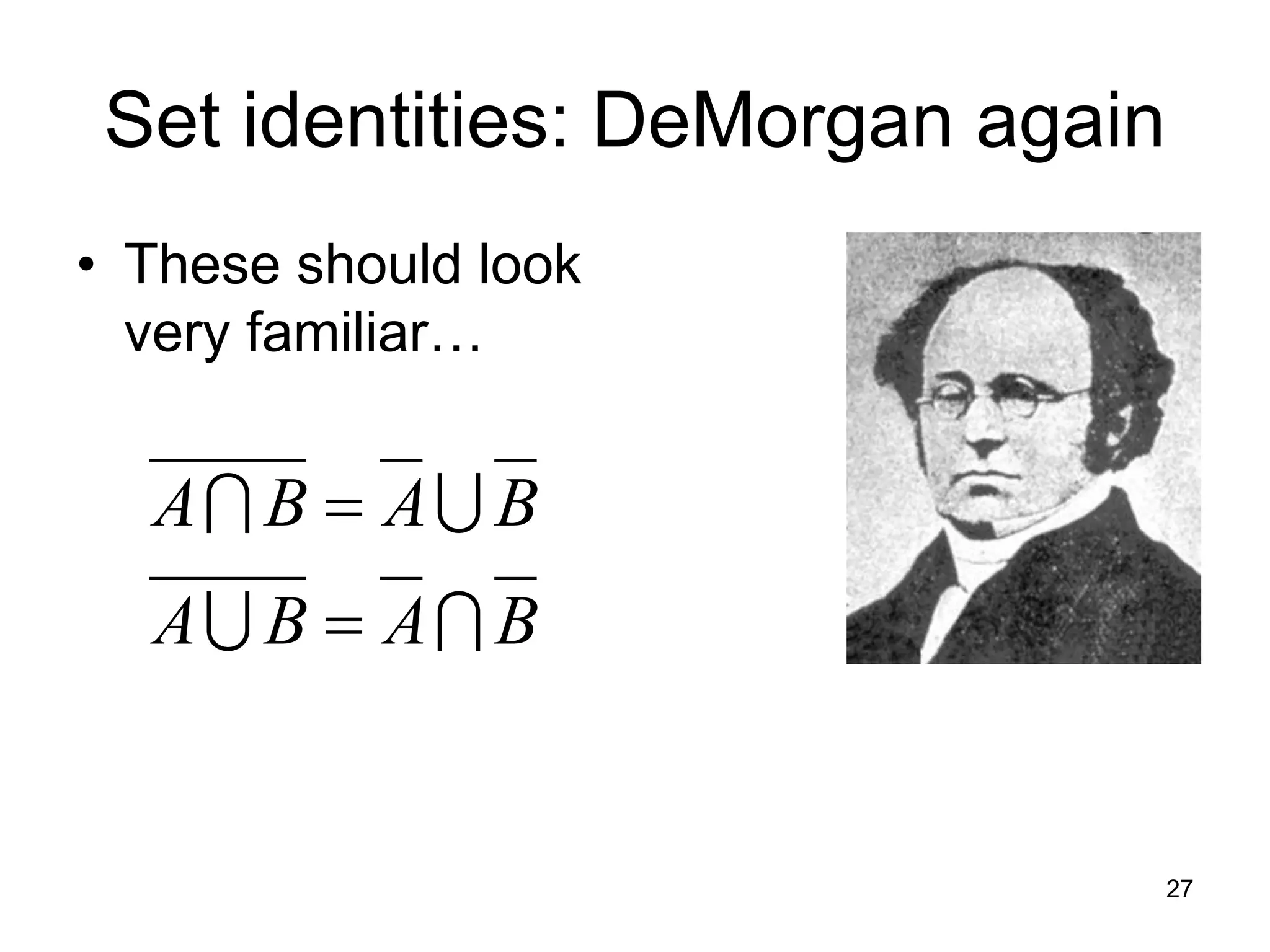
Set identities: DeMorgan again
B
A
B
A
B
A
B
A






• These should look
very familiar…
28
How to prove a set identity
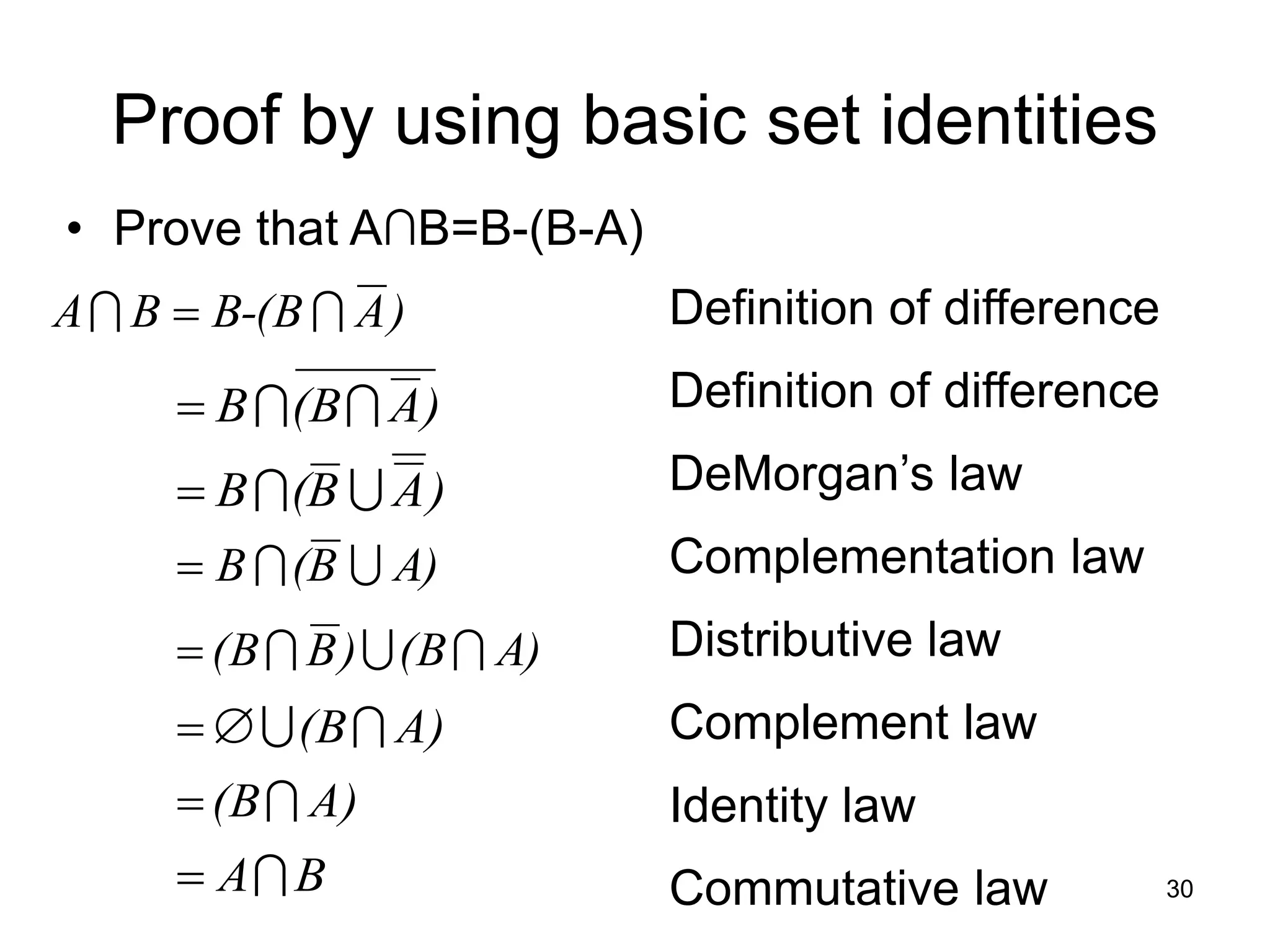
• For example: A∩B=B-(B-A)
• Four methods:
– Use the basic set identities (Rosen, p. 89)
– Use membership tables
– Prove each set is a subset of each other
• This is like proving that two numbers are equal by
showing that each is less than or equal to the other
– Use set builder notation and logical
equivalences
29
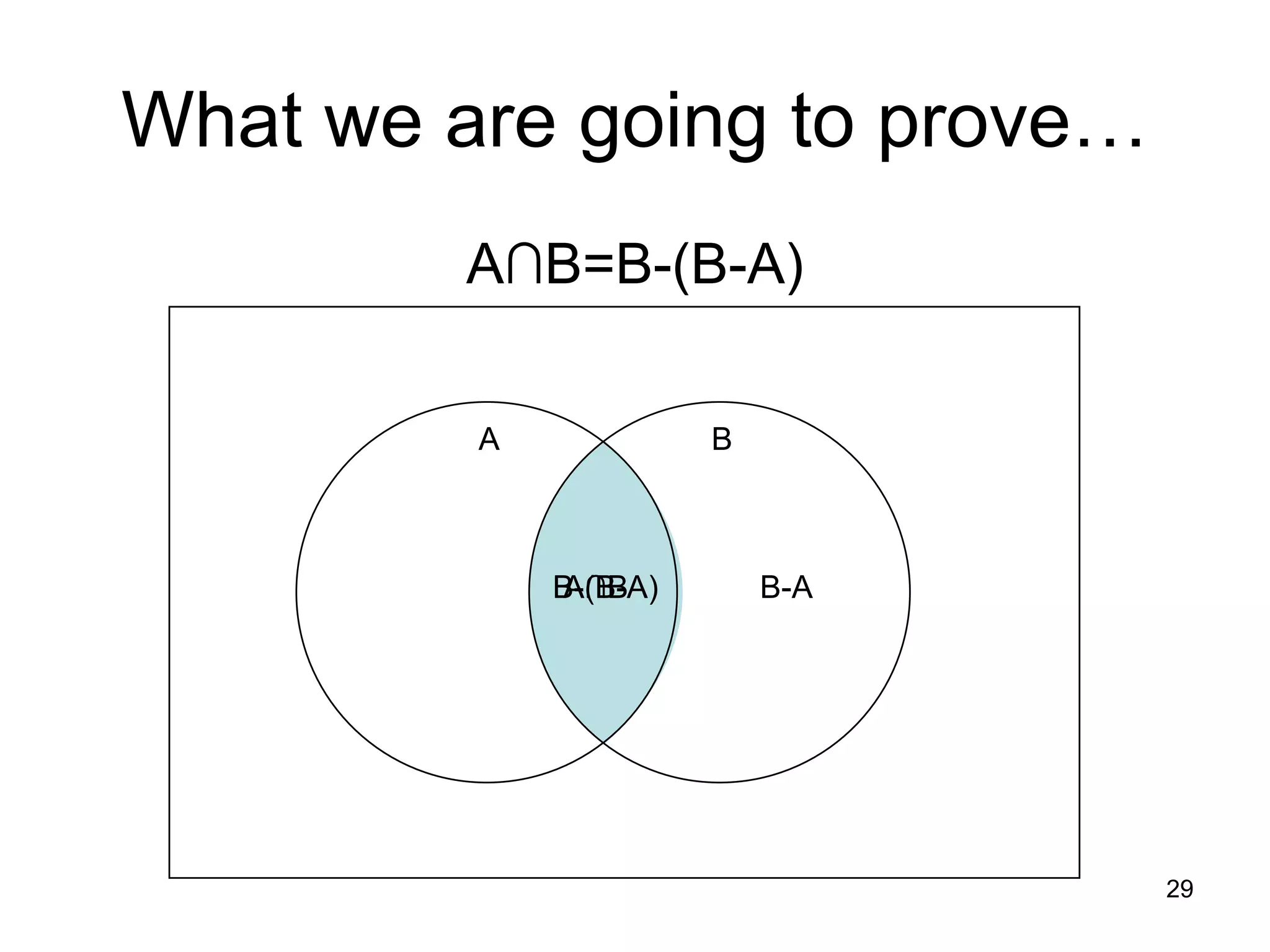
What we are going to prove…
A∩B=B-(B-A)
A B
A∩B B-A
B-(B-A)
30
Definition of difference
DeMorgan’s law
Complementation law
Distributive law
Complement law
Identity law
Commutative law
Proof by using basic set identities
• Prove that A∩B=B-(B-A)
)
A
B-(B
B
A 
 
)
A
(B
B 


)
A
B
(
B 


A)
B
(
B 


A)
(B
)
B
(B 



A)
(B



A)
(B

B
A

31
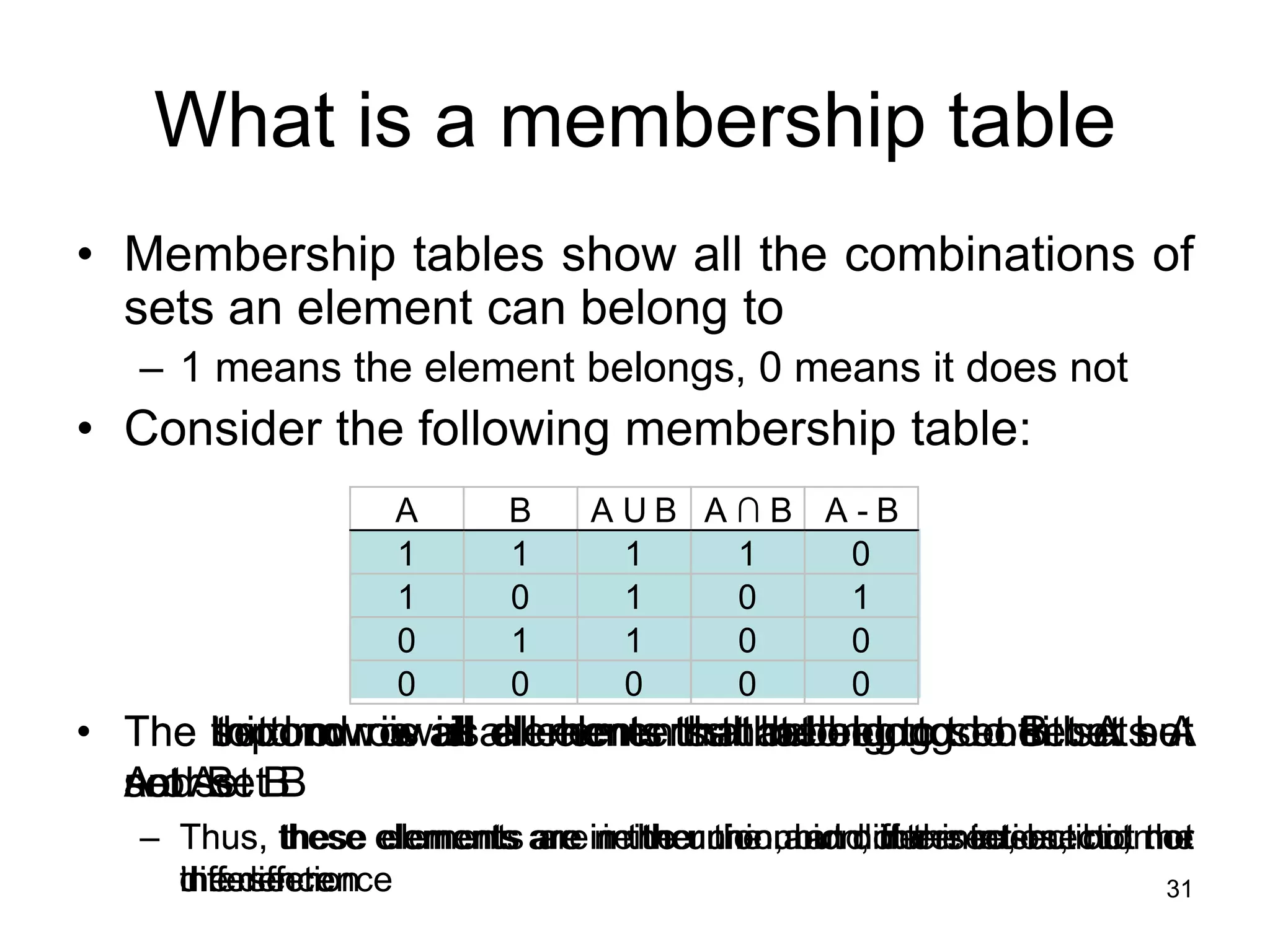
• The top row is all elements that belong to both sets A
and B
– Thus, these elements are in the union and intersection, but not
the difference
• The second row is all elements that belong to set A but
not set B
– Thus, these elements are in the union and difference, but not the
intersection
What is a membership table
• Membership tables show all the combinations of
sets an element can belong to
– 1 means the element belongs, 0 means it does not
• Consider the following membership table:
A B A U B A ∩ B A - B
1 1 1 1 0
1 0 1 0 1
0 1 1 0 0
0 0 0 0 0
• The third row is all elements that belong to set B but not
set A
– Thus, these elements are in the union, but not the intersection or
difference
• The bottom row is all elements that belong to neither set
A or set B
– Thus, these elements are neither the union, the intersection, nor
difference
32
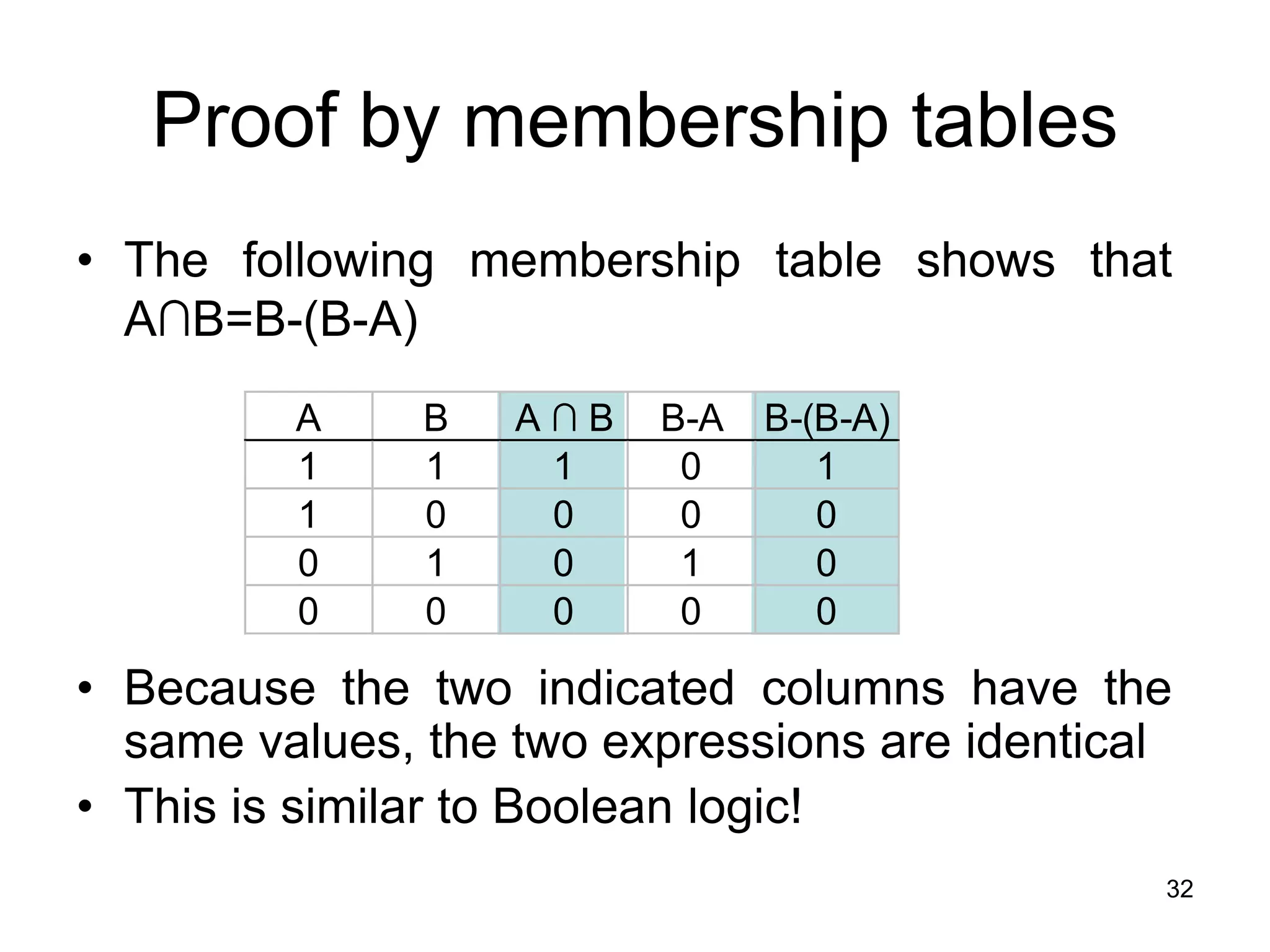
Proof by membership tables
• The following membership table shows that
A∩B=B-(B-A)
• Because the two indicated columns have the
same values, the two expressions are identical
• This is similar to Boolean logic!
A B A ∩ B B-A B-(B-A)
1 1 1 0 1
1 0 0 0 0
0 1 0 1 0
0 0 0 0 0
33
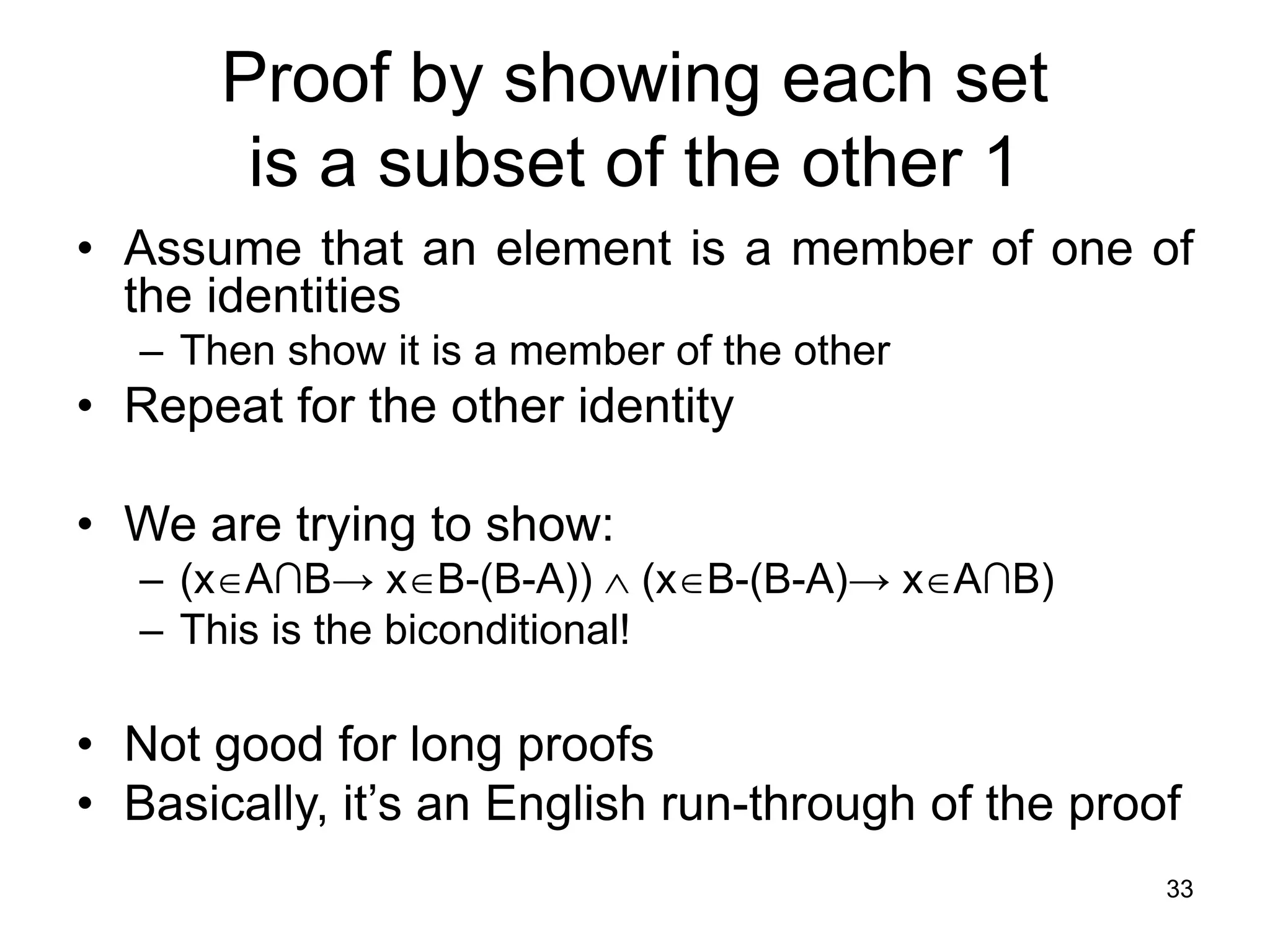
Proof by showing each set
is a subset of the other 1
• Assume that an element is a member of one of
the identities
– Then show it is a member of the other
• Repeat for the other identity
• We are trying to show:
– (xA∩B→ xB-(B-A))  (xB-(B-A)→ xA∩B)
– This is the biconditional!
• Not good for long proofs
• Basically, it’s an English run-through of the proof
34
Proof by showing each set
is a subset of the other 2
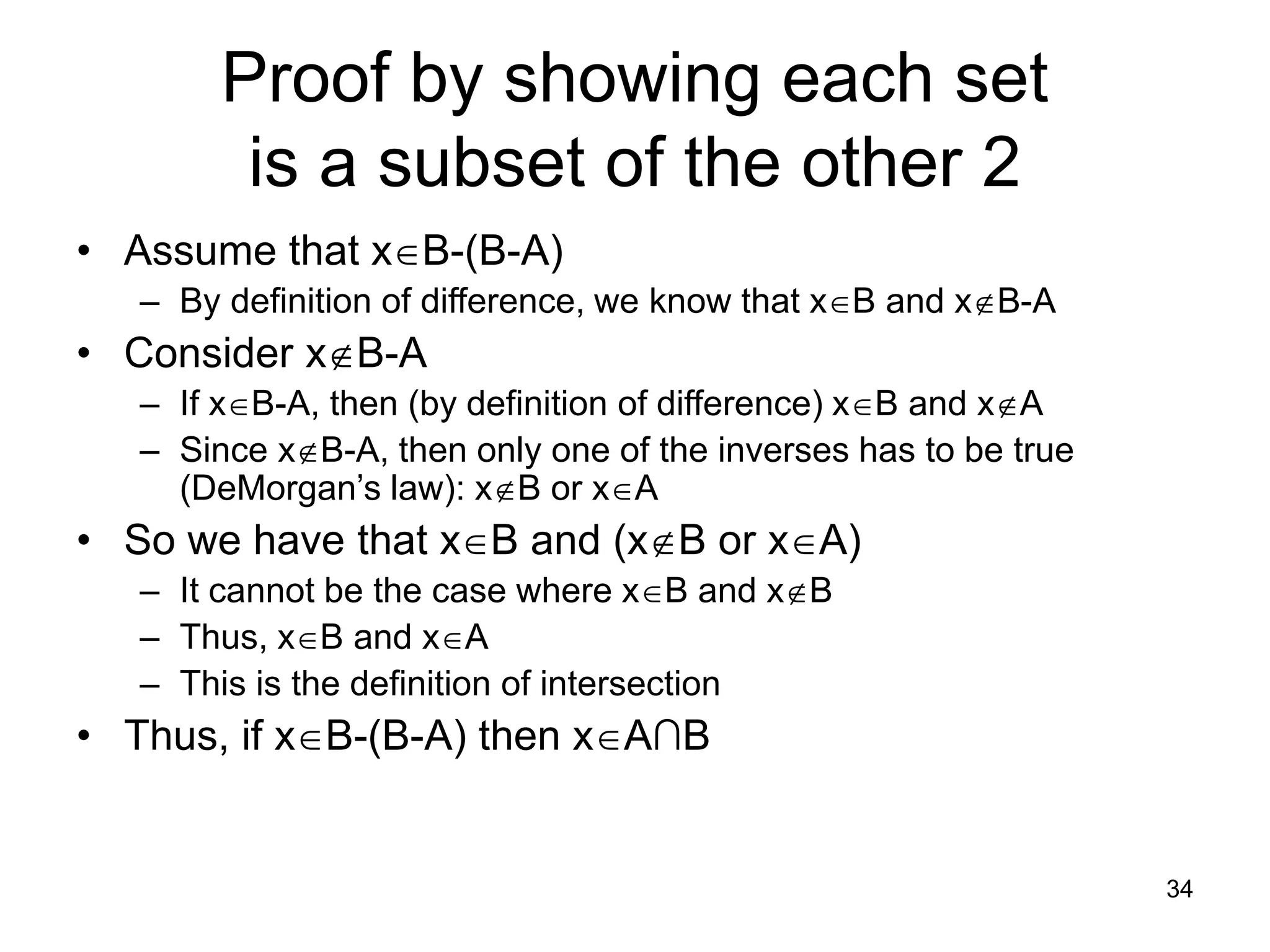
• Assume that xB-(B-A)
– By definition of difference, we know that xB and xB-A
• Consider xB-A
– If xB-A, then (by definition of difference) xB and xA
– Since xB-A, then only one of the inverses has to be true
(DeMorgan’s law): xB or xA
• So we have that xB and (xB or xA)
– It cannot be the case where xB and xB
– Thus, xB and xA
– This is the definition of intersection
• Thus, if xB-(B-A) then xA∩B
35
Proof by showing each set
is a subset of the other 3
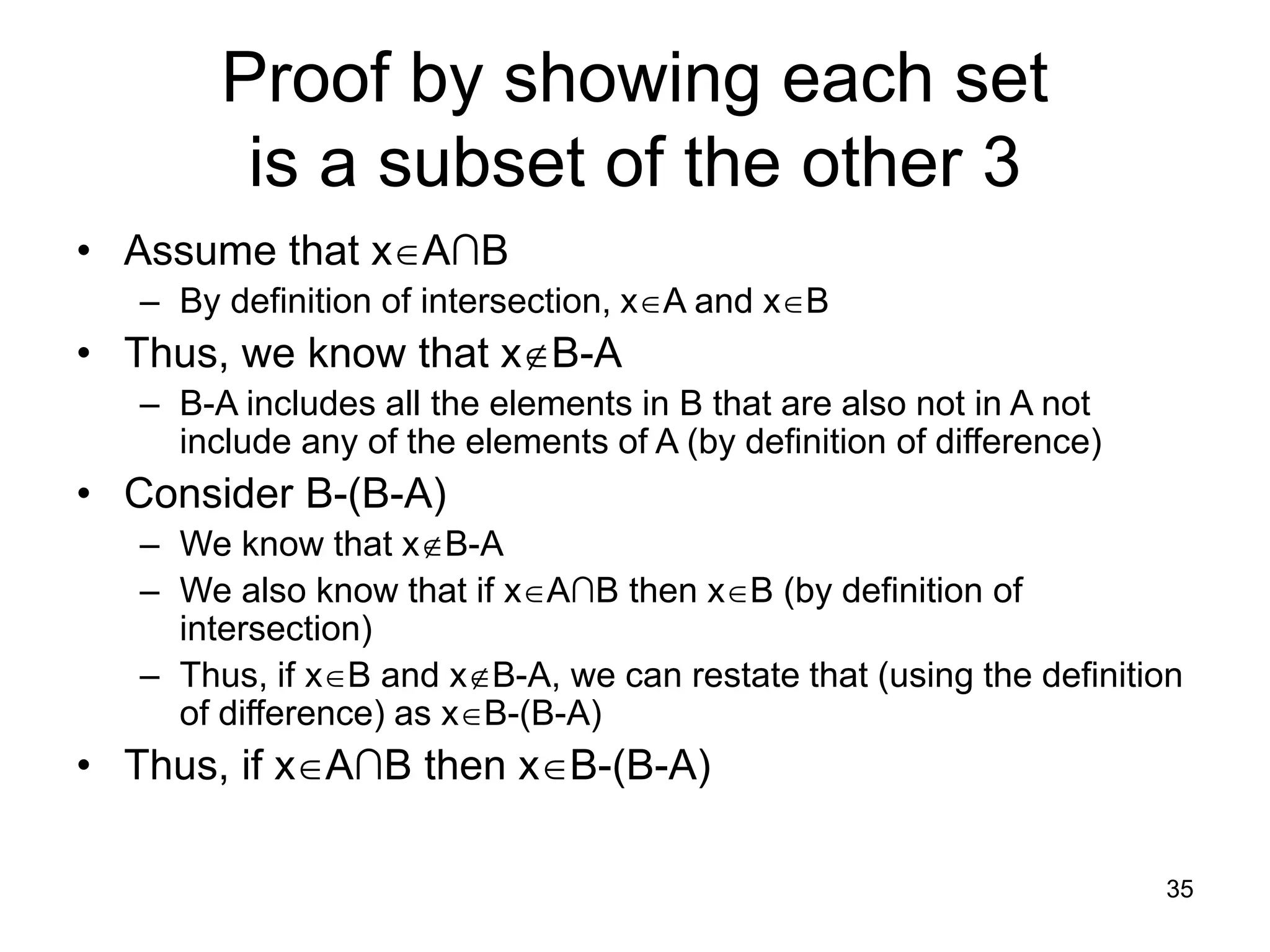
• Assume that xA∩B
– By definition of intersection, xA and xB
• Thus, we know that xB-A
– B-A includes all the elements in B that are also not in A not
include any of the elements of A (by definition of difference)
• Consider B-(B-A)
– We know that xB-A
– We also know that if xA∩B then xB (by definition of
intersection)
– Thus, if xB and xB-A, we can restate that (using the definition
of difference) as xB-(B-A)
• Thus, if xA∩B then xB-(B-A)
36
Proof by set builder notation
and logical equivalences 1
• First, translate both sides of the set
identity into set builder notation
• Then massage one side (or both) to make
it identical to the other
– Do this using logical equivalences
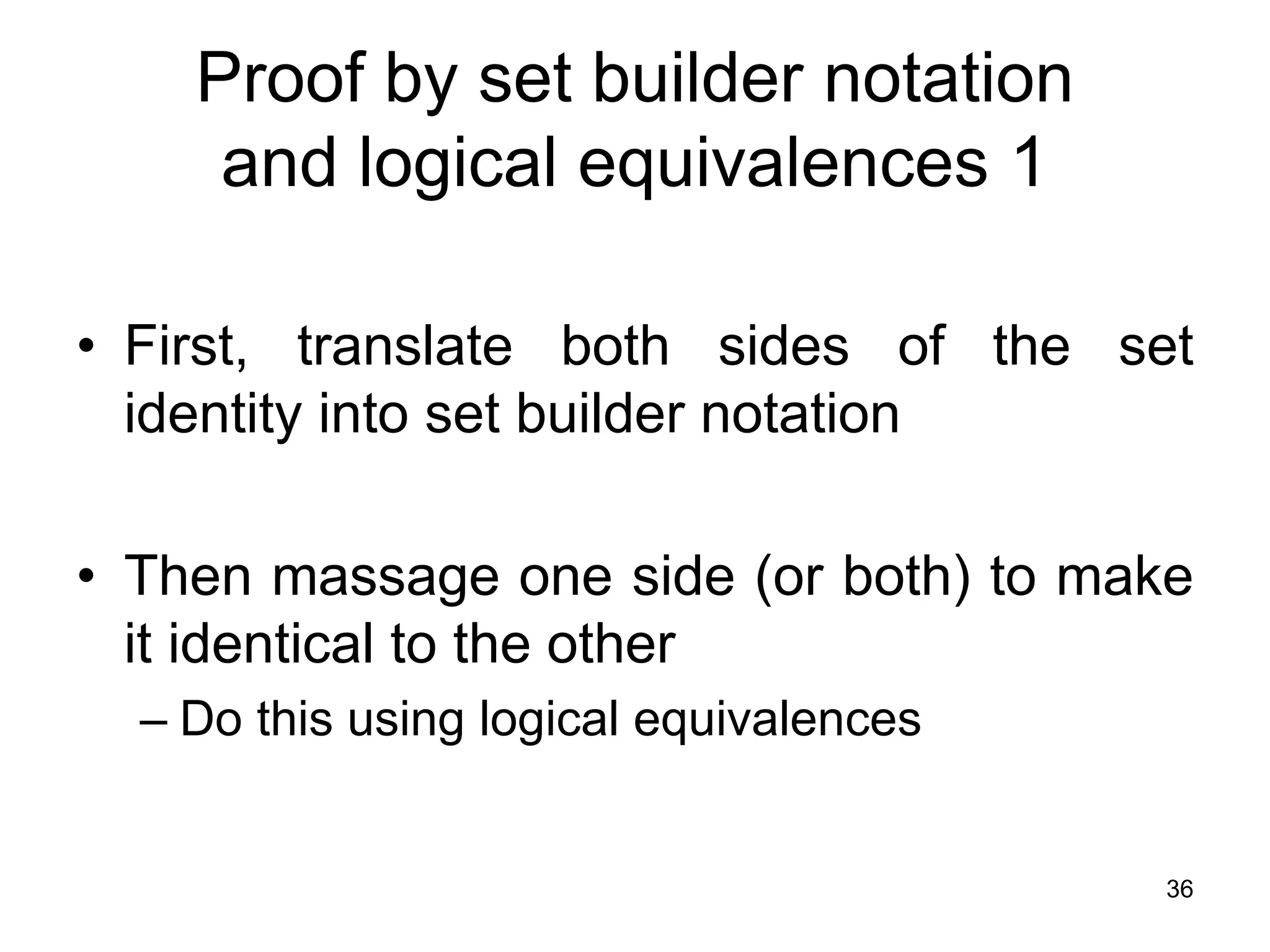
37
Proof by set builder notation
and logical equivalences 2
Original statement
Definition of difference
Negating “element of”
Definition of difference
DeMorgan’s Law
Distributive Law
Negating “element of”
Negation Law
Identity Law
Definition of intersection
)}
(
|
{ A
x
B
x
B
x
x 






)
( A
B
B 

)}
(
|
{ A
B
x
B
x
x 




))}
(
(
|
{ A
B
x
B
x
x 





}
|
{ A
x
B
x
x 



)}
(
|
{ A
x
B
x
B
x
x 





   }
|
{ A
x
B
x
B
x
B
x
x 







   }
)
(
|
{ A
x
B
x
B
x
B
x
x 








 }
|
{ A
x
B
x
F
x 




B
A

38
Proof by set builder notation
and logical equivalences 3
• Why can’t you prove it the “other” way?
– I.e. massage A∩B to make it look like B-(B-A)
• You can, but it’s a bit annoying
– In this case, it’s not simplifying the statement
39
Quick survey
 I understand (more or less) the four ways of
proving a set identity
a) Very well
b) With some review, I’ll be good
c) Not really
d) Not at all
40
Today’s demotivators
41
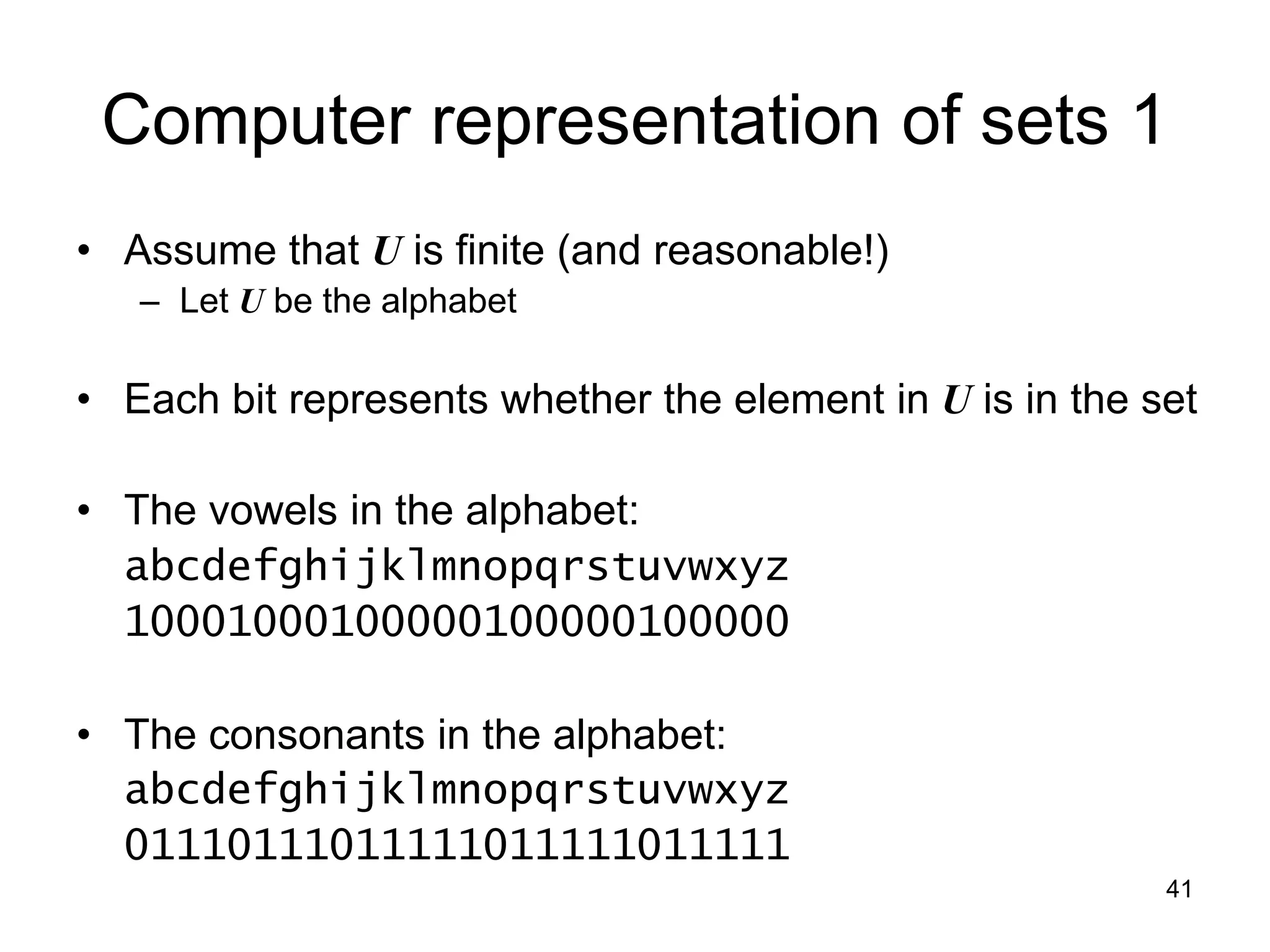
Computer representation of sets 1
• Assume that U is finite (and reasonable!)
– Let U be the alphabet
• Each bit represents whether the element in U is in the set
• The vowels in the alphabet:
abcdefghijklmnopqrstuvwxyz
10001000100000100000100000
• The consonants in the alphabet:
abcdefghijklmnopqrstuvwxyz
01110111011111011111011111
42
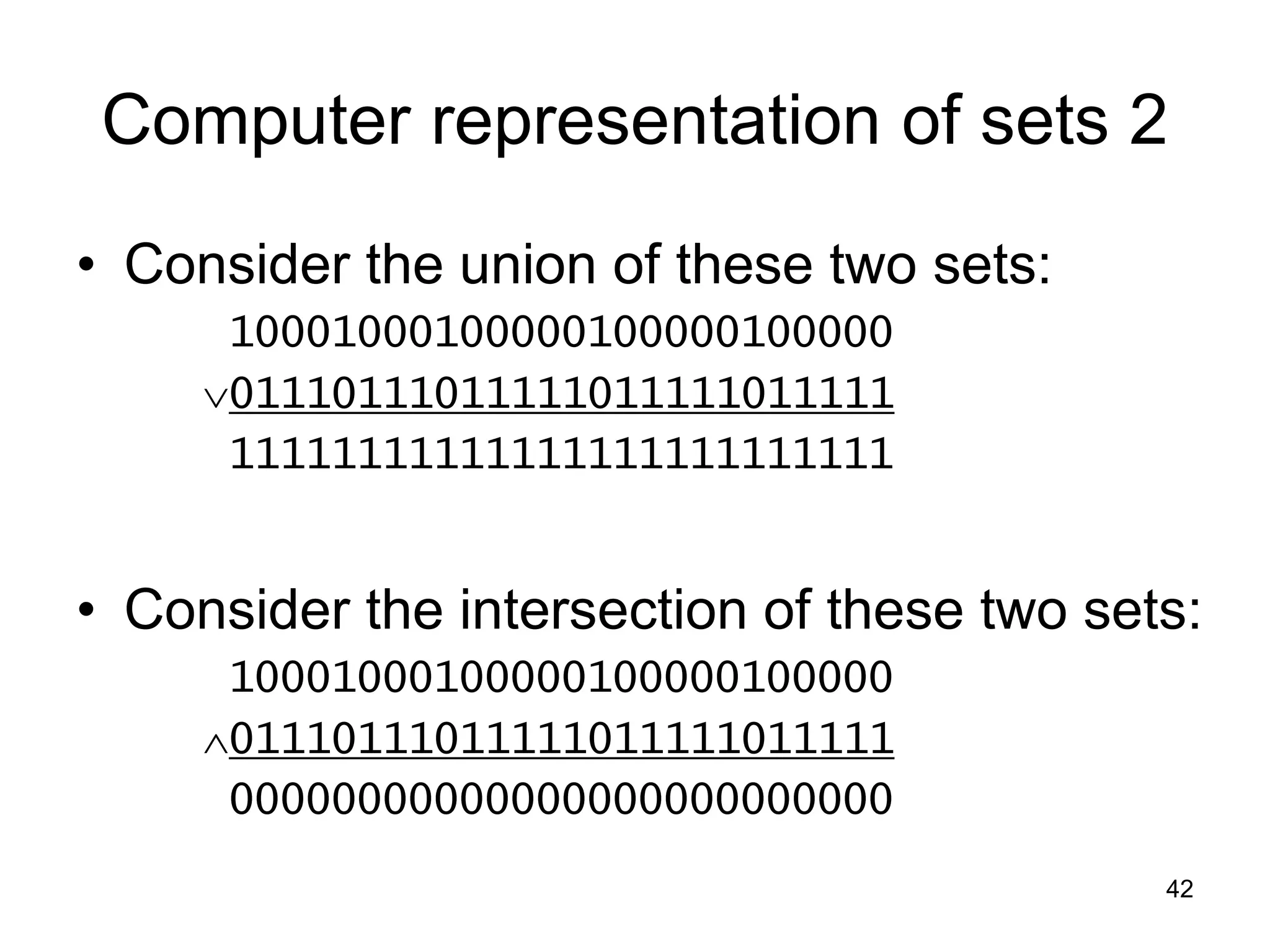
Computer representation of sets 2
• Consider the union of these two sets:
10001000100000100000100000
01110111011111011111011111
11111111111111111111111111
• Consider the intersection of these two sets:
10001000100000100000100000
01110111011111011111011111
00000000000000000000000000
43
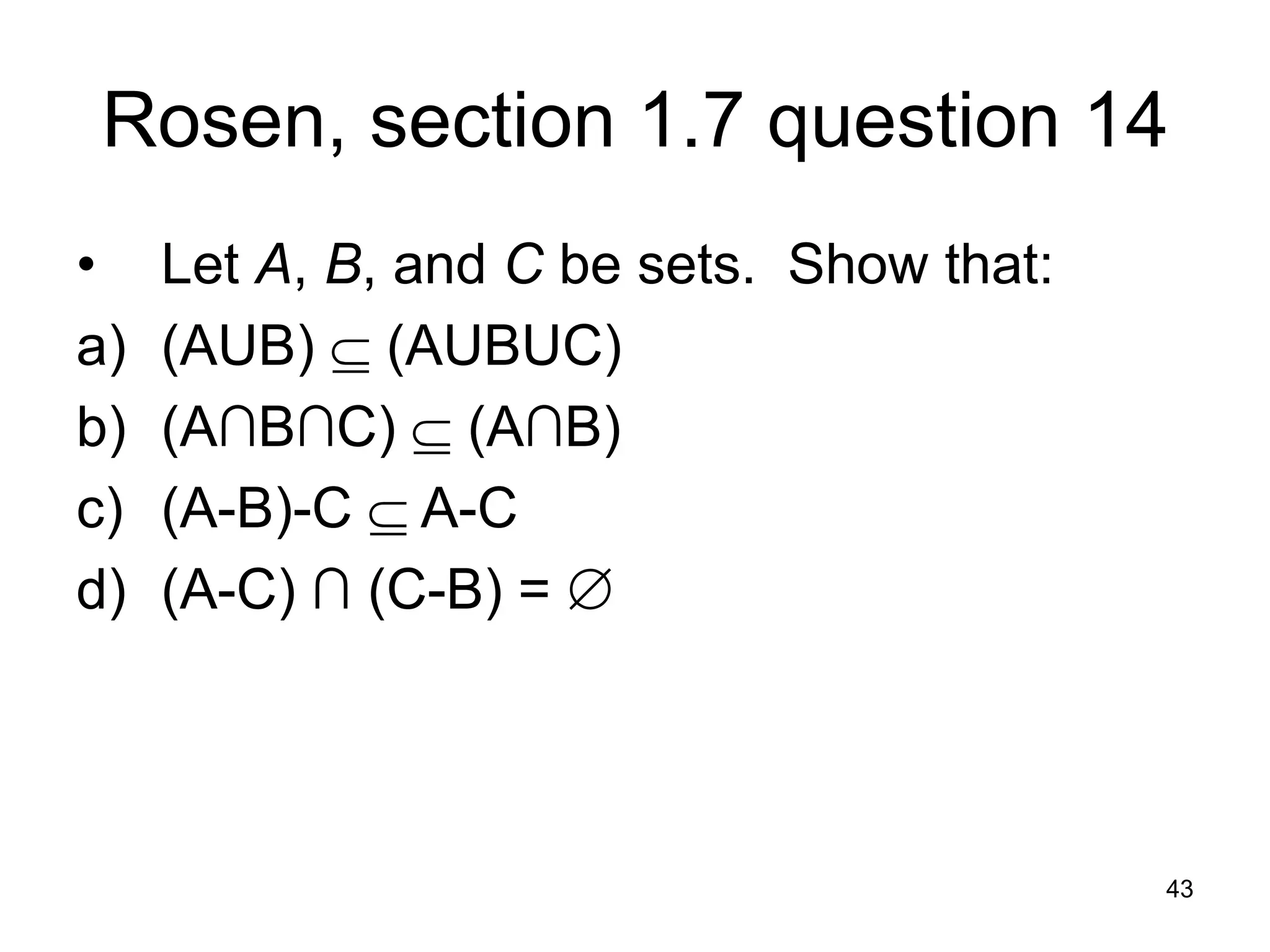
Rosen, section 1.7 question 14
• Let A, B, and C be sets. Show that:
a) (AUB)  (AUBUC)
b) (A∩B∩C)  (A∩B)
c) (A-B)-C  A-C
d) (A-C) ∩ (C-B) = 
44
Quick survey
 I felt I understood the material in this slide set…
a) Very well
b) With some review, I’ll be good
c) Not really
d) Not at all
45
Quick survey
 The pace of the lecture for this slide set was…
a) Fast
b) About right
c) A little slow
d) Too slow

06-set_operations.ppt

  • 1.
    1 Set Operations CS/APMA 202,Spring 2005 Rosen, section 1.7 Aaron Bloomfield
  • 2.
    2 • Triangle showsmixable color range (gamut) – the set of colors Sets of Colors Monitor gamut (M) Printer gamut (P) • Pick any 3 “primary” colors
  • 3.
    3 • A unionof the sets contains all the elements in EITHER set • Union symbol is usually a U • Example: C = M U P Monitor gamut (M) Printer gamut (P) Set operations: Union 1
  • 4.
  • 5.
    5 Set operations: Union3 • Formal definition for the union of two sets: A U B = { x | x  A or x  B } • Further examples – {1, 2, 3} U {3, 4, 5} = {1, 2, 3, 4, 5} – {New York, Washington} U {3, 4} = {New York, Washington, 3, 4} – {1, 2} U  = {1, 2}
  • 6.
    6 Set operations: Union4 • Properties of the union operation – A U  = A Identity law – A U U = U Domination law – A U A = A Idempotent law – A U B = B U A Commutative law – A U (B U C) = (A U B) U C Associative law
  • 7.
    7 • An intersectionof the sets contains all the elements in BOTH sets • Intersection symbol is a ∩ • Example: C = M ∩ P Monitor gamut (M) Printer gamut (P) Set operations: Intersection 1
  • 8.
  • 9.
    9 Set operations: Intersection3 • Formal definition for the intersection of two sets: A ∩ B = { x | x  A and x  B } • Further examples – {1, 2, 3} ∩ {3, 4, 5} = {3} – {New York, Washington} ∩ {3, 4} =  • No elements in common – {1, 2} ∩  =  • Any set intersection with the empty set yields the empty set
  • 10.
    11 Set operations: Intersection4 • Properties of the intersection operation – A ∩ U = A Identity law – A ∩  =  Domination law – A ∩ A = A Idempotent law – A ∩ B = B ∩ A Commutative law – A ∩ (B ∩ C) = (A ∩ B) ∩ C Associative law
  • 11.
    12 Disjoint sets 1 •Two sets are disjoint if the have NO elements in common • Formally, two sets are disjoint if their intersection is the empty set • Another example: the set of the even numbers and the set of the odd numbers
  • 12.
  • 13.
    14 Disjoint sets 3 •Formal definition for disjoint sets: two sets are disjoint if their intersection is the empty set • Further examples – {1, 2, 3} and {3, 4, 5} are not disjoint – {New York, Washington} and {3, 4} are disjoint – {1, 2} and  are disjoint • Their intersection is the empty set –  and  are disjoint! • Their intersection is the empty set
  • 14.
    15 Set operations: Difference1 • A difference of two sets is the elements in one set that are NOT in the other • Difference symbol is a minus sign • Example: C = M - P Monitor gamut (M) Printer gamut (P) • Also visa-versa: C = P - M
  • 15.
    16 Set operations: Difference2 U A B B - A A - B
  • 16.
    17 • Formal definitionfor the difference of two sets: A - B = { x | x  A and x  B } A - B = A ∩ B  Important! • Further examples – {1, 2, 3} - {3, 4, 5} = {1, 2} – {New York, Washington} - {3, 4} = {New York, Washington} – {1, 2} -  = {1, 2} • The difference of any set S with the empty set will be the set S Set operations: Difference 3 _
  • 17.
    18 • A symmetricdifference of the sets contains all the elements in either set but NOT both • Symetric diff. symbol is a  • Example: C = M  P Monitor gamut (M) Printer gamut (P) Set operations: Symmetric Difference 1
  • 18.
    19 • Formal definitionfor the symmetric difference of two sets: A  B = { x | (x  A or x  B) and x  A ∩ B} A  B = (A U B) – (A ∩ B)  Important! • Further examples – {1, 2, 3}  {3, 4, 5} = {1, 2, 4, 5} – {New York, Washington}  {3, 4} = {New York, Washington, 3, 4} – {1, 2}   = {1, 2} • The symmetric difference of any set S with the empty set will be the set S Set operations: Symmetric Difference 2
  • 19.
    20 • A complementof a set is all the elements that are NOT in the set • Difference symbol is a bar above the set name: P or M _ _ Monitor gamut (M) Printer gamut (P) Complement sets 1
  • 20.
  • 21.
    22 Complement sets 3 •Formal definition for the complement of a set: A = { x | x  A } – Or U – A, where U is the universal set • Further examples (assuming U = Z) – {1, 2, 3} = { …, -2, -1, 0, 4, 5, 6, … } – {New York, Washington} - {3, 4} = {New York, Washington} – {1, 2} -  = {1, 2} • The difference of any set S with the empty set will be the set S
  • 22.
    23 • Properties ofcomplement sets – A = A Complementation law – A U A = U Complement law – A ∩ A =  Complement law Complement sets 4 ¯ ¯ ¯ ¯
  • 23.
    24 Quick survey  Iunderstand the various set operations a) Very well b) With some review, I’ll be good c) Not really d) Not at all
  • 24.
    25 A last bitof color…
  • 25.
    26 Set identities • Setidentities are basic laws on how set operations work – Many have already been introduced on previous slides • Just like logical equivalences! – Replace U with  – Replace ∩ with  – Replace  with F – Replace U with T • Full list on Rosen, page 89
  • 26.
    27 Set identities: DeMorganagain B A B A B A B A       • These should look very familiar…
  • 27.
    28 How to provea set identity • For example: A∩B=B-(B-A) • Four methods: – Use the basic set identities (Rosen, p. 89) – Use membership tables – Prove each set is a subset of each other • This is like proving that two numbers are equal by showing that each is less than or equal to the other – Use set builder notation and logical equivalences
  • 28.
    29 What we aregoing to prove… A∩B=B-(B-A) A B A∩B B-A B-(B-A)
  • 29.
    30 Definition of difference Definitionof difference DeMorgan’s law Complementation law Distributive law Complement law Identity law Commutative law Proof by using basic set identities • Prove that A∩B=B-(B-A) ) A B-(B B A    ) A (B B    ) A B ( B    A) B ( B    A) (B ) B (B     A) (B    A) (B  B A 
  • 30.
    31 • The toprow is all elements that belong to both sets A and B – Thus, these elements are in the union and intersection, but not the difference • The second row is all elements that belong to set A but not set B – Thus, these elements are in the union and difference, but not the intersection What is a membership table • Membership tables show all the combinations of sets an element can belong to – 1 means the element belongs, 0 means it does not • Consider the following membership table: A B A U B A ∩ B A - B 1 1 1 1 0 1 0 1 0 1 0 1 1 0 0 0 0 0 0 0 • The third row is all elements that belong to set B but not set A – Thus, these elements are in the union, but not the intersection or difference • The bottom row is all elements that belong to neither set A or set B – Thus, these elements are neither the union, the intersection, nor difference
  • 31.
    32 Proof by membershiptables • The following membership table shows that A∩B=B-(B-A) • Because the two indicated columns have the same values, the two expressions are identical • This is similar to Boolean logic! A B A ∩ B B-A B-(B-A) 1 1 1 0 1 1 0 0 0 0 0 1 0 1 0 0 0 0 0 0
  • 32.
    33 Proof by showingeach set is a subset of the other 1 • Assume that an element is a member of one of the identities – Then show it is a member of the other • Repeat for the other identity • We are trying to show: – (xA∩B→ xB-(B-A))  (xB-(B-A)→ xA∩B) – This is the biconditional! • Not good for long proofs • Basically, it’s an English run-through of the proof
  • 33.
    34 Proof by showingeach set is a subset of the other 2 • Assume that xB-(B-A) – By definition of difference, we know that xB and xB-A • Consider xB-A – If xB-A, then (by definition of difference) xB and xA – Since xB-A, then only one of the inverses has to be true (DeMorgan’s law): xB or xA • So we have that xB and (xB or xA) – It cannot be the case where xB and xB – Thus, xB and xA – This is the definition of intersection • Thus, if xB-(B-A) then xA∩B
  • 34.
    35 Proof by showingeach set is a subset of the other 3 • Assume that xA∩B – By definition of intersection, xA and xB • Thus, we know that xB-A – B-A includes all the elements in B that are also not in A not include any of the elements of A (by definition of difference) • Consider B-(B-A) – We know that xB-A – We also know that if xA∩B then xB (by definition of intersection) – Thus, if xB and xB-A, we can restate that (using the definition of difference) as xB-(B-A) • Thus, if xA∩B then xB-(B-A)
  • 35.
    36 Proof by setbuilder notation and logical equivalences 1 • First, translate both sides of the set identity into set builder notation • Then massage one side (or both) to make it identical to the other – Do this using logical equivalences
  • 36.
    37 Proof by setbuilder notation and logical equivalences 2 Original statement Definition of difference Negating “element of” Definition of difference DeMorgan’s Law Distributive Law Negating “element of” Negation Law Identity Law Definition of intersection )} ( | { A x B x B x x        ) ( A B B   )} ( | { A B x B x x      ))} ( ( | { A B x B x x       } | { A x B x x     )} ( | { A x B x B x x          } | { A x B x B x B x x            } ) ( | { A x B x B x B x x           } | { A x B x F x      B A 
  • 37.
    38 Proof by setbuilder notation and logical equivalences 3 • Why can’t you prove it the “other” way? – I.e. massage A∩B to make it look like B-(B-A) • You can, but it’s a bit annoying – In this case, it’s not simplifying the statement
  • 38.
    39 Quick survey  Iunderstand (more or less) the four ways of proving a set identity a) Very well b) With some review, I’ll be good c) Not really d) Not at all
  • 39.
  • 40.
    41 Computer representation ofsets 1 • Assume that U is finite (and reasonable!) – Let U be the alphabet • Each bit represents whether the element in U is in the set • The vowels in the alphabet: abcdefghijklmnopqrstuvwxyz 10001000100000100000100000 • The consonants in the alphabet: abcdefghijklmnopqrstuvwxyz 01110111011111011111011111
  • 41.
    42 Computer representation ofsets 2 • Consider the union of these two sets: 10001000100000100000100000 01110111011111011111011111 11111111111111111111111111 • Consider the intersection of these two sets: 10001000100000100000100000 01110111011111011111011111 00000000000000000000000000
  • 42.
    43 Rosen, section 1.7question 14 • Let A, B, and C be sets. Show that: a) (AUB)  (AUBUC) b) (A∩B∩C)  (A∩B) c) (A-B)-C  A-C d) (A-C) ∩ (C-B) = 
  • 43.

    44 Quick survey  Ifelt I understood the material in this slide set… a) Very well b) With some review, I’ll be good c) Not really d) Not at all
  • 44.
    45 Quick survey  Thepace of the lecture for this slide set was… a) Fast b) About right c) A little slow d) Too slow