
Download to read offline
![International Reseach Journal,November,2010 ISSN-0975-3486 RNI: RAJBIL 2009/300097 VOL-I *ISSUE 14
88 RESEARCH ANALYSIS AND EVALUATION
INTRODUCTION
Through this study the investigator has successfully
found out a set of decisions and thus established the
need to carry out this research for facilitating the
learning of language for visually impaired (VI)
Students by application of Strategico-Instructional
Management (SIM) package - a combination of
brailled/large print and audio materials – especially
for facilitating learning of language through the
developmentofskillsoflistening,reading,speaking
andwritinginaninclusivesettingwhichisprimarily
based on classroom activities.
Rodger and Cavanagh (1962) put forward a
comprehensive and operationally useful framework
for deciding which strategies can be used for
overcoming performance deficiencies. In context of
learningoflanguagefor‘VisuallyImpairedStudents’
(VISs) the educational practitioners can do one of
two things.
1.FitVisuallyImpairedStudents[VISs]tothetask
ofLanguage learningthrough
1.1.guidance,1.2.selectionand 1.3.useofaidsfor
learning of language
2.FitthetaskofLanguageLearningtoVISsthrough
management changes in 2.1 Working conditions
2.2 Methods of working (classroom activities &
learning experiences) 2.3 Information system and
2.4Formofmotivationemployed.Butdeficienciesof
execution are rarely overcome to any extent by
existent formal education and training programmes.
Theirsolutionoflanguage learningforVISsinvolves
fittingthelanguagelearningtoVISs;and,thatiswhy,
the investigator decided to use the strategico-
instructional management (SIM) approach for
overcoming performance deficiencies by laying
emphasis on strategy management and strategic
planning including process management and
operational planning in generating ‘Inclusive
Learning and Friendly Classroom’.Learning of
languageforVISswaslocatedineverydayclassroom
processes. The SIM package i.e newly developed
Research Paper—Education
123456789012345678901234567890121234567890123456789012345678901212345678901234567890123456789012123456789012345678901234567
123456789012345678901234567890121234567890123456789012345678901212345678901234567890123456789012123456789012345678901234567
123456789012345678901234567890121234567890123456789012345678901212345678901234567890123456789012123456789012345678901234567
123456789012345678901234567890121234567890123456789012345678901212345678901234567890123456789012123456789012345678901234567
123456789012345678901234567890121234567890123456789012345678901212345678901234567890123456789012123456789012345678901234567
123456789012345678901234567890121234567890123456789012345678901212345678901234567890123456789012123456789012345678901234567
123456789012345678901234567890121234567890123456789012345678901212345678901234567890123456789012123456789012345678901234567
123456789012345678901234567890121234567890123456789012345678901212345678901234567890123456789012123456789012345678901234567
123456789012345678901234567890121234567890123456789012345678901212345678901234567890123456789012123456789012345678901234567
EXPERIMENTSWITHWHATASPECTS &
HOW TO MONITOR LANGUAGE LEARNING
FORVISUALLYIMPAIRED STUDENTIN
INCUSIVESETTING
November, 2010 * Mrs.Mukul Jana ** Dr.Shyam Sunder Bairagya,
* IED Cell, State Institute of Education, Port Blair
** Reader Dept. Education, University of Gaur Banga, Malda
activitybasedandskillorientedexemplarsprovided
an understanding to study the relationship between
pre-determined inputs and unpredictable process of
implementinglanguagelearningforVISsinInclusive
setting. The support for the teacher that the pre-
designed and pre-determined input and newly
developedpackagerepresented,wascomparedwith
requirementsthatgenerallyareimposedontheteacher
byofficialcurriculum.
In the class-rooms, Strategico-Instructional
Management(SIM)strategieswasmeantfortoteach
the four skills of listening, speaking, reading and
writing.
Thisstudyhascomeoutwithevidencethat‘learning
oflanguageisactivityspecificeventorphenomenon,
andlanguageisnotjustasubjectitisarangeofskills
thatVISsandothernormalchildrenneedinorderfor
them to access the curriculum (plan of action) and it
furtherhelpsthemtothinkandlearn. TheVISsneed
to be able to talk, listen, read and write in as many
situationsaspossible.Textualmaterialsappearedless
important if not entirely redundant. Class room
activities received proper direction and appropriate
focus. The SIM is flexible, activity based and
professional skills oriented approach for learning
languageforVISs.Thispartoftheresearchdealswith
the canvas of monitoring instruction of language
learning for VISs in inclusive setting.
Contextualismofmonitoringlanguagelearningfor
VisuallyImpairedStudents
The need to monitor the learning of language for
visually impaired students in inclusive setting
focuses two aspects.•What aspects of teaching-
learning need to be monitored?; and • How can it be
monitored?SelfmonitoringisthepracticeofEnglish
language teachers in an inclusive setting consisting
of visually impaired students. Language teachers
observe and reflect on what takes place in class with
aviewtorealizeinstructionalobjectives–cognitive,
affective and psychomotor- and also to bring about
desirable changes in teaching and learning.](https://image.slidesharecdn.com/88-95a-101201102753-phpapp02/85/88-95-a-1-320.jpg)
![International Reseach Journal,November,2010 ISSN-0975-3486 RNI: RAJBIL 2009/300097 VOL-I *ISSUE 14
90 RESEARCH ANALYSIS AND EVALUATION
theclassroom.Thebeliefsandattitudesoftheteacher
arerealizedinclassroomteaching.Achecklist(table:2)
(reproducedfromIGNOU,2007wasanalyzedbythe
investigatortoidentifyandclassifynine(9)teachers
who participated in this investigation as class room
teachers in inclusive setting as Transmission
‘Teachers’ or ‘Interpretation Teachers’.
Table:2: TheTeacher’sBeliefAboutHowEnglishIs
Learnt and It should Be Taught.
()InLanguagelearningasetofgrammaticalstructures
and words are to be taught.
( ) Language is a meaningful communication and is
learnt by practice in informal situations.
( ) Errors made by Ss in English should be corrected
immediatelyandlaterexplainedthroughexamples.
( ) When students learn English it is best to ignore
them as long as we know that they are saying.
( ) Students learning English need to master of basis
listening and speaking skills before they begin to
read and write.
( ) It is important to repeat and practice .
( ) The most important is learning the grammar.
()LearningEnglishiseasierforchildrenthanadults.
( ) Students begin speaking on their own and not
necessary to teach ‘how to speak English’.
( ) Everyone can learn English.
FindingsandInterpretation-II
Nine(9)Englishteachersfromdifferentschoolstook
initiative to teach English as second language in an
inclusivesetting.TheseteachersweregivenChecklist
showninTableNo.2. Allnine(9)teachers wereasked
toselectfive(5)statementsoutoften.Theinvestigator
wantedtoknowwhataccordingtotheteacherislearning
orteaching ofEnglishasasecondlanguage. Thiswas
anattempttolook,attheteacher’sbeliefsandattitudes
which influenced the way the teacher behaved in the
class room differently. Analysis of the data revealed
that teachers’ style influenced by their attitudes and
beliefs that is, the nature and role of knowledge in the
caseoflanguageteaching,theirviewsofteachingEnglish
asasecondlanguageandalsothenatureoflearningand
teaching to VISs.
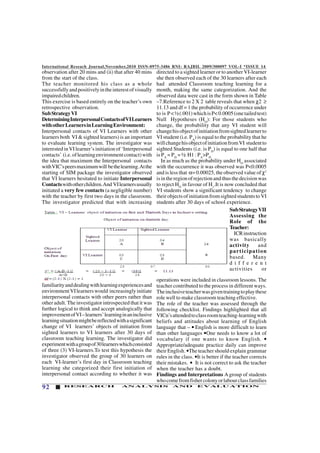
SeeStatements.Tree
The investigation further opined from other sources
of investigation associated to this present study that
“these two basic types are not exact opposites, but
are tendencies towards one extreme or the other”
(Douglas Barnes).
SUB-STRATEGY-III
Teachers’Interest in Doing Task in Class
Another sub-strategy was taken into consideration
to verify whether the teacher had keen interest in
doing the tasks/exercises/activities in class for the
VISslearninglanguage,howwellthetasks/exercises/
activitiestheteachersetupmeasureduptothecriteria
the teacher had in his mind. A set of criteria was
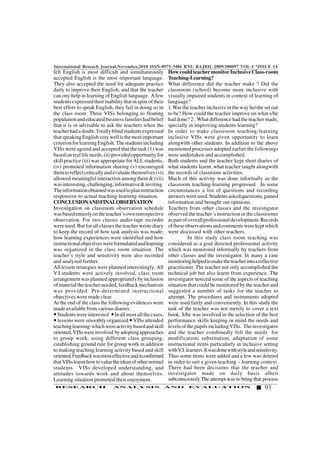
enlisted [Table:3] and observed and recorded the
teacher’s view as the class had been in progress.The
checklistwasdistributedattheendof20minutesand
the end of the class of 45 minutes with an aim to
modify the aspects of the learning task.
The teacher enlisted a set of criteria as suggested
below and recorded the views as the Inclusive Class
Room (ICR) teaching progressed .
CollectedData--(i)No.ofVISswhoattendedselected
three (3) tasks/activities. = 13 (ii) No. of selected
activities or task = 3 (iii) No. of items of criteria
= 8 (iv) No. of options for recording observation =
2[Attheendof20minutes(E20)andattheendofthe
class (EC) against two choices Y for yes as (+)ve
and
NforNo.as(-)ve
]=No.ofyes(Y)andNo.(N)caseeach
for E20 or EC = (13x3x8)=312 Thus viewed, total
number of expected responses (13x8x2x3)=624 In
respect of individual criterion where there had been
difficulty to visualize or ascertaining to recording
under category of ‘yes’ or ‘no’ or the observer failed
incategorizingintermsofYorN–allsuchcaseswere
taken as the cases ‘N’ category.
In order to test the significance of observed changes
by the McNemar Test, fourfold table of frequencies
to represent the first and second sets of responses
from the same individuals was used.](https://image.slidesharecdn.com/88-95a-101201102753-phpapp02/85/88-95-a-3-320.jpg)
![International Reseach Journal,November,2010 ISSN-0975-3486 RNI: RAJBIL 2009/300097 VOL-I *ISSUE 14
91RESEARCH ANALYSIS AND EVALUATION
StatisticalTest:TheMcNemartest
for significance of changes is
chosen because the study uses two
relatedsamples,isofthebefore(i.e.
attheendof20mins)–and-after(at
the end of the class) type and uses
nominal (classificatory)
measurement. progressed.
[ N.B Which tasks / aspects of tasks would need to
be modified ? Why ? ]
SubStrategy-V
ObservinglearningoflanguagesinClassRoomas
aWhole
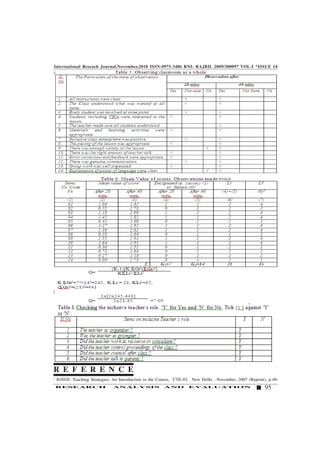
In order to monitor the class as a whole the
observation schedule below was used. [ Tick (“ ) the
cellaccordingly.]
Observing Classroom as a whole – applying the
CochranQ-Test
The investigator wanted that the teacher should
monitor his/her class as a whole. The teacher used
the observation schedule Table.5. Observation was
made twice – after 20 and also after 40 minutes from
the start of class. At the end of the class the teacher
could noted down comments he might had about
each of these statements focusing VISs and the class
as a whole.Achange in the position of fourteen (14)
itemsfrombefore–2/3rd
finishofinstruction(i.e.after
40 minutes from the start) would indicate possible
changeorimprovementinVICn’slearningeachitem
was scored under three categories. First category
represented ‘yes’ response by 2’s, ‘not sure’ by 1’s
and ‘No’by ‘O’s. Teachers scored eleven (11) VICn
who belonged to different classes against fourteen
(14) items. The mean value of scores of each of 14-
items, given by various teachers who taught
eleven(11)VICnarereproducedintable.6. Whenthe
meanvalueofthescoreislessthan1.00;observation
have been designated as ‘failure’ or unsuccessful in
terms of realizing the objectives of the statements
included in the observation schedule. If the mean
values of the score lie between 1 to 2, the objectives
expressed in the statements were designated as
‘successes’. Further failure responses were
represented by O’s and successful responses as 1’s
in columns (4) &(5) of the table.
Table value 7.64 at .01 level.
Withreferencetotablevalue,Qe”7.00hasprobability
of occurrence under H0
of P<.01
When df=1 at 0.01 level.
Thus, the value of Q is in the region of rejection and
therefore the decision is to reject H0
in favour of H1
.
Hence the conclusion is that the probabilities ‘Yes’
responses are different under two condition – (1)
Significance Level: α = .05, N=13, the number of
VISsparticipateonthestartingoftheclasstotwenty
minutes (E2)) and from E 20 to the end of the class.
Rejection Level: Since H1
specifies the direction of
the predicted difference, the region of rejection is
one-tailed. The region of rejection consists of all
values of χ2
(in which D>A) which are so large that
they have a one tailed probability associated with
their occurrence under H0
of .05 or less.
Findings
χ2
= 7.11 for df=1
ProbabilityofoccurrenceunderH0
isP<1/2(.01)which
is P<.005 (the probability value given in the table is
halvedbecauseaonetailedtestiscalledforandtable
givestwo-tailedvalue).Tablevalueat.001level(for
twotailedvalue)=10.83Foronetailedtest=5.415for
df=1Nowtheoreticalvalue=7.11>5.415or>Table
value,χ2
is in the region of rejection, thus decision is
to reject H0
in favour of H1
.
The conclusion is that The VISs show a significant
tendencies to change their behaviour through
realizing instructional objectives from starting time
of learning (i.e start of class) to the end of class.
Simultaneouslytheselectedtaskcriteriacombinedly
workedpositivelyorfavourablyinVIS’slearningof
language as the class progressed.
Sub-Strategy-IV
TesttheNeedforModificationofIndividualTaskor
TaskAspect
From the table. 4. it is clear that item No.8, brought
minimal favourable change in VICn’s learning of
language.Statistical test of significance in respect of
item No.8 was carried out with understanding that if
the test suggests the modification of item No.8 then
thesimilartestofsignificanceisrequiredtobecarried
outonthetaskorthetaskitemwhichbroughtsecond
minimal favourable change in VISs’ learning of
language.H0
is rejected in favour of H1
. The
conclusionistheTask/AspectofthetaskNo.8worked
favourably/positivelyinVISs’slearningoflanguage
as the class progressed. This is also true for all tasks/
aspects of tasks mentioned in table.4. There is no
need to modify any task/aspect of task. The list of
selected set of eight (8) criteria which was recorded
and observed worked favourably as the class](https://image.slidesharecdn.com/88-95a-101201102753-phpapp02/85/88-95-a-4-320.jpg)
This document summarizes research on monitoring language learning for visually impaired students in an inclusive classroom setting. It discusses several strategies used in the research: 1. Assessing students' beliefs about language learning to understand their expectations and goals. 2. Identifying teachers' beliefs which influence their teaching style as either "transmission" or "interpretation". 3. Using checklists to observe how well classroom tasks meet criteria and could be improved. 4. Applying statistical tests like McNemar to analyze changes in student responses over time. 5. Observing the whole class using a schedule to focus on students and language learning aspects. The goal was to effectively monitor the inclusive classroom and support language development for


![Netex | Smart Content 2016 [EN]](https://cdn.slidesharecdn.com/ss_thumbnails/netexsmartcontenten06102016-161117160238-thumbnail.jpg?width=640&height=640&fit=bounds)


![Netex learningCloud Mobile | What's New v2.1 [IT]](https://cdn.slidesharecdn.com/ss_thumbnails/nlcloudmobile-whatsnew-v2-160426115322-thumbnail.jpg?width=640&height=640&fit=bounds)

![Netex Webinar | Engage your learners with Stories and Challenges [EN]](https://cdn.slidesharecdn.com/ss_thumbnails/netexwebinarengageyourlearnerswithstoriesandchallengesen-160701101422-thumbnail.jpg?width=640&height=640&fit=bounds)


