EINSTEIN’S EQUIVALENCE PRINCIPLE
This principle is equivalent to the Galileo Galilei’s Principle of Relativity applied in absence of gravity, therefore it
would be appropriate to remember the meaning of Galileo’s principle according Wikipedia: Galilean
invariance or Galilean relativity states that the laws of motion are the same in all inertial frames. Galileo Galilei first
described this principle in 1632 in his “Dialogue Concerning the Two Chief World Systems” using the example of a
ship travelling at constant velocity, without rocking, on a smooth sea; any observer doing experiments below the deck
would not be able to tell whether the ship was moving or stationary.
Also, it is worth to mention that said Galileo’s Principle is no certain as demonstrates the exact math measure of the
elastic envelope (EE), of any frame or structure by the New Technology (New Physical Laws).
According with Galileo’s principle, it is easy to understand that Einstein was obliged to apply his principle under
conditions of weightlessness (zero gravity), as Einstein’s Theory of Relativity focuses on space and celestial bodies. It
should be convenient remember that Einstein’s theory initially was originated by the incorrect interpretation of the
Michelson-Morley experiment, which was held in order to demonstrate the existence of ether in space. In turn, said
experiment gave rise to the conviction or theory of the maximum light speed c as constant value, and therefore
preventing the measurement of the velocity of any object in space, as will be explained later. Also it is worth
remembering that once being constant c, this fact led to the creation of the equations or transformations of Hendrik
Lorentz, as necessary mathematical basis for the Einstein’s theory of relativity, as explained next:
 “The Michelson–Morley experiment was performed over the spring and summer of 1887 by Albert A.
Michelson and Edward W. Morley”. “The result was negative, in that the expected difference between the
speed of light in the direction of movement through the presumed aether, and the speed at right angles, was
found not to exist”. “Together with the Ives–Stilwell and Kennedy–Thorndike experiments, Michelson–
Morley type experiments form one of the fundamental tests of special relativity theory”. Wikipedia link:
https://en.wikipedia.org/wiki/Michelson%E2%80%93Morley_experiment.
 “The term Lorentz transformations only refers to transformations between inertial frames, usually in the
context of special relativity.” Wikipedia link: https://en.wikipedia.org/wiki/Lorentz_transformation (In 1904
Lorentz extended its mathematical formulation to introduce time dilation).
Once demonstrated the misinterpretation of the Michelson-Morley experiment, no longer exist any reason to justify the
constant value of light speed c; then, we are able to measure the speed of any object or frame in space, something
that will help to obtain a greater accuracy in the measurement of the distance among the celestial bodies, which are
usually classified according their capacity to emit light or reflect it.
Measure the speed of a body in space
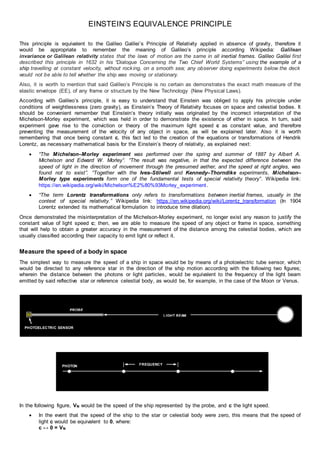
The simplest way to measure the speed of a ship in space would be by means of a photoelectric tube sensor, which
would be directed to any reference star in the direction of the ship motion according with the following two figures;
wherein the distance between the photons or light particles, would be equivalent to the frequency of the light beam
emitted by said reflective star or reference celestial body, as would be, for example, in the case of the Moon or Venus.
In the following figure, VN would be the speed of the ship represented by the probe, and c the light speed.
 In the event that the speed of the ship to the star or celestial body were zero, this means that the speed of
light c would be equivalent to 0, where:
c ↔ 0 = VN
LIGHT BEAM
PHOTOELECTRIC SENSOR
PROBE
PHOTON FREQUENCY
 The value VT in the figure will be equal to the total speed of light measured by the photoelectric sensor:
VT = c ± VN ; where VN is positive when the ship is directed towards the star, and negative when it moves
away from it, therefore:
VT = c + VN when the ship approaches the star or Venus; VN = VT - c (→)
VT = c - VN when the ship moves away from the star or Venus; VN = c - VT (←)
Miguel Cabral Martín
C
VN
VT

81 einstein’s equivalence principle

  • 1.
    EINSTEIN’S EQUIVALENCE PRINCIPLE Thisprinciple is equivalent to the Galileo Galilei’s Principle of Relativity applied in absence of gravity, therefore it would be appropriate to remember the meaning of Galileo’s principle according Wikipedia: Galilean invariance or Galilean relativity states that the laws of motion are the same in all inertial frames. Galileo Galilei first described this principle in 1632 in his “Dialogue Concerning the Two Chief World Systems” using the example of a ship travelling at constant velocity, without rocking, on a smooth sea; any observer doing experiments below the deck would not be able to tell whether the ship was moving or stationary. Also, it is worth to mention that said Galileo’s Principle is no certain as demonstrates the exact math measure of the elastic envelope (EE), of any frame or structure by the New Technology (New Physical Laws). According with Galileo’s principle, it is easy to understand that Einstein was obliged to apply his principle under conditions of weightlessness (zero gravity), as Einstein’s Theory of Relativity focuses on space and celestial bodies. It should be convenient remember that Einstein’s theory initially was originated by the incorrect interpretation of the Michelson-Morley experiment, which was held in order to demonstrate the existence of ether in space. In turn, said experiment gave rise to the conviction or theory of the maximum light speed c as constant value, and therefore preventing the measurement of the velocity of any object in space, as will be explained later. Also it is worth remembering that once being constant c, this fact led to the creation of the equations or transformations of Hendrik Lorentz, as necessary mathematical basis for the Einstein’s theory of relativity, as explained next:  “The Michelson–Morley experiment was performed over the spring and summer of 1887 by Albert A. Michelson and Edward W. Morley”. “The result was negative, in that the expected difference between the speed of light in the direction of movement through the presumed aether, and the speed at right angles, was found not to exist”. “Together with the Ives–Stilwell and Kennedy–Thorndike experiments, Michelson– Morley type experiments form one of the fundamental tests of special relativity theory”. Wikipedia link: https://en.wikipedia.org/wiki/Michelson%E2%80%93Morley_experiment.  “The term Lorentz transformations only refers to transformations between inertial frames, usually in the context of special relativity.” Wikipedia link: https://en.wikipedia.org/wiki/Lorentz_transformation (In 1904 Lorentz extended its mathematical formulation to introduce time dilation). Once demonstrated the misinterpretation of the Michelson-Morley experiment, no longer exist any reason to justify the constant value of light speed c; then, we are able to measure the speed of any object or frame in space, something that will help to obtain a greater accuracy in the measurement of the distance among the celestial bodies, which are usually classified according their capacity to emit light or reflect it. Measure the speed of a body in space The simplest way to measure the speed of a ship in space would be by means of a photoelectric tube sensor, which would be directed to any reference star in the direction of the ship motion according with the following two figures; wherein the distance between the photons or light particles, would be equivalent to the frequency of the light beam emitted by said reflective star or reference celestial body, as would be, for example, in the case of the Moon or Venus. In the following figure, VN would be the speed of the ship represented by the probe, and c the light speed.  In the event that the speed of the ship to the star or celestial body were zero, this means that the speed of light c would be equivalent to 0, where: c ↔ 0 = VN LIGHT BEAM PHOTOELECTRIC SENSOR PROBE PHOTON FREQUENCY
  • 2.
     The valueVT in the figure will be equal to the total speed of light measured by the photoelectric sensor: VT = c ± VN ; where VN is positive when the ship is directed towards the star, and negative when it moves away from it, therefore: VT = c + VN when the ship approaches the star or Venus; VN = VT - c (→) VT = c - VN when the ship moves away from the star or Venus; VN = c - VT (←) Miguel Cabral Martín C VN VT