Study on Gap Analysis of Malaysia Robotics
Industry for the Implementation of IC
Innovation for National Robotics (IC-I NR)
8. Target, Objectives and
Directions
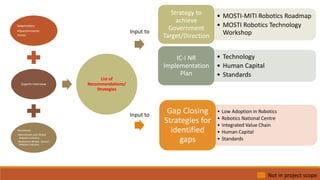
Stakeholders
•Questionnaires
•Visits
Experts Interview
Benchmark
•Benchmark with Global
Robotics Industry
•Reference Model : Korea’s
Robotics Industry
List of
Recommendations/
Strategies
• MOSTI-MITI Robotics Roadmap
• MOSTI Robotics Technology
Workshop
Strategy to
achieve
Government
Target/Direction
• Technology
• Human Capital
• Standards
IC-I NR
Implementation
Plan
Input to
Input to
• Low Adoption in Robotics
• Robotics National Centre
• Integrated Value Chain
• Human Capital
• Standards
Gap Closing
Strategies for
identified
gaps
Not in project scope
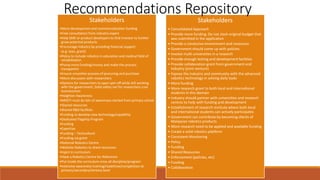
Stakeholders
•More development and commercialization funding
•Free consultation from industry expert
•Help SME or product developers to find investor to further
grow potential products
•Encourage industry by providing financial support
(e.g: loan, grant)
•Policy to include robotics in education and medical field of
rehabilitation
•Pump more funding/money and make the process
transparent
•Ensure smoother process of procuring and purchase
•More discussion with researchers
•Options for researchers to open spin off while still working
with the government. Solid safety net for researchers cum
businessman
•Heighten Awareness
•MOSTI must do lots of awareness started from primary school
•Shared resources
•Shared R&D facilities
•Funding to develop new technology/capability
•Dedicated Flagship Program
•Funding
•Expertise
•Funding – Technofund
•Funding via grant
•National Robotics Centre
•Website Robotics to share resources
•Inject in curriculum
•Have a Robotics Centre for Reference
•Put inside the curriculum cross all discipline/program
•Intensive awareness training/roadshow/competition at
primary/secondary/tertiary level
Stakeholders
• Consolidated Approach
• Provide more funding. Do not slash original budget that
was submitted in the application
• Provide a conducive environment and resources
• Government should come up with policies
• Involve multi universities in a research
• Provide enough testing and development facilities
• Provide collaboration grant from government and
industry (joint venture)
• Expose the industry and community with the advanced
robotics technology in solving daily tasks
• More funding
• More research grant to both local and international
students in this domain
• Industry should partner with universities and research
centres to help with funding and development
• Establishment of research institute where both local
and international students can actively participates
• Government can contribute by becoming clients of
Malaysian robotics products
• More research need to be applied and available funding
• Create a solid robotics platform
• Consistent Monitoring
• Policy
• Funding
• Shared Resources
• Enforcement (policies, etc)
• Funding
• Collaboration
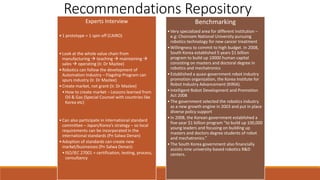
Recommendations Repository
Experts Interview
•1 prototype = 1 spin off (CAIRO)
•Look at the whole value chain from
manufacturing  teaching  maintaining 
sales  operating (Ir. Dr Mazlee)
•Robotics can follow the development of
Automation Industry – Flagship Program can
spurs industry (Ir. Dr Mazlee)
•Create market, not grant (Ir. Dr Mazlee)
•How to create market – Lessons learned from
Oil & Gas (Special Counsel with countries like
Korea etc)
•Can also participate in international standard
committee – Japan/Korea’s strategy – so local
requirements can be incorporated in the
international standards (Pn Salwa Denan)
•Adoption of standards can create new
market/businesses (Pn Salwa Denan):
•ISO/IEC 27001 = certification, testing, process,
consultancy
Benchmarking
•Very specialized area for different institution –
e.g: Chonnam National University pursuing
robotics technology for new cancer treatment
•Willingness to commit to high budget. In 2008,
South Korea established 5 years $1 billion
program to build up 10000 human capital
consisting on masters and doctoral degree in
robotics and mechatronics
•Established a quasi-government robot industry
promotion organization, the Korea Institute for
Robot Industry Advancement (KIRIA).
•Intelligent Robot Development and Promotion
Act 2008
•The government selected the robotics industry
as a new growth engine in 2003 and put in place
diverse policy support
•In 2008, the Korean government established a
five-year $1 billion program “to build up 100,000
young leaders and focusing on building up
masters and doctors degree students of robot
and mechatronics.”
•The South Korea government also financially
assists nine university-based robotics R&D
centers.
Recommendations Repository
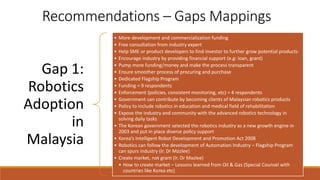
Recommendations – Gaps Mappings
Gap 1:
Robotics
Adoption
in
Malaysia
• More development and commercialization funding
• Free consultation from industry expert
• Help SME or product developers to find investor to further grow potential products
• Encourage industry by providing financial support (e.g: loan, grant)
• Pump more funding/money and make the process transparent
• Ensure smoother process of procuring and purchase
• Dedicated Flagship Program
• Funding = 9 respondents
• Enforcement (policies, consistent monitoring, etc) = 4 respondents
• Government can contribute by becoming clients of Malaysian robotics products
• Policy to include robotics in education and medical field of rehabilitation
• Expose the industry and community with the advanced robotics technology in
solving daily tasks
• The Korean government selected the robotics industry as a new growth engine in
2003 and put in place diverse policy support
• Korea’s Intelligent Robot Development and Promotion Act 2008
• Robotics can follow the development of Automation Industry – Flagship Program
can spurs industry (Ir. Dr Mazlee)
• Create market, not grant (Ir. Dr Mazlee)
• How to create market – Lessons learned from Oil & Gas (Special Counsel with
countries like Korea etc)
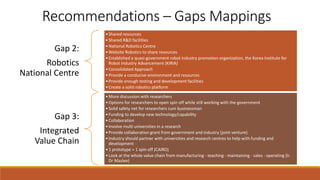
Recommendations – Gaps Mappings
Gap 2:
Robotics
National Centre
•Shared resources
•Shared R&D facilities
•National Robotics Centre
•Website Robotics to share resources
•Established a quasi-government robot industry promotion organization, the Korea Institute for
Robot Industry Advancement (KIRIA)
•Consolidated Approach
•Provide a conducive environment and resources
•Provide enough testing and development facilities
•Create a solid robotics platform
Gap 3:
Integrated
Value Chain
•More discussion with researchers
•Options for researchers to open spin off while still working with the government
•Solid safety net for researchers cum businessman
•Funding to develop new technology/capability
•Collaboration
•Involve multi universities in a research
•Provide collaboration grant from government and industry (joint venture)
•Industry should partner with universities and research centres to help with funding and
development
•1 prototype = 1 spin off (CAIRO)
•Look at the whole value chain from manufacturing - teaching - maintaining - sales - operating (Ir.
Dr Mazlee)
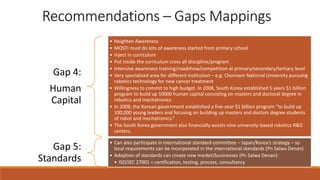
Recommendations – Gaps Mappings
Gap 4:
Human
Capital
• Heighten Awareness
• MOSTI must do lots of awareness started from primary school
• Inject in curriculum
• Put inside the curriculum cross all discipline/program
• Intensive awareness training/roadshow/competition at primary/secondary/tertiary level
• Very specialized area for different institution – e.g: Chonnam National University pursuing
robotics technology for new cancer treatment
• Willingness to commit to high budget. In 2008, South Korea established 5 years $1 billion
program to build up 10000 human capital consisting on masters and doctoral degree in
robotics and mechatronics
• In 2008, the Korean government established a five-year $1 billion program “to build up
100,000 young leaders and focusing on building up masters and doctors degree students
of robot and mechatronics.”
• The South Korea government also financially assists nine university-based robotics R&D
centers.
Gap 5:
Standards
• Can also participate in international standard committee – Japan/Korea’s strategy – so
local requirements can be incorporated in the international standards (Pn Salwa Denan)
• Adoption of standards can create new market/businesses (Pn Salwa Denan):
• ISO/IEC 27001 = certification, testing, process, consultancy
Government Target/Direction
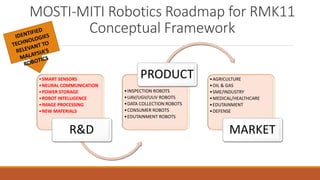
MOSTI-MITI Robotics Roadmap for RMK11
Conceptual Framework
•SMART SENSORS
•NEURAL COMMUNICATION
•POWER STORAGE
•ROBOT INTELLIGENCE
•IMAGE PROCESSING
•NEW MATERIALS
R&D
•INSPECTION ROBOTS
•UAV/UGV/UUV ROBOTS
•DATA COLLECTION ROBOTS
•CONSUMER ROBOTS
•EDUTAINMENT ROBOTS
PRODUCT •AGRICULTURE
•OIL & GAS
•SME/INDUSTRY
•MEDICAL/HEALTHCARE
•EDUTAINMENT
•DEFENSE
MARKET
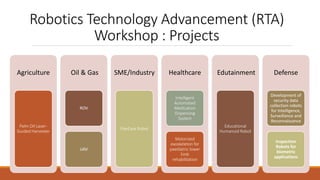
Robotics Technology Advancement (RTA)
Workshop : Projects
Agriculture
Palm Oil Laser-
Guided Harvester
Oil & Gas
ROV
UAV
SME/Industry
FlexEase Robot
Healthcare
Intelligent
Automated
Medication
Dispensing
System
Motorized
exoskeleton for
paediatric lower
limb
rehabilitation
Edutainment
Educational
Humanoid Robot
Defense
Development of
security data
collection robots
for Intelligence,
Surveillance and
Reconnaissance
Inspection
Robots for
biometric
applications
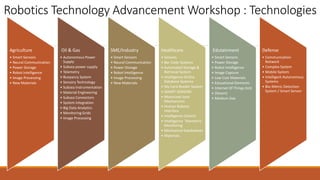
Robotics Technology Advancement Workshop : Technologies
Agriculture
• Smart Sensors
• Neural Communication
• Power Storage
• Robot Intelligence
• Image Processing
• New Materials
Oil & Gas
• Autonomous Power
Supply
• Subsea power supply
• Telemetry
• Buoyancy System
• Sensory Technology
• Subsea Instrumentation
• Material Engineering
• Subsea Connectors
• System Integration
• Big Data Analytics
• Monitoring Grids
• Image Processing
SME/Industry
• Smart Sensors
• Neural Communication
• Power Storage
• Robot Intelligence
• Image Processing
• New Materials
Healthcare
• Sensors
• Bar Code Systems
• Automated Storage &
Retrieval System
• Intelligence Online
Database Systems
• My Card Reader System
• SMART SENSORS
• Motorized Joint
Mechanisms
• Human Robotic
Interface
• Intelligence Control
• Intelligence Telemetric
Monitoring
• Mechanical Exoskeleton
• Materials
Edutainment
• Smart Sensors
• Power Storage
• Robot Intelligence
• Image Capture
• Low Cost Materials
• Educational Elements
• Internet Of Things (Iot)
• (Steam)
• Medium Size
Defense
• Communication
Network
• Complex System
• Mobile System
• Intelligent Autonomous
Systems
• Bio-Metric Detection
System / Smart Sensor
Implementation Plan for IC-I NR
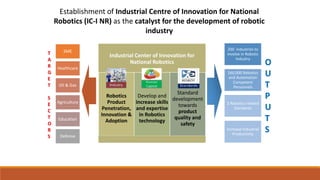
Establishment of Industrial Centre of Innovation for National
Robotics (IC-I NR) as the catalyst for the development of robotic
industry
SME
Healthcare
Oil & Gas
Agriculture
Education
Defense
200 industries to
involve in Robotic
Industry
160,000 Robotics
and Automation
Competent
Personnels
2 Robotics related
Standards
Increase Industrial
Productivity
T
A
R
G
E
T
S
E
C
T
O
R
S
O
U
T
P
U
T
S
Industrial Center of Innovation for
National Robotics
Robotics
Product
Penetration,
Innovation &
Adoption
Develop and
increase skills
and expertise
in Robotics
technology
Standard
development
towards
product
quality and
safety
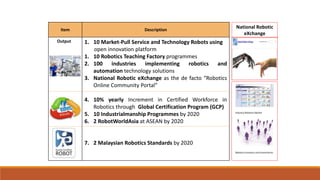
Item Description
Output 1. 10 Market-Pull Service and Technology Robots using
open innovation platform
1. 10 Robotics Teaching Factory programmes
2. 100 industries implementing robotics and
automation technology solutions
3. National Robotic eXchange as the de facto “Robotics
Online Community Portal”
4. 10% yearly Increment in Certified Workforce in
Robotics through Global Certification Program (GCP)
5. 10 Industrialmanship Programmes by 2020
6. 2 RobotWorldAsia at ASEAN by 2020
7. 2 Malaysian Robotics Standards by 2020
National Robotic
eXchange
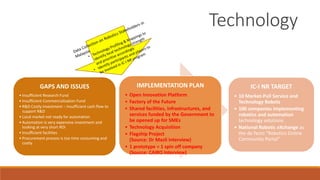
Technology
GAPS AND ISSUES
• Insufficient Research Fund
• Insufficient Commercialisation Fund
• R&D Costly Investment – Insufficient cash flow to
support R&D
• Local market not ready for automation
• Automation is very expensive investment and
looking at very short ROI
• Insufficient facilities
• Procurement process is too time consuming and
costly
IMPLEMENTATION PLAN
• Open Innovation Platform
• Factory of the Future
• Shared facilities, infrastructures, and
services funded by the Government to
be opened up for SMEs
• Technology Acquisition
• Flagship Project
(Source: Dr Mazli Interview)
• 1 prototype = 1 spin off company
(Source: CAIRO Interview)
IC-I NR TARGET
• 10 Market-Pull Service and
Technology Robots
• 100 companies implementing
robotics and automation
technology solutions
• National Robotic eXchange as
the de facto “Robotics Online
Community Portal”
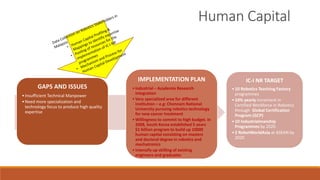
Human Capital
GAPS AND ISSUES
•Insufficient Technical Manpower
•Need more specialization and
technology focus to produce high quality
expertise
IMPLEMENTATION PLAN
• Industrial – Academia Research
Integration
• Very specialized area for different
institution – e.g: Chonnam National
University pursuing robotics technology
for new cancer treatment
• Willingness to commit to high budget. In
2008, South Korea established 5 years
$1 billion program to build up 10000
human capital consisting on masters
and doctoral degree in robotics and
mechatronics
• Intensify up-skilling of existing
engineers and graduates
IC-I NR TARGET
•10 Robotics Teaching Factory
programmes
•10% yearly Increment in
Certified Workforce in Robotics
through Global Certification
Program (GCP)
•10 Industrialmanship
Programmes by 2020
•2 RobotWorldAsia at ASEAN by
2020
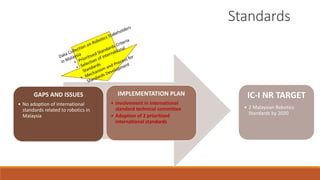
Standards
GAPS AND ISSUES
• No adoption of international
standards related to robotics in
Malaysia
IMPLEMENTATION PLAN
• Involvement in international
standard technical committee
• Adoption of 2 prioritized
international standards
IC-I NR TARGET
• 2 Malaysian Robotics
Standards by 2020
Future Robotics
Source: http://www.techhive.com/article/126858/article.html
2006
• Roomba sales top 2 million. [This already happened in
May 2006.]
2007
• Sales of pool-cleaning and window-washing robots rise
significantly. A new, bipedal Honda Asimo unit that can
run (at 4 miles per hour) debuts in United States.
2009
• In just three years, 4.5 million domestic robots have
been sold.
2010
• Service and personal robotics sales exceed $17 billion.
2025
• Sales of service and personal robots near $52 billion.
2040
• Most households now own a robot or are considering
buying one
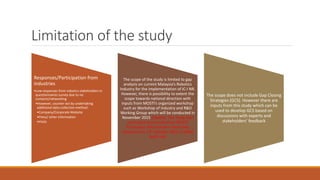
Limitation of the study
Responses/Participation from
industries
•Low responses from robotics stakeholders in
questionnaires survey due to no
contacts/networking
•However, counter-act by undertaking
additional data collection method:
•Company/Corporate Website
•Press/ other information
•Visits
The scope of the study is limited to gap
analysis on current Malaysia’s Robotics
Industry for the implementation of IC-I NR.
However, there is possibility to extent the
scope towards national direction with
inputs from MOSTI’s organized workshop
such as Workshop of Industry and R&D
Working Group which will be conducted in
November 2015 (Update: The Study also
used input and results from MOSTI
Technology Advancement Workshop
conducted on 13th October 2015 in SIRIM
Bukit Jalil
The scope does not include Gap Closing
Strategies (GCS). However there are
inputs from this study which can be
used to develop GCS based on
discussions with experts and
stakeholders’ feedback

8 targets objectives and directions

  • 1.
    Study on GapAnalysis of Malaysia Robotics Industry for the Implementation of IC Innovation for National Robotics (IC-I NR)
  • 2.
    8. Target, Objectivesand Directions
  • 3.
    Stakeholders •Questionnaires •Visits Experts Interview Benchmark •Benchmark withGlobal Robotics Industry •Reference Model : Korea’s Robotics Industry List of Recommendations/ Strategies • MOSTI-MITI Robotics Roadmap • MOSTI Robotics Technology Workshop Strategy to achieve Government Target/Direction • Technology • Human Capital • Standards IC-I NR Implementation Plan Input to Input to • Low Adoption in Robotics • Robotics National Centre • Integrated Value Chain • Human Capital • Standards Gap Closing Strategies for identified gaps Not in project scope
  • 4.
    Stakeholders •More development andcommercialization funding •Free consultation from industry expert •Help SME or product developers to find investor to further grow potential products •Encourage industry by providing financial support (e.g: loan, grant) •Policy to include robotics in education and medical field of rehabilitation •Pump more funding/money and make the process transparent •Ensure smoother process of procuring and purchase •More discussion with researchers •Options for researchers to open spin off while still working with the government. Solid safety net for researchers cum businessman •Heighten Awareness •MOSTI must do lots of awareness started from primary school •Shared resources •Shared R&D facilities •Funding to develop new technology/capability •Dedicated Flagship Program •Funding •Expertise •Funding – Technofund •Funding via grant •National Robotics Centre •Website Robotics to share resources •Inject in curriculum •Have a Robotics Centre for Reference •Put inside the curriculum cross all discipline/program •Intensive awareness training/roadshow/competition at primary/secondary/tertiary level Stakeholders • Consolidated Approach • Provide more funding. Do not slash original budget that was submitted in the application • Provide a conducive environment and resources • Government should come up with policies • Involve multi universities in a research • Provide enough testing and development facilities • Provide collaboration grant from government and industry (joint venture) • Expose the industry and community with the advanced robotics technology in solving daily tasks • More funding • More research grant to both local and international students in this domain • Industry should partner with universities and research centres to help with funding and development • Establishment of research institute where both local and international students can actively participates • Government can contribute by becoming clients of Malaysian robotics products • More research need to be applied and available funding • Create a solid robotics platform • Consistent Monitoring • Policy • Funding • Shared Resources • Enforcement (policies, etc) • Funding • Collaboration Recommendations Repository
  • 5.
    Experts Interview •1 prototype= 1 spin off (CAIRO) •Look at the whole value chain from manufacturing  teaching  maintaining  sales  operating (Ir. Dr Mazlee) •Robotics can follow the development of Automation Industry – Flagship Program can spurs industry (Ir. Dr Mazlee) •Create market, not grant (Ir. Dr Mazlee) •How to create market – Lessons learned from Oil & Gas (Special Counsel with countries like Korea etc) •Can also participate in international standard committee – Japan/Korea’s strategy – so local requirements can be incorporated in the international standards (Pn Salwa Denan) •Adoption of standards can create new market/businesses (Pn Salwa Denan): •ISO/IEC 27001 = certification, testing, process, consultancy Benchmarking •Very specialized area for different institution – e.g: Chonnam National University pursuing robotics technology for new cancer treatment •Willingness to commit to high budget. In 2008, South Korea established 5 years $1 billion program to build up 10000 human capital consisting on masters and doctoral degree in robotics and mechatronics •Established a quasi-government robot industry promotion organization, the Korea Institute for Robot Industry Advancement (KIRIA). •Intelligent Robot Development and Promotion Act 2008 •The government selected the robotics industry as a new growth engine in 2003 and put in place diverse policy support •In 2008, the Korean government established a five-year $1 billion program “to build up 100,000 young leaders and focusing on building up masters and doctors degree students of robot and mechatronics.” •The South Korea government also financially assists nine university-based robotics R&D centers. Recommendations Repository
  • 6.
    Recommendations – GapsMappings Gap 1: Robotics Adoption in Malaysia • More development and commercialization funding • Free consultation from industry expert • Help SME or product developers to find investor to further grow potential products • Encourage industry by providing financial support (e.g: loan, grant) • Pump more funding/money and make the process transparent • Ensure smoother process of procuring and purchase • Dedicated Flagship Program • Funding = 9 respondents • Enforcement (policies, consistent monitoring, etc) = 4 respondents • Government can contribute by becoming clients of Malaysian robotics products • Policy to include robotics in education and medical field of rehabilitation • Expose the industry and community with the advanced robotics technology in solving daily tasks • The Korean government selected the robotics industry as a new growth engine in 2003 and put in place diverse policy support • Korea’s Intelligent Robot Development and Promotion Act 2008 • Robotics can follow the development of Automation Industry – Flagship Program can spurs industry (Ir. Dr Mazlee) • Create market, not grant (Ir. Dr Mazlee) • How to create market – Lessons learned from Oil & Gas (Special Counsel with countries like Korea etc)
  • 7.
    Recommendations – GapsMappings Gap 2: Robotics National Centre •Shared resources •Shared R&D facilities •National Robotics Centre •Website Robotics to share resources •Established a quasi-government robot industry promotion organization, the Korea Institute for Robot Industry Advancement (KIRIA) •Consolidated Approach •Provide a conducive environment and resources •Provide enough testing and development facilities •Create a solid robotics platform Gap 3: Integrated Value Chain •More discussion with researchers •Options for researchers to open spin off while still working with the government •Solid safety net for researchers cum businessman •Funding to develop new technology/capability •Collaboration •Involve multi universities in a research •Provide collaboration grant from government and industry (joint venture) •Industry should partner with universities and research centres to help with funding and development •1 prototype = 1 spin off (CAIRO) •Look at the whole value chain from manufacturing - teaching - maintaining - sales - operating (Ir. Dr Mazlee)
  • 8.
    Recommendations – GapsMappings Gap 4: Human Capital • Heighten Awareness • MOSTI must do lots of awareness started from primary school • Inject in curriculum • Put inside the curriculum cross all discipline/program • Intensive awareness training/roadshow/competition at primary/secondary/tertiary level • Very specialized area for different institution – e.g: Chonnam National University pursuing robotics technology for new cancer treatment • Willingness to commit to high budget. In 2008, South Korea established 5 years $1 billion program to build up 10000 human capital consisting on masters and doctoral degree in robotics and mechatronics • In 2008, the Korean government established a five-year $1 billion program “to build up 100,000 young leaders and focusing on building up masters and doctors degree students of robot and mechatronics.” • The South Korea government also financially assists nine university-based robotics R&D centers. Gap 5: Standards • Can also participate in international standard committee – Japan/Korea’s strategy – so local requirements can be incorporated in the international standards (Pn Salwa Denan) • Adoption of standards can create new market/businesses (Pn Salwa Denan): • ISO/IEC 27001 = certification, testing, process, consultancy
  • 9.
  • 10.
    MOSTI-MITI Robotics Roadmapfor RMK11 Conceptual Framework •SMART SENSORS •NEURAL COMMUNICATION •POWER STORAGE •ROBOT INTELLIGENCE •IMAGE PROCESSING •NEW MATERIALS R&D •INSPECTION ROBOTS •UAV/UGV/UUV ROBOTS •DATA COLLECTION ROBOTS •CONSUMER ROBOTS •EDUTAINMENT ROBOTS PRODUCT •AGRICULTURE •OIL & GAS •SME/INDUSTRY •MEDICAL/HEALTHCARE •EDUTAINMENT •DEFENSE MARKET
  • 11.
    Robotics Technology Advancement(RTA) Workshop : Projects Agriculture Palm Oil Laser- Guided Harvester Oil & Gas ROV UAV SME/Industry FlexEase Robot Healthcare Intelligent Automated Medication Dispensing System Motorized exoskeleton for paediatric lower limb rehabilitation Edutainment Educational Humanoid Robot Defense Development of security data collection robots for Intelligence, Surveillance and Reconnaissance Inspection Robots for biometric applications
  • 12.
    Robotics Technology AdvancementWorkshop : Technologies Agriculture • Smart Sensors • Neural Communication • Power Storage • Robot Intelligence • Image Processing • New Materials Oil & Gas • Autonomous Power Supply • Subsea power supply • Telemetry • Buoyancy System • Sensory Technology • Subsea Instrumentation • Material Engineering • Subsea Connectors • System Integration • Big Data Analytics • Monitoring Grids • Image Processing SME/Industry • Smart Sensors • Neural Communication • Power Storage • Robot Intelligence • Image Processing • New Materials Healthcare • Sensors • Bar Code Systems • Automated Storage & Retrieval System • Intelligence Online Database Systems • My Card Reader System • SMART SENSORS • Motorized Joint Mechanisms • Human Robotic Interface • Intelligence Control • Intelligence Telemetric Monitoring • Mechanical Exoskeleton • Materials Edutainment • Smart Sensors • Power Storage • Robot Intelligence • Image Capture • Low Cost Materials • Educational Elements • Internet Of Things (Iot) • (Steam) • Medium Size Defense • Communication Network • Complex System • Mobile System • Intelligent Autonomous Systems • Bio-Metric Detection System / Smart Sensor
  • 13.
  • 14.
    Establishment of IndustrialCentre of Innovation for National Robotics (IC-I NR) as the catalyst for the development of robotic industry SME Healthcare Oil & Gas Agriculture Education Defense 200 industries to involve in Robotic Industry 160,000 Robotics and Automation Competent Personnels 2 Robotics related Standards Increase Industrial Productivity T A R G E T S E C T O R S O U T P U T S Industrial Center of Innovation for National Robotics Robotics Product Penetration, Innovation & Adoption Develop and increase skills and expertise in Robotics technology Standard development towards product quality and safety
  • 15.
    Item Description Output 1.10 Market-Pull Service and Technology Robots using open innovation platform 1. 10 Robotics Teaching Factory programmes 2. 100 industries implementing robotics and automation technology solutions 3. National Robotic eXchange as the de facto “Robotics Online Community Portal” 4. 10% yearly Increment in Certified Workforce in Robotics through Global Certification Program (GCP) 5. 10 Industrialmanship Programmes by 2020 6. 2 RobotWorldAsia at ASEAN by 2020 7. 2 Malaysian Robotics Standards by 2020 National Robotic eXchange
  • 16.
    Technology GAPS AND ISSUES •Insufficient Research Fund • Insufficient Commercialisation Fund • R&D Costly Investment – Insufficient cash flow to support R&D • Local market not ready for automation • Automation is very expensive investment and looking at very short ROI • Insufficient facilities • Procurement process is too time consuming and costly IMPLEMENTATION PLAN • Open Innovation Platform • Factory of the Future • Shared facilities, infrastructures, and services funded by the Government to be opened up for SMEs • Technology Acquisition • Flagship Project (Source: Dr Mazli Interview) • 1 prototype = 1 spin off company (Source: CAIRO Interview) IC-I NR TARGET • 10 Market-Pull Service and Technology Robots • 100 companies implementing robotics and automation technology solutions • National Robotic eXchange as the de facto “Robotics Online Community Portal”
  • 17.
    Human Capital GAPS ANDISSUES •Insufficient Technical Manpower •Need more specialization and technology focus to produce high quality expertise IMPLEMENTATION PLAN • Industrial – Academia Research Integration • Very specialized area for different institution – e.g: Chonnam National University pursuing robotics technology for new cancer treatment • Willingness to commit to high budget. In 2008, South Korea established 5 years $1 billion program to build up 10000 human capital consisting on masters and doctoral degree in robotics and mechatronics • Intensify up-skilling of existing engineers and graduates IC-I NR TARGET •10 Robotics Teaching Factory programmes •10% yearly Increment in Certified Workforce in Robotics through Global Certification Program (GCP) •10 Industrialmanship Programmes by 2020 •2 RobotWorldAsia at ASEAN by 2020
  • 18.
    Standards GAPS AND ISSUES •No adoption of international standards related to robotics in Malaysia IMPLEMENTATION PLAN • Involvement in international standard technical committee • Adoption of 2 prioritized international standards IC-I NR TARGET • 2 Malaysian Robotics Standards by 2020
  • 19.
    Future Robotics Source: http://www.techhive.com/article/126858/article.html 2006 •Roomba sales top 2 million. [This already happened in May 2006.] 2007 • Sales of pool-cleaning and window-washing robots rise significantly. A new, bipedal Honda Asimo unit that can run (at 4 miles per hour) debuts in United States. 2009 • In just three years, 4.5 million domestic robots have been sold. 2010 • Service and personal robotics sales exceed $17 billion. 2025 • Sales of service and personal robots near $52 billion. 2040 • Most households now own a robot or are considering buying one
  • 20.
    Limitation of thestudy Responses/Participation from industries •Low responses from robotics stakeholders in questionnaires survey due to no contacts/networking •However, counter-act by undertaking additional data collection method: •Company/Corporate Website •Press/ other information •Visits The scope of the study is limited to gap analysis on current Malaysia’s Robotics Industry for the implementation of IC-I NR. However, there is possibility to extent the scope towards national direction with inputs from MOSTI’s organized workshop such as Workshop of Industry and R&D Working Group which will be conducted in November 2015 (Update: The Study also used input and results from MOSTI Technology Advancement Workshop conducted on 13th October 2015 in SIRIM Bukit Jalil The scope does not include Gap Closing Strategies (GCS). However there are inputs from this study which can be used to develop GCS based on discussions with experts and stakeholders’ feedback