Newspeak:
Evolving Smalltalk for
the Age of the Net
Gilad Bracha
Distinguished Engineer
Cadence Design Systems
Genealogy of Newspeak
Smalltalk
Newspeak
Self Beta
Scala
Goals and Principles
Goals
Modularity
Security
Interoperability
Design Principle: Message based
Programming
Message-based
Programming
Smalltalk should have been message-oriented
- Alan Kay
Every run time operation is a message
send.
Message-based
Programming
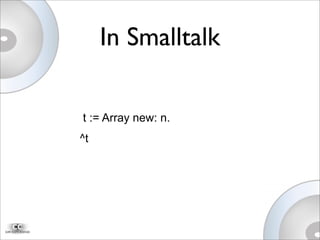
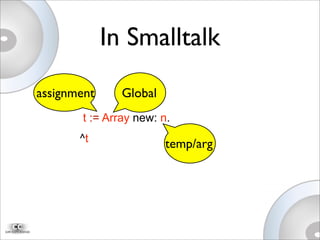
In Smalltalk
t := Array new: n.
^t
In Smalltalk
t := Array new: n.
^t
In Smalltalk
t := Array new: n.
^t
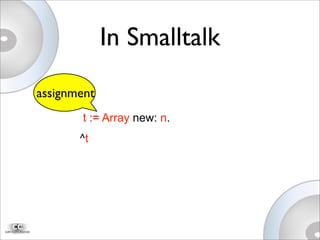
assignment
In Smalltalk
t := Array new: n.
^t
Globalassignment
In Smalltalk
t := Array new: n.
^t
Global
temp/arg
assignment
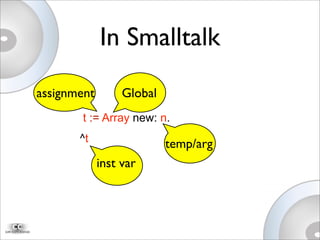
In Smalltalk
t := Array new: n.
^t
Global
inst var
temp/arg
assignment
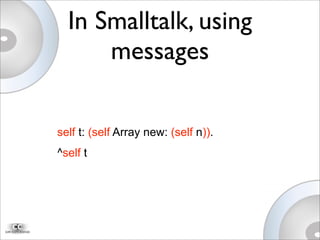
In Smalltalk, using
messages
self t: (self Array new: (self n)).
^self t
In Smalltalk, using
messages
self t: (self Array new: (self n)).
^self t
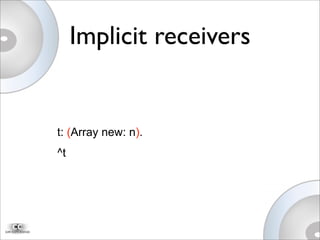
Implicit receivers
t: (Array new: n).
^t
In Newspeak
t:: Array new: n.
^t
In Smalltalk, using
messages
self t: (self Array new: (self n)).
^self t
In Smalltalk
t := Array new: n.
^t
inst var
Representation
Independence
No code depends on our choice of
storage representation
Clients never depended on it in Smalltalk
Now subclasses don’t depend on it either
Even the class itself doesn’t
In Smalltalk
t := Array new: n.
^t
Global
No Static
No globals, no class variables, no pool
variables of any kind; no class instance
variables
Good for
Distribution
Re-entrancy
Testing
Startup
Memory management
Security
No Static
Goals
Modularity
Security
Interoperability
Object-capability model (Miller06)
Object reachability defines authority
No static state
No Ambient Authority
Objects as Capabilities
Object-capability model (Miller06)
Object reachability defines authority
No static state
No Ambient Authority
Access control
Objects as Capabilities
Access Control
In Smalltalk, the only means of data hiding
are instance variables & blocks
Messages are always public
If everything is a message send, everything is
public
Public, protected and private messages
Mirror based Reflection
Mirrors act as capabilities for reflection
Availability of reflection can be controlled
For security
For deployment
Where does the state go?
No Static State
No Static State
How do different objects
conveniently share state?
No Static State
How do different objects
conveniently share state?
Via shared lexical scope
Nested Classes
Nested as in Beta, not as in
Java
Great for Modeling
Natural Modularity Solution
Goals
Modularity
Security
Interoperability
No References to Classes
Always use accessors
Classes are first class objects
Classes are always virtual
Classes are always mixins
Class hierarchy inheritance
External Dependencies
are Explicit
Module definition = Class not nested within
another class
No access to surrounding namespace
All names locally declared or inherited
Modules are Sandboxes
Factory method parameters are objects/
capabilities that determine per-module sandbox
Side by Side
Module definitions are instantiated into
stateful objects known as modules
Easy to create multiple instances, with
different parameters
Modules are Re-entrant
Module definitions are deeply immutable
Modules cannot step on each other’s state
Multiple Implementations
Modules are objects, accessed via their
protocol
Different implementations can co-exist
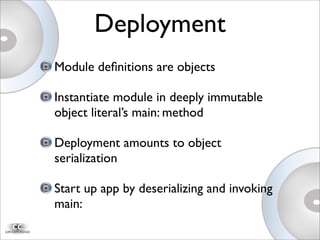
Module definitions are objects
Instantiate module in deeply immutable
object literal’s main: method
Deployment amounts to object
serialization
Start up app by deserializing and invoking
main:
Deployment
Goals
Modularity
Security
Interoperability
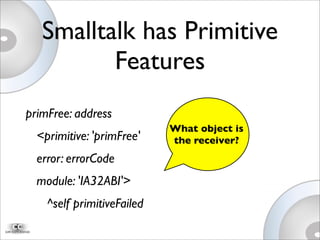
Smalltalk has Primitive
Features
Alberto Salguero
primFree: address
<primitive: 'primFree'
error: errorCode
module: 'IA32ABI'>

 ^self primitiveFailed
Smalltalk has Primitive
Features
Alberto Salguero
primFree: address
<primitive: 'primFree'
error: errorCode
module: 'IA32ABI'>

 ^self primitiveFailed
Smalltalk has Primitive
Features
primFree: address
<primitive: 'primFree'
error: errorCode
module: 'IA32ABI'>

 ^self primitiveFailed
Are you proud when
you explain this to a
non-Smalltalker?
Smalltalk has Primitive
Features
primFree: address
<primitive: 'primFree'
error: errorCode
module: 'IA32ABI'>

 ^self primitiveFailed
What object is
the receiver?
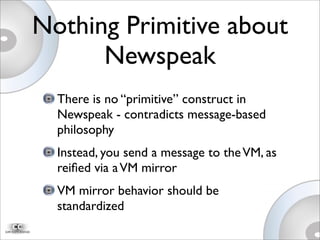
Nothing Primitive about
Newspeak
There is no “primitive” construct in
Newspeak - contradicts message-based
philosophy
Instead, you send a message to theVM, as
reified via aVM mirror
VM mirror behavior should be
standardized
Primitives & Foreign calls
In many languages, primitives are just
foreign calls
These notions are distinct
Primitives do not need to worry about
marshaling
Assumption thatVM is in another language is
inappropriate
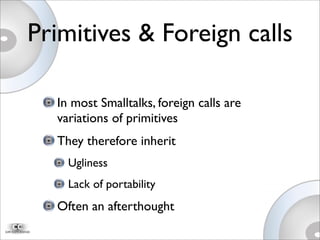
Primitives & Foreign calls
In most Smalltalks, foreign calls are
variations of primitives
They therefore inherit
Ugliness
Lack of portability
Often an afterthought
Aliens
In Newspeak, calling out is achieved by
sending messages to alien objects
You can send blocks as arguments to
implement call backs
Different alien libraries can support
different languages
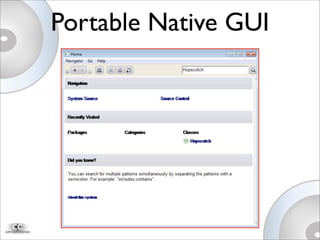
Portable Native GUI
The Age of the Net
Cloud Computing
The Age of the Net
Cloud Computing
The Age of the Net
Cloud Computing
Software delivery and maintenance over
the net
Javascript is the assembly language of the
internet, browser is the OS
The Age of the Net
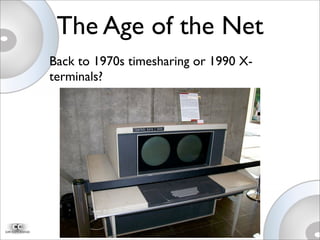
Back to 1970s timesharing or 1990 X-
terminals?
System software has to be local
UI issues
Depend on Reliable, Fast, Cheap Network
Make you “reboot” - it’s called: session
expired
Web Apps have Downsides
Combine advantages of web services and
traditional client applications
Always Available (even w/o network)
Always Up to date
Run locally, think globally
Restart-free
Network Serviced
Applications
Maintains software and data on server
Provides backup, audit trail, software
distribution & maintenance
Software distributed and updated when
client syncs with server
Client can run offline using locally cached
software and data
Sync does not imply application restart
Network Software Service
Hotswapping: Running applications can be
updated on-the-fly over the network
Modules: well defined units of deployment
and update
Security: Object capability model
Orthogonal Synchronization: Natural
update of program and data*
Platform Support for Network
Serviced Applications
Work in Progress
Expect some tweaks to syntax and
semantics
Implementation still incomplete -
especially libraries
Working toward public release
to be open sourced under Apache 2.0 license
Status
Libraries
System issues: Linux & Mac Native GUI,
FFI refinements
Concurrency: value types, actors
Orthogonal synchronization
Object literals, Metadata,Access control,
Pluggable Types
Future Work
Message-based programming
Component style modularity
Virtual classes, mixins, class hierarchy
inheritance
Object capability model and security
Synergy
Mirror based reflection
Actor style concurrency
Pluggable types
Synergy
Credits
Peter Ahe
Vassili Bykov
Yaron Kashai
Eliot Miranda (emeritus)
This file is licensed under the Creative Commons
Attribution ShareAlike 3.0 License. In short: you are
free to share and make derivative works of the file
under the conditions that you appropriately attribute
it, and that you distribute it only under a license
identical to this one. Official license.
The original Australopithecus skull image on slides
38/39 is the work of Albert Salguero and was
licensed under a very similar license (version 2.5 of
this license).
The Newspeak eye used in the bullets, slide
background etc. was designed by Victoria Bracha
and is used by permission.

Newspeak: Evolving Smalltalk for the Age of the Net