How are games consumed?
Gaming consumption
Gaming has changed from the days of coin-op arcades.
How we consume gaming products comes in a variety of
different ways, here are some to consider:
• Merchandise: t-shirts, Rockstar’s more unusual items
• Cosplay
• Fanfiction and Fanart
• E-sports
• Machinima
• Modding – Rockstar had a great beneficial relationship
   with their fans – right up until the Hot Coffee
   controversy which changed everything!
Merchandise
You only have to flick through the poster racks of
HMV to see that videogames merchanise is
everywhere. From Angry Birds selling 10 million
plush soft toys last year, to more extravegent –
replica samarai swords from Japanese
roleplaying games (RPGs)
Rockstar Games are particularly savvy with their
merchandise – Remember: For them their brand
is as much about style as it is about the product.
Merchandise
Cosplay
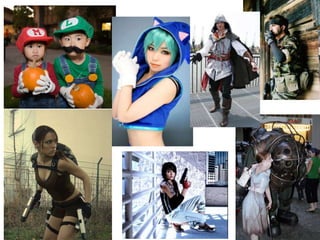
• Cosplay short for "costume play“ is a type of
  performance art in which participants don
  costumes and accessories to represent a
  specific character.
E-sports
• Electronic sports (or E-sports) comprises the competitive
  play of video games.
• Other terms include competitive gaming, professional
  gaming, e-sport, and cybersport. The most common video
  game genres associated with electronic sports are real-time
  strategy (RTS), fighting, first-person shooter
  (FPS), massively-multiplayer online (MMOG), and racing.
• Games are played competitively at amateur, semi-
  professional and professional levels, and some games have
  organized competition in the form of leagues and
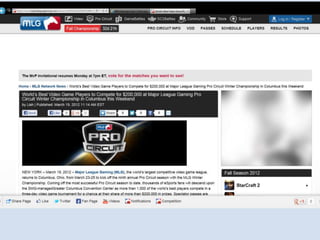
  tournaments. Events such as Major League Gaming
  (MLG), Global Starcraft II League (GSL), World Cyber Games
  (WCG), Dreamhack, and Intel Extreme Masters provide
  both real-time casting of streamed games, and cash prizes
  to the winners.
Machinima
Machinima (muh-sheen-eh-mah) is filmmaking within a real-
time, 3D virtual environment, often using 3D video-game
technologies.
In an expanded definition, it is the convergence of filmmaking,
animation and game development. Machinima is real-world
filmmaking techniques applied within an interactive virtual
space where characters and events can be either controlled by
humans, scripts or artificial intelligence.
By combining the techniques of filmmaking, animation
production and the technology of real-time 3D game engines,
Machinima makes for a very cost- and time-efficient way to
produce films, with a large amount of creative control.
Machinima
Machinima (muh-sheen-eh-mah) is filmmaking within a real-
time, 3D virtual environment, often using 3D video-game
technologies.
In an expanded definition, it is the convergence of filmmaking,
animation and game development. Machinima is real-world
filmmaking techniques applied within an interactive virtual
space where characters and events can be either controlled by
humans, scripts or artificial intelligence.
By combining the techniques of filmmaking, animation
production and the technology of real-time 3D game engines,
Machinima makes for a very cost- and time-efficient way to
produce films, with a large amount of creative control.
Machinima
Examples include Call of Duty gameplay videos
Halo 3 had built in machinima recording software
Games often feature cinematic camera angles and
graphics – particularly in cut scenes: sections in a
game where the player is not in control but ‘movie’
like scenes to provide context and explanation of
player motivations
Rockstar Games that have resulted in machinima
include GTA and Red Dead Redemption
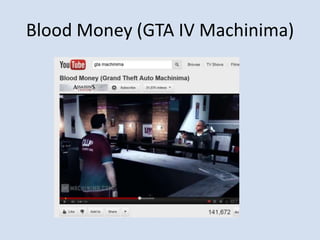
Blood Money (GTA IV Machinima)
Modding
Mod or modification is a term generally applied to
PC, especially first-person shooters, role-playing games and
real-time strategy games.
Mods are made by the general public or a developer and can
be entirely new games in themselves, but mods are not stand-
alone software and require the user to have the original
release in order to run. They can include new
items, weapons, characters, enemies, models, textures, levels,
 story lines, music, and game modes. They also usually take
place in unique locations. They can be single-player or
multiplayer. Mods that add new content to the underlying
game are often called partial conversions, while mods that
create an entirely new game are called total conversions and
mods that fix bugs are called unofficial patches.
Modding
Mod or modification is a term generally applied
to PC, especially first-person shooters, role-
playing games and real-time strategy games.
Mods are made by the general public or a
developer and can be entirely new games in
themselves, but mods are not stand-alone
software and require the user to have the
original release in order to run.
Modding
They can include new
items, weapons, characters, enemies, models, te
xtures, levels, story lines, music, and game
modes. They also usually take place in unique
locations. They can be single-player or
multiplayer. Mods that add new content to the
underlying game are often called partial
conversions, while mods that create an entirely
new game are called total conversions and mods
that fix bugs are called unofficial patches.
Modding
The Internet provides an inexpensive medium to
promote and distribute mods, and they have
become an increasingly important factor in the
commercial success of some games.
Developers such as Blizzard Entertainment, id
Software, Valve Software, Bethesda Softworks,
Firaxis, Crytek, The Creative Assembly and Epic
Games provide extensive tools and documentation
to assist mod makers, leveraging the potential
success brought in by a popular mod like Counter-
Strike.
Modding
Considering our focus on Rockstar Games, the most
important mod in recent history is the 2005 Hot Coffee
mod for Grand Theft Auto: San Andreas.
TASK: Research the answers to the following questions.
The more detail the better for your research. You will
need to look at more than one source for this.
1. What was the Hot Coffee mod?
2. How did the mod affect San Andreas’s age rating?
3. What was the impact for each of the stakeholders:
   The developers, the publishers, the platform holder
   and the consumer?

8 consumption

  • 1.
    How are gamesconsumed?
  • 2.
    Gaming consumption Gaming haschanged from the days of coin-op arcades. How we consume gaming products comes in a variety of different ways, here are some to consider: • Merchandise: t-shirts, Rockstar’s more unusual items • Cosplay • Fanfiction and Fanart • E-sports • Machinima • Modding – Rockstar had a great beneficial relationship with their fans – right up until the Hot Coffee controversy which changed everything!
  • 3.
    Merchandise You only haveto flick through the poster racks of HMV to see that videogames merchanise is everywhere. From Angry Birds selling 10 million plush soft toys last year, to more extravegent – replica samarai swords from Japanese roleplaying games (RPGs) Rockstar Games are particularly savvy with their merchandise – Remember: For them their brand is as much about style as it is about the product.
  • 4.
  • 6.
    Cosplay • Cosplay shortfor "costume play“ is a type of performance art in which participants don costumes and accessories to represent a specific character.
  • 9.
    E-sports • Electronic sports(or E-sports) comprises the competitive play of video games. • Other terms include competitive gaming, professional gaming, e-sport, and cybersport. The most common video game genres associated with electronic sports are real-time strategy (RTS), fighting, first-person shooter (FPS), massively-multiplayer online (MMOG), and racing. • Games are played competitively at amateur, semi- professional and professional levels, and some games have organized competition in the form of leagues and tournaments. Events such as Major League Gaming (MLG), Global Starcraft II League (GSL), World Cyber Games (WCG), Dreamhack, and Intel Extreme Masters provide both real-time casting of streamed games, and cash prizes to the winners.
  • 13.
    Machinima Machinima (muh-sheen-eh-mah) isfilmmaking within a real- time, 3D virtual environment, often using 3D video-game technologies. In an expanded definition, it is the convergence of filmmaking, animation and game development. Machinima is real-world filmmaking techniques applied within an interactive virtual space where characters and events can be either controlled by humans, scripts or artificial intelligence. By combining the techniques of filmmaking, animation production and the technology of real-time 3D game engines, Machinima makes for a very cost- and time-efficient way to produce films, with a large amount of creative control.
  • 14.
    Machinima Machinima (muh-sheen-eh-mah) isfilmmaking within a real- time, 3D virtual environment, often using 3D video-game technologies. In an expanded definition, it is the convergence of filmmaking, animation and game development. Machinima is real-world filmmaking techniques applied within an interactive virtual space where characters and events can be either controlled by humans, scripts or artificial intelligence. By combining the techniques of filmmaking, animation production and the technology of real-time 3D game engines, Machinima makes for a very cost- and time-efficient way to produce films, with a large amount of creative control.
  • 15.
    Machinima Examples include Callof Duty gameplay videos Halo 3 had built in machinima recording software Games often feature cinematic camera angles and graphics – particularly in cut scenes: sections in a game where the player is not in control but ‘movie’ like scenes to provide context and explanation of player motivations Rockstar Games that have resulted in machinima include GTA and Red Dead Redemption
  • 16.
    Blood Money (GTAIV Machinima)
  • 17.
    Modding Mod or modificationis a term generally applied to PC, especially first-person shooters, role-playing games and real-time strategy games. Mods are made by the general public or a developer and can be entirely new games in themselves, but mods are not stand- alone software and require the user to have the original release in order to run. They can include new items, weapons, characters, enemies, models, textures, levels, story lines, music, and game modes. They also usually take place in unique locations. They can be single-player or multiplayer. Mods that add new content to the underlying game are often called partial conversions, while mods that create an entirely new game are called total conversions and mods that fix bugs are called unofficial patches.
  • 18.
    Modding Mod or modificationis a term generally applied to PC, especially first-person shooters, role- playing games and real-time strategy games. Mods are made by the general public or a developer and can be entirely new games in themselves, but mods are not stand-alone software and require the user to have the original release in order to run.
  • 19.
    Modding They can includenew items, weapons, characters, enemies, models, te xtures, levels, story lines, music, and game modes. They also usually take place in unique locations. They can be single-player or multiplayer. Mods that add new content to the underlying game are often called partial conversions, while mods that create an entirely new game are called total conversions and mods that fix bugs are called unofficial patches.
  • 20.
    Modding The Internet providesan inexpensive medium to promote and distribute mods, and they have become an increasingly important factor in the commercial success of some games. Developers such as Blizzard Entertainment, id Software, Valve Software, Bethesda Softworks, Firaxis, Crytek, The Creative Assembly and Epic Games provide extensive tools and documentation to assist mod makers, leveraging the potential success brought in by a popular mod like Counter- Strike.
  • 21.
    Modding Considering our focuson Rockstar Games, the most important mod in recent history is the 2005 Hot Coffee mod for Grand Theft Auto: San Andreas. TASK: Research the answers to the following questions. The more detail the better for your research. You will need to look at more than one source for this. 1. What was the Hot Coffee mod? 2. How did the mod affect San Andreas’s age rating? 3. What was the impact for each of the stakeholders: The developers, the publishers, the platform holder and the consumer?