The Malegaon High School & Jr. College
Malegaon, (Nashik), 423203
7th Lecture on Electrochemistry
Chemistry Part I, 12th Science
By
Rizwana Mohammad
Lead storage battery (lead accumulator):
Lead accumulator stores electrical energy due to regeneration of original
reactants during recharging.
It functions as galvanic cell and as electrolytic cell, as well.
Construction:
• A group of lead plates packed with spongy lead serves as anode (-).
Another group of lead plates bearing lead dioxide (PbO2) serves as
cathode (+)
• The electrodes are immersed in an electrolytic aqueous solution of 38%
(by mass) of sulphuric acid of density 1.2 g/mL.
Notation of the cell:
Pb(s) | PbSO4(s) | 38% H₂SO4(aq) | PbSO4(s) | PbO2(s) | Pb(s)
a. Cell reaction during discharge:
i. Oxidation at anode (-):
Pb(s) → Pb+2 + 2e- (oxidation)
Pb+2
(aq) + SO4
-2
(aq) → PbSO4(s) (precipitation)
Pb(s) + SO4
-2
(aq) → PbSO4(s) +2e- overall reaction
ii. Reduction at cathode (+):
PbO2(s) + 4H+
(aq) + 2e- → Pb+2
(aq) + 2H2O(l) (reduction)
Pb+2
(aq) + SO4
-2
(aq) → PbSO4(s) (precipitation)
PbO2(s) + 4H+
(aq) + SO4
-2
(aq) + 2e- → PbSO4(s) + 2H2O(l) (overall reaction)
iii. Net cell reaction during discharge:
Pb(s) + PbO2(s) + 4H+
(aq) + 2SO4
-2
(aq) → 2PbSO4(s) + 2H2O(l)
Or
Pb(s) + PbO2(s) + 2H2SO4(aq) → 2PbSO4(s) + 2H2O(l)
b. Cell reactions during recharging:
• The potential of lead accumulator is 2V.
• It must be recharged with the falling of the cell potential to 1.8V.
• To recharge the cell, external potential slightly greater than 2V
needs to be applied across the electrodes.
• During recharging the cell functions as electrolytic cell.
• The anode and cathode are interchanged with PbO2 electrode being
anode (+) and lead electrode cathode (-).
i. Oxidation at anode (+):
PbSO4(s) + 2H2O(l) → PbO2(s) + 4H+
(aq) + SO4
-2
(aq) + 2e-
ii. Reduction at cathode (-):
PbSO4(s) + 2e- → Pb(s) + SO4
-2
(aq)
iii. Net cell reaction:
PbSO4(s) + 2H2O(l) → Pb(s) + PbO2(s) + 2H2SO4(aq)
Applications of lead accumulator:
i. It is used as a source of direct current in the laboratory
ii. A 12V lead storage battery constructed by connecting six 2V cells
in series is used in automobiles and inverters.
Nickel-Cadmium or NICAD storage cell:
It is a secondary dry cell, and can be recharged.
• Anode of cell is cadmium metal, cathode is nickel (IV) oxide, NiO2
supported on Ni. The electrolyte solution is basic.
• The electrode reactions and overall cell reaction are as follows:
Cd(s) + 2OH-
(aq) → Cd(OH)2(s) + 2e- (anodic oxidation)
NiO2(s) + 2H2O(l) + 2e- → Ni(OH)2(s) + 2OH-
(aq) (cathodic reduction)
Cd(s) + NiO2(s) + 2H2O(l) → Cd(OH)2(s) + Ni(OH)2(s) overall cell reaction
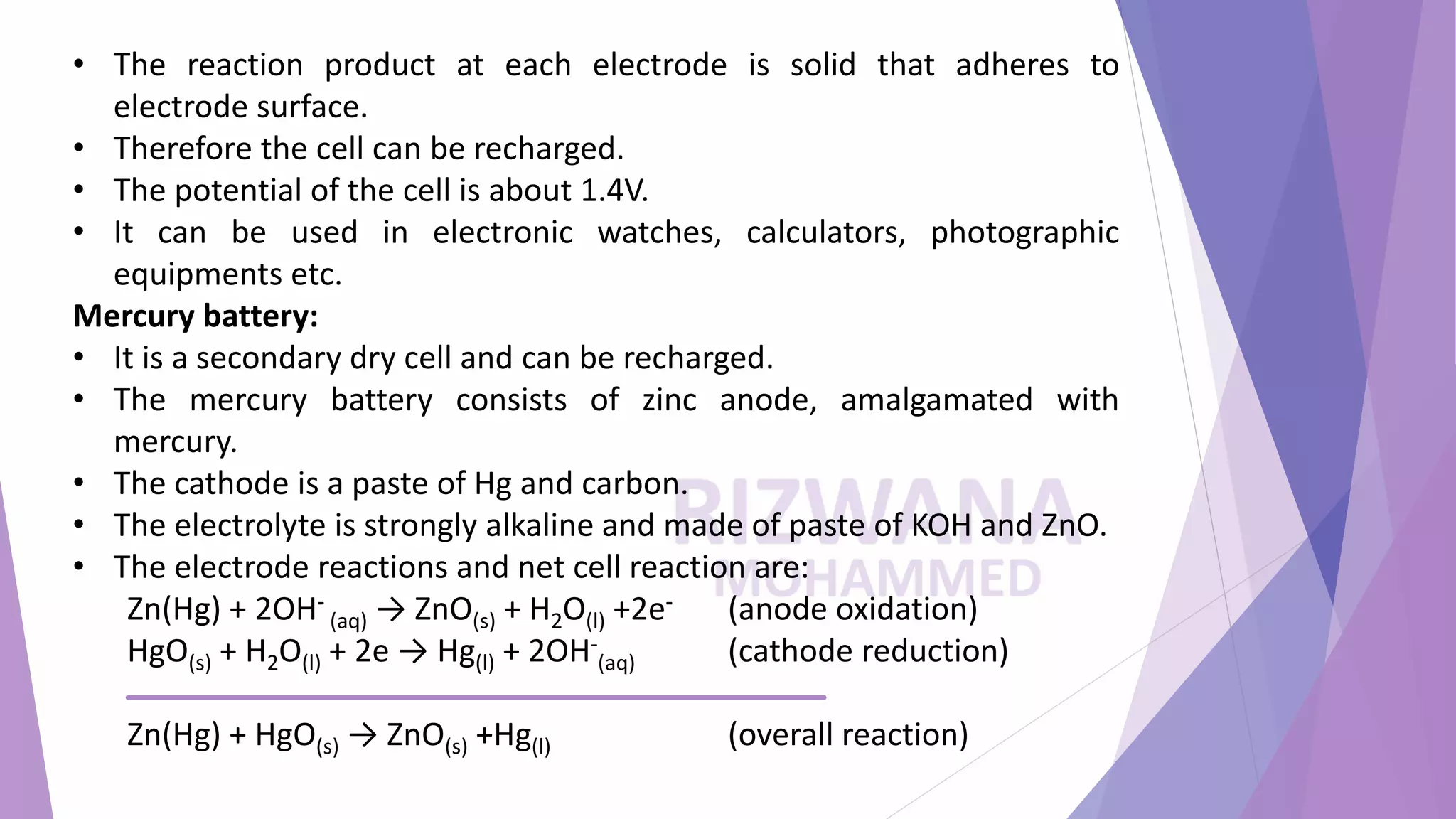
• The reaction product at each electrode is solid that adheres to
electrode surface.
• Therefore the cell can be recharged.
• The potential of the cell is about 1.4V.
• It can be used in electronic watches, calculators, photographic
equipments etc.
Mercury battery:
• It is a secondary dry cell and can be recharged.
• The mercury battery consists of zinc anode, amalgamated with
mercury.
• The cathode is a paste of Hg and carbon.
• The electrolyte is strongly alkaline and made of paste of KOH and ZnO.
• The electrode reactions and net cell reaction are:
Zn(Hg) + 2OH-
(aq) → ZnO(s) + H2O(l) +2e- (anode oxidation)
HgO(s) + H2O(l) + 2e → Hg(l) + 2OH-
(aq) (cathode reduction)
Zn(Hg) + HgO(s) → ZnO(s) +Hg(l) (overall reaction)
• The overall reaction involves only solid substances.
• There is no change in electrolyte composition during operation.
• The mercury battery therefore, provides more constant voltage
(1.35V) than the Leclanche dry cell.
• It also has considerably higher capacity and longer life than dry cell.
• It is used in hearing aids, electric watches, pacemakers etc.

7th Lecture on Electrochemistry | Chemistry Part I | 12th Std

  • 1.
    The Malegaon HighSchool & Jr. College Malegaon, (Nashik), 423203 7th Lecture on Electrochemistry Chemistry Part I, 12th Science By Rizwana Mohammad
  • 2.
    Lead storage battery(lead accumulator): Lead accumulator stores electrical energy due to regeneration of original reactants during recharging. It functions as galvanic cell and as electrolytic cell, as well. Construction: • A group of lead plates packed with spongy lead serves as anode (-). Another group of lead plates bearing lead dioxide (PbO2) serves as cathode (+) • The electrodes are immersed in an electrolytic aqueous solution of 38% (by mass) of sulphuric acid of density 1.2 g/mL. Notation of the cell: Pb(s) | PbSO4(s) | 38% H₂SO4(aq) | PbSO4(s) | PbO2(s) | Pb(s)
  • 3.
    a. Cell reactionduring discharge: i. Oxidation at anode (-): Pb(s) → Pb+2 + 2e- (oxidation) Pb+2 (aq) + SO4 -2 (aq) → PbSO4(s) (precipitation) Pb(s) + SO4 -2 (aq) → PbSO4(s) +2e- overall reaction ii. Reduction at cathode (+): PbO2(s) + 4H+ (aq) + 2e- → Pb+2 (aq) + 2H2O(l) (reduction) Pb+2 (aq) + SO4 -2 (aq) → PbSO4(s) (precipitation) PbO2(s) + 4H+ (aq) + SO4 -2 (aq) + 2e- → PbSO4(s) + 2H2O(l) (overall reaction) iii. Net cell reaction during discharge: Pb(s) + PbO2(s) + 4H+ (aq) + 2SO4 -2 (aq) → 2PbSO4(s) + 2H2O(l) Or Pb(s) + PbO2(s) + 2H2SO4(aq) → 2PbSO4(s) + 2H2O(l)
  • 4.
    b. Cell reactionsduring recharging: • The potential of lead accumulator is 2V. • It must be recharged with the falling of the cell potential to 1.8V. • To recharge the cell, external potential slightly greater than 2V needs to be applied across the electrodes. • During recharging the cell functions as electrolytic cell. • The anode and cathode are interchanged with PbO2 electrode being anode (+) and lead electrode cathode (-). i. Oxidation at anode (+): PbSO4(s) + 2H2O(l) → PbO2(s) + 4H+ (aq) + SO4 -2 (aq) + 2e- ii. Reduction at cathode (-): PbSO4(s) + 2e- → Pb(s) + SO4 -2 (aq) iii. Net cell reaction: PbSO4(s) + 2H2O(l) → Pb(s) + PbO2(s) + 2H2SO4(aq)
  • 5.
    Applications of leadaccumulator: i. It is used as a source of direct current in the laboratory ii. A 12V lead storage battery constructed by connecting six 2V cells in series is used in automobiles and inverters. Nickel-Cadmium or NICAD storage cell: It is a secondary dry cell, and can be recharged. • Anode of cell is cadmium metal, cathode is nickel (IV) oxide, NiO2 supported on Ni. The electrolyte solution is basic. • The electrode reactions and overall cell reaction are as follows: Cd(s) + 2OH- (aq) → Cd(OH)2(s) + 2e- (anodic oxidation) NiO2(s) + 2H2O(l) + 2e- → Ni(OH)2(s) + 2OH- (aq) (cathodic reduction) Cd(s) + NiO2(s) + 2H2O(l) → Cd(OH)2(s) + Ni(OH)2(s) overall cell reaction
  • 6.
    • The reactionproduct at each electrode is solid that adheres to electrode surface. • Therefore the cell can be recharged. • The potential of the cell is about 1.4V. • It can be used in electronic watches, calculators, photographic equipments etc. Mercury battery: • It is a secondary dry cell and can be recharged. • The mercury battery consists of zinc anode, amalgamated with mercury. • The cathode is a paste of Hg and carbon. • The electrolyte is strongly alkaline and made of paste of KOH and ZnO. • The electrode reactions and net cell reaction are: Zn(Hg) + 2OH- (aq) → ZnO(s) + H2O(l) +2e- (anode oxidation) HgO(s) + H2O(l) + 2e → Hg(l) + 2OH- (aq) (cathode reduction) Zn(Hg) + HgO(s) → ZnO(s) +Hg(l) (overall reaction)
  • 7.
    • The overallreaction involves only solid substances. • There is no change in electrolyte composition during operation. • The mercury battery therefore, provides more constant voltage (1.35V) than the Leclanche dry cell. • It also has considerably higher capacity and longer life than dry cell. • It is used in hearing aids, electric watches, pacemakers etc.