<< 103 >>
Class: 7
Week(s)
Unit /
Lesson Learning outcome(s)
Teacher
Activities by
Student
References
Physical Digital
Individual Group
Lesson-wise Plan - 2021-22
1 & 2 Food for
health.
The students will be able to ...
• state the components of
food.
• classify the components of
food.
• conduct experiments to
identify the food components.
• define balanced diet and
malnutrition.
• give examples for deficiency
diseases due to malnutrition.
• apply healthy lifestyle con-
cept in daily life.
1. Introduction
2. Components of
Food
3. Carbohydrates
4. Proteins
5. Fats
6. Minerals &
Vitamins
7. Dietary fibres
8. Water
9. Balanced diet
10. Healthy
lifestyle
Do the
activities in
the text book
page no. 4&
12 &14 &18
& 20 &22
Do the Lab
activities in
the text book
page 6&10
Prepare a
model of as a
Group
activity.
Participate in
the activity in
text book
page no. 14
• APSCERT
text book
Food items
• Dikshavideos
You tube
videos
Google
search
3 & 4 Nature of
substances
The students will be able to ...
• differentiate acids, bases and
neutral substances.
• conduct simple investigations
to find out natural indicators.
• write word equations for
chemical reactions.
• suggest the concept of neu-
tralization in daily life expe-
riences.
• conduct experiments to know
pH of different substances
and acid base reactions
• participate in field visit to
investigate pH of soils
1. Acids
2. Bases
3. Neutral sub-
stance
4. Acid Base
Indicators
5. pH of sub-
stances
6. Reaction of
acids with
metals
7. Reaction of
bases with
metals
Do the
activities in
the text book
page no. 36 &
38 & 42 & 48
& 52 & 54
&58.
Do the Lab
activity 1& 2.
pg. no. 44 &
50 as a Group
activity.
Participate in
the project
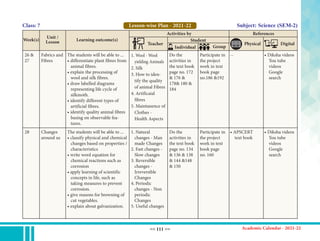
work in text
book page
no. 68 Soap
making.
• APSCERT
text book P.H
papers,
Natural
indicators,
Acids, bases
• Diksha videos
You tube
videos
Google
search
Subject: Science (SEM-1)
<< 104 >>
Week(s)
Unit /
Lesson Learning outcome(s)
Class: 7
Teacher
Activities by
Student
References
Physical Digital
Individual Group
Lesson-wise Plan - 2021-22
• appreciate the role of neu-
tralization in daily life
problems solving.
• apply the management and
misuse of substances con-
cepts in daily life.
8. Reaction of
dilute sulphu-
ric acid with
egg shell
9. Neutralization
Reaction
10. Uses of acids
and bases in
our daily life
11. Soap making
12. Precautions
to be taken
while handling
chemicals
5, 6 &
7
Nutrition
in organ-
isms
The students will be able to ...
• classify organisms based on
types of nutrition.
• conduct simple investigations
to know that whether leaves
other than green also carry
out Photosynthesis?
• identify different types of
teeth and their functions.
• explain process and phenom-
ena of organs and systems of
Nutrition in organisms.
• draw labelled diagrams/
flowcharts of human diges-
tive system.
1. Modes of
Nutrition
2. Autotrophic
nutrition in
plants
3. Essential raw
material in
photosynthesis
4. Saprophytic
Nutrition
5. Parasitic
Nutrition
6. Holozoic
Nutrition
Do the
activities in
the text book
page no. 70 &
80& 86 & 88
Participate in
the project
work in text
book page
no. 96.
Participate in
the Lab
activities in
text book
page number
76
• APSCERT
text book
Leaf t.s
model
Chloroplast
model
• Diksha videos
You tube
videos
Google
search
Subject: Science (SEM-1)
<< 105 >>
Class: 7
Week(s)
Unit /
Lesson Learning outcome(s)
Teacher
Activities by
Student
References
Physical Digital
Individual Group
Lesson-wise Plan - 2021-22
• construct models and ex-
plains their working.
• apply learned scientific
concepts in day-to- day life
such as dealing with acidity.
7. Nutrition in
Amoeba
8. Nutrition in
Human beings
8 & 9 Respiration
and circu-
lation
The students will be able to ...
• explain process and phenom-
enon of respiration in hu-
mans and plants.
• measure and calculate rate of
breathing and heart- beat.
• draw labelled diagrams and
pathway of respiration in
humans.
• construct model stethoscope
using materials from sur-
roundings and gets hands-on
experience to test it's working.
• improve their awareness and
feel the social resposibility
towards day to day happen-
ings around them.
• learn first-aid procedures for
drowning, chocking and
bleeding.
1. Breathing
2. Respiration in
human beings
3. Our Breath
contains Pre-
vention and
management of
substance
misuse - to-
bacco (SHP)
4. Breathing in
other animals
5. Respiration in
Plants
6. Blood circula-
tory system in
humans, Hu-
man blood
7. Blood in other
organisms
Do the
activities in
the text book
pg. no. 100,
104, 106 &
114
Participate in
the project
work in text
book page
no.128
Participate in
the activity in
text book no
112
• APSCERT
text book
Aquarium
Terrarium
• Diksha videos
You tube
videos
Google
search
Subject: Science (SEM-1)
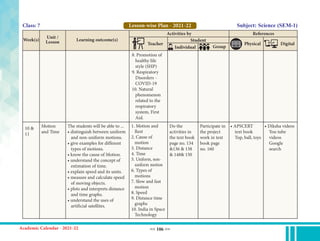
<< 106 >>
Week(s)
Unit /
Lesson Learning outcome(s)
Class: 7
Teacher
Activities by
Student
References
Physical Digital
Individual Group
Lesson-wise Plan - 2021-22
8. Promotion of
healthy life
style (SHP)
9. Respiratory
Disorders -
COVID-19
10. Natural
phenomenon
related to the
respiratory
system, First
Aid.
10 &
11
Motion
and Time
The students will be able to ...
• distinguish between uniform
and non-uniform motions.
• give examples for different
types of motions.
• know the cause of Motion.
• understand the concept of
estimation of time.
• explain speed and its units.
• measure and calculate speed
of moving objects.
• plots and interprets distance
and time graphs.
• understand the uses of
artificial satellites.
1. Motion and
Rest
2. Cause of
motion
3. Distance
4. Time
5. Uniform, non-
uniform motion
6. Types of
motions
7. Slow and fast
motion
8. Speed
9. Distance time
graphs
10. India in Space
Technology
Do the
activities in
the text book
page no. 134
&136 & 138
& 148& 150
Participate in
the project
work in text
book page
no. 160
• APSCERT
text book
Top, ball, toys
• Diksha videos
You tube
videos
Google
search
Subject: Science (SEM-1)
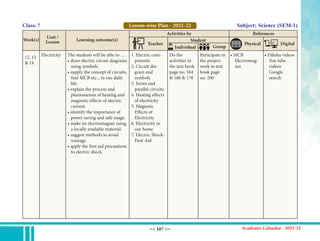
<< 107 >>
Class: 7
Week(s)
Unit /
Lesson Learning outcome(s)
Teacher
Activities by
Student
References
Physical Digital
Individual Group
Lesson-wise Plan - 2021-22
12, 13
& 14
Electricity The students will be able to ...
• draw electric circuit diagrams
using symbols.
• supply the concept of circuits,
fuse MCB etc.., in our daily
life.
• explain the process and
phenomenon of heating and
magnetic effects of electric
current.
• identify the importance of
power saving and safe usage.
• make an electromagnet using
a locally available material.
• suggest methods to avoid
wastage.
• apply the first aid precautions
to electric shock.
1. Electric com-
ponents
2. Circuit dia-
gram and
symbols
3. Series and
parallel circuits
4. Heating effects
of electricity
5. Magnetic
Effects of
Electricity
6. Electricity in
our home
7. Electric Shock-
First Aid
Do the
activities in
the text book
page no. 164
& 166 & 178
Participate in
the project
work in text
book page
no. 200
• MCB
Electromag-
net
• Diksha videos
You tube
videos
Google
search
Subject: Science (SEM-1)
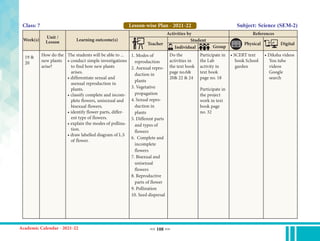
<< 108 >>
Week(s)
Unit /
Lesson Learning outcome(s)
Class: 7
Teacher
Activities by
Student
References
Physical Digital
Individual Group
Lesson-wise Plan - 2021-22
19 &
20
How do the
new plants
arise?
The students will be able to ...
• conduct simple investigations
to find how new plants
arises.
• differentiate sexual and
asexual reproduction in
plants.
• classify complete and incom-
plete flowers, unisexual and
bisexual flowers.
• identify flower parts, differ-
ent type of flowers.
• explain the modes of pollina-
tion.
• draw labelled diagram of L.S
of flower.
1. Modes of
reproduction
2. Asexual repro-
duction in
plants
3. Vegetative
propagation
4. Sexual repro-
duction in
plants
5. Different parts
and types of
flowers
6. Complete and
incomplete
flowers
7. Bisexual and
unisexual
flowers
8. Reproductive
parts of flower
9. Pollination
10. Seed dispersal
Do the
activities in
the text book
page no.6&
20& 22 & 24
Participate in
the Lab
activity in
text book
page no. 18
Participate in
the project
work in text
book page
no. 32
• SCERT text
book School
garden
• Diksha videos
You tube
videos
Google
search
Subject: Science (SEM-2)
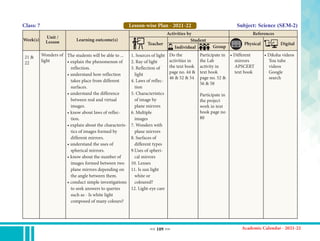
<< 109 >>
Class: 7
Week(s)
Unit /
Lesson Learning outcome(s)
Teacher
Activities by
Student
References
Physical Digital
Individual Group
Lesson-wise Plan - 2021-22
21 &
22
Wonders of
light
The students will be able to ...
• explain the phenomenon of
reflection.
• understand how reflection
takes place from different
surfaces.
• understand the difference
between real and virtual
images.
• know about laws of reflec-
tion.
• explain about the characteris-
tics of images formed by
different mirrors.
• understand the uses of
spherical mirrors.
• know about the number of
images formed between two
plane mirrors depending on
the angle between them.
• conduct simple investigations
to seek answers to queries
such as - Is white light
composed of many colours?
1. Sources of light
2. Ray of light
3. Reflection of
light
4. Laws of reflec-
tion
5. Characteristics
of image by
plane mirrors
6. Multiple
images
7. Wonders with
plane mirrors
8. Surfaces of
different types
9.Uses of spheri-
cal mirrors
10. Lenses
11. Is sun light
white or
coloured?
12. Light-eye care
Do the
activities in
the text book
page no. 44 &
46 & 52 & 54
Participate in
the Lab
activity in
text book
page no. 52 &
56 & 58
Participate in
the project
work in text
book page no
80
• Different
mirrors
APSCERT
text book
• Diksha videos
You tube
videos
Google
search
Subject: Science (SEM-2)
<< 110 >>
Week(s)
Unit /
Lesson Learning outcome(s)
Class: 7
Teacher
Activities by
Student
References
Physical Digital
Individual Group
Lesson-wise Plan - 2021-22 Subject: Science (SEM-2)
23 &
25
Heat,
Tempera-
ture and
Climate
The students will be able to ...
• differentiate materials such
as, conductors and insulators
of heat on the basis of their
properties.
• relate processes and phenom-
ena with causes, example
wind speed with air pressure.
• measure and calculates
temperature.
• construct anemometer model
using materials from sur-
roundings and explainsits
working.
• understand the changes of
climate.
• explain the uses of thermom-
eters.
1. Heat, Tempera-
ture
2. Conductors
3. Modes of
transfer of heat
4. Expansion and
contraction of
substances due
to heat
5. Thermom-
eters-
kinds,uses
6. Hot air is
lighter than
cold air
7. Air exerts
pressure
8. Uneven heat-
ing on earth
9. Weather
10. Climate
11. Importance of
weather and
climate in
12. Living world
Do the
activities in
the text book
page no. 86 &
88 & 90 &96
&106 &108
Participate in
the project
work in text
book page
no. 92 &98 &
112 &128
Collect
images or
newspaper
cuttings and
prepare a
scrap book
• Conductors,
insulaters,
Thermom-
eters
APSCERT
text book
• Diksha videos
You tube
videos
Google
search
<< 111 >>
Class: 7
Week(s)
Unit /
Lesson Learning outcome(s)
Teacher
Activities by
Student
References
Physical Digital
Individual Group
Lesson-wise Plan - 2021-22 Subject: Science (SEM-2)
26 &
27
Fabrics and
Fibres
The students will be able to ...
• differentiate plant fibres from
animal fibres.
• explain the processing of
wool and silk fibres.
• draw labelled diagrams
representing life cycle of
silkmoth.
• identify different types of
artificial fibres.
• identify quality animal fibres
basing on observable fea-
tures.
1. Wool - Wool
yielding Animals
2. Silk
3. How to iden-
tify the quality
of animal Fibres
4. Artificaial
fibres
5. Maintanence of
Clothes -
Health Aspects
Do the
activities in
the text book
page no. 172
& 176 &
178& 180 &
184
Participate in
the project
work in text
book page
no.186 &192
-- • Diksha videos
You tube
videos
Google
search
28 Changes
around us
The students will be able to ...
• classify physical and chemical
changes based on properties /
characteristics
• write word equation for
chemical reactions such as
corrosion
• apply learning of scientific
concepts in life, such as
taking measures to prevent
corrosion.
• give reasons for browning of
cut vegetables.
• explain about galvanization.
1. Natural
changes - Man
made Changes
2. Fast changes -
Slow changes
3. Reversible
changes -
Irreversible
Changes
4. Periodic
changes - Non
periodic
Changes
5. Useful changes
Do the
activities in
the text book
page no. 134
& 136 & 138
& 144 &148
& 150
Participate in
the project
work in text
book page
no. 160
• APSCERT
text book
• Diksha videos
You tube
videos
Google
search
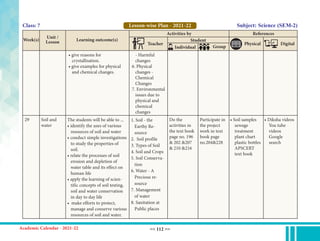
<< 112 >>
Week(s)
Unit /
Lesson Learning outcome(s)
Class: 7
Teacher
Activities by
Student
References
Physical Digital
Individual Group
Lesson-wise Plan - 2021-22 Subject: Science (SEM-2)
• give reasons for
crystallisation.
• give examples for physical
and chemical changes.
- Harmful
changes
6. Physical
changes -
Chemical
Changes
7. Environmental
issues due to
physical and
chemical
changes
29 Soil and
water
The students will be able to ...
• identify the uses of various
resources of soil and water
• conduct simple investigations
to study the properties of
soil.
• relate the processes of soil
erosion and depletion of
water table and its effect on
human life
• apply the learning of scien-
tific concepts of soil testing,
soil and water conservation
in day to day life
• make efforts to protect,
manage and conserve various
resources of soil and water.
1. Soil - the
Earthy Re-
source
2. Soil profile
3. Types of Soil
4. Soil and Crops
5. Soil Conserva-
tion
6. Water - A
Precious re-
source
7. Management
of water
8. Sanitation at
Public places
Do the
activities in
the text book
page no. 196
& 202 &207
& 210 &216
Participate in
the project
work in text
book page
no.204&228
• Soil samples
sewage
treatment
plant chart
plastic bottles
APSCERT
text book
• Diksha videos
You tube
videos
Google
search

7th-CLASS cbse board full detail SCIENCE.pdf

  • 1.
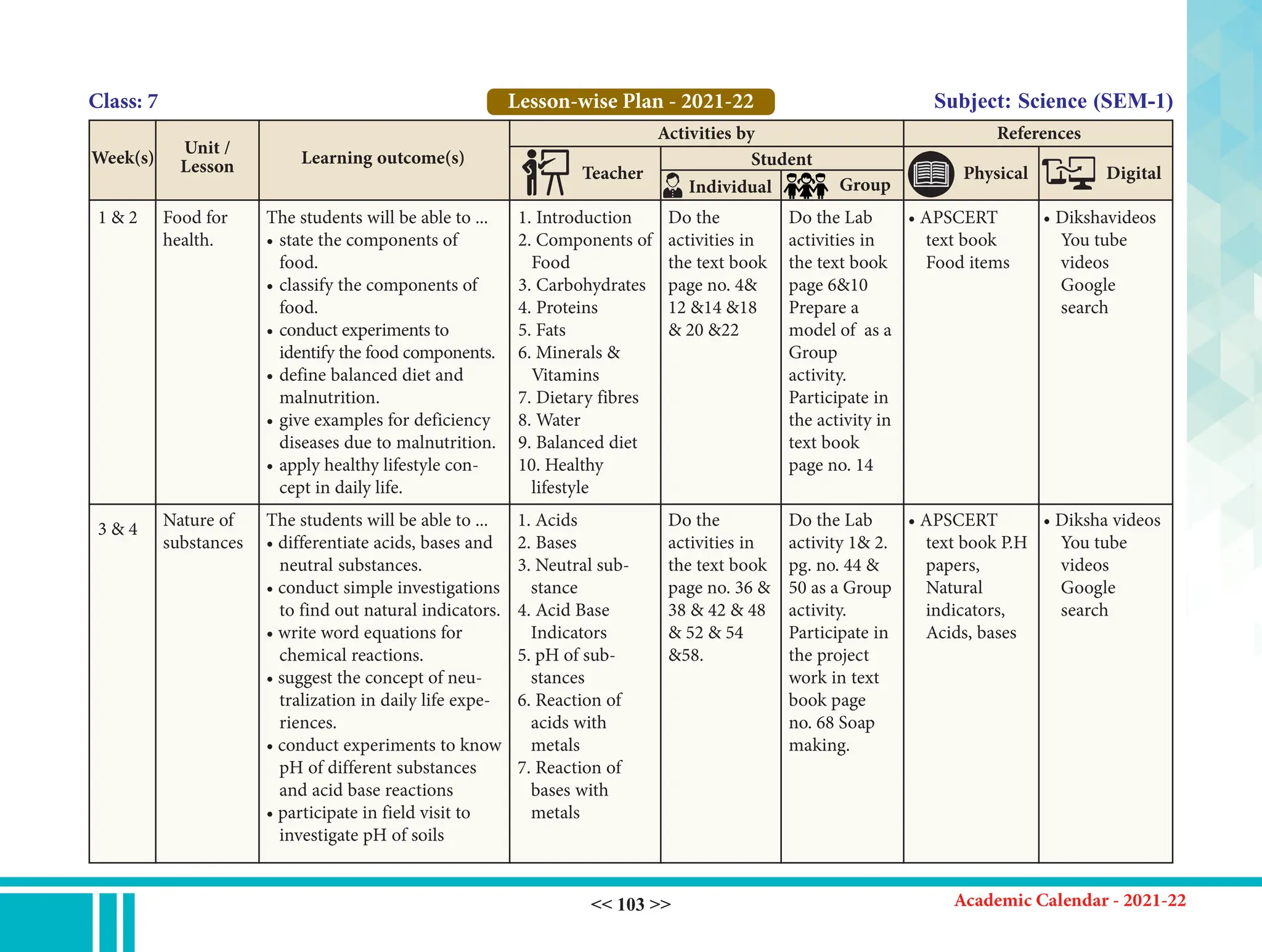
    << 103 >> Class:7 Week(s) Unit / Lesson Learning outcome(s) Teacher Activities by Student References Physical Digital Individual Group Lesson-wise Plan - 2021-22 1 & 2 Food for health. The students will be able to ... • state the components of food. • classify the components of food. • conduct experiments to identify the food components. • define balanced diet and malnutrition. • give examples for deficiency diseases due to malnutrition. • apply healthy lifestyle con- cept in daily life. 1. Introduction 2. Components of Food 3. Carbohydrates 4. Proteins 5. Fats 6. Minerals & Vitamins 7. Dietary fibres 8. Water 9. Balanced diet 10. Healthy lifestyle Do the activities in the text book page no. 4& 12 &14 &18 & 20 &22 Do the Lab activities in the text book page 6&10 Prepare a model of as a Group activity. Participate in the activity in text book page no. 14 • APSCERT text book Food items • Dikshavideos You tube videos Google search 3 & 4 Nature of substances The students will be able to ... • differentiate acids, bases and neutral substances. • conduct simple investigations to find out natural indicators. • write word equations for chemical reactions. • suggest the concept of neu- tralization in daily life expe- riences. • conduct experiments to know pH of different substances and acid base reactions • participate in field visit to investigate pH of soils 1. Acids 2. Bases 3. Neutral sub- stance 4. Acid Base Indicators 5. pH of sub- stances 6. Reaction of acids with metals 7. Reaction of bases with metals Do the activities in the text book page no. 36 & 38 & 42 & 48 & 52 & 54 &58. Do the Lab activity 1& 2. pg. no. 44 & 50 as a Group activity. Participate in the project work in text book page no. 68 Soap making. • APSCERT text book P.H papers, Natural indicators, Acids, bases • Diksha videos You tube videos Google search Subject: Science (SEM-1)
  • 2.
    << 104 >> Week(s) Unit/ Lesson Learning outcome(s) Class: 7 Teacher Activities by Student References Physical Digital Individual Group Lesson-wise Plan - 2021-22 • appreciate the role of neu- tralization in daily life problems solving. • apply the management and misuse of substances con- cepts in daily life. 8. Reaction of dilute sulphu- ric acid with egg shell 9. Neutralization Reaction 10. Uses of acids and bases in our daily life 11. Soap making 12. Precautions to be taken while handling chemicals 5, 6 & 7 Nutrition in organ- isms The students will be able to ... • classify organisms based on types of nutrition. • conduct simple investigations to know that whether leaves other than green also carry out Photosynthesis? • identify different types of teeth and their functions. • explain process and phenom- ena of organs and systems of Nutrition in organisms. • draw labelled diagrams/ flowcharts of human diges- tive system. 1. Modes of Nutrition 2. Autotrophic nutrition in plants 3. Essential raw material in photosynthesis 4. Saprophytic Nutrition 5. Parasitic Nutrition 6. Holozoic Nutrition Do the activities in the text book page no. 70 & 80& 86 & 88 Participate in the project work in text book page no. 96. Participate in the Lab activities in text book page number 76 • APSCERT text book Leaf t.s model Chloroplast model • Diksha videos You tube videos Google search Subject: Science (SEM-1)
  • 3.
    << 105 >> Class:7 Week(s) Unit / Lesson Learning outcome(s) Teacher Activities by Student References Physical Digital Individual Group Lesson-wise Plan - 2021-22 • construct models and ex- plains their working. • apply learned scientific concepts in day-to- day life such as dealing with acidity. 7. Nutrition in Amoeba 8. Nutrition in Human beings 8 & 9 Respiration and circu- lation The students will be able to ... • explain process and phenom- enon of respiration in hu- mans and plants. • measure and calculate rate of breathing and heart- beat. • draw labelled diagrams and pathway of respiration in humans. • construct model stethoscope using materials from sur- roundings and gets hands-on experience to test it's working. • improve their awareness and feel the social resposibility towards day to day happen- ings around them. • learn first-aid procedures for drowning, chocking and bleeding. 1. Breathing 2. Respiration in human beings 3. Our Breath contains Pre- vention and management of substance misuse - to- bacco (SHP) 4. Breathing in other animals 5. Respiration in Plants 6. Blood circula- tory system in humans, Hu- man blood 7. Blood in other organisms Do the activities in the text book pg. no. 100, 104, 106 & 114 Participate in the project work in text book page no.128 Participate in the activity in text book no 112 • APSCERT text book Aquarium Terrarium • Diksha videos You tube videos Google search Subject: Science (SEM-1)
  • 4.
    << 106 >> Week(s) Unit/ Lesson Learning outcome(s) Class: 7 Teacher Activities by Student References Physical Digital Individual Group Lesson-wise Plan - 2021-22 8. Promotion of healthy life style (SHP) 9. Respiratory Disorders - COVID-19 10. Natural phenomenon related to the respiratory system, First Aid. 10 & 11 Motion and Time The students will be able to ... • distinguish between uniform and non-uniform motions. • give examples for different types of motions. • know the cause of Motion. • understand the concept of estimation of time. • explain speed and its units. • measure and calculate speed of moving objects. • plots and interprets distance and time graphs. • understand the uses of artificial satellites. 1. Motion and Rest 2. Cause of motion 3. Distance 4. Time 5. Uniform, non- uniform motion 6. Types of motions 7. Slow and fast motion 8. Speed 9. Distance time graphs 10. India in Space Technology Do the activities in the text book page no. 134 &136 & 138 & 148& 150 Participate in the project work in text book page no. 160 • APSCERT text book Top, ball, toys • Diksha videos You tube videos Google search Subject: Science (SEM-1)
  • 5.
    << 107 >> Class:7 Week(s) Unit / Lesson Learning outcome(s) Teacher Activities by Student References Physical Digital Individual Group Lesson-wise Plan - 2021-22 12, 13 & 14 Electricity The students will be able to ... • draw electric circuit diagrams using symbols. • supply the concept of circuits, fuse MCB etc.., in our daily life. • explain the process and phenomenon of heating and magnetic effects of electric current. • identify the importance of power saving and safe usage. • make an electromagnet using a locally available material. • suggest methods to avoid wastage. • apply the first aid precautions to electric shock. 1. Electric com- ponents 2. Circuit dia- gram and symbols 3. Series and parallel circuits 4. Heating effects of electricity 5. Magnetic Effects of Electricity 6. Electricity in our home 7. Electric Shock- First Aid Do the activities in the text book page no. 164 & 166 & 178 Participate in the project work in text book page no. 200 • MCB Electromag- net • Diksha videos You tube videos Google search Subject: Science (SEM-1)
  • 6.
    << 108 >> Week(s) Unit/ Lesson Learning outcome(s) Class: 7 Teacher Activities by Student References Physical Digital Individual Group Lesson-wise Plan - 2021-22 19 & 20 How do the new plants arise? The students will be able to ... • conduct simple investigations to find how new plants arises. • differentiate sexual and asexual reproduction in plants. • classify complete and incom- plete flowers, unisexual and bisexual flowers. • identify flower parts, differ- ent type of flowers. • explain the modes of pollina- tion. • draw labelled diagram of L.S of flower. 1. Modes of reproduction 2. Asexual repro- duction in plants 3. Vegetative propagation 4. Sexual repro- duction in plants 5. Different parts and types of flowers 6. Complete and incomplete flowers 7. Bisexual and unisexual flowers 8. Reproductive parts of flower 9. Pollination 10. Seed dispersal Do the activities in the text book page no.6& 20& 22 & 24 Participate in the Lab activity in text book page no. 18 Participate in the project work in text book page no. 32 • SCERT text book School garden • Diksha videos You tube videos Google search Subject: Science (SEM-2)
  • 7.
    << 109 >> Class:7 Week(s) Unit / Lesson Learning outcome(s) Teacher Activities by Student References Physical Digital Individual Group Lesson-wise Plan - 2021-22 21 & 22 Wonders of light The students will be able to ... • explain the phenomenon of reflection. • understand how reflection takes place from different surfaces. • understand the difference between real and virtual images. • know about laws of reflec- tion. • explain about the characteris- tics of images formed by different mirrors. • understand the uses of spherical mirrors. • know about the number of images formed between two plane mirrors depending on the angle between them. • conduct simple investigations to seek answers to queries such as - Is white light composed of many colours? 1. Sources of light 2. Ray of light 3. Reflection of light 4. Laws of reflec- tion 5. Characteristics of image by plane mirrors 6. Multiple images 7. Wonders with plane mirrors 8. Surfaces of different types 9.Uses of spheri- cal mirrors 10. Lenses 11. Is sun light white or coloured? 12. Light-eye care Do the activities in the text book page no. 44 & 46 & 52 & 54 Participate in the Lab activity in text book page no. 52 & 56 & 58 Participate in the project work in text book page no 80 • Different mirrors APSCERT text book • Diksha videos You tube videos Google search Subject: Science (SEM-2)
  • 8.
    << 110 >> Week(s) Unit/ Lesson Learning outcome(s) Class: 7 Teacher Activities by Student References Physical Digital Individual Group Lesson-wise Plan - 2021-22 Subject: Science (SEM-2) 23 & 25 Heat, Tempera- ture and Climate The students will be able to ... • differentiate materials such as, conductors and insulators of heat on the basis of their properties. • relate processes and phenom- ena with causes, example wind speed with air pressure. • measure and calculates temperature. • construct anemometer model using materials from sur- roundings and explainsits working. • understand the changes of climate. • explain the uses of thermom- eters. 1. Heat, Tempera- ture 2. Conductors 3. Modes of transfer of heat 4. Expansion and contraction of substances due to heat 5. Thermom- eters- kinds,uses 6. Hot air is lighter than cold air 7. Air exerts pressure 8. Uneven heat- ing on earth 9. Weather 10. Climate 11. Importance of weather and climate in 12. Living world Do the activities in the text book page no. 86 & 88 & 90 &96 &106 &108 Participate in the project work in text book page no. 92 &98 & 112 &128 Collect images or newspaper cuttings and prepare a scrap book • Conductors, insulaters, Thermom- eters APSCERT text book • Diksha videos You tube videos Google search
  • 9.
    << 111 >> Class:7 Week(s) Unit / Lesson Learning outcome(s) Teacher Activities by Student References Physical Digital Individual Group Lesson-wise Plan - 2021-22 Subject: Science (SEM-2) 26 & 27 Fabrics and Fibres The students will be able to ... • differentiate plant fibres from animal fibres. • explain the processing of wool and silk fibres. • draw labelled diagrams representing life cycle of silkmoth. • identify different types of artificial fibres. • identify quality animal fibres basing on observable fea- tures. 1. Wool - Wool yielding Animals 2. Silk 3. How to iden- tify the quality of animal Fibres 4. Artificaial fibres 5. Maintanence of Clothes - Health Aspects Do the activities in the text book page no. 172 & 176 & 178& 180 & 184 Participate in the project work in text book page no.186 &192 -- • Diksha videos You tube videos Google search 28 Changes around us The students will be able to ... • classify physical and chemical changes based on properties / characteristics • write word equation for chemical reactions such as corrosion • apply learning of scientific concepts in life, such as taking measures to prevent corrosion. • give reasons for browning of cut vegetables. • explain about galvanization. 1. Natural changes - Man made Changes 2. Fast changes - Slow changes 3. Reversible changes - Irreversible Changes 4. Periodic changes - Non periodic Changes 5. Useful changes Do the activities in the text book page no. 134 & 136 & 138 & 144 &148 & 150 Participate in the project work in text book page no. 160 • APSCERT text book • Diksha videos You tube videos Google search
  • 10.
    << 112 >> Week(s) Unit/ Lesson Learning outcome(s) Class: 7 Teacher Activities by Student References Physical Digital Individual Group Lesson-wise Plan - 2021-22 Subject: Science (SEM-2) • give reasons for crystallisation. • give examples for physical and chemical changes. - Harmful changes 6. Physical changes - Chemical Changes 7. Environmental issues due to physical and chemical changes 29 Soil and water The students will be able to ... • identify the uses of various resources of soil and water • conduct simple investigations to study the properties of soil. • relate the processes of soil erosion and depletion of water table and its effect on human life • apply the learning of scien- tific concepts of soil testing, soil and water conservation in day to day life • make efforts to protect, manage and conserve various resources of soil and water. 1. Soil - the Earthy Re- source 2. Soil profile 3. Types of Soil 4. Soil and Crops 5. Soil Conserva- tion 6. Water - A Precious re- source 7. Management of water 8. Sanitation at Public places Do the activities in the text book page no. 196 & 202 &207 & 210 &216 Participate in the project work in text book page no.204&228 • Soil samples sewage treatment plant chart plastic bottles APSCERT text book • Diksha videos You tube videos Google search