SHANTO-MARIAM UNIVERSITYSHANTO-MARIAM UNIVERSITY
OFOF
CREATIVE TECHNOLOGYCREATIVE TECHNOLOGY
MGT-101MGT-101
PRESENTATION ON:PRESENTATION ON:
““MANAGEMENTMANAGEMENT””
Submitted to:Submitted to:
Ubeda Shahira SowdaUbeda Shahira Sowda
Lecturer of SMUCTLecturer of SMUCT
A C K N O W L E D G E M EA C K N O W L E D G E M E
N TN T
We are grateful to our honourable teacher UbedaWe are grateful to our honourable teacher Ubeda
Shahira Sowda, who provide us information andShahira Sowda, who provide us information and
lecture sheet to made this presentation. Thislecture sheet to made this presentation. This
presentation would not have been possiblepresentation would not have been possible
without his lecture and contribution from ourwithout his lecture and contribution from our
faculty.faculty.
At last,we would like to thank Almighty Allah forAt last,we would like to thank Almighty Allah for
giving me knowledge and strength for hardgiving me knowledge and strength for hard
working to do Presentation.working to do Presentation.
Thank you………..Thank you………..
Shanto-Mariam UniversityShanto-Mariam University
ofof
creative technologycreative technology
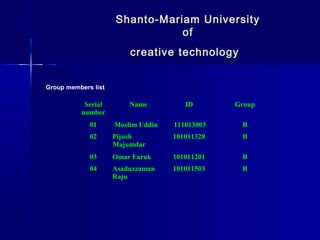
Group members list
Serial
number
Name ID Group
01 Moslim Uddin 111013003 B
02 Pijush
Majumdar
101011328 B
03 Omar Faruk 101011201 B
04 Asaduzzaman
Raju
101011503 B
Aim:Aim:
Our aim is to achieve some particular knowledge and also to knowOur aim is to achieve some particular knowledge and also to know
“how to reach to the aim by using Management.“how to reach to the aim by using Management.
 Objectives:Objectives:
Object refers to “how to reach to the aim?” andObject refers to “how to reach to the aim?” and
“What to do to reach to aim.” To complete the“What to do to reach to aim.” To complete the
aim successfully objectives play a vital role. Weaim successfully objectives play a vital role. We
have to determine what to do to reach to the aim.have to determine what to do to reach to the aim.
A success may come when the objectives isA success may come when the objectives is
completely done.completely done.
To reach to a successful aim some importantTo reach to a successful aim some important
requirement is needed that are as follows.requirement is needed that are as follows.
What to do to reach to the aim and how toWhat to do to reach to the aim and how to
reach the aim by using Management.reach the aim by using Management.
 Making a strong aim.Making a strong aim.
 By working together a group of people may reach to the aim.By working together a group of people may reach to the aim.
 Objectively assess your current processes  against industry-Objectively assess your current processes  against industry-
recognized best practices.recognized best practices.
 Identify gaps in your project management practices.Identify gaps in your project management practices.
 Focus on improvement opportunities to drive your businessFocus on improvement opportunities to drive your business
performance resultsperformance results
 Proper management is to establish in the group to reach theProper management is to establish in the group to reach the
expected aim.expected aim.
 Actual decision is to take in according to actual time.Actual decision is to take in according to actual time.
 Everybody has to thing about the solution when aim is beingEverybody has to thing about the solution when aim is being
destroyed.destroyed.
 Thinking about the improvement of the aim.Thinking about the improvement of the aim.
 These management points are very important that helps to reach to aThese management points are very important that helps to reach to a
expected aimexpected aim
Methodology:Methodology:
Methodology refers to the way by which we can do somethingMethodology refers to the way by which we can do something
by following some management. Each and every aim has toby following some management. Each and every aim has to
complete by maintaining the Management. To complete thecomplete by maintaining the Management. To complete the
objectives at first methodology needs to point out the problemobjectives at first methodology needs to point out the problem
and actual solution of the requirements of the objectives. Ifand actual solution of the requirements of the objectives. If
any major problem is seen in the objectives then an accurateany major problem is seen in the objectives then an accurate
methods may be taken to eliminate the problem. If themethods may be taken to eliminate the problem. If the
objectives is seen accurately and there is no any mistake forobjectives is seen accurately and there is no any mistake for
the expected aim then Management needs to more betterthe expected aim then Management needs to more better
idea that may fulfill the objectives.idea that may fulfill the objectives.
Each and every task has to do according to the plan. ByEach and every task has to do according to the plan. By
focusing an aim each and every task may be done by workingfocusing an aim each and every task may be done by working
together with a group of people and by making a strongtogether with a group of people and by making a strong
management.management.
Participation and mentality to work of the all members of aParticipation and mentality to work of the all members of a
group can also be helpful for the expected aim.group can also be helpful for the expected aim.
The way by which we want :The way by which we want :
 To achieve the aim of deferments way we need properTo achieve the aim of deferments way we need proper
management.management.
 Objectively assess your current processes  against industry-Objectively assess your current processes  against industry-
recognized best practices.recognized best practices.
 Identify gaps in your project management practices.Identify gaps in your project management practices.
 Focus on improvement opportunities to drive your businessFocus on improvement opportunities to drive your business
performance resultsperformance results
 To make sure the particular statement what we want together.To make sure the particular statement what we want together.
 To visit and gather the practical knowledge.To visit and gather the practical knowledge.
 All the section of the garments industry is important that weAll the section of the garments industry is important that we
need to visit and know practically.need to visit and know practically.
 For a better submission and presentation we also make sureFor a better submission and presentation we also make sure
our courseour course Mgt-101Mgt-101 successfully.successfully.
Company Description:
T-shirt retailer & wholesaler carrying 1000's of designs such as
Christian t-shirts, firefighter t-shirts, softball t-shirts etc. Custom t-
shirts available with our t-shirt designer. 100% Satisfaction
Guaranteed. ... Great selection of Wildlife designs printed on t-
shirts, long sleeve t-shirts or sweatshirts. Moose, bear, deer,
eagles, elk, owls etc. Check us out at www.trenzshirts.com
Definitions of managementDefinitions of management
Management is the art and science of organizing and directing human
efforts applied to control the forces and utilize the materials of nature
for the benefit of man. —American Society of Mechanical Engineers
To manage is to forecast and to plan, to organize to command, to
coordinate and to control. —Henry Fayol
Management Key ConceptsManagement Key Concepts
 Organizations:Organizations: People working togetherPeople working together
and coordinating their actions to achieveand coordinating their actions to achieve
specific goals.specific goals.
 Goal:Goal: A desired future condition that theA desired future condition that the
organization seeks to achieve.organization seeks to achieve.
 Management:Management: The process of usingThe process of using
organizational resources to achieve theorganizational resources to achieve the
organization’s goals by...organization’s goals by...
 Planning, Organizing, Leading, andPlanning, Organizing, Leading, and
ControllingControlling
Additional Key ConceptsAdditional Key Concepts
 Resources are organizational assets andResources are organizational assets and
include:include:
 People,People,
 Machinery,Machinery,
 Raw materials,Raw materials,
 Information, skills,Information, skills,
 Financial capital.Financial capital.
 Managers are the people responsible forManagers are the people responsible for
supervising the use of an organization’ssupervising the use of an organization’s
resources to meet its goals.resources to meet its goals.
Scope of managementScope of management
Management is guiding human and physical resources intoManagement is guiding human and physical resources into
dynamic organizational units which attain their objectives todynamic organizational units which attain their objectives to
the satisfaction of those served and with a high degree ofthe satisfaction of those served and with a high degree of
morale and sense of attainment on the part of those renderingmorale and sense of attainment on the part of those rendering
service.service.
Management is a multipurpose organ that manages aManagement is a multipurpose organ that manages a
business and manages Managers and manages workers andbusiness and manages Managers and manages workers and
work in:work in:
 Production ManagementProduction Management
 Marketing ManagementMarketing Management
 Financial ManagementFinancial Management
 Personnel ManagementPersonnel Management
Management processManagement process
 Management as a process has the following implications:Management as a process has the following implications:
(i)(i) Social Process:Social Process: Management involves interactions amongManagement involves interactions among
people. Goals can be achieved only when relations betweenpeople. Goals can be achieved only when relations between
people are productive. Human factor is the most important partpeople are productive. Human factor is the most important part
of the management.of the management.
(ii)(ii) Integrated Process:Integrated Process: Management brings human, physical andManagement brings human, physical and
financial resources together to put into effort. Management alsofinancial resources together to put into effort. Management also
integrates human efforts so as to maintain harmony amongintegrates human efforts so as to maintain harmony among
them.them.
(iii)(iii) Continuous Process:Continuous Process: Management involves continuousManagement involves continuous
identifying and solving problems. It is repeated every now andidentifying and solving problems. It is repeated every now and
then till the goal is achieved.then till the goal is achieved.
(iv)(iv) Interactive process:Interactive process: Managerial functions are contained withinManagerial functions are contained within
each other. For example, when a manager prepares plans, heeach other. For example, when a manager prepares plans, he
is also laying down standards for control.is also laying down standards for control.
Management LevelsManagement Levels
 Organizations often have 3 levels of managers:Organizations often have 3 levels of managers:
 First-line Managers:First-line Managers: responsible for day-to-dayresponsible for day-to-day
operation. They supervise the people performingoperation. They supervise the people performing
the activities required to make the good or service.the activities required to make the good or service.
 Middle Managers:Middle Managers: Supervise first-line managers.Supervise first-line managers.
They are also responsible to find the best way toThey are also responsible to find the best way to
use departmental resources to achieve goals.use departmental resources to achieve goals.
 Top Managers:Top Managers: Responsible for the performanceResponsible for the performance
of all departments and have cross-departmentalof all departments and have cross-departmental
responsibility. They establish organizational goalsresponsibility. They establish organizational goals
and monitor middle managers.and monitor middle managers.
Managerial SkillsManagerial Skills
 There are three skill sets that managers need toThere are three skill sets that managers need to
perform effectively.perform effectively.
1.1. Conceptual skills:Conceptual skills: the ability to analyze andthe ability to analyze and
diagnose a situation and find the cause and effect.diagnose a situation and find the cause and effect.
2.2. Human skills:Human skills: the ability to understand, alter,the ability to understand, alter,
lead, and control people’s behavior.lead, and control people’s behavior.
3.3. Technical skills:Technical skills: the job-specific knowledgethe job-specific knowledge
required to perform a task. Common examplesrequired to perform a task. Common examples
include marketing, accounting, and manufacturing.include marketing, accounting, and manufacturing.
All three skills are enhanced through formalAll three skills are enhanced through formal
training, reading, and practicetraining, reading, and practice
Managerial RolesManagerial Roles
Roles are directed inside as well as outside the organization.Roles are directed inside as well as outside the organization.
There are 3 broad role categories:There are 3 broad role categories:
 Interpersonal RolesInterpersonal Roles
Roles managers assume to coordinate and interact withRoles managers assume to coordinate and interact with
employees and provide direction to the organization.employees and provide direction to the organization.
 Informational RolesInformational Roles
Associated with the tasks needed to obtain and transmitAssociated with the tasks needed to obtain and transmit
information for management of the organization.information for management of the organization.
 Decisional RolesDecisional Roles
Associated with the methods managers use to plan strategyAssociated with the methods managers use to plan strategy
and utilize resources to achieve goals.and utilize resources to achieve goals.
Management TrendsManagement Trends
 Empowerment:Empowerment: expand the tasks andexpand the tasks and
responsibilities of workers.responsibilities of workers.
Supervisors might be empowered to makeSupervisors might be empowered to make
some resource allocation decisions.some resource allocation decisions.
 Self-managed teams:Self-managed teams: give a group ofgive a group of
employees’ responsibility for supervisingemployees’ responsibility for supervising
their own actions.their own actions.
The team can monitor its members and theThe team can monitor its members and the
quality of the work performed.quality of the work performed.
 Management ChallengesManagement Challenges
 Increasing number of global organizations.Increasing number of global organizations.
 Building competitive advantage throughBuilding competitive advantage through
superior efficiency, quality, innovation, andsuperior efficiency, quality, innovation, and
responsiveness.responsiveness.
 Increasing performance while remainingIncreasing performance while remaining
ethical managers.ethical managers.
 Managing an increasingly diverse workManaging an increasingly diverse work
force.force.
 Using new technologiesUsing new technologies
ConclutionConclution
 Management covers a wide spectrumManagement covers a wide spectrum
of activities that are expected from allof activities that are expected from all
line managers and supervisors wholine managers and supervisors who
have responsibility for managing staff.have responsibility for managing staff.
Management effectively manage theManagement effectively manage the
performance of their team, which areperformance of their team, which are
delivered by both Staff Developersdelivered by both Staff Developers
and Managers from Humanand Managers from Human
Resources.Resources.

Mgt 101 group no. 8

  • 1.
    SHANTO-MARIAM UNIVERSITYSHANTO-MARIAM UNIVERSITY OFOF CREATIVETECHNOLOGYCREATIVE TECHNOLOGY MGT-101MGT-101 PRESENTATION ON:PRESENTATION ON: ““MANAGEMENTMANAGEMENT”” Submitted to:Submitted to: Ubeda Shahira SowdaUbeda Shahira Sowda Lecturer of SMUCTLecturer of SMUCT
  • 2.
    A C KN O W L E D G E M EA C K N O W L E D G E M E N TN T We are grateful to our honourable teacher UbedaWe are grateful to our honourable teacher Ubeda Shahira Sowda, who provide us information andShahira Sowda, who provide us information and lecture sheet to made this presentation. Thislecture sheet to made this presentation. This presentation would not have been possiblepresentation would not have been possible without his lecture and contribution from ourwithout his lecture and contribution from our faculty.faculty. At last,we would like to thank Almighty Allah forAt last,we would like to thank Almighty Allah for giving me knowledge and strength for hardgiving me knowledge and strength for hard working to do Presentation.working to do Presentation. Thank you………..Thank you………..
  • 3.
    Shanto-Mariam UniversityShanto-Mariam University ofof creativetechnologycreative technology Group members list Serial number Name ID Group 01 Moslim Uddin 111013003 B 02 Pijush Majumdar 101011328 B 03 Omar Faruk 101011201 B 04 Asaduzzaman Raju 101011503 B
  • 4.
    Aim:Aim: Our aim isto achieve some particular knowledge and also to knowOur aim is to achieve some particular knowledge and also to know “how to reach to the aim by using Management.“how to reach to the aim by using Management.  Objectives:Objectives: Object refers to “how to reach to the aim?” andObject refers to “how to reach to the aim?” and “What to do to reach to aim.” To complete the“What to do to reach to aim.” To complete the aim successfully objectives play a vital role. Weaim successfully objectives play a vital role. We have to determine what to do to reach to the aim.have to determine what to do to reach to the aim. A success may come when the objectives isA success may come when the objectives is completely done.completely done. To reach to a successful aim some importantTo reach to a successful aim some important requirement is needed that are as follows.requirement is needed that are as follows.
  • 5.
    What to doto reach to the aim and how toWhat to do to reach to the aim and how to reach the aim by using Management.reach the aim by using Management.  Making a strong aim.Making a strong aim.  By working together a group of people may reach to the aim.By working together a group of people may reach to the aim.  Objectively assess your current processes  against industry-Objectively assess your current processes  against industry- recognized best practices.recognized best practices.  Identify gaps in your project management practices.Identify gaps in your project management practices.  Focus on improvement opportunities to drive your businessFocus on improvement opportunities to drive your business performance resultsperformance results  Proper management is to establish in the group to reach theProper management is to establish in the group to reach the expected aim.expected aim.  Actual decision is to take in according to actual time.Actual decision is to take in according to actual time.  Everybody has to thing about the solution when aim is beingEverybody has to thing about the solution when aim is being destroyed.destroyed.  Thinking about the improvement of the aim.Thinking about the improvement of the aim.  These management points are very important that helps to reach to aThese management points are very important that helps to reach to a expected aimexpected aim
  • 6.
    Methodology:Methodology: Methodology refers tothe way by which we can do somethingMethodology refers to the way by which we can do something by following some management. Each and every aim has toby following some management. Each and every aim has to complete by maintaining the Management. To complete thecomplete by maintaining the Management. To complete the objectives at first methodology needs to point out the problemobjectives at first methodology needs to point out the problem and actual solution of the requirements of the objectives. Ifand actual solution of the requirements of the objectives. If any major problem is seen in the objectives then an accurateany major problem is seen in the objectives then an accurate methods may be taken to eliminate the problem. If themethods may be taken to eliminate the problem. If the objectives is seen accurately and there is no any mistake forobjectives is seen accurately and there is no any mistake for the expected aim then Management needs to more betterthe expected aim then Management needs to more better idea that may fulfill the objectives.idea that may fulfill the objectives. Each and every task has to do according to the plan. ByEach and every task has to do according to the plan. By focusing an aim each and every task may be done by workingfocusing an aim each and every task may be done by working together with a group of people and by making a strongtogether with a group of people and by making a strong management.management. Participation and mentality to work of the all members of aParticipation and mentality to work of the all members of a group can also be helpful for the expected aim.group can also be helpful for the expected aim.
  • 7.
    The way bywhich we want :The way by which we want :  To achieve the aim of deferments way we need properTo achieve the aim of deferments way we need proper management.management.  Objectively assess your current processes  against industry-Objectively assess your current processes  against industry- recognized best practices.recognized best practices.  Identify gaps in your project management practices.Identify gaps in your project management practices.  Focus on improvement opportunities to drive your businessFocus on improvement opportunities to drive your business performance resultsperformance results  To make sure the particular statement what we want together.To make sure the particular statement what we want together.  To visit and gather the practical knowledge.To visit and gather the practical knowledge.  All the section of the garments industry is important that weAll the section of the garments industry is important that we need to visit and know practically.need to visit and know practically.  For a better submission and presentation we also make sureFor a better submission and presentation we also make sure our courseour course Mgt-101Mgt-101 successfully.successfully.
  • 8.
    Company Description: T-shirt retailer& wholesaler carrying 1000's of designs such as Christian t-shirts, firefighter t-shirts, softball t-shirts etc. Custom t- shirts available with our t-shirt designer. 100% Satisfaction Guaranteed. ... Great selection of Wildlife designs printed on t- shirts, long sleeve t-shirts or sweatshirts. Moose, bear, deer, eagles, elk, owls etc. Check us out at www.trenzshirts.com
  • 9.
    Definitions of managementDefinitionsof management Management is the art and science of organizing and directing human efforts applied to control the forces and utilize the materials of nature for the benefit of man. —American Society of Mechanical Engineers To manage is to forecast and to plan, to organize to command, to coordinate and to control. —Henry Fayol
  • 10.
    Management Key ConceptsManagementKey Concepts  Organizations:Organizations: People working togetherPeople working together and coordinating their actions to achieveand coordinating their actions to achieve specific goals.specific goals.  Goal:Goal: A desired future condition that theA desired future condition that the organization seeks to achieve.organization seeks to achieve.  Management:Management: The process of usingThe process of using organizational resources to achieve theorganizational resources to achieve the organization’s goals by...organization’s goals by...  Planning, Organizing, Leading, andPlanning, Organizing, Leading, and ControllingControlling
  • 11.
    Additional Key ConceptsAdditionalKey Concepts  Resources are organizational assets andResources are organizational assets and include:include:  People,People,  Machinery,Machinery,  Raw materials,Raw materials,  Information, skills,Information, skills,  Financial capital.Financial capital.  Managers are the people responsible forManagers are the people responsible for supervising the use of an organization’ssupervising the use of an organization’s resources to meet its goals.resources to meet its goals.
  • 12.
    Scope of managementScopeof management Management is guiding human and physical resources intoManagement is guiding human and physical resources into dynamic organizational units which attain their objectives todynamic organizational units which attain their objectives to the satisfaction of those served and with a high degree ofthe satisfaction of those served and with a high degree of morale and sense of attainment on the part of those renderingmorale and sense of attainment on the part of those rendering service.service. Management is a multipurpose organ that manages aManagement is a multipurpose organ that manages a business and manages Managers and manages workers andbusiness and manages Managers and manages workers and work in:work in:  Production ManagementProduction Management  Marketing ManagementMarketing Management  Financial ManagementFinancial Management  Personnel ManagementPersonnel Management
  • 13.
    Management processManagement process Management as a process has the following implications:Management as a process has the following implications: (i)(i) Social Process:Social Process: Management involves interactions amongManagement involves interactions among people. Goals can be achieved only when relations betweenpeople. Goals can be achieved only when relations between people are productive. Human factor is the most important partpeople are productive. Human factor is the most important part of the management.of the management. (ii)(ii) Integrated Process:Integrated Process: Management brings human, physical andManagement brings human, physical and financial resources together to put into effort. Management alsofinancial resources together to put into effort. Management also integrates human efforts so as to maintain harmony amongintegrates human efforts so as to maintain harmony among them.them. (iii)(iii) Continuous Process:Continuous Process: Management involves continuousManagement involves continuous identifying and solving problems. It is repeated every now andidentifying and solving problems. It is repeated every now and then till the goal is achieved.then till the goal is achieved. (iv)(iv) Interactive process:Interactive process: Managerial functions are contained withinManagerial functions are contained within each other. For example, when a manager prepares plans, heeach other. For example, when a manager prepares plans, he is also laying down standards for control.is also laying down standards for control.
  • 14.
    Management LevelsManagement Levels Organizations often have 3 levels of managers:Organizations often have 3 levels of managers:  First-line Managers:First-line Managers: responsible for day-to-dayresponsible for day-to-day operation. They supervise the people performingoperation. They supervise the people performing the activities required to make the good or service.the activities required to make the good or service.  Middle Managers:Middle Managers: Supervise first-line managers.Supervise first-line managers. They are also responsible to find the best way toThey are also responsible to find the best way to use departmental resources to achieve goals.use departmental resources to achieve goals.  Top Managers:Top Managers: Responsible for the performanceResponsible for the performance of all departments and have cross-departmentalof all departments and have cross-departmental responsibility. They establish organizational goalsresponsibility. They establish organizational goals and monitor middle managers.and monitor middle managers.
  • 15.
    Managerial SkillsManagerial Skills There are three skill sets that managers need toThere are three skill sets that managers need to perform effectively.perform effectively. 1.1. Conceptual skills:Conceptual skills: the ability to analyze andthe ability to analyze and diagnose a situation and find the cause and effect.diagnose a situation and find the cause and effect. 2.2. Human skills:Human skills: the ability to understand, alter,the ability to understand, alter, lead, and control people’s behavior.lead, and control people’s behavior. 3.3. Technical skills:Technical skills: the job-specific knowledgethe job-specific knowledge required to perform a task. Common examplesrequired to perform a task. Common examples include marketing, accounting, and manufacturing.include marketing, accounting, and manufacturing. All three skills are enhanced through formalAll three skills are enhanced through formal training, reading, and practicetraining, reading, and practice
  • 16.
    Managerial RolesManagerial Roles Rolesare directed inside as well as outside the organization.Roles are directed inside as well as outside the organization. There are 3 broad role categories:There are 3 broad role categories:  Interpersonal RolesInterpersonal Roles Roles managers assume to coordinate and interact withRoles managers assume to coordinate and interact with employees and provide direction to the organization.employees and provide direction to the organization.  Informational RolesInformational Roles Associated with the tasks needed to obtain and transmitAssociated with the tasks needed to obtain and transmit information for management of the organization.information for management of the organization.  Decisional RolesDecisional Roles Associated with the methods managers use to plan strategyAssociated with the methods managers use to plan strategy and utilize resources to achieve goals.and utilize resources to achieve goals.
  • 17.
    Management TrendsManagement Trends Empowerment:Empowerment: expand the tasks andexpand the tasks and responsibilities of workers.responsibilities of workers. Supervisors might be empowered to makeSupervisors might be empowered to make some resource allocation decisions.some resource allocation decisions.  Self-managed teams:Self-managed teams: give a group ofgive a group of employees’ responsibility for supervisingemployees’ responsibility for supervising their own actions.their own actions. The team can monitor its members and theThe team can monitor its members and the quality of the work performed.quality of the work performed.
  • 18.
     Management ChallengesManagementChallenges  Increasing number of global organizations.Increasing number of global organizations.  Building competitive advantage throughBuilding competitive advantage through superior efficiency, quality, innovation, andsuperior efficiency, quality, innovation, and responsiveness.responsiveness.  Increasing performance while remainingIncreasing performance while remaining ethical managers.ethical managers.  Managing an increasingly diverse workManaging an increasingly diverse work force.force.  Using new technologiesUsing new technologies
  • 19.
    ConclutionConclution  Management coversa wide spectrumManagement covers a wide spectrum of activities that are expected from allof activities that are expected from all line managers and supervisors wholine managers and supervisors who have responsibility for managing staff.have responsibility for managing staff. Management effectively manage theManagement effectively manage the performance of their team, which areperformance of their team, which are delivered by both Staff Developersdelivered by both Staff Developers and Managers from Humanand Managers from Human Resources.Resources.