Lecture:1 Date: 7/9/2010
Rahul K. Kher
Assistant Professor,
Department of Electronics & Communication
Engg.
710402: Information Theory &
Coding
Course Contents
 Three segments: Source Coding, Channel
Coding and Cryptography
 Concept and need of coding: Entropy,
Redundancy of data etc.
 Source coding techniques:
Unique decodable codes (UDC)
Instantaneous decodable codes (IDC)
Huffman and Shannon-Fano codes
Arithmetic Coding
Lossless vs. lossy coding (compression)
 Channel coding techniques:
Linear Block codes
Cyclic codes
Hamming codes
BCH codes
Reed-Solomon codes
Convolutional Coding and decoding algorithms
 Cryptography
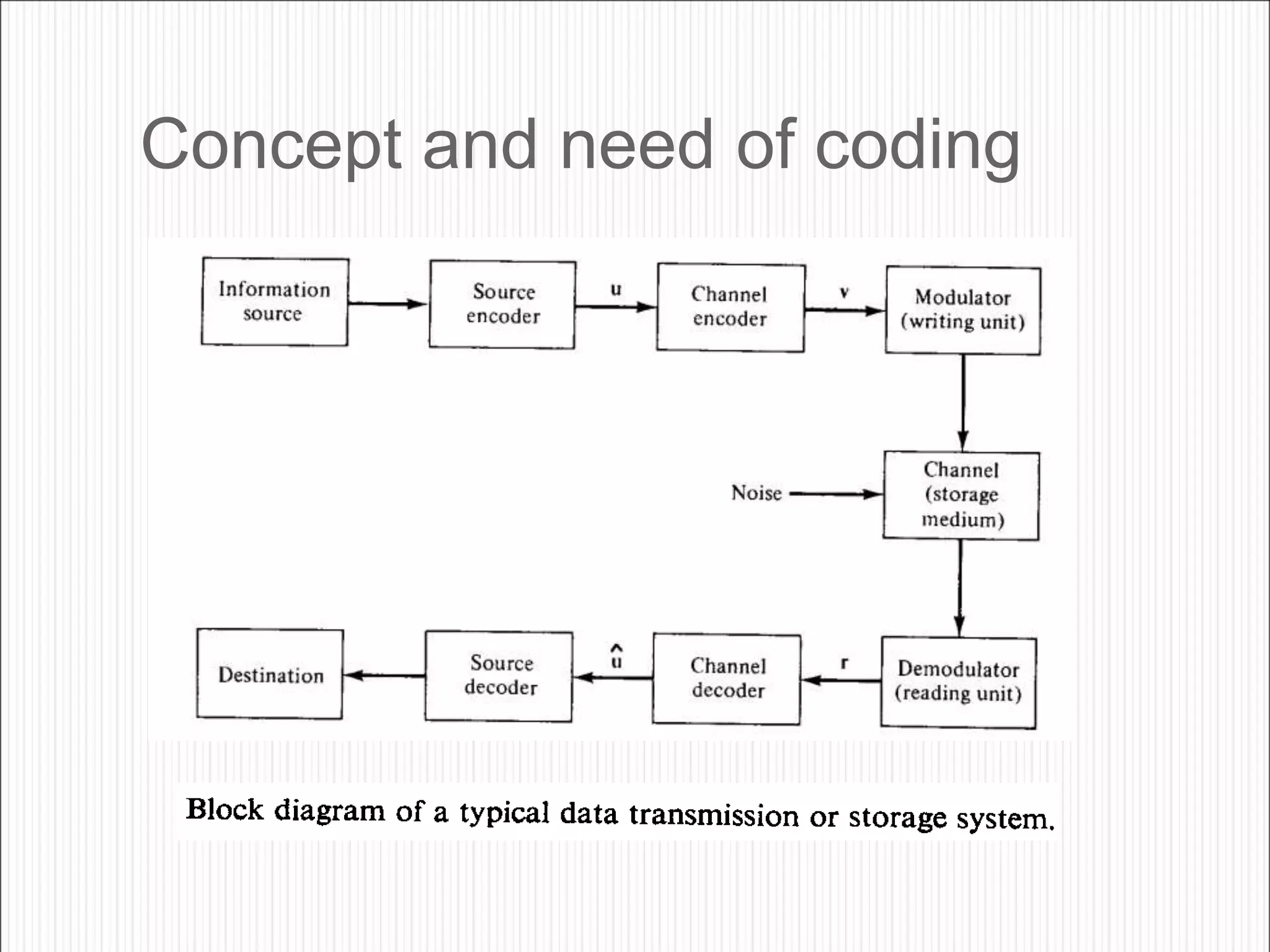
Concept and need of coding
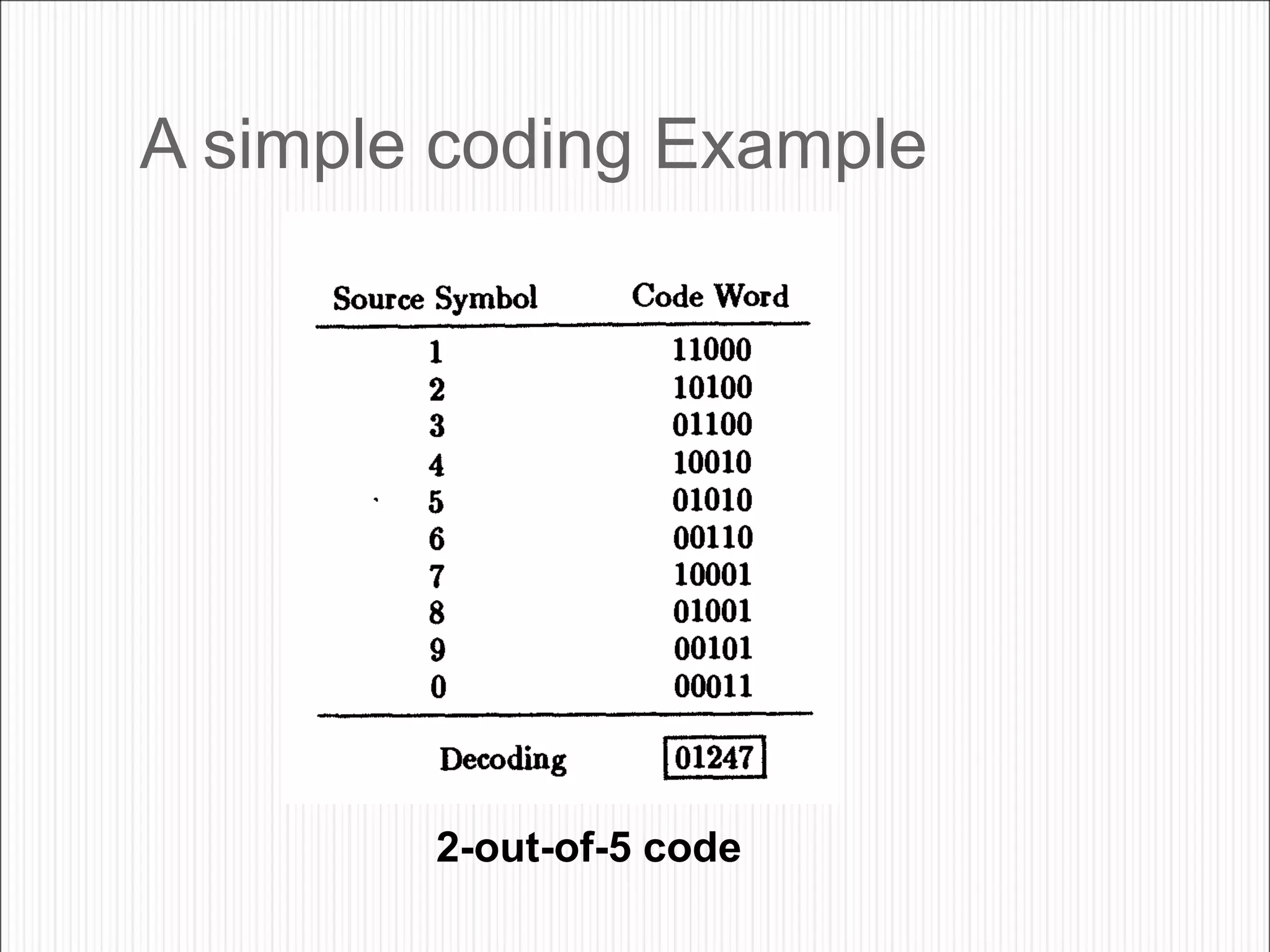
A simple coding Example
2-out-of-5 code
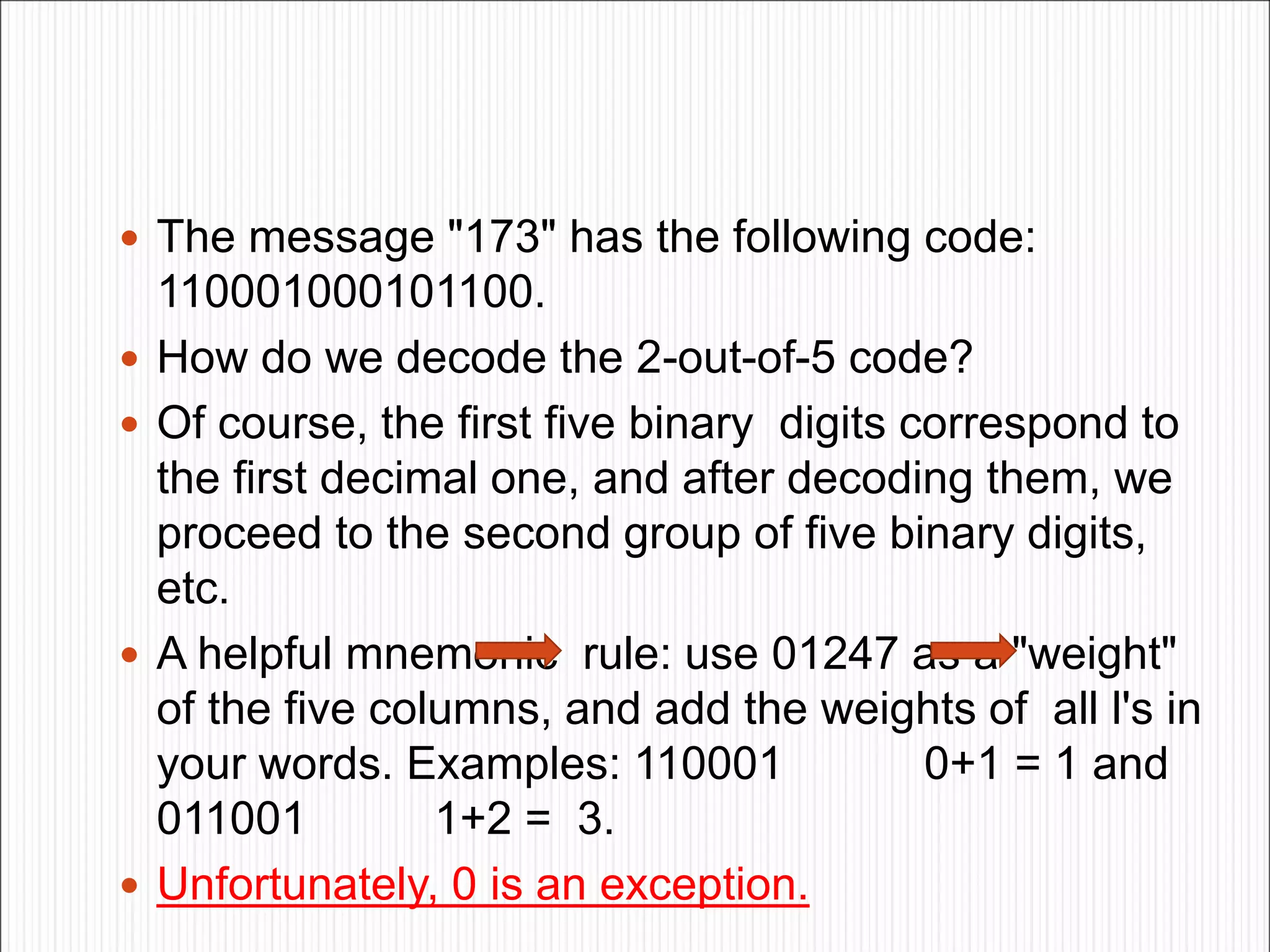
 The message "173" has the following code:
110001000101100.
 How do we decode the 2-out-of-5 code?
 Of course, the first five binary digits correspond to
the first decimal one, and after decoding them, we
proceed to the second group of five binary digits,
etc.
 A helpful mnemonic rule: use 01247 as a "weight"
of the five columns, and add the weights of all l's in
your words. Examples: 110001 0+1 = 1 and
011001 1+2 = 3.
 Unfortunately, 0 is an exception.
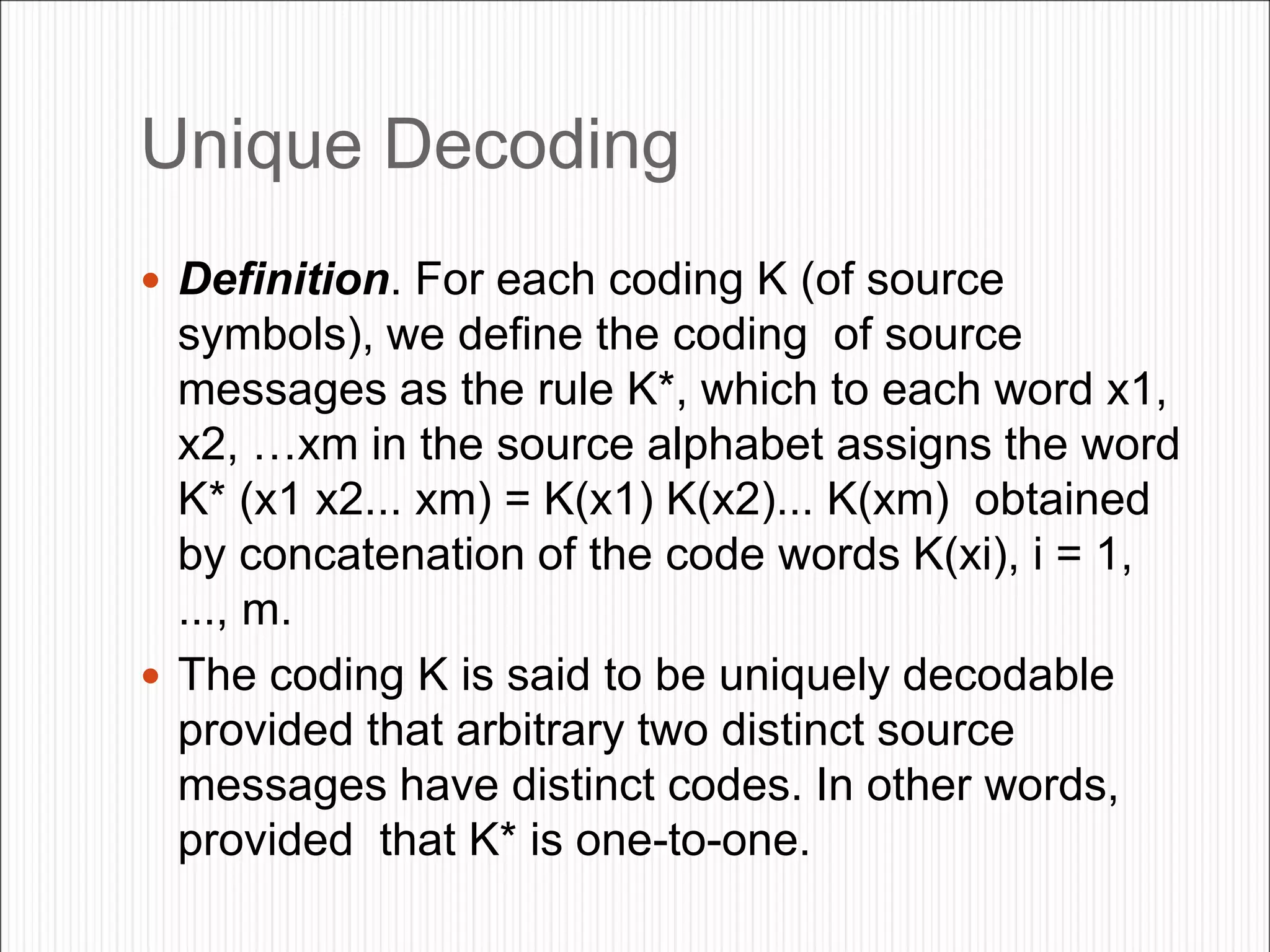
Unique Decoding
 Definition. For each coding K (of source
symbols), we define the coding of source
messages as the rule K*, which to each word x1,
x2, …xm in the source alphabet assigns the word
K* (x1 x2... xm) = K(x1) K(x2)... K(xm) obtained
by concatenation of the code words K(xi), i = 1,
..., m.
 The coding K is said to be uniquely decodable
provided that arbitrary two distinct source
messages have distinct codes. In other words,
provided that K* is one-to-one.
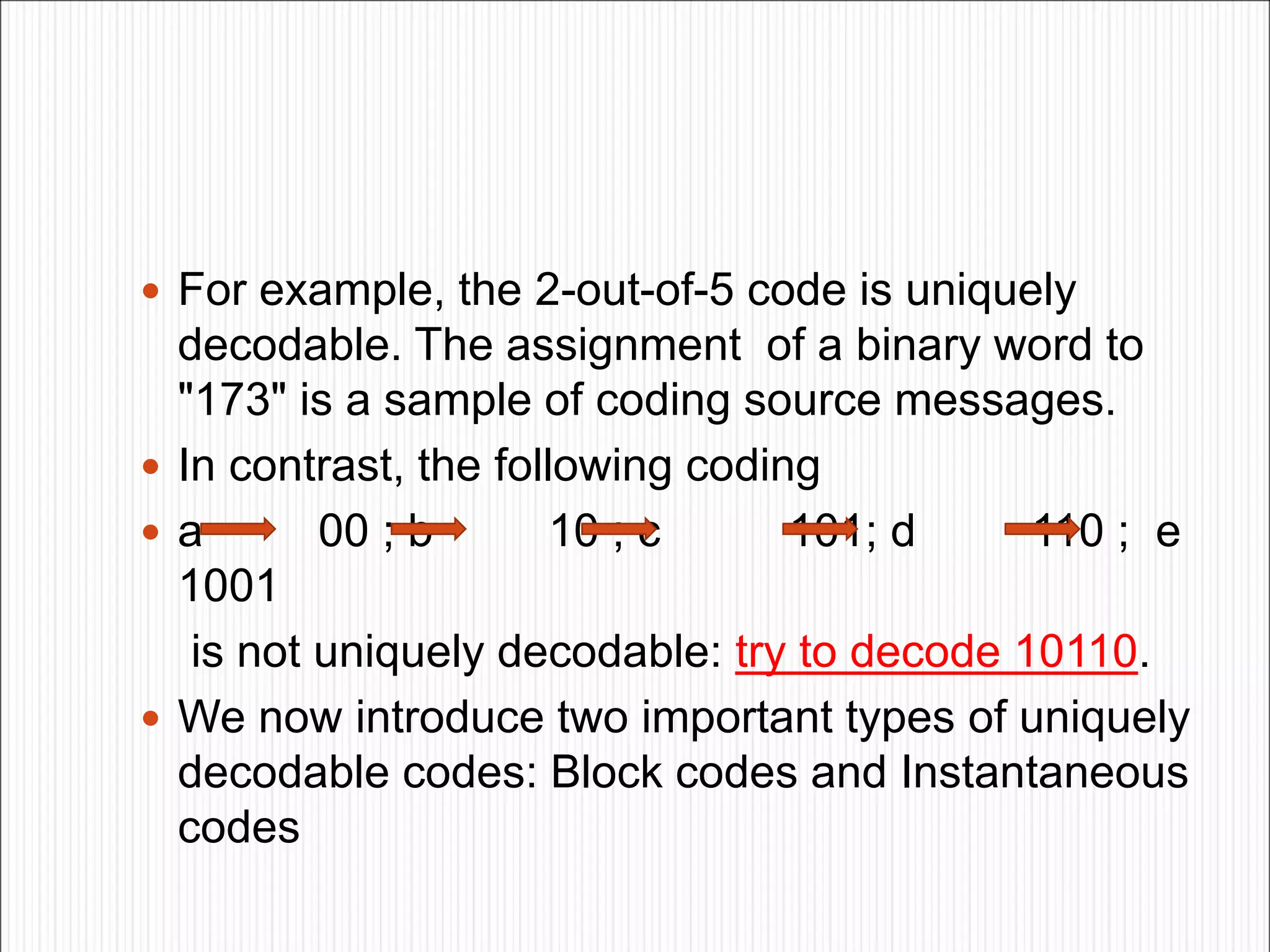
 For example, the 2-out-of-5 code is uniquely
decodable. The assignment of a binary word to
"173" is a sample of coding source messages.
 In contrast, the following coding
 a 00 ; b 10 ; c 101; d 110 ; e
1001
is not uniquely decodable: try to decode 10110.
 We now introduce two important types of uniquely
decodable codes: Block codes and Instantaneous
codes
 Instantaneous codes: codes of variable word
lengths decodable symbol per symbol.
A coding is called instantaneous provided that no
code word is a prefix of another code word; i.e., if a
source symbol has a code b1 b2 ... bn then no
other source symbol has a code
b1 b2 ... bn bn+1 ...bm.
 Block codes, are the special case of
instantaneous codes with constant word length.
A coding using only pairwise distinct code words of
a certain length n is called a block coding of length
n.
Examples
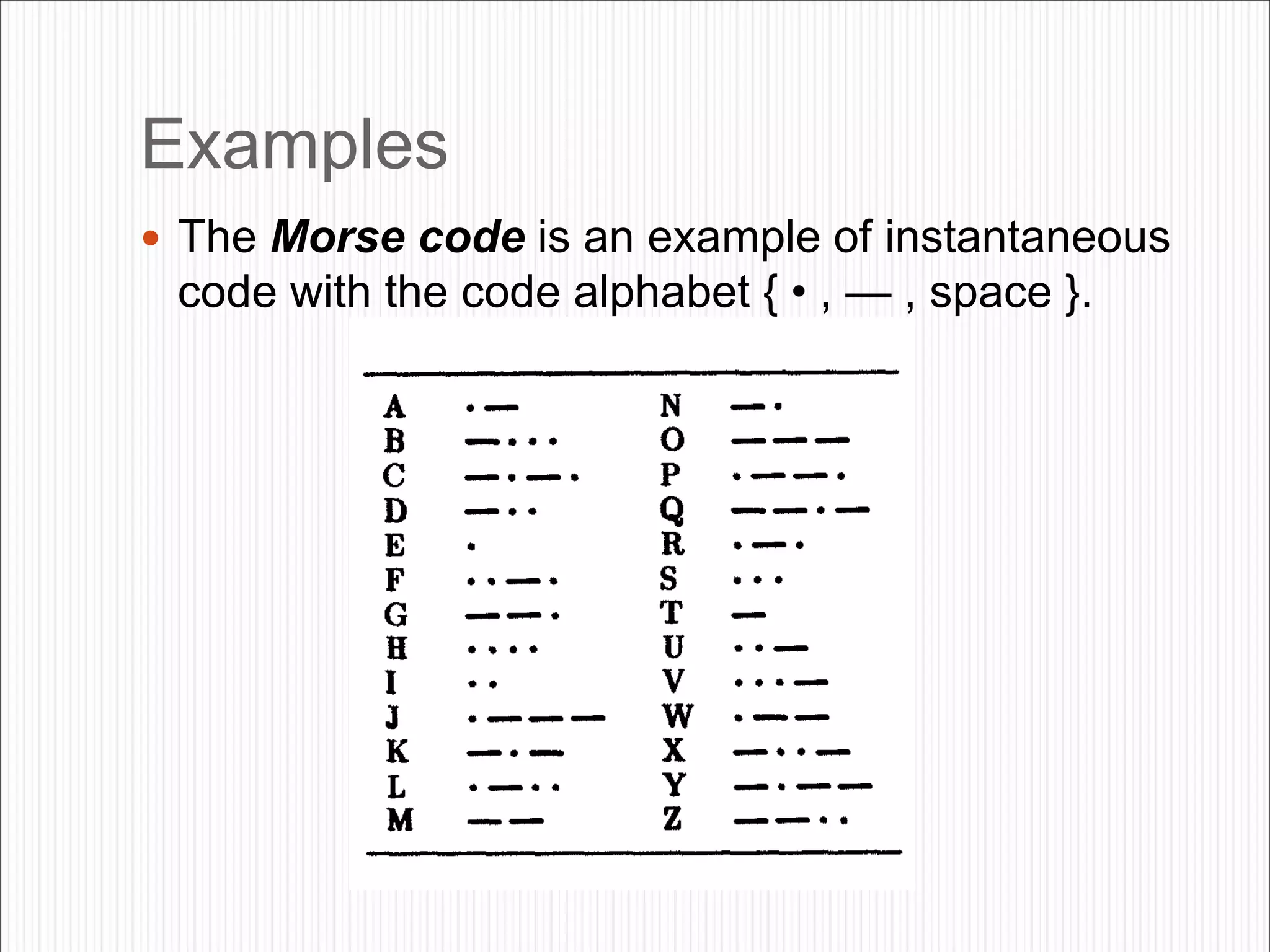
 The Morse code is an example of instantaneous
code with the code alphabet { • , — , space }.
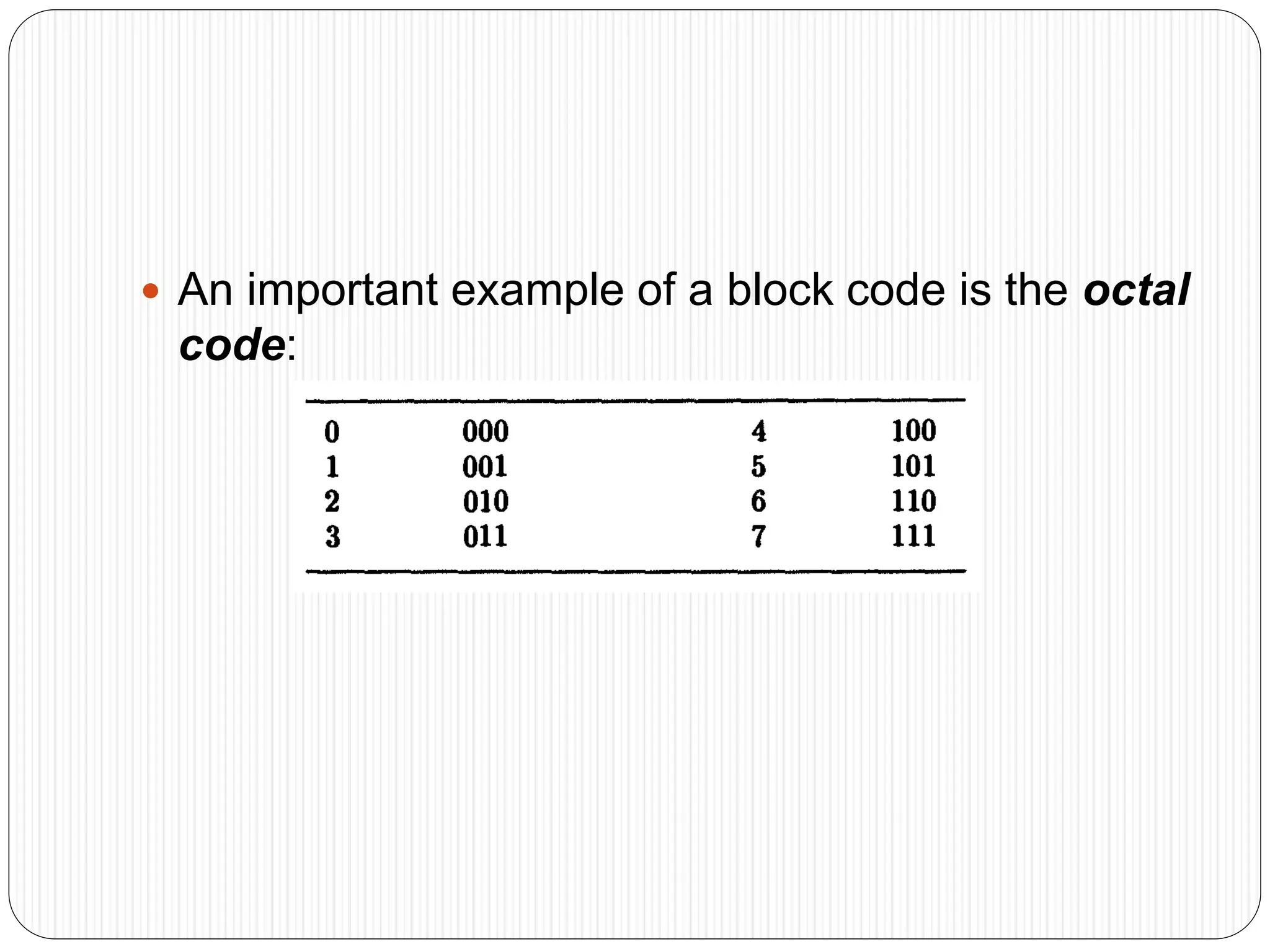
 An important example of a block code is the octal
code:
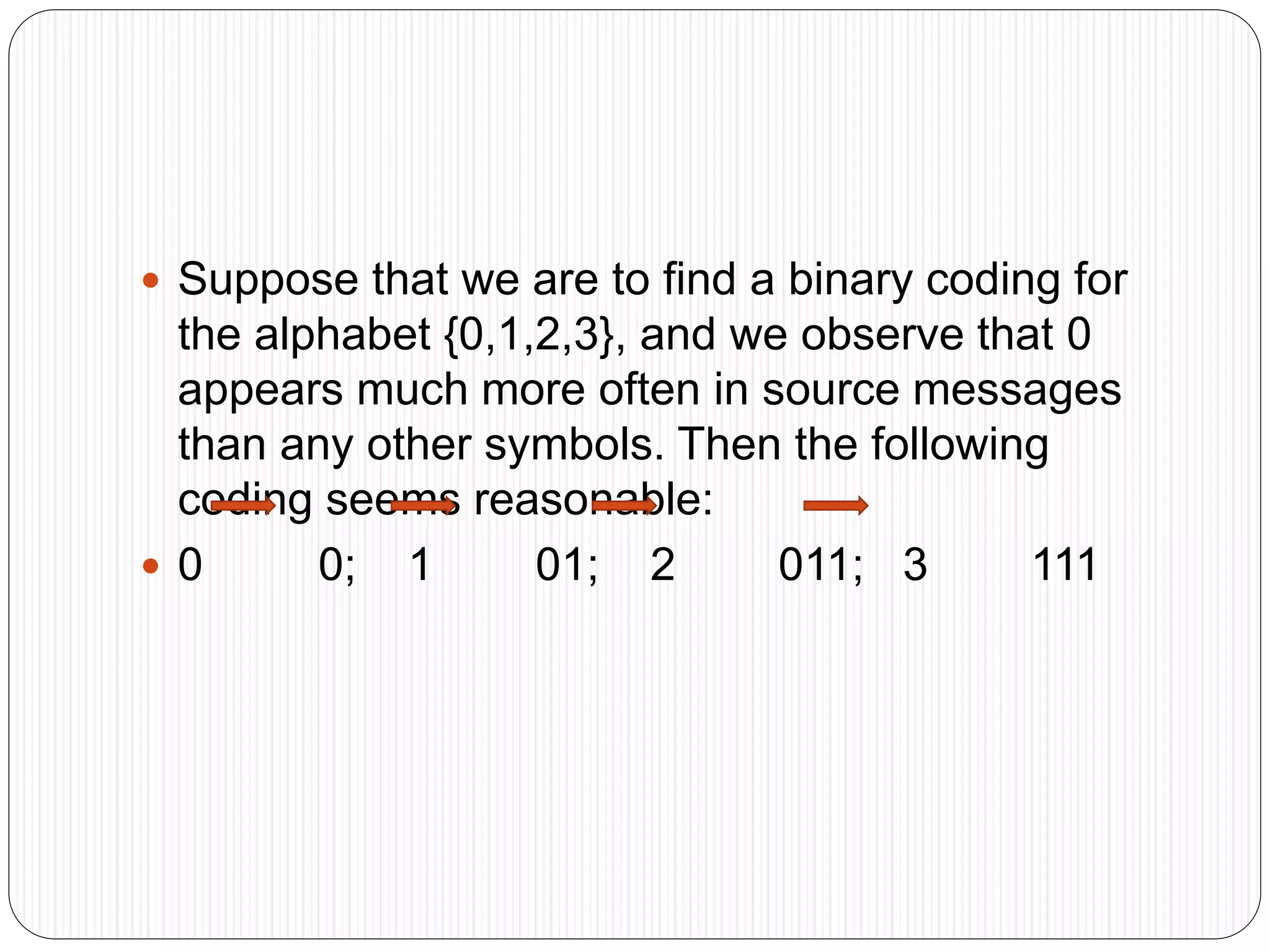
 Suppose that we are to find a binary coding for
the alphabet {0,1,2,3}, and we observe that 0
appears much more often in source messages
than any other symbols. Then the following
coding seems reasonable:
 0 0; 1 01; 2 011; 3 111
Some important Block codes
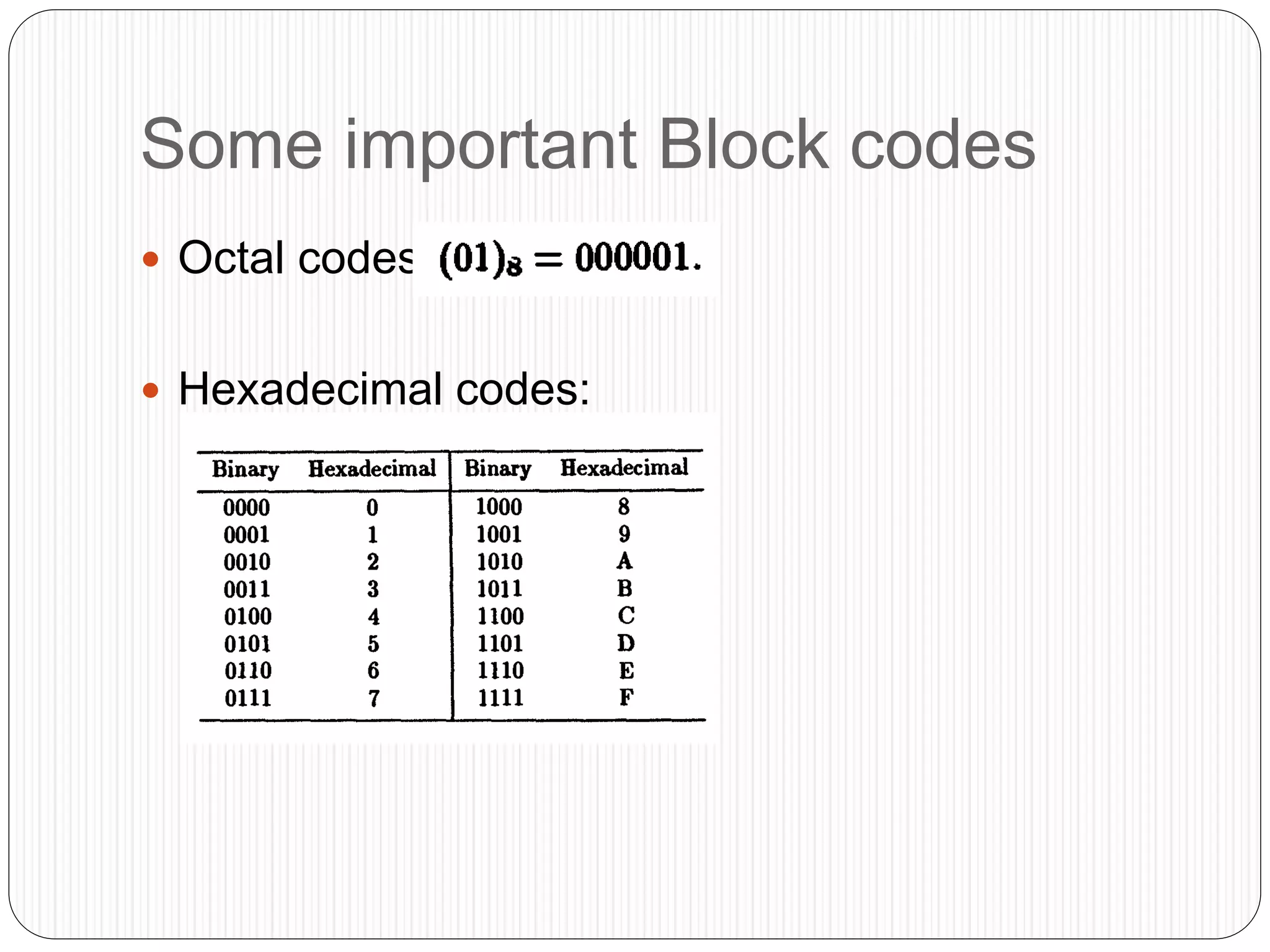
 Octal codes:
 Hexadecimal codes:
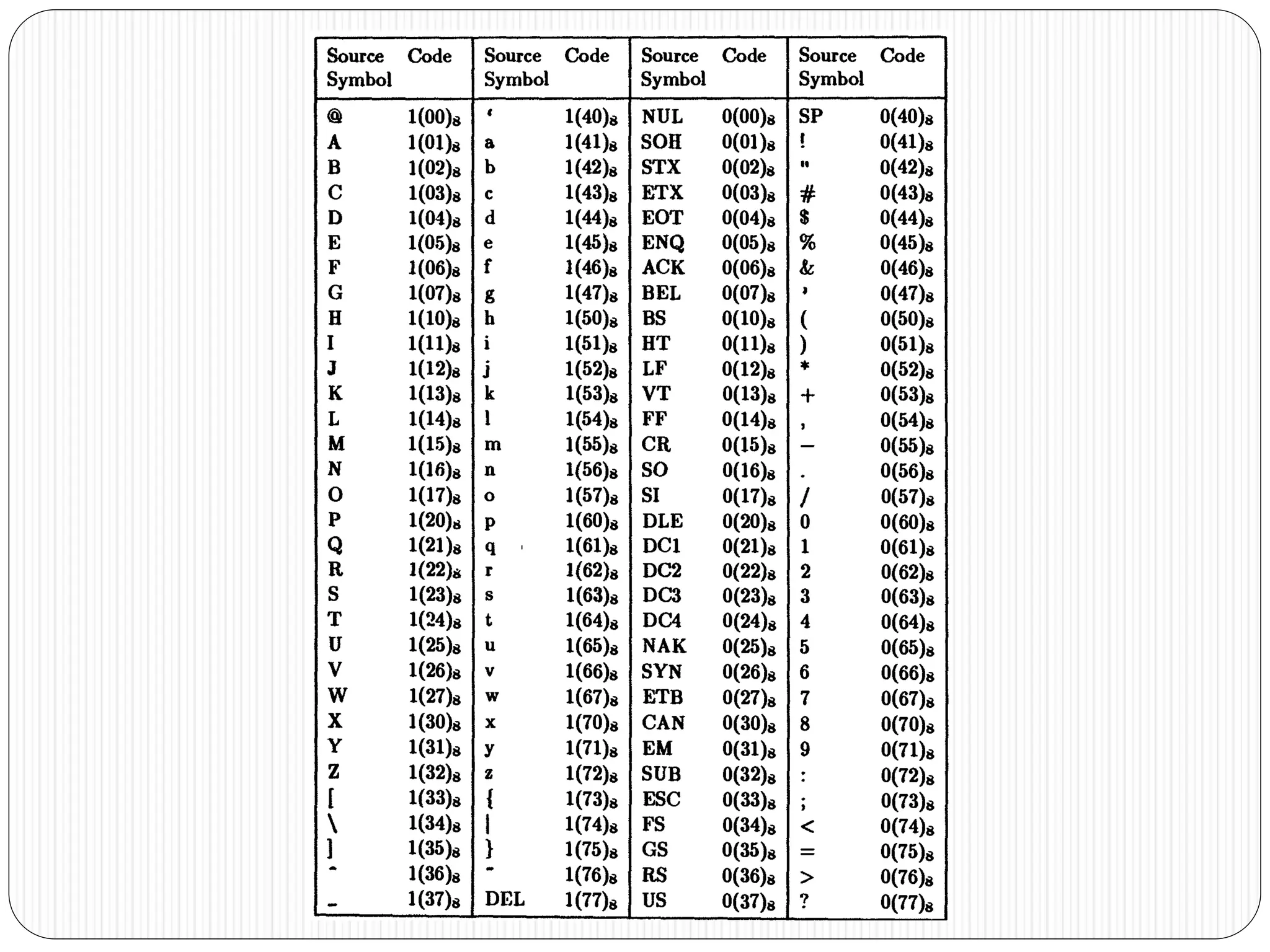
 ASCII codes:
A very important code used for a standard binary
representation of alphabetic and numeric symbols is
the ASCII code. It has 27 = 128 source symbols
encoded into binary words of length 8: the first
seven symbols carry the information, and the eighth
one is set in such a way that the parity is even (i.e.,
each code word contains an even number of l's).
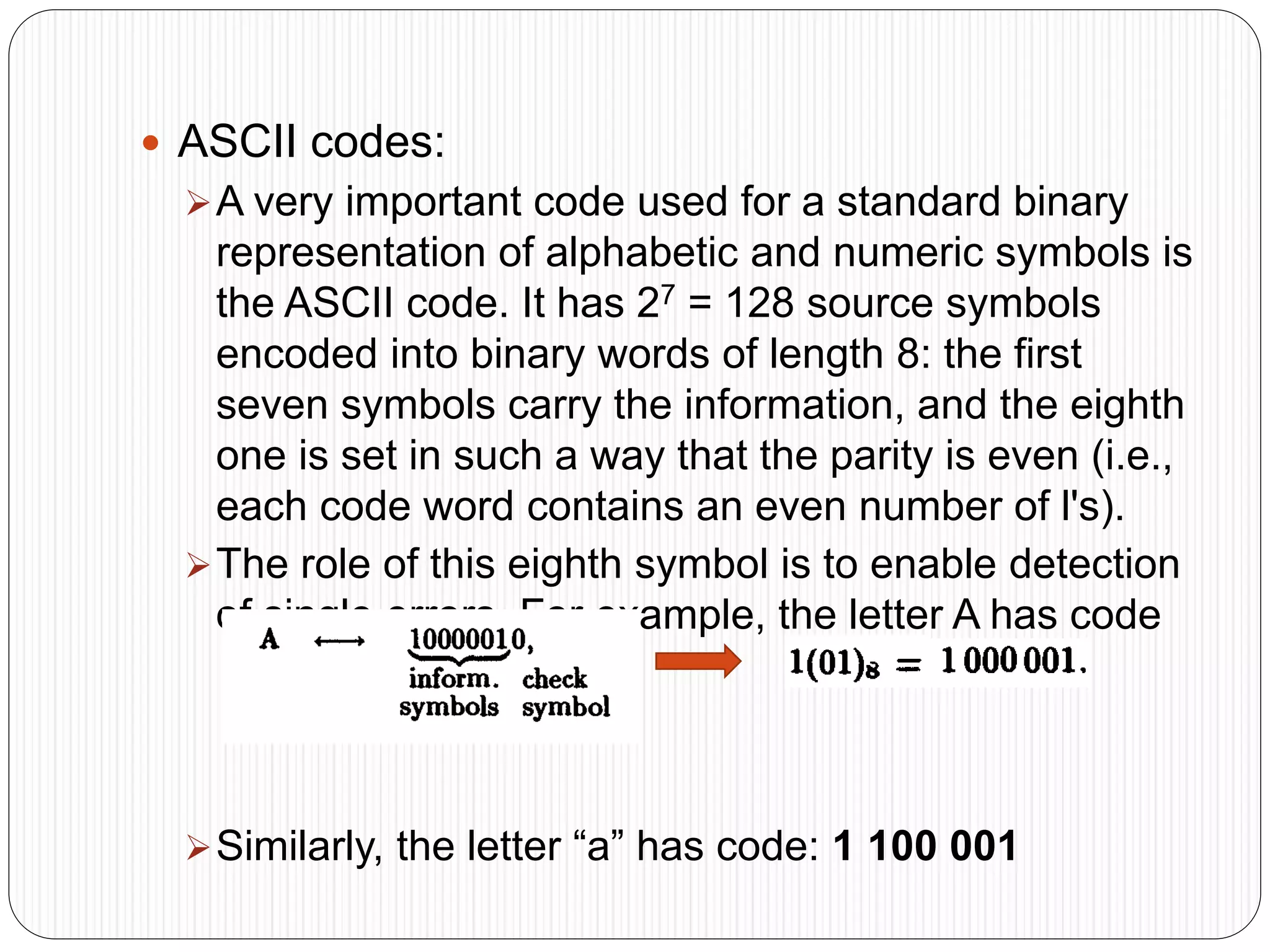
The role of this eighth symbol is to enable detection
of single errors. For example, the letter A has code
Similarly, the letter “a” has code: 1 100 001
710402_Lecture 1.ppt

710402_Lecture 1.ppt

  • 1.
    Lecture:1 Date: 7/9/2010 RahulK. Kher Assistant Professor, Department of Electronics & Communication Engg. 710402: Information Theory & Coding
  • 2.
    Course Contents  Threesegments: Source Coding, Channel Coding and Cryptography  Concept and need of coding: Entropy, Redundancy of data etc.  Source coding techniques: Unique decodable codes (UDC) Instantaneous decodable codes (IDC) Huffman and Shannon-Fano codes Arithmetic Coding Lossless vs. lossy coding (compression)
  • 3.
     Channel codingtechniques: Linear Block codes Cyclic codes Hamming codes BCH codes Reed-Solomon codes Convolutional Coding and decoding algorithms  Cryptography
  • 4.
  • 5.
    A simple codingExample 2-out-of-5 code
  • 6.
     The message"173" has the following code: 110001000101100.  How do we decode the 2-out-of-5 code?  Of course, the first five binary digits correspond to the first decimal one, and after decoding them, we proceed to the second group of five binary digits, etc.  A helpful mnemonic rule: use 01247 as a "weight" of the five columns, and add the weights of all l's in your words. Examples: 110001 0+1 = 1 and 011001 1+2 = 3.  Unfortunately, 0 is an exception.
  • 7.
    Unique Decoding  Definition.For each coding K (of source symbols), we define the coding of source messages as the rule K*, which to each word x1, x2, …xm in the source alphabet assigns the word K* (x1 x2... xm) = K(x1) K(x2)... K(xm) obtained by concatenation of the code words K(xi), i = 1, ..., m.  The coding K is said to be uniquely decodable provided that arbitrary two distinct source messages have distinct codes. In other words, provided that K* is one-to-one.
  • 8.
     For example,the 2-out-of-5 code is uniquely decodable. The assignment of a binary word to "173" is a sample of coding source messages.  In contrast, the following coding  a 00 ; b 10 ; c 101; d 110 ; e 1001 is not uniquely decodable: try to decode 10110.  We now introduce two important types of uniquely decodable codes: Block codes and Instantaneous codes
  • 9.
     Instantaneous codes:codes of variable word lengths decodable symbol per symbol. A coding is called instantaneous provided that no code word is a prefix of another code word; i.e., if a source symbol has a code b1 b2 ... bn then no other source symbol has a code b1 b2 ... bn bn+1 ...bm.  Block codes, are the special case of instantaneous codes with constant word length. A coding using only pairwise distinct code words of a certain length n is called a block coding of length n.
  • 10.
    Examples  The Morsecode is an example of instantaneous code with the code alphabet { • , — , space }.
  • 11.
     An importantexample of a block code is the octal code:
  • 12.
     Suppose thatwe are to find a binary coding for the alphabet {0,1,2,3}, and we observe that 0 appears much more often in source messages than any other symbols. Then the following coding seems reasonable:  0 0; 1 01; 2 011; 3 111
  • 13.
    Some important Blockcodes  Octal codes:  Hexadecimal codes:
  • 14.
     ASCII codes: Avery important code used for a standard binary representation of alphabetic and numeric symbols is the ASCII code. It has 27 = 128 source symbols encoded into binary words of length 8: the first seven symbols carry the information, and the eighth one is set in such a way that the parity is even (i.e., each code word contains an even number of l's). The role of this eighth symbol is to enable detection of single errors. For example, the letter A has code Similarly, the letter “a” has code: 1 100 001