Chapter 2 The Solar
Chapter 2 The Solar
System
System
Section 1 Observing the
Solar System
Solar System
Ch. 2, section 1 Observing the
Solar System Objectives
 Explain how the heliocentric and
Explain how the heliocentric and
geocentric models of the solar
system differ
system differ
 Describe Kepler’s discovery about
Describe Kepler’s discovery about
the planet’s orbit
the planet’s orbit
 Identify two factors that keep the
Identify two factors that keep the
planets in their orbits.
1.
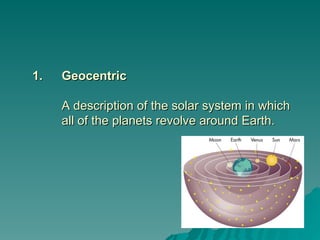
1. Geocentric
Geocentric
A description of the solar system in which
all of the planets revolve around Earth.
2.
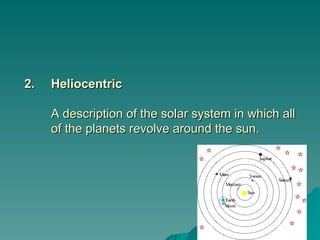
2. Heliocentric
Heliocentric
A description of the solar system in which all
of the planets revolve around the sun.
3.
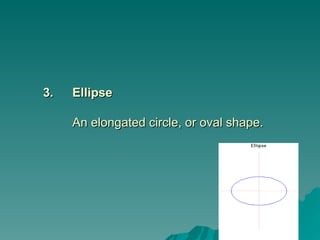
3. Ellipse
Ellipse
An elongated circle, or oval shape.
4.
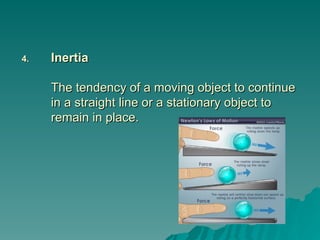
4. Inertia
Inertia
The tendency of a moving object to continue
in a straight line or a stationary object to
remain in place.
remain in place.
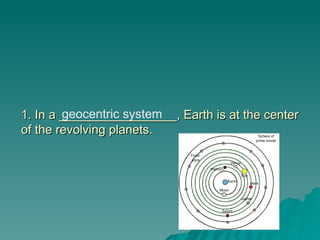
1. In a _________________, Earth is at the center
of the revolving planets.
geocentric system
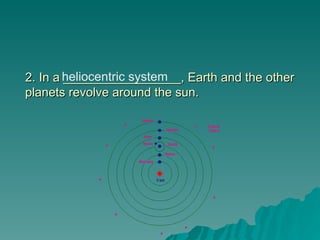
2. In a _________________, Earth and the other
planets revolve around the sun.
heliocentric system
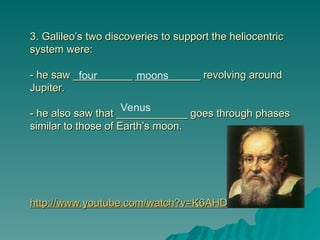
3. Galileo’s two discoveries to support the heliocentric
system were:
system were:
- he saw __________ ___________ revolving around
Jupiter.
Jupiter.
- he also saw that ____________ goes through phases
similar to those of Earth’s moon.
http://www.youtube.com/watch?v=K6AHDhmJXKo
four moons
Venus
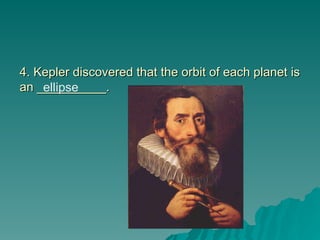
4. Kepler discovered that the orbit of each planet is
an __________.
an __________.
ellipse
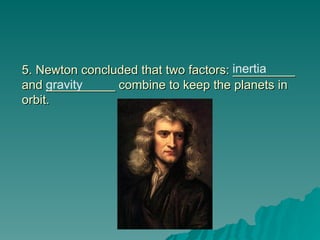
5. Newton concluded that two factors: _________
and __________ combine to keep the planets in
orbit.
orbit.
inertia
gravity
Chapter 2 The Solar
Chapter 2 The Solar
System
System
Section 2 The Sun
Section 2 The Sun
Ch. 2, section 2 The Sun
Objectives
Objectives
 Explain how the sun gets its energy
Explain how the sun gets its energy
 Identify the layers of the sun’s
Identify the layers of the sun’s
atmosphere
atmosphere
 Describe some features of the sun’s
Describe some features of the sun’s
surface
surface
1.
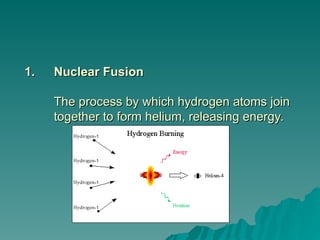
1. Nuclear Fusion
Nuclear Fusion
The process by which hydrogen atoms join
together to form helium, releasing energy.
2.
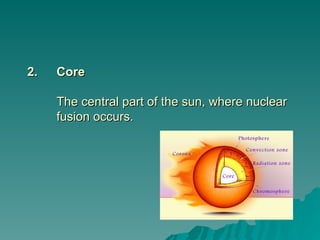
2. Core
Core
The central part of the sun, where nuclear
fusion occurs.
fusion occurs.
3.
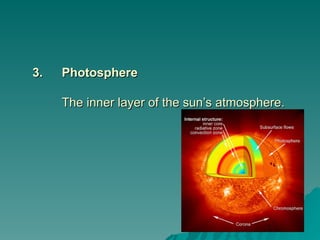
3. Photosphere
Photosphere
The inner layer of the sun’s atmosphere.
4.
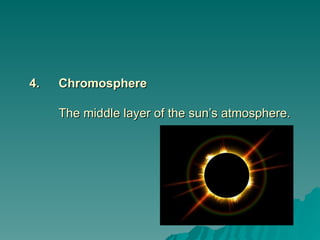
4. Chromosphere
Chromosphere
The middle layer of the sun’s atmosphere.
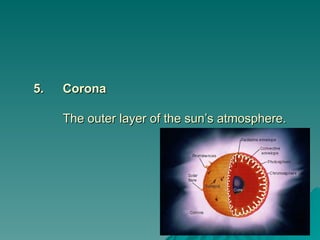
5.
5. Corona
Corona
The outer layer of the sun’s atmosphere.
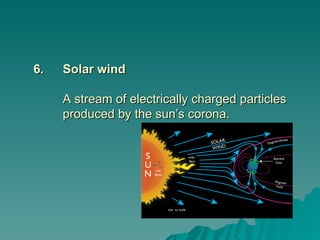
6.
6. Solar wind
Solar wind
A stream of electrically charged particles
produced by the sun’s corona.
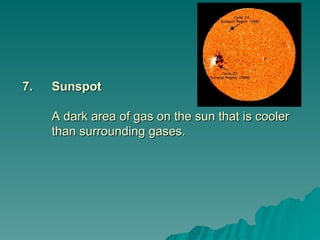
7.
7. Sunspot
Sunspot
A dark area of gas on the sun that is cooler
than surrounding gases.
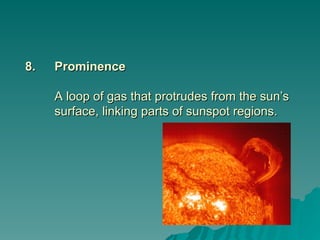
8.
8. Prominence
Prominence
A loop of gas that protrudes from the sun’s
surface, linking parts of sunspot regions.
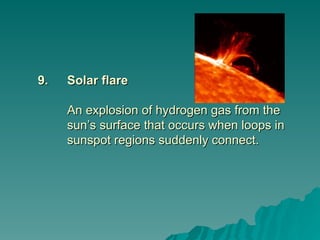
9.
9. Solar flare
Solar flare
An explosion of hydrogen gas from the
sun’s surface that occurs when loops in
sunspot regions suddenly connect.
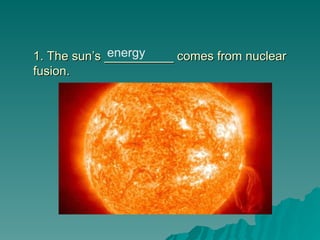
1. The sun’s __________ comes from nuclear
fusion.
fusion.
energy
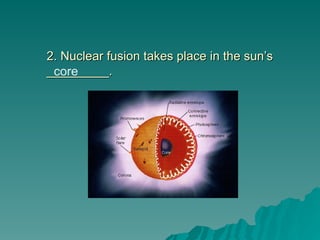
2. Nuclear fusion takes place in the sun’s
_________.
_________.
core
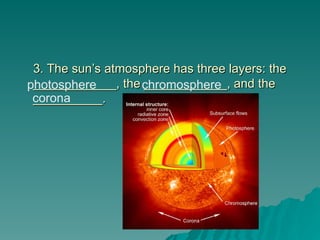
3. The sun’s atmosphere has three layers: the
____________, the ____________, and the
__________.
__________.
photosphere chromosphere
corona
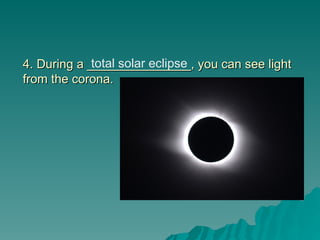
4. During a _______________, you can see light
from the corona.
from the corona.
total solar eclipse
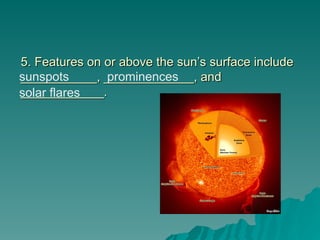
5. Features on or above the sun’s surface include
___________, _____________, and
____________.
____________.
sunspots prominences
solar flares
Chapter 2 The Solar
Chapter 2 The Solar
System
System
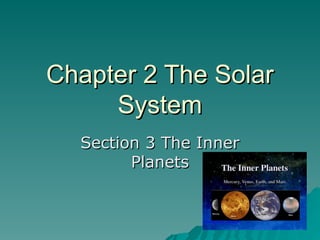
Section 3 The Inner
Section 3 The Inner
Planets
Planets
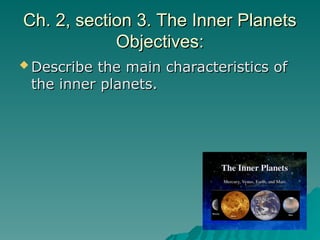
Ch. 2, section 3. The Inner Planets
Objectives:
Objectives:
 Describe the main characteristics of
Describe the main characteristics of
the inner planets.
the inner planets.
1.
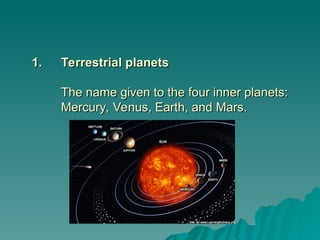
1. Terrestrial planets
Terrestrial planets
The name given to the four inner planets:
Mercury, Venus, Earth, and Mars.
2.
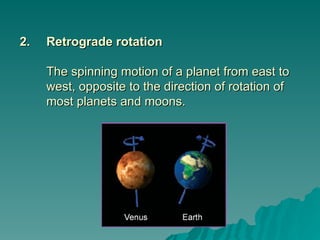
2. Retrograde rotation
Retrograde rotation
The spinning motion of a planet from east to
west, opposite to the direction of rotation of
most planets and moons.
3.
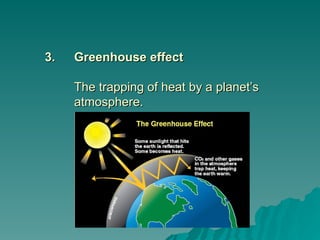
3. Greenhouse effect
Greenhouse effect
The trapping of heat by a planet’s
atmosphere.
atmosphere.
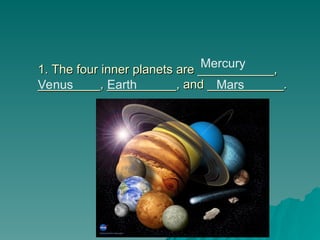
1. The four inner planets are ___________,
_________, __________, and ___________.
Mercury
Venus Earth Mars
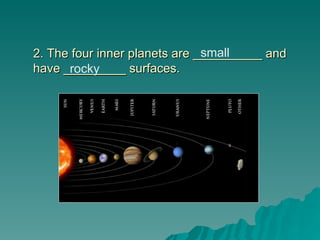
2. The four inner planets are __________ and
have _________ surfaces.
small
rocky
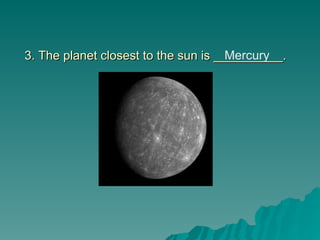
3. The planet closest to the sun is __________.
Mercury
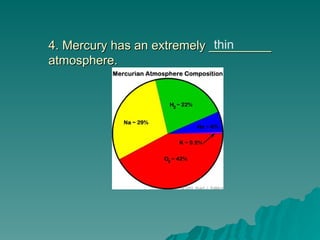
4. Mercury has an extremely _________
atmosphere.
atmosphere.
thin
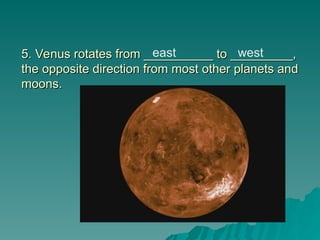
5. Venus rotates from __________ to _________,
the opposite direction from most other planets and
moons.
moons.
east west
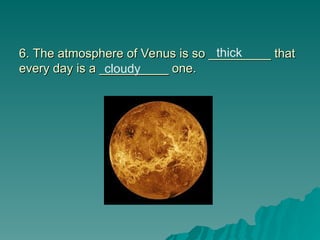
6. The atmosphere of Venus is so _________ that
every day is a __________ one.
thick
cloudy
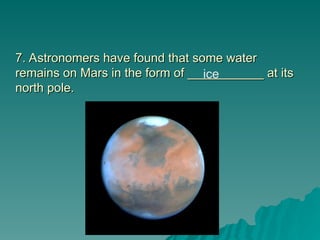
7. Astronomers have found that some water
remains on Mars in the form of ___________ at its
north pole.
north pole.
ice
Chapter 2 The Solar
Chapter 2 The Solar
System
System
Section 4 The Outer
Section 4 The Outer
Planets
Planets
Ch. 2, section 4. The outer planets
Objectives
Objectives
 Describe the main characteristics of
Describe the main characteristics of
the gas giant planets
 Explain how Pluto differs from the
Explain how Pluto differs from the
outer planets
outer planets
1.
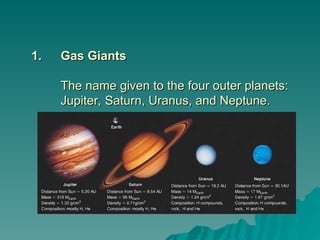
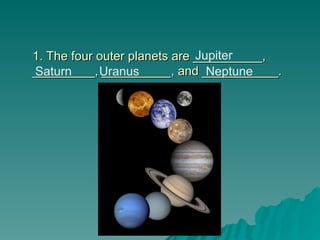
1. Gas Giants
Gas Giants
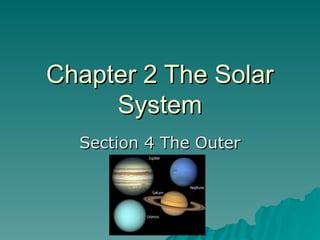
The name given to the four outer planets:
Jupiter, Saturn, Uranus, and Neptune.
1. The four outer planets are __________,
_________, __________, and ___________.
Jupiter
Saturn Uranus Neptune
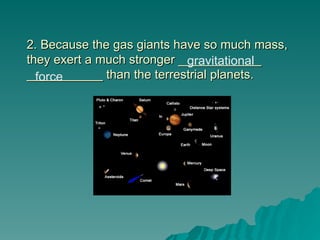
2. Because the gas giants have so much mass,
they exert a much stronger ____________
___________ than the terrestrial planets.
gravitational
force
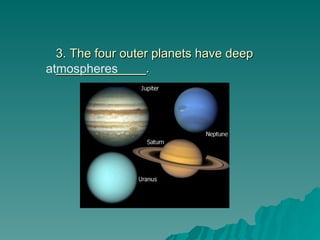
3. The four outer planets have deep
_____________.
_____________.
atmospheres
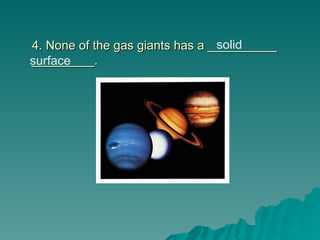
4. None of the gas giants has a __________
_________.
_________.
solid
surface
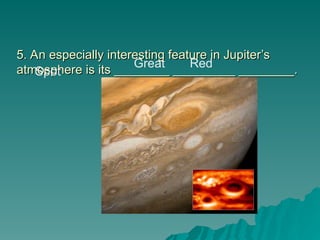
5. An especially interesting feature in Jupiter’s
atmosphere is its ________ _________ ________.
Great Red
Spot
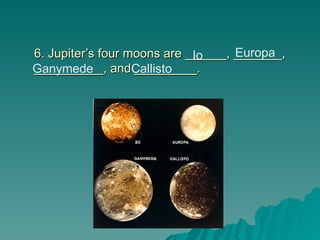
6. Jupiter’s four moons are ______, _______,
__________, and _________.
Io Europa
Ganymede Callisto
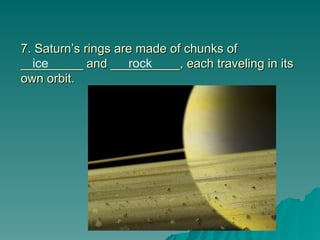
7. Saturn’s rings are made of chunks of
_________ and __________, each traveling in its
own orbit.
own orbit.
ice rock
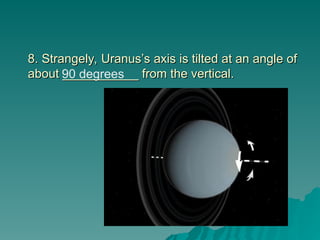
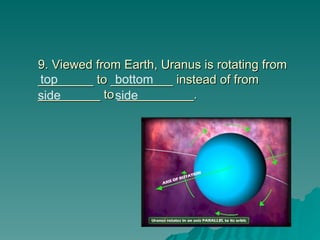
8. Strangely, Uranus’s axis is tilted at an angle of
about ___________ from the vertical.
90 degrees
9. Viewed from Earth, Uranus is rotating from
________ to _________ instead of from
_________ to ___________.
top bottom
side side
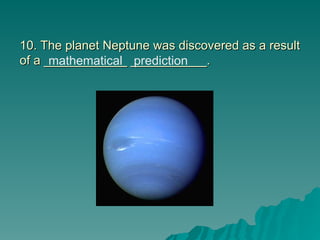
10. The planet Neptune was discovered as a result
of a ____________ ___________.
mathematical prediction
Chapter 2 The Solar
Chapter 2 The Solar
System
System
Section 5 Comets,
Section 5 Comets,
Asteroids, and Meteors
Ch. 2, section 5 Comets, Asteroids,
and Meteors Objectives
 Describe the characteristics of
Describe the characteristics of
comets and asteroids
 Identify where meteoroids come
Identify where meteoroids come
from
from
1.
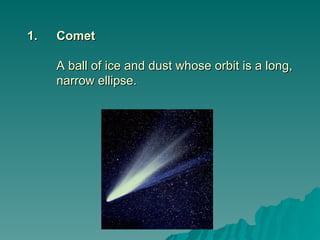
1. Comet
Comet
A ball of ice and dust whose orbit is a long,
narrow ellipse.
narrow ellipse.
2.
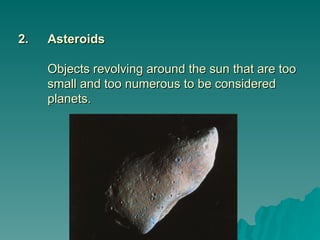
2. Asteroids
Asteroids
Objects revolving around the sun that are too
small and too numerous to be considered
planets.
planets.
3.
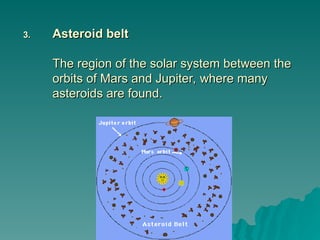
3. Asteroid belt
Asteroid belt
The region of the solar system between the
orbits of Mars and Jupiter, where many
asteroids are found.
4.
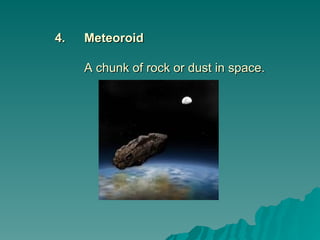
4. Meteoroid
Meteoroid
A chunk of rock or dust in space.
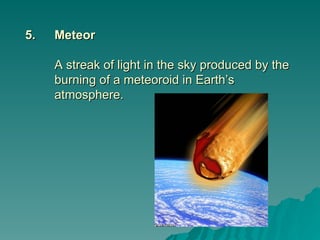
5.
5. Meteor
Meteor
A streak of light in the sky produced by the
burning of a meteoroid in Earth’s
atmosphere.
atmosphere.
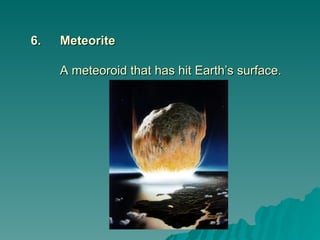
6.
6. Meteorite
Meteorite
A meteoroid that has hit Earth’s surface.
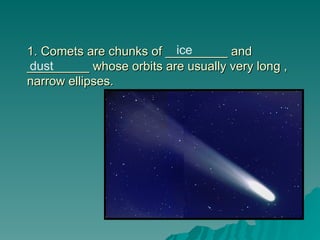
1. Comets are chunks of _________ and
_________ whose orbits are usually very long ,
narrow ellipses.
narrow ellipses.
ice
dust
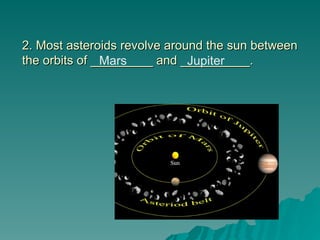
2. Most asteroids revolve around the sun between
the orbits of _________ and __________.
Mars Jupiter
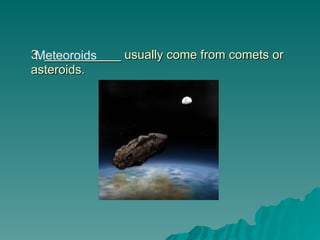
3. ___________ usually come from comets or
asteroids.
asteroids.
Meteoroids
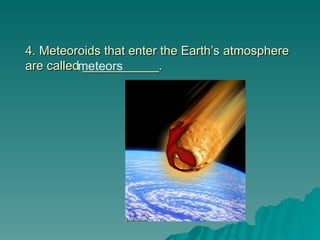
4. Meteoroids that enter the Earth’s atmosphere
are called ___________.
meteors
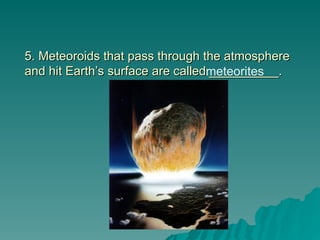
5. Meteoroids that pass through the atmosphere
and hit Earth’s surface are called __________.
meteorites
 Section 5 reading.
Section 5 reading.
 Video:
Video:
– Part 1: (9:22 minutes)
Part 1: (9:22 minutes)
– http://www.youtube.com/watch?v=dku64Ad3a
http://www.youtube.com/watch?v=dku64Ad3a
gA
gA
– Part 2 (10:20 minutes)
Part 2 (10:20 minutes)
http://www.youtube.com/watch?v=29byorgwM
GY
GY
Chapter 2 The Solar
Chapter 2 The Solar
System
System
Section 6 Is There Life
Beyond Earth?
Beyond Earth?
Ch. 2, section 6 Is There Life
Beyond Earth? Objectives
 Describe what living things need to
Describe what living things need to
exist on Earth
exist on Earth
 Explain why scientists are looking at
Explain why scientists are looking at
Mars and Europa for signs of life
1.
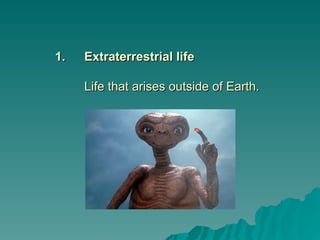
1. Extraterrestrial life
Extraterrestrial life
Life that arises outside of Earth.
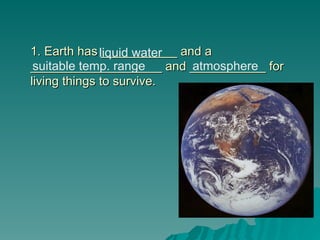
1. Earth has ___________ and a
___________________ and ___________ for
living things to survive.
liquid water
suitable temp. range atmosphere
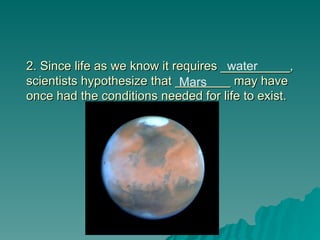
2. Since life as we know it requires __________,
scientists hypothesize that ________ may have
once had the conditions needed for life to exist.
water
Mars
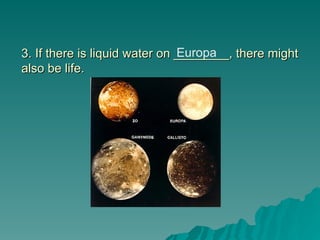
3. If there is liquid water on ________, there might
also be life.
also be life.
Europa

6th grade science Chapter 2 The Solar System.ppt

  • 1.
    Chapter 2 TheSolar Chapter 2 The Solar System System Section 1 Observing the Section 1 Observing the Solar System Solar System
  • 2.
    Ch. 2, section1 Observing the Ch. 2, section 1 Observing the Solar System Objectives Solar System Objectives  Explain how the heliocentric and Explain how the heliocentric and geocentric models of the solar geocentric models of the solar system differ system differ  Describe Kepler’s discovery about Describe Kepler’s discovery about the planet’s orbit the planet’s orbit  Identify two factors that keep the Identify two factors that keep the planets in their orbits. planets in their orbits.
  • 3.
    1. 1. Geocentric Geocentric A descriptionof the solar system in which A description of the solar system in which all of the planets revolve around Earth. all of the planets revolve around Earth.
  • 4.
    2. 2. Heliocentric Heliocentric A descriptionof the solar system in which all A description of the solar system in which all of the planets revolve around the sun. of the planets revolve around the sun.
  • 5.
    3. 3. Ellipse Ellipse An elongatedcircle, or oval shape. An elongated circle, or oval shape.
  • 6.
    4. 4. Inertia Inertia The tendencyof a moving object to continue The tendency of a moving object to continue in a straight line or a stationary object to in a straight line or a stationary object to remain in place. remain in place.
  • 7.
    1. In a_________________, Earth is at the center 1. In a _________________, Earth is at the center of the revolving planets. of the revolving planets. geocentric system
  • 8.
    2. In a_________________, Earth and the other 2. In a _________________, Earth and the other planets revolve around the sun. planets revolve around the sun. heliocentric system
  • 9.
    3. Galileo’s twodiscoveries to support the heliocentric 3. Galileo’s two discoveries to support the heliocentric system were: system were: - he saw __________ ___________ revolving around - he saw __________ ___________ revolving around Jupiter. Jupiter. - he also saw that ____________ goes through phases - he also saw that ____________ goes through phases similar to those of Earth’s moon. similar to those of Earth’s moon. http://www.youtube.com/watch?v=K6AHDhmJXKo http://www.youtube.com/watch?v=K6AHDhmJXKo four moons Venus
  • 10.
    4. Kepler discoveredthat the orbit of each planet is 4. Kepler discovered that the orbit of each planet is an __________. an __________. ellipse
  • 11.
    5. Newton concludedthat two factors: _________ 5. Newton concluded that two factors: _________ and __________ combine to keep the planets in and __________ combine to keep the planets in orbit. orbit. inertia gravity
  • 12.
    Chapter 2 TheSolar Chapter 2 The Solar System System Section 2 The Sun Section 2 The Sun
  • 13.
    Ch. 2, section2 The Sun Ch. 2, section 2 The Sun Objectives Objectives  Explain how the sun gets its energy Explain how the sun gets its energy  Identify the layers of the sun’s Identify the layers of the sun’s atmosphere atmosphere  Describe some features of the sun’s Describe some features of the sun’s surface surface
  • 14.
    1. 1. Nuclear Fusion NuclearFusion The process by which hydrogen atoms join The process by which hydrogen atoms join together to form helium, releasing energy. together to form helium, releasing energy.
  • 15.
    2. 2. Core Core The centralpart of the sun, where nuclear The central part of the sun, where nuclear fusion occurs. fusion occurs.
  • 16.
    3. 3. Photosphere Photosphere The innerlayer of the sun’s atmosphere. The inner layer of the sun’s atmosphere.
  • 17.
    4. 4. Chromosphere Chromosphere The middlelayer of the sun’s atmosphere. The middle layer of the sun’s atmosphere.
  • 18.
    5. 5. Corona Corona The outerlayer of the sun’s atmosphere. The outer layer of the sun’s atmosphere.
  • 19.
    6. 6. Solar wind Solarwind A stream of electrically charged particles A stream of electrically charged particles produced by the sun’s corona. produced by the sun’s corona.
  • 20.
    7. 7. Sunspot Sunspot A darkarea of gas on the sun that is cooler A dark area of gas on the sun that is cooler than surrounding gases. than surrounding gases.
  • 21.
    8. 8. Prominence Prominence A loopof gas that protrudes from the sun’s A loop of gas that protrudes from the sun’s surface, linking parts of sunspot regions. surface, linking parts of sunspot regions.
  • 22.
    9. 9. Solar flare Solarflare An explosion of hydrogen gas from the An explosion of hydrogen gas from the sun’s surface that occurs when loops in sun’s surface that occurs when loops in sunspot regions suddenly connect. sunspot regions suddenly connect.
  • 23.
    1. The sun’s__________ comes from nuclear 1. The sun’s __________ comes from nuclear fusion. fusion. energy
  • 24.
    2. Nuclear fusiontakes place in the sun’s 2. Nuclear fusion takes place in the sun’s _________. _________. core
  • 25.
    3. The sun’satmosphere has three layers: the 3. The sun’s atmosphere has three layers: the ____________, the ____________, and the ____________, the ____________, and the __________. __________. photosphere chromosphere corona
  • 26.
    4. During a_______________, you can see light 4. During a _______________, you can see light from the corona. from the corona. total solar eclipse
  • 27.
    5. Features onor above the sun’s surface include 5. Features on or above the sun’s surface include ___________, _____________, and ___________, _____________, and ____________. ____________. sunspots prominences solar flares
  • 28.
    Chapter 2 TheSolar Chapter 2 The Solar System System Section 3 The Inner Section 3 The Inner Planets Planets
  • 29.
    Ch. 2, section3. The Inner Planets Ch. 2, section 3. The Inner Planets Objectives: Objectives:  Describe the main characteristics of Describe the main characteristics of the inner planets. the inner planets.
  • 30.
    1. 1. Terrestrial planets Terrestrialplanets The name given to the four inner planets: The name given to the four inner planets: Mercury, Venus, Earth, and Mars. Mercury, Venus, Earth, and Mars.
  • 31.
    2. 2. Retrograde rotation Retrograderotation The spinning motion of a planet from east to The spinning motion of a planet from east to west, opposite to the direction of rotation of west, opposite to the direction of rotation of most planets and moons. most planets and moons.
  • 32.
    3. 3. Greenhouse effect Greenhouseeffect The trapping of heat by a planet’s The trapping of heat by a planet’s atmosphere. atmosphere.
  • 33.
    1. The fourinner planets are ___________, 1. The four inner planets are ___________, _________, __________, and ___________. _________, __________, and ___________. Mercury Venus Earth Mars
  • 34.
    2. The fourinner planets are __________ and 2. The four inner planets are __________ and have _________ surfaces. have _________ surfaces. small rocky
  • 35.
    3. The planetclosest to the sun is __________. 3. The planet closest to the sun is __________. Mercury
  • 36.
    4. Mercury hasan extremely _________ 4. Mercury has an extremely _________ atmosphere. atmosphere. thin
  • 37.
    5. Venus rotatesfrom __________ to _________, 5. Venus rotates from __________ to _________, the opposite direction from most other planets and the opposite direction from most other planets and moons. moons. east west
  • 38.
    6. The atmosphereof Venus is so _________ that 6. The atmosphere of Venus is so _________ that every day is a __________ one. every day is a __________ one. thick cloudy
  • 39.
    7. Astronomers havefound that some water 7. Astronomers have found that some water remains on Mars in the form of ___________ at its remains on Mars in the form of ___________ at its north pole. north pole. ice
  • 40.
    Chapter 2 TheSolar Chapter 2 The Solar System System Section 4 The Outer Section 4 The Outer Planets Planets
  • 41.
    Ch. 2, section4. The outer planets Ch. 2, section 4. The outer planets Objectives Objectives  Describe the main characteristics of Describe the main characteristics of the gas giant planets the gas giant planets  Explain how Pluto differs from the Explain how Pluto differs from the outer planets outer planets
  • 42.
    1. 1. Gas Giants GasGiants The name given to the four outer planets: The name given to the four outer planets: Jupiter, Saturn, Uranus, and Neptune. Jupiter, Saturn, Uranus, and Neptune.
  • 43.
    1. The fourouter planets are __________, 1. The four outer planets are __________, _________, __________, and ___________. _________, __________, and ___________. Jupiter Saturn Uranus Neptune
  • 44.
    2. Because thegas giants have so much mass, 2. Because the gas giants have so much mass, they exert a much stronger ____________ they exert a much stronger ____________ ___________ than the terrestrial planets. ___________ than the terrestrial planets. gravitational force
  • 45.
    3. The fourouter planets have deep 3. The four outer planets have deep _____________. _____________. atmospheres
  • 46.
    4. None ofthe gas giants has a __________ 4. None of the gas giants has a __________ _________. _________. solid surface
  • 47.
    5. An especiallyinteresting feature in Jupiter’s 5. An especially interesting feature in Jupiter’s atmosphere is its ________ _________ ________. atmosphere is its ________ _________ ________. Great Red Spot
  • 48.
    6. Jupiter’s fourmoons are ______, _______, 6. Jupiter’s four moons are ______, _______, __________, and _________. __________, and _________. Io Europa Ganymede Callisto
  • 49.
    7. Saturn’s ringsare made of chunks of 7. Saturn’s rings are made of chunks of _________ and __________, each traveling in its _________ and __________, each traveling in its own orbit. own orbit. ice rock
  • 50.
    8. Strangely, Uranus’saxis is tilted at an angle of 8. Strangely, Uranus’s axis is tilted at an angle of about ___________ from the vertical. about ___________ from the vertical. 90 degrees
  • 51.
    9. Viewed fromEarth, Uranus is rotating from 9. Viewed from Earth, Uranus is rotating from ________ to _________ instead of from ________ to _________ instead of from _________ to ___________. _________ to ___________. top bottom side side
  • 52.
    10. The planetNeptune was discovered as a result 10. The planet Neptune was discovered as a result of a ____________ ___________. of a ____________ ___________. mathematical prediction
  • 53.
    Chapter 2 TheSolar Chapter 2 The Solar System System Section 5 Comets, Section 5 Comets, Asteroids, and Meteors Asteroids, and Meteors
  • 54.
    Ch. 2, section5 Comets, Asteroids, Ch. 2, section 5 Comets, Asteroids, and Meteors Objectives and Meteors Objectives  Describe the characteristics of Describe the characteristics of comets and asteroids comets and asteroids  Identify where meteoroids come Identify where meteoroids come from from
  • 55.
    1. 1. Comet Comet A ballof ice and dust whose orbit is a long, A ball of ice and dust whose orbit is a long, narrow ellipse. narrow ellipse.
  • 56.
    2. 2. Asteroids Asteroids Objects revolvingaround the sun that are too Objects revolving around the sun that are too small and too numerous to be considered small and too numerous to be considered planets. planets.
  • 57.
    3. 3. Asteroid belt Asteroidbelt The region of the solar system between the The region of the solar system between the orbits of Mars and Jupiter, where many orbits of Mars and Jupiter, where many asteroids are found. asteroids are found.
  • 58.
    4. 4. Meteoroid Meteoroid A chunkof rock or dust in space. A chunk of rock or dust in space.
  • 59.
    5. 5. Meteor Meteor A streakof light in the sky produced by the A streak of light in the sky produced by the burning of a meteoroid in Earth’s burning of a meteoroid in Earth’s atmosphere. atmosphere.
  • 60.
    6. 6. Meteorite Meteorite A meteoroidthat has hit Earth’s surface. A meteoroid that has hit Earth’s surface.
  • 61.
    1. Comets arechunks of _________ and 1. Comets are chunks of _________ and _________ whose orbits are usually very long , _________ whose orbits are usually very long , narrow ellipses. narrow ellipses. ice dust
  • 62.
    2. Most asteroidsrevolve around the sun between 2. Most asteroids revolve around the sun between the orbits of _________ and __________. the orbits of _________ and __________. Mars Jupiter
  • 63.
    3. ___________ usuallycome from comets or 3. ___________ usually come from comets or asteroids. asteroids. Meteoroids
  • 64.
    4. Meteoroids thatenter the Earth’s atmosphere 4. Meteoroids that enter the Earth’s atmosphere are called ___________. are called ___________. meteors
  • 65.
    5. Meteoroids thatpass through the atmosphere 5. Meteoroids that pass through the atmosphere and hit Earth’s surface are called __________. and hit Earth’s surface are called __________. meteorites
  • 66.
     Section 5reading. Section 5 reading.  Video: Video: – Part 1: (9:22 minutes) Part 1: (9:22 minutes) – http://www.youtube.com/watch?v=dku64Ad3a http://www.youtube.com/watch?v=dku64Ad3a gA gA – Part 2 (10:20 minutes) Part 2 (10:20 minutes) http://www.youtube.com/watch?v=29byorgwM http://www.youtube.com/watch?v=29byorgwM GY GY
  • 67.
    Chapter 2 TheSolar Chapter 2 The Solar System System Section 6 Is There Life Section 6 Is There Life Beyond Earth? Beyond Earth?
  • 68.
    Ch. 2, section6 Is There Life Ch. 2, section 6 Is There Life Beyond Earth? Objectives Beyond Earth? Objectives  Describe what living things need to Describe what living things need to exist on Earth exist on Earth  Explain why scientists are looking at Explain why scientists are looking at Mars and Europa for signs of life Mars and Europa for signs of life
  • 69.
    1. 1. Extraterrestrial life Extraterrestriallife Life that arises outside of Earth. Life that arises outside of Earth.
  • 70.
    1. Earth has___________ and a 1. Earth has ___________ and a ___________________ and ___________ for ___________________ and ___________ for living things to survive. living things to survive. liquid water suitable temp. range atmosphere
  • 71.
    2. Since lifeas we know it requires __________, 2. Since life as we know it requires __________, scientists hypothesize that ________ may have scientists hypothesize that ________ may have once had the conditions needed for life to exist. once had the conditions needed for life to exist. water Mars
  • 72.
    3. If thereis liquid water on ________, there might 3. If there is liquid water on ________, there might also be life. also be life. Europa