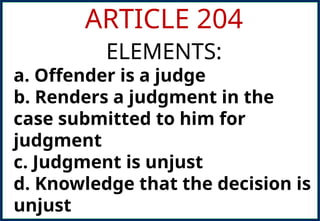
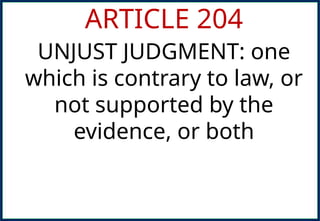
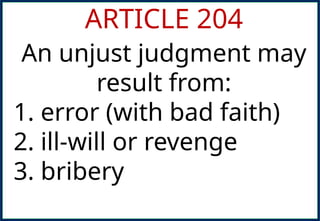
ARTICLE 204
ELEMENTS:
a. Offenderis a judge
b. Renders a judgment in the
case submitted to him for
judgment
c. Judgment is unjust
d. Knowledge that the decision is
unjust
7.
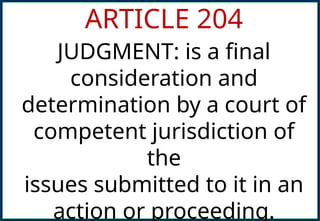
ARTICLE 204
JUDGMENT: isa final
consideration and
determination by a court of
competent jurisdiction of
the
issues submitted to it in an
action or proceeding.
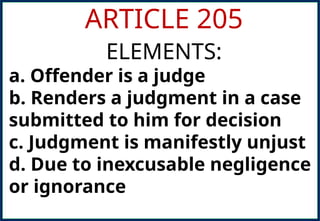
ARTICLE 205
ELEMENTS:
a. Offenderis a judge
b. Renders a judgment in a case
submitted to him for decision
c. Judgment is manifestly unjust
d. Due to inexcusable negligence
or ignorance
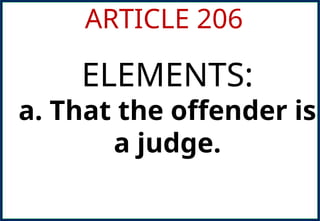
ARTICLE 206
ELEMENTS:
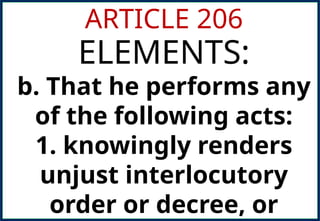
b. Thathe performs any
of the following acts:
1. knowingly renders
unjust interlocutory
order or decree, or
15.
ARTICLE 206
ELEMENTS:
b. Thathe performs any
of the following acts:
2. renders a manifestly unjust
interlocutory order or decree
through inexcusable
negligence or ignorance.
16.
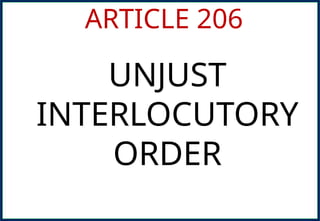
ARTICLE 206
INTERLOCUTORY ORDER:one
issued by the court deciding
a collateral or incidental
matter. It is not a final
determination of the issues
of the action or proceeding
ARTICLE 207
ELEMENTS:
a. Thatthe offender is a
judge.
b. That there is a proceeding
in his court.
c. That he delays the
administration of justice.
19.
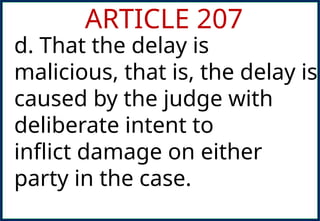
ARTICLE 207
d. Thatthe delay is
malicious, that is, the delay is
caused by the judge with
deliberate intent to
inflict damage on either
party in the case.
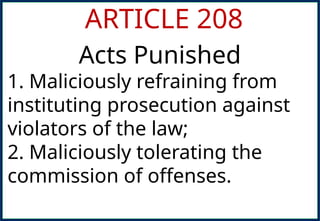
ARTICLE 208
Acts Punished
1.Maliciously refraining from
instituting prosecution against
violators of the law;
2. Maliciously tolerating the
commission of offenses.
24.
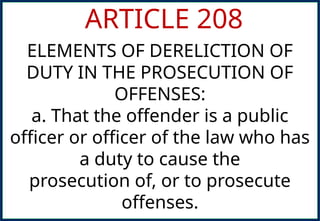
ARTICLE 208
ELEMENTS OFDERELICTION OF
DUTY IN THE PROSECUTION OF
OFFENSES:
a. That the offender is a public
officer or officer of the law who has
a duty to cause the
prosecution of, or to prosecute
offenses.
25.
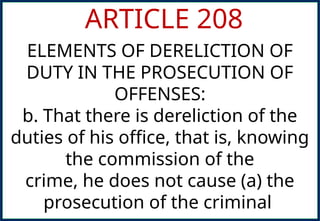
ARTICLE 208
ELEMENTS OFDERELICTION OF
DUTY IN THE PROSECUTION OF
OFFENSES:
b. That there is dereliction of the
duties of his office, that is, knowing
the commission of the
crime, he does not cause (a) the
prosecution of the criminal
26.
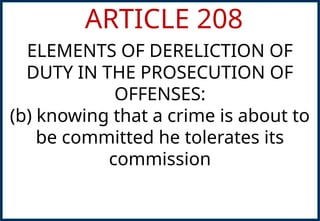
ARTICLE 208
ELEMENTS OFDERELICTION OF
DUTY IN THE PROSECUTION OF
OFFENSES:
(b) knowing that a crime is about to
be committed he tolerates its
commission
27.
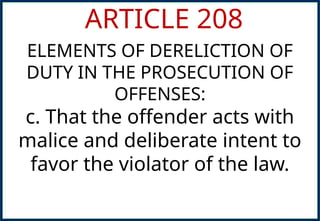
ARTICLE 208
ELEMENTS OFDERELICTION OF
DUTY IN THE PROSECUTION OF
OFFENSES:
c. That the offender acts with
malice and deliberate intent to
favor the violator of the law.
ARTICLE 209
ACTS PUNISHED:
a.Causing damage to client
(prejudice is essential) either
1. by any malicious breach of
professional duty, or
2. by inexcusable negligence or
ignorance.
31.
ARTICLE 209
ACTS PUNISHED:
b.Revealing any of the secrets of
his client learned by him in his
professional capacity
(damage not necessary
32.
ARTICLE 209
ACTS PUNISHED:
c.Undertaking the defense of
the opposing party of the 1st
client and/or having received
confidential information from
the latter and without the latter’s
consent
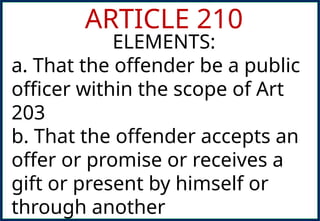
ARTICLE 210
ELEMENTS:
a. Thatthe offender be a public
officer within the scope of Art
203
b. That the offender accepts an
offer or promise or receives a
gift or present by himself or
through another
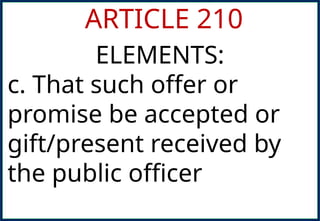
ARTICLE 210
ELEMENTS:
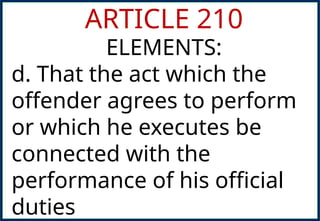
d. Thatthe act which the
offender agrees to perform
or which he executes be
connected with the
performance of his official
duties
37.
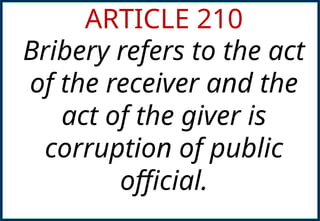
ARTICLE 210
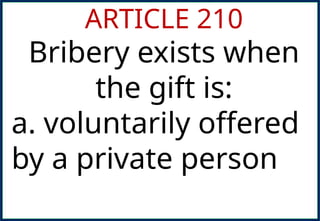
Bribery refersto the act
of the receiver and the
act of the giver is
corruption of public
official.
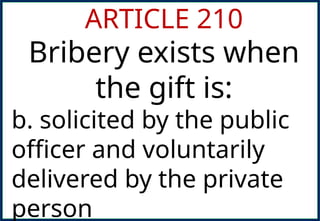
ARTICLE 210
Bribery existswhen
the gift is:
b. solicited by the public
officer and voluntarily
delivered by the private
person
41.
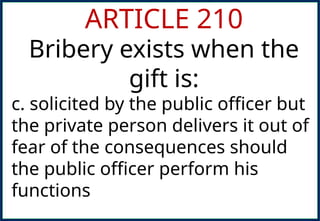
ARTICLE 210
Bribery existswhen the
gift is:
c. solicited by the public officer but
the private person delivers it out of
fear of the consequences should
the public officer perform his
functions
ARTICLE 211
ELEMENTS:
a. Thatthe offender is a
public officer.
b. That he accepts gifts.
c. That the said gifts are
offered to him by reason of
his office.
44.
ARTICLE 211
The giftis given in
anticipation of future
favor from the public
officer
45.
ARTICLE 211
Public officersreceiving
gifts and private persons
giving gifts on any
occasion, including
Christmas
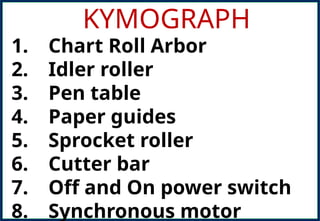
KYMOGRAPH
1. Chart RollArbor
2. Idler roller
3. Pen table
4. Paper guides
5. Sprocket roller
6. Cutter bar
7. Off and On power switch
8. Synchronous motor