Making Major Decisions -
Preparing Your Narrative
Unit 23
ASL III
Introduction
Life is full of decisions that range from as simple
as what to eat at a restaurant to as complex as
where to live. For major decisions people make
lists of pros and cons, gather information, and
solicit the opinions of experts or of family and
friends. Making major decisions is a process.
Everyone can describe what they went through to
make a decision like choosing a college or a
career, moving to another city or state, getting
married, getting a divorce, having a baby, buying
a car, finding an apartment, or buying a house.
Goal of the Unit
This unit is to help you expand your vocabulary and
develop conversational fluency by encouraging you
to discuss your experiences. You will develop skills
enabling you to talk about the choices you had at the
beginning, the criteria you used to evaluate options,
what you chose, and how you felt about the decisions
you made. Then you will use those same skills to
retell information told to you by others. You will
rehearse conversation skills such as asking for
clarification, elaborating, and sharing opinions.
Preparing Your Narrative: Telling
about a Major Decision
In order to prepare to sign a narrative about a major
life decision you have made, use the following
Narrative Structure:
1. Explain the situation.
2. Explain the problems/issues.
3. Tell what experiences/information you drew on to
plan the next step.
4. Tell how you arrived at your decision.
5. Tell how you feel about your decision now.
Preparing Your Narrative:
Describing the Process
When discussing your process for making a decision,
not all events or steps are equally important, so you
need to incorporate language that allow you to “fast
forward” your story to significant events and yet give
your listener a sense of what happened in the interim.
Here are language tools you might find helpful.
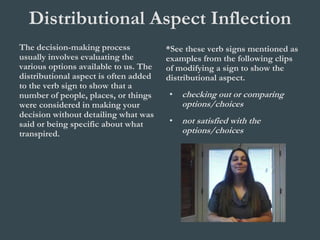
Distributional Aspect Inflection
The decision-making process
usually involves evaluating the
various options available to us. The
distributional aspect is often added
to the verb sign to show that a
number of people, places, or things
were considered in making your
decision without detailing what was
said or being specific about what
transpired.
*See these verb signs mentioned as
examples from the following clips
of modifying a sign to show the
distributional aspect.
• checking out or comparing
options/choices
• not satisfied with the
options/choices
Distributional Aspect Inflection
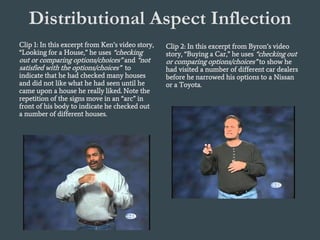
Clip 1: In this excerpt from Ken’s video story,
“Looking for a House,” he uses “checking
out or comparing options/choices” and “not
satisfied with the options/choices” to
indicate that he had checked many houses
and did not like what he had seen until he
came upon a house he really liked. Note the
repetition of the signs move in an “arc” in
front of his body to indicate he checked out
a number of different houses.
Clip 2: In this excerpt from Byron’s video
story, “Buying a Car,” he uses “checking out
or comparing options/choices” to show he
had visited a number of different car dealers
before he narrowed his options to a Nissan
or a Toyota.
Continuous Aspect Inflection
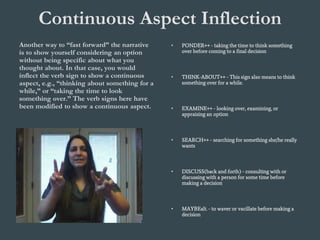
Another way to “fast forward” the narrative
is to show yourself considering an option
without being specific about what you
thought about. In that case, you would
inflect the verb sign to show a continuous
aspect, e.g., “thinking about something for a
while,” or “taking the time to look
something over.” The verb signs here have
been modified to show a continuous aspect.
• PONDER++ - taking the time to think something
over before coming to a final decision
• THINK-ABOUT++ - This sign also means to think
something over for a while.
• EXAMINE++ - looking over, examining, or
appraising an option
• SEARCH++ - searching for something she/he really
wants
• DISCUSS(back and forth) - consulting with or
discussing with a person for some time before
making a decision
• MAYBEalt. - to waver or vacillate before making a
decision
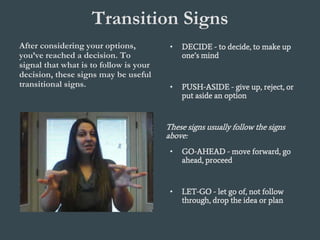
Transition Signs
After considering your options,
you’ve reached a decision. To
signal that what is to follow is your
decision, these signs may be useful
transitional signs.
• DECIDE - to decide, to make up
one’s mind
• PUSH-ASIDE - give up, reject, or
put aside an option
These signs usually follow the signs
above:
• GO-AHEAD - move forward, go
ahead, proceed
• LET-GO - let go of, not follow
through, drop the idea or plan
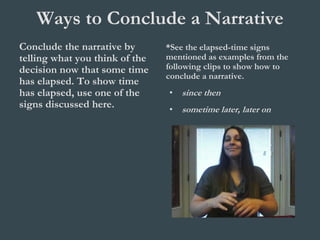
Ways to Conclude a Narrative
Conclude the narrative by
telling what you think of the
decision now that some time
has elapsed. To show time
has elapsed, use one of the
signs discussed here.
*See the elapsed-time signs
mentioned as examples from the
following clips to show how to
conclude a narrative.
• since then
• sometime later, later on
Ways to Conclude a Narrative
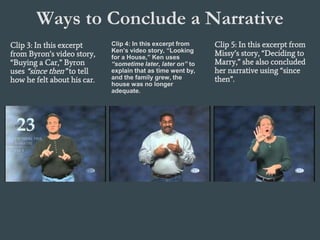
Clip 3: In this excerpt
from Byron’s video story,
“Buying a Car,” Byron
uses “since then” to tell
how he felt about his car.
Clip 5: In this excerpt from
Missy’s story, “Deciding to
Marry,” she also concluded
her narrative using “since
then”.
Clip 4: In this excerpt from
Ken’s video story, “Looking
for a House,” Ken uses
“sometime later, later on” to
explain that as time went by,
and the family grew, the
house was no longer
adequate.
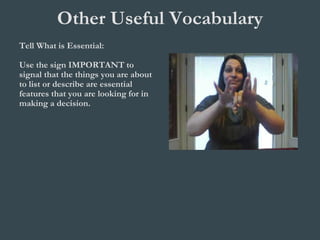
Other Useful Vocabulary
Tell What is Essential:
Use the sign IMPORTANT to
signal that the things you are about
to list or describe are essential
features that you are looking for in
making a decision.
Other Useful Vocabulary
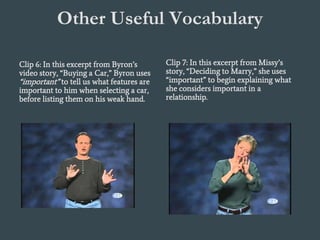
Tell What is Essential:
Clip 6: In this excerpt from Byron’s
video story, “Buying a Car,” Byron uses
“important” to tell us what features are
important to him when selecting a car,
before listing them on his weak hand.
Clip 7: In this excerpt from Missy’s
story, “Deciding to Marry,” she uses
“important” to begin explaining what
she considers important in a
relationship.
Other Useful Vocabulary
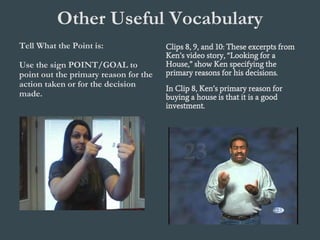
Tell What the Point is:
Use the sign POINT/GOAL to
point out the primary reason for the
action taken or for the decision
made.
Clips 8, 9, and 10: These excerpts from
Ken’s video story, “Looking for a
House,” show Ken specifying the
primary reasons for his decisions.
In Clip 8, Ken’s primary reason for
buying a house is that it is a good
investment.
Other Useful Vocabulary
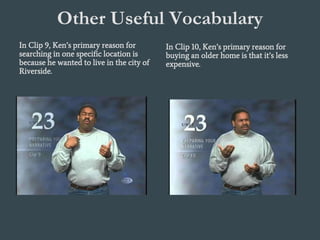
In Clip 9, Ken’s primary reason for
searching in one specific location is
because he wanted to live in the city of
Riverside.
In Clip 10, Ken’s primary reason for
buying an older home is that it’s less
expensive.
Other Useful Vocabulary
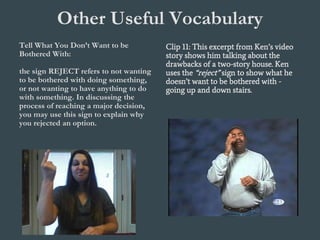
Tell What You Don’t Want to be
Bothered With:
the sign REJECT refers to not wanting
to be bothered with doing something,
or not wanting to have anything to do
with something. In discussing the
process of reaching a major decision,
you may use this sign to explain why
you rejected an option.
Clip 11: This excerpt from Ken’s video
story shows him talking about the
drawbacks of a two-story house. Ken
uses the “reject” sign to show what he
doesn’t want to be bothered with -
going up and down stairs.
Other Useful Vocabulary
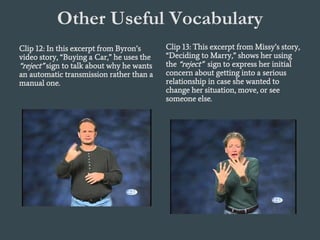
Clip 12: In this excerpt from Byron’s
video story, “Buying a Car,” he uses the
“reject” sign to talk about why he wants
an automatic transmission rather than a
manual one.
Clip 13: This excerpt from Missy’s story,
“Deciding to Marry,” shows her using
the “reject” sign to express her initial
concern about getting into a serious
relationship in case she wanted to
change her situation, move, or see
someone else.
Review for Assignment -
“Successful Conversation Tips”
1. checks for understanding - “you understand?” “make sense?”
“clear?”
2. asks clarification questions - “don’t-understand” “sign again
please” “sign slow” “fingerspell please” Then, ask specific
questions about the story to make sure you understand
correctly
3. adds/elaborates/clarifies unclear information - “yes, right,
(rephrase)” “no, wrong, me explain/clarify”
4. confirms understanding - “oh-I-see”, “I understand”, “haha,
funny”, “interesting”, “really?”
5. comments on the decision/retells decision/summarizes info -
start with “happen”
6. compliments - “I like, I agree, good decision, good job, nice
story”
7. mention possible problems to look for (“warning,
understand, careful, inform-you, problem”)
8. suggest ways to resolve any dissatisfaction with that decision
- “suggest-to-you” “resolve how” “tip” “fix I explain”
Note: make sure to stop signer throughout story when don’t
understand or have question - (wave hand), “hold-on”, “wait” “go
back” (confused facial expression), “huh” “question-wiggle”
Review
Throughout this presentation, you have learned the following:
• Narrative Structure:
1. Explain the situation.
2. Explain the problems/issues.
3. Tell what experiences/information you drew on to plan the next step.
4. Tell how you arrived at your decision.
5. Tell how you feel about your decision now.
• “Fast Forward”/Language Tools
1. Distributional Aspect Inflection
2. Continuous Aspect Inflection
3. Transition Signs
4. Concluding a Narrative
5. Other Useful Vocabulary (what’s essential, what’s the point, and rejection)
• Successful Conversation Tips

6c. Making Major Decisions - Preparing Your Narrative

  • 1.
    Making Major Decisions- Preparing Your Narrative Unit 23 ASL III
  • 2.
    Introduction Life is fullof decisions that range from as simple as what to eat at a restaurant to as complex as where to live. For major decisions people make lists of pros and cons, gather information, and solicit the opinions of experts or of family and friends. Making major decisions is a process. Everyone can describe what they went through to make a decision like choosing a college or a career, moving to another city or state, getting married, getting a divorce, having a baby, buying a car, finding an apartment, or buying a house.
  • 3.
    Goal of theUnit This unit is to help you expand your vocabulary and develop conversational fluency by encouraging you to discuss your experiences. You will develop skills enabling you to talk about the choices you had at the beginning, the criteria you used to evaluate options, what you chose, and how you felt about the decisions you made. Then you will use those same skills to retell information told to you by others. You will rehearse conversation skills such as asking for clarification, elaborating, and sharing opinions.
  • 4.
    Preparing Your Narrative:Telling about a Major Decision In order to prepare to sign a narrative about a major life decision you have made, use the following Narrative Structure: 1. Explain the situation. 2. Explain the problems/issues. 3. Tell what experiences/information you drew on to plan the next step. 4. Tell how you arrived at your decision. 5. Tell how you feel about your decision now.
  • 5.
    Preparing Your Narrative: Describingthe Process When discussing your process for making a decision, not all events or steps are equally important, so you need to incorporate language that allow you to “fast forward” your story to significant events and yet give your listener a sense of what happened in the interim. Here are language tools you might find helpful.
  • 6.
    Distributional Aspect Inflection Thedecision-making process usually involves evaluating the various options available to us. The distributional aspect is often added to the verb sign to show that a number of people, places, or things were considered in making your decision without detailing what was said or being specific about what transpired. *See these verb signs mentioned as examples from the following clips of modifying a sign to show the distributional aspect. • checking out or comparing options/choices • not satisfied with the options/choices
  • 7.
    Distributional Aspect Inflection Clip1: In this excerpt from Ken’s video story, “Looking for a House,” he uses “checking out or comparing options/choices” and “not satisfied with the options/choices” to indicate that he had checked many houses and did not like what he had seen until he came upon a house he really liked. Note the repetition of the signs move in an “arc” in front of his body to indicate he checked out a number of different houses. Clip 2: In this excerpt from Byron’s video story, “Buying a Car,” he uses “checking out or comparing options/choices” to show he had visited a number of different car dealers before he narrowed his options to a Nissan or a Toyota.
  • 8.
    Continuous Aspect Inflection Anotherway to “fast forward” the narrative is to show yourself considering an option without being specific about what you thought about. In that case, you would inflect the verb sign to show a continuous aspect, e.g., “thinking about something for a while,” or “taking the time to look something over.” The verb signs here have been modified to show a continuous aspect. • PONDER++ - taking the time to think something over before coming to a final decision • THINK-ABOUT++ - This sign also means to think something over for a while. • EXAMINE++ - looking over, examining, or appraising an option • SEARCH++ - searching for something she/he really wants • DISCUSS(back and forth) - consulting with or discussing with a person for some time before making a decision • MAYBEalt. - to waver or vacillate before making a decision
  • 9.
    Transition Signs After consideringyour options, you’ve reached a decision. To signal that what is to follow is your decision, these signs may be useful transitional signs. • DECIDE - to decide, to make up one’s mind • PUSH-ASIDE - give up, reject, or put aside an option These signs usually follow the signs above: • GO-AHEAD - move forward, go ahead, proceed • LET-GO - let go of, not follow through, drop the idea or plan
  • 10.
    Ways to Concludea Narrative Conclude the narrative by telling what you think of the decision now that some time has elapsed. To show time has elapsed, use one of the signs discussed here. *See the elapsed-time signs mentioned as examples from the following clips to show how to conclude a narrative. • since then • sometime later, later on
  • 11.
    Ways to Concludea Narrative Clip 3: In this excerpt from Byron’s video story, “Buying a Car,” Byron uses “since then” to tell how he felt about his car. Clip 5: In this excerpt from Missy’s story, “Deciding to Marry,” she also concluded her narrative using “since then”. Clip 4: In this excerpt from Ken’s video story, “Looking for a House,” Ken uses “sometime later, later on” to explain that as time went by, and the family grew, the house was no longer adequate.
  • 12.
    Other Useful Vocabulary TellWhat is Essential: Use the sign IMPORTANT to signal that the things you are about to list or describe are essential features that you are looking for in making a decision.
  • 13.
    Other Useful Vocabulary TellWhat is Essential: Clip 6: In this excerpt from Byron’s video story, “Buying a Car,” Byron uses “important” to tell us what features are important to him when selecting a car, before listing them on his weak hand. Clip 7: In this excerpt from Missy’s story, “Deciding to Marry,” she uses “important” to begin explaining what she considers important in a relationship.
  • 14.
    Other Useful Vocabulary TellWhat the Point is: Use the sign POINT/GOAL to point out the primary reason for the action taken or for the decision made. Clips 8, 9, and 10: These excerpts from Ken’s video story, “Looking for a House,” show Ken specifying the primary reasons for his decisions. In Clip 8, Ken’s primary reason for buying a house is that it is a good investment.
  • 15.
    Other Useful Vocabulary InClip 9, Ken’s primary reason for searching in one specific location is because he wanted to live in the city of Riverside. In Clip 10, Ken’s primary reason for buying an older home is that it’s less expensive.
  • 16.
    Other Useful Vocabulary TellWhat You Don’t Want to be Bothered With: the sign REJECT refers to not wanting to be bothered with doing something, or not wanting to have anything to do with something. In discussing the process of reaching a major decision, you may use this sign to explain why you rejected an option. Clip 11: This excerpt from Ken’s video story shows him talking about the drawbacks of a two-story house. Ken uses the “reject” sign to show what he doesn’t want to be bothered with - going up and down stairs.
  • 17.
    Other Useful Vocabulary Clip12: In this excerpt from Byron’s video story, “Buying a Car,” he uses the “reject” sign to talk about why he wants an automatic transmission rather than a manual one. Clip 13: This excerpt from Missy’s story, “Deciding to Marry,” shows her using the “reject” sign to express her initial concern about getting into a serious relationship in case she wanted to change her situation, move, or see someone else.
  • 18.
    Review for Assignment- “Successful Conversation Tips” 1. checks for understanding - “you understand?” “make sense?” “clear?” 2. asks clarification questions - “don’t-understand” “sign again please” “sign slow” “fingerspell please” Then, ask specific questions about the story to make sure you understand correctly 3. adds/elaborates/clarifies unclear information - “yes, right, (rephrase)” “no, wrong, me explain/clarify” 4. confirms understanding - “oh-I-see”, “I understand”, “haha, funny”, “interesting”, “really?” 5. comments on the decision/retells decision/summarizes info - start with “happen” 6. compliments - “I like, I agree, good decision, good job, nice story” 7. mention possible problems to look for (“warning, understand, careful, inform-you, problem”) 8. suggest ways to resolve any dissatisfaction with that decision - “suggest-to-you” “resolve how” “tip” “fix I explain” Note: make sure to stop signer throughout story when don’t understand or have question - (wave hand), “hold-on”, “wait” “go back” (confused facial expression), “huh” “question-wiggle”
  • 19.
    Review Throughout this presentation,you have learned the following: • Narrative Structure: 1. Explain the situation. 2. Explain the problems/issues. 3. Tell what experiences/information you drew on to plan the next step. 4. Tell how you arrived at your decision. 5. Tell how you feel about your decision now. • “Fast Forward”/Language Tools 1. Distributional Aspect Inflection 2. Continuous Aspect Inflection 3. Transition Signs 4. Concluding a Narrative 5. Other Useful Vocabulary (what’s essential, what’s the point, and rejection) • Successful Conversation Tips