Discussing Health Conditions:
Presentation
Unit 24
ASL III
Discussing Health
Conditions
In everyday conversations, you may find
yourselves in situations where you need to
explain complex ideas in ASL. This unit on
health introduces you to language skills that
will help you organize and discuss complex
topics.
Discussing Health
Conditions
This unit will prepare you to take complex
information written on a particular illness,
identify the important points to cover,
organize the information into three areas;
symptoms, causes, and treatments, and make a
concise 5-minute presentation.
Sample Presentation Parkinson’s
Disease: Questions and Answers
● Introduction
1. Parkinson’s disease is described as what?
What is it related to?
deterioration of movement
2. List the types of body movement mentioned.
opening/closing fingers, lifting arms, walking,
moving eyes around, blinking eyes, chewing and
swallowing food and then moving food down the
esophagus, stomach digesting food, and heart
pumping
3. Describe the symptoms associated with
Parkinson’s disease.
delayed response time to stop walking, to sitting
down and to getting up from a chair, hands
trembling (which is what most of us notice), legs
trembling, moving eyes slowly, blinking eyes
slowly, drooling, to absolute deterioration where
you can’t move at all
Read the questions and answers to
“Parkinson’s Disease” by Nikki
Schmitz on the following slides.
Then, watch the video. By doing so,
you will be able to examine how
Nikki organized and presented the
information.
Parkinson’s Disease:
Questions and Answers
● Body (Causes and Treatments)
1. Describe the process the brain goes through when one wants to move his/her body.
There are two parts inside the brain; one part is responsible for producing chemicals to stimulate body
functions, one of them being dopamine. The other part “requests” and collect the chemical to provide the
brain with the ability to send the chemical so that the body can move (e.g., reach for a cup of coffee).
2. Describe how the process in the brain is affected by Parkinson’s disease.
When the request is made (“I want to reach for the cup of coffee”), the part of the brain that
manufactures the needed chemical dopamine for the movement is unable to make enough of it, resulting
in the person being able to reach to get the cup of coffee only very slowly.
3. Is there a cure?
No.
4. What kind of treatment is available? How does the medication work?
Take medication called L-Dopa. When taken, it stimulates that part of the brain to continue to make
dopamine, so when the other part of the brain makes a “request” there is plenty of dopamine to “reach
for the cup of coffee.” If the person doesn’t take the medication, then the symptoms reappear.
Parkinson’s Disease:
Questions and Answers
● Language Features
1. How did Nikki handle these terminologies?
● “Parkinson’s disease” - She wrote the name on the board, pointed to it, looked to make
sure everybody saw what she wrote on the board, and then gave the sign she would be
using to refer to it “SUMMARIZE/ABBREVIATE fs-PD.”
● “Movement” - She fingerspelled fs-MOVEMENT,” asked what the word meant, and
went on to give examples.
● “Chemical” - She used the sign CHEMICAL and fingerspelled fs-CHEMICALS for
clarification on this potentially unfamiliar sign.
● “Dopamine” - After spelling the word out as clearly as possible, she showed the sign
“shake-D” to mean “dopamine.” Afterward, she either used “shake-D” or spelled fs-
DOPAMINE, although less clearly, to refer to it.
● “L-Dopa” - Nikki described type of medication before spelling the name clearly, e.g.,
“MEDICINE TAKE-PILL BE-NAMED fs-L-DOPA.” When repeating the terminology
for the second time, she spelled it clearly again, and then signed MEDICINE. Referring
to the medicine a third time, she used only the sign MEDICINE without fingerspelling
the term.
Parkinson’s Disease:
Questions and Answers
● Language Features
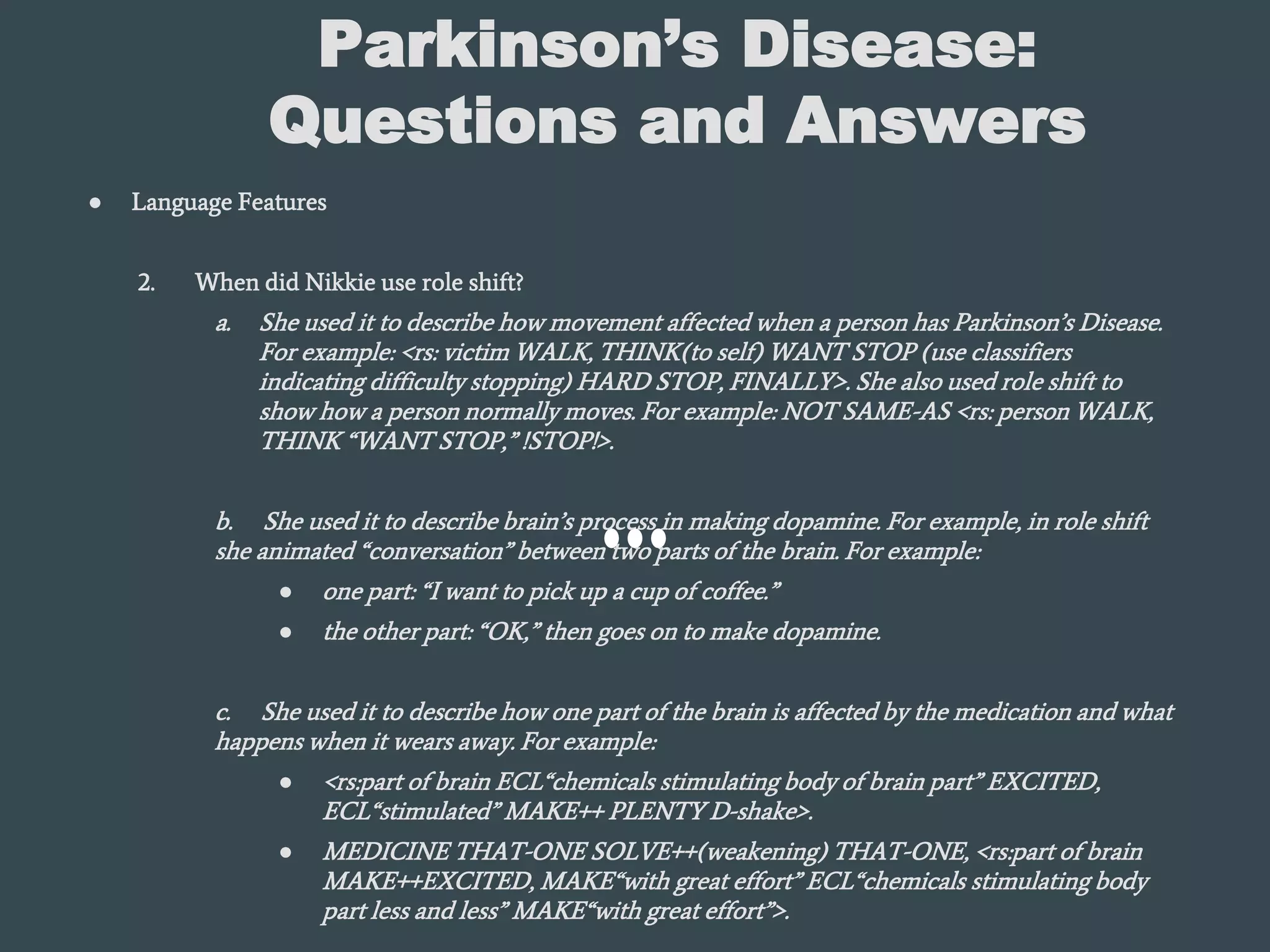
2. When did Nikkie use role shift?
a. She used it to describe how movement affected when a person has Parkinson’s Disease.
For example: <rs: victim WALK, THINK(to self) WANT STOP (use classifiers
indicating difficulty stopping) HARD STOP, FINALLY>. She also used role shift to
show how a person normally moves. For example: NOT SAME-AS <rs: person WALK,
THINK “WANT STOP,” !STOP!>.
b. She used it to describe brain’s process in making dopamine. For example, in role shift
she animated “conversation” between two parts of the brain. For example:
● one part: “I want to pick up a cup of coffee.”
● the other part: “OK,” then goes on to make dopamine.
c. She used it to describe how one part of the brain is affected by the medication and what
happens when it wears away. For example:
● <rs:part of brain ECL“chemicals stimulating body of brain part” EXCITED,
ECL“stimulated” MAKE++ PLENTY D-shake>.
● MEDICINE THAT-ONE SOLVE++(weakening) THAT-ONE, <rs:part of brain
MAKE++EXCITED, MAKE“with great effort” ECL“chemicals stimulating body
part less and less” MAKE“with great effort”>.
Parkinson’s Disease:
Questions and Answers
● Language Features
3. What transitions did Nikki use to begin each segment in her presentation?
a. She used rhetorical questions to introduce the topic of the segment. For example:
● fs-PD SICK(disease) RELATED-TO “what”(rh-q)
● MOVEMENT MEANING “what”(rh-q)
● fs-PD LOOK+SAME-AS “what”(rh-q)
b. She used NOW to signal to the listener she is about to begin a new segment, which is
often followed by a rhetorical question. For example:
● before describing “causes”: NOW YOU MAYBE WONDER HOW(rh-q)
● after describing normal process, and before comparing to abnormal ones with
Parkinson’s disease: NOW fs-PD “well”...(rh-q)
● at start of the treatment section: NOW HAVE CAN SOLVE…(rh-q)
● wrapping up her lecture: NOW IX “all” DOCTOR, SCIENTIST STILL
INVESTIGATE++
Parkinson’s Disease:
Questions and Answers
● Language Features
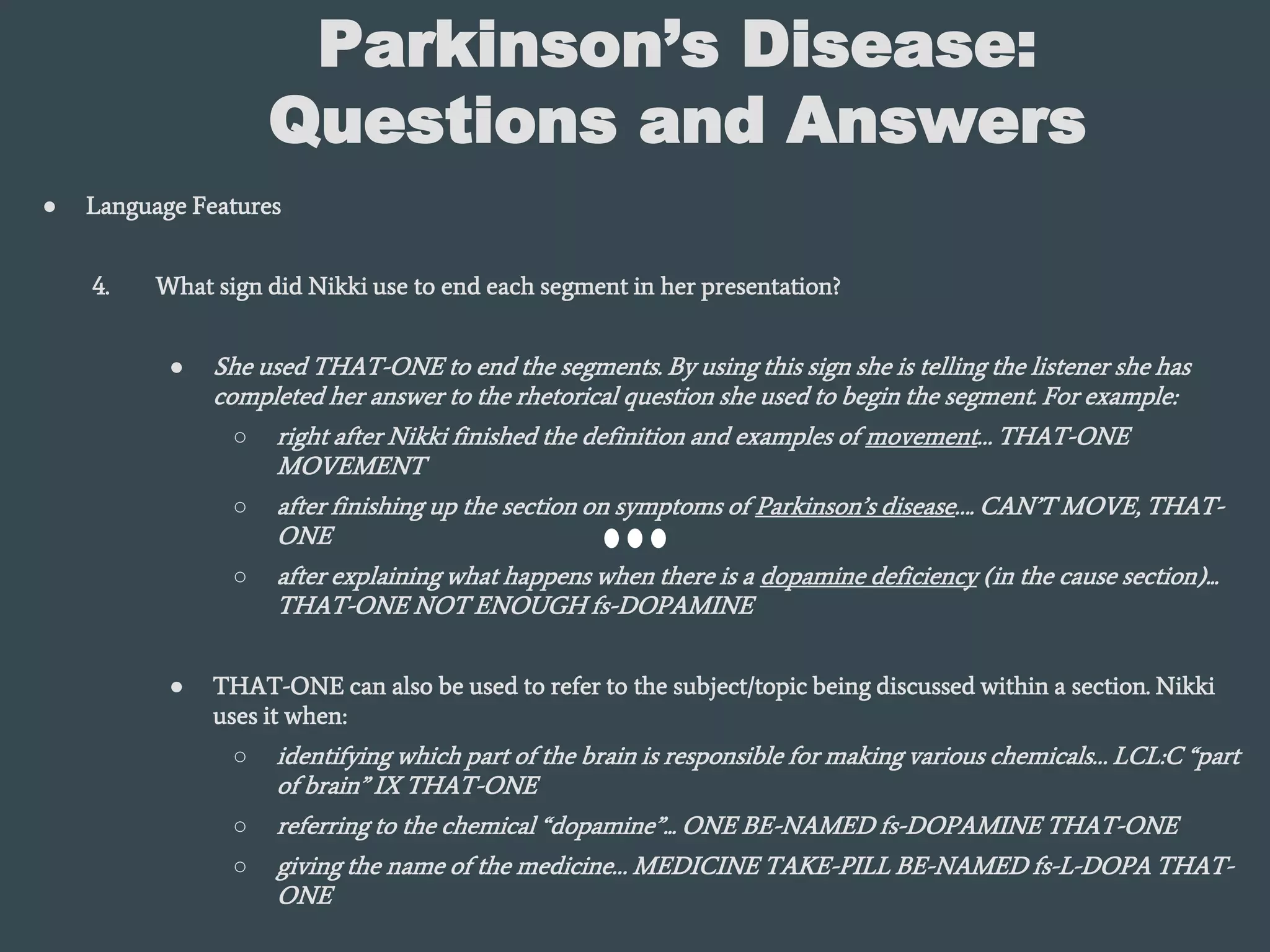
4. What sign did Nikki use to end each segment in her presentation?
● She used THAT-ONE to end the segments. By using this sign she is telling the listener she has
completed her answer to the rhetorical question she used to begin the segment. For example:
○ right after Nikki finished the definition and examples of movement… THAT-ONE
MOVEMENT
○ after finishing up the section on symptoms of Parkinson’s disease…. CAN’T MOVE, THAT-
ONE
○ after explaining what happens when there is a dopamine deficiency (in the cause section)...
THAT-ONE NOT ENOUGH fs-DOPAMINE
● THAT-ONE can also be used to refer to the subject/topic being discussed within a section. Nikki
uses it when:
○ identifying which part of the brain is responsible for making various chemicals… LCL:C “part
of brain” IX THAT-ONE
○ referring to the chemical “dopamine”... ONE BE-NAMED fs-DOPAMINE THAT-ONE
○ giving the name of the medicine… MEDICINE TAKE-PILL BE-NAMED fs-L-DOPA THAT-
ONE
Parkinson’s Disease:
Questions and Answers
● Language Features
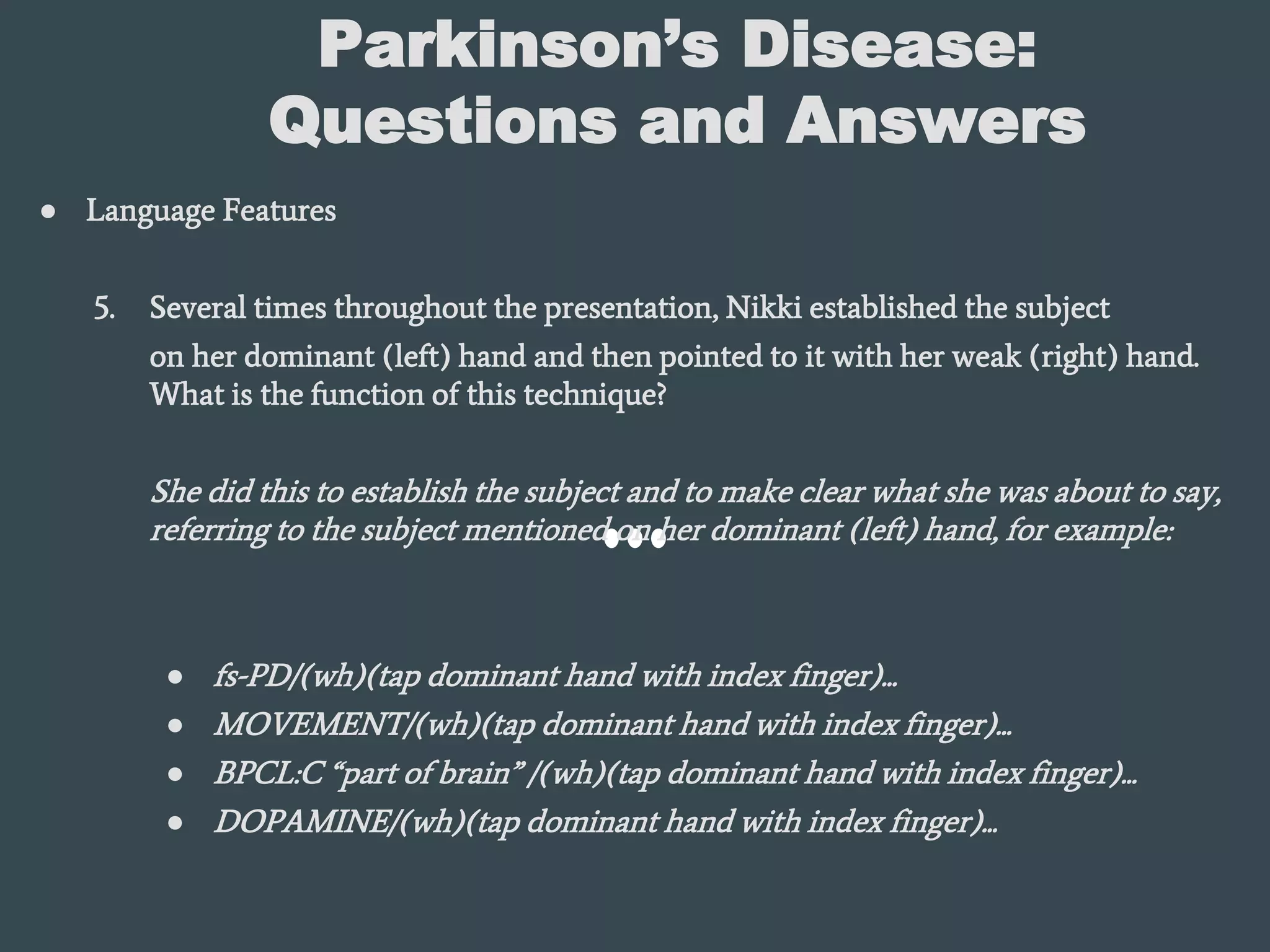
5. Several times throughout the presentation, Nikki established the subject
on her dominant (left) hand and then pointed to it with her weak (right) hand.
What is the function of this technique?
She did this to establish the subject and to make clear what she was about to say,
referring to the subject mentioned on her dominant (left) hand, for example:
● fs-PD/(wh)(tap dominant hand with index finger)...
● MOVEMENT/(wh)(tap dominant hand with index finger)...
● BPCL:C “part of brain” /(wh)(tap dominant hand with index finger)...
● DOPAMINE/(wh)(tap dominant hand with index finger)...
Preparing Your Health
Presentation
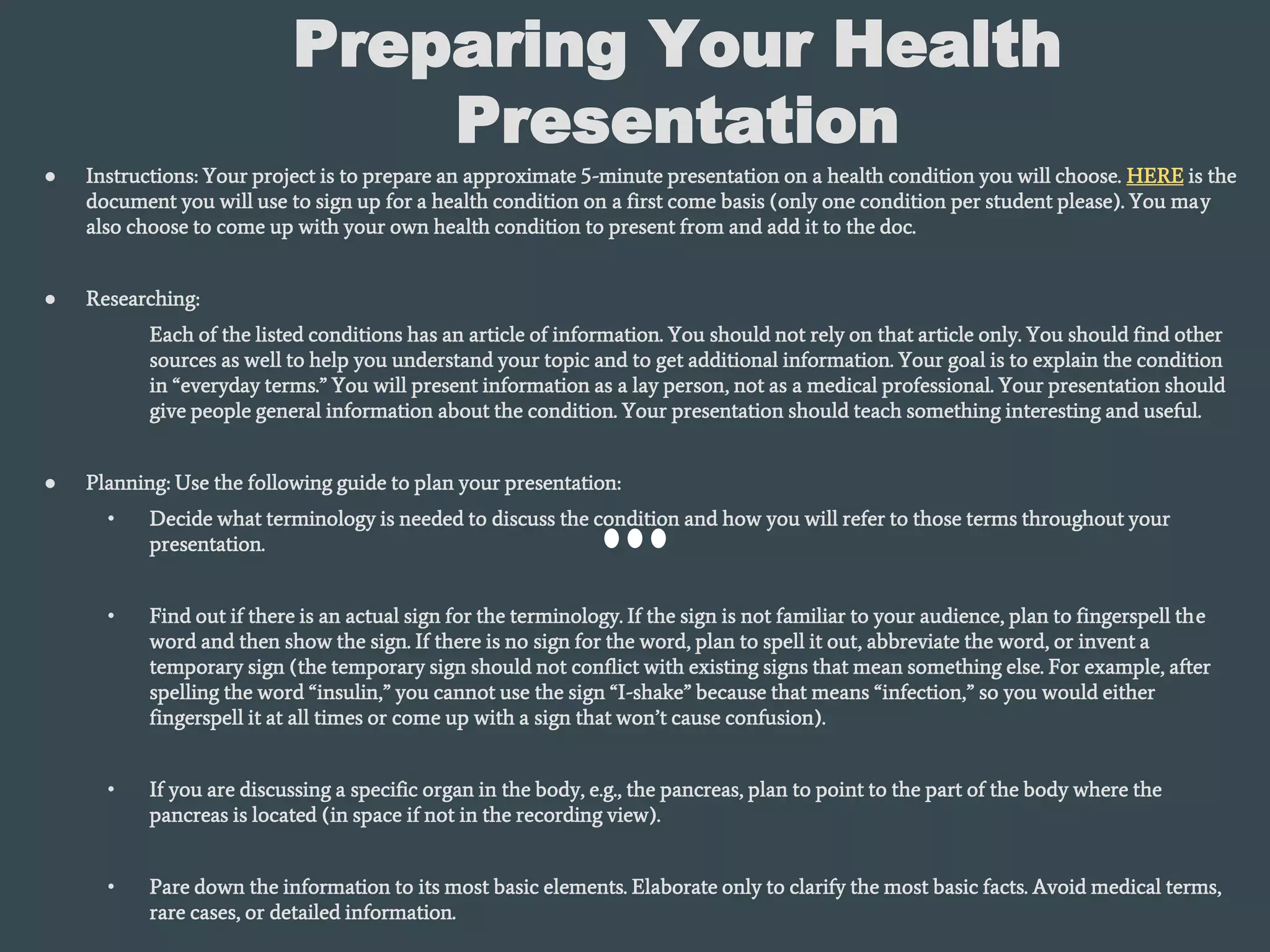
● Instructions: Your project is to prepare an approximate 5-minute presentation on a health condition you will choose. HERE is the
document you will use to sign up for a health condition on a first come basis (only one condition per student please). You may
also choose to come up with your own health condition to present from and add it to the doc.
● Researching:
Each of the listed conditions has an article of information. You should not rely on that article only. You should find other
sources as well to help you understand your topic and to get additional information. Your goal is to explain the condition
in “everyday terms.” You will present information as a lay person, not as a medical professional. Your presentation should
give people general information about the condition. Your presentation should teach something interesting and useful.
● Planning: Use the following guide to plan your presentation:
• Decide what terminology is needed to discuss the condition and how you will refer to those terms throughout your
presentation.
• Find out if there is an actual sign for the terminology. If the sign is not familiar to your audience, plan to fingerspell the
word and then show the sign. If there is no sign for the word, plan to spell it out, abbreviate the word, or invent a
temporary sign (the temporary sign should not conflict with existing signs that mean something else. For example, after
spelling the word “insulin,” you cannot use the sign “I-shake” because that means “infection,” so you would either
fingerspell it at all times or come up with a sign that won’t cause confusion).
• If you are discussing a specific organ in the body, e.g., the pancreas, plan to point to the part of the body where the
pancreas is located (in space if not in the recording view).
• Pare down the information to its most basic elements. Elaborate only to clarify the most basic facts. Avoid medical terms,
rare cases, or detailed information.
Preparing Your Health Presentation
- Questions and Answers
● Before you begin forming your presentation, you will want to read and learn about the
condition and then answer ALL of the following questions:
1. What terminology is needed to discuss your chosen condition?
2. What are the symptoms?
3. What is the normal process for the affected organ/body part?
4. How is the process affected by the condition?
5. What are the causes?
6. Is the condition curable?
7. What kind of treatment is available?
8. If not treated, what will happen?
● Answering these questions will give you all of the basic information you need (and in
order) to start organizing your final presentation.
● I would suggest writing the answers AND glossing them following what has been
learned throughout the unit.
Preparing Your Health Presentation
- Questions and Answers (Diabetes)
● We will use “Diabetes” as an example on how to prepare your
Health Presentation.
Browse through the information in the “Diabetes” article.
Read the “Preparation Questions” and their answers (with
glosses).
Note: You can make a copy of this doc to use to answer the
questions about your chosen condition
Preparing Your Health Presentation
- Giving a Coherent Presentation
Now that you have all of the relevant
information researched and written for
your presentation, here is a detailed guide
on exactly what to do, step by step, for
your presentation.
Preparing Your Health Presentation
- Giving a Coherent Presentation
(Diabetes)
Introduction
● Identify health topic
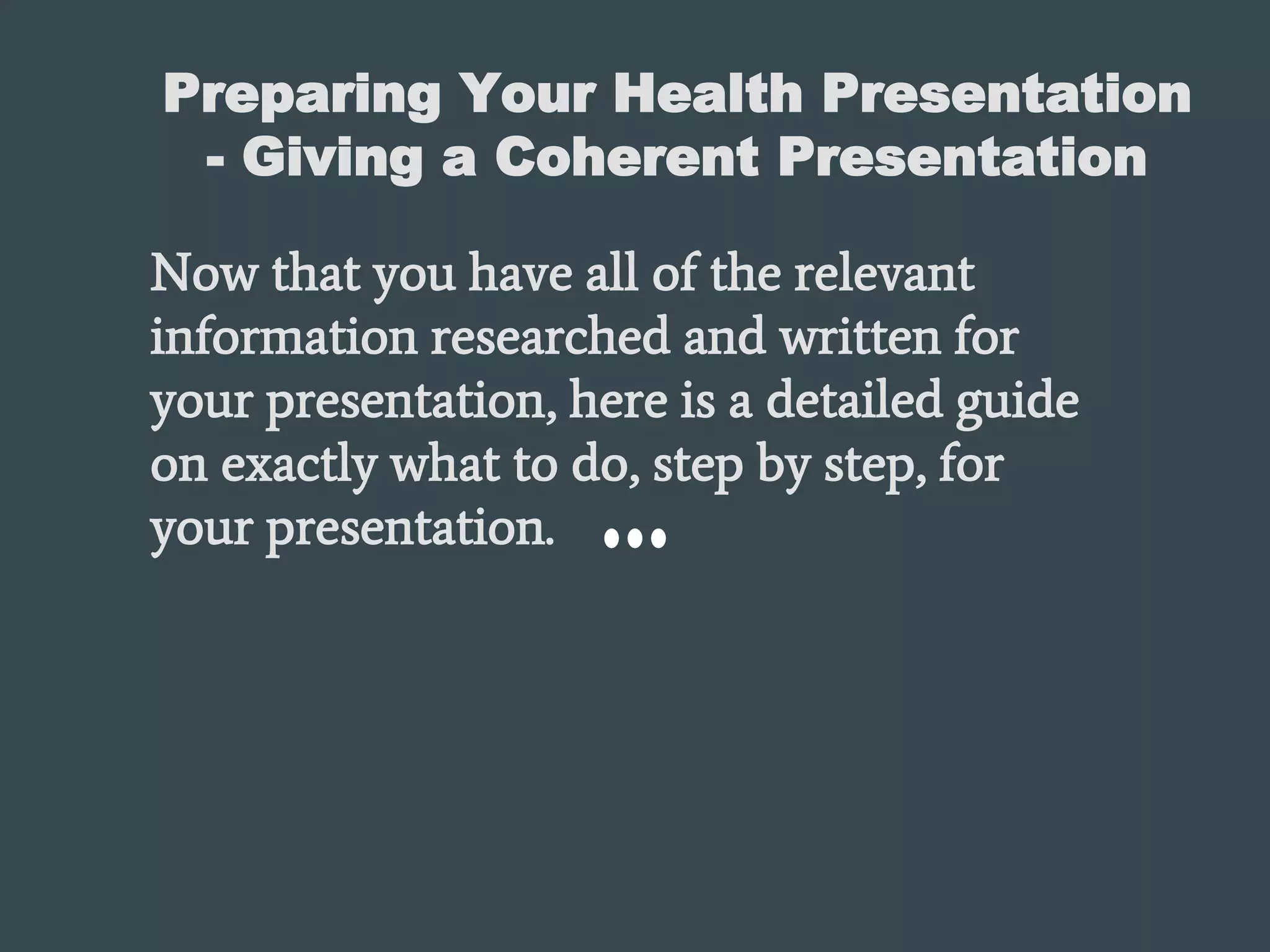
1. Begin your presentation by introducing
the topic with a sign, an invented sign,
fingerspelling, or an abbreviation of the
word.
2. Next, use a rhetorical question “What
is it?”, and then tell what that condition
is related to. For example, diabetes is a
condition related to sugar in the blood.
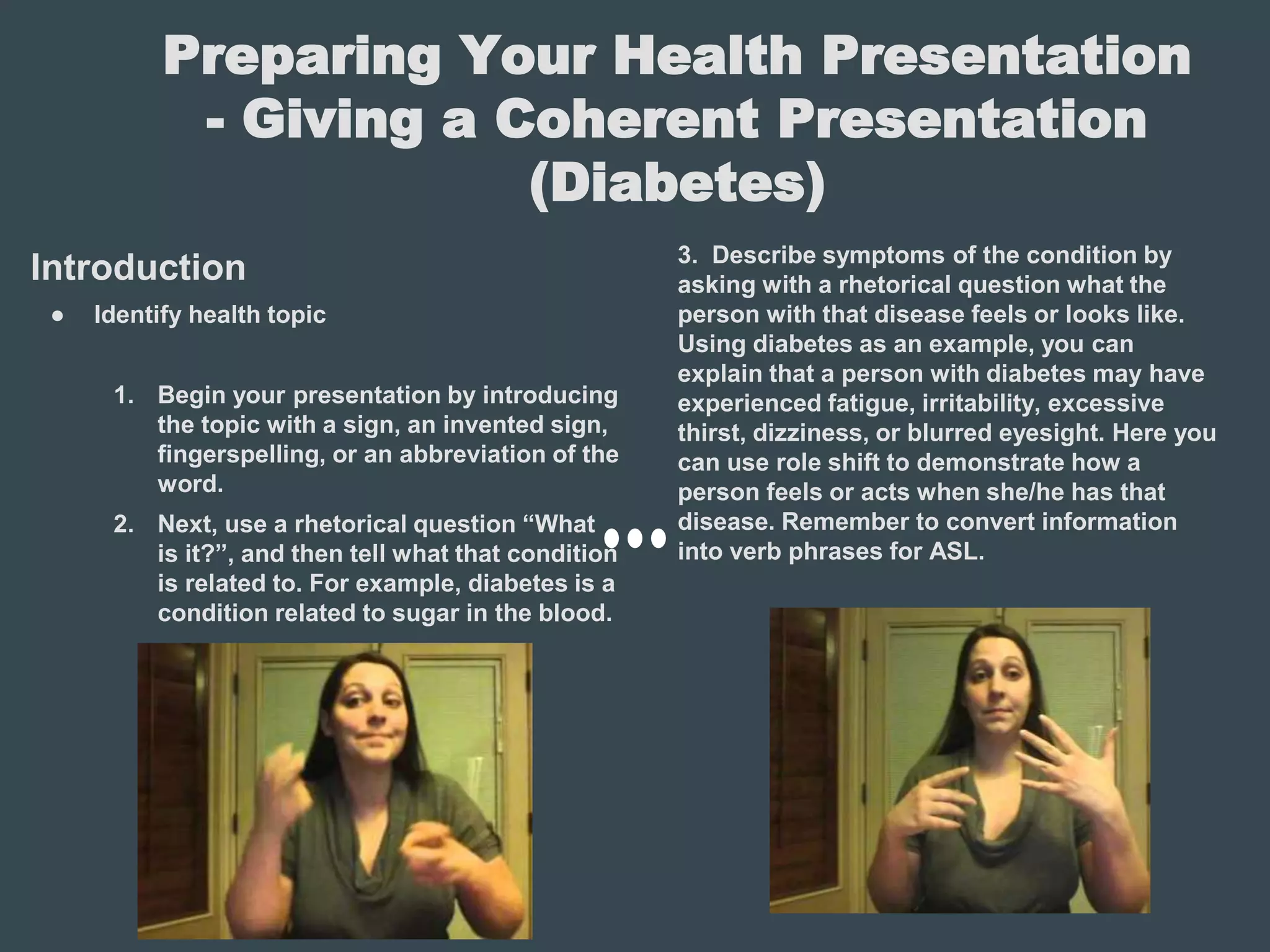
3. Describe symptoms of the condition by
asking with a rhetorical question what the
person with that disease feels or looks like.
Using diabetes as an example, you can
explain that a person with diabetes may have
experienced fatigue, irritability, excessive
thirst, dizziness, or blurred eyesight. Here you
can use role shift to demonstrate how a
person feels or acts when she/he has that
disease. Remember to convert information
into verb phrases for ASL.
Preparing Your Health Presentation
- Giving a Coherent Presentation
(Diabetes)
Body
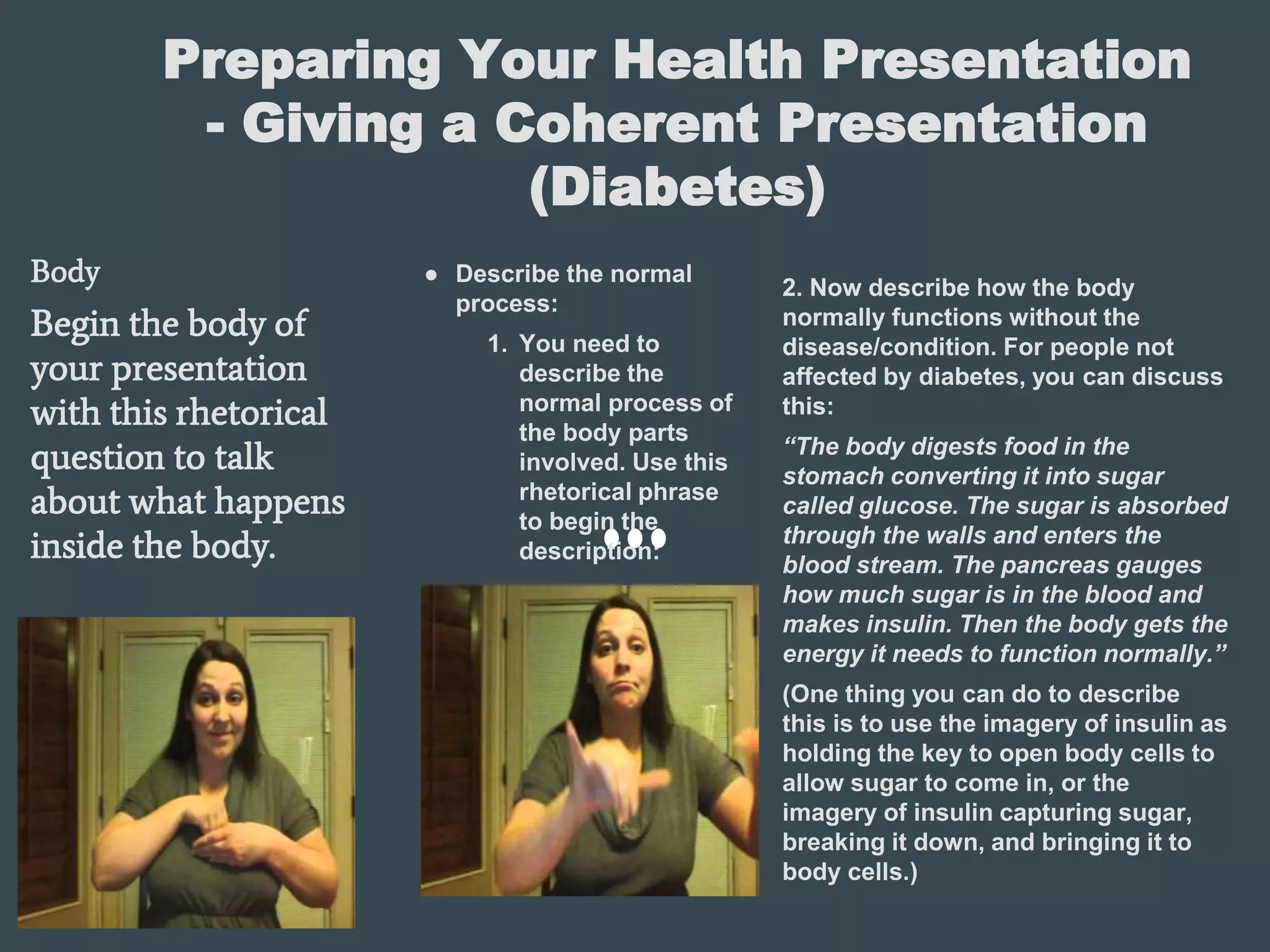
Begin the body of
your presentation
with this rhetorical
question to talk
about what happens
inside the body.
● Describe the normal
process:
1. You need to
describe the
normal process of
the body parts
involved. Use this
rhetorical phrase
to begin the
description:
2. Now describe how the body
normally functions without the
disease/condition. For people not
affected by diabetes, you can discuss
this:
“The body digests food in the
stomach converting it into sugar
called glucose. The sugar is absorbed
through the walls and enters the
blood stream. The pancreas gauges
how much sugar is in the blood and
makes insulin. Then the body gets the
energy it needs to function normally.”
(One thing you can do to describe
this is to use the imagery of insulin as
holding the key to open body cells to
allow sugar to come in, or the
imagery of insulin capturing sugar,
breaking it down, and bringing it to
body cells.)
Preparing Your Health Presentation
- Giving a Coherent Presentation
(Diabetes)
Body (cont.)
● Describe how the process is affected:
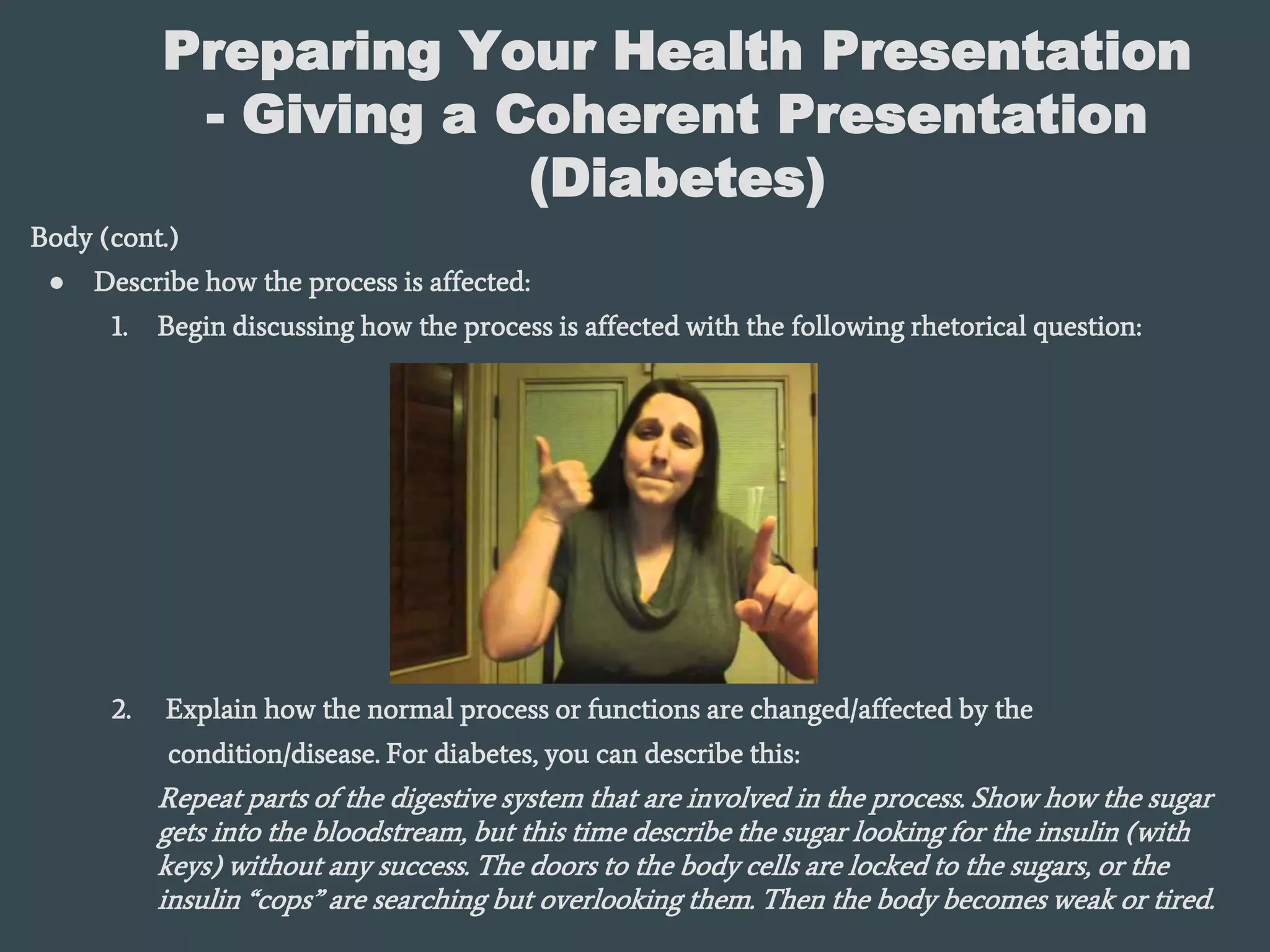
1. Begin discussing how the process is affected with the following rhetorical question:
2. Explain how the normal process or functions are changed/affected by the
condition/disease. For diabetes, you can describe this:
Repeat parts of the digestive system that are involved in the process. Show how the sugar
gets into the bloodstream, but this time describe the sugar looking for the insulin (with
keys) without any success. The doors to the body cells are locked to the sugars, or the
insulin “cops” are searching but overlooking them. Then the body becomes weak or tired.
Preparing Your Health Presentation - Giving a
Coherent Presentation (Diabetes)
Body (cont.)
● Tell the cause(s)
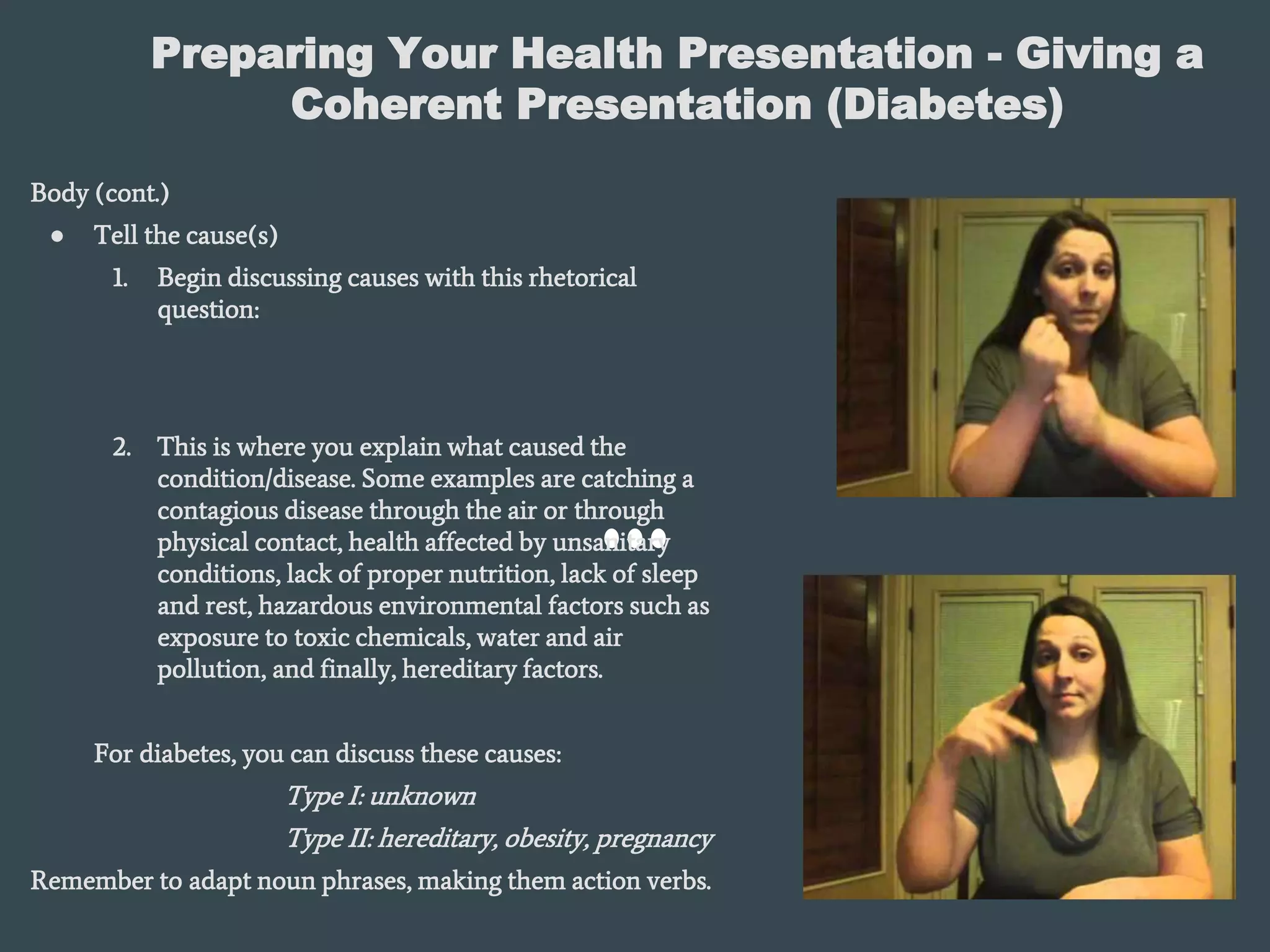
1. Begin discussing causes with this rhetorical
question:
2. This is where you explain what caused the
condition/disease. Some examples are catching a
contagious disease through the air or through
physical contact, health affected by unsanitary
conditions, lack of proper nutrition, lack of sleep
and rest, hazardous environmental factors such as
exposure to toxic chemicals, water and air
pollution, and finally, hereditary factors.
For diabetes, you can discuss these causes:
Type I: unknown
Type II: hereditary, obesity, pregnancy
Remember to adapt noun phrases, making them action verbs.
Preparing Your Health Presentation
- Giving a Coherent Presentation
(Diabetes)
Body (cont.)
● Discuss treatment(s)
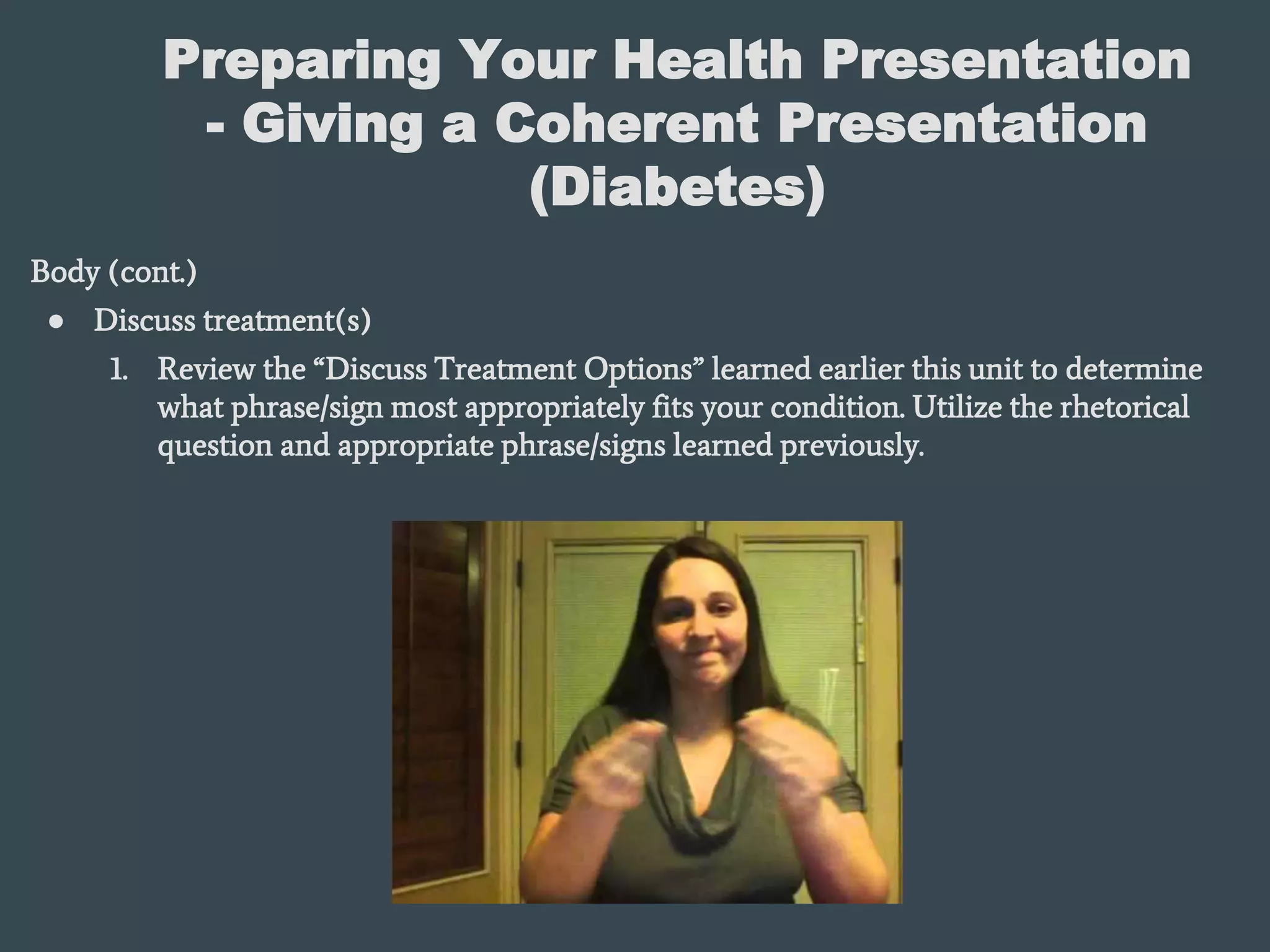
1. Review the “Discuss Treatment Options” learned earlier this unit to determine
what phrase/sign most appropriately fits your condition. Utilize the rhetorical
question and appropriate phrase/signs learned previously.
Preparing Your Health Presentation - Giving a
Coherent Presentation (Diabetes)
Body (cont.)
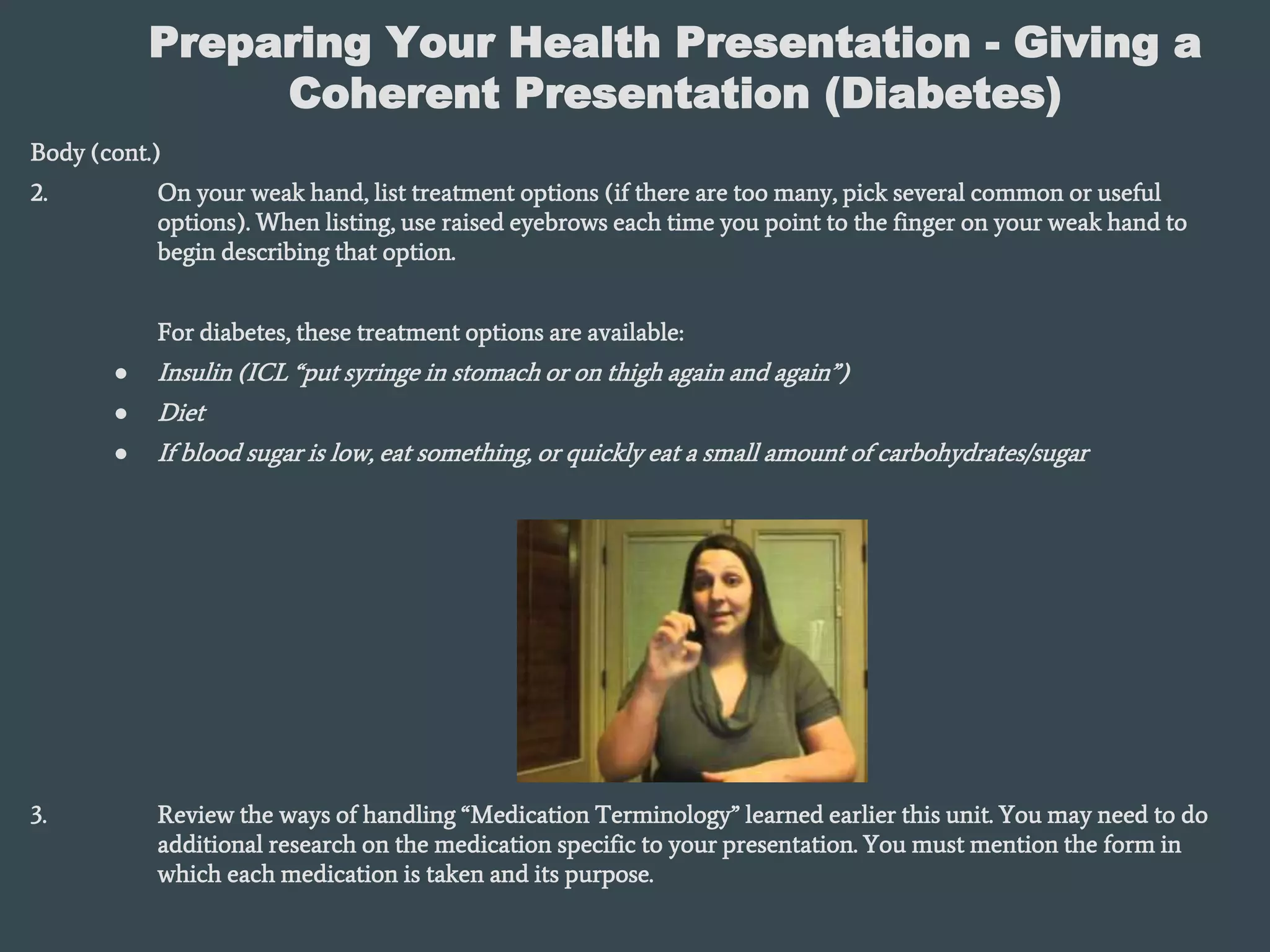
2. On your weak hand, list treatment options (if there are too many, pick several common or useful
options). When listing, use raised eyebrows each time you point to the finger on your weak hand to
begin describing that option.
For diabetes, these treatment options are available:
● Insulin (ICL “put syringe in stomach or on thigh again and again”)
● Diet
● If blood sugar is low, eat something, or quickly eat a small amount of carbohydrates/sugar
3. Review the ways of handling “Medication Terminology” learned earlier this unit. You may need to do
additional research on the medication specific to your presentation. You must mention the form in
which each medication is taken and its purpose.
Preparing Your Health Presentation - Giving a
Coherent Presentation (Diabetes)
Conclusion
● Give conclusion
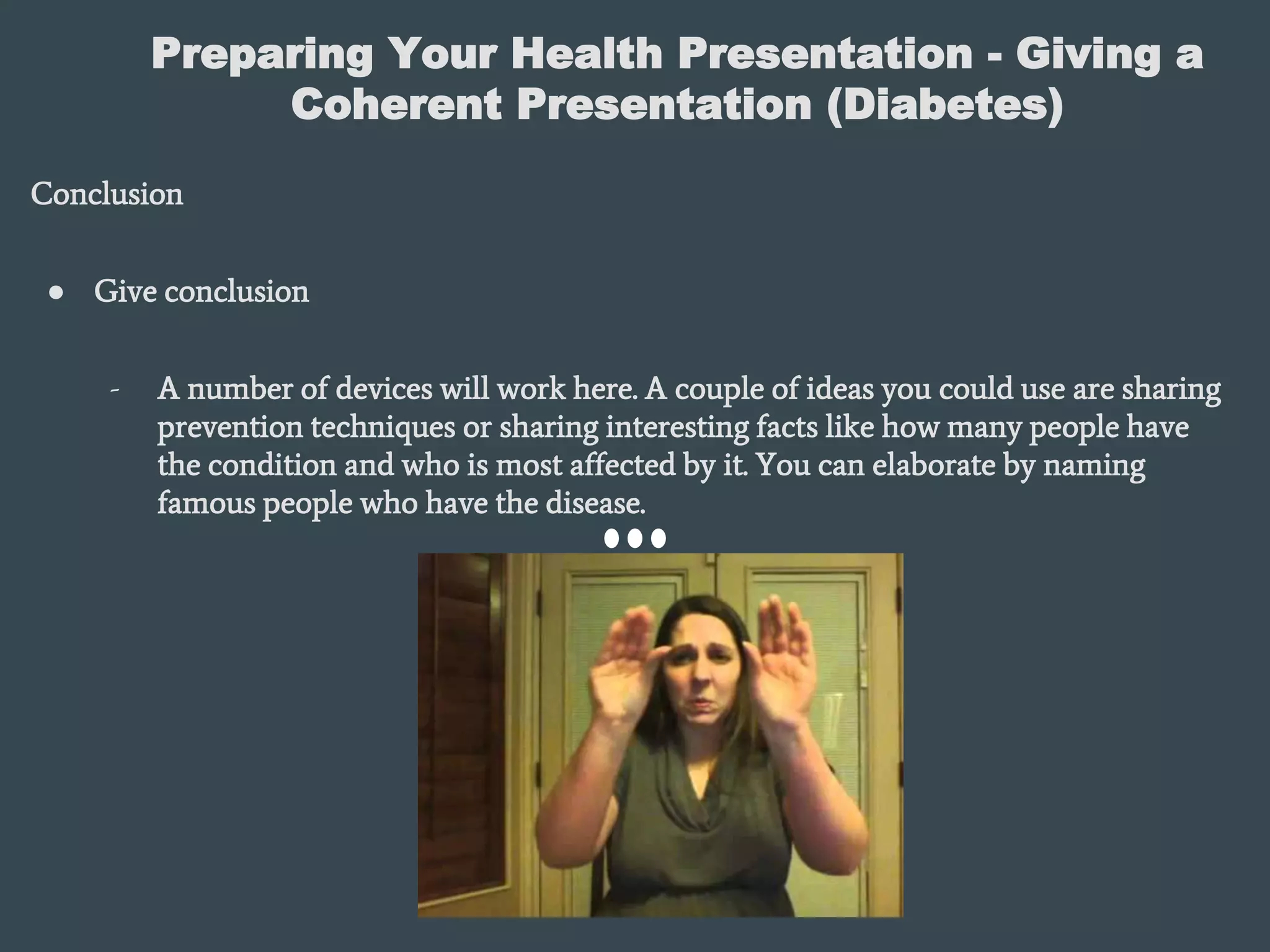
- A number of devices will work here. A couple of ideas you could use are sharing
prevention techniques or sharing interesting facts like how many people have
the condition and who is most affected by it. You can elaborate by naming
famous people who have the disease.
Tips for Making a Presentation
● If giving an in person presentation, stand in the center of the “stage,” body facing
forward so it will be easier to look at the entire audience.
● Keep your shoulders back and down in a relaxed position. Hunching your shoulders
or pulling them up makes you sign smaller.
● DON’T CHEW GUM!!!
● During any long pauses before, during, and after the presentation, keep your hands in
a rested position at your waist. Don’t let your hands fall limp.
● Use pauses to give emphasis to certain parts and to make transitions clear.
● In a live presentation, never break eye contact with the audience. Glance around,
making eye contact with as many audience members as possible. Take note of
audience response. Elaborate on parts until you obtain the needed response.
● By the way, DON’T CHEW GUM!!!
● If your hair tends to fall in your eyes, pin it back or wear it in a ponytail.
● Wear solid colored clothes. Don’t wear clothes with busy backgrounds like plaids or
stripes. Your clothes should contrast with the color of your hands.
● Did I mention, DON’T CHEW GUM!!!
Review
Throughout this presentation, you have learned the following:
▪ Sample Presentations
1. Parkinson’s Disease
2. Diabetes
▪ Preparing Your Health Presentation
▪ Questions and Answers
▪ Giving a Coherent Presentation (detailed outline)
▪ Tips for Making a Presentation
▪ Just make sure that you DON’T CHEW GUM!!!

7c. Discussing Health Conditions - Presentation

  • 1.
  • 2.
    Discussing Health Conditions In everydayconversations, you may find yourselves in situations where you need to explain complex ideas in ASL. This unit on health introduces you to language skills that will help you organize and discuss complex topics.
  • 3.
    Discussing Health Conditions This unitwill prepare you to take complex information written on a particular illness, identify the important points to cover, organize the information into three areas; symptoms, causes, and treatments, and make a concise 5-minute presentation.
  • 4.
    Sample Presentation Parkinson’s Disease:Questions and Answers ● Introduction 1. Parkinson’s disease is described as what? What is it related to? deterioration of movement 2. List the types of body movement mentioned. opening/closing fingers, lifting arms, walking, moving eyes around, blinking eyes, chewing and swallowing food and then moving food down the esophagus, stomach digesting food, and heart pumping 3. Describe the symptoms associated with Parkinson’s disease. delayed response time to stop walking, to sitting down and to getting up from a chair, hands trembling (which is what most of us notice), legs trembling, moving eyes slowly, blinking eyes slowly, drooling, to absolute deterioration where you can’t move at all Read the questions and answers to “Parkinson’s Disease” by Nikki Schmitz on the following slides. Then, watch the video. By doing so, you will be able to examine how Nikki organized and presented the information.
  • 5.
    Parkinson’s Disease: Questions andAnswers ● Body (Causes and Treatments) 1. Describe the process the brain goes through when one wants to move his/her body. There are two parts inside the brain; one part is responsible for producing chemicals to stimulate body functions, one of them being dopamine. The other part “requests” and collect the chemical to provide the brain with the ability to send the chemical so that the body can move (e.g., reach for a cup of coffee). 2. Describe how the process in the brain is affected by Parkinson’s disease. When the request is made (“I want to reach for the cup of coffee”), the part of the brain that manufactures the needed chemical dopamine for the movement is unable to make enough of it, resulting in the person being able to reach to get the cup of coffee only very slowly. 3. Is there a cure? No. 4. What kind of treatment is available? How does the medication work? Take medication called L-Dopa. When taken, it stimulates that part of the brain to continue to make dopamine, so when the other part of the brain makes a “request” there is plenty of dopamine to “reach for the cup of coffee.” If the person doesn’t take the medication, then the symptoms reappear.
  • 6.
    Parkinson’s Disease: Questions andAnswers ● Language Features 1. How did Nikki handle these terminologies? ● “Parkinson’s disease” - She wrote the name on the board, pointed to it, looked to make sure everybody saw what she wrote on the board, and then gave the sign she would be using to refer to it “SUMMARIZE/ABBREVIATE fs-PD.” ● “Movement” - She fingerspelled fs-MOVEMENT,” asked what the word meant, and went on to give examples. ● “Chemical” - She used the sign CHEMICAL and fingerspelled fs-CHEMICALS for clarification on this potentially unfamiliar sign. ● “Dopamine” - After spelling the word out as clearly as possible, she showed the sign “shake-D” to mean “dopamine.” Afterward, she either used “shake-D” or spelled fs- DOPAMINE, although less clearly, to refer to it. ● “L-Dopa” - Nikki described type of medication before spelling the name clearly, e.g., “MEDICINE TAKE-PILL BE-NAMED fs-L-DOPA.” When repeating the terminology for the second time, she spelled it clearly again, and then signed MEDICINE. Referring to the medicine a third time, she used only the sign MEDICINE without fingerspelling the term.
  • 7.
    Parkinson’s Disease: Questions andAnswers ● Language Features 2. When did Nikkie use role shift? a. She used it to describe how movement affected when a person has Parkinson’s Disease. For example: <rs: victim WALK, THINK(to self) WANT STOP (use classifiers indicating difficulty stopping) HARD STOP, FINALLY>. She also used role shift to show how a person normally moves. For example: NOT SAME-AS <rs: person WALK, THINK “WANT STOP,” !STOP!>. b. She used it to describe brain’s process in making dopamine. For example, in role shift she animated “conversation” between two parts of the brain. For example: ● one part: “I want to pick up a cup of coffee.” ● the other part: “OK,” then goes on to make dopamine. c. She used it to describe how one part of the brain is affected by the medication and what happens when it wears away. For example: ● <rs:part of brain ECL“chemicals stimulating body of brain part” EXCITED, ECL“stimulated” MAKE++ PLENTY D-shake>. ● MEDICINE THAT-ONE SOLVE++(weakening) THAT-ONE, <rs:part of brain MAKE++EXCITED, MAKE“with great effort” ECL“chemicals stimulating body part less and less” MAKE“with great effort”>.
  • 8.
    Parkinson’s Disease: Questions andAnswers ● Language Features 3. What transitions did Nikki use to begin each segment in her presentation? a. She used rhetorical questions to introduce the topic of the segment. For example: ● fs-PD SICK(disease) RELATED-TO “what”(rh-q) ● MOVEMENT MEANING “what”(rh-q) ● fs-PD LOOK+SAME-AS “what”(rh-q) b. She used NOW to signal to the listener she is about to begin a new segment, which is often followed by a rhetorical question. For example: ● before describing “causes”: NOW YOU MAYBE WONDER HOW(rh-q) ● after describing normal process, and before comparing to abnormal ones with Parkinson’s disease: NOW fs-PD “well”...(rh-q) ● at start of the treatment section: NOW HAVE CAN SOLVE…(rh-q) ● wrapping up her lecture: NOW IX “all” DOCTOR, SCIENTIST STILL INVESTIGATE++
  • 9.
    Parkinson’s Disease: Questions andAnswers ● Language Features 4. What sign did Nikki use to end each segment in her presentation? ● She used THAT-ONE to end the segments. By using this sign she is telling the listener she has completed her answer to the rhetorical question she used to begin the segment. For example: ○ right after Nikki finished the definition and examples of movement… THAT-ONE MOVEMENT ○ after finishing up the section on symptoms of Parkinson’s disease…. CAN’T MOVE, THAT- ONE ○ after explaining what happens when there is a dopamine deficiency (in the cause section)... THAT-ONE NOT ENOUGH fs-DOPAMINE ● THAT-ONE can also be used to refer to the subject/topic being discussed within a section. Nikki uses it when: ○ identifying which part of the brain is responsible for making various chemicals… LCL:C “part of brain” IX THAT-ONE ○ referring to the chemical “dopamine”... ONE BE-NAMED fs-DOPAMINE THAT-ONE ○ giving the name of the medicine… MEDICINE TAKE-PILL BE-NAMED fs-L-DOPA THAT- ONE
  • 10.
    Parkinson’s Disease: Questions andAnswers ● Language Features 5. Several times throughout the presentation, Nikki established the subject on her dominant (left) hand and then pointed to it with her weak (right) hand. What is the function of this technique? She did this to establish the subject and to make clear what she was about to say, referring to the subject mentioned on her dominant (left) hand, for example: ● fs-PD/(wh)(tap dominant hand with index finger)... ● MOVEMENT/(wh)(tap dominant hand with index finger)... ● BPCL:C “part of brain” /(wh)(tap dominant hand with index finger)... ● DOPAMINE/(wh)(tap dominant hand with index finger)...
  • 11.
    Preparing Your Health Presentation ●Instructions: Your project is to prepare an approximate 5-minute presentation on a health condition you will choose. HERE is the document you will use to sign up for a health condition on a first come basis (only one condition per student please). You may also choose to come up with your own health condition to present from and add it to the doc. ● Researching: Each of the listed conditions has an article of information. You should not rely on that article only. You should find other sources as well to help you understand your topic and to get additional information. Your goal is to explain the condition in “everyday terms.” You will present information as a lay person, not as a medical professional. Your presentation should give people general information about the condition. Your presentation should teach something interesting and useful. ● Planning: Use the following guide to plan your presentation: • Decide what terminology is needed to discuss the condition and how you will refer to those terms throughout your presentation. • Find out if there is an actual sign for the terminology. If the sign is not familiar to your audience, plan to fingerspell the word and then show the sign. If there is no sign for the word, plan to spell it out, abbreviate the word, or invent a temporary sign (the temporary sign should not conflict with existing signs that mean something else. For example, after spelling the word “insulin,” you cannot use the sign “I-shake” because that means “infection,” so you would either fingerspell it at all times or come up with a sign that won’t cause confusion). • If you are discussing a specific organ in the body, e.g., the pancreas, plan to point to the part of the body where the pancreas is located (in space if not in the recording view). • Pare down the information to its most basic elements. Elaborate only to clarify the most basic facts. Avoid medical terms, rare cases, or detailed information.
  • 12.
    Preparing Your HealthPresentation - Questions and Answers ● Before you begin forming your presentation, you will want to read and learn about the condition and then answer ALL of the following questions: 1. What terminology is needed to discuss your chosen condition? 2. What are the symptoms? 3. What is the normal process for the affected organ/body part? 4. How is the process affected by the condition? 5. What are the causes? 6. Is the condition curable? 7. What kind of treatment is available? 8. If not treated, what will happen? ● Answering these questions will give you all of the basic information you need (and in order) to start organizing your final presentation. ● I would suggest writing the answers AND glossing them following what has been learned throughout the unit.
  • 13.
    Preparing Your HealthPresentation - Questions and Answers (Diabetes) ● We will use “Diabetes” as an example on how to prepare your Health Presentation. Browse through the information in the “Diabetes” article. Read the “Preparation Questions” and their answers (with glosses). Note: You can make a copy of this doc to use to answer the questions about your chosen condition
  • 14.
    Preparing Your HealthPresentation - Giving a Coherent Presentation Now that you have all of the relevant information researched and written for your presentation, here is a detailed guide on exactly what to do, step by step, for your presentation.
  • 15.
    Preparing Your HealthPresentation - Giving a Coherent Presentation (Diabetes) Introduction ● Identify health topic 1. Begin your presentation by introducing the topic with a sign, an invented sign, fingerspelling, or an abbreviation of the word. 2. Next, use a rhetorical question “What is it?”, and then tell what that condition is related to. For example, diabetes is a condition related to sugar in the blood. 3. Describe symptoms of the condition by asking with a rhetorical question what the person with that disease feels or looks like. Using diabetes as an example, you can explain that a person with diabetes may have experienced fatigue, irritability, excessive thirst, dizziness, or blurred eyesight. Here you can use role shift to demonstrate how a person feels or acts when she/he has that disease. Remember to convert information into verb phrases for ASL.
  • 16.
    Preparing Your HealthPresentation - Giving a Coherent Presentation (Diabetes) Body Begin the body of your presentation with this rhetorical question to talk about what happens inside the body. ● Describe the normal process: 1. You need to describe the normal process of the body parts involved. Use this rhetorical phrase to begin the description: 2. Now describe how the body normally functions without the disease/condition. For people not affected by diabetes, you can discuss this: “The body digests food in the stomach converting it into sugar called glucose. The sugar is absorbed through the walls and enters the blood stream. The pancreas gauges how much sugar is in the blood and makes insulin. Then the body gets the energy it needs to function normally.” (One thing you can do to describe this is to use the imagery of insulin as holding the key to open body cells to allow sugar to come in, or the imagery of insulin capturing sugar, breaking it down, and bringing it to body cells.)
  • 17.
    Preparing Your HealthPresentation - Giving a Coherent Presentation (Diabetes) Body (cont.) ● Describe how the process is affected: 1. Begin discussing how the process is affected with the following rhetorical question: 2. Explain how the normal process or functions are changed/affected by the condition/disease. For diabetes, you can describe this: Repeat parts of the digestive system that are involved in the process. Show how the sugar gets into the bloodstream, but this time describe the sugar looking for the insulin (with keys) without any success. The doors to the body cells are locked to the sugars, or the insulin “cops” are searching but overlooking them. Then the body becomes weak or tired.
  • 18.
    Preparing Your HealthPresentation - Giving a Coherent Presentation (Diabetes) Body (cont.) ● Tell the cause(s) 1. Begin discussing causes with this rhetorical question: 2. This is where you explain what caused the condition/disease. Some examples are catching a contagious disease through the air or through physical contact, health affected by unsanitary conditions, lack of proper nutrition, lack of sleep and rest, hazardous environmental factors such as exposure to toxic chemicals, water and air pollution, and finally, hereditary factors. For diabetes, you can discuss these causes: Type I: unknown Type II: hereditary, obesity, pregnancy Remember to adapt noun phrases, making them action verbs.
  • 19.
    Preparing Your HealthPresentation - Giving a Coherent Presentation (Diabetes) Body (cont.) ● Discuss treatment(s) 1. Review the “Discuss Treatment Options” learned earlier this unit to determine what phrase/sign most appropriately fits your condition. Utilize the rhetorical question and appropriate phrase/signs learned previously.
  • 20.
    Preparing Your HealthPresentation - Giving a Coherent Presentation (Diabetes) Body (cont.) 2. On your weak hand, list treatment options (if there are too many, pick several common or useful options). When listing, use raised eyebrows each time you point to the finger on your weak hand to begin describing that option. For diabetes, these treatment options are available: ● Insulin (ICL “put syringe in stomach or on thigh again and again”) ● Diet ● If blood sugar is low, eat something, or quickly eat a small amount of carbohydrates/sugar 3. Review the ways of handling “Medication Terminology” learned earlier this unit. You may need to do additional research on the medication specific to your presentation. You must mention the form in which each medication is taken and its purpose.
  • 21.
    Preparing Your HealthPresentation - Giving a Coherent Presentation (Diabetes) Conclusion ● Give conclusion - A number of devices will work here. A couple of ideas you could use are sharing prevention techniques or sharing interesting facts like how many people have the condition and who is most affected by it. You can elaborate by naming famous people who have the disease.
  • 22.
    Tips for Makinga Presentation ● If giving an in person presentation, stand in the center of the “stage,” body facing forward so it will be easier to look at the entire audience. ● Keep your shoulders back and down in a relaxed position. Hunching your shoulders or pulling them up makes you sign smaller. ● DON’T CHEW GUM!!! ● During any long pauses before, during, and after the presentation, keep your hands in a rested position at your waist. Don’t let your hands fall limp. ● Use pauses to give emphasis to certain parts and to make transitions clear. ● In a live presentation, never break eye contact with the audience. Glance around, making eye contact with as many audience members as possible. Take note of audience response. Elaborate on parts until you obtain the needed response. ● By the way, DON’T CHEW GUM!!! ● If your hair tends to fall in your eyes, pin it back or wear it in a ponytail. ● Wear solid colored clothes. Don’t wear clothes with busy backgrounds like plaids or stripes. Your clothes should contrast with the color of your hands. ● Did I mention, DON’T CHEW GUM!!!
  • 23.
    Review Throughout this presentation,you have learned the following: ▪ Sample Presentations 1. Parkinson’s Disease 2. Diabetes ▪ Preparing Your Health Presentation ▪ Questions and Answers ▪ Giving a Coherent Presentation (detailed outline) ▪ Tips for Making a Presentation ▪ Just make sure that you DON’T CHEW GUM!!!