Advanced Wind Turbine Controls Input Based on
RealTime Loads Measured with Fiber Optical Sensors
Embedded in Rotor Blades
ewec 2006, Athens
28 February
S. Kuhnt, J. Wernicke, R. Byars, J. Shadden (WindForce GmbH)
Main Issues on Wind Power
Plants
• High Operational and Maintenance Costs
• Reliability below Customer Expectation
– MTBF, MTTR
• Competitiveness of COE
• Low Insurability
• Rapid Market Development
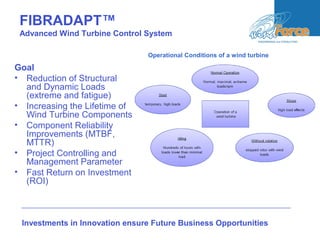
FIBRADAPT™
Advanced Wind Turbine Control System
Goal
• Reduction of Structural
and Dynamic Loads
(extreme and fatigue)
• Increasing the Lifetime of
Wind Turbine Components
• Component Reliability
Improvements (MTBF,
MTTR)
• Project Controlling and
Management Parameter
• Fast Return on Investment
(ROI)
Investments in Innovation ensure Future Business Opportunities
Operational Conditions of a wind turbine
• Measuring of Rotor flapwise and edgewise Loads and
Frequencies during Operation
• Traceability of single Events (extreme Loads, emergency
Stop etc.)
• Traceability of fatigue Loads for residual Lifetime
Estimation
• Monitoring of Design Parameter
• Monitoring of the Component Structure for early Detection
of Damages and for determining predictive Maintenance
Targets
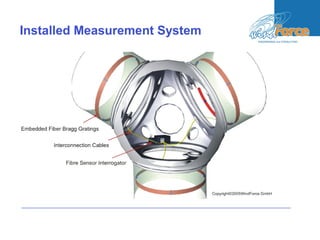
Installed Measurement System
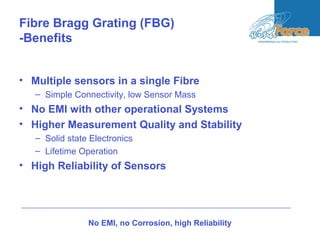
Fibre Bragg Grating (FBG)
-Benefits
• Multiple sensors in a single Fibre
– Simple Connectivity, low Sensor Mass
• No EMI with other operational Systems
• Higher Measurement Quality and Stability
– Solid state Electronics
– Lifetime Operation
• High Reliability of Sensors
No EMI, no Corrosion, high Reliability
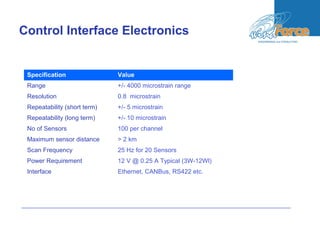
Control Interface Electronics
Specification Value
Range +/- 4000 microstrain range
Resolution 0.8 microstrain
Repeatability (short term) +/- 5 microstrain
Repeatability (long term) +/- 10 microstrain
No of Sensors 100 per channel
Maximum sensor distance > 2 km
Scan Frequency 25 Hz for 20 Sensors
Power Requirement 12 V @ 0.25 A Typical (3W-12Wl)
Interface Ethernet, CANBus, RS422 etc.
FIBRADAPT:
Advanced wind turbine controls
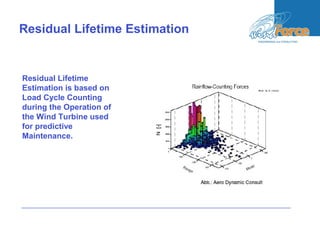
Residual Lifetime Estimation
Residual Lifetime
Estimation is based on
Load Cycle Counting
during the Operation of
the Wind Turbine used
for predictive
Maintenance.
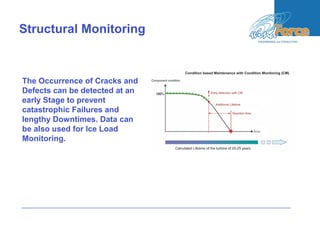
Structural Monitoring
The Occurrence of Cracks and
Defects can be detected at an
early Stage to prevent
catastrophic Failures and
lengthy Downtimes. Data can
be also used for Ice Load
Monitoring.
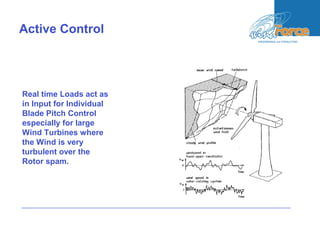
Active Control
Real time Loads act as
in Input for Individual
Blade Pitch Control
especially for large
Wind Turbines where
the Wind is very
turbulent over the
Rotor spam.
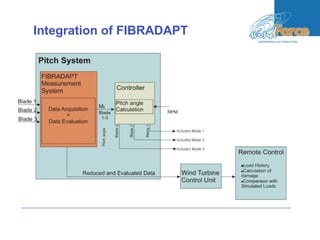
Integration of FIBRADAPT
FIBRADAPT™
System Additional Applications
• Integration into the SCADA System
• Standard Application for Design Verifications
• Development of a Wind Park Management System
based on Load Data
• Black Box Functionality
Test Installation –
Application of FIBRADAPT
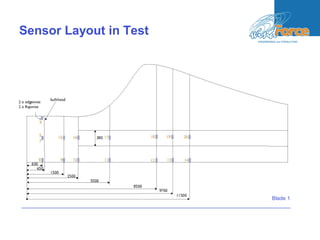
Sensor Layout in Test
Blade 1
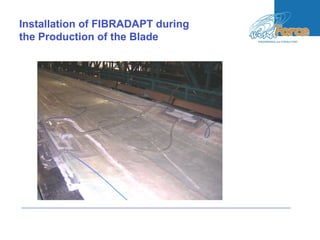
Installation of FIBRADAPT during
the Production of the Blade
Bending Moment flapwise
50 100 150 200 250 300 350 400 450 500 550 600
Time [s]
4E+05
6E+05
8E+05
1E+06
1.2E+06
1.4E+06
BendingMoment[kNm]
Mbf_1_fos
Copyright©2005 WindForce GmbH
0 2 4 6 8 10 12 14 16 18 20
Time [s]
4E+05
6E+05
8E+05
1E+06
1.2E+06
1.4E+06
BendingMoment[kNm]
Flap- and edgewise Loads
during Operation
450
500
550
600
650
343 345 347 349 351 Time [s]
strain(16)[mikrostrain]
-600
-400
-200
0
200
strain(12)[mikrostrain]
Sensor16 Sensor12
Frequency Analysis (Turbine
Operation)
0 0.2 0.4 0.6 0.8 1 1.2
Frequenz [Hz]
3
4
FFT-Mbf
FFT_Mbf_1
FFT_Mbf_1_fos
Copyright©2005 WindForce GmbH 2004-08-12 18-40-00_fft
Project planning - Outlook
• Integration of FIBRADAPT into a Serie
• Development and testing of active Control Algorithms for
FIBRADAPT
• Development of Methods for controlling and operating,
based on Variables
• Development of Methods for assuring the Application
Process in Serial Production in Offshore Installations
• Development of Software for Load Monitoring and
Residual Lifetime Estimation
www.wind-force.com
sabrina.kuhnt@wind-force.com
Die Entwicklung wird teilweise finanziert durch Mittel aus dem PFAU Programm
der BIS Bremerhaven
WindForce GmbH wird unterstützt durch Mittel des GRW Programms des Landes Bremen
Thank you for your attention!

6973432

  • 1.
    Advanced Wind TurbineControls Input Based on RealTime Loads Measured with Fiber Optical Sensors Embedded in Rotor Blades ewec 2006, Athens 28 February S. Kuhnt, J. Wernicke, R. Byars, J. Shadden (WindForce GmbH)
  • 2.
    Main Issues onWind Power Plants • High Operational and Maintenance Costs • Reliability below Customer Expectation – MTBF, MTTR • Competitiveness of COE • Low Insurability • Rapid Market Development
  • 3.
    FIBRADAPT™ Advanced Wind TurbineControl System Goal • Reduction of Structural and Dynamic Loads (extreme and fatigue) • Increasing the Lifetime of Wind Turbine Components • Component Reliability Improvements (MTBF, MTTR) • Project Controlling and Management Parameter • Fast Return on Investment (ROI) Investments in Innovation ensure Future Business Opportunities Operational Conditions of a wind turbine
  • 4.
    • Measuring ofRotor flapwise and edgewise Loads and Frequencies during Operation • Traceability of single Events (extreme Loads, emergency Stop etc.) • Traceability of fatigue Loads for residual Lifetime Estimation • Monitoring of Design Parameter • Monitoring of the Component Structure for early Detection of Damages and for determining predictive Maintenance Targets
  • 5.
  • 6.
    Fibre Bragg Grating(FBG) -Benefits • Multiple sensors in a single Fibre – Simple Connectivity, low Sensor Mass • No EMI with other operational Systems • Higher Measurement Quality and Stability – Solid state Electronics – Lifetime Operation • High Reliability of Sensors No EMI, no Corrosion, high Reliability
  • 7.
    Control Interface Electronics SpecificationValue Range +/- 4000 microstrain range Resolution 0.8 microstrain Repeatability (short term) +/- 5 microstrain Repeatability (long term) +/- 10 microstrain No of Sensors 100 per channel Maximum sensor distance > 2 km Scan Frequency 25 Hz for 20 Sensors Power Requirement 12 V @ 0.25 A Typical (3W-12Wl) Interface Ethernet, CANBus, RS422 etc.
  • 8.
  • 9.
    Residual Lifetime Estimation ResidualLifetime Estimation is based on Load Cycle Counting during the Operation of the Wind Turbine used for predictive Maintenance.
  • 10.
    Structural Monitoring The Occurrenceof Cracks and Defects can be detected at an early Stage to prevent catastrophic Failures and lengthy Downtimes. Data can be also used for Ice Load Monitoring.
  • 11.
    Active Control Real timeLoads act as in Input for Individual Blade Pitch Control especially for large Wind Turbines where the Wind is very turbulent over the Rotor spam.
  • 12.
  • 13.
    FIBRADAPT™ System Additional Applications •Integration into the SCADA System • Standard Application for Design Verifications • Development of a Wind Park Management System based on Load Data • Black Box Functionality
  • 14.
  • 15.
    Sensor Layout inTest Blade 1
  • 16.
    Installation of FIBRADAPTduring the Production of the Blade
  • 17.
    Bending Moment flapwise 50100 150 200 250 300 350 400 450 500 550 600 Time [s] 4E+05 6E+05 8E+05 1E+06 1.2E+06 1.4E+06 BendingMoment[kNm] Mbf_1_fos Copyright©2005 WindForce GmbH 0 2 4 6 8 10 12 14 16 18 20 Time [s] 4E+05 6E+05 8E+05 1E+06 1.2E+06 1.4E+06 BendingMoment[kNm]
  • 18.
    Flap- and edgewiseLoads during Operation 450 500 550 600 650 343 345 347 349 351 Time [s] strain(16)[mikrostrain] -600 -400 -200 0 200 strain(12)[mikrostrain] Sensor16 Sensor12
  • 19.
    Frequency Analysis (Turbine Operation) 00.2 0.4 0.6 0.8 1 1.2 Frequenz [Hz] 3 4 FFT-Mbf FFT_Mbf_1 FFT_Mbf_1_fos Copyright©2005 WindForce GmbH 2004-08-12 18-40-00_fft
  • 20.
    Project planning -Outlook • Integration of FIBRADAPT into a Serie • Development and testing of active Control Algorithms for FIBRADAPT • Development of Methods for controlling and operating, based on Variables • Development of Methods for assuring the Application Process in Serial Production in Offshore Installations • Development of Software for Load Monitoring and Residual Lifetime Estimation
  • 21.
    www.wind-force.com sabrina.kuhnt@wind-force.com Die Entwicklung wirdteilweise finanziert durch Mittel aus dem PFAU Programm der BIS Bremerhaven WindForce GmbH wird unterstützt durch Mittel des GRW Programms des Landes Bremen Thank you for your attention!

Editor's Notes

  • #5 <number>