ETFRN NEWS 53: APRIL 2012
250
6.5 Conflict management
and sustainable forest
management in the
Himalayas
RAJAN KOTRU and NAVRAJ PRADHAN
Introduction
Conflicts in the context. of forest management are common. In the future both climatic
and non-climatic factors (e.g., insecure tenure rights, demands for ecosystem services) will
exacerbate these conflicts. An analysis of global examples, such as water sharing or forest
use (Kotru 2006), endorses this hypothesis.
Demands for a sustainable supply of forest goods
and services from a variety of stakeholders are
increasing. This puts pressure on forestry institu-
tions and governance systems to perform efficiently,
effectively and equitably. This challenge will
demand a better understanding of emerging conflict
situations in relation to climate change and environmental degradation. If conflicts are
not addressed, they will worsen environmental degradation, compromise the desired
impacts of public and private investments, and undermine livelihoods.
Conventional participatory approaches, policies and legislations are constrained in their
ability to consider and apply conflict management mechanisms in practice. Due to rapid
socio-demographic and economic changes there is a need to develop consensus over the
role of good forest governance in making national development investments focus on
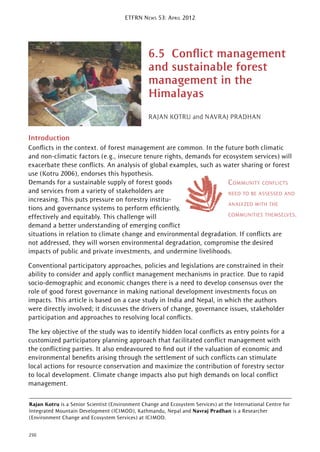
impacts. This article is based on a case study in India and Nepal, in which the authors
were directly involved; it discusses the drivers of change, governance issues, stakeholder
participation and approaches to resolving local conflicts.
The key objective of the study was to identify hidden local conflicts as entry points for a
customized participatory planning approach that facilitated conflict management with
the conflicting parties. It also endeavoured to find out if the valuation of economic and
environmental benefits arising through the settlement of such conflicts can stimulate
local actions for resource conservation and maximize the contribution of forestry sector
to local development. Climate change impacts also put high demands on local conflict
management.
Rajan Kotru is a Senior Scientist (Environment Change and Ecosystem Services) at the International Centre for
Integrated Mountain Development (ICIMOD), Kathmandu, Nepal and Navraj Pradhan is a Researcher
(Environment Change and Ecosystem Services) at ICIMOD.
COMMUNITY CONFLICTS
NEED TO BE ASSESSED AND
ANALYZED WITH THE
COMMUNITIES THEMSELVES.
251
6.5 CONFLICT MANAGEMENT AND SUSTAINABLE FOREST MANAGEMENT IN THE HIMALAYAS
Managing conflicts
The main approach to settling forest resource conflicts is local empowerment. It is the key
to judicious decision-making on resource management, which in turn is the outcome of
decentralization implemented through participatory and multi-stakeholder consultation
tools. The “Earth Summit” (Agenda 21; UN 1993) was the precursor to a wave of forest
sector decentralization reforms in developing countries. In addition to achieving multi-
stakeholders cooperation, the overall aim was to minimize conflicts between the state and
local communities over forest use (Gleditsch, Salahyan and Nordas 2007; Reuveny 2007).
Thereafter, community-based forest management frameworks were broadened. The
underlying rationale was that local people should not only help design participatory
forest management (PFM) but also contribute to inclusive decision-making processes and
effective norms for governing forest resources on an equitable basis, which are crucial to
mitigating conflicts (Sikor, Barlösius and Scheumann 2008).
There is also a need to examine development programmes in terms of local understand-
ings and approaches to community-based natural resource management initiatives, and of
local power and status relationships with the environment (Twyman 2000). On the other
hand, participatory approaches (e.g., Participatory Rural Appraisals, Appreciative Inquiry,
etc.) are not designed to treat local conflicts. Public investments in forest production and
conservation are often not sustainable, since projects/programmes operate on an ad-hoc
basis, and project cycles seldom allow time for conflict identification and mitigation.
Despite the advancement of PFM in India and Nepal and huge investment, (e.g., about
US$141.4 million (from 1996–2011) through donor support in Nepal),1
there are conflicts
around forest areas. Forest encroachments in the state forests of Nepal are a clear clash
of interests in protection on the one hand and access on the other. The poor survival rate
of plantations on common lands in India is due to a conflict of interest between open
grazing and conservation.
The overall lack of commitment and facilitative skills of implementing personnel add to
the ability of forest governance to solve the local conflict of interest (e.g., exploitative
fellings in remote community forests) in already degraded forests and plantations. This
leads to forest cover loss in Nepal, where the annual deforestation rate from 2005–10 was
27,000 ha (Mongabay 2011).
The conventional mode of settling forest-based conflicts demands tactics that recognize
two main challenges: First: managing conflicts must be part of future forest governance
mechanisms. In extreme cases, violence is likely to occur when internal and external
stresses are not countered by capable and legitimate institutions. Second: increased
demands on the good governance of forest resources will emerge from the diversified
range of stakeholders who seek inclusive participation in securing production, quality of
services and equitable access and benefit sharing. Public schemes and donor-aided
projects have targeted and scheduled implementation, and conflict management has often
proved ideal to achieve the positive impacts of investments.
ETFRN NEWS 53: APRIL 2012
252
Case studies
Conflicts arise because of differences in the values and interests of diverse stakeholders.
Because conflicts are inevitable, processes for dealing with them constructively are need-
ed. The main objective is to analyze forest-based conflict situations and use the results to
develop a new conceptual framework for planning sustainable forest management (SFM).2
This case study relied on logical steps from conflict identification to its management:3
• selection of three sites (one in India and two in Nepal);
• identification of any conflicts that hindered SFM (what, why, who, how);
• use of a combination of participatory assessment and consultative tools to
facilitate local sensitization and conflict management;
• conflict analysis (assessing the power and position of various stakeholders) and
proposal of locally owned conflict resolutions and management; and
• distillation of lessons learned in order to propose a conceptual framework.
The three case studies had scenarios of resource scarcity, long-established social conflicts,
a range of governance standards, and political instability at the local and national level
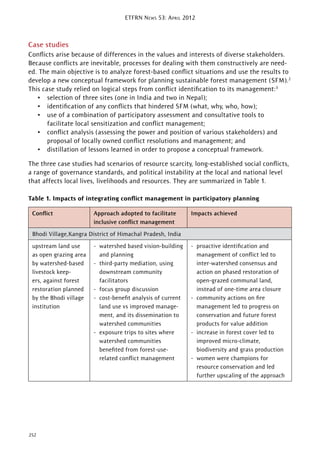
that affects local lives, livelihoods and resources. They are summarized in Table 1.
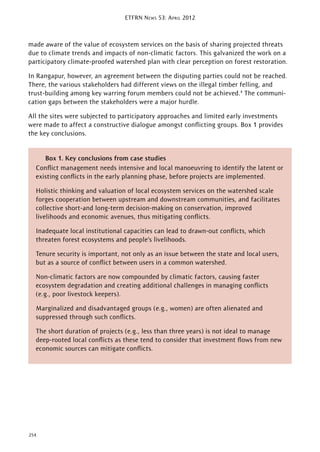
Table 1. Impacts of integrating conflict management in participatory planning
Conflict Approach adopted to facilitate
inclusive conflict management
Impacts achieved
Bhodi Village,Kangra District of Himachal Pradesh, India
upstream land use
as open grazing area
by watershed-based
livestock keep-
ers, against forest
restoration planned
by the Bhodi village
institution
- watershed based vision-building
and planning
- third-party mediation, using
downstream community
facilitators
- focus group discussion
- cost-benefit analysis of current
land use vs improved manage-
ment, and its dissemination to
watershed communities
- exposure trips to sites where
watershed communities
benefited from forest-use-
related conflict management
- proactive identification and
management of conflict led to
inter-watershed consensus and
action on phased restoration of
open-grazed communal land,
instead of one-time area closure
- community actions on fire
management led to progress on
conservation and future forest
products for value addition
- increase in forest cover led to
improved micro-climate,
biodiversity and grass production
- women were champions for
resource conservation and led
further upscaling of the approach
253
6.5 CONFLICT MANAGEMENT AND SUSTAINABLE FOREST MANAGEMENT IN THE HIMALAYAS
Lorpa Village, Jumla District, Nepal
overuse of local
forest resources for
illegal purposes by
local community
members, against
inadequate institu-
tional capacity to
counter misuse of
these resources
- vision-building
- non-confrontational style of
conflict resolution
- watershed planning based on
resource balance studies if
conflict of interest continues
- focus group discussion with
Community Forest User Group
- Community-based Climate
Vulnerability Assessment
- climate modelling (downscaled)
used for assessing future trends
- exposure trips to good
community forestry groups
- awareness of communities to set-
tle the conflict of interest between
different forest stakeholders as
the key to progress and prosperity
through an Integrated Participa-
tory Watershed Plan
- the plan is the means to achieve
good forest governance and an
ideal response to climate change
challenges
Rangapur Village Development Committee, Rautahat District, Nepal
wider group of
stakeholders with
demands on forest
use, against local
forest-dependent
groups
authoritarian
conflict manage-
ment style used by
distant users
- multi-stakeholder dialogue
- focus group discussion
- targeted development activities
- collaborative forest manage-
ment plan
- no consensus for an inter-
community dialogue to manage
forests on long term was achieved
- although a collaborative forest
management plan could not be
implemented, it did lead to the
suppression of criminal elements
carrying out illegal cuttings, and
minimized further conflicts
General findings of case studies
Since earlier public investments on conservation and afforestation had failed, the authors
established the link to conflict of interests on the common use of communal and
forest lands. Therefore, the first focus-group discussions outlined the needs and probable
solutions of conflicting groups. Rather than implementing the development programme,
the authors linked the further planning of investments to non-climatic issues that hinder
the regeneration of forests. This triggered the local response: “If we have to progress and
prosper, we need to manage conflict of interests.”
In Bhodi (see Table 1), a downstream community affected by soil erosion and water
scarcity found the solution in restoring the forest cover in the upstream. This community
was sensitized to facilitate a consensus for an integrated watershed plan that balanced
the needs of livestock-keepers in upstream with a phased plan for forest conservation. In
Lorpa (affected by heavy deforestation and degradation), forest-dependent groups were
ETFRN NEWS 53: APRIL 2012
254
made aware of the value of ecosystem services on the basis of sharing projected threats
due to climate trends and impacts of non-climatic factors. This galvanized the work on a
participatory climate-proofed watershed plan with clear perception on forest restoration.
In Rangapur, however, an agreement between the disputing parties could not be reached.
There, the various stakeholders had different views on the illegal timber felling, and
trust-building among key warring forum members could not be achieved.4
The communi-
cation gaps between the stakeholders were a major hurdle.
All the sites were subjected to participatory approaches and limited early investments
were made to affect a constructive dialogue amongst conflicting groups. Box 1 provides
the key conclusions.
Box 1. Key conclusions from case studies
Conflict management needs intensive and local manoeuvring to identify the latent or
existing conflicts in the early planning phase, before projects are implemented.
Holistic thinking and valuation of local ecosystem services on the watershed scale
forges cooperation between upstream and downstream communities, and facilitates
collective short-and long-term decision-making on conservation, improved
livelihoods and economic avenues, thus mitigating conflicts.
Inadequate local institutional capacities can lead to drawn-out conflicts, which
threaten forest ecosystems and people’s livelihoods.
Tenure security is important, not only as an issue between the state and local users,
but as a source of conflict between users in a common watershed.
Non-climatic factors are now compounded by climatic factors, causing faster
ecosystem degradation and creating additional challenges in managing conflicts
(e.g., poor livestock keepers).
Marginalized and disadvantaged groups (e.g., women) are often alienated and
suppressed through such conflicts.
The short duration of projects (e.g., less than three years) is not ideal to manage
deep-rooted local conflicts as these tend to consider that investment flows from new
economic sources can mitigate conflicts.
255
6.5 CONFLICT MANAGEMENT AND SUSTAINABLE FOREST MANAGEMENT IN THE HIMALAYAS
Recommendations
The conflict management skills of facilitators (including institutions, local resource
persons and women) should be upgraded on a continual basis and used proactively during
the early planning phase of development projects. Capacity-building support should be
customized accordingly, from micro to macro level.
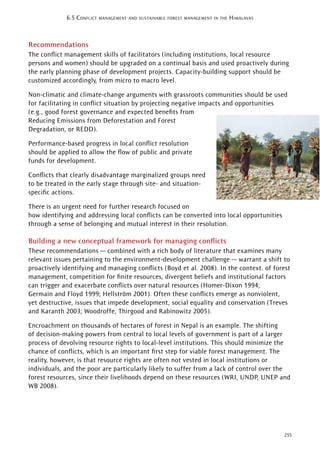
Non-climatic and climate-change arguments with grassroots communities should be used
for facilitating in conflict situation by projecting negative impacts and opportunities
(e.g., good forest governance and expected benefits from
Reducing Emissions from Deforestation and Forest
Degradation, or REDD).
Performance-based progress in local conflict resolution
should be applied to allow the flow of public and private
funds for development.
Conflicts that clearly disadvantage marginalized groups need
to be treated in the early stage through site- and situation-
specific actions.
There is an urgent need for further research focused on
how identifying and addressing local conflicts can be converted into local opportunities
through a sense of belonging and mutual interest in their resolution.
Building a new conceptual framework for managing conflicts
These recommendations — combined with a rich body of literature that examines many
relevant issues pertaining to the environment-development challenge — warrant a shift to
proactively identifying and managing conflicts (Boyd et al. 2008). In the context. of forest
management, competition for finite resources, divergent beliefs and institutional factors
can trigger and exacerbate conflicts over natural resources (Homer-Dixon 1994;
Germain and Floyd 1999; Hellström 2001). Often these conflicts emerge as nonviolent,
yet destructive, issues that impede development, social equality and conservation (Treves
and Karanth 2003; Woodroffe, Thirgood and Rabinowitz 2005).
Encroachment on thousands of hectares of forest in Nepal is an example. The shifting
of decision-making powers from central to local levels of government is part of a larger
process of devolving resource rights to local-level institutions. This should minimize the
chance of conflicts, which is an important first step for viable forest management. The
reality, however, is that resource rights are often not vested in local institutions or
individuals, and the poor are particularly likely to suffer from a lack of control over the
forest resources, since their livelihoods depend on these resources (WRI, UNDP, UNEP and
WB 2008).
ETFRN NEWS 53: APRIL 2012
256
Obviously, governments need to develop suitable conflict management strategies and
more inclusive practices, recognizing the inter-relationships between conflict, social,
political, economic and cultural factors (Upreti et al. 2010). An improved conceptual
framework must assist in dealing with conflicts about the management of forests. This
framework can be piloted at different scales and be made more robust through ongoing
learning. The cases analyzed in this paper contribute to such a framework.
Proposed framework
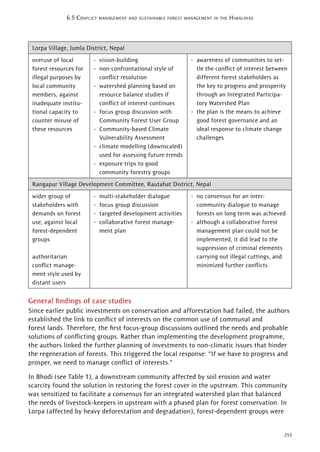
A 4-C framework for managing conflicts is proposed that includes these elements:
1. Conflict: its resolution as the basis of successful short-long-term development
outcomes and overall peace
2. Community: as the prime social medium to facilitate resolution and make
development progress
3. Commerce: valuating and investing in inclusive economic initiatives to generate
interest for conflict mitigation
4. Climate: as the precursor to conflicts, demanding integration in participatory tools
and for galvanizing local community support.
The proposed framework aims to conceptualize the social dynamics between principles of
equitable human development, technological advancement, environmental security and
politically sensitive atmospheres and the ways forward to keeping conflict issues part of
the focus of sustaining forest resources. Figure 1 provides the essential aspects of such a
conceptual framework, bridging gaps where there is lack of governance, disruption of
forest resources surrounded by conflict scenarios at micro and macro scales.
Figure 1. Proposed 4-C framework for managing conflicts in forest management
Assess and analyze
Conflict
(identify and analyze priorities)
Community
(change mindsets for
proactive management)
Commerce
(use cost-benefit analysis of
recurring conflict situations)
Climate
(add climate as an argument
to solve conflicts)
Plan and implement
Peace
Progress
Prosperity
Promise
Inclusive
socio-economic
development
and climate
resilience
Deliver credible impacts
Goal
257
6.5 CONFLICT MANAGEMENT AND SUSTAINABLE FOREST MANAGEMENT IN THE HIMALAYAS
In other words, community conflicts need to be assessed and analyzed with the local com-
munities. Short- and long-term resolution often needs to be accompanied by visible and
sustainable income generation and conservation activities that address climate resilience.
When external planners design target investments, they often have the notion that
community participation will take place as a precursor to planned targets, given an
assumed mindset of collectivism and commonality within a community. In reality, this
is not the case, as there are always latent or actual conflict situations in and among
communities. These should be identified at the outset, and can be addressed by designing
tangible and intangible benefits.
Acknowledgement
The views expressed in this article are personal views of the authors and do not
necessarily reflect those of ICIMOD.
Endnotes
1. Source: Ministry of Forests and Soil Conservation, Foreign Aid Division, Government of Nepal.
2. In these case studies, the authors have directly been involved in the design and analysis of the local
conflict resolution process.
3. As a common guideline for selected case studies, FAO’s Land Tenure Manuals format was used,
using “Local Conflict” as the entry point.
4. This site was a test area for a new concept of community-based collaborative forest
management, where traditional users and settled forest users were brought together under an
institutional arrangement of District Forest Coordination Committee. However, forest destruction
and illegal encroachments on the CFM area have been substantially increasing in these areas and
CFM sub-committees have a very limited capacity and commitment (partly because it can be life-
threatening) to protect local forests (barring a few proactive members of CFM sub-committees).
In Rangapur there was no change in the intensity of encroachments/illegal felling after the
Biodiversity Sector Programme for Shiwaliks and Terai (BISEP-ST)4. Visual assessment shows that
intact forestlands can be converted to open area/agriculture in 7–10 years.
References
Boyd, E. et al. 2008. “Resilience and ‘climatizing’ development: examples and policy implications.”
Development 51(3): 390–396.
Germain, R. H. and D. W. Floyd. 1999. “Developing resource-based social conflict models for
assessing the utility of negotiation in conflict resolution.” Forest Science 45(3): 394–406.
Gleditsch, N.P., I. Salahyan and R. Nordas. 2007. Climate change and conflict: The migration link.
Vienna: International Peace Institute.
Hellström, E. 2001. Conflict cultures: qualitative comparative analysis of environmental conflicts in
forestry. Ph.D. Thesis, Economic Department of the Faculty of Agriculture and Forestry at the
University of Helsinki.
Homer-Dixon, T.F. 1994. “Environmental scarcities and violent conflict: evidence from cases.”
International Security 19(1): 5–40.
Kotru, R. 2006. Environmental policy/conservation and sustainable use of natural resources: “How Green
is my Village.” Tackling degradation through empowerment. GiZ Process Study. New Delhi, India.
ETFRN NEWS 53: APRIL 2012
258
Mongabay. 2011. Nepal Forest Information and Data. Retrieved July 8, 2011.
http://rainforests.mongabay.com/deforestation/2000/Nepal.htm.
Reuveny, R. 2007. “Climate change-induced migration and violent conflict.” Political Geography
26(6): 656–673.
Sikor, T., E. Barlösius and W. Scheumann. 2008. “Introduction: Public- Private Relations and Key
Policy Issues in Natural Resource Governance.” pp 1–18 in T. Sikor (ed.). Public and Private in
Natural Resource Governance: False Dichotomy? London: Earthscan.
Treves, A. and K.U. Karanth. 2003. “Human-carnivore conflict and perspectives on carnivore
management worldwide.” Conservation Biology 17(6): 1491–1499.
Twyman, C. 2000. “Participatory conservation? Community-based natural resource management
in Botswana.” Geographical Journal 166(4): 323–335.
UN (United Nations). 1993. Agenda 21. New York: United Nations Department of Public
Information.
Upreti, B.R., S.R. Sharma, K.N. Pyakuryal and S. Ghimire (eds.). 2010. The Remake of a State:
Post-conflict Challenges and State Building in Nepal. South Asia Regional Coordination Office of the
Swiss National Centre of Competence in Research (NCCR-North-South) and Human and Natural
Resources Studies Centre, Kathmandu University.
Woodroffe, R., S.J. Thirgood and J. Rabinowitz. 2005. People and Wildlife: Conflict or Co-Existence?
Cambridge: Cambridge University Press.
(WRI) World Resources Institute in collaboration with UNDP, UNEP and World Bank. 2008.
World Resources 2008: Roots of Resilience—Growing the Wealth of the Poor. Washington, D.C.: WRI.

6.5.R.Kotru-N.Pradhan copy

  • 1.
    ETFRN NEWS 53:APRIL 2012 250 6.5 Conflict management and sustainable forest management in the Himalayas RAJAN KOTRU and NAVRAJ PRADHAN Introduction Conflicts in the context. of forest management are common. In the future both climatic and non-climatic factors (e.g., insecure tenure rights, demands for ecosystem services) will exacerbate these conflicts. An analysis of global examples, such as water sharing or forest use (Kotru 2006), endorses this hypothesis. Demands for a sustainable supply of forest goods and services from a variety of stakeholders are increasing. This puts pressure on forestry institu- tions and governance systems to perform efficiently, effectively and equitably. This challenge will demand a better understanding of emerging conflict situations in relation to climate change and environmental degradation. If conflicts are not addressed, they will worsen environmental degradation, compromise the desired impacts of public and private investments, and undermine livelihoods. Conventional participatory approaches, policies and legislations are constrained in their ability to consider and apply conflict management mechanisms in practice. Due to rapid socio-demographic and economic changes there is a need to develop consensus over the role of good forest governance in making national development investments focus on impacts. This article is based on a case study in India and Nepal, in which the authors were directly involved; it discusses the drivers of change, governance issues, stakeholder participation and approaches to resolving local conflicts. The key objective of the study was to identify hidden local conflicts as entry points for a customized participatory planning approach that facilitated conflict management with the conflicting parties. It also endeavoured to find out if the valuation of economic and environmental benefits arising through the settlement of such conflicts can stimulate local actions for resource conservation and maximize the contribution of forestry sector to local development. Climate change impacts also put high demands on local conflict management. Rajan Kotru is a Senior Scientist (Environment Change and Ecosystem Services) at the International Centre for Integrated Mountain Development (ICIMOD), Kathmandu, Nepal and Navraj Pradhan is a Researcher (Environment Change and Ecosystem Services) at ICIMOD. COMMUNITY CONFLICTS NEED TO BE ASSESSED AND ANALYZED WITH THE COMMUNITIES THEMSELVES.
  • 2.
    251 6.5 CONFLICT MANAGEMENTAND SUSTAINABLE FOREST MANAGEMENT IN THE HIMALAYAS Managing conflicts The main approach to settling forest resource conflicts is local empowerment. It is the key to judicious decision-making on resource management, which in turn is the outcome of decentralization implemented through participatory and multi-stakeholder consultation tools. The “Earth Summit” (Agenda 21; UN 1993) was the precursor to a wave of forest sector decentralization reforms in developing countries. In addition to achieving multi- stakeholders cooperation, the overall aim was to minimize conflicts between the state and local communities over forest use (Gleditsch, Salahyan and Nordas 2007; Reuveny 2007). Thereafter, community-based forest management frameworks were broadened. The underlying rationale was that local people should not only help design participatory forest management (PFM) but also contribute to inclusive decision-making processes and effective norms for governing forest resources on an equitable basis, which are crucial to mitigating conflicts (Sikor, Barlösius and Scheumann 2008). There is also a need to examine development programmes in terms of local understand- ings and approaches to community-based natural resource management initiatives, and of local power and status relationships with the environment (Twyman 2000). On the other hand, participatory approaches (e.g., Participatory Rural Appraisals, Appreciative Inquiry, etc.) are not designed to treat local conflicts. Public investments in forest production and conservation are often not sustainable, since projects/programmes operate on an ad-hoc basis, and project cycles seldom allow time for conflict identification and mitigation. Despite the advancement of PFM in India and Nepal and huge investment, (e.g., about US$141.4 million (from 1996–2011) through donor support in Nepal),1 there are conflicts around forest areas. Forest encroachments in the state forests of Nepal are a clear clash of interests in protection on the one hand and access on the other. The poor survival rate of plantations on common lands in India is due to a conflict of interest between open grazing and conservation. The overall lack of commitment and facilitative skills of implementing personnel add to the ability of forest governance to solve the local conflict of interest (e.g., exploitative fellings in remote community forests) in already degraded forests and plantations. This leads to forest cover loss in Nepal, where the annual deforestation rate from 2005–10 was 27,000 ha (Mongabay 2011). The conventional mode of settling forest-based conflicts demands tactics that recognize two main challenges: First: managing conflicts must be part of future forest governance mechanisms. In extreme cases, violence is likely to occur when internal and external stresses are not countered by capable and legitimate institutions. Second: increased demands on the good governance of forest resources will emerge from the diversified range of stakeholders who seek inclusive participation in securing production, quality of services and equitable access and benefit sharing. Public schemes and donor-aided projects have targeted and scheduled implementation, and conflict management has often proved ideal to achieve the positive impacts of investments.
  • 3.
    ETFRN NEWS 53:APRIL 2012 252 Case studies Conflicts arise because of differences in the values and interests of diverse stakeholders. Because conflicts are inevitable, processes for dealing with them constructively are need- ed. The main objective is to analyze forest-based conflict situations and use the results to develop a new conceptual framework for planning sustainable forest management (SFM).2 This case study relied on logical steps from conflict identification to its management:3 • selection of three sites (one in India and two in Nepal); • identification of any conflicts that hindered SFM (what, why, who, how); • use of a combination of participatory assessment and consultative tools to facilitate local sensitization and conflict management; • conflict analysis (assessing the power and position of various stakeholders) and proposal of locally owned conflict resolutions and management; and • distillation of lessons learned in order to propose a conceptual framework. The three case studies had scenarios of resource scarcity, long-established social conflicts, a range of governance standards, and political instability at the local and national level that affects local lives, livelihoods and resources. They are summarized in Table 1. Table 1. Impacts of integrating conflict management in participatory planning Conflict Approach adopted to facilitate inclusive conflict management Impacts achieved Bhodi Village,Kangra District of Himachal Pradesh, India upstream land use as open grazing area by watershed-based livestock keep- ers, against forest restoration planned by the Bhodi village institution - watershed based vision-building and planning - third-party mediation, using downstream community facilitators - focus group discussion - cost-benefit analysis of current land use vs improved manage- ment, and its dissemination to watershed communities - exposure trips to sites where watershed communities benefited from forest-use- related conflict management - proactive identification and management of conflict led to inter-watershed consensus and action on phased restoration of open-grazed communal land, instead of one-time area closure - community actions on fire management led to progress on conservation and future forest products for value addition - increase in forest cover led to improved micro-climate, biodiversity and grass production - women were champions for resource conservation and led further upscaling of the approach
  • 4.
    253 6.5 CONFLICT MANAGEMENTAND SUSTAINABLE FOREST MANAGEMENT IN THE HIMALAYAS Lorpa Village, Jumla District, Nepal overuse of local forest resources for illegal purposes by local community members, against inadequate institu- tional capacity to counter misuse of these resources - vision-building - non-confrontational style of conflict resolution - watershed planning based on resource balance studies if conflict of interest continues - focus group discussion with Community Forest User Group - Community-based Climate Vulnerability Assessment - climate modelling (downscaled) used for assessing future trends - exposure trips to good community forestry groups - awareness of communities to set- tle the conflict of interest between different forest stakeholders as the key to progress and prosperity through an Integrated Participa- tory Watershed Plan - the plan is the means to achieve good forest governance and an ideal response to climate change challenges Rangapur Village Development Committee, Rautahat District, Nepal wider group of stakeholders with demands on forest use, against local forest-dependent groups authoritarian conflict manage- ment style used by distant users - multi-stakeholder dialogue - focus group discussion - targeted development activities - collaborative forest manage- ment plan - no consensus for an inter- community dialogue to manage forests on long term was achieved - although a collaborative forest management plan could not be implemented, it did lead to the suppression of criminal elements carrying out illegal cuttings, and minimized further conflicts General findings of case studies Since earlier public investments on conservation and afforestation had failed, the authors established the link to conflict of interests on the common use of communal and forest lands. Therefore, the first focus-group discussions outlined the needs and probable solutions of conflicting groups. Rather than implementing the development programme, the authors linked the further planning of investments to non-climatic issues that hinder the regeneration of forests. This triggered the local response: “If we have to progress and prosper, we need to manage conflict of interests.” In Bhodi (see Table 1), a downstream community affected by soil erosion and water scarcity found the solution in restoring the forest cover in the upstream. This community was sensitized to facilitate a consensus for an integrated watershed plan that balanced the needs of livestock-keepers in upstream with a phased plan for forest conservation. In Lorpa (affected by heavy deforestation and degradation), forest-dependent groups were
  • 5.
    ETFRN NEWS 53:APRIL 2012 254 made aware of the value of ecosystem services on the basis of sharing projected threats due to climate trends and impacts of non-climatic factors. This galvanized the work on a participatory climate-proofed watershed plan with clear perception on forest restoration. In Rangapur, however, an agreement between the disputing parties could not be reached. There, the various stakeholders had different views on the illegal timber felling, and trust-building among key warring forum members could not be achieved.4 The communi- cation gaps between the stakeholders were a major hurdle. All the sites were subjected to participatory approaches and limited early investments were made to affect a constructive dialogue amongst conflicting groups. Box 1 provides the key conclusions. Box 1. Key conclusions from case studies Conflict management needs intensive and local manoeuvring to identify the latent or existing conflicts in the early planning phase, before projects are implemented. Holistic thinking and valuation of local ecosystem services on the watershed scale forges cooperation between upstream and downstream communities, and facilitates collective short-and long-term decision-making on conservation, improved livelihoods and economic avenues, thus mitigating conflicts. Inadequate local institutional capacities can lead to drawn-out conflicts, which threaten forest ecosystems and people’s livelihoods. Tenure security is important, not only as an issue between the state and local users, but as a source of conflict between users in a common watershed. Non-climatic factors are now compounded by climatic factors, causing faster ecosystem degradation and creating additional challenges in managing conflicts (e.g., poor livestock keepers). Marginalized and disadvantaged groups (e.g., women) are often alienated and suppressed through such conflicts. The short duration of projects (e.g., less than three years) is not ideal to manage deep-rooted local conflicts as these tend to consider that investment flows from new economic sources can mitigate conflicts.
  • 6.
    255 6.5 CONFLICT MANAGEMENTAND SUSTAINABLE FOREST MANAGEMENT IN THE HIMALAYAS Recommendations The conflict management skills of facilitators (including institutions, local resource persons and women) should be upgraded on a continual basis and used proactively during the early planning phase of development projects. Capacity-building support should be customized accordingly, from micro to macro level. Non-climatic and climate-change arguments with grassroots communities should be used for facilitating in conflict situation by projecting negative impacts and opportunities (e.g., good forest governance and expected benefits from Reducing Emissions from Deforestation and Forest Degradation, or REDD). Performance-based progress in local conflict resolution should be applied to allow the flow of public and private funds for development. Conflicts that clearly disadvantage marginalized groups need to be treated in the early stage through site- and situation- specific actions. There is an urgent need for further research focused on how identifying and addressing local conflicts can be converted into local opportunities through a sense of belonging and mutual interest in their resolution. Building a new conceptual framework for managing conflicts These recommendations — combined with a rich body of literature that examines many relevant issues pertaining to the environment-development challenge — warrant a shift to proactively identifying and managing conflicts (Boyd et al. 2008). In the context. of forest management, competition for finite resources, divergent beliefs and institutional factors can trigger and exacerbate conflicts over natural resources (Homer-Dixon 1994; Germain and Floyd 1999; Hellström 2001). Often these conflicts emerge as nonviolent, yet destructive, issues that impede development, social equality and conservation (Treves and Karanth 2003; Woodroffe, Thirgood and Rabinowitz 2005). Encroachment on thousands of hectares of forest in Nepal is an example. The shifting of decision-making powers from central to local levels of government is part of a larger process of devolving resource rights to local-level institutions. This should minimize the chance of conflicts, which is an important first step for viable forest management. The reality, however, is that resource rights are often not vested in local institutions or individuals, and the poor are particularly likely to suffer from a lack of control over the forest resources, since their livelihoods depend on these resources (WRI, UNDP, UNEP and WB 2008).
  • 7.
    ETFRN NEWS 53:APRIL 2012 256 Obviously, governments need to develop suitable conflict management strategies and more inclusive practices, recognizing the inter-relationships between conflict, social, political, economic and cultural factors (Upreti et al. 2010). An improved conceptual framework must assist in dealing with conflicts about the management of forests. This framework can be piloted at different scales and be made more robust through ongoing learning. The cases analyzed in this paper contribute to such a framework. Proposed framework A 4-C framework for managing conflicts is proposed that includes these elements: 1. Conflict: its resolution as the basis of successful short-long-term development outcomes and overall peace 2. Community: as the prime social medium to facilitate resolution and make development progress 3. Commerce: valuating and investing in inclusive economic initiatives to generate interest for conflict mitigation 4. Climate: as the precursor to conflicts, demanding integration in participatory tools and for galvanizing local community support. The proposed framework aims to conceptualize the social dynamics between principles of equitable human development, technological advancement, environmental security and politically sensitive atmospheres and the ways forward to keeping conflict issues part of the focus of sustaining forest resources. Figure 1 provides the essential aspects of such a conceptual framework, bridging gaps where there is lack of governance, disruption of forest resources surrounded by conflict scenarios at micro and macro scales. Figure 1. Proposed 4-C framework for managing conflicts in forest management Assess and analyze Conflict (identify and analyze priorities) Community (change mindsets for proactive management) Commerce (use cost-benefit analysis of recurring conflict situations) Climate (add climate as an argument to solve conflicts) Plan and implement Peace Progress Prosperity Promise Inclusive socio-economic development and climate resilience Deliver credible impacts Goal
  • 8.
    257 6.5 CONFLICT MANAGEMENTAND SUSTAINABLE FOREST MANAGEMENT IN THE HIMALAYAS In other words, community conflicts need to be assessed and analyzed with the local com- munities. Short- and long-term resolution often needs to be accompanied by visible and sustainable income generation and conservation activities that address climate resilience. When external planners design target investments, they often have the notion that community participation will take place as a precursor to planned targets, given an assumed mindset of collectivism and commonality within a community. In reality, this is not the case, as there are always latent or actual conflict situations in and among communities. These should be identified at the outset, and can be addressed by designing tangible and intangible benefits. Acknowledgement The views expressed in this article are personal views of the authors and do not necessarily reflect those of ICIMOD. Endnotes 1. Source: Ministry of Forests and Soil Conservation, Foreign Aid Division, Government of Nepal. 2. In these case studies, the authors have directly been involved in the design and analysis of the local conflict resolution process. 3. As a common guideline for selected case studies, FAO’s Land Tenure Manuals format was used, using “Local Conflict” as the entry point. 4. This site was a test area for a new concept of community-based collaborative forest management, where traditional users and settled forest users were brought together under an institutional arrangement of District Forest Coordination Committee. However, forest destruction and illegal encroachments on the CFM area have been substantially increasing in these areas and CFM sub-committees have a very limited capacity and commitment (partly because it can be life- threatening) to protect local forests (barring a few proactive members of CFM sub-committees). In Rangapur there was no change in the intensity of encroachments/illegal felling after the Biodiversity Sector Programme for Shiwaliks and Terai (BISEP-ST)4. Visual assessment shows that intact forestlands can be converted to open area/agriculture in 7–10 years. References Boyd, E. et al. 2008. “Resilience and ‘climatizing’ development: examples and policy implications.” Development 51(3): 390–396. Germain, R. H. and D. W. Floyd. 1999. “Developing resource-based social conflict models for assessing the utility of negotiation in conflict resolution.” Forest Science 45(3): 394–406. Gleditsch, N.P., I. Salahyan and R. Nordas. 2007. Climate change and conflict: The migration link. Vienna: International Peace Institute. Hellström, E. 2001. Conflict cultures: qualitative comparative analysis of environmental conflicts in forestry. Ph.D. Thesis, Economic Department of the Faculty of Agriculture and Forestry at the University of Helsinki. Homer-Dixon, T.F. 1994. “Environmental scarcities and violent conflict: evidence from cases.” International Security 19(1): 5–40. Kotru, R. 2006. Environmental policy/conservation and sustainable use of natural resources: “How Green is my Village.” Tackling degradation through empowerment. GiZ Process Study. New Delhi, India.
  • 9.
    ETFRN NEWS 53:APRIL 2012 258 Mongabay. 2011. Nepal Forest Information and Data. Retrieved July 8, 2011. http://rainforests.mongabay.com/deforestation/2000/Nepal.htm. Reuveny, R. 2007. “Climate change-induced migration and violent conflict.” Political Geography 26(6): 656–673. Sikor, T., E. Barlösius and W. Scheumann. 2008. “Introduction: Public- Private Relations and Key Policy Issues in Natural Resource Governance.” pp 1–18 in T. Sikor (ed.). Public and Private in Natural Resource Governance: False Dichotomy? London: Earthscan. Treves, A. and K.U. Karanth. 2003. “Human-carnivore conflict and perspectives on carnivore management worldwide.” Conservation Biology 17(6): 1491–1499. Twyman, C. 2000. “Participatory conservation? Community-based natural resource management in Botswana.” Geographical Journal 166(4): 323–335. UN (United Nations). 1993. Agenda 21. New York: United Nations Department of Public Information. Upreti, B.R., S.R. Sharma, K.N. Pyakuryal and S. Ghimire (eds.). 2010. The Remake of a State: Post-conflict Challenges and State Building in Nepal. South Asia Regional Coordination Office of the Swiss National Centre of Competence in Research (NCCR-North-South) and Human and Natural Resources Studies Centre, Kathmandu University. Woodroffe, R., S.J. Thirgood and J. Rabinowitz. 2005. People and Wildlife: Conflict or Co-Existence? Cambridge: Cambridge University Press. (WRI) World Resources Institute in collaboration with UNDP, UNEP and World Bank. 2008. World Resources 2008: Roots of Resilience—Growing the Wealth of the Poor. Washington, D.C.: WRI.