The Year in Review in  61 MINUTES Joop Loomans  Robert Magnus  Mike Pownall
The Economy  in Recovery?
Technology A Vets Best Friend?
Work/Life Balance?Students  Jobs/Debt!!
The Global Economy  in Crisis … it effects the veterinary community
Challenging Times 2008 2009 2010 … The Future
Financial Investment Bankers Wall Street Rating Companies The Consumer Responsibility & Accountability
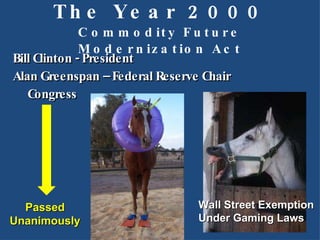
The Year 2000 Commodity Future Modernization Act Bill Clinton - President Alan Greenspan – Federal Reserve Chair Congress Wall Street Exemption  Under Gaming Laws Passed Unanimously
Financial Instruments Derivatives, Mortgage Back Securities Derivative:  A financial instrument whose value is based on something else “ basically it’s a side bet” The Bet: 1.  Whether interest rates would go up or down 2.  Whether people would default on their mortgages Credit default swaps  Insurance Contracts $ Poor Performing Asset No Regulation No Asset Coverage
Economic Drivers Financial Institutions Incentives Regulatory failure Housing / Mortgage Market Over-built 2003-07 Over-priced Irresponsible financing Real Estate Market No skin in the game – derivatives & securities Labor Market Lag effect of consumer spending
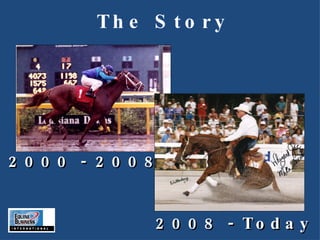
The Story 2000 - 2008 2008 - Today
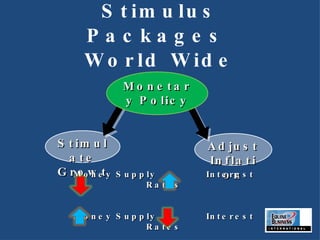
Stimulus Packages  World Wide Adjust Inflation Stimulate Growth Money Supply  Interest Rates Money Supply  Interest Rates Monetary Policy
Paris, France and Whitehouse Station, NJ. – March 9, 2010 –  Sanofi-aventis and Merck to create a Global Leader in Animal Health   Sanofi-aventis exercises its option to combine Merial with Intervet/Schering-Plough in a new equally-owned Joint Venture with Merck  Sanofi-aventis (EURONEXT: SAN and NYSE: SNY) and Merck & Co., Inc. (NYSE: MRK) announced today that sanofi-aventis has exercised its option to combine Merial with Intervet/Schering-Plough, Merck’s Animal Health business, to create a global leader in Animal Health.  Industry Consolodation
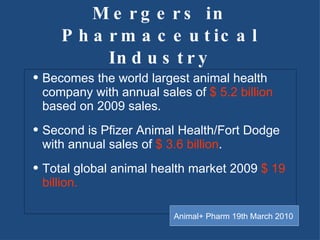
Mergers in Pharmaceutical Industry Becomes the world largest animal health company with annual sales of  $ 5.2 billion  based on 2009 sales.  Second is Pfizer Animal Health/Fort Dodge with annual sales of  $ 3.6 billion . Total global animal health market 2009  $ 19 billion. Animal+ Pharm 19th March 2010
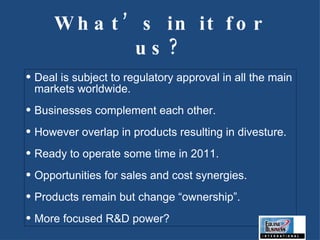
What’s in it for us? Deal is subject to regulatory approval in all the main markets worldwide. Businesses complement each other. However overlap in products resulting in divesture. Ready to operate some time in 2011. Opportunities for sales and cost synergies. Products remain but change “ownership”. More focused R&D power?
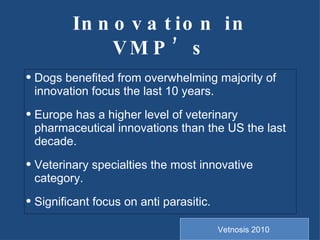
Innovation in VMP’s Dogs benefited from overwhelming majority of innovation focus the last 10 years. Europe has a higher level of veterinary pharmaceutical innovations than the US the last decade. Veterinary specialties the most innovative category. Significant focus on anti parasitic. Vetnosis 2010
Social Networking More grandparents on Facebook than high schoolers Italy is most active in world on Social Networks as of Jan, 2010 Facebook & You Tube are largest networks More NA markets using SN(58%) vs Europeans (34%) In USA people value internet more than TV and radio
Social Networking - Facebook >500 million users 1/2 of active users go on every day. 1/6 internet pages in UK are Facebook Iceland has most penetraton 63% followed by Canada then Denmark Mobile users are twice as active. (<1/3) #3 site used by US users older than 65.
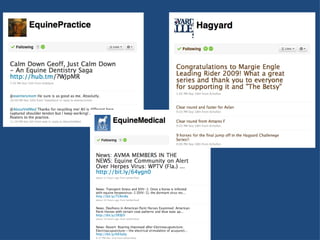
Social Networking - Facebook
 
Social Networking - Linkedin Linkedin
Social Networking - Twitter Conversations with your clients!
 
Commercial Real Estate
Commercial Real Estate Next wave of real estate defaults Rising unemployment Another round of banking “crisis” Real Estate “value” decreasing Short term notes = coming due New issues  New opportunities
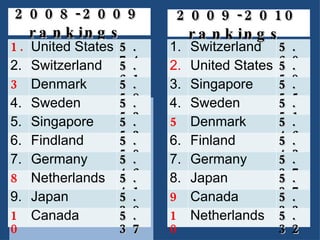
Global Competitiveness Report   Assesses the ability of countries to provide  high levels of prosperity
2008-2009 rankings   1. United States 5.74 2. Switzerland 5.61 3. Denmark 5.58 4. Sweden 5.53 5. Singapore 5.53 6. Findland 5.50 7. Germany 5.46 8. Netherlands 5.41 9. Japan 5.38 10. Canada 5.37 1. Switzerland 5.60 2. United States 5.59 3. Singapore 5.55 4. Sweden 5.51 5. Denmark 5.46 6. Finland 5.43 7. Germany 5.37 8. Japan 5.37 9. Canada 5.33 10. Netherlands 5.32 2009-2010 rankings
Ease of Doing Business Index created by the World Bank  Higher rankings indicate better, usually simpler regulations for businesses and stronger protections of property rights
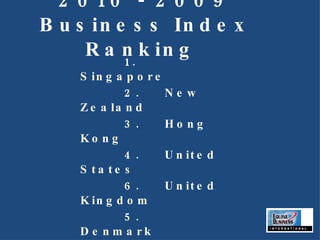
2010 - 2009 Business Index Ranking  1.  Singapore  2.  New Zealand   3.  Hong Kong  4.  United States  6.  United Kingdom  5.  Denmark  7.  Ireland  8.  Canada  9.  Australia  10.  Norway
Cloud Computing Data stored on server farms Safe Information accessible via the web only Amazon & Google Microsoft Office 2010 Image Archiving
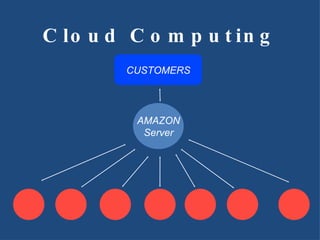
Cloud Computing AMAZON Server CUSTOMERS
Collaboration Basecamp Yelp Go To Meeting Google Docs yelp.com
Yelp
Everyone is Talking About You!
Google Docs
Almost  1/3  of the total population in the Netherlands is member of a sports organization There is a trend in western society to  work less hours and work more part-time.  Leisure industry is booming! In the European Union, the Netherlands has the shortest average working week and the highest % of  part-time workers In 2002 34 hours In 2006 31 hours Lifestyles
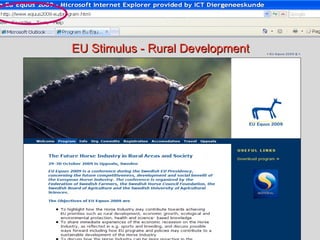
Lifestyle changes / increased importance of leisure EU Stimulus - Rural Development
Policy 2007 – 2013 Increase  diversity  of farming Development of non agricultural sector Services of  social value Providing  employment  in rural areas Make rural areas  more attractive   Special  equine experiences There is a lot of EU money available for rural development! EU Stimulus - Rural Development
Unemployment
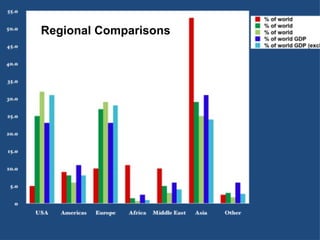
Regional Comparisons
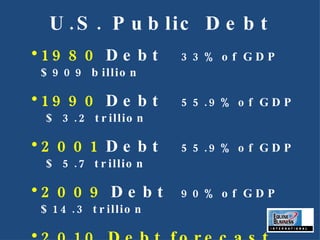
U.S. Public Debt 1980   Debt   33% of GDP $909 billion 1990   Debt   55.9% of GDP $ 3.2 trillion 2001   Debt   55.9% of GDP $ 5.7 trillion 2009   Debt   90% of GDP $14.3 trillion 2010 Debt forecast 100% of GDP
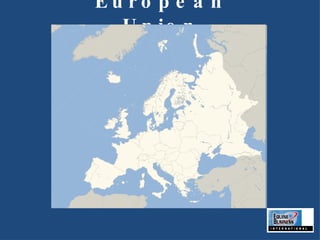
European Union
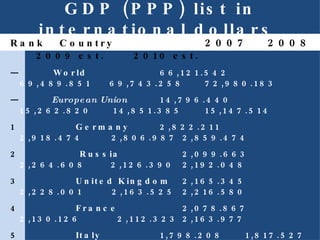
GDP (PPP) list in international dollars  Rank   Country    2007   2008   2009 est.   2010 est.  —    World    66,121.542    69,489.851  69,743.258  72,980.183 —     European Union   14,796.440  15,262.820  14,851.385  15,147.514 1      Germany  2,822.211    2,918.474  2,806.987 2,859.474  2     Russia  2,099.663    2,264.608  2,126.390  2,192.048  3      United Kingdom  2,165.345    2,228.001  2,163.525  2,216.580  4      France  2,078.867    2,130.126    2,112.323  2,163.977  5      Italy  1,798.208    1,817.527    1,750.903  1,781.946  6      Spain  1,345.644    1,395.421    1,363.793  1,374.353  7      Turkey  888.095    915.212    869.068    915.022  8      Netherlands  650.341    677.490  659.344    673.906  9      Poland  624.055    668.551    685.594    711.313
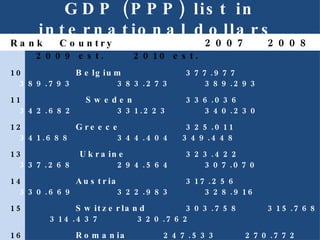
GDP (PPP) list in international dollars  Rank   Country    2007   2008   2009 est.   2010 est.  10    Belgium   377.977    389.793    383.273  389.293  11     Sweden   336.036    342.682    331.223  340.230  12     Greece    325.011    341.688    344.404  349.448 13    Ukraine  323.422    337.268    294.564  307.070  14     Austria    317.256    330.669    322.983  328.916  15     Switzerland  303.758    315.768    314.437  320.762  16     Romania  247.533    270.772    251.741  256.857  17     Czech Republic  249.570    261.777    254.375  261.620  18     Norway  246.605    257.243    256.273  263.505  19     Portugal   231.215    236.049    232.538  237.037  20     Denmark  202.429    204.269    202.407  207.388
Economy of Germany Germany is the largest national economy in Europe, the fourth-largest by nominal GDP in the world, and fifth by GDP (PPP) in 2008.  Germany is the  world's second largest exporter  with $1.170 trillion exported in 2009 ( Eurozone  countries are included). Exports account for more than one-third of national output.
Today’s World Opportunities Niche Markets Sector Growth Sustainable Economies Identifiable Environments Equine Industry?
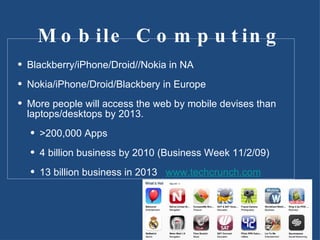
Mobile Computing Blackberry/iPhone/Droid//Nokia in NA Nokia/iPhone/Droid/Blackbery in Europe More people will access the web by mobile devises than laptops/desktops by 2013. >200,000 Apps 4 billion business by 2010 (Business Week 11/2/09) 13 billion business in 2013  www.techcrunch.com
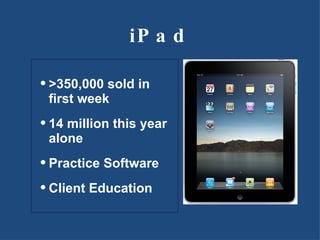
iPad >350,000 sold in first week 14 million this year alone Practice Software Client Education
skype.com Business Buddy Tool
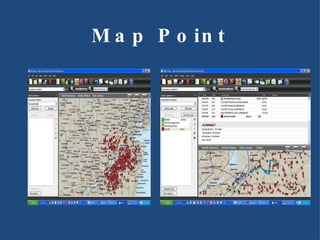
Map Point
Equine Vets Under Attack
Practice Burnout
 
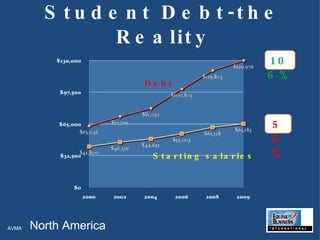
Student Debt-the Reality Debt Starting salaries AVMA North America 106% 56%
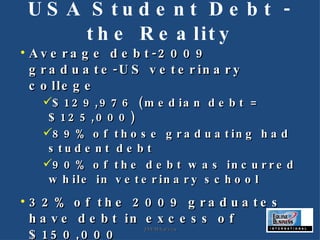
USA Student Debt - the Reality Average debt-2009 graduate-US veterinary college $129,976 (median debt = $125,000)  89% of those graduating had student debt 90% of the debt was incurred while in veterinary school 32% of the 2009 graduates have debt in excess of $150,000 11% have debt in excess of $200,000 Some in excess of $250,000  JAVMA 9/1/09
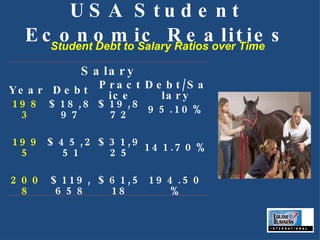
USA Student Economic Realities Student Debt to Salary Ratios over Time Salary Year Debt Practice Debt/Salary 1983 $18,897 $19,872 95.10%   1995 $45,251 $31,925 141.70%   2008 $119,658 $61,518 194.50%
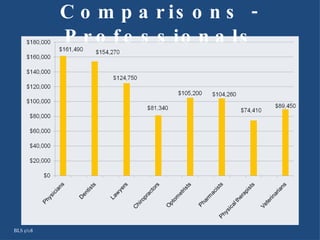
Comparisons - Professionals BLS 5/08
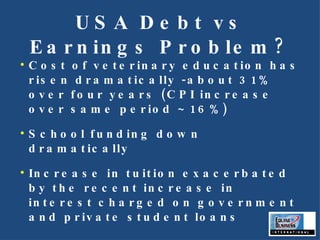
USA Debt vs Earnings Problem? Cost of veterinary education has risen dramatically -about 31% over four years (CPI increase over same period ~ 16%) School funding down dramatically Increase in tuition exacerbated by the recent increase in interest charged on government and private student loans
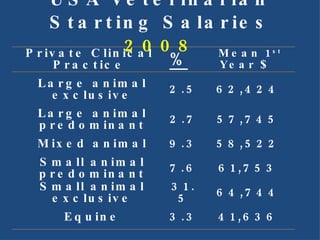
USA Veterinarian Starting Salaries  2008 Private Clinical Practice %   Mean 1 st  Year  $   Large animal exclusive 2.5 62,424 Large animal predominant 2.7 57,745 Mixed animal 9.3 58,522 Small animal predominant 7.6 61,753 Small animal exclusive 31.5 64,744 Equine 3.3 41,636
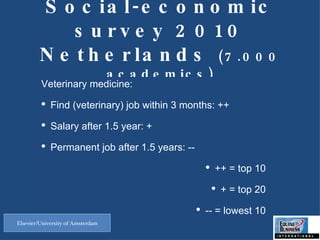
Social-economic survey 2010 Netherlands  (7.000 academics) Veterinary medicine: Find (veterinary) job within 3 months: ++ Salary after 1.5 year: + Permanent job after 1.5 years: -- ++ = top 10 + = top 20 -- = lowest 10 Elsevier/University of Amsterdam
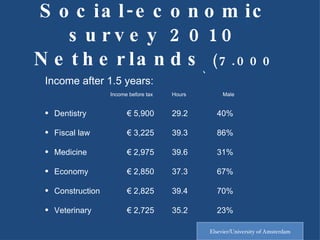
Social-economic survey 2010 Netherlands  (7.000 academics) Income after 1.5 years:   Income before tax  Hours    Male Dentistry € 5,900 29.2 40% Fiscal law € 3,225 39.3 86% Medicine € 2,975 39.6 31% Economy € 2,850 37.3 67% Construction   € 2,825 39.4 70% Veterinary  € 2,725 35.2 23% Elsevier/University of Amsterdam
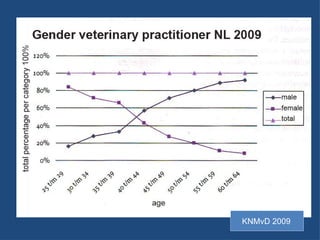
KNMvD 2009
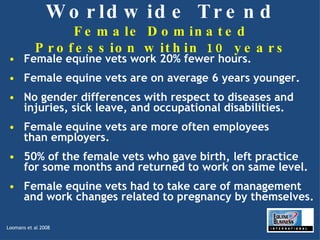
Female equine vets work 20% fewer hours. Female equine vets are on average 6 years younger. No gender differences with respect to diseases and injuries, sick leave, and occupational disabilities. Female equine vets are more often employees  than employers. 50% of the female vets who gave birth, left practice for some months and returned to work on same level. Female equine vets had to take care of management and work changes related to pregnancy by themselves. Loomans et al 2008 Worldwide Trend Female Dominated Profession within 10 years
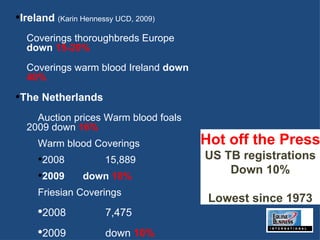
Hot off the Press US TB registrations Down 10% Lowest since 1973 Ireland   (Karin Hennessy UCD, 2009) Coverings thoroughbreds Europe  down   15-20% Coverings warm blood Ireland  down   40% The Netherlands Auction prices Warm blood foals 2009 down  16% Warm blood Coverings  2008   15,889 2009  down   10% Friesian Coverings 2008 7,475 2009 down  10%
Sales In North America Keeneland Sales  2008 ave $90,984, med $37,000 2009 ave $60,734, med $22,000 Ave  -33% , med  -41% Lexington Select Yearling Sales (Standardbreds) med  $25,000, +13.6%   over Tbs
Business Resources Drive - Daniel Pink Flip The Funnel - Jeff Jaffe Switch - Chip & Dan Heath Linchpin - Seth Godin Books of 2010  so far
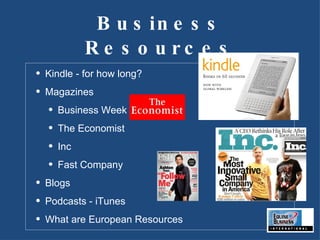
Business Resources Kindle - for how long? Magazines Business Week The Economist Inc Fast Company Blogs Podcasts - iTunes What are European Resources
Blogs www.equinevetbusiness.com Links with EBMS website AAEP Practice Management Facebook Page
Resources AAEP.org Veterinary Study Groups (VMG Groups) Consultants  VetPartners.org Equine Best Practices Benchmarking NCEVI.org Government Web Sites Bea.gov  Bls.gov Networking  Other industries Community Business Leaders & Friends
 
2010 Workshop November 5-6, 2010 Indianapolis, Indiana
2010 AAEP Convention Baltimore, Maryland We want to hear your ideas and suggestions as we build upon this new initiative!
Thank You

61 minutes EBMS amsterdam

  • 1.
    The Year inReview in 61 MINUTES Joop Loomans Robert Magnus Mike Pownall
  • 2.
    The Economy in Recovery?
  • 3.
    Technology A VetsBest Friend?
  • 4.
  • 5.
    The Global Economy in Crisis … it effects the veterinary community
  • 6.
    Challenging Times 20082009 2010 … The Future
  • 7.
    Financial Investment BankersWall Street Rating Companies The Consumer Responsibility & Accountability
  • 8.
    The Year 2000Commodity Future Modernization Act Bill Clinton - President Alan Greenspan – Federal Reserve Chair Congress Wall Street Exemption Under Gaming Laws Passed Unanimously
  • 9.
    Financial Instruments Derivatives,Mortgage Back Securities Derivative: A financial instrument whose value is based on something else “ basically it’s a side bet” The Bet: 1. Whether interest rates would go up or down 2. Whether people would default on their mortgages Credit default swaps Insurance Contracts $ Poor Performing Asset No Regulation No Asset Coverage
  • 10.
    Economic Drivers FinancialInstitutions Incentives Regulatory failure Housing / Mortgage Market Over-built 2003-07 Over-priced Irresponsible financing Real Estate Market No skin in the game – derivatives & securities Labor Market Lag effect of consumer spending
  • 11.
    The Story 2000- 2008 2008 - Today
  • 12.
    Stimulus Packages World Wide Adjust Inflation Stimulate Growth Money Supply Interest Rates Money Supply Interest Rates Monetary Policy
  • 13.
    Paris, France andWhitehouse Station, NJ. – March 9, 2010 – Sanofi-aventis and Merck to create a Global Leader in Animal Health Sanofi-aventis exercises its option to combine Merial with Intervet/Schering-Plough in a new equally-owned Joint Venture with Merck Sanofi-aventis (EURONEXT: SAN and NYSE: SNY) and Merck & Co., Inc. (NYSE: MRK) announced today that sanofi-aventis has exercised its option to combine Merial with Intervet/Schering-Plough, Merck’s Animal Health business, to create a global leader in Animal Health. Industry Consolodation
  • 14.
    Mergers in PharmaceuticalIndustry Becomes the world largest animal health company with annual sales of $ 5.2 billion based on 2009 sales. Second is Pfizer Animal Health/Fort Dodge with annual sales of $ 3.6 billion . Total global animal health market 2009 $ 19 billion. Animal+ Pharm 19th March 2010
  • 15.
    What’s in itfor us? Deal is subject to regulatory approval in all the main markets worldwide. Businesses complement each other. However overlap in products resulting in divesture. Ready to operate some time in 2011. Opportunities for sales and cost synergies. Products remain but change “ownership”. More focused R&D power?
  • 16.
    Innovation in VMP’sDogs benefited from overwhelming majority of innovation focus the last 10 years. Europe has a higher level of veterinary pharmaceutical innovations than the US the last decade. Veterinary specialties the most innovative category. Significant focus on anti parasitic. Vetnosis 2010
  • 17.
    Social Networking Moregrandparents on Facebook than high schoolers Italy is most active in world on Social Networks as of Jan, 2010 Facebook & You Tube are largest networks More NA markets using SN(58%) vs Europeans (34%) In USA people value internet more than TV and radio
  • 18.
    Social Networking -Facebook >500 million users 1/2 of active users go on every day. 1/6 internet pages in UK are Facebook Iceland has most penetraton 63% followed by Canada then Denmark Mobile users are twice as active. (<1/3) #3 site used by US users older than 65.
  • 19.
  • 20.
  • 21.
    Social Networking -Linkedin Linkedin
  • 22.
    Social Networking -Twitter Conversations with your clients!
  • 23.
  • 24.
  • 25.
    Commercial Real EstateNext wave of real estate defaults Rising unemployment Another round of banking “crisis” Real Estate “value” decreasing Short term notes = coming due New issues New opportunities
  • 26.
    Global Competitiveness Report  Assesses the ability of countries to provide high levels of prosperity
  • 27.
    2008-2009 rankings 1. United States 5.74 2. Switzerland 5.61 3. Denmark 5.58 4. Sweden 5.53 5. Singapore 5.53 6. Findland 5.50 7. Germany 5.46 8. Netherlands 5.41 9. Japan 5.38 10. Canada 5.37 1. Switzerland 5.60 2. United States 5.59 3. Singapore 5.55 4. Sweden 5.51 5. Denmark 5.46 6. Finland 5.43 7. Germany 5.37 8. Japan 5.37 9. Canada 5.33 10. Netherlands 5.32 2009-2010 rankings
  • 28.
    Ease of DoingBusiness Index created by the World Bank Higher rankings indicate better, usually simpler regulations for businesses and stronger protections of property rights
  • 29.
    2010 - 2009Business Index Ranking 1. Singapore  2. New Zealand  3. Hong Kong  4. United States  6. United Kingdom  5. Denmark  7. Ireland  8. Canada  9. Australia  10. Norway
  • 30.
    Cloud Computing Datastored on server farms Safe Information accessible via the web only Amazon & Google Microsoft Office 2010 Image Archiving
  • 31.
    Cloud Computing AMAZONServer CUSTOMERS
  • 32.
    Collaboration Basecamp YelpGo To Meeting Google Docs yelp.com
  • 33.
  • 34.
  • 35.
  • 36.
    Almost 1/3 of the total population in the Netherlands is member of a sports organization There is a trend in western society to work less hours and work more part-time. Leisure industry is booming! In the European Union, the Netherlands has the shortest average working week and the highest % of part-time workers In 2002 34 hours In 2006 31 hours Lifestyles
  • 37.
    Lifestyle changes /increased importance of leisure EU Stimulus - Rural Development
  • 38.
    Policy 2007 –2013 Increase diversity of farming Development of non agricultural sector Services of social value Providing employment in rural areas Make rural areas more attractive Special equine experiences There is a lot of EU money available for rural development! EU Stimulus - Rural Development
  • 39.
  • 40.
  • 41.
    U.S. Public Debt1980 Debt 33% of GDP $909 billion 1990 Debt 55.9% of GDP $ 3.2 trillion 2001 Debt 55.9% of GDP $ 5.7 trillion 2009 Debt 90% of GDP $14.3 trillion 2010 Debt forecast 100% of GDP
  • 42.
  • 43.
    GDP (PPP) listin international dollars Rank Country   2007 2008 2009 est. 2010 est. — World 66,121.542 69,489.851 69,743.258 72,980.183 —   European Union 14,796.440 15,262.820 14,851.385 15,147.514 1   Germany 2,822.211 2,918.474 2,806.987 2,859.474 2   Russia 2,099.663 2,264.608 2,126.390 2,192.048 3   United Kingdom 2,165.345 2,228.001 2,163.525 2,216.580 4   France 2,078.867 2,130.126 2,112.323 2,163.977 5   Italy 1,798.208 1,817.527 1,750.903 1,781.946 6   Spain 1,345.644 1,395.421 1,363.793 1,374.353 7   Turkey 888.095 915.212 869.068 915.022 8   Netherlands 650.341 677.490 659.344 673.906 9   Poland 624.055 668.551 685.594 711.313
  • 44.
    GDP (PPP) listin international dollars Rank Country   2007 2008 2009 est. 2010 est. 10 Belgium 377.977 389.793 383.273 389.293 11   Sweden 336.036 342.682 331.223 340.230 12   Greece 325.011 341.688 344.404 349.448 13   Ukraine 323.422 337.268 294.564 307.070 14   Austria 317.256 330.669 322.983 328.916 15   Switzerland 303.758 315.768 314.437 320.762 16   Romania 247.533 270.772 251.741 256.857 17   Czech Republic 249.570 261.777 254.375 261.620 18   Norway 246.605 257.243 256.273 263.505 19   Portugal 231.215 236.049 232.538 237.037 20   Denmark 202.429 204.269 202.407 207.388
  • 45.
    Economy of GermanyGermany is the largest national economy in Europe, the fourth-largest by nominal GDP in the world, and fifth by GDP (PPP) in 2008. Germany is the world's second largest exporter  with $1.170 trillion exported in 2009 ( Eurozone  countries are included). Exports account for more than one-third of national output.
  • 46.
    Today’s World OpportunitiesNiche Markets Sector Growth Sustainable Economies Identifiable Environments Equine Industry?
  • 47.
    Mobile Computing Blackberry/iPhone/Droid//Nokiain NA Nokia/iPhone/Droid/Blackbery in Europe More people will access the web by mobile devises than laptops/desktops by 2013. >200,000 Apps 4 billion business by 2010 (Business Week 11/2/09) 13 billion business in 2013 www.techcrunch.com
  • 48.
    iPad >350,000 soldin first week 14 million this year alone Practice Software Client Education
  • 49.
  • 50.
  • 51.
  • 52.
  • 53.
  • 54.
    Student Debt-the RealityDebt Starting salaries AVMA North America 106% 56%
  • 55.
    USA Student Debt- the Reality Average debt-2009 graduate-US veterinary college $129,976 (median debt = $125,000) 89% of those graduating had student debt 90% of the debt was incurred while in veterinary school 32% of the 2009 graduates have debt in excess of $150,000 11% have debt in excess of $200,000 Some in excess of $250,000 JAVMA 9/1/09
  • 56.
    USA Student EconomicRealities Student Debt to Salary Ratios over Time Salary Year Debt Practice Debt/Salary 1983 $18,897 $19,872 95.10%   1995 $45,251 $31,925 141.70%   2008 $119,658 $61,518 194.50%
  • 57.
  • 58.
    USA Debt vsEarnings Problem? Cost of veterinary education has risen dramatically -about 31% over four years (CPI increase over same period ~ 16%) School funding down dramatically Increase in tuition exacerbated by the recent increase in interest charged on government and private student loans
  • 59.
    USA Veterinarian StartingSalaries 2008 Private Clinical Practice %   Mean 1 st Year $   Large animal exclusive 2.5 62,424 Large animal predominant 2.7 57,745 Mixed animal 9.3 58,522 Small animal predominant 7.6 61,753 Small animal exclusive 31.5 64,744 Equine 3.3 41,636
  • 60.
    Social-economic survey 2010Netherlands (7.000 academics) Veterinary medicine: Find (veterinary) job within 3 months: ++ Salary after 1.5 year: + Permanent job after 1.5 years: -- ++ = top 10 + = top 20 -- = lowest 10 Elsevier/University of Amsterdam
  • 61.
    Social-economic survey 2010Netherlands (7.000 academics) Income after 1.5 years: Income before tax Hours Male Dentistry € 5,900 29.2 40% Fiscal law € 3,225 39.3 86% Medicine € 2,975 39.6 31% Economy € 2,850 37.3 67% Construction € 2,825 39.4 70% Veterinary € 2,725 35.2 23% Elsevier/University of Amsterdam
  • 62.
  • 63.
    Female equine vetswork 20% fewer hours. Female equine vets are on average 6 years younger. No gender differences with respect to diseases and injuries, sick leave, and occupational disabilities. Female equine vets are more often employees than employers. 50% of the female vets who gave birth, left practice for some months and returned to work on same level. Female equine vets had to take care of management and work changes related to pregnancy by themselves. Loomans et al 2008 Worldwide Trend Female Dominated Profession within 10 years
  • 64.
    Hot off thePress US TB registrations Down 10% Lowest since 1973 Ireland (Karin Hennessy UCD, 2009) Coverings thoroughbreds Europe down 15-20% Coverings warm blood Ireland down 40% The Netherlands Auction prices Warm blood foals 2009 down 16% Warm blood Coverings 2008 15,889 2009 down 10% Friesian Coverings 2008 7,475 2009 down 10%
  • 65.
    Sales In NorthAmerica Keeneland Sales 2008 ave $90,984, med $37,000 2009 ave $60,734, med $22,000 Ave -33% , med -41% Lexington Select Yearling Sales (Standardbreds) med $25,000, +13.6% over Tbs
  • 66.
    Business Resources Drive- Daniel Pink Flip The Funnel - Jeff Jaffe Switch - Chip & Dan Heath Linchpin - Seth Godin Books of 2010 so far
  • 67.
    Business Resources Kindle- for how long? Magazines Business Week The Economist Inc Fast Company Blogs Podcasts - iTunes What are European Resources
  • 68.
    Blogs www.equinevetbusiness.com Linkswith EBMS website AAEP Practice Management Facebook Page
  • 69.
    Resources AAEP.org VeterinaryStudy Groups (VMG Groups) Consultants VetPartners.org Equine Best Practices Benchmarking NCEVI.org Government Web Sites Bea.gov Bls.gov Networking Other industries Community Business Leaders & Friends
  • 70.
  • 71.
    2010 Workshop November5-6, 2010 Indianapolis, Indiana
  • 72.
    2010 AAEP ConventionBaltimore, Maryland We want to hear your ideas and suggestions as we build upon this new initiative!
  • 73.

Editor's Notes

  • #27 The report &amp;quot;assesses the ability of countries to provide high levels of prosperity to their citizens. This in turn depends on how productively a country uses available resources. Therefore, the Global Competitiveness Index measures the set of institutions, policies, and factors that set the sustainable current and medium-term levels of economic prosperity. by the  World Economic Forum
  • #29 The  Ease of Doing Business Index  is an index created by the  World Bank . Higher rankings indicate better, usually simpler, regulations for businesses and stronger protections of property rights. Empirical research funded by the World Bank to justify their work claims to show that the effect of improving these regulations on economic growth is strong The Ease of Doing Business index is meant to measure regulations directly affecting businesses and does not directly measure more general conditions such as a nation&apos;s proximity to large markets, quality of infrastruc ture ,  inflatio n , or  crime . A n ation&apos;s r anking on the index is based on the average of 10 subindices:
  • #30 Starting a business - Procedures, time, cost and minimum capital to open a new business Dealing with licenses - Procedures, time and cost of business inspections and licensing (construction industry) Hiring and firing workers - Difficulty of hiring index, rigidity of hours of index, difficulty of firing index, hiring cost and firing cost Registering property - Procedures, time and cost to register commercial real estate Getting credit - Strength of legal rights index, depth of credit information index Protecting investors - Indices on the extent of disclosure, extent of director liability and ease of shareholder suits Paying taxes - Number of taxes paid, hours per year spent preparing tax returns and total tax payable as share of gross profit Trading across borders - Number of documents, number of signatures and time necessary to export and import Enforcing contracts - Procedures, time and cost to enforce a debt contract Closing a business - Time and cost to close down a business, and recovery rate
  • #41 The U.S. economy grew by an average of 3.8% from 1946 to 1973, while real median household income surged 55% (or 1.6% a year).  The economy since 1973, however, has been characterized by both slower growth (averaging 2.7%), and nearly stagnant living standards, with household incomes increasing by 10%, or only 0.3% annually. The worst recession in recent decades, in terms of lost output, occurred during the  2008 financial crisis , when GDP fell by 3.9% from the spring of 2008 to the spring of 2009. Other significant recessions took place in 1957–58, when GDP fell 3.7%, following the  1973 oil crisis , with a 3.1% fall fr om late 1973 to early 1975, and in the 1981–82 recession, when GDP dropped by 2.9%.   Recent, mild recessions have included the 1990–91 downturn, when output fell by 1.3%, and the 2001 recession, in which GDP slid by 0.3%; the 2001 downturn lasted just eight months.  The most vigorous, sustained periods of growth, on the other hand, took place from early 1961 to mid 1969, with an expansion of 53% (5.1% a year), from early 1991 to late in 2000, at 43% (3.8% a year), and from late 1982 to mid 1990, at 37% (4% a year).
  • #42 In 1980, the U.S. public debt was $909 billion - or an amount equal to 33.3% of America&apos;s gross domestic product (GDP). By 1990, that number had more than tripled to $3.2 trillion - or 55.9% of GDP. In 2001 the national debt was $5.7 trillion; however, the debt-to-GDP ratio remained at 1990 levels. Debt levels rose quickly in the following decade, and on January 28, 2010, the US debt ceiling was raised to $14.3 trillion dollars. Based on the 2010 U.S. budget, total national debt will grow to nearly 100% of GDP, versus a level of approximately 80% in early 2009.  The White House estimates that the government’s tab for servicing the debt will exceed $700 billion a year in 2019, up from $202 billion in 2009. The U.S. Treasury statistics indicate that, at the end of 2006, non-US citizens and institutions held 44% of federal debt  held by the public . China, holding $801.5 billion in treasury bonds, is the largest foreign financier of the record U.S. public debt.
  • #43 The European Union has the largest economy in the world. The EU economy is expected to grow further over the next decade as more countries join the union – especially considering that the new States are usually poorer than the EU average, and hence the expected fast GDP growth will help achieve the dynamic of the united Europe. It is estimated that the Eurozone will grow around 2.6 per cent this year (2006), on a par with other industrialized nations such as the United States at 2.6% (Q2 2006) and 1.6 (Q3 2006).
  • #44 This is a list of European nations sorted by their Gross Domestic P roduct (GDP) , the valu e of all final goods and services produced within a nation in a given year. The GDP dollar estimates presented here are derived from purchasing power parity (PPP) calculat ions, in millions of In ternational dollars . The table below includes data for the years 2007, 2008, 200 9, 2010. Data produced by the International Monetary Fund as of October 2009. the European Communities . With ov er 500 million citizens, th e EU combined generated an estimated 28% share (US$ 1 6.5 trillion) of the nominal and about 21% (US$14.8 trillion) of the PPP gross world product in 2009.
  • #45 This is a list of European nations sorted by their Gross Domestic P roduct (GDP) , the valu e of all final goods and services produced within a nation in a given year. The GDP dollar estimates presented here are derived from purchasing power parity (PPP) calculat ions, in millions of In ternational dollars . The table below includes data for the years 2007, 2008, 200 9, 2010. Data produced by the International Monetary Fund as of October 2009. the European Communities . With ov er 500 million citizens, th e EU combined generated an estimated 28% share (US$ 1 6.5 trillion) of the nominal and about 21% (US$14.8 trillion) of the PPP gross world product in 2009.