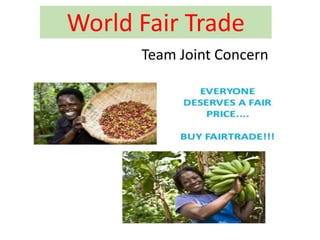
World Fair Trade
Team Joint Concern
 What does fair trade mean?
 Fair trade products
 Functions of fair trade
 Fair trade principles
 Fair trade movements
 Aims of fair trade
 WFTO code of practice
 Fair trade benefits
 Fair trade award
 Fair trade certification
 Company that use fair trade
 Countries where fair trade works
 Criticism
Learning Objectives
Fair trade is an organized social movement and
market-based approach to empowering developing
country producers and promoting sustainability.
What is
fair trade ?
What are the aims of Fair Trade?
• Building benefits for smallholders and workers
• Deepening impact through Services and
Programs
• Building Fair Trade market
• Influencing Government policies
• Building a strong Global System
Fair trade products
• Bananas
• Chocolate
• Coffee
• Tea
• Sugar
• Cotton
• Flowers
• Cocoa
• Handicrafts
• Honey
Function of fair trade
 Putting power in the hands of farmer
 Direct distribution
 Wage and labor
 Community development
 Environment sustainability
10 Principles of Fair Trade
I. Creating opportunities for economically disadvantages producers
II. Transparency and Accountability
III. Fair trading practices
IV. Payment of a fair price
V. Ensuring no labor and forced labor
VI. Commitment to Non Discrimination, Gender Equity and Women’s
Economic Empowerment, and Freedom of Association
VII.Ensuring good working conditions
VIII.Providing capacity building
IX. Promoting Fair Trade
X. Respect for the Environment
Fair Trade movement
(Market oriented Global social movement)
 Fair trade is intrinsically a global movement harnessing
development goals to new market relationship.
 Fair trade is understood as having three components-
The organization of alternative trading networks ;
The marketing of Fair Trade labelled products through
licensed conventional traders and retailers ;
The campaign-based promotion of Fair Trade to change both
purchasing practices and rules of conventional trade
WFTO CODE OF PRACTICE
• The World Fair Trade Organization (WFTO) aims
to improve the livelihoods of disadvantaged
people in developing countries by linking and
strengthening organisations.
• WFTO members come together in solidarity and
mutual cooperation to create an alternative and
fairer way of doing business.
• WFTO is a global network that promotes fair
trade and provides forum for the exchange of
information.
• To help members increase benefits to producers.
WFTO members share the
following practices:
1.Commitment to Fair Trade.
2.Transparency.
3.Ethical Issues.
4.Working Condition.
5.Equal Employment Opportunities.
6.Concern For People.
7.Concern For The Environment.
8.Respect For Producers' Cultural Identity.
9.Education and Advocacy.
WORKING RELATIONSHIPS
1. Relationships between Fair Trade
Organisations (FTOs) and consumers.
2. Relationships between FTOs.
3. Relationships between FTOs and
Producer Organisations.
4. Relationships between Producer
Organisations.
Fairtrade facts and figures
 There are 1.65 million farmers and workers in Fairtrade
certified producer organisations.
 There are a total of 1,226 Fairtrade producer organisations in
74 countries.
 A quarter of all workers in Fairtrade are women.
 Farmer and worker organisations own 50% of the global
Fairtrade system.
 On plantations, 26% of workers spent their Fairtrade premiums
on education.
 The Fairtrade foods sold in the biggest quantities worldwide
are bananas, coffee beans, sugar and cocoa beans.
 other Fairtrade products include wine, tea, cotton, flowers,
rice, orange juice and gold.
More Fairtrade benefits
Fairtrade provides access to, and oversees,
loans to help producers invest.
Fairtrade can improve food security which is
closely linked to economic growth, stable
incomes and reduced risk and vulnerability.
Fairtrade gives shoppers the opportunity to
live.
Fairtrade provides consumers with an
opportunity to connect with the people.
Fair Trade award
Bangladesh has won one champion award and five
Merit awards at the APICTA Awards 2018.
The merit awarded as follow
1. Sindabad.com Limited’s Project (Start-up)
2. A2i & SoftBD Limited’s Joint project (Service
category)
3. St Joseph Higher Secondary School Project
(Senior student category)
4. ACI Agribusiness Project (Agriculture Category)
5. Zantrik 911 in Industries ( Transport category)
Main challenges learn
Bangladesh from NCAP project
Agriculture: The climate change impacts could result in
significant reductions in crop yield, in most cases and therefore
production.
Fisheries: It has found poor structural strength of the boats is
the principal reason for the accident involving fishing boats.
Housing: Instead of designing a proto-typical model house to
be indiscriminately without paying heed to context.
Institution: The local level institute need to be equipped with
climate change knowledge so that they can help the local
people in adapting to the change.
Companies that uses fair trade:
American Apparel
BeGood Clothing
Boll and Branch
Cherie Amie
Fair trade Australia
Fair Indigo
Good and fair Clothing Company
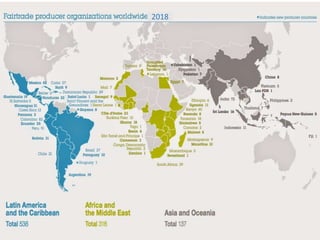
Countries where Fair Trade works
2018
.
Distribution channels
1.The Integrated supply chain route
2.The Product certification route
Distribution Channels
Fair Trade Certification
Fair Trade Pricing
Fair trade and stainable business practice
Stainable business practice:
A business practice that is economically viable, socially
responsible and environmentally friendly is usually regarded
as being stainable.
How is fair trade environmentally sustainable?
We at fair trade USA believe that in order to improve producer’s
living and working conditions, their environment must also be
clean and healthy.
Requirements of fair trade:
It promotes sustainable development by offering
better trading conditions to, and securing the
rights of, marginalized producers and workers in
developing countries.
Fair trade is grounded in three core beliefs, first,
producers have the power to express unity with
consumers.
Fair trade criticism
Ethical basis:
Studies have shown a significant number of consumers were
content to pay higher prices for fair trade products, in the
belief that this helps the poor.
Unethical selling techniques:
Philip Booth says that the selling techniques used by some
sellers and some supporters of fair trade are bullying,
misleading, and unethical.
Political objections:
There have been largely political criticisms of fair trade from
the left and the right. Some believe the fair trade system is not
radical enough.
THANK YOU
for your
ATTENTION!

World Fair Trade

  • 1.
    World Fair Trade TeamJoint Concern
  • 2.
     What doesfair trade mean?  Fair trade products  Functions of fair trade  Fair trade principles  Fair trade movements  Aims of fair trade  WFTO code of practice  Fair trade benefits  Fair trade award  Fair trade certification  Company that use fair trade  Countries where fair trade works  Criticism Learning Objectives
  • 3.
    Fair trade isan organized social movement and market-based approach to empowering developing country producers and promoting sustainability. What is fair trade ?
  • 4.
    What are theaims of Fair Trade? • Building benefits for smallholders and workers • Deepening impact through Services and Programs • Building Fair Trade market • Influencing Government policies • Building a strong Global System
  • 5.
    Fair trade products •Bananas • Chocolate • Coffee • Tea • Sugar • Cotton • Flowers • Cocoa • Handicrafts • Honey
  • 6.
    Function of fairtrade  Putting power in the hands of farmer  Direct distribution  Wage and labor  Community development  Environment sustainability
  • 7.
    10 Principles ofFair Trade I. Creating opportunities for economically disadvantages producers II. Transparency and Accountability III. Fair trading practices IV. Payment of a fair price V. Ensuring no labor and forced labor VI. Commitment to Non Discrimination, Gender Equity and Women’s Economic Empowerment, and Freedom of Association VII.Ensuring good working conditions VIII.Providing capacity building IX. Promoting Fair Trade X. Respect for the Environment
  • 8.
    Fair Trade movement (Marketoriented Global social movement)  Fair trade is intrinsically a global movement harnessing development goals to new market relationship.  Fair trade is understood as having three components- The organization of alternative trading networks ; The marketing of Fair Trade labelled products through licensed conventional traders and retailers ; The campaign-based promotion of Fair Trade to change both purchasing practices and rules of conventional trade
  • 9.
    WFTO CODE OFPRACTICE • The World Fair Trade Organization (WFTO) aims to improve the livelihoods of disadvantaged people in developing countries by linking and strengthening organisations. • WFTO members come together in solidarity and mutual cooperation to create an alternative and fairer way of doing business. • WFTO is a global network that promotes fair trade and provides forum for the exchange of information. • To help members increase benefits to producers.
  • 10.
    WFTO members sharethe following practices: 1.Commitment to Fair Trade. 2.Transparency. 3.Ethical Issues. 4.Working Condition. 5.Equal Employment Opportunities. 6.Concern For People. 7.Concern For The Environment. 8.Respect For Producers' Cultural Identity. 9.Education and Advocacy.
  • 11.
    WORKING RELATIONSHIPS 1. Relationshipsbetween Fair Trade Organisations (FTOs) and consumers. 2. Relationships between FTOs. 3. Relationships between FTOs and Producer Organisations. 4. Relationships between Producer Organisations.
  • 12.
    Fairtrade facts andfigures  There are 1.65 million farmers and workers in Fairtrade certified producer organisations.  There are a total of 1,226 Fairtrade producer organisations in 74 countries.  A quarter of all workers in Fairtrade are women.  Farmer and worker organisations own 50% of the global Fairtrade system.  On plantations, 26% of workers spent their Fairtrade premiums on education.  The Fairtrade foods sold in the biggest quantities worldwide are bananas, coffee beans, sugar and cocoa beans.  other Fairtrade products include wine, tea, cotton, flowers, rice, orange juice and gold.
  • 13.
    More Fairtrade benefits Fairtradeprovides access to, and oversees, loans to help producers invest. Fairtrade can improve food security which is closely linked to economic growth, stable incomes and reduced risk and vulnerability. Fairtrade gives shoppers the opportunity to live. Fairtrade provides consumers with an opportunity to connect with the people.
  • 14.
    Fair Trade award Bangladeshhas won one champion award and five Merit awards at the APICTA Awards 2018. The merit awarded as follow 1. Sindabad.com Limited’s Project (Start-up) 2. A2i & SoftBD Limited’s Joint project (Service category) 3. St Joseph Higher Secondary School Project (Senior student category) 4. ACI Agribusiness Project (Agriculture Category) 5. Zantrik 911 in Industries ( Transport category)
  • 15.
    Main challenges learn Bangladeshfrom NCAP project Agriculture: The climate change impacts could result in significant reductions in crop yield, in most cases and therefore production. Fisheries: It has found poor structural strength of the boats is the principal reason for the accident involving fishing boats. Housing: Instead of designing a proto-typical model house to be indiscriminately without paying heed to context. Institution: The local level institute need to be equipped with climate change knowledge so that they can help the local people in adapting to the change.
  • 16.
    Companies that usesfair trade: American Apparel BeGood Clothing Boll and Branch Cherie Amie Fair trade Australia Fair Indigo Good and fair Clothing Company
  • 17.
  • 18.
  • 19.
    . Distribution channels 1.The Integratedsupply chain route 2.The Product certification route
  • 20.
  • 21.
  • 22.
  • 23.
    Fair trade andstainable business practice Stainable business practice: A business practice that is economically viable, socially responsible and environmentally friendly is usually regarded as being stainable. How is fair trade environmentally sustainable? We at fair trade USA believe that in order to improve producer’s living and working conditions, their environment must also be clean and healthy.
  • 24.
    Requirements of fairtrade: It promotes sustainable development by offering better trading conditions to, and securing the rights of, marginalized producers and workers in developing countries. Fair trade is grounded in three core beliefs, first, producers have the power to express unity with consumers.
  • 25.
    Fair trade criticism Ethicalbasis: Studies have shown a significant number of consumers were content to pay higher prices for fair trade products, in the belief that this helps the poor. Unethical selling techniques: Philip Booth says that the selling techniques used by some sellers and some supporters of fair trade are bullying, misleading, and unethical. Political objections: There have been largely political criticisms of fair trade from the left and the right. Some believe the fair trade system is not radical enough.
  • 26.