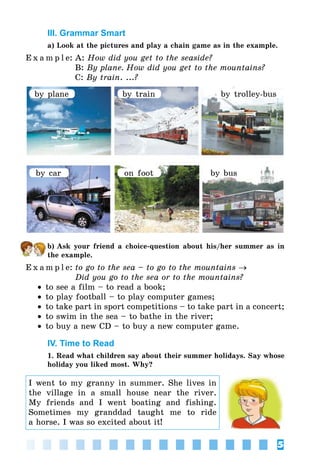
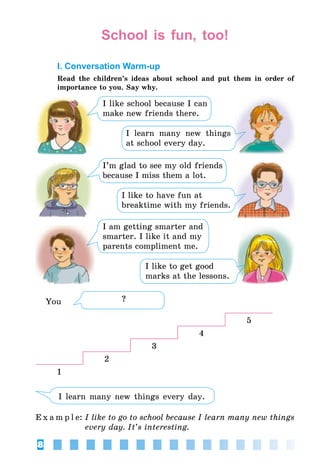
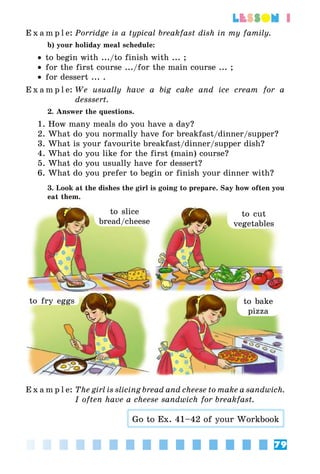
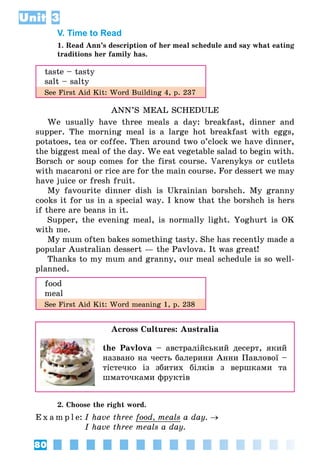
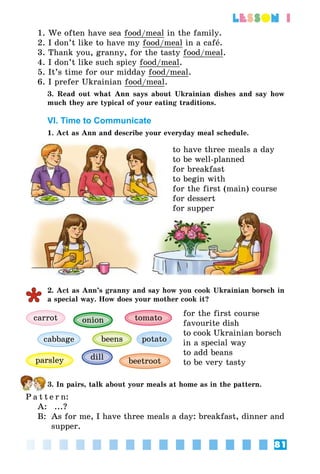
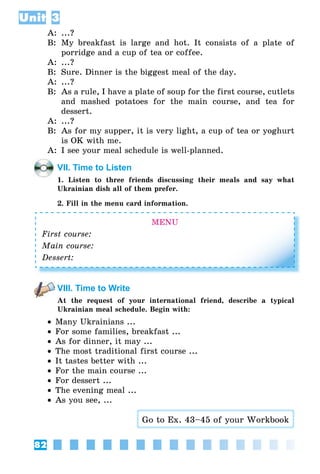
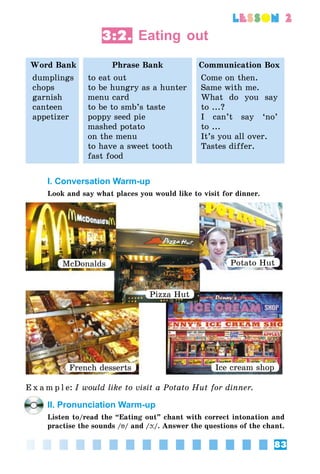
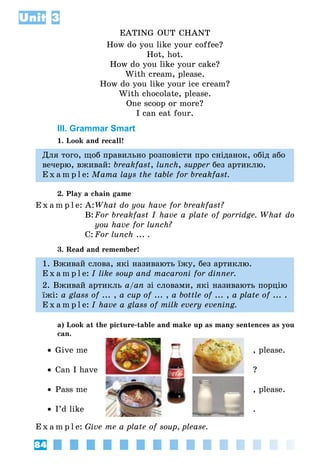
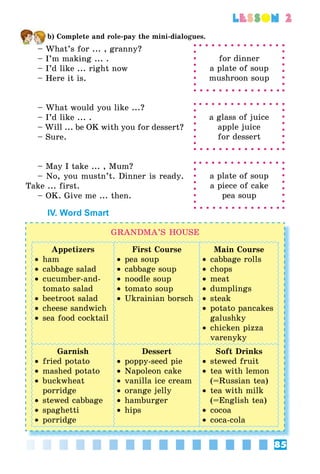
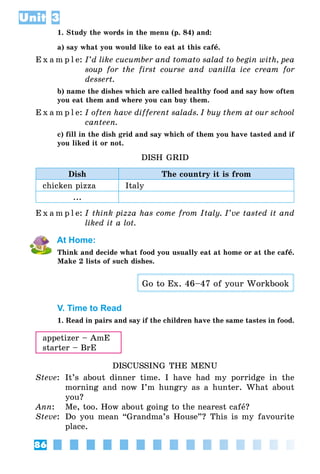
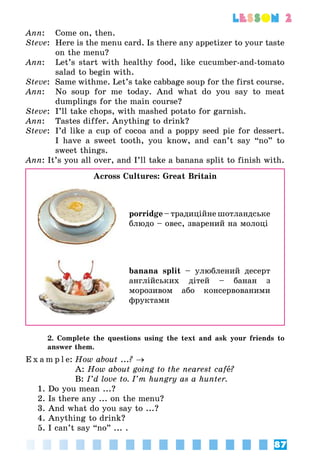
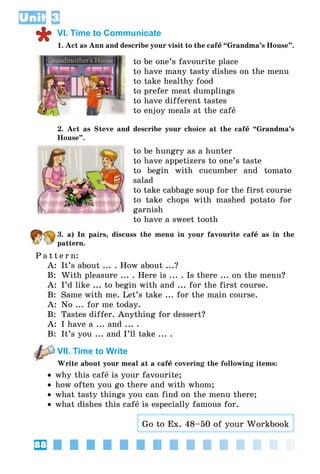
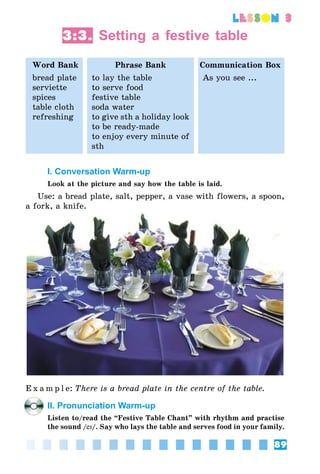
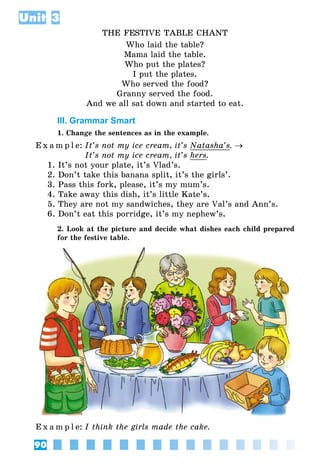
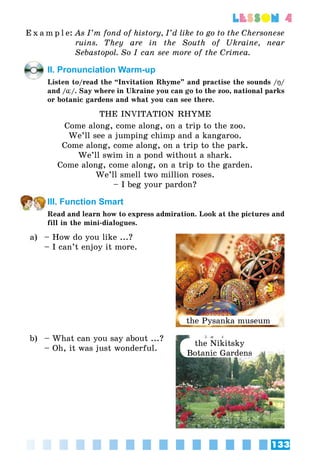
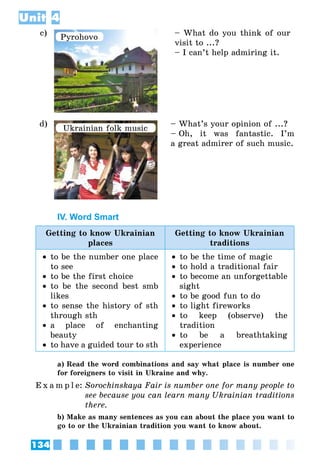
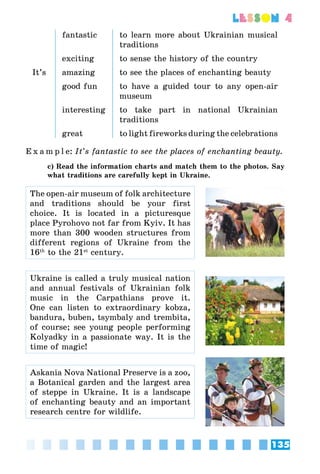
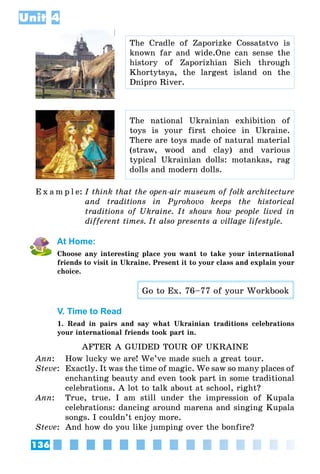
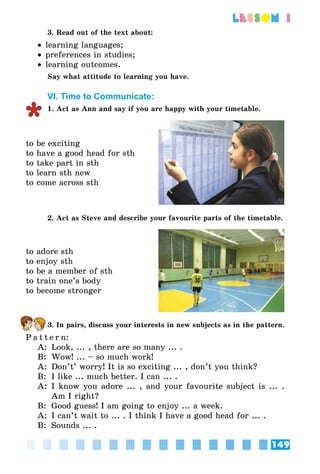
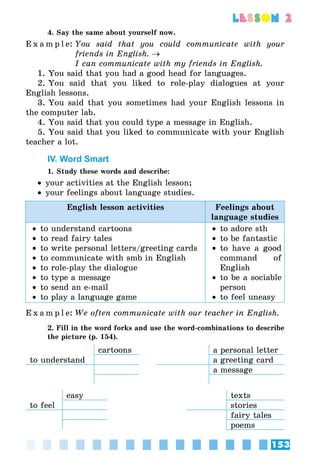
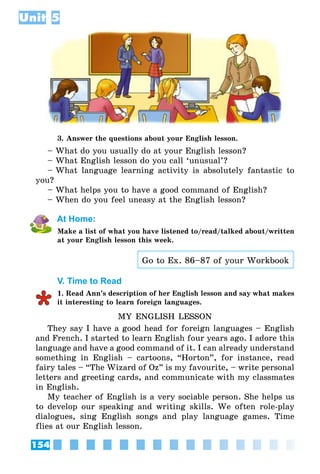
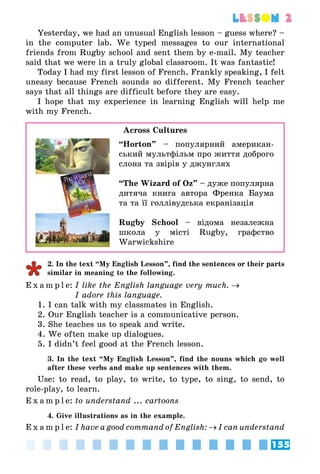
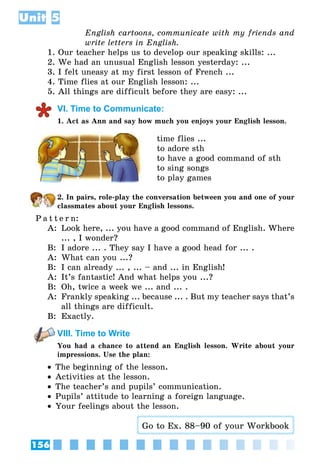
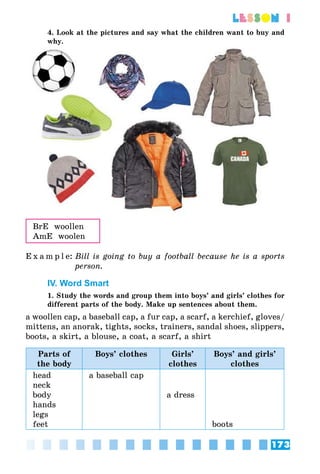
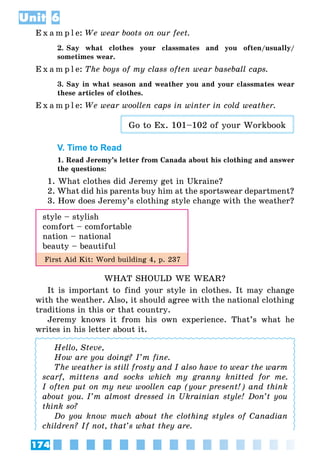
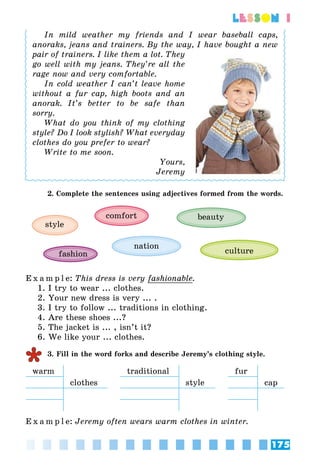
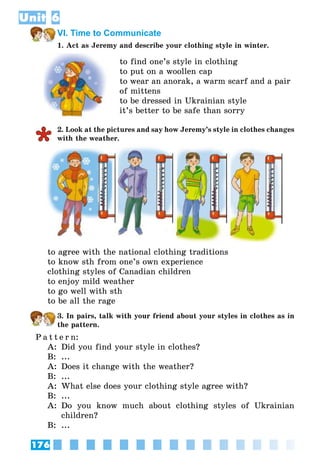
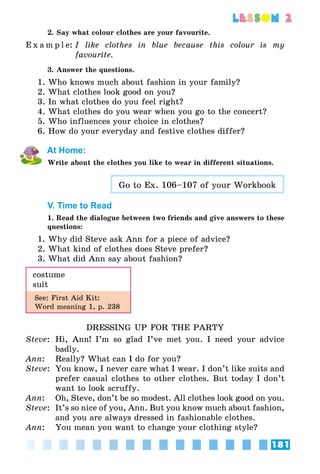
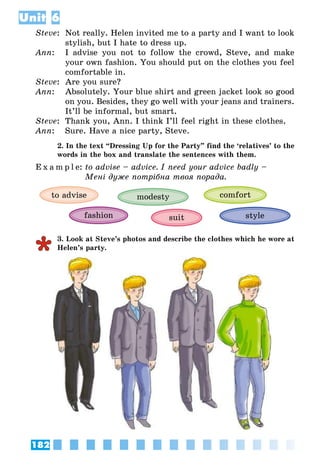
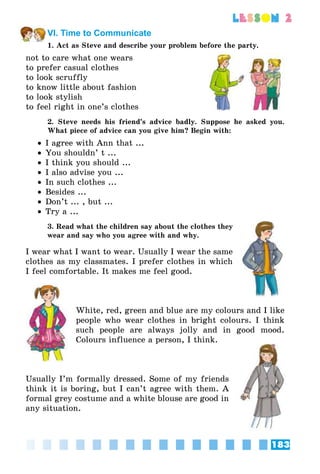
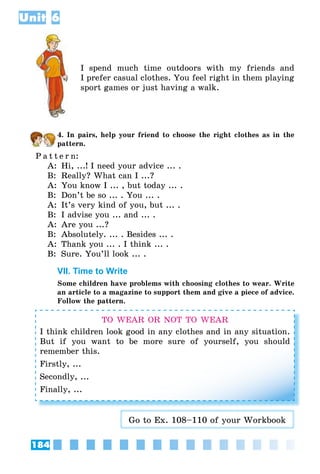
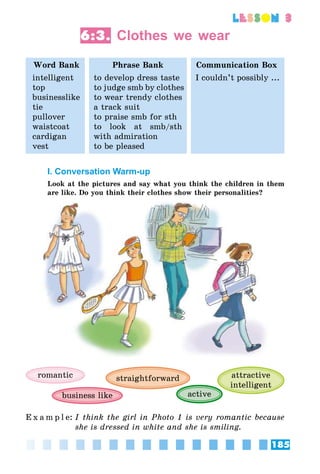
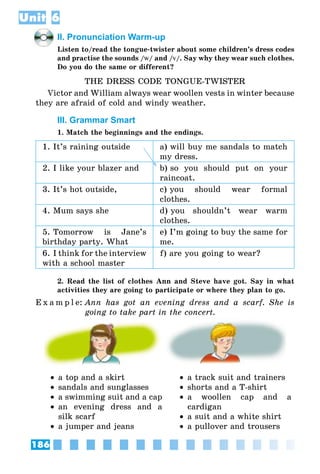
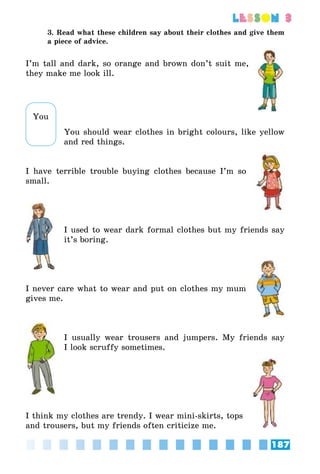
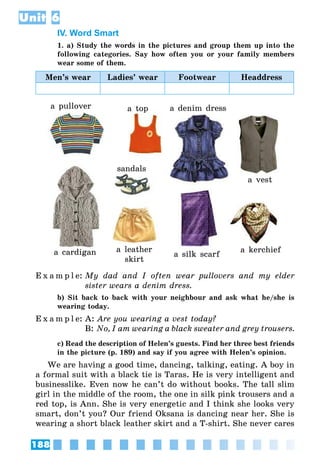
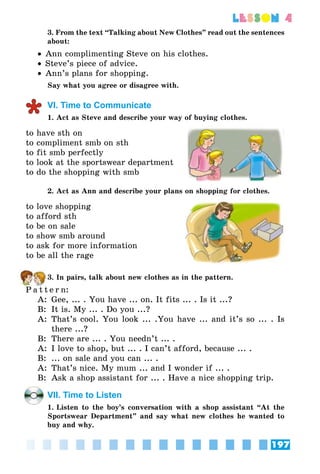
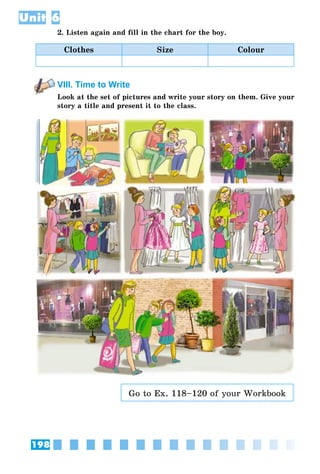
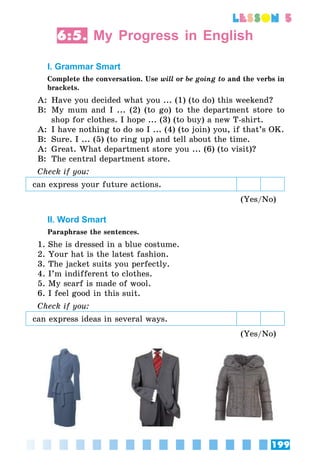
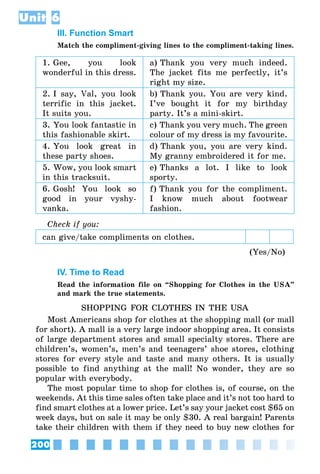
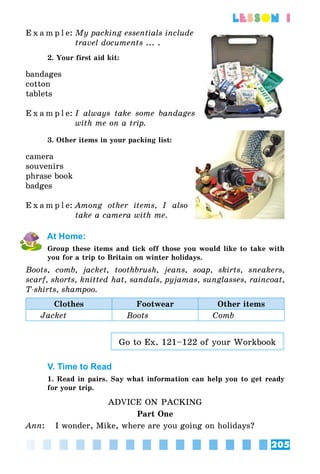
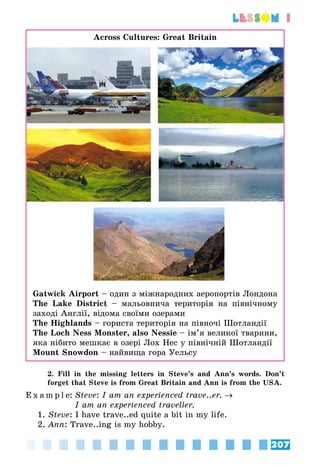
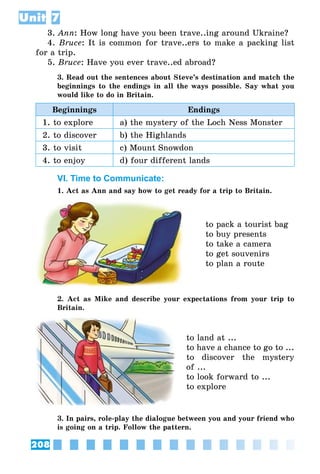
Англійська мова
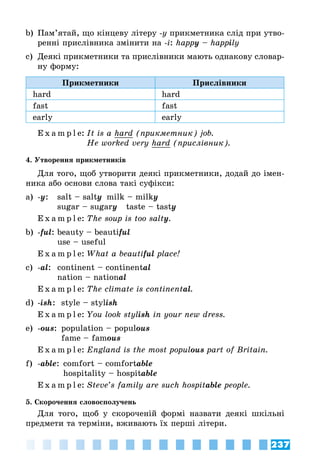
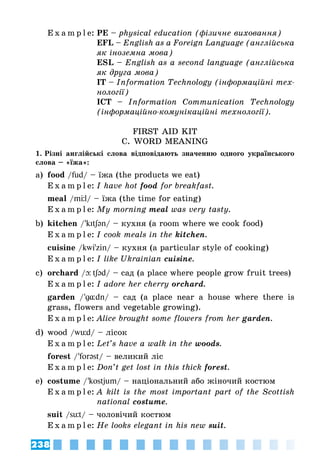
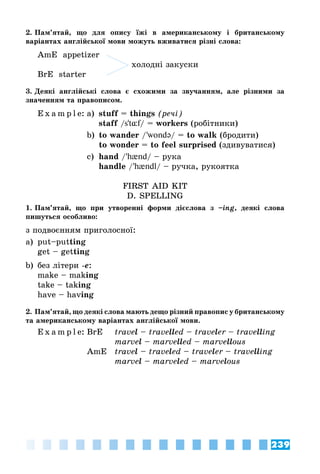
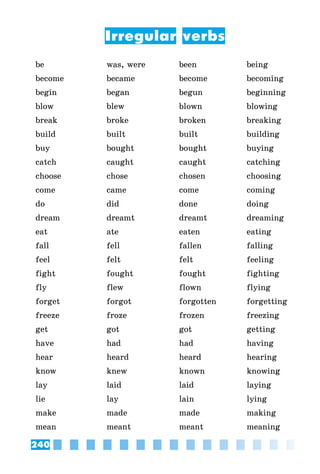
Підручник для 5 класу спеціалізованих шкіл
з поглибленим вивченням англійської мови
Л.В. Калініна, І.В. Самойлюкевич
©	Калініна Л.В., Самойлюкевич І.В.,
2013
©	Видавництво «Генеза», оригінал-
макет, 2013ISBN 978-966-11-0252-0
Рекомендовано Міністерством освіти і науки,
молоді та спорту України
(Наказ МОНмолодьспорту України від 04.01.2013 р. № 10)
К17
Калініна Л.В.
	 Англійська мова : підруч. для 5-го кл. спеціаліз. шк.
з поглибл­. вивч. англ. мови / Л.В. Калініна, І.В. Самой­
люкевич. – К. : Генеза, 2013. – 256 с.: іл.
	 ISBN 978-966-11-0252-0.
УДК 811.111(075.3)
ББК 81.2AНГЛ-922
Умовні позначення:
—	Вправи на аудіювання/фонетичне опрацюван-
ня мовленнєвого матеріалу
—	Вправи на формування вмінь групового спіл-
кування
—	Вправи на формування вмінь парного спілку­
вання
—	Додаткові ускладнені завдання
—	Письмові вправи
—	Домашне завдання
3
Любий друже!
Перед тобою підручник з англійської мови. Він склада­ється
із семи розділів – Units. Кожний розділ – це велика тема,
наприклад, «Сім’я» або «Шкільне життя». Для того, щоб з
книгою було зручніше працювати, розділи поділено на шість
частин, залежно від того, про що конкретно йдеться.
Робота над темою/підтемою розпочинається з активізації
раніше засвоєного лексико-граматичного матеріалу. Це руб­
рика “Conversational Warm-up”, у якій тобі також дається
приклад висловлювання.
Навчитися «розмовляти, як англієць» тобі допоможе руб­
рика “Pronunciation Warm-up”. У ній ти знайдеш багато весе­
лих англійських віршів, які допоможуть удосконалити твою
вимову й інтонацію.
У тебе з’являться нові друзі з різних країн – з Великої
Британії, Канади, США, Австралії та Нової Зеландії. Це – Ann,
Steve, Helen, з якими ти будеш спілкуватися англійською,
гратися, пізнавати їхню культуру. Разом з ними ти побачиш
Трафальгарську площу в Лондоні, відвідаєш Нью-Йорк в
Америці, познайомишся з австралійськими святковими тра­
диціями. Це допоможе тобі не тільки по­глибити знання з
англійської мови, а й подивитися на світ широко відкритими
очима, навчитися розмовляти англійською як мовою міжна­
родного спілкування.
Good luck!
Хай щастить!
4
Summer was fun!
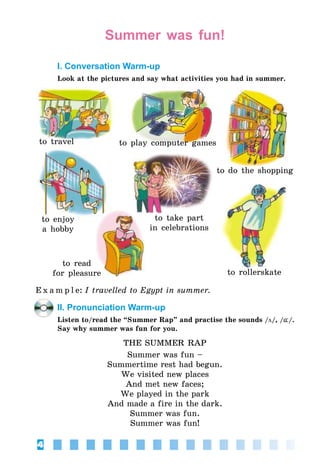
I. Conversation Warm-up
Look at the pictures and say what activities you had in summer.
to travel to play computer games
to do the shopping
to enjoy
a hobby
to take part
in celebrations
to read
for pleasure to rollerskate
E x a m p l e:	I travelled to Egypt in summer.
II. Pronunciation Warm-up
Listen to/read the “Summer Rap” and practise the sounds /ö/, /¸/.
Say why summer was fun for you.
THE SUMMER RAP
Summer was fun –
Summertime rest had begun.
We visited new places
And met new faces;
We played in the park
And made a fire in the dark.
Summer was fun.
Summer was fun!
5
III. Grammar Smart
a) Look at the pictures and play a chain game as in the example.
E x a m p l e:	A: How did you get to the seaside?
	 B: By plane. How did you get to the mountains?
	 C: By train. ...?
by plane
by car on foot by bus
by train by trolley-bus
b) Ask your friend a choice-question about his/her summer as in
the example.
E x a m p l e:	to go to the sea – to go to the mountains →
	 Did you go to the sea or to the mountains?
•• to see a film – to read a book;
•• to play football – to play computer games;
•• to take part in sport competitions – to take part in a concert;
•• to swim in the sea – to bathe in the river;
•• to buy a new CD – to buy a new computer game.
IV. Time to Read
1. Read what children say about their summer holidays. Say whose
holiday you liked most. Why?
I went to my granny in summer. She lives in
the village in a small house near the river.
My friends and I went boating and fishing.
Sometimes my granddad taught me to ride
a horse. I was so excited about it!
6
My family and I travelled to Turkey. We went
sightseeing every day. I saw many interesting
museums, monuments and other historical
places. I took a lot of pictures and learned much
new about their lifestyle.
I went to the summer camp Artek. It is a very
beautiful place at the Black Sea. I made many
new friends from different countries there.
We had interesting discussions, sea trips and
meetings with well-known actors, writers and
artists.
I stayed at home in summer. I read a lot,
played computer games and visited my friends.
Besides, my cousin Julia from Poland came to
us. I showed her our town and we had much fun
together.
2. Look at the pictures and describe the children’s summer holidays.
Egypt Artek
Granny’s village My native
place
7
V. Time to Communicate
1. Compare the children’s summer time with your own. Follow the
question plan.
QUESTION PLAN
1. Where did you spend your holidays?
2. How did you get there?
3. Who did you go with?
4. What did you see and do during your summer holidays?
5. What made a great impression on you?
2. Talk with your friend about your summer holidays. Follow the
pattern.
P a t t e r n:
A: I say ... , you look ... . Where did you ...?
B: As for me, I ... and ... .
A: Did you go there ... or ...?
B: I went with ... . And what about you?
A: I spent my summer holidays ... .
B: How did you get to ...?
A: We went there by ... .
B: Did you ...?
A: Sure. I enjoyed ... .
VI. Time to Write
You are going to take part in the writing competition “Summer was
Fun”. Write a description of your summer time.
8
School is fun, too!
I. Conversation Warm-up
Read the children’s ideas about school and put them in order of
importance to you. Say why.
I like school because I can
make new friends there.
I learn many new things
at school every day.
I’m glad to see my old friends
because I miss them a lot.
I like to have fun at
breaktime with my friends.
I am getting smarter and
smarter. I like it and my
parents compliment me.
I like to get good
marks at the lessons.
You
5
4
3
2
1
I learn many new things every day.
E x a m p l e:	I like to go to school because I learn many new things
every day. It’s interesting.
?
9
II. Pronunciation Warm-up
Listen to/read “The First of September Chant” and practise the
rhythm. Say how you get ready for your first day at school.
THE FIRST OF SEPTEMBER CHANT
– Get ’up, get up!
– ’What time is it?
– It is ’seven o’clock.
– Why must I get up?
– It’s your ’first day at school,
the ’first of September.
You ’can’t be late
You ’must come in time.
III. Grammar Smart
a) Say as many sentences as you can about your last school year.
Use the table below.
My friends
The
teachers
I
•	ran around in the classroom
•	drew pictures on the blackboard
•	asked a lot of questions
•	wrote tests and dictations
•	read interesting story
•	went on excursions
•	at the
lesson
•	at the
breaktime
•	after
classes
E x a m p l e:	My friends ran around in the classroom at the
breaktime.
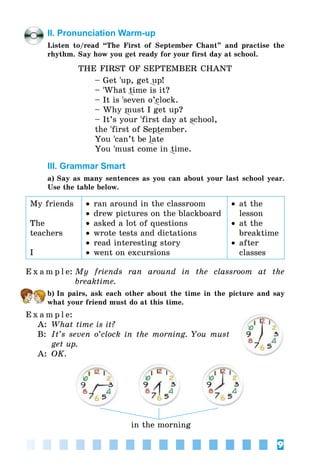
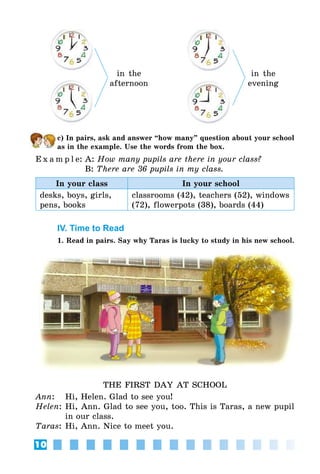
b) In pairs, ask each other about the time in the picture and say
what your friend must do at this time.
E x a m p l e:
A:	 What time is it?
B:	 It’s seven o’clock in the morning. You must
get up.
A:	 OK.
in the morning
10
in the
afternoon
in the
evening
c) In pairs, ask and answer “how many” question about your school
as in the example. Use the words from the box.
E x a m p l e:	A: How many pupils are there in your class?
	 B: There are 36 pupils in my class.
In your class In your school
desks, boys, girls,
pens, books
classrooms (42), teachers (52), windows
(72), flowerpots (38), boards (44)
IV. Time to Read
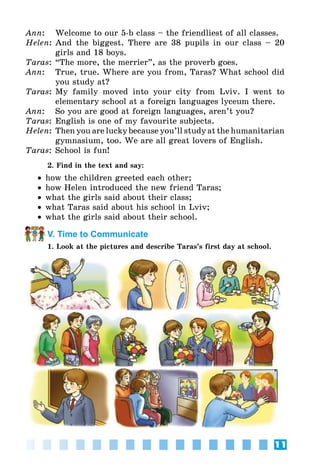
1. Read in pairs. Say why Taras is lucky to study in his new school.
THE FIRST DAY AT SCHOOL
Ann:	 Hi, Helen. Glad to see you!
Helen:	Hi, Ann. Glad to see you, too. This is Taras, a new pupil
in our class.
Taras:	Hi, Ann. Nice to meet you.
11
Ann:	 Welcome to our 5-b class – the friendliest of all classes.
Helen:	And the biggest. There are 38 pupils in our class – 20
girls and 18 boys.
Taras:	“The more, the merrier”, as the proverb goes.
Ann:	 True, true. Where are you from, Taras? What school did
you study at?
Taras:	My family moved into your city from Lviv. I went to
elementary school at a foreign languages lyceum there.
Ann:	 So you are good at foreign languages, aren’t you?
Taras:	English is one of my favourite subjects.
Helen:	Then you are lucky because you’ll study at the humanitarian
gymnasium, too. We are all great lovers of English.
Taras:	School is fun!
2. Find in the text and say:
•• how the children greeted each other;
•• how Helen introduced the new friend Taras;
•• what the girls said about their class;
•• what Taras said about his school in Lviv;
•• what the girls said about their school.
V. Time to Communicate
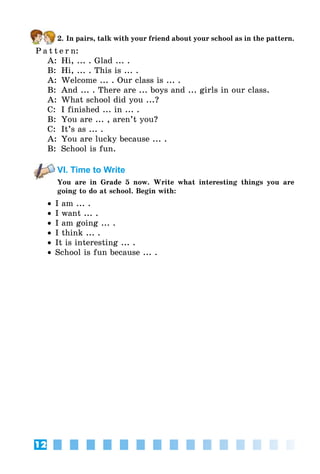
1. Look at the pictures and describe Taras’s first day at school.
12
2. In pairs, talk with your friend about your school as in the pattern.
P a t t e r n:
A:	 Hi, ... . Glad ... .
B:	 Hi, ... . This is ... .
A:	 Welcome ... . Our class is ... .
B:	 And ... . There are ... boys and ... girls in our class.
A:	 What school did you ...?
C:	 I finished ... in ... .
B:	 You are ... , aren’t you?
C:	 It’s as ... .
A:	 You are lucky because ... .
B:	 School is fun.
VI. Time to Write
You are in Grade 5 now. Write what interesting things you are
going to do at school. Begin with:
•• I am ... .
•• I want ... .
•• I am going ... .
•• I think ... .
•• It is interesting ... .
•• School is fun because ... .
13
lesson 1
Unit One: We are a Family
1:1. What makes a family?
Word Bank Phrase Bank Communication Box
relatives
friendly
nuclear
extended
family reunion
to get on together
on your mother’s/
father’s side
Actually ...
Unfortunately, ...
It sounds good to me ...
Come to my place.
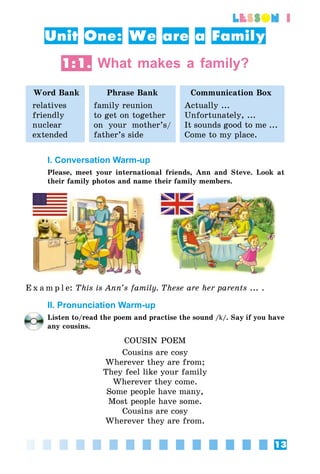
I. Conversation Warm-up
Please, meet your international friends, Ann and Steve. Look at
their family photos and name their family members.
E x a m p l e: This is Ann’s family. These are her parents ... .
II. Pronunciation Warm-up
Listen to/read the poem and practise the sound /k/. Say if you have
any cousins.
COUSIN POEM
Cousins are cosy
Wherever they are from;
They feel like your family
Wherever they come.
Some people have many,
Most people have some.
Cousins are cosy
Wherever they are from.
14
Unit 1
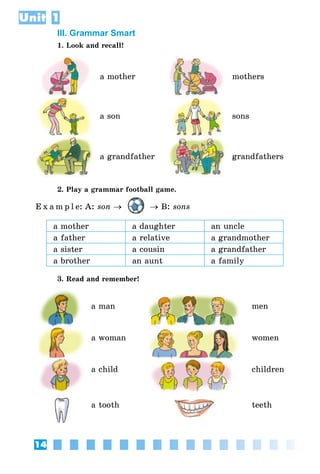
III. Grammar Smart
1. Look and recall!
a mother mothers
a son sons
a grandfather grandfathers
2. Play a grammar football game.
E x a m p l e:	A: son → → B: sons
a mother a daughter an uncle
a father a relative a grandmother
a sister a cousin a grandfather
a brother an aunt a family
3. Read and remember!
a man men
a woman women
a child children
a tooth teeth
15
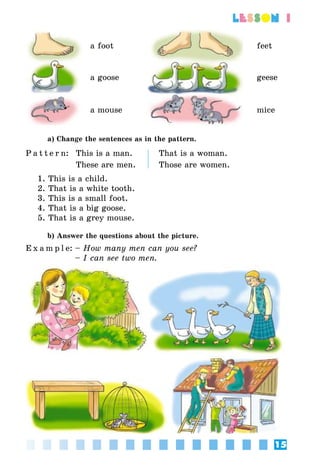
lesson 1
a foot feet
a goose geese
a mouse mice
a) Change the sentences as in the pattern.
P a t t e r n: This is a man. That is a woman.
These are men. Those are women.
1. This is a child.
2. That is a white tooth.
3. This is a small foot.
4. That is a big goose.
5. That is a grey mouse.
b) Answer the questions about the picture.
E x a m p l e:	– How many men can you see?
	 – I can see two men.
16
Unit 1
1. How many women can you see?
2. How many children can you see?
3. How many teeth has the baby got?
4. How many geese can you see?
5. How many mice can you see?
Go to Ex. 1–2 of your Workbook
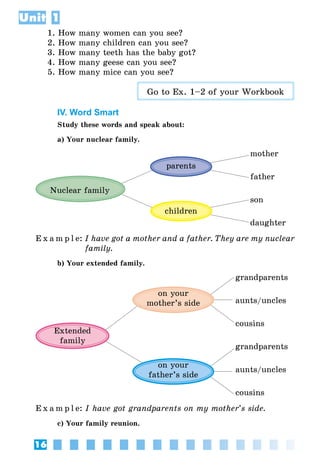
IV. Word Smart
Study these words and speak about:
a) Your nuclear family.
mother
father
son
daughter
E x a m p l e:	I have got a mother and a father. They are my nuclear
family.
b) Your extended family.
grandparents
aunts/uncles
cousins
grandparents
aunts/uncles
cousins
E x a m p l e: I have got grandparents on my mother’s side.
c) Your family reunion.
Nuclear family
parents
children
on your
mother’s side
on your
father’s side
Extended
family
17
lesson 1
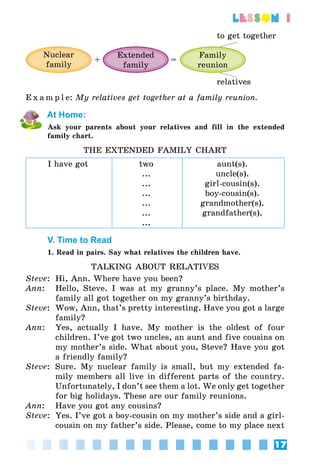
to get together
relatives
E x a m p l e: My relatives get together at a family reunion.
At Home:
Ask your parents about your relatives and fill in the extended
family chart.
THE EXTENDED FAMILY CHART
I have got two
...
...
...
...
...
...
aunt(s).
uncle(s).
girl-cousin(s).
boy-cousin(s).
grandmother(s).
grandfather(s).
V. Time to Read
1. Read in pairs. Say what relatives the children have.
TALKING ABOUT RELATIVES
Steve:	 Hi, Ann. Where have you been?
Ann:	 Hello, Steve. I was at my granny’s place. My mother’s
family all got together on my granny’s birthday.
Steve:	 Wow, Ann, that’s pretty interesting. Have you got a large
family?
Ann:	 Yes, actually I have. My mother is the oldest of four
children. I’ve got two uncles, an aunt and five cousins on
my mother’s side. What about you, Steve? Have you got
a friendly family?
Steve:	 Sure. My nuclear family is small, but my extended fa­
mily members all live in different parts of the country.
Unfortunately, I don’t see them a lot. We only get together
for big holidays. These are our family reunions.
Ann:	 Have you got any cousins?
Steve:	 Yes. I’ve got a boy-cousin on my mother’s side and a girl-
cousin on my father’s side. Please, come to my place next
Extended
family
Family
reunion
Nuclear
family
+ =
18
Unit 1
Saturday evening and meet my family.
Ann:	 It sounds good to me. I’ll be glad to come.
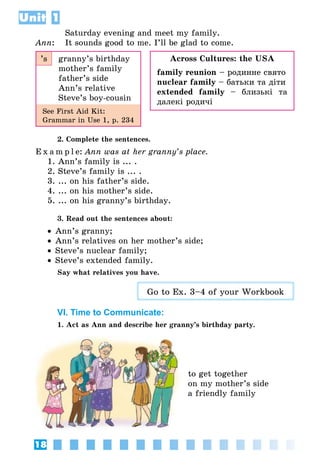
’s granny’s birthday
mother’s family
father’s side
Ann’s relative
Steve’s boy-cousin
See First Aid Kit:
Grammar in Use 1, p. 234
2. Complete the sentences.
E x a m p l e:	Ann was at her granny’s place.
1. Ann’s family is ... .
2. Steve’s family is ... .
3. ... on his father’s side.
4. ... on his mother’s side.
5. ... on his granny’s birthday.
3. Read out the sentences about:
•• Ann’s granny;
•• Ann’s relatives on her mother’s side;
•• Steve’s nuclear family;
•• Steve’s extended family.
Say what relatives you have.
Go to Ex. 3–4 of your Workbook
VI. Time to Communicate:
1. Act as Ann and describe her granny’s birthday party.
to get together
on my mother’s side
a friendly family
Across Cultures: the USA
family reunion – родинне свято
nuclear family – батьки та діти
extended family – близькі та
далекі родичі
19
lesson 1
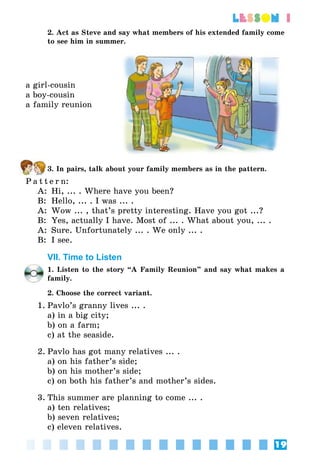
2. Act as Steve and say what members of his extended family come
to see him in summer.
a girl-cousin
a boy-cousin
а family reunion
3. In pairs, talk about your family members as in the pattern.
P a t t e r n:
A:	 Hi, ... . Where have you been?
B:	 Hello, ... . I was ... .
A:	 Wow ... , that’s pretty interesting. Have you got ...?
B:	 Yes, actually I have. Most of ... . What about you, ... .
A:	 Sure. Unfortunately ... . We only ... .
B:	 I see.
VII. Time to Listen
1. Listen to the story “A Family Reunion” and say what makes a
family.
2. Choose the correct variant.
1.	Pavlo’s granny lives ... .
	 a) in a big city;
	 b) on a farm;
	 c) at the seaside.
2.	Pavlo has got many relatives ... .
	 a) on his father’s side;
	 b) on his mother’s side;
	 c) on both his father’s and mother’s sides.
3.	This summer are planning to come ... .
	 a) ten relatives;
	 b) seven relatives;
	 c) eleven relatives.
20
Unit 1
4.	Pavlo has got a new ... .
	 a) brother;
	 b) cousin;
	 c) nephew.
5.	Uncle Taras is ... .
	 a) painting a picture;
	 b) taking a photo;
	 c) writing a book.
6.	In the picture “A Family Reunion” you can see ... .
	 a) white geese;
	 b) some flowers and trees;
	 c) a long river.
VIII. Time to Write
Fill in your application form.
APPLICATION FORM
First Name _______________________
Family name _______________________
Your mother’s full name _____________________
Your father’s full name _______________________
Have you got any brother? ____________________ (Yes/No)
Have you got any sisters? _____________________ (Yes/No)
What other relatives have you got?
___________________________________________________
___________________________________________________
___________________________________________________
___________________________________________________
___________________________________________________
___________________________________________________
Go to Ex. 5 of your Workbook
21
lesson 2
1:2. What do we look like?
Word Bank Phrase Bank Communication Box
handsome
beard
moustache
plump
to be young at heart
straggly hair
bushy eyebrows
wrinkled face
slender figure
to look like smb
to be everybody’s put
Both ... and ...
Unlike ...
I. Conversation Warm-up
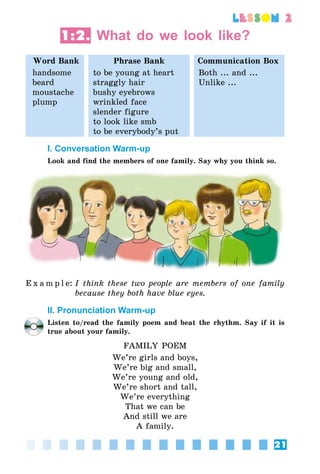
Look and find the members of one family. Say why you think so.
E x a m p l e:	I think these two people are members of one family
because they both have blue eyes.
II. Pronunciation Warm-up
Listen to/read the family poem and beat the rhythm. Say if it is
true about your family.
FAMILY POEM
We’re girls and boys,
We’re big and small,
We’re young and old,
We’re short and tall,
We’re everything
That we can be
And still we are
A family.
22
Unit 1
III. Grammar Smart
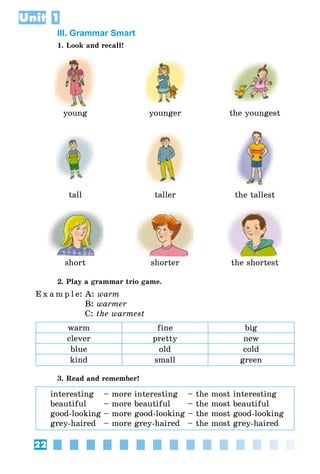
1. Look and recall!
young younger the youngest
tall taller the tallest
short shorter the shortest
2. Play a grammar trio game.
E x a m p l e:	A: warm
	 B: warmer
	 C: the warmest
warm fine big
clever pretty new
blue old cold
kind small green
3. Read and remember!
interesting 	 – more interesting 	 – the most interesting
beautiful 	 – more beautiful 	 – the most beautiful
good-looking	– more good-looking	– the most good-looking
grey-haired 	 – more grey-haired 	 – the most grey-haired
23
lesson 2
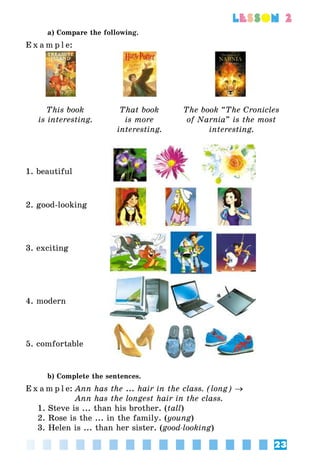
a) Compare the following.
E x a m p l e:
	 This book 	 That book	 The book “The Cronicles
	 is interesting. 	 is more	 of Narnia” is the most
		 interesting.	 interesting.
1. beautiful
2. good-looking
3. exciting
4. modern
5. comfortable
b) Complete the sentences.
E x a m p l e:	Ann has the ... hair in the class. (long) →
	 Ann has the longest hair in the class.
1. Steve is ... than his brother. (tall)
2. Rose is the ... in the family. (young)
3. Helen is ... than her sister. (good-looking)
24
Unit 1
4. Jennifer is the ... among the Collinses. (reasonable)
5. William has an ... sister. (old)
Go to Ex. 6–7 of your Workbook
IV. Word Smart
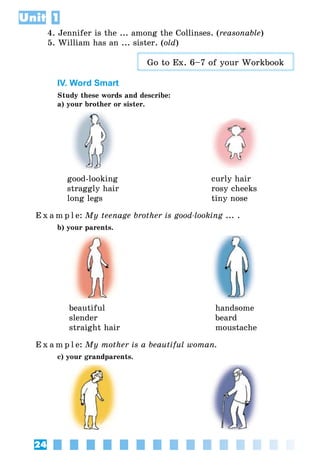
Study these words and describe:
a) your brother or sister.
good-looking
straggly hair
long legs
curly hair
rosy cheeks
tiny nose
E x a m p l e:	My teenage brother is good-looking ... .
b) your parents.
beautiful
slender
straight hair
handsome
beard
moustache
E x a m p l e:	My mother is a beautiful woman.
c) your grandparents.
25
lesson 2
grey-haired
wrinkled face
young at heart
bald
stooping back
bushy eyebrows
E x a m p l e:	My grandparents are young at heart ... .
At Home:
Find a photo of your nuclear family and write who you look like.
V. Time to Read
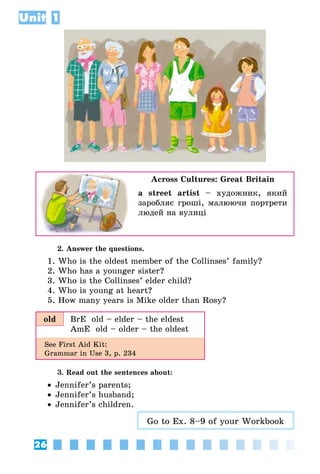
1. Read Helen’s letter home about the members of her English host
family and find the artist’s mistakes at the picture of the Collinses.
DESCRIBING FAMILY MEMBERS
We are all individual in appearance, aren’t we? We have
different hair, eyes, noses, and lips. But young or old, we are all
good-looking. Helen thinks so, too. That’s what she writes about
it in her letter.
Dear Mum and Dad,
How are you? I’m fine. Yesterday my English family had
guests: Jennifer’s parents came to see them. The whole family
got together and we had a wonderful time.
Everyone looked so beautiful! Jennifer was in her nice black
dress. Her husband, David, is very handsome. I like his beard
and moustache.
Jennifer’s parents are not old: though grandpa is bald,
grandma is grey-haired, their faces are not wrinkled. I think
they are young at heart.
The Collinses’ elder child, Mike, is a teenager, he is thirteen.
He is very good-looking with his slender figure, long legs and
straggly hair. The younger child, Rosy, is only four. She is a
sweet, plump girl with curly hair, rosy cheeks and a tiny little
nose. She is everybody’s pet.
I am sending you a funny picture of the Collinses. When we
went for a walk in the evening, a street artist drew it for us.
I hope you will see who is who.
Write to me soon.
Love,
Helen.
26
Unit 1
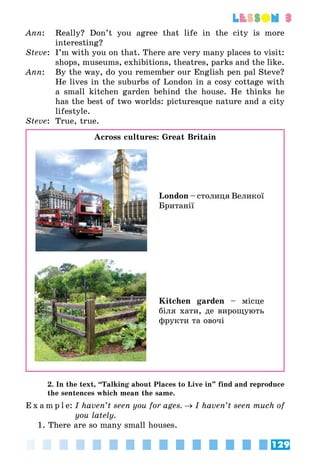
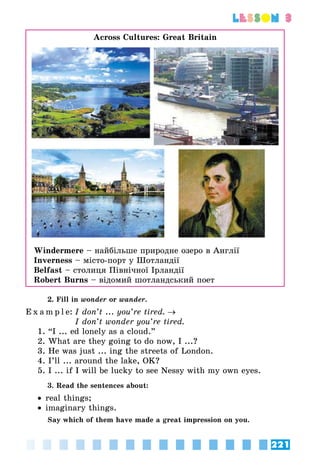
Across Cultures: Great Britain
a street artist – художник, який
заробляє гроші, малюючи портрети
людей на вулиці
2. Answer the questions.
1. Who is the oldest member of the Collinses’ family?
2. Who has a younger sister?
3. Who is the Collinses’ elder child?
4. Who is young at heart?
5. How many years is Mike older than Rosy?
old BrE  old – elder – the eldest
AmE  old – older – the oldest
See First Aid Kit:
Grammar in Use 3, p. 234
3. Read out the sentences about:
•• Jennifer’s parents;
•• Jennifer’s husband;
•• Jennifer’s children.
Go to Ex. 8–9 of your Workbook
27
lesson 2
VI. Time to Communicate
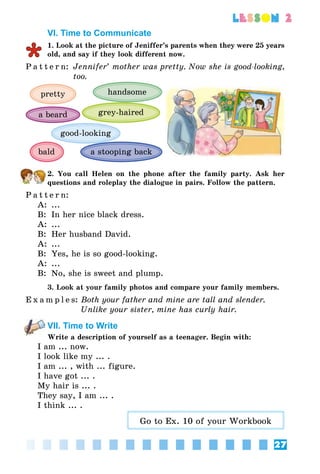
1. Look at the picture of Jeniffer’s parents when they were 25 years
old, and say if they look different now.
P a t t e r n:	 Jennifer’ mother was pretty. Now she is good-looking,
too.
pretty handsome
bald
grey-haireda beard
a stooping back
good-looking
2. You call Helen on the phone after the family party. Ask her
questions and roleplay the dialogue in pairs. Follow the pattern.
P a t t e r n:
A:	 ...
B:	 In her nice black dress.
A:	 ...
B:	 Her husband David.
A:	 ...
B:	 Yes, he is so good-looking.
A:	 ...
B:	 No, she is sweet and plump.
3. Look at your family photos and compare your family members.
E x a m p l e s:	Both your father and mine are tall and slender.
	 Unlike your sister, mine has curly hair.
VII. Time to Write
Write a description of yourself as a teenager. Begin with:
I am ... now.
I look like my ... .
I am ... , with ... figure.
I have got ... .
My hair is ... .
They say, I am ... .
I think ... .
Go to Ex. 10 of your Workbook
28
Unit 1
1:3. What are we like?
Word Bank Phrase Bank Communication Box
intelligent
well-organised
modest
reliable
well-bread
reasonable
to have a sense
of humour
to boast of sth
to be proud of smb
to have a good head
for sth
Please, meet ...
That’s his/her minus.
I. Conversation Warm-up
If you want to know about yourself, do the character quiz and say
what character you have.
Yes No
1. Are you often late?
2. Do you always tell the truth?
3. Do you like to help your friends?
4. Do you like to communicate with people?
5. Are you often angry?
6. Do you spend much time on your homework?
7. Do you often say “Please” and “Thank you”?
E x a m p l e:	I am never late for classes.
	 I’m punctual.
II. Pronunciation Warm-up
Listen to/read the poem about manners and practise the sounds //
and /eI/. Say how much it is true about you.
MANNERS POEM
We say “Thank you”,
We say “Please”,
And “Excuse me”
When we sneeze.
That’s the way
We do what’s right.
We have manners
We’re polite.
Helen H. Moore
29
lesson 3
III. Grammar Smart
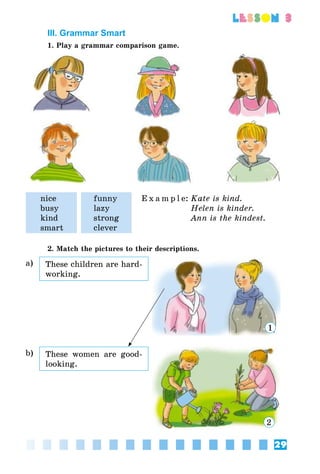
1. Play a grammar comparison game.
nice
busy
kind
smart
funny
lazy
strong
clever
E x a m p l e:	Kate is kind.
	 Helen is kinder.
	 Ann is the kindest.
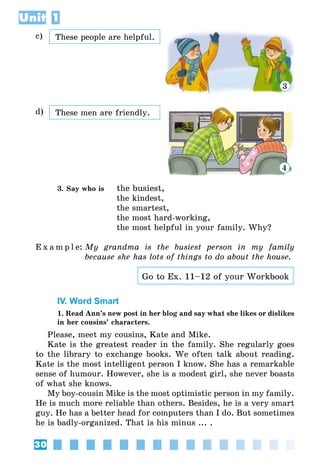
2. Match the pictures to their descriptions.
a) These children are hard-
working.
1
b) These women are good-
looking.
2
30
Unit 1
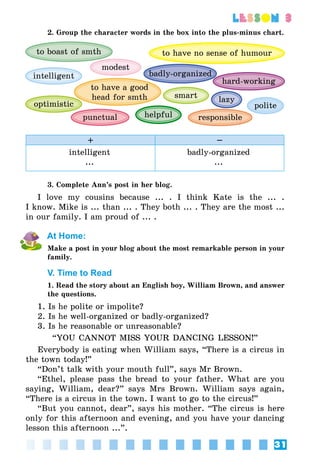
c) These people are helpful.
3
d) These men are friendly.
4
3. Say who is	 the busiest,
	 the kindest,
	 the smartest,
	 the most hard-working,
	 the most helpful in your family. Why?
E x a m p l e:	My grandma is the busiest person in my family
because she has lots of things to do about the house.
Go to Ex. 11–12 of your Workbook
IV. Word Smart
1. Read Ann’s new post in her blog and say what she likes or dislikes
in her cousins’ characters.
Please, meet my cousins, Kate and Mike.
Kate is the greatest reader in the family. She regularly goes
to the library to exchange books. We often talk about reading.
Kate is the most intelligent person I know. She has a remarkable
sense of humour. However, she is a modest girl, she never boasts
of what she knows.
My boy-cousin Mike is the most optimistic person in my family.
He is much more reliable than others. Besides, he is a very smart
guy. He has a better head for computers than I do. But sometimes
he is badly-organized. That is his minus ... .
31
lesson 3
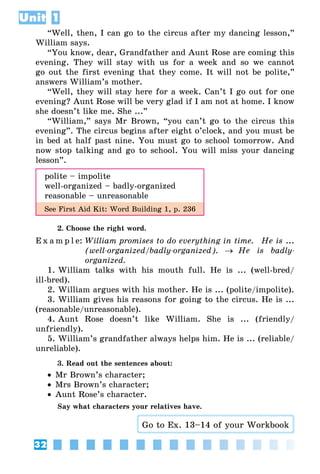
2. Group the character words in the box into the plus-minus chart.
badly-organized
modest
to boast of smth to have no sense of humour
hard-working
smart
optimistic
to have a good
head for smth
helpful
lazy
punctual responsible
intelligent
polite
+ –
intelligent
...
badly-organized
...
3. Complete Ann’s post in her blog.
I love my cousins because ... . I think Kate is the ... .
I know. Mike is ... than ... . They both ... . They are the most ...
in our family. I am proud of ... .
At Home:
Make a post in your blog about the most remarkable person in your
family.
V. Time to Read
1. Read the story about an English boy, William Brown, and answer
the questions.
1. Is he polite or impolite?
2. Is he well-organized or badly-organized?
3. Is he reasonable or unreasonable?
“YOU CANNOT MISS YOUR DANCING LESSON!”
Everybody is eating when William says, “There is a circus in
the town today!”
“Don’t talk with your mouth full”, says Mr Brown.
“Ethel, please pass the bread to your father. What are you
saying, William, dear?” says Mrs Brown. William says again,
“There is a circus in the town. I want to go to the circus!”
“But you cannot, dear”, says his mother. “The circus is here
only for this afternoon and evening, and you have your dancing
lesson this afternoon ...”.
32
Unit 1
“Well, then, I can go to the circus after my dancing lesson,”
William says.
“You know, dear, Grandfather and Aunt Rose are coming this
evening. They will stay with us for a week and so we cannot
go out the first evening that they come. It will not be polite,”
answers William’s mother.
“Well, they will stay here for a week. Can’t I go out for one
evening? Aunt Rose will be very glad if I am not at home. I know
she doesn’t like me. She ...”
“William,” says Mr Brown, “you can’t go to the circus this
evening”. The circus begins after eight o’clock, and you must be
in bed at half past nine. You must go to school tomorrow. And
now stop talking and go to school. You will miss your dancing
lesson”.
polite – impolite
well-organized – badly-organized
reasonable – unreasonable
See First Aid Kit: Word Building 1, p. 236
2. Choose the right word.
E x a m p l e:	William promises to do everything in time. 	 He is ...
(well-organized/badly-organized). → He is badly-
organized.
1. William talks with his mouth full. He is ... (well-bred/
ill-bred).
2. William argues with his mother. He is ... (polite/impolite).
3. William gives his reasons for going to the circus. He is ...
(reasonable/unreasonable).
4. Aunt Rose doesn’t like William. She is ... (friendly/
unfriendly).
5. William’s grandfather always helps him. He is ... (reliable/
unreliable).
3. Read out the sentences about:
•• Mr Brown’s character;
•• Mrs Brown’s character;
•• Aunt Rose’s character.
Say what characters your relatives have.
Go to Ex. 13–14 of your Workbook
33
lesson 3
VI. Time to Communicate
1. Act as William and give your reasons for going to the circus.
to want to go to the circus
to go to the dancing lesson
to stay for a week
2. Act as William’s elder sister Ethel and describe your brother’s
character.
to be polite
to be reasonable
to be in bed at half past nine
3. In pairs, talk about William’s family as in the pattern.
P a t t e r n:
A:	 I think William’s mother is too strict.
B:	 Sure, because ... .
A:	 As for his father, he ... .
B:	 Yes, he always agrees with ... .
A:	 What do you think of ...?
B:	 She is ... and ... .
A:	 Do you like ...?
B:	 I do. He is a good boy.
VII. Time to Write
Write what kind of person you want to be. Use the plan below:
... intelligent?
... well-bred?
... reliable?
... well-organized?
... with a remarkable sense of humour?
... helpful?
... reasonable?
Go to Ex. 15 of your Workbook
34
Unit 1
1:4. What do we like?
Word Bank Phrase Bank Communication Box
pastime
hobby
prefer
seashore
to go sightseeing
to be in the list of
likes
from time to time
to go picnicking
out in the open
at smb’s invitation
to have the time of
one’s life
It’s a habit with ...
I can’t do without ...
I. Conversation Warm-up
Look and say what these families like to do together.
E x a m p l e:	This family likes hiking together.
II. Pronunciation Warm-up
Listen to/read the character poem and practise the sound /Á/.
Which do you more often say: “I’ll try” or “I can’t”?
CHARACTER POEM
The little boy who says “I’ll try”,
Will climb to the hilltop;
The little boy who says “I can’t”,
Will at the bottom stop.
35
lesson 4
III. Function Smart
Read and learn to talk about your likes. Look at the pictures and
fill in the mini-dialogues.
a) –	What’s your hobby?
–	Music. I like ... at my family
reunions.
to play the piano
b) –	What is your favourite pastime?
–	Sports. ... is in my list of likes.
I often go to the pool with my
parents.
swimming
c) –	How do you like ...?
–	I can play some from time to time.
computer games
d) –	Reading is something I can’t do
without.
–	Not me. I prefer ... with my
family.
to watch videos
Go to Ex. 16–17 of your Workbook
36
Unit 1
IV. Word-smart
1. Look at the popular family pastime chart and say which you
prefer.
POPULAR FAMILY PASTIME CHART
reading listening
to music
playing
sports
picnicking
watching
videos
playing
computer
games
E x a m p l e:	Reading is something my family can’t do without.
2. Read the rhyme and find the pastime words. Rank them in order
of importance to you.
PASTIME RHYME
Pastime means a lot of pleasure,
Healthy rest and healthy leisure,
Reading, playing, going for a walk,
And over-a-cup-of-tea talk.
3. When Helen stayed in England with the Collinses, she learnt a
lot about their family pastime. Read her notes and complete her
diary entry.
5 o’clock tea – inviting guests for tea
Sunday picnic – having a picnic out in the open on Sunday
weekend trip – travelling at the weekend
family party – an English family getting together for dinner
on Sunday.
37
lesson 4
Dear diary,
It’s a habit with the Collinses to have ... from time to time
on weekdays. At the weekend, they prefer to go on a ... or to
have ... . Sometimes they take a ... and do a lot of sightseeing.
I like the Collinses’ ... . And you?
At Home:
Make a list of your family pastimes and fill in the “How Often?”
Chart.
THE “HOW OFTEN?” CHART
From time to time Often
V. Time to Read
1. Read in pairs. Say what pastime is popular with the Collinses.
PLANNING THE FAMILY WEEKEND
Jennifer:	 I say, David, the weekend is coming. It’s time to make
plans.
David:	 Let’s take a weekend trip to Blackpool, at my mother’s
invitation.
Mike:	 Great! Travelling is always in my list of likes. Where
are we going to stay?
David:	 With your grandparents. Your aunt Rose and your
cousins are staying with them now. We are going to
have a real family reunion.
Mike:	 I’d like to meet my relatives. I’m sure they are nice
and sociable people.
Jennifer:	 Exactly. We can do a lot of sightseeing together. We
are going to have the time of our lives, with a Sunday
picnic on the seashore or a real family party.
David:	 Don’t forget your swimming stuff, Mike.
Mike:	 Don’t worry, Dad, I won’t. Swimming is something I
can’t do without, you know.
Jennifer:	 Let’s get down to packing then.
the Collinses Blackpool
See First Aid Kit: Grammar 4, p, 235
38
Unit 1
Across Cultures: Great Britain
Blackpool / ’blkpül/ – курортне місто на Пів­
ночі Англії
2. Fill in the where necessary.
E x a m p l e:	– (немає артиклю) William wants to go to the circus.
1. Aunt Rose is coming to stay with ... Browns.
2. My relatives live in ... Kyiv.
3. ... Mike can’t do without swimming.
4. ... Collinses are going on a weekend trip.
5. ... Blackpool is a seaside town.
3. Read out the sentences about:
•• a weekend trip;
•• Sunday pastime;
•• hobbies in the family.
Say what your family’s weekends are like.
VI. Time to Communicate
1. Act as Mike and describe your hobby:
to go to Blackpool
swimming stuff
can’t do without
2. Act as Mike’s girl-cousin and describe your stay in Blackpool:
seaside town
to have a family reunion
to do a lot of sightseeing
39
lesson 4
3. In pairs, talk about her family pastime as in the pattern.
P a t t e r n:
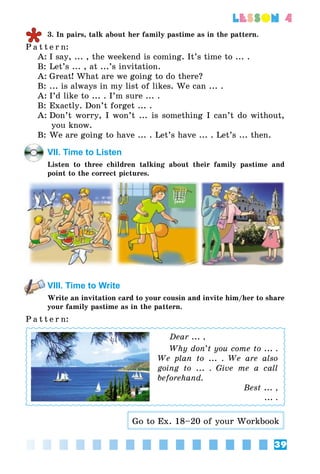
A:	I say, ... , the weekend is coming. It’s time to ... .
B:	Let’s ... , at ...’s invitation.
A:	Great! What are we going to do there?
B:	... is always in my list of likes. We can ... .
A:	I’d like to ... . I’m sure ... .
B:	Exactly. Don’t forget ... .
A:	Don’t worry, I won’t ... is something I can’t do without,
you know.
B:	We are going to have ... . Let’s have ... . Let’s ... then.
VII. Time to Listen
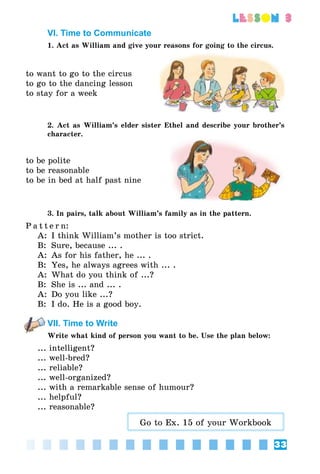
Listen to three children talking about their family pastime and
point to the correct pictures.
VIII. Time to Write
Write an invitation card to your cousin and invite him/her to share
your family pastime as in the pattern.
P a t t e r n:
Dear ... ,
Why don’t you come to ... .
We plan to ... . We are also
going to ... . Give me a call
beforehand.
Best ... ,
... .
Go to Ex. 18–20 of your Workbook
40
Unit 1
1:5. My progress in English
I. Grammar Smart
Write the underlined words in the plural.
1. My elder sister has a child.
2. My baby brother has a new tooth.
3. My granny has got a white goose.
4. I can see a policeman over there.
5. Jack is afraid of a mouse.
Check if you:
can use nouns in the plural.
(Yes/No)
II. Word Smart
Fill in the right words.
1. Someone who works hard is a ... person.
2. Someone who does everything in time is a ... person.
3. Someone who likes to communicate with people is a ...
person.
4. Someone who has good manners is a ... person.
5. Some you can rely on is a ... person.
Check if you:
know character words.
(Yes/No)
III. Function Smart
Match the beginnings and the endings
1. Reading is something ... a) ... my list of likes.
2. Swimming is in ... b) ... favourite pastime.
3. We had the time of ... c) ... your hobby?
4. Music is my ... d) ... I can’t do without.
5. What’s ... e) ... our lives at the seaside.
Check if you:
can express your likes.
(Yes/No)
41
lesson 5
IV. Time to Read
Read the story and answer the questions.
THINK BEFORE YOU TRIP
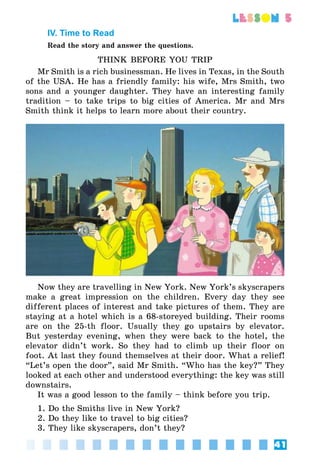
Mr Smith is a rich businessman. He lives in Texas, in the South
of the USA. He has a friendly family: his wife, Mrs Smith, two
sons and a younger daughter. They have an interesting family
tradition – to take trips to big cities of America. Mr and Mrs
Smith think it helps to learn more about their country.
Now they are travelling in New York. New York’s skyscrapers
make a great impression on the children. Every day they see
different places of interest and take pictures of them. They are
staying at a hotel which is a 68-storeyed building. Their rooms
are on the 25-th floor. Usually they go upstairs by elevator.
But yesterday evening, when they were back to the hotel, the
elevator didn’t work. So they had to climb up their floor on
foot. At last they found themselves at their door. What a relief!
“Let’s open the door”, said Mr Smith. “Who has the key?” They
looked at each other and understood everything: the key was still
downstairs.
It was a good lesson to the family – think before you trip.
1. Do the Smiths live in New York?
2. Do they like to travel to big cities?
3. They like skyscrapers, don’t they?
42
Unit 1
4. Is their hotel a skyscraper too?
5. Does the elevator work perfectly in the hotel?
6. Did they leave the key upstairs?
Check if you:
can read and understand a short story about
a family.
(Yes/No)
V. Time to Listen
Listen to Helen’s oral letter from Britain and mark the statements
true or false.
1. Helen has a boy-cousin. ...
2. Susan is not very friendly to Helen. ...
3. The girls often go places together. ...
4. They visited Blackpool last weekend. ...
5. Helen’s cousin knows much about different places of
interest. ...
6. Helen took pictures of Susan. ...
Check if you:
can listen to a short story and understand
the details.
(Yes/No)
VI. Time to Write
Draw your family tree and describe it.
Check if you:
can write about a description of your family.
(Yes/No)
Go to your WB, Cross-cultural Workshop 1
43
lesson 1
Unit Two: Day in, Day out
2:1. Morning schedule
Word Bank Phrase Bank Communication
Box
to check
to ring
at present
at the moment
to do morning exercises
to pack a schoolbag
to call smb for breakfast
to do one’s hair
to brush one’s teeth
to go for a morning jog
to take a swim
to do one’s bed
Good of you!
Just wait.
Bye for now.
See you.
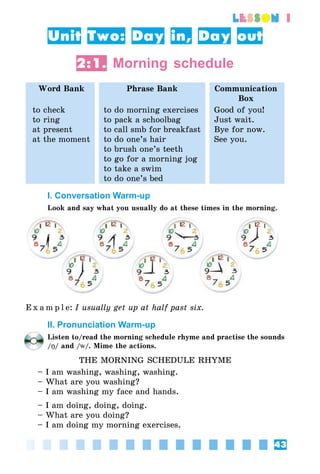
I. Conversation Warm-up
Look and say what you usually do at these times in the morning.
E x a m p l e:	I usually get up at half past six.
II. Pronunciation Warm-up
Listen to/read the morning schedule rhyme and practise the sounds
/Î/ and /w/. Mime the actions.
THE MORNING SCHEDULE RHYME
– I am washing, washing, washing.
– What are you washing?
– I am washing my face and hands.
– I am doing, doing, doing.
– What are you doing?
– I am doing my morning exercises.
44
Unit 2
– I am eating, eating, eating.
– What are you eating?
– I am eating breakfast.
– I am walking, walking, walking.
– Where are you walking?
– I am walking to my granny.
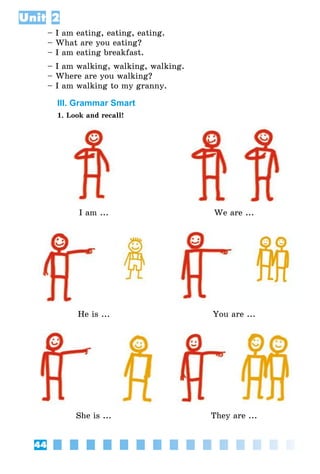
III. Grammar Smart
1. Look and recall!
I am ... We are ...
He is ... You are ...
She is ... They are ...
45
lesson 1
2. Play a grammar completion game.
E x a m p l e:	Ann ... busy in the morning. →
	 Ann is busy in the morning.
1. I ... at school now.
2. My friends ... my classmates.
3. My grandma ... at home now.
4. Steve ... an English boy.
5. Rose and Mike ... in London now.
3. Read and remember!
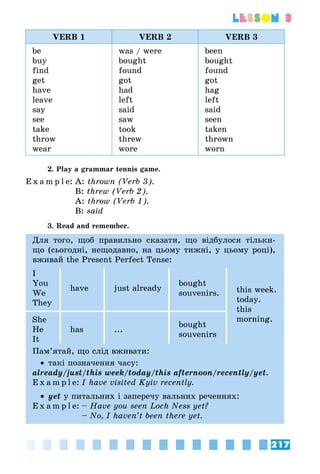
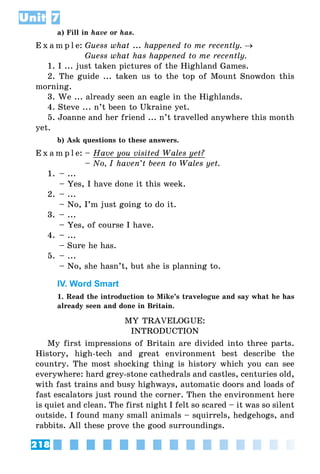
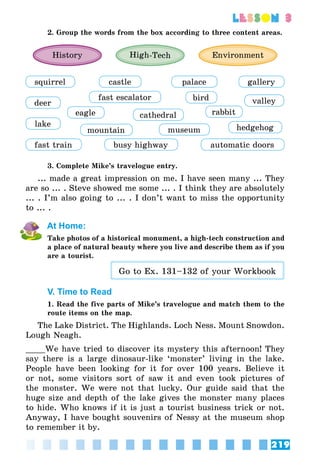
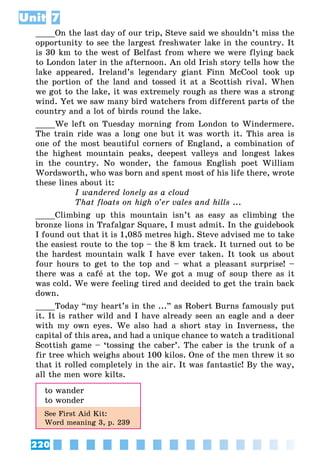
Для того, щоб правильно сказати, що відбувається зараз,
вживай:
I am (= I’m) reading now
We/they/you are (= We’re/they’re/
you’re)
working at present
He/she/it is (= he’s/she’s/it’s) walking at the
moment
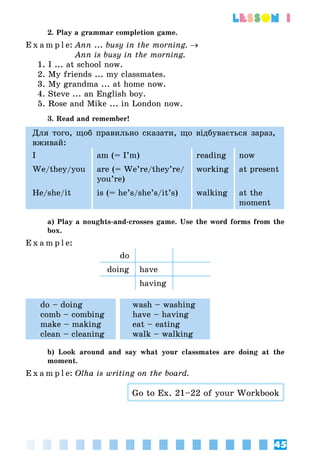
a) Play a noughts-and-crosses game. Use the word forms from the
box.
E x a m p l e:
do
doing have
having
do – doing
comb – combing
make – making
clean – cleaning
wash – washing
have – having
eat – eating
walk – walking
b) Look around and say what your classmates are doing at the
moment.
E x a m p l e:	Olha is writing on the board.
Go to Ex. 21–22 of your Workbook
46
Unit 2
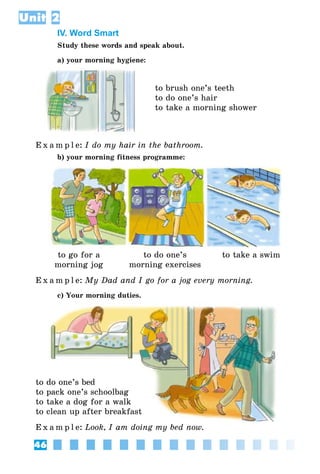
IV. Word Smart
Study these words and speak about.
a) your morning hygiene:
to brush one’s teeth
to do one’s hair
to take a morning shower
E x a m p l e:	I do my hair in the bathroom.
b) your morning fitness programme:
to go for a
morning jog
to do one’s
morning exercises
to take a swim
E x a m p l e:	My Dad and I go for a jog every morning.
c) Your morning duties.
to do one’s bed
to pack one’s schoolbag
to take a dog for a walk
to clean up after breakfast
E x a m p l e:	Look, I am doing my bed now.
47
lesson 1
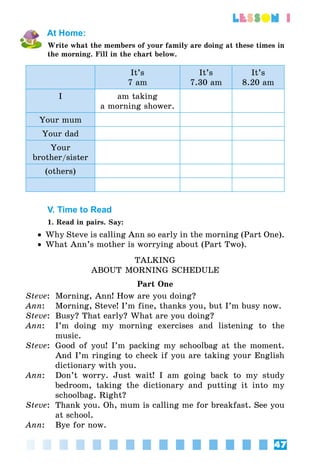
At Home:
Write what the members of your family are doing at these times in
the morning. Fill in the chart below.
It’s
7 am
It’s
7.30 am
It’s
8.20 am
I am taking
a morning shower.
Your mum
Your dad
Your
brother/sister
(others)
V. Time to Read
1. Read in pairs. Say:
•• Why Steve is calling Ann so early in the morning (Part One).
•• What Ann’s mother is worrying about (Part Two).
TALKING
ABOUT MORNING SCHEDULE
Part One
Steve:	 Morning, Ann! How are you doing?
Ann:	 Morning, Steve! I’m fine, thanks you, but I’m busy now.
Steve:	 Busy? That early? What are you doing?
Ann:	 I’m doing my morning exercises and listening to the
music.
Steve:	 Good of you! I’m packing my schoolbag at the moment.
And I’m ringing to check if you are taking your English
dictionary with you.
Ann:	 Don’t worry. Just wait! I am going back to my study
bedroom, taking the dictionary and putting it into my
schoolbag. Right?
Steve:	 Thank you. Oh, mum is calling me for breakfast. See you
at school.
Ann:	 Bye for now.
48
Unit 2
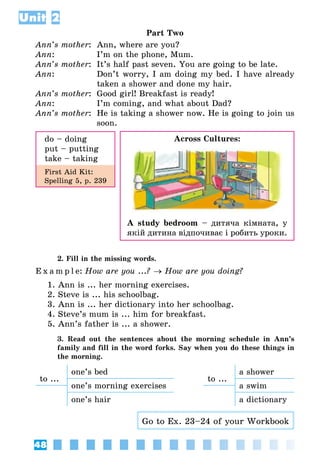
Part Two
Ann’s mother:	 Ann, where are you?
Ann:	 I’m on the phone, Mum.
Ann’s mother:	 It’s half past seven. You are going to be late.
Ann:	 Don’t worry, I am doing my bed. I have already
taken a shower and done my hair.
Ann’s mother:	 Good girl! Breakfast is ready!
Ann:	 I’m coming, and what about Dad?
Ann’s mother:	 He is taking a shower now. He is going to join us
soon.
do – doing
put – putting
take – taking
First Aid Kit:
Spelling 5, p. 239
2. Fill in the missing words.
E x a m p l e:	How are you ...? → How are you doing?
1. Ann is ... her morning exercises.
2. Steve is ... his schoolbag.
3. Ann is ... her dictionary into her schoolbag.
4. Steve’s mum is ... him for breakfast.
5. Ann’s father is ... a shower.
3. Read out the sentences about the morning schedule in Ann’s
family and fill in the word forks. Say when you do these things in
the morning.
to ...
one’s bed
to ...
a shower
one’s morning exercises a swim
one’s hair a dictionary
Go to Ex. 23–24 of your Workbook
Across Cultures:
A study bedroom – дитяча кімната, у
якій дитина відпочиває і робить уроки.
49
lesson 1
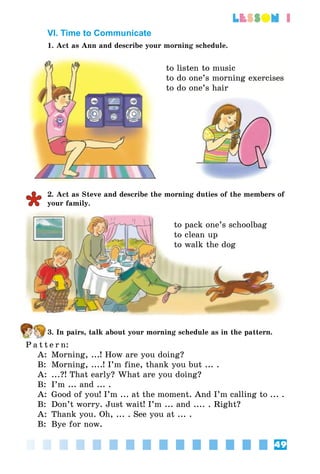
VI. Time to Communicate
1. Act as Ann and describe your morning schedule.
to listen to music
to do one’s morning exercises
to do one’s hair
2. Act as Steve and describe the morning duties of the members of
your family.
to pack one’s schoolbag
to clean up
to walk the dog
3. In pairs, talk about your morning schedule as in the pattern.
P a t t e r n:
A:	 Morning, ...! How are you doing?
B:	 Morning, ....! I’m fine, thank you but ... .
A:	 ...?! That early? What are you doing?
B:	 I’m ... and ... .
A:	 Good of you! I’m ... at the moment. And I’m calling to ... .
B:	 Don’t worry. Just wait! I’m ... and .... . Right?
A:	 Thank you. Oh, ... . See you at ... .
B:	 Bye for now.
50
Unit 2
VII. Time to Listen
1. Listen to the story “Panic on Being Late” and say why the boy
was late for school.
2. Choose the correct answer.
1. What books does Henry like?
a) fairy tales;
b) adventure stories;
c) detective stories.
2. What did he read yesterday?
a) a newspaper;
b) a book of poems;
c) a book about travelling.
3. Where did he find himself?
a) in Africa;
b) in South America;
c) in New Zealand.
4. What happened to him later?
a) He had dinner.
b) He fell asleep.
c) He wrote a letter.
5. When did he wake up?
a) at 7 am;	 b) at 8 am;	 c) at 8.25 am.
6. What was he late for?
a) school;	 b) the cinema;	 c) the sports club.
VIII. Time to Write
Write an e-mail to your friend to check if she/he is taking something
for you to school. Follow the pattern below.
P a t t e r n:
Hi, ... .
I’m ... and now ... . I’m ... to check if you are ... for me to
school. I’m going to ... See you soon.
... .
Go to Ex. 25 of your Workbook
51
lesson 2
2:2. Afternoon schedule
Word Bank Phrase Bank Communication Box
to relax
to socialize
sleepy
tired
choir
to help about the house
to resume one’s classes
to have a problem
with ...
to become oneself again
to go to the pictures
The thing is ...
Perhaps ...
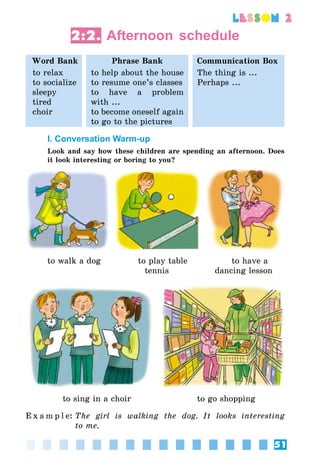
I. Conversation Warm-up
Look and say how these children are spending an afternoon. Does
it look interesting or boring to you?
to walk a dog to play table
tennis
to have a
dancing lesson
to sing in a choir to go shopping
E x a m p l e:	The girl is walking the dog. It looks interesting
to me.
52
Unit 2
II. Pronunciation Warm-up
Read the afternoon rap and beat the rhythm. Say how it differs
from your weekly schedule.
Afternoon Rap
Park on Sunday,
School on Monday,
Sport on Tuesday,
Books on Wednesday,
Computer on Thursday,
Films on Friday,
Fun on Saturday.
Hooray!
III. Grammar Smart
1. Look and recall!
never sometimes often usually always
E x a m p l e:	I never go shopping.
now
at the moment
at present
at the present moment
E x a m p l e:	I am doing the room now.
2. Play a grammar contrast game.
E x a m p l e:	A:	I usually clean up after dinner.
	 B:	I am cleaning up after dinner now. I always walk
my dog in the afternoon.
	 A:	I am walking my dog at the moment.
to clean up	 to watch TV
to walk one’s dog	 to visit one’s grandma
to do the room	 to listen to music
to play tennis	 to do one’s lesson
53
lesson 2
3. Read and remember!
Для того, щоб правильно сказати, що відбувається у
теперішній проміжок часу, вживай:
I am these days.
He/she is doing something this week.
We/they/you are this month.
this year.
E x a m p l e:	I am learning to play table tennis these days.
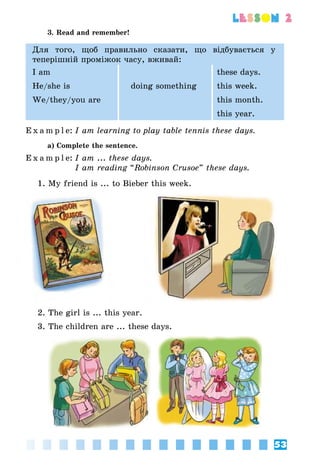
a) Complete the sentence.
E x a m p l e:	I am ... these days.
	 I am reading “Robinson Crusoe” these days.
1. My friend is ... to Bieber this week.
2. The girl is ... this year.
3. The children are ... these days.
54
Unit 2
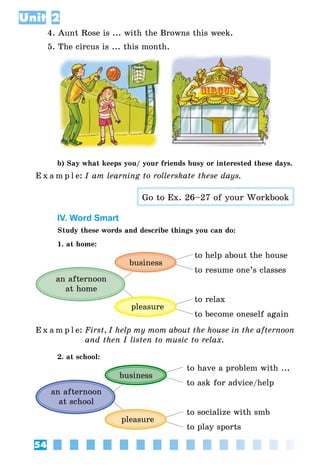
4. Aunt Rose is ... with the Browns this week.
5. The circus is ... this month.
b) Say what keeps you/ your friends busy or interested these days.
E x a m p l e:	I am learning to rollerskate these days.
Go to Ex. 26–27 of your Workbook
IV. Word Smart
Study these words and describe things you can do:
1. at home:
an afternoon
at home
business
pleasure
to help about the house
to resume one’s classes
to relax
to become oneself again
E x a m p l e:	First, I help my mom about the house in the afternoon
and then I listen to music to relax.
2. at school:
an afternoon
at school
business
pleasure
to have a problem with ...
to ask for advice/help
to socialize with smb
to play sports
55
lesson 2
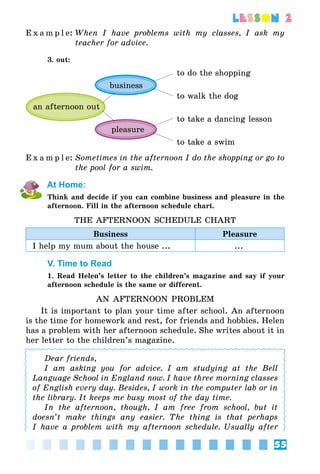
E x a m p l e:	When I have problems with my classes, I ask my
teacher for advice.
3. out:
to do the shopping
to walk the dog
to take a dancing lesson
to take a swim
E x a m p l e:	Sometimes in the afternoon I do the shopping or go to
the pool for a swim.
At Home:
Think and decide if you can combine business and pleasure in the
afternoon. Fill in the afternoon schedule chart.
THE AFTERNOON SCHEDULE CHART
Business Pleasure
I help my mum about the house ... ...
V. Time to Read
1. Read Helen’s letter to the children’s magazine and say if your
afternoon schedule is the same or different.
AN AFTERNOON PROBLEM
It is important to plan your time after school. An afternoon
is the time for homework and rest, for friends and hobbies. Helen
has a problem with her afternoon schedule. She writes about it in
her letter to the children’s magazine.
Dear friends,
I am asking you for advice. I am studying at the Bell
Language School in England now. I have three morning classes
of English every day. Besides, I work in the computer lab or in
the library. It keeps me busy most of the day time.
In the afternoon, though, I am free from school, but it
doesn’t make things any easier. The thing is that perhaps
I have a problem with my afternoon schedule. Usually after
an afternoon out
business
pleasure
56
Unit 2
classes I socialize with my English friends. It’s a habit with us
to spend our time at the shopping centre where we go window-
shopping. We can also drop in at a café for desserts or go
to the pictures. Sometimes I go to the swimming pool or just
take a walk. When I come back, I often feel tired and sleepy
and I can’t resume my classes. But I need to relax to become
myself again, don’t I? What shall I do?
Yours,
Helen.
advice – to advise
practice – to practise
walk – to walk
See First Aid Kit: Word Building 2, p. 236
Across Cultures: Great Britain
Bell Language School – мовна
школа у Баті, Англія, у якій
навчаються діти і дорослі
з-за кордону
a host family – сім’я,
яка при­ймає у свій дім
дітей з-за кордону для
тимчасового проживання
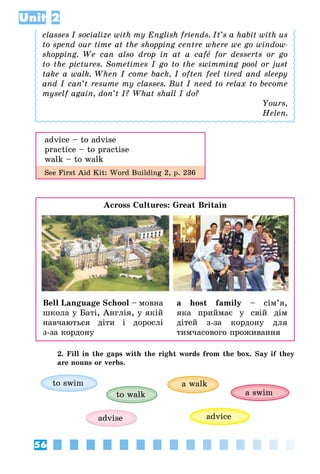
2. Fill in the gaps with the right words from the box. Say if they
are nouns or verbs.
advise
to walk
advice
a swim
to swim a walk
57
lesson 2
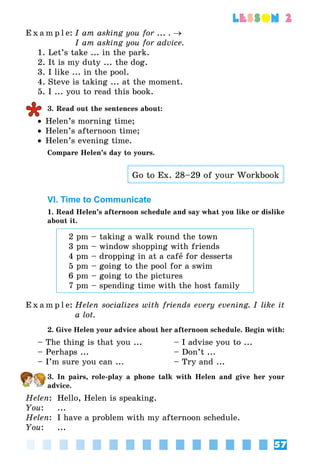
E x a m p l e:	I am asking you for ... . →
	 I am asking you for advice.
1. Let’s take ... in the park.
2. It is my duty ... the dog.
3. I like ... in the pool.
4. Steve is taking ... at the moment.
5. I ... you to read this book.
3. Read out the sentences about:
•• Helen’s morning time;
•• Helen’s afternoon time;
•• Helen’s evening time.
Compare Helen’s day to yours.
Go to Ex. 28–29 of your Workbook
VI. Time to Communicate
1. Read Helen’s afternoon schedule and say what you like or dislike
about it.
2 pm – taking a walk round the town
3 pm – window shopping with friends
4 pm – dropping in at a cafå for desserts
5 pm – going to the pool for a swim
6 pm – going to the pictures
7 pm – spending time with the host family
E x a m p l e:	Helen socializes with friends every evening. I like it
a lot.
2. Give Helen your advice about her afternoon schedule. Begin with:
– The thing is that you ...	 – I advise you to ...
– Perhaps ...	 – Don’t ...
– I’m sure you can ...	 – Try and ...
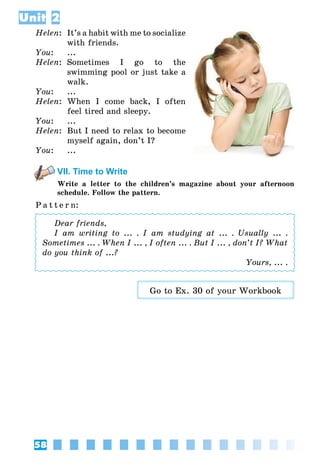
3. In pairs, role-play a phone talk with Helen and give her your
advice.
Helen:	 Hello, Helen is speaking.
You:	 ...
Helen:	 I have a problem with my afternoon schedule.
You:	 ...
58
Unit 2
Helen:	 It’s a habit with me to socialize
with friends.
You:	 ...
Helen:	 Sometimes I go to the
swimming pool or just take a
walk.
You:	 ...
Helen:	 When I come back, I often
feel tired and sleepy.
You:	 ...
Helen:	 But I need to relax to become
myself again, don’t I?
You:	 ...
VII. Time to Write
Write a letter to the children’s magazine about your afternoon
schedule. Follow the pattern.
P a t t e r n:
Dear friends,
I am writing to ... . I am studying at ... . Usually ... .
Sometimes ... . When I ... , I often ... . But I ... , don’t I? What
do you think of ...?
Yours, ... .
Go to Ex. 30 of your Workbook
59
lesson 3
2:3. Evening schedule
Word Bank Phrase Bank Communication Box
library
tourist
ancient
to take a music lesson
to make a great
impression on smb
to take a walking tour of
sth
to take a boat trip
to have much to offer
to set the alarm clock
As for ...
Luckily ...
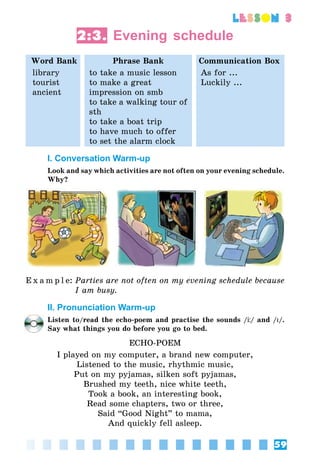
I. Conversation Warm-up
Look and say which activities are not often on your evening schedule.
Why?
E x a m p l e:	Parties are not often on my evening schedule because
I am busy.
II. Pronunciation Warm-up
Listen to/read the echo-poem and practise the sounds // and /I/.
Say what things you do before you go to bed.
ECHO-POEM
I played on my computer, a brand new computer,
Listened to the music, rhythmic music,
Put on my pyjamas, silken soft pyjamas,
Brushed my teeth, nice white teeth,
Took a book, an interesting book,
Read some chapters, two or three,
Said “Good Night” to mama,
And quickly fell asleep.
60
Unit 2
III. Grammar Smart
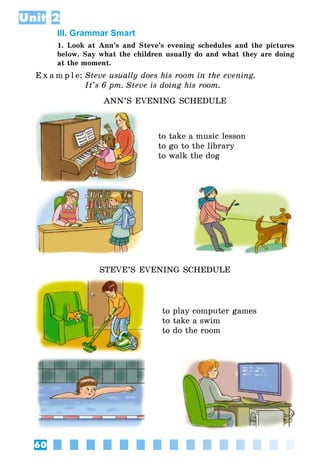
1. Look at Ann’s and Steve’s evening schedules and the pictures
below. Say what the children usually do and what they are doing
at the moment.
E x a m p l e:	Steve usually does his room in the evening.
	 It’s 6 pm. Steve is doing his room.
ANN’S EVENING SCHEDULE
to take a music lesson
to go to the library
to walk the dog
STEVE’S EVENING SCHEDULE
to play computer games
to take a swim
to do the room
61
lesson 3
2. Match the beginnings and the endings.
Beginnings Endings
1. I watch videos ... a) ... I come back home.
2. I feel tired and sleepy when ... b) ... at the moment.
3. Helen is helping her mother
about the house ...
c) ... after school.
4. Mike is learning to swim ... d) ... in the evening.
5. William usually socializes with
friends ...
e) ... these days.
6. Look, the girls ... f) ... are playing football!
3. Answer the questions about your evening schedule.
1. When do you usually resume your classes?
2. What are you learning to do these days?
3. How do you relax in the evening?
4. What are you going to do this evening?
5. It’s a habit with you to take a walk in the evening,
isn’t it?
Go to Ex. 31–32 of your Workbook
IV. Word Smart
1. Read Helen’s story “My Stay in Bath” and say how she spends
her evenings there.
MY STAY IN BATH
So I’m in Bath. It is so exciting! At first the weather was cold,
but sunny. Then it changed very quickly.
Bath has made a great impression on me. It has much to offer
for tourists. They can go to a palace, see an ancient cathedral,
visit a theme park and other places of interest.
It’s evening now. It’s raining but I have an umbrella with
me. I am taking a walking tour of the town at the moment. I am
having the time of my life, with the Roman Baths on my left and
the Museum of Costume right ahead of me. I’m also going to take
a boat trip on the river Avon this evening.
62
Unit 2
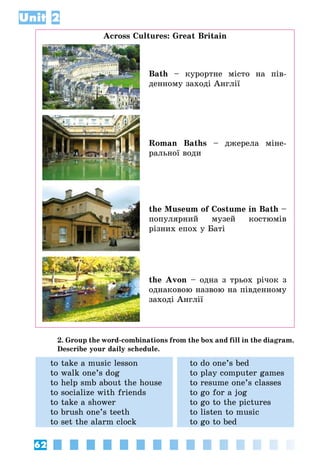
Across Cultures: Great Britain
Bath – курортне місто на пів­
денному заході Англії
Roman Baths – джерела міне­
ральної води
the Museum of Costume in Bath –
популярний музей костюмів
різних епох у Баті
the Avon – одна з трьох річок з
однаковою назвою на півден­ному
заході Англії
2. Group the word-combinations from the box and fill in the diagram.
Describe your daily schedule.
to take a music lesson
to walk one’s dog
to help smb about the house
to socialize with friends
to take a shower
to brush one’s teeth
to set the alarm clock
to do one’s bed
to play computer games
to resume one’s classes
to go for a jog
to go to the pictures
to listen to music
to go to bed
63
lesson 3
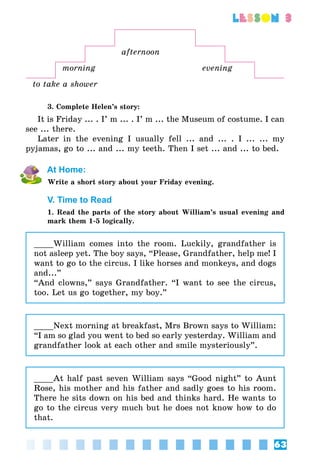
afternoon
morning evening
to take a shower
3. Complete Helen’s story:
It is Friday ... . I’ m ... . I’ m ... the Museum of costume. I can
see ... there.
Later in the evening I usually fell ... and ... . I ... ... my
pyjamas, go to ... and ... my teeth. Then I set ... and ... to bed.
At Home:
Write a short story about your Friday evening.
V. Time to Read
1. Read the parts of the story about William’s usual evening and
mark them 1-5 logically.
____William comes into the room. Luckily, grandfather is
not asleep yet. The boy says, “Please, Grandfather, help me! I
want to go to the circus. I like horses and monkeys, and dogs
and...”
“And clowns,” says Grandfather. “I want to see the circus,
too. Let us go together, my boy.”
____Next morning at breakfast, Mrs Brown says to William:
“I am so glad you went to bed so early yesterday. William and
grandfather look at each other and smile mysteriously”.
____At half past seven William says “Good night” to Aunt
Rose, his mother and his father and sadly goes to his room.
There he sits down on his bed and thinks hard. He wants to
go to the circus very much but he does not know how to do
that.
64
Unit 2
____When the circus is over, William and Grandfather go
home. They are very happy. They speak about the clown, the
dogs and the monkeys, and laugh happily. When they come
home, they quietly go to their bedrooms.
____William goes quietly out of his bedroom and opens the
door of his Grandfather’s room. Grandfather is sitting in his
chair and reading a newspaper.
Adapted from William
-ly quick – quickly
happy – happily
mysterious – mysteriously
See First Aid Kit:
Word Building 3, p. 236
2. Choose the right word.
E x a m p l e:	Helen smiled ... (happy/happily). →
	 Helen smiled happily.
1. William ... (usually/usual) goes to bed at half past eight.
2. William and Grandfather laugh ... (happy/happily).
3. William and Grandfather look at each other ... (mysterious/
mysteriously).
4. When William and Grandfather come home, they open the
door ... (quiet/quietly).
5. At half past seven William ... (sadly/sad) goes to his room.
3. Read out the sentences about:
•• William’s plans for the evening;
•• Grandfather’s help;
•• William and Grandfather’s secret.
Say if you like or dislike their evening schedule.
Go to Ex. 33–34 of your Workbook
65
lesson 3
VI. Time to Communicate
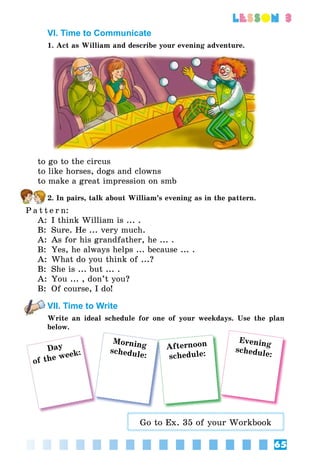
1. Act as William and describe your evening adventure.
to go to the circus
to like horses, dogs and clowns
to make a great impression on smb
2. In pairs, talk about William’s evening as in the pattern.
P a t t e r n:
A:	 I think William is ... .
B:	 Sure. He ... very much.
A:	 As for his grandfather, he ... .
B:	 Yes, he always helps ... because ... .
A:	 What do you think of ...?
B:	 She is ... but ... .
A:	 You ... , don’t you?
B:	 Of course, I do!
VII. Time to Write
Write an ideal schedule for one of your weekdays. Use the plan
below.
Day
of the week:
Morning
schedule:
Afternoon
schedule:
Evening
schedule:
Go to Ex. 35 of your Workbook
66
Unit 2
2:4. Weekend Plans
Word Bank Phrase Bank Communication Box
tennis club
jam
to list
to bake
to go on a hike
to choose a route
to pack a rucksack
fishing rods
to go fishing
to take an outing to sth
to get ready for sth
to sing along
What’s on your mind?
Sounds like a good
idea.
Thank you for the
invitation.
I. Conversation Warm-up
Mime what plans you usually have for the weekend. Let your
classmates guess and say if they do the same.
II. Pronunciation Warm-up
Listen to/read the weekend questions and beat the rhythm. Answer
these questions.
WEEKEND QUESTIONS
What are you going to do on Friday?
What are you going to do?
Where are you going to be on Saturday?
Where are you going to be?
Who are you going to see on Sunday?
Who are you going to see?
What are you going to say?
Where are you going to stay?
When are you going to leave?
What are you going to give?
Friday
Saturday Sunday
III. Function Smart
Read and learn to talk about your weekend plans. Look at the notes
and fill in the mini-dialogues.
67
lesson 4
a)	 – What are your plans for ...?
	 – I’m going to ... .
b)	 – What about going to ...?
	 – I’d love to ... .
c)	 – Let’s go to ... Saturday.
	 – I don’t feel like it.
d)	– Is it OK with you if ...?
	 – Fine.
IV. Word Smart
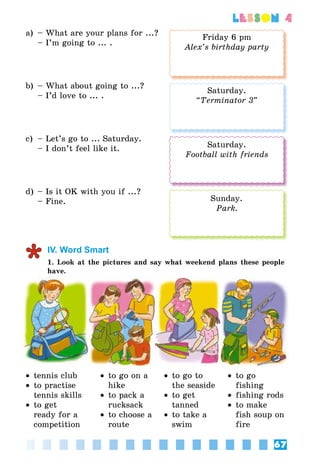
1. Look at the pictures and say what weekend plans these people
have.
•• tennis club
•• to practise
tennis skills
•• to get
ready for a
competition
•• to go on a
hike
•• to pack a
rucksack
•• to choose a
route
•• to go to
the seaside
•• to get
tanned
•• to take a
swim
•• to go
fishing
•• fishing rods
•• to make
fish soup on
fire
Friday 6 pm
Alex’s birthday party
Saturday.
“Terminator 3”
Saturday.
Football with friends
Sunday.
Park.
68
Unit 2
E x a m p l e:	The girl is going to the tennis club on Saturday. She
plans to practise her tennis skills. She is getting ready
for a competition these days.
2. Read the weather rhymes and say what weekend plans you can
make for these days. What about:
•• spending much time out in the open?
•• gathering mushrooms and berries in the wood?
•• swimming in the river?
•• lying in the sun?
•• travelling to the seaside?
•• taking pictures?
•• helping your grandparents in the garden?
WEATHER RHYMES
Red leaves and yellow leaves,	 Down, down!
Orange leaves and brown,	 Yellow and brown.
Leaves are dancing everywhere,	 The leaves are falling
Happily dancing down.	 Over the town.
***
The leaves on the ground go swish, swish, swish.
The raindrops keep falling drop, drop, drop.
The ground goes muddy splash, splash, splash.
The children jump around hop, hop, hop.
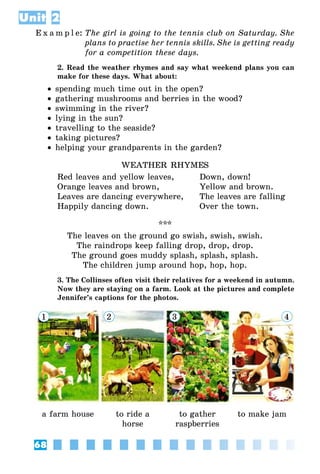
3. The Collinses often visit their relatives for a weekend in autumn.
Now they are staying on a farm. Look at the pictures and complete
Jennifer’s captions for the photos.
1 2 3 4
a farm house to ride a
horse
to gather
raspberries
to make jam
69
lesson 4
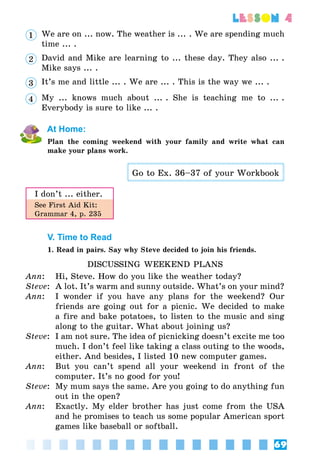
1 	 We are on ... now. The weather is ... . We are spending much
time ... .
2 	 David and Mike are learning to ... these day. They also ... .
Mike says ... .
3 	 It’s me and little ... . We are ... . This is the way we ... .
4 	 My ... knows much about ... . She is teaching me to ... .
Everybody is sure to like ... .
At Home:
Plan the coming weekend with your family and write what can
make your plans work.
Go to Ex. 36–37 of your Workbook
I don’t ... either.
See First Aid Kit:
Grammar 4, p. 235
V. Time to Read
1. Read in pairs. Say why Steve decided to join his friends.
DISCUSSING WEEKEND PLANS
Ann:	 Hi, Steve. How do you like the weather today?
Steve:	 A lot. It’s warm and sunny outside. What’s on your mind?
Ann:	 I wonder if you have any plans for the weekend? Our
friends are going out for a picnic. We decided to make
a fire and bake potatoes, to listen to the music and sing
along to the guitar. What about joining us?
Steve:	 I am not sure. The idea of picnicking doesn’t excite me too
much. I don’t feel like taking a class outing to the woods,
either. And besides, I listed 10 new computer games.
Ann:	 But you can’t spend all your weekend in front of the
computer. It’s no good for you!
Steve:	 My mum says the same. Are you going to do anything fun
out in the open?
Ann:	 Exactly. My elder brother has just come from the USA
and he promises to teach us some popular American sport
games like baseball or softball.
70
Unit 2
Steve:	 Wow! Sounds like a good idea. I like sports and I’m
interested in sport of other countries.
Ann:	 Then you’ll kill two birds with one stone, as the proverb
goes: you’ll have a nice rest and learn new sport games.
Steve:	 Thank you for the invitation, Ann. It’ll be an unforgettable
weekend, I bet.
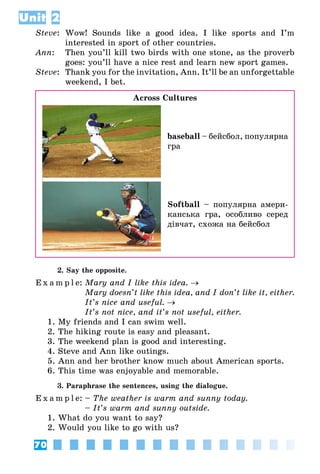
Across Cultures
baseball – бейсбол, популярна
гра
Softball – популярна амери­
канська гра, особливо серед
дівчат, схожа на бейсбол
2. Say the opposite.
E x a m p l e:	Mary and I like this idea. →
	 Mary doesn’t like this idea, and I don’t like it, either.
	 It’s nice and useful. →
	 It’s not nice, and it’s not useful, either.
1. My friends and I can swim well.
2. The hiking route is easy and pleasant.
3. The weekend plan is good and interesting.
4. Steve and Ann like outings.
5. Ann and her brother know much about American sports.
6. This time was enjoyable and memorable.
3. Paraphrase the sentences, using the dialogue.
E x a m p l e:	– The weather is warm and sunny today.
	 – It’s warm and sunny outside.
1. What do you want to say?
2. Would you like to go with us?
71
lesson 4
3. I don’t like this idea.
4. It’s bad for your health.
5. My mum is of the same opinion.
6. I like this idea.  
4. Read out the sentences about:
a) a picnic;                            b) outdoor sport games.
Compare these weekend activities with those of yours.
VI. Time to Communicate
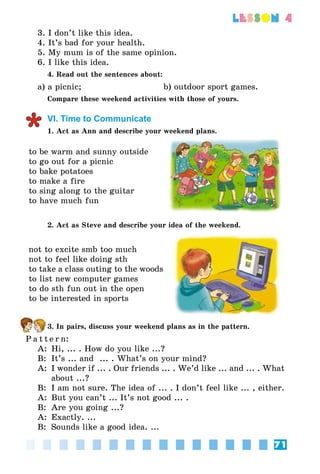
1. Act as Ann and describe your weekend plans.
to be warm and sunny outside
to go out for a picnic
to bake potatoes
to make a fire
to sing along to the guitar
to have much fun
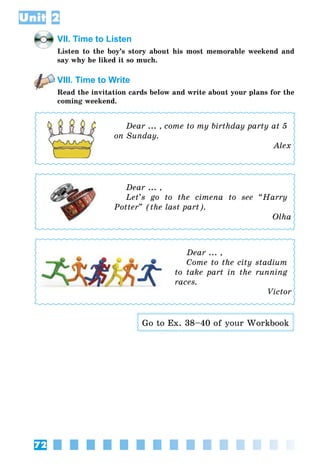
2. Act as Steve and describe your idea of the weekend.
not to excite smb too much
not to feel like doing sth
to take a class outing to the woods
to list new computer games
to do sth fun out in the open
to be interested in sports
3. In pairs, discuss your weekend plans as in the pattern.
P a t t e r n:
A:	 Hi, ... . How do you like ...?
B:	 It’s ... and  ... . What’s on your mind?
A:	 I wonder if ... . Our friends ... . We’d like ... and ... . What
about ...?
B:	 I am not sure. The idea of ... . I don’t feel like ... , either.
A:	 But you can’t ... It’s not good ... .
B:	 Are you going ...?
A:	 Exactly. ...
B:	 Sounds like a good idea. ...
72
Unit 2
VII. Time to Listen
Listen to the boy’s story about his most memorable weekend and
say why he liked it so much.
VIII. Time to Write
Read the invitation cards below and write about your plans for the
coming weekend.
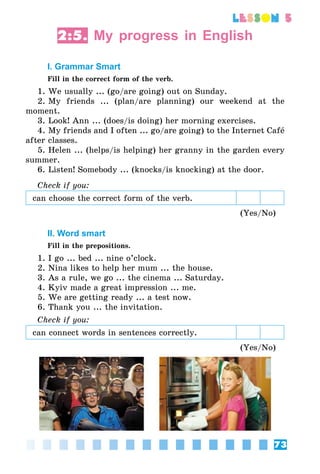
Dear ... , come to my birthday party at 5
on Sunday.
Alex
Dear ... ,
Let’s go to the cimena to see “Harry
Potter” (the last part).
Olha
Dear ... ,
Come to the city stadium
to take part in the running
races.
Victor
Go to Ex. 38–40 of your Workbook
73
lesson 5
2:5. My progress in English
I. Grammar Smart
Fill in the correct form of the verb.
1. We usually ... (go/are going) out on Sunday.
2. My friends ... (plan/are planning) our weekend at the
moment.
3. Look! Ann ... (does/is doing) her morning exercises.
4. My friends and I often ... go/are going) to the Internet Café
after classes.
5. Helen ... (helps/is helping) her granny in the garden every
summer.
6. Listen! Somebody ... (knocks/is knocking) at the door.
Check if you:
can choose the correct form of the verb.
(Yes/No)
II. Word smart
Fill in the prepositions.
1. I go ... bed ... nine o’clock.
2. Nina likes to help her mum ... the house.
3. As a rule, we go ... the cinema ... Saturday.
4. Kyiv made a great impression ... me.
5. We are getting ready ... a test now.
6. Thank you ... the invitation.
Check if you:
can connect words in sentences correctly.
(Yes/No)
74
Unit 2
III. Function Smart
Match the questions to the answers.
1.	What are your plans for
the weekend?
a)	 Sorry, I’ll be very busy on
Saturday.
2.	Let’s go to the cinema on
Saturday.
b)	 Fine. I’m free after the
lessons.
3.	What about visiting our
friends in the evening?
c)	I’m going to Kyiv this
weekend.
4.	Is it OK with you if we
play computer games after
classes?
d)	I’d love to, but I have so
many things to do in the
evening.
5.	Would you like to go on a
hike with us?
e)	 I’m not. Hiking doesn’t
excite me too much.
Check if you:
can talk about weekend plans.
(Yes/No)
IV. Time to Read
Read the story “A Perfect Pupil” and mark the right statements.
A PERFECT PUPIL
I have a friend, her name is Alice. She is the best pupil in
my class and she has become our school tennis champion this
year. The teachers think that Alice is a perfect pupil. She herself
doesn’t think so. Alice says, “I am a well-organized person and
try to do everything in time. That’s why I manage to do a lot
of things. I follow the proverb “Business before pleasure” and
I don’t like to waste time. I resume my lessons at about four
o’clock when I come back from my tennis club. As a rule, I do all
the lessons and always get good marks at school.
I started to play tennis four years ago at a summer camp.
At first it was just a hobby. Then I started to take part in
competitions. I play tennis three times a week and it helps me to
keep fit. I love tennis, but I have lots of other interests, too, like
going dancing, listening to music or reading. I know that all this
helps me to study well.
1. Alice has become our school tennis champion this year.
2. She started to play tennis, when she was five.
75
lesson 5
3. Alice began playing tennis at a summer camp.
4. Alice says she is a well-organized person.
5. She resumes her lessons in the evening.
6. Her interests and hobby help her to study well.
Check if you:
can read and understand a short story about smb’s
time schedule.
(Yes/No)
V. Time to Listen
Listen to Martin’s story “Lucky’s Best Friend” and match the
activities to the characters.
1.	 Martin
2.	 My mum
3.	 My dad
4.	 My elder sister Nina
5.	 My niece Lisa
6.	 Lucky
a)	 gives Lisa breakfast.
b)	 buys chocolate for Lisa.
c)	 shares the best.
d)	 takes Lisa for a morning walk.
e)	 likes to play with Lisa.
f)	 gets up early at 7 o’clock.
Check if you:
can understand the details of the text.
(Yes/No)
VI. Time to Write
Write a description of your everyday schedule.
Check if you:
can write a description of your working day.
(Yes/No)
Go to your WB, Cross-cultural Workshop 2
76
Unit 3
Unit Three: Eat with Pleasure
3:1. Meals at home
Word Bank Phrase Bank Communication Box
cutlets
to slice
rice
beans
to bake
porridge
to cut
to try
to have ... meals a day
to begin (to finish) with ...
for the 1-st course (the
main course)
for dessert
dish
breakfast/dinner/supper
meal schedule
... is OK with me.
Thanks to ...
Normally ...
I. Conversation Warm-up
Look and say what dishes you usually have for breakfast/dinner/
supper.
porridge macaroni fruit
yogurt potatoes sausage
E x a m p l e:	I usually have porridge for breakfast and jogurt for
supper.
II. Pronunciation Warm-up
Listen to/read “The Tea Party Poem” with correct stress and
practise the sound /eI/. Say what you prepare for your tea party.
77
lesson 1
THE TEA PARTY POEM
I shall make a little cake,
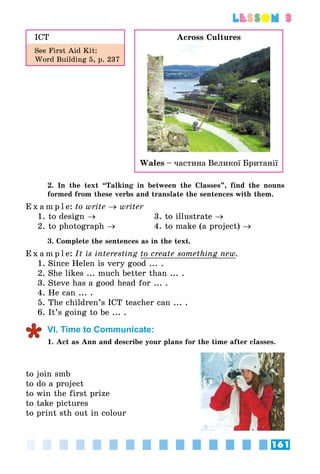
He and she will make some tea,
We shall make another cake,
For you and they will come today.
III. Grammar Smart
1. Look and recall!
а) Щоб правильно ска­
зати, хто їсть або готує
їжу, вживай:
I, you, he, she,
we, they
I shall make
a little cake.
б) Щоб правильно ска­
зати, для кого готуєть­
ся або подається їжа,
вживай:
me, him, her, us,
them
Give me a cake,
please.
в) Щоб правильно ска­
зати, чия це улюблена
їжа, вживай:
my, your, his,
her, our, their
перед іменником
Fish soup is my
favourite dish for
the first course.
2. Play a grammar game, using the model.
E x a m p l e:	I – me, me – my.
3. Read and remember!
Щоб додатково підкрес­
лити, що це саме моя/
твоя/його/її/наша/їхня
їжа, а не іншої людини,
вживай:
mine, yours, his,
hers, ours, theirs,
без іменника
This apple is
mine, not yours.
a) Paraphrase the sentences as in the example.
E x a m p l e:	Buying bread is my duty. →
	 Buying bread is a duty of mine.
1. Porridge is my favourite breakfast dish.
2. Cooking is her duty.
3. This is our dining room.
4. Take your piece of pie.
5. I like their dinner.
6. We enjoy our meals.
78
Unit 3
b) Look at the pictures and complete the sentences.
E x a m p l e:	It’s not my cake, it is his.
1. It’s not ... sandwich, it is ... .
2. It’s not ... salad, it is ... .
3. It’s not ... ice cream, it is ... .
4. It’s not ... soup, it is ... .
5. It’s not ... sweet, it is ... .
At Home:
Write what meal schedule your family has every day (sometimes,
never).
IV. Word Smart
1. Study these words and describe:
a) your everyday meals schedule:
Use: porridge, cutlets, rice, breakfast, macaroni, meat, cake,
sandwich, salad, ice cream, yogurt, borsch, sausage, omelette,
soup.
79
lesson 1
E x a m p l e:	Porridge is a typical breakfast dish in my family.
b) your holiday meal schedule:
•• to begin with .../to finish with ... ;
•• for the first course .../for the main course ... ;
•• for dessert ... .
E x a m p l e:	We usually have a big cake and ice cream for a
desssert.
2. Answer the questions.
1. How many meals do you have a day?
2. What do you normally have for breakfast/dinner/supper?
3. What is your favourite breakfast/dinner/supper dish?
4. What do you like for the first (main) course?
5. What do you usually have for dessert?
6. What do you prefer to begin or finish your dinner with?
3. Look at the dishes the girl is going to prepare. Say how often you
eat them.
to slice
bread/cheese
to cut
vegetables
to bake
pizza
to fry eggs
E x a m p l e:	The girl is slicing bread and cheese to make a sandwich.
I often have a cheese sandwich for breakfast.
Go to Ex. 41–42 of your Workbook
80
Unit 3
V. Time to Read
1. Read Ann’s description of her meal schedule and say what eating
traditions her family has.
taste – tasty
salt – salty
See First Aid Kit: Word Building 4, p. 237
ANN’S MEAL SCHEDULE
We usually have three meals a day: breakfast, dinner and
supper. The morning meal is a large hot breakfast with eggs,
potatoes, tea or coffee. Then around two o’clock we have dinner,
the biggest meal of the day. We eat vegetable salad to begin with.
Borsch or soup comes for the first course. Varenykys or cutlets
with macaroni or rice are for the main course. For dessert we may
have juice or fresh fruit.
My favourite dinner dish is Ukrainian borshch. My granny
cooks it for us in a special way. I know that the borshch is hers
if there are beans in it.
Supper, the evening meal, is normally light. Yoghurt is OK
with me.
My mum often bakes something tasty. She has recently made a
popular Australian dessert — the Pavlova. It was great!
Thanks to my mum and granny, our meal schedule is so well-
planned.
food
meal
See First Aid Kit: Word meaning 1, p. 238
Across Cultures: Australia
the Pavlova – австралійський десерт, який
названо на честь балерини Анни Павлової –
тістечко із збитих білків з вершками та
шматочками фруктів
2. Choose the right word.
E x a m p l e:	I have three food, meals a day. →
	 I have three meals a day.
81
lesson 1
1. We often have sea food/meal in the family.
2. I don’t like to have my food/meal in a café.
3. Thank you, granny, for the tasty food/meal.
4. I don’t like such spicy food/meal.
5. It’s time for our midday food/meal.
6. I prefer Ukrainian food/meal.
3. Read out what Ann says about Ukrainian dishes and say how
much they are typical of your eating traditions.
VI. Time to Communicate
1. Act as Ann and describe your everyday meal schedule.
to have three meals a day
to be well-planned
for breakfast
to begin with
for the first (main) course
for dessert
for supper
2. Act as Ann’s granny and say how you cook Ukrainian borsch in
a special way. How does your mother cook it?
carrot
parsley
beens
onion
dill
tomato
beetroot
cabbage potato
for the first course
favourite dish
to cook Ukrainian borsch
in a special way
to add beans
to be very tasty
3. In pairs, talk about your meals at home as in the pattern.
P a t t e r n:
A:	 ...?
B:	 As for me, I have three meals a day: breakfast, dinner and
supper.
82
Unit 3
A:	 ...?
B:	 My breakfast is large and hot. It consists of a plate of
porridge and a cup of tea or coffee.
A:	 ...?
B:	 Sure. Dinner is the biggest meal of the day.
A:	 ...?
B:	 As a rule, I have a plate of soup for the first course, cutlets
and mashed potatoes for the main course, and tea for
dessert.
A:	 ...?
B:	 As for my supper, it is very light, a cup of tea or yoghurt
is OK with me.
A:	 I see your meal schedule is well-planned.
VII. Time to Listen
1. Listen to three friends discussing their meals and say what
Ukrainian dish all of them prefer.
2. Fill in the menu card information.
MENU
First course:
Main course:
Dessert:
VIII. Time to Write
At the request of your international friend, describe a typical
Ukrainian meal schedule. Begin with:
•• Many Ukrainians ...
•• For some families, breakfast ...
•• As for dinner, it may ...
•• The most traditional first course ...
•• It tastes better with ...
•• For the main course ...
•• For dessert ...
•• The evening meal ...
•• As you see, ...
Go to Ex. 43–45 of your Workbook
83
lesson 2
3:2. Eating out
Word Bank Phrase Bank Communication Box
dumplings
chops
garnish
canteen
appetizer
to eat out
to be hungry as a hunter
menu card
to be to smb’s taste
poppy seed pie
mashed potato
on the menu
to have a sweet tooth
fast food
Come on then.
Same with me.
What do you say
to ...?
I can’t say ‘no’
to ...
It’s you all over.
Tastes differ.
I. Conversation Warm-up
Look and say what places you would like to visit for dinner.
McDonalds
French desserts Ice cream shop
Potato Hut
Pizza Hut
E x a m p l e:	I would like to visit a Potato Hut for dinner.
II. Pronunciation Warm-up
Listen to/read the “Eating out” chant with correct intonation and
practise the sounds /Á/ and /ю/. Answer the questions of the chant.
84
Unit 3
EATING OUT CHANT
How do you like your coffee?
Hot, hot.
How do you like your cake?
With cream, please.
How do you like your ice cream?
With chocolate, please.
One scoop or more?
I can eat four.
III. Grammar Smart
1. Look and recall!
Для того, щоб правильно розповісти про сніданок, обід або
вечерю, вживай: breakfast, lunch, supper без артиклю.
E x a m p l e:	Mama lays the table for breakfast.
2. Play a chain game
E x a m p l e:	A:	What do you have for breakfast?
	 B:	For breakfast I have a plate of porridge. What do
you have for lunch?
	 C:	For lunch ... .
3. Read and remember!
1. Вживай слова, які називають їжу, без артиклю.
E x a m p l e:	I like soup and macaroni for dinner.
2. Вживай артикль a/an зі словами, які називають порцію
їжі: a glass of ... , a cup of ... , a bottle of ... , a plate of ... .
E x a m p l e:	I have a glass of milk every evening.
a) Look at the picture-table and make up as many sentences as you
can.
•• Give me	 , please.
•• Can I have 	 ?
•• Pass me 	 , please.
•• I’d like	 .
E x a m p l e:	Give me a plate of soup, please.
85
lesson 2
b) Complete and role-pay the mini-dialogues.
– What’s for ... , granny?
– I’m making ... .
– I’d like ... right now
– Here it is.
– What would you like ...?
– I’d like ... .
– Will ... be OK with you for dessert?
– Sure.
– May I take ... , Mum?
– No, you mustn’t. Dinner is ready.
Take ... first.
– OK. Give me ... then.
IV. Word Smart
GRANDMA’S HOUSE
Appetizers
•• ham
•• cabbage salad
•• cucumber-and-
tomato salad
•• beetroot salad
•• cheese sandwich
•• sea food cocktail
First Course
•• pea soup
•• cabbage soup
•• noodle soup
•• tomato soup
•• Ukrainian borsch
Main Course
•• cabbage rolls
•• chops
•• meat
•• dumplings
•• steak
•• potato pancakes
galushky
•• chicken pizza
varenyky
Garnish
•• fried potato
•• mashed potato
•• buckwheat
porridge
•• stewed cabbage
•• spaghetti
•• porridge
Dessert
•• poppy-seed pie
•• Napoleon cake
•• vanilla ice cream
•• orange jelly
•• hamburger
•• hips
Soft Drinks
•• stewed fruit
•• tea with lemon
(=Russian tea)
•• tea with milk
(=English tea)
•• cocoa
•• coca-cola
for dinner
a plate of soup
mushroon soup
a glass of juice
apple juice
for dessert
a plate of soup
a piece of cake
pea soup
86
Unit 3
1. Study the words in the menu (p. 84) and:
a) say what you would like to eat at this café.
E x a m p l e:	I’d like cucumber and tomato salad to begin with, pea
soup for the first course and vanilla ice cream for
dessert.
b) name the dishes which are called healthy food and say how often
you eat them and where you can buy them.
E x a m p l e:	I often have different salads. I buy them at our school
canteen.
c) fill in the dish grid and say which of them you have tasted and if
you liked it or not.
DISH GRID
Dish The country it is from
chicken pizza Italy
...
E x a m p l e:	I think pizza has come from Italy. I’ve tasted it and
liked it a lot.
At Home:
Think and decide what food you usually eat at home or at the café.
Make 2 lists of such dishes.
Go to Ex. 46–47 of your Workbook
V. Time to Read
1. Read in pairs and say if the children have the same tastes in food.
appetizer – AmE
starter – BrE
DISCUSSING THE MENU
Steve:	 It’s about dinner time. I have had my porridge in the
morning and now I’m hungry as a hunter. What about
you?
Ann:	 Me, too. How about going to the nearest cafå?
Steve:	 Do you mean “Grandma’s House”? This is my favourite
place.
87
lesson 2
Ann:	 Come on, then.
Steve:	 Here is the menu card. Is there any appetizer to your taste
on the menu?
Ann:	 Let’s start with healthy food, like cucumber-and-tomato
salad to begin with.
Steve:	 Same withme. Let’s take cabbage soup for the first course.
Ann:	 No soup for me today. And what do you say to meat
dumplings for the main course?
Steve:	 I’ll take chops, with mashed potato for garnish.
Ann:	 Tastes differ. Anything to drink?
Steve:	 I’d like a cup of cocoa and a poppy seed pie for dessert.
I  have a sweet tooth, you know, and can’t say “no” to
sweet things.
Ann: It’s you all over, and I’ll take a banana split to finish with.
Across Cultures: Great Britain
porridge – традиційне шотландське
блюдо – овес, зварений на молоці
banana split – улюблений десерт
англійських дітей – банан з
морозивом або консервованими
фруктами
2. Complete the questions using the text and ask your friends to
answer them.
E x a m p l e:	How about ...? →
	 A: How about going to the nearest cafå?
	 B: I’d love to. I’m hungry as a hunter.
1. Do you mean ...?
2. Is there any ... on the menu?
3. And what do you say to ...?
4. Anything to drink?
5. I can’t say “no” ... .
88
Unit 3
VI. Time to Communicate
1. Act as Ann and describe your visit to the café “Grandma’s House”.
to be one’s favourite place
to have many tasty dishes on the menu
to take healthy food
to prefer meat dumplings
to have different tastes
to enjoy meals at the cafå
2. Act as Steve and describe your choice at the café “Grandma’s
House”.
to be hungry as a hunter
to have appetizers to one’s taste
to begin with cucumber and tomato
salad
to take cabbage soup for the first course
to take chops with mashed potato for
garnish
to have a sweet tooth
3. a) In pairs, discuss the menu in your favourite café as in the
pattern.
P a t t e r n:
A:	 It’s about ... . How about ...?
B:	 With pleasure ... . Here is ... . Is there ... on the menu?
A:	 I’d like ... to begin with and ... for the first course.
B:	 Same with me. Let’s take ... for the main course.
A:	 No ... for me today.
B:	 Tastes differ. Anything for dessert?
A:	 I have a ... and ... .
B:	 It’s you ... and I’ll take ... .
VII. Time to Write
Write about your meal at a café covering the following items:
•• why this café is your favourite;
•• how often you go there and with whom;
•• what tasty things you can find on the menu there;
•• what dishes this café is especially famous for.
Go to Ex. 48–50 of your Workbook
89
lesson 3
3:3. Setting a festive table
Word Bank Phrase Bank Communication Box
bread plate
serviette
spices
table cloth
refreshing
to lay the table
to serve food
festive table
soda water
to give sth a holiday look
to be ready-made
to enjoy every minute of
sth
As you see ...
I. Conversation Warm-up
Look at the picture and say how the table is laid.
Use: a bread plate, salt, pepper, a vase with flowers, a spoon,
a fork, a knife.
E x a m p l e:	There is a bread plate in the centre of the table.
II. Pronunciation Warm-up
Listen to/read the “Festive Table Chant” with rhythm and practise
the sound /eI/. Say who lays the table and serves food in your family.
90
Unit 3
THE FESTIVE TABLE CHANT
Who laid the table?
Mama laid the table.
Who put the plates?
I put the plates.
Who served the food?
Granny served the food.
And we all sat down and started to eat.
III. Grammar Smart
1. Change the sentences as in the example.
E x a m p l e:	It’s not my ice cream, it’s Natasha’s. →
	 It’s not my ice cream, it’s hers.
1. It’s not your plate, it’s Vlad’s.
2. Don’t take this banana split, it’s the girls’.
3. Pass this fork, please, it’s my mum’s.
4. Take away this dish, it’s little Kate’s.
5. They are not my sandwiches, they are Val’s and Ann’s.
6. Don’t eat this porridge, it’s my nephew’s.
2. Look at the picture and decide what dishes each child prepared
for the festive table.
E x a m p l e:	I think the girls made the cake.
91
lesson 3
3. Read a short story of your English friend’s packed lunch and fill
in articles where necessary. Say if you have the same or different.
For X lunch I usually have ... sandwich. ... cheese sandwich is
my favourite. I take ... slice of ... bread first and put ... butter
and ... slice of cheese on it. Then I cover it with another slice of
bread. I have it with ... cup of tea. Then comes ... chocolate or ...
small cake to finish with. This is a traditional packed lunch for
schoolchildren in England.
IV. Word Smart
1. Look at the pictures and choose those which will help you to lay
the festive table. Describe their places on the table.
plates
forks, knives,
spoons
a sauce pan
a table cloth
serviette
spices glasses
a plant
mineral
water
a bread plate
E x a m p l e:	There are plates for every person.
2. Read a passage from Ann’s letter about a children’s party in
Australia. Say what impressed Ann and why.
92
Unit 3
... There is a good tradition in many Australian families to
organize parties for children. So I took part in one of them. It
was really exciting and unusual.
The festive table was beautifully laid in the garden. It was
covered with a white table cloth. Near every plate there was a
lovely many-coloured bird made of serviettes. The bottles of soda
water were also unusual – all covered with bright flowers. All this
gave the table a holiday look. On the table they put many extra
ready-made dishes. Some Australian dishes were to my taste
like chocolate crackles, the Pavlova and fairy bread. It was the
first time  I tasted them and liked them a lot. But my favourite
dishes were the ice pole and the coconut ice. It is very hot in
Australia, you know, and dishes with ice were very refreshing.
As you see, I enjoyed every minute of the children’s party ...
Across Cultures: Australia
	 chocolate crackles	 fairy bread
	 icy pole	 coconut ice
3. Complete Ann’s story.
It’s Sunday and I am at the children’s party. There is a good
tradition ... for children. I took part ... . It was really ... and ... .
The festive table ... in the garden. It was covered ... . Near
every plate ... . The bottles of soda water ... . All this gave ... .
On the table ... . Some Australian dishes ... and I liked them a
lot. But my favourite dishes were ... . It is very hot in Australia
and ... . I enjoyed ... .
93
lesson 3
At Home:
Write a short story about a children’s party you’ve recently been to.
Go to Ex. 51–52 of your Workbook
V. Time to Read
1. Read the “Tale of Two Bad Mice” after Beatrix Potter and match
its parts correctly.
1. Once upon a time there was
a very beautiful doll’s house:
it was red with white windows,
and it had red curtains and a
front door. Two dolls, Lucinda
and Jane, lived there. Jane was
the cook; but she never did any
cooking, because the dinner was
ready-made.
a) So that is the story of
the two bad mice – but
they were so very very
bad. Tom Thumb paid for
everything he broke. He
found a sixpence under
the rug, and at Christmas
he and Hunca Munca put
it into one of the stockings
of Lucinda and Jane.
2. One morning there was no one
in the dining room.Tom Thumb,
a mouse, put his head out of
the hole near the fireplace. A
minute later Hunca Munca, his
wife, put her head out two. They
wanted to taste dishes on the
festive table in the dining room.
b) Tom Thumb became
very angry. He put the
ham on the floor and
broke it – bang, bang,
smash, smash. The ham
flew into pieces because
under the paint there was
nothing but plaster!
3. The doll’s house was not far
from the fireplace. Tom Thumb
and Hunca Munca came into
the house and went upstairs to
the dining room. Such a lovely
festive dinner was on the table
covered with a bright table cloth!
There were spoons and forks, to
the left of each plate and a knife
to the right of it. In the middle
of the table there were spices
and big plates with cheese and
ham and fish.
c) Tom Thumb wanted to
cut the ham, but it was
very hard. “Give me some
fish, Hunca  Munca!” said
Tom. Hunca Munca tried
every spoon but the fish
didn’t come off the plate.
94
Unit 3
4. So Tom Thumb and Hunca
Munca broke up the pudding,
the lobsters, the cheese, the
pears and the oranges. The mice
were hungry and very angry.
d) It consisted of two red
lobsters, some ham, fish,
cheese, a pudding, some
pears and oranges. They
were not real, but they
were very beautiful.
Prepositions of Place
On the left/right ...
To the right of ...
In the middle of ...
See First Aid Kit:
Grammar in Use 5, p. 235
2. Fill in the prepositions.
E x a m p l e:	The flowers are in the middle of the table.
1. The spoon is ... the left ... the plate.
2. The spices are ... ... ... of the festive table.
3. ... the left there is a bread plate.
4. ... the right ... the bread plate there is a bottle of soda
water.
5. I can see a plate of salad ... the left.
3. Read out of the story:
•• how a festive table was laid;
•• what the ready-made dinner was like;
•• how the mice ate the dinner;
•• how the mice paid for everything they had broken.
Say what you like or dislike in the mice’s behaviour in the dining
room.
VI. Time to Communicate
1. Look at the pictures and tell the tale of the two bad mice.
95
lesson 3
•• to cover a table with a bright table cloth
•• ready-made food
•• to be hard to eat
•• to come off the plate
•• to break up lobsters, fish etc.
•• to be hungry and angry
•• to pay for everything
2. In pairs, discuss the “Mice’s Misadventure” in the dining room
of a doll’s house.
A:	 I think the mice were very hungry ... .
B:	 Sure. They saw a festive table and ... .
A:	 Was there anything to their ... on the table?
B:	 I guess a lot of things. There was ... .
A:	 Unfortunately, cheese was hard ... and fish didn’t ... .
B:	 Exactly, that’s why the mice became ... and ... .
A:	 Do you think the mice were really ...?
B:	 Oh, no. As Christmas ... .
A:	 So they paid ... , right?
B:	 As you see, ... .
VII. Time to Write
Write how you help your mum to lay the festive table. Follow the
plan:
PLAN
•• What you begin with.
•• What you put on the table and where.
•• What dishes you prepare for the festive dinner.
Go to Ex. 53–55 of your Workbook
96
Unit 3
3:4. Tastes differ
Word Bank Phrase Bank Communication Box
to include
portion
cheeseburger
recipe
instead
puffed rice
sea food salad
to know much about
cooking
to do sth in no time at
all
guessing game
(not)to be much of smb
take-away food
to have a meal outdoors
Don’t speak too
soon.
Yummy, yummy.
Here they are.
I. Conversation Warm-up
Look and say what dishes are to your taste.
fruits
chicken hotdog
cakepizza
hamburger
ice cream
E x a m p l e:	Fruis are to my taste.
II. Pronunciation Warm-up
Listen to/read the “Taste Rhyme” with emotion and practise the
sound /T/. Say which of the dishes you like or don’t like.
THE TASTE RHYME
I don’t like chicken,
I don’t like steak,
97
lesson 4
I don’t like hotdogs
Or Napoleon cake.
But I do like one thing,
And that thing is nice:
The thing I like most is
A ball of puffed rice.
III. Function Smart
Read and learn how to express tastes in food. Look at the pictures
and fill in the mini-dialogues.
a)	– I like both ... and ... .
	 – So do I. I adore ... .
a pear; an apple
b)	– I like neither ... nor ... .
	 – Neither do I.
sausage; cheese
c)	– I prefer ... to ... .
	 – Not me. I am not a coffee
person.
coffee; tea
d)	– I don’t like ... .
	 – Neither do I. I prefer ...
instead.
cocoa; coffee; milk
98
Unit 3
IV. Word Smart
1. Fill in the brain map with your favourite dishes. Say how often
you have them.
milk
dishes
meat
dishes
fruit
dishes
lobster
apple
pie
Food
?
?
?
?
?
?
?
cutletesporridge
chops
?
?
?
seafood
vegetable
dishes
cabbage
salad
E x a m p l e:	I like meat dishes, especially cutlets and I often
have them for dinner. My favourite vegetable dish
is cabbage salad. My granny serves it every day for
supper ... .
2. a) Interview your friends and find out:
•• What food she/he prefers.
•• Hhow often she/he has the dish.
•• Who cooks his/her favourite dish.
b) Present your findings to the class.
E x a m p l e:
A:	 I say, Helen, what is your favourite dish?
H:	Sea food salad is to my taste.
A:	 How often do you have this dish?
H:	I have it for a festive dinner.
A:	 Who cooks this dish in your family?
H:	My granny does.
A:	 I’ve found out that Helen’s favourite dish is sea food salad.
She has it only for a festive dinner. Her granny cooks this
salad for all the family.
99
lesson 4
3. In pairs, read the invitations and discuss what you may like or
dislike to eat and to do there. Use the pattern.
P a t t e r n:
A:	 ... is to my taste. I like ... .
B:	 So do I. I’m sure we’ll win in ... .
A:	 Don’t speak too soon. I’m not much of a ... . I prefer ...
party to ... .
B:	 OK. Let’s try ... then.
Dear friends,
If you’re fans of fruit, make sure you’re in the town of
Queensland at the fruit festival. It will take place on the
second Saturday in January. The programme of the festival
will include fruit races, fruit-eating competitions, fruit parties
and fruit street parades. Don’t miss it.
Love,
Sarah.
Dear friends,
You have a chance to eat your favourite ice cream in no
time at all and to participate in funny guessing games. If
you win, you’ll get a nice prize – the second portion of your
favourite dresses.
Welcome to our ice cream shop! It’s a favourite place with
many English children. We offer you all ice creams imaginable.
Enjoy!
Steve
Across Cultures: Australia
Queensland –
другий за величиною
з австралійських
штатів на північному
сході континенту
100
Unit 3
At Home:
Write about the favourite dishes and drinks popular in your family.
Fill in the chart.
Favourite dish Favourite drink
I
My mum
My dad
My brother
My granny
My granddad
Go to Ex. 56–57 of your Workbook
V. Time to Read
1. Read in pairs and say about how the children changed the recipe.
cuisine
kitchen
First Aid Kit:
Word Meaning 1, p. 238
TASTES DIFFER
Steve:	 Have you heard the news, Ann?
Ann:	 What news?
Steve:	 Tomorrow we are going to have a display of our favourite
dishes with their recipes.
Ann:	 So, you’d like to take part in it, right?
Steve:	 I’m not much of a cook, you know, but we can do something
together! If we win a prize ... .
Ann:	 Don’t speak too soon! Let’s decide on a dish first. What’s
your favourite?
Steve:	 As I’m a fruit person, I prefer fruit salads to other dishes.
Ann:	 So do I. I’m also a big fruit fan. Let’s make a “Fruit
Tower”. Take two apples, two bananas, wash them and cut
into pieces.
Steve:	 Here they are. Anything else?
Ann:	 Add some strawberries and mix them with yoghurt or
cream.
101
lesson 4
Steve:	 Oh, I like neither yoghurt, nor cream. Can we do without
them?
Ann:	 Tastes differ. Let’s put much ice cream on top instead.
The fruit tower should be very big. Now our fruit salad is
ready. Enjoy it.
Steve:	 Yummy, yummy. It’s like English truffle.
Ann:	 Do you know much about English cuisine?
Steve:	 No, I know only this dish. I tasted it at my English friend’s
place when I visited England and I liked it a lot.
Ann:	 I see.
Across Cultures: Great Britain
	 truffle – популярний десерт для дітей
у Великій Британії, який складається з
різних фруктів, з вершками. Подається з
тортом
2. Kitchen or cuisine? Fill in the right word.
E x a m p l e:	I like Italian ... . → I like Italian cuisine.
1. Go to the ... and wash up after dinner.
2. Do you have your meals in the ...?
3. I’m a great fun of British ... .
4. My international friends prefer Ukrainian ... to others.
5. Our ... is comfortable and cosy.
3. Look at the pictures and say how the children prepare their
favourite dish “Fruit Tower”.
to wash to cut into pieces
to put ice cream on top to add strawberries
102
Unit 3
VI. Time to Communicate
1. Act as Steve and describe his preferences in food.
to have a display of favourite
dishes
(not) to be much of a cook
to be a big fruit fun
to prefer fruit salads to other
salads
to like neither yoghurt nor
cream
to enjoy the salad
2. Act as Ann and give a recipe of the fruit salad you’ve prepared.
to decide on a dish
to be a big fruit fan
to cut fruit into pieces
to add strawberries
to mix fruits with yoghurt
to put ice cream on top
3. In pairs, talk about your favourite dishes as in the pattern.
P a t t e r n:
A:	 I say, what is your favourite ...?
B:	 As I’m a big ... , I prefer ... to ... .
A:	 So do I. I’m also a big ... .
B:	 Do you know much ...?
A:	 Not me. Usually my mum ... for all the family. What about
you? Do you like English or American?
B:	 I like neither ... nor ... cuisine. I adore Ukrainian national
dishes.
A:	 Great! You can give me some ... , right? I’ll prepare
something for my ... , Sarah and Steve.
B:	 Sure. You may cook ... or ... .
A:	 Will you ...?
B:	 With pleasure.
103
lesson 4
VII. Time to Listen
Listen to three children talking about their favourite dishes and
match the speakers to their dishes.
VIII. Time to Write
Write a recipe of your favourite dish for the class cookbook. Use
the format.
CLASS COOKBOOK
For this dish you need:
At first you must ...
Then ...
Add to it ...
After that ...
Finally ...
The dish is ready! Enjoy it!
Go to Ex. 58–60 of your Workbook
104
Unit 3
3:5. My progress in English
I. Grammar Smart
Choose the correct form of the word.
1. I have eaten all ... (my, mine) chocolates.
2. Can I have one of ... (your, yours)?
3. I hope Ann won’t forget to write about ... (ours, our)
Ukrainian cuisine.
4. Sure, we will write about ... (theirs, their).
5. Dinner was served an hour ago. I had ... (my, mine).
6. Did Ann have ... (her, hers)?
Check if you:
can use correct forms of the words.
(Yes/No)
II. Word Smart
Insert the prepositions where necessary.
1. I have three meals ... a day.
2. We have Ukrainian borsch ... the first course.
3. An apple pie is ... my taste.
4. There are many tasty dishes ... the menu.
5. Put a knife ... the right ... the plate.
6. My granny knows much ... cooking.
Check if you:
can connect words in senten­ces correctly.
(Yes/No)
105
lesson 5
III. Function Smart
Match conversation lines A to lines B
A. B.
1.	I adore cooking. a)	Neither do I.
2.	I like neither milk nor
cream.
b)	So do I. I’m also a big fruit
fun.
3.	I prefer chops to cutlets. c)	Neither do I. I prefer potatoes
instead.
4.	I don’t like macaroni. d)	So have I.
5.	I have a sweet tooth. e)	So do I.
6.	I like apples and pears. f)	Not me. I’m not a meat
person.
Check if you:
can express your tastes in food.
(Yes/No)
IV. Time to Read
Read the news story and choose the correct title.
1. A Sweet Tooth.
2. Believe or not.
3. Dark Danger.
If you put much sugar in your tea, if you can eat a jar of jam,
if you eat chocolate every day, then you are sure to have got a
sweet tooth. Your parents scold you for that and the doctors
don’t advise you to eat much sweet. They are right, of course.
But here is a piece of great news for every sweet tooth – chocolate
is good for you.
•• Firstly, chocolate is good for your heart.
•• Secondly, you feel happy when you eat chocolate because it
tastes good and because it has the right chemicals.
•• Thirdly, chocolate helps you to think and concentrate. So if
you have a test or a dictation, eat some chocolate to prepare
for it.
Of course, don’t eat too much and choose dark chocolate which
has a lot of cocoa (over 70%). They say, if you eat chocolate three
106
Unit 3
times a month, you can live a year longer than those who don’t
eat it at all. Do you believe it? See for yourself!
Check if you:
can read and understand a news story.
(Yes/No)
V. Time to Listen
Listen to Mary’s story “When I was a child” and complete the
sentences below.
1. I’m a fifth grader and go to school ... .
2. In my free time I go to the gym to do ... .
3. I want to be slim because I want to be ... .
4. When I was a baby, I ate a lot of porridge and drank a lot
of ... .
5. I don’t eat much for lunch, just a sandwich and ... .
6. Sometimes in the evening I have ... .
Check if you:
can listen to smb’s opinion and fully understand it.
(Yes/No)
Go to your WB, Cross-cultural Workshop 3
107
lesson 1
Unit Four: You are in Ukraine
4:1. Far and wide
Word Bank Phrase Bank Communication Box
sketch
marsh
waterway
picturesque
scenery
population
to boast of sth.
to be well-known for sth
to be washed by sth
to divide into sth
to be rich in sth
mineral resources
to be widely spread
See for yourself.
As you see ...
I. Conversation Warm-up
Look at the photos and say what Ukraine is well-known for.
E x a m p l e:	I think Ukraine is known far and wide for its beautiful
Carpathian Mountains.
108
Unit 4
II. Pronunciation Warm-up
Listen to/read the “Rap of Ukraine” and practise the rhythm. Say
why you adore your country.
RAP OF UKRAINE
Ukraine is known far and wide
For its lakes and rivers
And seas in the south,
For steppes and forests
And mountains too
I adore my country,
And what about you?
III. Grammar Smart
1. Read and remember!
1. Для того, щоб правильно розповідати про країну, вживай
артикль the з назвою:
•• океанів, морей, річок
E x a m p l e:	Ukraine is washed by the Black sea. The Dnipro is
the largest river in Ukraine.
•• гірських ланцюжків
E x a m p l e:	The Carpathian mountains are very picturesque.
•• груп озер
E x a m p l e:	The Shatski lakes are in the West of Ukraine.
•• географічних регіонів (the South, the West, the East, the
North)
E x a m p l e:	There are marshes in the North of Ukraine.
2. Не вживай артикля з назвою:
•• континентів (Europe, Asia, America, Africa, Australia)
E x a m p l e:	Ukraine is the heart of Europe.
•• більшості країн
E x a m p l e:	I live in Ukraine.
•• міст
E x a m p l e:	Kyiv is the capital of Ukraine.
•• окремих гірських вершин
E x a m p l e:	Mount Hoverla is the highest peak in the Carpathian
Mountains.
2. Let’s play a grammar hide-and-seek game. In pairs, name as
many places as you can: with/without an article.
109
lesson 1
E x a m p l e:	A: I want to see the Carpathians.
	 B: I climbed Mount Hoverla last summer.
•• Crimean mountains
•• Sea of Azov
•• Dnipro
•• Europe
•• Kharkiv
•• Black Sea
•• Shatski lakes
•• Kyiv
•• West
3. Look at the photos and say in what part of Ukraine these rivers/
lakes/mountains are situated.
E x a m p l e:	The Crimean Mountains are in the South of Ukraine.
110
Unit 4
4. Answer the questions:
1. What continent do you live in?
2. What is the name of your home town?
3. In what part of Ukraine do you live?
4. What river is your town/city, village situated on?
5. By what sea is Ukraine washed?
6. What is the biggest city near your home town?
IV. Word Smart
What? What kind of?
marshes
steppes
scenery
waterway
population
plantation
mineral resourses
picturesque
unique
rich
hospitable
friendly
widely spread
marvellous
a) Study these words and in chain ask what? or what kind ...?
questions.
E x a m p l e:	A:	Where can we find marshes in Ukraine?
	 B:	As far as I know, we can find marshes in the
North of Ukraine. And what kind of people live in
Ukraine?
	 A:	Friendly and hospitable people live in Ukraine.
b) Match the adjectives to the nouns and make up your sentences
with them.
Adjectives Nouns
1. longest
2. multinational
3. rich
4. picturesque
5. unique
6. hospitable
a) population
b) scenery
c) waterway
d) people
e) mountains
f) mineral resourses
E x a m p l e:	The Dnipro River is the third longest waterway in
Europe.
111
lesson 1
c) Say what Ukraine can boast of.
E x a m p l e:	Ukraine can boast of its picturesque scenery. There
are many beautiful forests in my country. We have
many unique trees and flowers in Ukraine.
At Home:
Work with the geographical map of Ukraine in your Workbook and
mark:
•• seas, rivers and lakes;
•• mountains;
•• mineral resources;
•• neighbours of Ukraine;
•• the biggest cities.
Go to Ex. 61–62 of your Workbook
V. Time to Read
Read the poster about Ukraine which was designed for Europe 2012
and say the answer to what question the foreign guests must find
themselves.
WELCOME TO UKRAINE
Welcome to Ukraine, the heart of Europe, its geographical
centre.
How far and wide is Ukraine?
It stretches from the mountains in the West to the steppes in
the East, from the marshes in the North to the Black Sea in the
South. Its territory is 603,700 sq. km.
112
Unit 4
How deep is Ukraine?
The country is washed by the Black Sea and the Sea of Azov,
with a rich animal life. It also has more than 3,000 lakes. The
Shatski Lakes, with the beautiful Lake Svityaz, are the most
picturesque. Ukraine’s longest river is the Dnipro. It is Europe’s
third longest waterway, and it divides the country into right-
bank and left-bank Ukraine.
How green is Ukraine?
Ukraine is famous for its forests with beautiful scenery and
plantations of oak, pine and birch. Most forests are in Polissia
and the Carpathians.
How high is Ukraine?
There are the marvellous Carpathian and Crimean Mountains
in Ukraine. Mount Hoverla (2061 m.) in the Carpathians is the
highest peak in the country.
How rich is Ukraine?
Ukraine has 5% of the world’s mineral resources. It is rich in
coal, iron, granite and marble.
How friendly and hospitable is Ukraine?
To find the answer to the question you must visit the country
and see for yourself.
continent-continental
population-populous
hospitality-hospitable
See First Aid Kit: Word Building 4, p. 237
Across Cultures: Ukraine
Dilove
м. Ділове, в Закарпатті, яке вважа­
ється географічним центром Європи
Svityaz
озеро Світязь – найбільше озеро з
Шацьких озер на північному заході
України
Polissia
Полісся, центральна та північна
частини України, відома своїми
мішаними лісами
113
lesson 1
a) In the text “Welcome to Ukraine”, find the sentences with the
relative words to the words given and reproduce them. Make up
your own sentences by analogy.
continent
uniqueness
hospitality fame
picture population
E x a m p l e:	Picture – picturesque. There are many picturesque
places in Ukraine.
b) Read the numbers and say what information they stand for in
the text “Welcome to Ukraine”.
E x a m p l e:	603, 700 sq. km → It is the territory of Ukraine.
22%     3.000     5%     1%     2,061 m     +25     72%
c) In the text “Welcome to Ukraine” find the information about:
•• the territory of Ukraine;	 • its scenery;
•• the population of the country;	 • its waterways;
		 • its mineral resources.
V. Time to Communicate
a) Look at the photos from the pupils’ website about Ukraine and
comment on them.
to be known for sth	 hospitable and friendly
to divide into sth	 widely spread
picturesque scenery 	 plantation
114
Unit 4
b) Look at the photo of a foreign guest who is going to visit Ukraine
and help him to answer his questions. Use the following words and
word combinations.
to boast of sth
unique and picturesque
to be rich in sth
to be washed by sth
to enjoy sth
the Carpathian Mountains and Mount Hoverlа
the Shatski Lakes and Lake Svityaz
сlimate
the Dnipro River, the Black Sea
c) In pairs, role-play the dialogue between you and a foreign guest
as in the pattern.
P a t t e r n:
A:	 Hi, are you ...?
B:	 Sure. What can I do for you?
A:	 Oh, can you ...? I’m so fond of swimming.
B:	 With pleasure. ... is washed by ... and there are ... in the
west. You can ... .
A:	 And are there ...?
B:	 Sure. The Dnipro ... . It divides ... .
A:	 I can ... , can’t I?
B:	 Exactly. Have ... and see for yourself.
A:	 Thank you. You are so kind.
VII. Time to Listen
1. Listen to a geography teacher’s talk “At the Map of Ukraine”
and say why the teacher asked her pupils to add to her story.
115
lesson 1
2. Listen again and complete the sentences. Choose a correct ending.
1. Ukraine is situated ...
a) in the south west of Europe;
b) in the east-west of Europe;
c) in the south-east of Europe.
2. The Crimean Peninsula is shaped like ...
a) a big fish;
b) a big brown bear;
c) a long boot.
3. 95% of Ukrainian territory is ...
a) mountainous;
b) flat;
c) mixed forest zone.
4. The Carpathian Mountains can boast of ...
a) waterfalls and rapid rivers;
b) wildlife;
c) rare plants.
5. The Crimean Mountains are famous for ...
a) mountain lakes;
b) their height;
c) unique animals and birds.
6. There is ... lower than 1,500 m deep in the Black Sea.
a) various animal life;
b) no animal or plant life;
c) strange underwater plants’ life.
VIII. Time to Write
Writea10-sentenceentrytotheencyclopedia“NationalGeographics”
about your country. Follow the plan.
PLAN:
•• The geographical position of your country.
•• Its physical geographical zones.
•• Its fauna and flora.
•• Its area and population.
Go to Ex. 63–65 of your Workbook
116
Unit 4
4:2. Celebrating seasons
Word Bank Phrase Bank Communication Box
snowstorm
to bloom
to melt
to sunbathe
to remind
beastly weather
to be cold and frosty
outside
to break into blossom
to be out in the open
to travel abroad
to have a memorable time
to have its own charm
to be a great admirer of
sth
Indian summer
to turn sth into sth
Don’t grumble!
No way!
That’s better!
Small wonder!
I. Conversation Warm-up
Look at the photos and say in what season you may have such
weather in Ukraine.
E x a m p l e:	I think photo 1 is about autumn because it often rains
in this season.
II. Pronunciation Warm-up
Listen to/read the “Weather Chant” and practise the sound /w/.
Say what weather the author enjoys most. What is your favourite
weather?
117
lesson 2
THE WEATHER CHANT
– What is the weather like today?
– It’s wet and cloudy, wet and cloudy.
– What was the weather like yesterday?
– It was foggy and windy, foggy and windy.
– What will the weather be tomorrow?
– It’ll be hot and sunny, hot and sunny.
– Hooray!
III. Grammar Smart
1. Look and recall!
sun + y = sunny
cloud + y = cloudy
storm + y = stormy
wind + y = windy
snow + y = snowy
fog + y = foggy
2. Play a grammar matching game and match the words to the
pictures. Make up your own sentences as in the example.
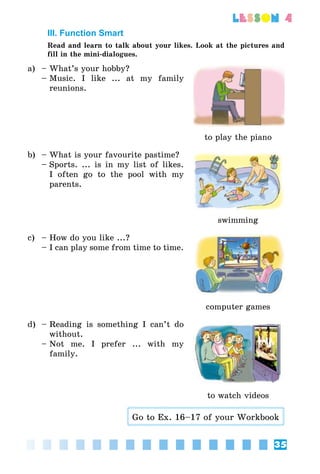
E x a m p l e:	It’s cloudy outside.
118
Unit 4
3. Read and remember!
Вживай артикль the перед іменниками, коли розповідаєш
про унікальні природні об’єкти: the Sun, the Moon, the
Earth, the sky, the ground.
E x a m p l e: The sun is bright.
Не вживай артиклю, коли розповідаєш про події, що відбу­
ваються.
Події, що відбуваються No article
– у певну пору року in autumn
– у певний місяць in September, in October, in
November
– у певну погоду in rainy weather
a) Answer the questions.
1. What season is it now?
2. What was the season before it?
3. What season will be after it?
4. What do you like to do in winter (spring/summer/autumn)?
5. What month is it now?
6. What month was before?
7. What month will be after it?
b) Read a short story and fill in the articles where necessary.
It is ... autumn now. ... sun is shining, ... sky is blue. It is
still warm in ... October. Little Kitty likes to gather mushrooms
in ... . good weather. She sees mushrooms on ... ... ground. She
wants to pick one.
Oops! It is jumping away. A squirrel!
IV. Word Smart
Study the words and word combinations (p. 119) and say:
a)	What you can see in every season.
	 E x a m p l e: We can see much snow in winter.
b)	What the weather is like in different seasons.
	 E x a m p l e: It’s cold and frosty in winter.
c)	 What you can do or like to do in every season.
	 E x a m p l e: I like to go skating in winter.
119
lesson 2
SEASONS
winter words spring words
beastly weather
snowflakes
to enjoy
skating/skiing/sledging
snowstorm
cold and frosty outside
to bloom
to break into blossom
icicles and snow
to melt
lovely weather
blossoming orchard
summer words autumn words
to sunbathe
out in the open
to go hiking
to travel abroad
to have a memorable time
to have its own charm
a great admirer of sth
to remind of school
Indian summer
At Home:
Find a picture/photo of any season in Ukraine and describe it.
V. Time to Read
1. Read the dialogue between two Ukrainian girls and say what
seasons they like most.
Go to Ex. 66–67 of your Workbook
orchard	 the woods
garden	forest
See: First Aid Kit:
Word Meaning 1, p. 238
WHAT BEASTLY WEATHER WE ARE HAVING TODAY!
Winter
Alex: 	 It’s so cold and frosty outside. I’m staying at home the
whole morning.
Helen:	Don’t grumble,Ann. LastSunday,justafterthesnowstorm,
we had much fun – we enjoyed skating, skiing, sledging,
throwing snowballs and what not.
120
Unit 4
Alex:	 So we did. There was so much sun and snow that it was a
pity to stay at home in such lovely weather. But today ... .
Helen:	Oh, stop it. In a month the snow and icicles will melt,
the weather will change for better and you’ll enjoy every
minute of spring.
Spring
Alex:	 True, true. I adore this lovely season when fruit trees
break into blossom and spring flowers bloom. A fairy tale,
just a fairy tale!
Helen:	Small wonder. Spring is the morning of the year and in
Ukraine it turns the whole country into a blossoming
orchard. But I prefer summer to all other seasons. I can
swim and sunbathe a lot, go hiking, travel abroad or just
spend all day long out in the open.
Summer
Alex:	 Agreed. We are having the most memorable time on our
summer holidays. Sometimes we even don’t notice when
autumn is on the way.
Helen:	Exactly. Only yellow and brown leaves of Indian summer
remind us of a new school year.
Across Cultures
Indian summer – бабине літо
121
lesson 2
Autumn
Alex:	 And this season also has a charm of its own: autumn
mushrooms and nuts in the forests and woods, fruits and
vegetables in the gardens and orchards ... .
Helen:	I see you are a great admirer of all the seasons, except
winter.
Alex: 	 No way. Winter is also a great season, whatever it can be
said against it.
Helen:	That’s better.
2. Fill in the missing words.
E x a m p l e:	We like to have a cup of tea in the ... (garden/
orchard). → We like to have a cup of tea in the garden.
1. It’s easy to get lost in the ... (forest/wood).
2. There is ... near our house (wood/forest).
3. In spring, when fruit trees break into blossom, our ...
(garden/orchard) is very beautiful.
4. Many people in Ukraine have big ... (orchards/gardens) near
their houses.
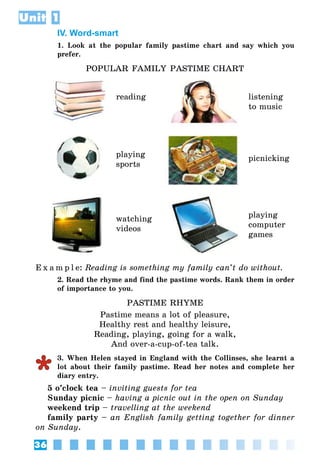
5. Have you ever been to the ... (forest/wood) and picked nuts?
6. All ... (forests/woods) are full of mushrooms in Ukraine in
autumn.
3. Read the sentences and say whose words these are and what they
mean.
E x a m p l e:	“What beastly weather we are having!” →
	 Alex says it about winter because it was cold and
frosty outside and he stayed at home.
1. “In a month the weather will change for better”.
2. “A fairy tale, just a fairy tale”.
3. “I can spend all days long out in the open”.
4. “It was a pity to stay at home in such lovely weather”.
5. “This season also has a charm of its own”.
6. “It turns Ukraine into a blossoming orchard”.
7. “I adore this lovely season”
4. Reproduce the characteristics of four seasons from the dialogue
and add 3-4 logically connected sentences.
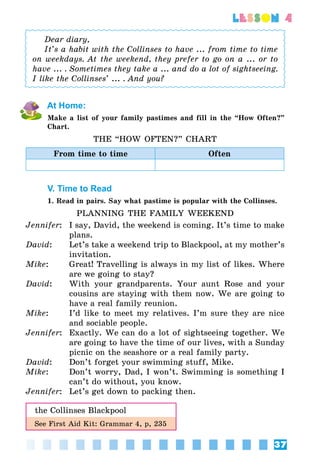
E x a m p l e:	I adore this lovely season when fruit trees break into
blossom and spring flowers bloom. I like to go out of
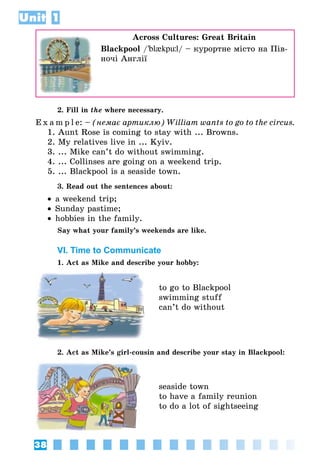
town, to look at the snowdrops, to see how birds make
their nests. The weather is warm and sunny. We can
spend all days long outside.
122
Unit 4
VI. Time to Communicate
1. Act as Alex or Helen and invite your international friends
Rachel/Bruce to come to Ukraine in the season they like most. Begin
with:
•• All seasons in Ukraine are
lovely, but ... .
•• The weather in this time of
the year ... .
•• In this season ... .
•• The season has a charm of its
own because ... .
•• You can enjoy ... .
•• Besides, you’ll have a
memorable time ... .
•• Come to Ukraine in ... and
have the time of your life.
2. Look at the photos, and describe the season. Use the words and
word combinations (p. 123).
123
lesson 2
to be out
in the open
to bloom
cold and frosty
weather
to have
a memorable
time
a lovely
season
to break
into blossom
to be a great
admirer of sth
to go hiking
to have
a charm of its
own
to enjoy
sledging
E x a m p l e:	I think it is winter in the Carpathian Mountains.
They are in the west of Ukraine. The weather is cold,
but sunny. Children enjoy sledging ... .
3. In pairs, discuss your favourite seasons in Ukraine as in the
pattern.
P a t t e r n:
A:	 What ... we are having today! It is so ... and ... .
B:	 But I prefer to ... because ... .
A:	 Agreed. When the weather ... it’s a pity ... .
B:	 True, true. But Ukraine is especially beautiful in ... when
... .
A:	 Small wonder. ... has a charm of its own.
B:	 Exactly. We can ... and ... .
A:	 I see you are a great admirer of ... , right?
B:	 Sure. I have ... .
VII. Time to Write
Write an essay about the weather and seasons where you live. Use
the plan to help you.
PLAN
Each Season Start
•• weather
•• nature
•• pastime
E x a m p l e:	I live in Zhytomir. It is in Polissya. Winter begins in
December there ... .
Go to Ex. 68–70 of your Workbook
124
Unit 4
4:3. Do you live in ...?
Word Bank Phrase Bank Communication Box
village
suburbs
exhibition
to move into a new house
many-storeyed house
to like sth much better
than ...
to have the best of two
worlds
a city lifestyle
native place
to go round with friends
That’s it.
I’m with you on that.
... and the like.
By the way ...
It takes me ... to do
sth.
I. Conversation Warm-up
Look at the photos and say where you would like to live and why.
a village a big city
a small town a farm
E x a m p l e: 	I’d like to live in a village because nature is picturesque
there.
125
lesson 3
II. Pronunciation Warm-up
Listen to/read the rhyme “A Place to Live In” and practise the
sounds /dZ/, /I/. Say where these people live. What about you and
your relatives?
A PLACE TO LIVE IN
– Where do you live?
– I live in a city.
– What about Mr Brown?
– He lives in a small town.
– What about his mum?
– She lives on a farm.
– What about the family of Ridge?
– They live in the village.
A city, a town, a farm, a village –
They all have a special image.
III. Grammar Smart
1. Read and remember!
•• Для того, щоб правильно запитати про те, чого є багато в
місті або на селі, якщо це можна порахувати (наприклад,
shops), вживай слово many: Are there many shops in your
town?
Якщо це не можна порахувати (наприклад, snow),
вживай слово much: Is there much snow in the country
in winter?
•• У позитивній відповіді вживай слова so, very, too перед
many, much, There are so many streets in the city! There is
too much noise in the cafå!
•• У заперечній відповіді вживай:
a)	few (мало), якщо предмет можна порахувати:
	 E x a m p l e: No, there are few shops here.
b)	little (мало), якщо не можна порахувати:
	 E x a m p l e: No, there is little noise in the cafå.
•• Для того, щоб сказати, що твоє місце не велике, не
маленьке, вживай: neither ... nor ... .
	 E x a m p l e: My native place is neither big nor small.
126
Unit 4
2. Let’s play a grammar chain game.
SO MUCH OR SO MANY?
schoolssnow
streets
houses trees
shops
noise
flowers
grass
cafås
water
roads
E x a m p l e:
A: ... snow 	 A: ... shops
B: so much snow 	 B: so many shops
3. Answer the questions about your house as in the example.
E x a m p l e:	A: Is your house big or small?
	 B: My house is neither big nor small.
1. Is your native place big or small?
2. Is your native place new or old?
3. Is your street long or short?
4. Are the trees in your street tall or low?
5. Is your school old or new?
6. Is the life in your place busy or quiet?
4. Look at the pictures and make up sentences about them as in the
example.
E x a m p l e:	There are so many beautiful flowers in the field!
flowers/field
water/ground
children/yard
grass/garden shops/street
127
lesson 3
IV. Word smart
Life
in a big city
Life
in a small town
Life
in a village
many-storeyed
house
suburbs
much noise
exhibition
museums
flower bed
not much traffic
peaceful and quiet
place
two-storeyed house
playground
cottage
to breathe fresh air
to eat healthy food
picturesque place
to communicate
with nature
1. Read the words and say what every place can boast of.
E x a m p l e:	There are very many interesting museums in a big
city.
2. Fill in the plus-minus chart and speak about life in different
places.
PLUS-MINUS CHART
Life in ... + –
a big city many interesting
places to see
much traffic
a small town
a village
E x a m p l e:	On the one hand, there are very many interesting
places to see in a big city.
	 On the other hand, there are many cars on the roads,
that’s why there is so much noise.
3. Read what children say about their native places and say if they
remind you of your place. Why/why not?
I’m Joanne. I like the place I live in. It is not
very big but it is beautiful and green. There
are a lot of small cottages there with big
gardens behind them. My house is situated
near the river. It’s a very picturesque place:
fresh air to breathe and healthy food.
128
Unit 4
My name is Taras. I live in the suburbs in a
two-storeyed house. It takes me an hour to
get to the centre. There are too many roads,
cars and buses there. There is also very
much noise and I don’t like it. But I like to
live there. Because there is so much to see:
museums, monuments, picture galleries,
exhibitions and what not. I can also go round
with friends.
I’m Helen. My native place is neither large
nor small. It is comfortable to live in. On
the one hand, there isn’t much traffic and
on the other – there is so much to do. For
example, there is a swimming pool, which
I often visit and my favourite library.
At Home:
Make a photo page of the place you live in and say about your
favourite places.
Go to Ex. 71–72 of your Workbook
V. Time to Read
1. Read in pairs. Say where the children prefer to live.
TALKING ABOUT PLACES TO LIVE IN
Ann:	 Hi, Steve! Where have you been? I haven’t seen much of
you lately.
Steve:	 Small wonder. I’m spending a lot of time in my granny’s
village. She moved into a new house a month ago.
Ann:	 Are there many houses in your granny’s village? Is there
much to see there?
Steve:	 It’s a small picturesque place. There are few two-storeyed
houses but there are so many small cottages.
Ann:	 Sure, there is a small river, and a green wood with lots of
flowers, mushrooms and berries there. Am I right?
Steve:	 That’s it. Besides, there is so much fresh air. I like to live
in the country much better than in town, especially in
spring and summer.
129
lesson 3
Ann:	 Really? Don’t you agree that life in the city is more
interesting?
Steve:	 I’m with you on that. There are very many places to visit:
shops, museums, exhibitions, theatres, parks and the like.
Ann:	 By the way, do you remember our English pen pal Steve?
He lives in the suburbs of London in a cosy cottage with
a small kitchen garden behind the house. He thinks he
has the best of two worlds: picturesque nature and a city
lifestyle.
Steve:	 True, true.
Across cultures: Great Britain
London – столиця Великої
Британії
Kitchen garden – місце
біля хати, де вирощу­ють
фрукти та овочі
2. In the text, “Talking about Places to Live in” find and reproduce
the sentences which mean the same.
E x a m p l e:	I haven’t seen you for ages. → I haven’t seen much of
you lately.
1. There are so many small houses.
130
Unit 4
2. I agree with you on this point.
3. There are very many places to visit: shops, museums,
exhibitions, parks and what not.
4. Steve lives in the area which is away from the centre of
London.
5. Behind the house he has a small place where he grows fruits
and vegetables.
6. Granny got a new house to live in a month ago.
3. Fill in the word forks and make up your sentences with some of
them.
river house
small a many-storeyed
place
a quiet
4. Complete the sentences from the text and add one more logically
connected sentence.
E x a m p l e:	I’m spending a lot of time ... →
	 I’m spending a lot of time in my granny’s village.
I like to live here much better than in town.
•• It is a small picturesque place with ...
•• There is much fresh air ...
•• There are many places to see in a big city, but ...
•• Life in the city is more interesting because ...
•• Bruce lives in ...
•• He thinks he has the best of two worlds ...
VI. Time to Communicate
1. Act as Ann and say why you like to live in a big city.
to enjoy a city lifestyle
to have many places to visit
to live an interesting life
to see different places of interest
to be exciting
131
lesson 3
2. Act as Steve and say why you like to live in a small village.
to enjoy picturesque nature
to like life in the village much better
to breathe the fresh air
to eat healthy food
to have a peaceful life
3. In pairs, talk about the lifestyles in different places as in the
pattern.
P a t t e r n:
A:	 Hi, ...! Where have you been? I haven’t seen much of you
... .
B:	 Small wonder. I ... .
A:	 Are there many ...? Is there much ...?
B:	 There are few ... but there are so many ... .
A:	 Sure, there is ... . Am I right?
B:	 That’s it. Besides, there is much ... . I like ... much better
than ... , especially ... ... .
A:	 Really? Don’t you agree that ...?
B:	 I’m with you on that.
VII. Time to Write
Write a description of your native place covering the following
points:
•• What part of Ukraine you live in.
•• What kind of lifestyle you have.
•• What pluses and minuses of this lifestyle there are.
•• Why you enjoy/don’t enjoy living there.
Go to Ex. 73–75 of your Workbook
132
Unit 4
4:4. People and places
Word Bank Phrase Bank Communication Box
bonfire
embroidery
whistle
open-air museum
to be the time of magic
enchanting beauty
to be still under the
impression
to be a breathtaking
experience
place number one to see
to be the second best smb
likes
brand new
to be an unforgettable
sight
I’m bursting with
news ...
... as the tradition
goes.
How lucky we are!
I. Conversation Warm-up
Look at the photos of some Ukrainian places and say where you’ve
already been to or would like to go to. Say why you want to go
there.
Chersones
Ruines
Askania-Nova
Zaporizhska Sich
Yaremche
Kolomyya
133
lesson 4
E x a m p l e:	As I’m fond of history, I’d like to go to the Chersonese
ruins. They are in the South of Ukraine, near
Sebastopol. So I can see more of the Crimea.
II. Pronunciation Warm-up
Listen to/read the “Invitation Rhyme” and practise the sounds /Î/
and /¸/. Say where in Ukraine you can go to the zoo, national parks
or botanic gardens and what you can see there.
THE INVITATION RHYME
Come along, come along, on a trip to the zoo.
We’ll see a jumping chimp and a kangaroo.
Come along, come along, on a trip to the park.
We’ll swim in a pond without a shark.
Come along, come along, on a trip to the garden.
We’ll smell two million roses.
– I beg your pardon?
III. Function Smart
Read and learn how to express admiration. Look at the pictures and
fill in the mini-dialogues.
a) – How do you like ...?
– I can’t enjoy it more.
the Pysanka museum
b) – What can you say about ...?
– Oh, it was just wonderful.
the Nikitsky
Botanic Gardens
134
Unit 4
c) Pyrohovo – What do you think of our
visit to ...?
– I can’t help admiring it.
d)
Ukrainian folk music
– What’s your opinion of ...?
– Oh, it was fantastic. I’m
a great admirer of such music.
IV. Word Smart
Getting to know Ukrainian
places
Getting to know Ukrainian
traditions
•• to be the number one place
to see
•• to be the first choice
•• to be the second best smb
likes
•• to sense the history of sth
through sth
•• a place of enchanting
beauty
•• to have a guided tour to sth
•• to be the time of magic
•• to hold a traditional fair
•• to become an unforgettable
sight
•• to be good fun to do
•• to light fireworks
•• to keep (observe) the
tradition
•• to be a breathtaking
experience
a) Read the word combinations and say what place is number one
for foreigners to visit in Ukraine and why.
E x a m p l e:	Sorochinskaya Fair is number one for many people to
see because you can learn many Ukrainian traditions
there.
b) Make as many sentences as you can about the place you want to
go to or the Ukrainian tradition you want to know about.
135
lesson 4
fantastic to learn more about Ukrainian musical
traditions
exciting to sense the history of the country
It’s amazing to see the places of enchanting beauty
good fun to have a guided tour to any open-air
museum
interesting to take part in national Ukrainian
traditions
great to light fireworks during the celebrations
E x a m p l e:	It’s fantastic to see the places of enchanting beauty.
c) Read the information charts and match them to the photos. Say
what traditions are carefully kept in Ukraine.
The open-air museum of folk architecture
and traditions should be your first
choice. It is located in a picturesque
place Pyrohovo not far from Kyiv. It has
more than 300 wooden structures from
different regions of Ukraine from the
16th
to the 21st
century.
Ukraine is called a truly musical nation
and annual festivals of Ukrainian folk
music in the Carpathians prove it.
One can listen to extraordinary kobza,
bandura, buben, tsymbaly and trembita,
of course; see young people performing
Kolyadky in a passionate way. It is the
time of magic!
Askania Nova National Preserve is a zoo,
a Botanical garden and the largest area
of steppe in Ukraine. It is a landscape
of enchanting beauty and an important
research centre for wildlife.
136
Unit 4
The Cradle of Zaporizke Cossatstvo is
known far and wide.One can sense the
history of Zaporizhian Sich through
Khortytsya, the largest island on the
Dnipro River.
The national Ukrainian exhibition of
toys is your first choice in Ukraine.
There are toys made of natural material
(straw, wood and clay) and various
typical Ukrainian dolls: motankas, rag
dolls and modern dolls.
E x a m p l e:	I think that the open-air museum of folk architecture
and traditions in Pyrohovo keeps the historical
traditions of Ukraine. It shows how people lived in
different times. It also presents a village lifestyle.
At Home:
Choose any interesting place you want to take your international
friends to visit in Ukraine. Present it to your class and explain your
choice.
Go to Ex. 76–77 of your Workbook
V. Time to Read
1. Read in pairs and say what Ukrainian traditions celebrations
your international friends took part in.
AFTER A GUIDED TOUR OF UKRAINE
Ann:	 How lucky we are! We’ve made such a great tour.
Steve:	 Exactly. It was the time of magic. We saw so many places of
enchanting beauty and even took part in some traditional
celebrations. A lot to talk about at school, right?
Ann:	 True, true. I am still under the impression of Kupala
celebrations: dancing around marena and singing Kupala
songs. I couldn’t enjoy more.
Steve:	 And how do you like jumping over the bonfire?
137
lesson 4
Ann:	 Oh, it was a really breathtaking experience. Frankly
speaking, I felt scared at first, but the second and the
third jumps were really wonderful. It was an unforgettable
sight!
Steve:	 We did it safely so we must be lucky as the tradition goes.
Ann:	 I hope so. And what do you think of Sorochynska Fair?
Steve:	 Oh, it was the second best I liked. I could not only see
extraordinary hand-made things but learn how to make
them. Look, I’ve made a clay whistle myself.
Ann:	 Fantastic! As I’m a great admirer of embroidery, I’ve
bought an embroidered towel or rushnyk, with a nice
floral design. They say it is a symbol of wedding. My
cousin Andrew on my mother’s side is going to marry
soon so it’ll be a good present for the wedding, don’t you
think?
Steve:	 A national gift from Sorochynska Fair is sure to bring
luck.
Across cultures: Ukraine
•• свято літнього сонця, який свят­
кується 7 липня за Юліанським
календарем
•• лялька в людський зріст, зроблена
з соломи – символ свята Купала
•• Сорочинський ярмарок – один з
найвідоміших ярмарків в Україні,
що відбувається в селі Великі Со­
рочинці Миргородського району
на Полтавщині
Kupala
Marena
Sorochyntsi Fair
138
Unit 4
2. Read the words and use them to tell about the friend’s travelling
experience.
Adjective Noun Verb Noun
beautiful
traditional
successful
magic
impressive
lucky
beauty
tradition
success
magic
impression
luck
to guide
to tour
to visit
to admire
to jump
to whistle
a guide
a tour
a visit
an admirer
a jump
a whistle
E x a m p l e:	The friends made a grand tour and saw many places
of enchanting beauty.
3. Look at the pictures and say where your international friends
saw them and what new information they learned about them.
E x a m p l e:	Ann and Steve visited Sorochynska Fair on holiday.
They saw many extraordinary handmade things there
and Ann bought an embroidered towel – a symbol of
wedding for her cousin.
139
lesson 4
VI. Time to Communicate
a) Act as Ann and say what traditions you have experienced.
to be the time of magic
to be a breathtaking experience
to jump over the bonfire
to take part in celebrations
to be under the impression
b) Act as Steve and describe your impressions of Sorochynska Fair.
to be the second best smb likes
to hold a traditional fair
to exhibit extraordinary handmade
things
to make a clay whistle
to be good fun to do sth
c) In pairs, discuss your tour of Ukraine and express your admiration.
Use the pattern.
A:	 How lucky we are! ... .
B:	 Exactly. It was the time of magic and ... . A lot to talk
about at school, right?
A:	 True, true. I couldn’t enjoy ... .
B:	 And how do you like ...?
A:	 It was a really breathtaking experience. Frankly speaking,
... .
B:	 And what do you think of ...?
A:	 It was the second best I liked. ... .
B:	 Fantastic! As for me, ... .
VII. Time to Listen
Listen to the children’s international friends talking about their
visit to Ukraine. Choose the pictures which belong to Ann’s or
Steve’s story.
140
Unit 4
1 2 3
4 5 6
VIII. Time to Write
Plan a guided tour round Ukraine for your international friends.
Use the following plan:
•• to go?
•• to see?
•• to learn?
•• to take part in?
Go to Ex. 78–80 of your Workbook
141
lesson 5
4:5. My progress in English
I. Grammar Smart
Fill in few/little/much/many in the following sentences.
1. You can see ... schoolchildren on September 1.
2. There is ... snow in the Carpathian Mountains in winter.
3. The lake is nearly dry, there is ... water in it.
4. There are ... beaches in the Crimea.
5. ... people can swim in the Black Sea in such cold weather.
6. There was ... rain in our region last summer.
Check if you:
can use these words correctly.  
(Yes/No)
II. Word Smart
Build word forms where possible.
a) noun verb
to jump
admirer
to whistle
success
b) noun adjective
beautiful
guide
success
historical
Check if you:
can build different word forms.
(Yes/No)
142
Unit 4
III. Function Smart
Match the questions to the answers.
1. How do you enjoy the
trip?
a) It was wonderful, especially
ancient halls.
2. What can you say about
the museum?
b) Oh, I’m a great admirer of
old customs and I like it a lot.
3. What’s your opinion of
the embroidered shirt?
c) Oh, it’s fantastic! I’ve seen
such a pattern in the towels,
but not on clothes.
4. What do you think of
these rare plants?
d) I can’t enjoy it more.
5. How do you like the
tradition?
e) I can’t help admiring them.
IV. Time to Read
Read the story “Young at Heart” and mark the true statements.
YOUNG AT HEART
Artek is the oldest and the most beautiful International
children’s centre on the southern coast of the Crimea. It was
founded in 1925 near the town of Gurzuf and immediately became
very popular.
Now it consists of ten camps of different shapes and sizes. It
has many green parks and beaches. Its territory stretches from
Mount Aiu-Dag all the way to Genoese Rocks and the ruins of the
ancient fortress.
Children have the time of magic travelling by bus or taking a
boat trip out to sea.  
It is good fun to explore the world from the top of Mount Aiu-
Dag (also known as Bear Mountain, which is an unforgettable
sight), go hiking to extraordinary places or just discovering
science at Artek’s space exhibition and TV studio.
Every day you socialize with your friends and learn from one
another. You also meet famous people from the world of sport,
science or art. But the highlight of your stay in Artek is the
campfire by which you care and share until after dark.
STATEMENTS
1. Artek is situated on the western coast of the Crimea.
2. Artek has big and small camps of different shapes.
143
lesson 5
3. Mount Aui-Dag has also another name.
4. Children enjoy travelling by train.
5. There are different museums and galleries on the territory
of Artek.
6. The campfire is the most memorable time for all children.
Check if you:
can read information about your country
and understand the main points.
(Yes/No)
V. Listening
Listen to Helen’s talk with her international friend and complete
the sentences.
1. And are you from ...?
2. I’ve come from Lviv, which is the ... of Ukraine.
3. I visited Lviv last year and was greatly impressed by this
very ancient ... .
4. There are many beautiful places in Ukraine, especially in
the South, which is washed by the ... .
5. I read about ... where the International children’s camp
Artek is situated.
6. This place is famous for its climate because the sea and the
... mountains create special healthy climatic conditions.
Check if you:
can listen to the dialogue and understand
the details.
(Yes/No)
VI. Time to Write
Write a letter to your international friends and invite them to come
to your country.
Check if you:
can write a letter of invitation.
(Yes/No)
Go to your WB, Cross-cultural Workshop 4
144
Unit 5
Unit Five: School Life
5:1. My school timetable
Word Bank Phrase Bank Communication Box
to adore
immigrant
contest
once
twice
to learn sth new
to become sth new
to stand for sth
to come across sth
to train one’s body
to have a good head
for sth
Am I right?
... can’t wait to do sth.
... , don’t you think?
Now I understand.
Poor guess.
I. Conversation Warm-up
Look at Ann’s timetable and compare it to yours.
ANN’S TIMETABLE
Monday Tuesday Wednesday Thursday Friday
Math Literature English Science Chinese
PE Arts Algebra Literature Science
English Chinese PE History Arts
History Information
Technology
Geography Information
Technology
Math
E x a m p l e:	Ann has Chinese lessons and I have English lessons.
II. Pronunciation Warm-up
Listen to/read the timetable rap and practise the sound /e/. Say if
the timetable is OK for Grade 5.
THE TIMETABLE RAP
Math on Monday,
Technology on Tuesday.
World Literature on Wednesday,
Science on Thursday,
Arts on Friday,
Fun on Saturday.
Hooray!
145
lesson 1
III. Grammar Smart
1. Look and recall!
BrE Maths
AmE Math
once a week = one time a week
twice a week = two times a week
three times a week, four times a week
•• Play a grammar question game.
STEVE’S TIMETABLE
Math Monday, Friday, Wednesday, Thursday
Music Tuesday
Art Thursday
English Monday, Wednesday, Friday
History Wednesday, Thursday
Science Tuesday, Thursday
E x a m p l e:	A:	How often does Steve have Maths lessons?
	 B:	Four times a week. How often does he have music
lessons?
	 A:	Once a week ... .
2. Read and remember!
Too many / too much More than we need
A few / a little Some
Few / little Almost none
Several More than a few but not a lot
Для того, щоб правильно сказати, чого є багато або мало у
шкільному житті, вживай:
a) many, a lot of, a few, few and several з іменниками у
множині:
E x a m p l e:	There are so many new subjects on the timetable!
b) much, lot of, a little, little з незліченними іменниками
в однині:
E x a m p l e:	There is so much work to do!
c) many / much та інші + of перед займенниками та
артиклями:
E x a m p l e:	Several of my classmates have changed schools.
146
Unit 5
3. Fill in of where necessary.
E x a m p l e:	Many ... the subjects in Grade 5 are going to be
new. →
	 Many of the subjects in Grade 5 are going to be new.
1. We are going to study many ... subjects.
2. It is much ... work.
3. We are going to do much ... the work in Information
Technology class on the computer.
4. There are several ... new pupils in my class.
5. I have already met several ... them.
4. Paraphrase the sentences as in the example.
E x a m p l e:	I’ve got some very interesting subjects in Grade 5. →
I’ve got a few very interesting subjects in Grade 5.
1. I speak some French.
2. We have almost no time left before the bell.
3. I think we have more lessons of math than we need.
4. Almost none of the pupils likes this lesson.
5. I need some help.
6. The teacher reminded me about the home task more than a
few times, but I forgot.
IV. Word Smart
Learn something new – become something new.
Lessons Actions Objects Mind and
character
Math
English
Ukrainian
Literature
Physical
Education (PE)
Music
Arts
to count
to communicate
to write
to read
to train
to sing
to draw
numbers
letters
dictations
poems
body
songs
pictures
logical
sociable
literate
well-read
strong
musical
creative
a) Read the words in each line of the chart and say:
•• What you do at these lessons.
•• What you learn about.
•• What kind of person you become.
E x a m p l e:	At math lessons I count. I learn about numbers.
I become logical.
147
lesson 1
b) Look and say what these children usually do at their favourite
lessons to become something new.
I am
strong and
healthy.
I am sociable
and well-read.
I am logical
and computer-
literate.
I am
musical and
creative.
E x a m p l e:	Alex is strong and healthy because he usually trains
his body at PE lessons.
c) Look at the photos and complete the American teacher’s saying
about school subjects.
Most students in American schools enjoy ... .
In ... class students learn how to ... .
American students love their ... lessons
because ... .
They say it’s fun to ... at ... lessons. Students
often ... .
At Home:
Fill in your timetable and write how often you have your favourite
lessons.
Go to Ex. 81–82 of your Workbook
148
Unit 5
V. Time to Read
1. Read in trios. Say what the children expect to learn this school
year.
TALKING ABOUT SCHOOL TIMETABLE
Steve:	 Look, girls, there are so many new subjects in the timetable
this year!
Helen:	Wow! Information technology, history, French – so much
work!
Ann:	 Don’t worry. It is so exciting to learn something new,
don’t you think?
Steve:	 Speaking of learning something new, what does EFL mean?
I have just come across it somewhere on the timetable.
Ann:	 It just stands for English as a foreign language. But my
American friend sometimes mentions ESL as a school
subject in her emails.
Helen:	She does! I wondered about it, too. What’s that?
Ann:	 English as a second language for immigrants’ children in
the USA.
Steve:	 Now I understand. But I like PE much better. I can train
my body and become stronger and stronger.
Helen:	We have PE lessons twice a week, but music is only once
a week.
Ann:	 I know you adore music. You were a member of the dancing
group last year, weren’t you?
Helen:	Yes, we took part in the dancing contest and won. And
your favourite subject is going to be history. Am I right,
Ann?
Steve:	 Poor guess! I know Ann has a good head for languages. So
she is going to enjoy French lessons four times a week.
Ann:	 Sounds interesting. I can’t wait to learn a new foreign
language.
PE
EFL
ESL
See First Aid Kit:
Word Building 5, p. 237
2. In the text “Talking about School Timetable”, find the subjects
which the children are going to have: once a week (twice a week,
four times a week).
149
lesson 1
3. Read out of the text about:
•• learning languages;
•• preferences in studies;
•• learning outcomes.
Say what attitude to learning you have.
VI. Time to Communicate:
1. Act as Ann and say if you are happy with your timetable.
to be exciting
to have a good head for sth
to take part in sth
to learn sth new
to come across sth
2. Act as Steve and describe your favourite parts of the timetable.
to adore sth
to enjoy sth
to be a member of sth
to train one’s body
to become stronger
3. In pairs, discuss your interests in new subjects as in the pattern.
P a t t e r n:
A:	 Look, ... , there are so many ... .
B:	 Wow! ... – so much work!
A:	 Don’t’ worry! It is so exciting ... , don’t you think?
B:	 I like ... much better. I can ... .
A:	 I know you adore ... , and your favourite subject is ... .
Am I right?
B:	 Good guess! I am going to enjoy ... a week.
A:	 I can’t wait to ... . I think I have a good head for ... .
B:	 Sounds ... .
150
Unit 5
VII. Time to Listen
a) Listen to six people talking at school and say where exactly they
can be.
In the computer room
In the library
1 In the school cafeteria
In the gym
In the English classroom
In the Assembly hall
b) Fill in the gaps.
1. The pudding is so ...! Can I have some ... , please?
2. Can I borrow this book for a ...?
3. I’m ... , this computer is out of order.
4. Will you ... me to switch on the CD player, please?
5. Attention, everybody! The basketball ... begins in five
minutes.
6. Look! There are some ... on the stage. They are dancing.
VIII. Time to Write
Compose a timetable of your dream and write your reasons.
E x a m p l e:	Reason 1. I think it is so exciting to have Art lessons
four times a week. I am learning to be creative.
Go to Ex. 83–85 of your Workbook
151
lesson 2
5:2. At the English lesson
Word Bank Phrase Bank Communication Box
sociable
global
to have a good command
of sth
to develop one’s skills
to feel uneasy
to type a message
to send sth by e-mail
For instance, ...
Time flies ...
Frankly speaking, ...
I. Conversation Warm-up
In pairs, look at the words and discuss the things you do at your
English lessons.
roleplay
dialogues
do rhythmic
exercises
read stories
sing English songswrite letters
listen to fairy tales
watch videos
describe pictures
E x a m p l e:	We read interesting stories at our English lessons.
II. Pronunciation Warm-up
Listen to/read the English lesson chant and practise the sound
/jü/. Answer the questions of the chant.
THE ENGLISH LESSON CHANT
Do you often have your English?
Yes, I do.
Yes, I do.
Do you always use computers?
Yes, I do.
Does your teacher play the music?
Does she tell you any stories?
Does she sometimes draw you pictures?
Yes, she does.
Yes, she does.
152
Unit 5
III. Grammar Smart
1. Look and recall!
Для того, щоб правильно переказати, хто що каже
про теперішній час, вживай теж теперішній час, але у
відповідній особі.
Direct Speech Ann says, “I adore English”.
Indirect Speech Ann says that she adores English.
•• Play a grammar chain game.
E x a m p l e:	A:	I like to learn foreign languages.
	 B:	What does Ann say?
	 C:	She says she likes to learn foreign languages.
	 D:	I can read fairy tales in English. ...
2. Read and remember!
Для того, щоб правильно переказати, хто що сказав про
теперішній час, дотримуйся узгодження часів, тобто замість
дієслова у теперішньому часі вживай дієслово у минулому
часі.
Direct Speech Ann said, “I adore English”.
(Present Simple)
Indirect Speech Ann said that she adored English.
(Past Simple)
3. Tell your friends about it as in the example:
E x a m p l e:	My teacher said, “I want to help you develop your
writing skills”. →
	 My teacher said that she wanted to help me develop
my writing skills.
1. My deskmate said, “Time flies at the English lesson”.
2. My mother said, “All things are difficult before they are
easy”.
3. Steve said, “ I like PE much better”.
4. Helen said, “I am a member of the dancing group”.
5. Steve said, “I can send you e-mail messages from time to
time”.
6. Ann said, “I study French at school”.
153
lesson 2
4. Say the same about yourself now.
E x a m p l e:	You said that you could communicate with your
friends in English. →
	 I can communicate with my friends in English.
1. You said that you had a good head for languages.
2. You said that you liked to role-play dialogues at your
English lessons.
3. You said that you sometimes had your English lessons in
the computer lab.
4. You said that you could type a message in English.
5. You said that you liked to communicate with your English
teacher a lot.
IV. Word Smart
1. Study these words and describe:
•• your activities at the English lesson;
•• your feelings about language studies.
English lesson activities Feelings about
language studies
•• to understand cartoons
•• to read fairy tales
•• to write personal letters/greeting cards
•• to communicate with smb in English
•• to role-play the dialogue
•• to type a message
•• to send an e-mail
•• to play a language game
•• to adore sth
•• to be fantastic
•• to have a good
command of
English
•• to be a sociable
person
•• to feel uneasy
E x a m p l e:	We often communicate with our teacher in English.
2. Fill in the word forks and use the word-combinations to describe
the picture (p. 154).
cartoons a personal letter
to understand a greeting card
a message
easy texts
to feel stories
fairy tales
poems
154
Unit 5
3. Answer the questions about your English lesson.
– What do you usually do at your English lesson?
– What English lesson do you call ‘unusual’?
– What language learning activity is absolutely fantastic to
you?
– What helps you to have a good command of English?
– When do you feel uneasy at the English lesson?
At Home:
Make a list of what you have listened to/read/talked about/written
at your English lesson this week.
Go to Ex. 86–87 of your Workbook
V. Time to Read
1. Read Ann’s description of her English lesson and say what makes
it interesting to learn foreign languages.
MY ENGLISH LESSON
They say I have a good head for foreign languages – English
and French. I started to learn English four years ago. I adore this
language and have a good command of it. I can already understand
something in English – cartoons, “Horton”, for instance, read
fairy tales – “The Wizard of Oz” is my favourite, – write personal
letters and greeting cards, and communicate with my classmates
in English.
My teacher of English is a very sociable person. She helps us
to develop our speaking and writing skills. We often role-play
dialogues, sing English songs and play language games. Time
flies at our English lesson.
155
lesson 2
Yesterday, we had an unusual English lesson – guess where? –
in the computer lab. We typed messages to our international
friends from Rugby school and sent them by e-mail. My teacher
said that we were in a truly global classroom. It was fantastic!
Today I had my first lesson of French. Frankly speaking, I felt
uneasy because French sounds so different. My French teacher
says that all things are difficult before they are easy.
I hope that my experience in learning English will help me
with my French.
Across Cultures
“Horton” – популярний американ­
ський мультфільм про життя доброго
слона та звірів у джунглях
“The Wizard of Oz” – дуже популярна
дитяча книга автора Френка Баума
та та її голлівудська екранізація
Rugby School – відома незалежна
школа у місті Rugby, графство
Warwickshire
2. In the text “My English Lesson”, find the sentences or their parts
similar in meaning to the following.
E x a m p l e:	I like the English language very much. →
	 I adore this language.
1. I can talk with my classmates in English.
2. Our English teacher is a communicative person.
3. She teaches us to speak and write.
4. We often make up dialogues.
5. I didn’t feel good at the French lesson.
3. In the text “My English Lesson”, find the nouns which go well
after these verbs and make up sentences with them.
Use: to read, to play, to write, to type, to sing, to send, to
role-play, to learn.
E x a m p l e:	to understand ... cartoons
4. Give illustrations as in the example.
E x a m p l e:	I have a good command of English: → I can understand
156
Unit 5
English cartoons, communicate with my friends and
write letters in English.
1. Our teacher helps us to develop our speaking skills: ...
2. We had an unusual English lesson yesterday: ...
3. I felt uneasy at my first lesson of French ...
4. Time flies at our English lesson: ...
5. All things are difficult before they are easy: ...
VI. Time to Communicate:
1. Act as Ann and say how much you enjoys your English lesson.
time flies ...
to adore sth
to have a good command of sth
to sing songs
to play games
2. In pairs, role-play the conversation between you and one of your
classmates about your English lessons.
P a t t e r n:
A:	 Look here, ... you have a good command of English. Where
... , I wonder?
B:	 I adore ... . They say I have a good head for ... .
A:	 What can you ...?
B:	 I can already ... , ... – and ... in English!
A:	 It’s fantastic! And what helps you ...?
B:	 Oh, twice a week we ... and ... .
A:	 Frankly speaking ... because ... . But my teacher says that’s
all things are difficult.
B:	 Exactly.
VIII. Time to Write
You had a chance to attend an English lesson. Write about your
impressions. Use the plan:
•• The beginning of the lesson.
•• Activities at the lesson.
•• The teacher’s and pupils’ communication.
•• Pupils’ attitude to learning a foreign language.
•• Your feelings about the lesson.
Go to Ex. 88–90 of your Workbook
157
lesson 3
5:3. In between the classes
Word Bank Phrase Bank Communication Box
illustrator
project-maker
scanner
to do puzzles
theme park
to design a web page
to win the first prize
to be good at sth
to print sth out in
colour
(not) to waste time
As usual ...
Thank goodness!
How about ...?
It sounds like ...
I bet ...
I. Conversation Warm-up
Mime what you normally do after classes. Let your classmates guess
and say if they do the same.
II. Pronunciation Warm-up
Listen to/read the computer fun rhyme and practise the sounds /ü/
and /ö/. Say what you think of the boy’s after-school activity.
THE COMPUTER FUN RHYME
Little Roy Scooter
has bought a computer.
Give him another
to match the other
and he will play on two.
III. Grammar Smart
1. Look and recall!
SOME ANY
I can take some pictures for
the project.
Can you take any pictures for
the project?
2. Play a grammar agreement game.
E x a m p l e:	A: Can you print out any pictures in colour?
	 B: Sure I can print out some.
to create
web pages
to draw funny
pictures
to take part in
competitions
to post
comments
158
Unit 5
3. Read and remember!
Для того, щоб правильно розповідати про когось, вживай
займенники someone / somebody, anyone / anybody, no one /
nobody.
E x a m p l e:	Someone / somebody is at the door.
	 Has anyone / anybody won the first prize?
	 No one / nobody must waste time.
Для того, щоб правильно розповідати про щось, вживай
займенники something / anything / nothing.
E x a m p l e:	I have something to tell you.
	 Have you got anything to say?
	 Nothing happened yesterday.
a) Choose the right word.
E x a m p l e:	I don’t have ... (some / any) plans for the afternoon. →
I don’t have any plans for the afternoon.
1. We will do ... (some / any) after classes.
2. Helen can draw ... (some/ any) funny pictures.
3. Steve has never taken part in ... (some /any) competitions.
4. ... (Anyone / no one) won the first prize.
5. Everyone has ... (something / nothing) to do for the project.
b) Complete Steve’s e-mail with pronouns.
Dear friends,
I haven’t heard from you for some time. I hope ... wrong
has happened, you are just too busy. I have ... to tell you:
I am going to do ... travelling soon. I am going to come to
Ukraine and stay for ... days there. Perhaps we will do ...
special together.
Have you got ... travelling plans? Write to me soon.
Steve
IV. Word Smart
Things and plans for
after-classes activities
After-classes activities
•• music
•• cartoons
•• outings
•• web page
•• doing sports (swimming,
running, jogging)
•• playing sports games:
football, basketball
159
lesson 3
•• TV and video
•• theatre
•• cinema
•• school clubs
•• theme parks
•• playing computer games
•• making projects
•• creating something new
•• spending time out in the open
•• doing puzzles
1. Study these words and phrases and describe:
•• what different things you and your friends can do after
classes;
E x a m p l e:	My friends and I can choose between an outing and
a school club.
•• what you did after classes last week.
E x a m p l e:	As it rained a lot last week, I stayed at home and did
puzzles.
2. Read the notices and choose an after-school activity for yourself.
Let’s have
an international
evening!
A baseball game!
Don’t miss your
chance!
Welcome to the
English-speaking
club!
E x a m p l e:	My choice is the baseball game as I am interested in
American sports.
3. Interview your classmates and ask:
•• What they like to do after classes?
•• Where they like to spend their free time after classes?
•• Whom they share their after-school activities with?
Present your findings to the class.
E x a m p l e:	I’ve found out that Nina likes to do swimming after
classes. She goes to the swimming pool three times
a week. Her friends Nelly and Ann share Nina’s
interests.
At Home:
Keep a record of all the after-school activities in which you are
taking part this week and rank them in order of importance.
Describe one of them.
Go to Ex. 91–92 of your Workbook
160
Unit 5
V. Time to Read
1. Read in trios and choose the best title for the children’s project.
Give reasons for your choice.
1. Spending Time Together
2. Unforgettable Impressions
3. Enjoying Nature!
Ann:	 I say, Helen, are you going to join me in the swimming
pool after classes? We can do a lot of swimming, as usual.
Helen:	Not today, I’m afraid. I must get ready for my music
lesson. I have them 3 times a week, you know.
Steve:	 Thank Goodness, I’ve found you, girls. I have something
to tell you.
Ann:	 I hope it is not about football again. You seem to be crazy
about it.
Steve:	 Poor guess! How about taking part in a project competition?
We can design a web page about our favourite outings.
Helen:	It sounds like a lot of fun.
Ann:	 I bet, you like this idea, Steve, right?
Steve:	 Sure. It’s interesting to create something new and to show
what we can do, don’t you think?
Helen:	I do. How do you like the idea of creating a web page
about our favourite pastime out in the open?
Ann:	 Sounds good.
Helen:	I know, Ann, that you can take good pictures. Last year
your photo “Rafting in Wales” won the first prize at our
school competition.
Ann:	 Glad you remember it. I can be a photographer and take
some nice pictures for our project.
Steve:	 Since Helen is very good at drawing, she can draw some
funny pictures.
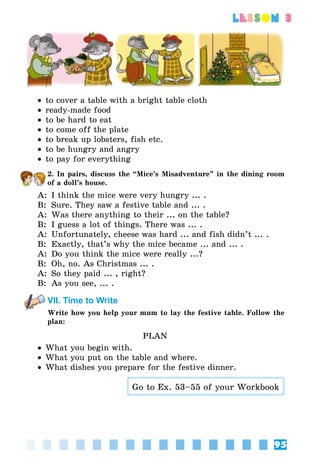
Helen:	I don’t mind being an illustrator, but I think cartoons are
much better for this. And you, Alex, have a good head for
information and computer technologies. Can you design
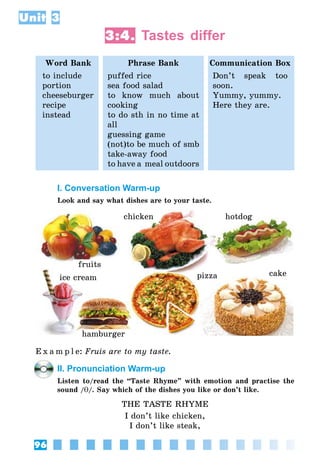
our web page on the computer?
Steve:	 I’ll try. I know how to use the scanner and do the design.
Ann:	 Great! Our ICT teacher can help to print out the whole
page in colour.
Helen:	It is going to be a nice project, I believe. Steve is a good
designer and we are good project makers.
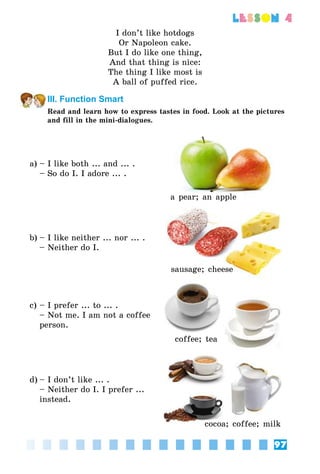
Ann:	 We mustn’t waste time. Let’s get started.
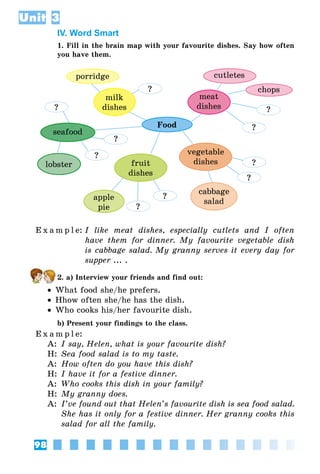
161
lesson 3
ICT
See First Aid Kit:
Word Building 5, p. 237
2. In the text “Talking in between the Classes”, find the nouns
formed from these verbs and translate the sentences with them.
E x a m p l e:	to write → writer
1. to design → 	 	 3. to illustrate →
2. to photograph → 	 4. to make (a project) →
3. Complete the sentences as in the text.
E x a m p l e:	It is interesting to create something new.
1. Since Helen is very good ... .
2. She likes ... much better than ... .
3. Steve has a good head for ... .
4. He can ... .
5. The children’s ICT teacher can ... .
6. It’s going to be ... .
VI. Time to Communicate:
1. Act as Ann and describe your plans for the time after classes.
to join smb
to do a project
to win the first prize
to take pictures
to print sth out in colour
Across Cultures
Wales – частина Великої Британії
162
Unit 5
2. Act as Steve and describe the way you are going to do your
project.
to design a web page
to take part in sth
to be good at sth
to use the scanner
(not) to waste time
3. In pairs, discuss your after-school activities. Use the pattern.
P a t t e r n:
– I bet ... right.
– Sure. It’s interesting ... . How do you like ...?
– It sounds ... . I know ... and you can ... .
– Exactly! Since you are good at ... What about?
– I don’t mind ... ... has a good head for ... and ... .
– Great! It’s going to be ... .
– We mustn’t ... . Let’s ... .
– Sure. ... . I believe ... .
VIII. Time to Write
Write a short essay about your after-school activities. Cover the
following questions:
•• What activities are the most popular with fifth-grades?
•• What are your favourite activities?
•• How often do you take part in them?
•• Who do you like to share your activities with?
Go to Ex. 93–95 of your Workbook
163
lesson 4
5:4. In the computer room
Word Bank Phrase Bank Communication Box
stuff
search e-pal
lab e-mail
message
computer skills
computer literate
brand-new
to become addicted
to set the time
limit
It is easier said than
done.
If I can do it, you can
do it too.
I know what you mean.
I. Conversation Warm-up
Look at the photos and describe the computer room in action.
computer
skills
computer
search
To send e-mail
messages
E x a m p l e:	The children are practicing their computer skills.
II. Pronunciation Warm-up
Listen to/read the interview with a computer user and practise the
sound /Î/. Say what else you can use the computer for.
INTERVIEW
What can we use our computers for?
For schoolwork and playing,
For searching and sharing,
For emails and chatrooms,
For making new friends.
164
Unit 5
III. Function Smart
Read and learn to express preferences in computer activities. Look
at the pictures and fill in the mini-dialogues.
1.
2.
3.
4.
– What about playing ...?
– I prefer ... to ... .
– Let’s find this information in the ... .
– Fantastic! It is just my choice.
– I want ... to my e-pals, but I have no idea
how to do it.
– It’s just a piece of cake. If I can do it, you
can do it, too.
– ... is so exciting!
– I don’t think so. I like ... much better.
Use: a racing game/an adventure game, talking in Skype,
to send e-mail messages, Internet.
IV. Word Smart
Study these words and describe:
1. The role of computers in your life:
... computer literate?
... computer skills?
... computer addict?
E x a m p l e:	Everyone is computer literate these days. Me, too.
2. The computer room in your school:
monitor
mouse
printer
scannerwi-fikeyboard
165
lesson 4
E x a m p l e:	The computer room is well-equipped ... .
3. A new computer user:
to have no idea how ...
to show how ...
to be difficult ...
At Home:
Compare your preferences in computer activities with those of your
friend’s. Fill in the preference chart.
THE PREFERENCE CHART
Computer activities You Your friend
1. doing school work
2. typing messages
3. sending e-mails
4. searching for information
5. playing computer games
6. ...
+ –
Go to Ex. 96–97 of your Workbook
V. Time to Read
1. Read in pairs. Say what computer skills the children have.
TALKING ABOUT COMPUTER SKILLS
Steve:	 Hi, Helen. Where are you going?
Helen:	To the computer room. I want to do some information
search in the Internet.
Steve:	 Do you know much about computers?
Helen: 	Sure. Everyone is computer literate these days. Why do
you ask?
Steve:	 I have some good news: my parents have just bought me a
brand new iPad. It is my choice. It works so fast and it is
so easy to carry. Here it is.
Helen:	Wow! It is so exciting! Now you can use it everywhere
for school work, playing games, sending messages and
making new friends, right?
166
Unit 5
Steve:	 Certainly. At the click of the mouse I can get any
information from the Internet in class and out of class.
Helen:	But there are all kinds of stuff there. That is why it is
so important to be safe, wise and responsible computer
users. Besides, it isn’t a very good idea to spend too much
time with the computer.
Steve:	 I know what you mean. The more time you spend with the
computer, the more addicted you become.
Helen:	As for me, I prefer to set the time limit for myself – just
one hour a day.
Steve: 	It is easier said than done.
Helen:	If I can do it, you can do it, too.
stuff
staff
See First Aid Kit: Word meaning 3, p. 239
2. Fill in stuff or staff.
E x a m p l e:	There are all kinds of ... in the Internet. → There are
all kinds of stuff in the Internet.
1. The ... in the computer lab are very helpful.
2. What kind of ... do you like to read?
3. The ... room is a room for teachers in a school.
4. All the teaching ... are women in our school.
5. There is a lot of interesting ... in the computer room.
3. Read out the sentences about and say what you can do on the
computer.
•• the plus side of computers;
•• their minuses.
VI. Time to Communicate:
1. Act as Ann and describe your computer room.
computer skills
to do some information search
computer user
to set the time limit
to send messages
167
lesson 4
2. Act as Steve and say if you are a computer addict.
to spend too much time with the
computer
to get information from the Internet
at the click of a mouse
to use sth for school work
3. In pairs, talk about your computer skills as in the pattern.
P a t t e r n:
A:	 Hi, ... , where ...?
B:	 To the computer ... I want ... .
A:	 Do you know much about ...?
B:	 Sure. Everyone is ... Why do you ask?
A: 	I have some good news: ... .
B:	 Wow! Now you can ... , right?
A:	 Certainly. At the click of the mouse I can ... .
B:	 But there are ... .
A:	 I know what you mean.
VII. Time to Listen
Listen to Helen talking about her brand-new computer and say
what she uses it for.
VIII. Time to Write
Write a paragraph about how the computer can help you to learn
English. Begin with:
•• I have some good news: ...
•• It is so ...
•• Now I can ...
•• At the click of the mouse ...
•• But there are ...
•• That is why ...
•• Besides, ...
•• All in all, ...
Go to Ex. 98–100 of your Workbook
168
Unit 5
5:5. My progress in English
I. Grammar Smart
Report the children’s words.
1. Steve said, “At the click of the mouse, I can get any
information from the Internet in class and out of class.”
2. Ann said, “I can already understand something in English.”
3. Helen said, “I want to do some information search in the
Internet.”
4. Steve said, “We are not experienced computer users yet.”
5. Ann said, “If I can do it, you can do it, too.”
Check if you:
can report other people’s words.
(Yes/No)
II. Word Smart
Fill in the prepositions where necessary.
1. We have PE lessons twice ... a week.
2. We took part ... the dancing contest and won.
3. My French teacher says that all things are difficult ... they
are easy.
4. Helen is very good ... drawing.
5. We usually have a meeting ... our Technology club in the
afternoon.
Check if you:
know school words.
(Yes/No)
169
lesson 5
III. Function Smart
Match the beginnings and the endings.
Beginnings Endings
1. I prefer sport games
2. I like English
3. It is just
4. It is just a
5. I have a good
a) much better.
b) piece of cake.
c) to computer games.
d) head for computers.
e) my choice.
Check if you:
can express your preferences.
(Yes/No)
IV. Time to Read
Read the story “Simple Arithmetic” and correct the underlined
parts of the sentences below.
SIMPLE ARITHMETIC
Dear father,
Well, the exams are over. I got a C in English because I
don’t know how to spell. In Science, Math, and Latin I got As,
and in French and history I got a B plus. This makes me first
in the class, which doesn’t mean very much. I know I have to
work and harder. Do you want me to come to New York for the
Easter vacation, or shall I just stay here and get a rest?
Love, Stephen.
Dear Stephen,
I’m so pleased with the examination results. Congratulations!
Practise your spelling and our worries will be over.
Love, Father.
1. It was summer time.
2. English grammar is Stephen’s weak point.
3. All his classmates are very clever.
4. Stephen is the last in his class.
5. His father is unhappy with the exam results.
170
Unit 5
Check if you:
can read and understand a short story about
school.
(Yes/No)
V. Time to Listen
Listen to the description of Steve’s classroom and mark the
statements True or False.
1. There is enough equipment in Steve’s classroom. ...
2. All the books are in the school library. ...
3. Steve is reading “Alice in Wonderland” at present. ...
4. The children can’t draw at the lessons. ...
5. There are a dozen desks in Steve’s classroom. ...
6. His seat is near the wall. ...
Check if you:
can listen to a short story and understand
the details.
(Yes/No)
VI. Time to Write
Draw a picture of your school and describe your life there.
Check if you:
can write a description of your school life.
(Yes/No)
Go to your WB, Cross-cultural Workshop 5
171
lesson 1
Unit Six: Wear it!
6:1. Clothing styles
Word Bank Phrase Bank Communication Box
stylish
tights
anorak
slippers
fashionable
scarf
clothing style
sports style
to go well with sth
to be all the rage
articles of clothes
to be dressed
fur cap
sandal shoes
Probably ...
Perhaps ...
Don’t you think so?
It’s better to be safe
than sorry.
I. Conversation Warm-up
Look and say what clothing style you like.
stylish traditional smart sporty
E x a m p l e:	I like sports style in clothing because I want to look
stylish.
II. Pronunciation Warm-up
Listen to/read the dialogue “Clothing Styles” and beat the rhythm.
Practise the sounds /w/ and /dZ/. Say what articles of clothing
go well with each other.
CLOTHING STYLES
– That’s a nice jacket. Is it new?
– It is. I’ve bought it at Dillards.
– It goes well with your jeans.
It goes well with your jeans.
172
Unit 6
– It’s just my style.
It’s just my style.
– Those are nice sneakers. Are they new?
– No, they aren’t. I’ve had them for months.
– They go well with your shorts.
They go well with your shorts.
They’re all the rage. They’re all the rage.
II. Grammar Smart
1. Look and recall!
Для того, щоб правильно сказати, що ти плануєш купити,
вживай:
I am
going
to buy
He, she, it is to send
We, they, you are to present
E x a m p l e:	I am going to buy a new jacket soon.
•• Play a grammar chain game.
E x a m p l e:	A: I am going to buy new shoes. And what are you
going to buy?
	 B: As for me, I’m going to buy a CD. And what are
you going to buy?
	 C: ...
2. Read and remember!
Для того, щоб правильно сказати, що ти ймовірно купиш у
майбутньому, вживай:
Maybe
Prоbably
Perhaps
I
you
we
he/she
they
will buy
a winter jacket.
an anorak.
trainers.
E x a m p l e:	Maybe, I will buy a winter jacket.
3. Say as many sentences as you can about:
•• what clothes you are going to buy soon;
E x a m p l e:	I am going to buy a new jacket soon.
•• What your parents will probably buy you for your birthday.
E x a m p l e:	Perhaps, they will buy me a new CD.
173
lesson 1
4. Look at the pictures and say what the children want to buy and
why.
BrE woollen
AmE woolen
E x a m p l e:	Bill is going to buy a football because he is a sports
person.
IV. Word Smart
1. Study the words and group them into boys’ and girls’ clothes for
different parts of the body. Make up sentences about them.
a woollen cap, a baseball cap, a fur cap, a scarf, a kerchief, gloves/
mittens, an anorak, tights, socks, trainers, sandal shoes, slippers,
boots, a skirt, a blouse, a coat, a scarf, a shirt
Parts of
the body
Boys’ clothes Girls’
clothes
Boys’ and girls’
clothes
head
neck
body
hands
legs
feet
a baseball cap
a dress
boots
174
Unit 6
E x a m p l e:	We wear boots on our feet.
2. Say what clothes your classmates and you often/usually/
sometimes wear.
E x a m p l e:	The boys of my class often wear baseball caps.
3. Say in what season and weather you and your classmates wear
these articles of clothes.
E x a m p l e:	We wear woollen caps in winter in cold weather.
Go to Ex. 101–102 of your Workbook
V. Time to Read
1. Read Jeremy’s letter from Canada about his clothing and answer
the questions:
1. What clothes did Jeremy get in Ukraine?
2. What did his parents buy him at the sportswear department?
3. How does Jeremy’s clothing style change with the weather?
style – stylish
comfort – comfortable
nation – national
beauty – beautiful
First Aid Kit: Word building 4, p. 237
WHAT SHOULD WE WEAR?
It is important to find your style in clothes. It may change
with the weather. Also, it should agree with the national clothing
traditions in this or that country.
Jeremy knows it from his own experience. That’s what he
writes in his letter about it.
Hello, Steve,
How are you doing? I’m fine.
The weather is still frosty and I also have to wear the warm
scarf, mittens and socks which my granny knitted for me.
I often put on my new woollen cap (your present!) and think
about you. I’m almost dressed in Ukrainian style! Don’t you
think so?
Do you know much about the clothing styles of Canadian
children? If not, that’s what they are.
175
lesson 1
In mild weather my friends and I  wear baseball caps,
anoraks, jeans and trainers. By the way, I have bought a new
pair of trainers. I like them a lot. They
go well with my jeans. They’re all the
rage now and very comfortable.
In cold weather I can’t leave home
without a fur cap, high boots and an
anorak. It’s better to be safe than
sorry.
What do you think of my clothing
style? Do I look stylish? What everyday
clothes do you prefer to wear?
Write to me soon.
Yours,
Jeremy
2. Complete the sentences using adjectives formed from the words.
style
beautycomfort
culturefashion
nation
E x a m p l e:	This dress is very fashionable.
1. I try to wear ... clothes.
2. Your new dress is very ... .
3. I try to follow ... traditions in clothing.
4. Are these shoes ...?
5. The jacket is ... , isn’t it?
6. We like your ... clothes.
3. Fill in the word forks and describe Jeremy’s clothing style.
warm traditional fur
clothes style cap
E x a m p l e:	Jeremy often wears warm clothes in winter.
176
Unit 6
VI. Time to Communicate
1. Act as Jeremy and describe your clothing style in winter.
to find one’s style in clothing
to put on a woollen cap
to wear an anorak, a warm scarf and a pair
of mittens
to be dressed in Ukrainian style
it’s better to be safe than sorry
2. Look at the pictures and say how Jeremy’s style in clothes changes
with the weather.
to agree with the national clothing traditions
to know sth from one’s own experience
clothing styles of Canadian children
to enjoy mild weather
to go well with sth
to be all the rage
3. In pairs, talk with your friend about your styles in clothes as in
the pattern.
P a t t e r n:
A:	 Did you find your style in clothes?
B:	 ...
A:	 Does it change with the weather?
B:	 ...
A:	 What else does your clothing style agree with?
B:	 ...
A:	 Do you know much about clothing styles of Ukrainian
children?
B:	 ...
177
lesson 1
VII. Time to Listen
1. Listen to the expert on Ukrainian national costumes and say on
what its clothing style depends.
2. Look at the pictures and point to the clothes which you can’t
find in Ukrainian national costumes.
vyshyvanka an apron high-heeled shoes
fur hat straw hat shorts
VIII. Time to Write
Write an answer to Jeremy’s letter about your clothing styles.
Follow the pattern.
P a t t e r n:
Dear Jeremy,
In your last letter you asked me to compare Ukrainian and
Canadian children’s clothing styles. In my opinion, ... .
Go to Ex. 103–105 of your Workbook
178
Unit 6
6:2. Choosing clothes
Word Bank Phrase Bank Communication Box
uniform
scruffy
amazing
purity
informal
to influence
to dress up
party dress
to need sth badly
not to care what someone
wears
to look good on smb
to know much about
fashions
to make one’s own
fashion
to feel right in sth
to wear sth in blue (red)
What can I do for
you?
Absolutely.
Have a nice party!
I. Conversation Warm-up
Look at the clothes in the pictures. Say which of them you like to
wear and why.
179
lesson 2
E x a m p l e:	As for me, I like to wear skirts and blouses because
I look smart in them.
II. Pronunciation Warm-up
Listen to/read the “Everyday Clothes” chant and practise the sounds
/w/, /Æ:/, and /v/. Say what everyday clothes the author advises to
wear. Do you agree?
THE EVERYDAY
CLOTHES CHANT
You should wear skirts,
You should wear blouses.
You should wear shirts,
You should wear trousers.
Shirts and blouses, skirts and trousers.
Wear them every day
And always look OK.
III. Grammar Smart
1. Read and remember!
а) Для того, щоб правильно сказати, як слід одягатися до
школи, вживай should:
E x a m p l e:	You should wear a school uniform to school.
b) Для того, щоб правильно сказати, як не слід одягатися
до школи, вживай should:
E x a m p l e:	You shouldn’t wear shorts to school.
2. Play the grammar opposite game
E x a m p l e:	A: You should wear a cap. It’s cold.
	 B: Oh, no. You shouldn’t wear a cap. It’s hot.
3. Say what clothes boys and girls should or shouldn’t wear to
school.
E x a m p l e:	We should wear a school uniform to school.
	 We shouldn’t wear shorts to school.
4. Look at the pictures and say what clothes you should wear:
•• to a party;
•• to a picnic;
•• to a sports ground.
180
Unit 6
a T-shirt
costume a party dress
jeans
vyshyvanka
smart shoes
a suit
trainers
a straw hat
V. Word Smart
1. When Helen was in England, she learnt a lot about clothes. Read
her story and say what colour clothes she wore in different situations
and why.
HELEN’S STORY
England is an amazing country with its
interesting national traditions in clothes.
Do you know where I was last Sunday? At
an English wedding. Jennifer’s sister got
married and there were many guests in
party clothes. I wore a beautiful pink dress
to express my joy yesterday.
I put on my green blouse and a white
skirt because I went to a Greenpeace
meeting. These colours symbolize the purity
of nature and its beauty.
Tomorrow we are going to have a goodbye party at our language
school. Of course, I should wear a nice vyshyvanka, the national
costume of my country.
181
lesson 2
2. Say what colour clothes are your favourite.
E x a m p l e:	I like clothes in blue because this colour is my
favourite.
3. Answer the questions.
1. Who knows much about fashion in your family?
2. What clothes look good on you?
3. In what clothes do you feel right?
4. What clothes do you wear when you go to the concert?
5. Who influences your choice in clothes?
6. How do your everyday and festive clothes differ?
At Home:
Write about the clothes you like to wear in different situations.
Go to Ex. 106–107 of your Workbook
V. Time to Read
1. Read the dialogue between two friends and give answers to these
questions:
1. Why did Steve ask Ann for a piece of advice?
2. What kind of clothes does Steve prefer?
3. What did Ann say about fashion?
costume
suit
See: First Aid Kit:
Word meaning 1, p. 238
DRESSING UP FOR THE PARTY
Steve: 	Hi, Ann! I’m so glad I’ve met you. I need your advice
badly.
Ann:	 Really? What can I do for you?
Steve:	 You know, I never care what I wear. I don’t like suits and
prefer casual clothes to other clothes. But today I don’t
want to look scruffy.
Ann:	 Oh, Steve, don’t be so modest. All clothes look good on you.
Steve:	 It’s so nice of you, Ann. But you know much about fashion,
and you are always dressed in fashionable clothes.
Ann:	 You mean you want to change your clothing style?
182
Unit 6
Steve:	 Not really. Helen invited me to a party and I want to look
stylish, but I hate to dress up.
Ann:	 I advise you not to follow the crowd, Steve, and make
your own fashion. You should put on the clothes you feel
comfortable in.
Steve:	 Are you sure?
Ann:	 Absolutely. Your blue shirt and green jacket look so good
on you. Besides, they go well with your jeans and trainers.
It’ll be informal, but smart.
Steve:	 Thank you, Ann. I think I’ll feel right in these clothes.
Ann:	 Sure. Have a nice party, Steve.
2. In the text “Dressing Up for the Party” find the ‘relatives’ to the
words in the box and translate the sentences with them.
E x a m p l e:	to advise – advice. I need your advice badly –
	 Мені дуже потрібна твоя порада.
comfort
fashion suit
to advise modesty
style
3. Look at Steve’s photos and describe the clothes which he wore at
Helen’s party.
183
lesson 2
VI. Time to Communicate
1. Act as Steve and describe your problem before the party.
not to care what one wears
to prefer casual clothes
to look scruffly
to know little about fashion
to look stylish
to feel right in one’s clothes
2. Steve needs his friend’s advice badly. Suppose he asked you.
What piece of advice can you give him? Begin with:
•• I agree with Ann that ...
•• You shouldn’ t ...
•• I think you should ...
•• I also advise you ...
•• In such clothes ...
•• Besides ...
•• Don’t ... , but ...
•• Try a ...
3. Read what the children say about the clothes they
wear and say who you agree with and why.
I wear what I want to wear. Usually I wear the same
clothes as my classmates. I prefer clothes in which
I feel comfortable. It makes me feel good.
White, red, green and blue are my colours and I like
people who wear clothes in bright colours. I think
such people are always jolly and in good mood.
Colours influence a person, I think.
Usually I’m formally dressed. Some of my friends
think it is boring, but I can’t agree with them. A
formal grey costume and a white blouse are good in
any situation.
184
Unit 6
I spend much time outdoors with my friends and
I prefer casual clothes. You feel right in them playing
sport games or just having a walk.
4. In pairs, help your friend to choose the right clothes as in the
pattern.
P a t t e r n:
A:	 Hi, ...! I need your advice ... .
B:	 Really? What can I ...?
A:	 You know I ... , but today ... .
B:	 Don’t be so ... . You ... .
A:	 It’s very kind of you, but ... .
B:	 I advise you ... and ... .
A:	 Are you ...?
B:	 Absolutely. ... . Besides ... .
A:	 Thank you ... . I think ... .
B:	 Sure. You’ll look ... .
VII. Time to Write
Some children have problems with choosing clothes to wear. Write
an article to a magazine to support them and give a piece of advice.
Follow the pattern.
TO WEAR OR NOT TO WEAR
I think children look good in any clothes and in any situation.
But if you want to be more sure of yourself, you should
remember this.
Firstly, ...
Secondly, ...
Finally, ...
Go to Ex. 108–110 of your Workbook
185
lesson 3
6:3. Clothes we wear
Word Bank Phrase Bank Communication Box
intelligent
top
businesslike
tie
pullover
waistcoat
cardigan
vest
to develop dress taste
to judge smb by clothes
to wear trendy clothes
a track suit
to praise smb for sth
to look at smb/sth
with admiration
to be pleased
I couldn’t possibly ...
I. Conversation Warm-up
Look at the pictures and say what you think the children in them
are like. Do you think their clothes show their personalities?
romantic attractive
intelligent
activebusiness like
straightforward
E x a m p l e:	I think the girl in Photo 1 is very romantic because
she is dressed in white and she is smiling.
186
Unit 6
II. Pronunciation Warm-up
Listen to/read the tongue-twister about some children’s dress codes
and practise the sounds /w/ and /v/. Say why they wear such clothes.
Do you do the same or different?
THE DRESS CODE TONGUE-TWISTER
Victor and William always wear woollen vests in winter because
they are afraid of cold and windy weather.
III. Grammar Smart
1. Match the beginnings and the endings.
1. It’s raining outside   a) will buy me sandals to match
my dress.
2. I like your blazer and b) so you should put on your
raincoat.
3. It’s hot outside, c) you should wear formal
clothes.
4. Mum says she d) you shouldn’t wear warm
clothes.
5. Tomorrow is Jane’s
birthday party. What
e) I’m going to buy the same for
me.
6. I think for the interview
with a school master 	
f) are you going to wear?
2. Read the list of clothes Ann and Steve have got. Say in what
activities they are going to participate or where they plan to go.
E x a m p l e:	Ann has got an evening dress and a scarf. She is
going to take part in the concert.
•• a top and a skirt
•• sandals and sunglasses
•• a swimming suit and a cap
•• an evening dress and a
silk scarf
•• a jumper and jeans
•• a track suit and trainers
•• shorts and a T-shirt
•• a woollen cap and a
cardigan
•• a suit and a white shirt
•• a pullover and trousers
187
lesson 3
3. Read what these children say about their clothes and give them
a piece of advice.
I’m tall and dark, so orange and brown don’t suit me,
they make me look ill.
You should wear clothes in bright colours, like yellow
and red things.
I have terrible trouble buying clothes because I’m so
small.
I used to wear dark formal clothes but my friends say
it’s boring.
I never care what to wear and put on clothes my mum
gives me.
I usually wear trousers and jumpers. My friends say
I look scruffy sometimes.
I think my clothes are trendy. I wear mini-skirts, tops
and trousers, but my friends often criticize me.
You
188
Unit 6
IV. Word Smart
1. a) Study the words in the pictures and group them up into the
following categories. Say how often you or your family members
wear some of them.
Men’s wear Ladies’ wear Footwear Headdress
a vest
sandals
a cardigan a leather
skirt
a silk scarf
a kerchief
a pullover a denim dressa top
E x a m p l e:	My dad and I often wear pullovers and my elder
sister wears a denim dress.
b) Sit back to back with your neighbour and ask what he/she is
wearing today.
E x a m p l e:	A: Are you wearing a vest today?
	 B: No, I am wearing a black sweater and grey trousers.
c) Read the description of Helen’s guests. Find her three best friends
in the picture (p. 189) and say if you agree with Helen’s opinion.
We are having a good time, dancing, talking, eating. A boy in
a formal suit with a black tie is Taras. He is very intelligent and
businesslike. Even now he can’t do without books. The tall slim
girl in the middle of the room, the one in silk pink trousers and a
red top, is Ann. She is very energetic and I think she looks very
smart, don’t you? Our friend Oksana is dancing near her. She is
wearing a short black leather skirt and a T-shirt. She never cares
189
lesson 3
what she wears and we should help her to develop dress taste. But
she is the kindest girl I know.
At Home:
Write a short story about the clothes you wear.
Say: where you bought them, who influences your choice, what your
friends think of them.
Go to Ex. 111–112 of your Workbook
V. Time to Read
1. Read the story “The Prize” and number its parts 1-6 in logical
order.
hard (adj.) hard (adv.)
fast (adj.) fast (adv.)
See First Aid Kit: Word Building 3, p. 237
____Ma made a dress for Ora of red cotton she was saving for a
quilt. It was very long and full so that her elder sister Loretta
could wear it. Everybody tried to help. Loretta gave Ora her
brown felt hat with the beautiful blue feathers. Vida brought the
brooch in which the green glass stone she may have found in the
street, looked almost exactly like an emerald.
____When Ora came to the party she couldn’t recognize her
schoolmates: they were dressed in old sweaters and jeans, faded
hats with funny flowers and torn lace and ribbons. To Ora a
party always meant to wear the best you had, but it was a tacky
party and everybody laughed at her new dress and praised her for
looking tacky.
190
Unit 6
1 Ora Tarrabie was ten years old and lived with her family in
a poor immigratory camp in California. She went to school and
studied together with children from big ranches. This week at
school everybody was speaking about Hester Burt’s party, the
girl from a rich family who lived in the biggest ranch. On Friday
she came up to Ora and invited her to the party.
____When she was washed, dressed and ready to go, the family
looked at her with admiration. “Doesn’t she look a picture, pa?”
Ma was smiling happily.
____When the party reached its peak, Hester’s grandmother said,
“You have won the prize, child, for the tackiest costume. Here
it is.” And all the children were clapping and shouting. But Ora
wasn’t glad. “I can’t take the prize home. If ma thought I looked
funny, she’d feel unhappy.” So she took the box with a prize and
threw it into the mud that would keep her secret and hide her
shame.
____When Ora said about the invitation at home, all the family
was very much pleased. Pa promised to bring Ora fast to the Burt
ranch and back and ma said, “Ora is going to the party. And what
is more, she is going to wear a new dress”.
(Adapted from “The Prize” by Rachel Field)
Across Cultures: the USA
California – південно-захід­
ний Штат в США, розташо­
ваний біля Тихого океану
2. Fill in fast or hard.
1. Everybody tried ... to help Ora.
2. My mum works ... every day, but on Saturday her work
isn’t that ... .
3. Pa promised to bring Ora ... to the ranch.
4. Jane is a ... swimmer.
5. I advise you to travel by train, it travels ... .
6. This year’s exam is very ... .
191
lesson 3
3. Read out the sentences about:
•• How the family members tried to help Ora to be dressed well.
•• How Ora was surprised looking at her classmates.
•• How the girl felt after the party.
Say how Ora’s clothes different from other guests’ dresses.
VI. Time to Communicate
1. Act as Ora and describe the children’s
clothes at the tacky party.
to recognize smb
to be dressed in old clothes
to wear faded hats
to have torn lace and ribbons
(not) to wear not the best clothes one has
to look tacky
2. In pairs, talk about Ora’s party as in the pattern.
P a t t e r n:
A:	 I say, ... , why do you think Hester Burt invited Ora to the
party?
B:	 ...
A:	 Agreed. And how did the family react to this invitation?
B:	 ...
A:	 I think so, too. And how did everybody in the family try to
help Ora to look smart?
B:	 ...
A:	 Why was Ora greatly surprised when she saw her classmates?
B:	 ...
A:	 Exactly. And why didn’t she take her prize home?
B:	 ...
VII. Time to Write
Write what you think on the statement “We sometimes judge people
from their clothes.” Is it a good idea to do this? Begin with:
•• In my opinion ...
•• I figure ...
•• It seems to me ...
•• It’s absolutely wrong/right ...
•• I hate when ...
•• I couldn’t possibly ...
Go to Ex. 113–115 of your Workbook
192
Unit 6
6:4. You look wonderful today
Word Bank Phrase Bank Communication Box
shopassistant
shopper
to afford
price
expensive
elegant
department store
to look terrific in sth
to be on sale
to suit smb perfectly
to look sporty
to try sth on
to be a real bargain
to compliment smb on
sth
to have sth on
Gee!
Gosh!
Thank you for the
compliment.
That is cool!
I. Conversation Warm-up
Look at the shop window and choose something new for yourself.
Say why you want to have it.
E x a m p l e:	I want to have a new T-shirt because I like to play
sports.
193
lesson 4
II. Pronunciation Warm-up
Read the “Compliment Chant” with correct intonation and practise
the sounds. Say how to give and take compliments politely. How
often do you do it?
THE COMPLIMENT CHANT
– You look wonderful in your new cap.
– Thanks a lot.
– You look great in your new shirt.
– Thank you very much indeed.
– You look terrific in your new sweater.
– Thank you for the compliment.
– You look fantastic in your new skirt.
– You’re very kind.
– Thank you.
III. Function Smart
Read and give/take compliments on clothes. Look at the pictures
and fill in the mini-dialogues.
a) – Gee, you look wonderful in your ... .
– Thank you for the compliment.
b) – Wow, you look great in your ... .
– Thanks a lot.
c) – I say ... , you look terrific in your
... .
– Thank you very much indeed.
d) – Gosh, you look fantastic in your ... .
– Thank you. You’re very kind.
194
Unit 6
IV. Word Smart
1. Look at the wordsearch puzzle and find six words for buying new
clothes. Make up your sentences with these words.
a s h o p a s s i s t a n t p
b c d e p s g a n I I k e n o
d e p a r t m e n t s t o r e
q r s t i u a v w x o k b d m
z w s a c z r o l k m n b l d
s n o p e p e r s a l e s o s
a b f k d m t n o z d n o s n
E x a m p l e:	I usually buy new clothes at the department store.
2. Look at the clothes in the shopping bags and match them to the
children in the pictures. How can you compliment them?
E x a m p l e:	You look sporty in this tracksuit.
195
lesson 4
3. Read what Helen says about her shopping for new clothing and
fill in the missing words and phrases from the box. Say if you do
the same or different.
to look elegant
department store shop assistant to try on
to fit perfectly
cooldepartmentshopper choice
to compliment
I am a great shopper and I like to do the shopping with my
mum or my friends. As a rule, we go to a big ... because it has all
the ... and a big ... of clothes at that. My mum and a ... help me
to choose the right thing. Yesterday I ... a blue denim dress. My
mum said, “It’s a lovely shade of blue, you ... in it”. And the shop
assistant added, “It ... , and it’s a real bargain, only 45 hryvnas”.
My friends ... me on it and said that was ... .
At Home:
Describe your typical shopping tour for new clothes covering the
following points:
•• where you usually buy new clothes;
•• who helps you to make the right choice;
•• how your friends and relatives compliment you on your new
clothes.
Go to Ex. 116–117 of your Workbook
V. Time to Read
1. Read in pairs. Say what kind of shopping the children did.
to choose – choice
to compliment – compliment
to shop – shopper
See First Aid Kit: Word Building 2, p. 236
TALKING ABOUT NEW CLOTHES
Ann:	 Hi, Steve. You have a nice sweater on. It fits you perfectly.
Is it new? Steve: It is. My grandma has recently bought it
at the department store. Do you like it?
196
Unit 6
Ann:	 That is cool. You look terrific in it. By the way, you have
blue eyes and it looks so good on you. Is there a good
choice of sweaters there?
Steve:	 There are several sportswear departments. No need to go
to other shops.
Ann:	 I love shopping, but I’m afraid, I have to look at the
prices first. I can’t afford an expensive sweater.
Steve:	 There are some good ones on sale on the second floor. You
just have to ask a shop-assistant to show you around.
Ann:	 My mum has bought me a pair of Nike trainers this month
and I wonder if they have any Nike sweaters .They are all
the rage this season.
Steve:	 I think they do. Ask for more information at the department
store.
Ann:	 I will.
Across Cultures: Great Britain, the USA, Canada
Sale – розпродаж товарів
за зниженими цінами
Nike – американська компа­
нія, яка виробляє популярний
спортивний одяг та взуття
2. Complete the sentences choosing the right form of the word.
E x a m p l e:	There is a great choice of clothes at the shop.
1. My elder sister likes ... .
2. Thank you for the ... . You are very
kind.
3. Nina always wears ... clothes.
4. My friend is a good ... and I like to go
to the department store with her.
5. I’d like ... you on your new part dress.
a) shopper
b) to compliment
c) fashion
d) to shop
e) complimenting
197
lesson 4
3. From the text “Talking about New Clothes” read out the sentences
about:
•• Ann complimenting Steve on his clothes.
•• Steve’s piece of advice.
•• Ann’s plans for shopping.
Say what you agree or disagree with.
VI. Time to Communicate
1. Act as Steve and describe your way of buying clothes.
to have sth on
to compliment smb on sth
to fit smb perfectly
to look at the sportswear department
to do the shopping with smb
2. Act as Ann and describe your plans on shopping for clothes.
to love shopping
to afford sth
to be on sale
to show smb around
to ask for more information
to be all the rage
3. In pairs, talk about new clothes as in the pattern.
P a t t e r n:
A:	 Gee, ... . You have ... on. It fits ... . Is it ...?
B:	 It is. My ... . Do you ...?
A:	 That’s cool. You look ... .You have ... and it’s so ... . Is
there ...?
B:	 There are ... . You needn’t ... .
A:	 I love to shop, but ... . I can’t afford, because ... .
B: 	... on sale and you can ... .
A:	 That’s nice. My mum ... and I wonder if ... .
B:	 Ask a shop assistant for ... . Have a nice shopping trip.
VII. Time to Listen
1. Listen to the boy’s conversation with a shop assistant “At the
Sportswear Department” and say what new clothes he wanted to
buy and why.
198
Unit 6
2. Listen again and fill in the chart for the boy.
Clothes Size Colour
VIII. Time to Write
Look at the set of pictures and write your story on them. Give your
story a title and present it to the class.
Go to Ex. 118–120 of your Workbook
199
lesson 5
6:5. My Progress in English
I. Grammar Smart
Сomplete the conversation. Use will or be going to and the verbs in
brackets.
A:	 Have you decided what you ... (1) (to do) this weekend?
B:	 My mum and I ... (2) (to go) to the department store to
shop for clothes. I hope ... (3) (to buy) a new T-shirt.
A:	 I have nothing to do so I ... (4) (to join) you, if that’s OK.
B:	 Sure. I ... (5) (to ring up) and tell about the time.
A:	 Great. What department store you ... (6) (to visit)?
B:	 The central department store.
Check if you:
can express your future actions.
(Yes/No)
II. Word Smart
Paraphrase the sentences.
1. She is dressed in a blue costume.
2. Your hat is the latest fashion.
3. The jacket suits you perfectly.
4. I’m indifferent to clothes.
5. My scarf is made of wool.
6. I feel good in this suit.
Check if you:
can express ideas in several ways.
(Yes/No)
200
Unit 6
III. Function Smart
Match the compliment-giving lines to the compliment-taking lines.
1. Gee, you look
wonderful in this dress.
a) Thank you very much indeed.
The jacket fits me perfectly, it’s
right my size.
2. I say, Val, you look
terrific in this jacket.
It suits you.
b) Thank you. You are very kind.
I’ve bought it for my birthday
party. It’s a mini-skirt.
3. You look fantastic in
this fashionable skirt.
c) Thank you very much. The green
colour of my dress is my favourite.
4. You look great in
these party shoes.
d) Thank you, you are very kind.
My granny embroidered it for me.
5. Wow, you look smart
in this tracksuit.
e) Thanks a lot. I like to look
sporty.
6. Gosh! You look so
good in your vyshy-
vanka.
f) Thank you for the compliment.
I know much about footwear
fashion.
Check if you:
can give/take compliments on clothes.
(Yes/No)
IV. Time to Read
Read the information file on “Shopping for Clothes in the USA”
and mark the true statements.
SHOPPING FOR CLOTHES IN THE USA
Most Americans shop for clothes at the shopping mall (or mall
for short). A mall is a very large indoor shopping area. It consists
of large department stores and small specialty stores. There are
children’s, women’s, men’s and teenagers’ shoe stores, clothing
stores for every style and taste and many others. It is usually
possible to find anything at the mall! No wonder, they are so
popular with everybody.
The most popular time to shop for clothes is, of course, on the
weekends. At this time sales often take place and it’s not too hard to
find smart clothes at a lower price. Let’s say your jacket cost $65 on
week days, but on sale it may be only $30. A real bargain! Parents
take their children with them if they need to buy new clothes for
201
lesson 5
them. Many of them like shopping tours because sometimes much
more is bought for them that has been planned before.
Statements
1. A mall is a large area out in the open air.
2. A mall includes many big and small stores.
3. It’s very convenient to shop at the mall.
4. The best time for shopping is any week day.
5. Sales are popular with Americans because of lower prices.
6. Children dislike shopping tours as they are boring and
tiring.
Check if you:
can read simple texts and understand the main
idea.
(Yes/No)
V. Time to Listen
Listen to Peter’s story about a dress code and spot the errors.
1. Peter worked in an office.
2. Men should wear a suit and a tie.
3. Women can choose between trousers and a dress.
4. There is also a rule about footwear.
5. Working in a bank you can wear bright colours.
6. Experts say, if we want to feel good we should wear black,
blue and pink.
Check if you:
can listen to a piece of information and spot
the errors.
(Yes/No)
VI. Time to Write
Design a web photo page “Smart and Comfortable”. Come up with
your ideas about children’s clothes.
Check if you:
can express your ideas about clothes in writing.
(Yes/No)
Go to your WB, Cross-cultural Workshop 6
202
Unit 7
Unit Seven: A Mind Trip
to Britain
7:1. Getting ready
Word Bank Phrase Bank Communication Box
essentials
bandage
item
to explore badge
destination
to land
cash/credit card
phrase book
to give advice on sth
to have a chance to
do sth
to look forward to
doing sth
to discover the
mystery of sth
to plan one’s route
Lucky you!
Isn’t it splendid!
I can’t wait to see
it!
I. Conversation Warm-up
Hooray! We are going to take a mind trip to Britain! Please, do the
quiz and show that you are ready to go.
QUIZ:
1. What British boy did you NOT meet in this book?
	 a) Steve	 b) William	 c) Nick
2. What British family did you NOT meet in this book?
	 a) The Smiths	 b) The Collinses	 c) The Browns
3. What British towns did you read about in this book?
	 a) Birmingham	 b) Bath	 c) Blackpool
4. What British traditions did you read about in this book?
	 a) Sunday picnic	 b) Sunday brunch	 c) Sunday gathering
II. Pronunciation Warm-up
Listen to/read the wishes chant and practise the sound /I/. Say
what else you would like to wish.
THE WISHES CHANT
Have a nice mind trip,
Say hello to William.
I will, I will.
203
lesson 1
Make a new friend in Britain,
Say good-bye and come home.
I will, I will.
III. Grammar Smart
1. Look and recall!
I can take pictures of
different places.
I can travel by plane.
Для того, щоб правильно сказати, що ти можеш робити,
вживай:
I can make a packing list myself.
2. Play a grammar question-and-answer game.
Can you
I can
make a packing list
give advice on packing
take a camera with you/me
buy souvenirs
plan your/my route
pack your/my suitcase
E x a m p l e:	A: Can you make a packing list?
	 B: Yes, I can. I can show you.
3. Read and remember!
Для того, щоб правильно сказати, що ти або хтось інший
повинен робити, вживай: I must do a lot of things.
Для того, щоб правильно сказати, що ти або хтось інший
має дозвіл щось робити, вживай: I may visit Steve’s school.
204
Unit 7
a) Paraphrase the sentences.
E x a m p l e:	Make a packing list. It is necessary for a trip. →
	 You must make a packing list.
1. Take my camera with you. I don’t mind.
2. I want to meet your classmates. Is it OK?
3. Don’t forget to take some souvenirs.
4. Plan your route in advance. It’s common practice.
5. Take care of your travel documents. Or you will get into
trouble.
b) Look at the picture and say what these people can / may/ must
do before the trip.
E x a m p l e:	The family must make a packing list.
	 The girl can take badges as souvenirs.
IV. Word Smart
Study these words and describe:
1. Your packing essentials:
suitcase
passport / travel documents
ticket
list of important contacts
cash / credit card
205
lesson 1
E x a m p l e:	My packing essentials include
travel documents ... .
2. Your first aid kit:
bandages
cotton
tablets
E x a m p l e:	I always take some bandages
with me on a trip.
3. Other items in your packing list:
camera
souvenirs
phrase book
badges
E x a m p l e:	Among other items, I also
take a camera with me.
At Home:
Group these items and tick off those you would like to take with
you for a trip to Britain on winter holidays.
Boots, comb, jacket, toothbrush, jeans, soap, skirts, sneakers,
scarf, shorts, knitted hat, sandals, pyjamas, sunglasses, raincoat,
T-shirts, shampoo.
Clothes Footwear Other items
Jacket Boots Comb
Go to Ex. 121–122 of your Workbook
V. Time to Read
1. Read in pairs. Say what information can help you to get ready
for your trip.
ADVICE ON PACKING
Part One
Ann:	 I wonder, Mike, where are you going on holidays?
206
Unit 7
Mike:	 I’m going to Britain, at Bruce’s invitation.
Ann:	 Wow! Isn’t it splendid! When is your flight?
Mike:	 On Sunday morning. I can’t believe it but I will be landing
at Gatwick Airport at noon. Four different lands are
waiting for me to explore: England, Wales, Scotland, and
Northern Ireland.
Ann:	 What is your first destination?
Mike:	 England as it is the largest of the four. Steve has already
planned our route – from London to the Lake District.
Ann:	 If you have a chance to go to Scotland, you are sure to
enjoy the Highlands. Maybe, you’ll be the one to discover
the mystery of the Loch Ness Monster at last!
Mike:	 I can’t wait to see it! I also look forward to visiting Mount
Snowdon in Wales and Lough Neagh, Britain’s largest
fresh-water lake which is in Northern Ireland.
Ann:	 Lucky you!
Part Two
Ann:	 So, Steve, how are you getting ready for your trip?
Mike:	 Here is my packing list: travel documents, important
contacts, visa and the like; then clothes, toiletries and a
first aid kit and other items. I must do a lot of things:
pack my suitcase, buy some presents, get a plane ticket
and what not!
Ann:	 You sound like an experienced traveller!
Mike:	 I have travelled quite a bit in my life. Practice makes
perfect, you know.
Ann:	 True, true. Anyway, among other items, you can also take
a camera with you. It’s good to take pictures of different
places.
Mike:	 Exactly! Steve’s teacher says I may visit his school and
meet his friends.
Ann:	 Great! Don’t forget to take some souvenirs for them, like
badges, postcards, things like that.
Mike:	 Good idea! Thanks for your advice.
BrE  travel – travelled – traveller – travelling
AmE  travel – traveled – traveler – traveling
See First Aid Kit:
Spelling 2, p. 239
207
lesson 1
Across Cultures: Great Britain
Gatwick Airport – один з міжнародних аеропортів Лондона
The Lake District – мальовнича територія на північному
заході Англії, відома своїми озерами
The Highlands – гориста територія на півночі Шотландії
The Loch Ness Monster, also Nessie – ім’я великої тварини,
яка нібито мешкає в озері Лох Нес у північній Шотландії
Mount Snowdon – найвища гора Уельсу
2. Fill in the missing letters in Steve’s and Ann’s words. Don’t
forget that Steve is from Great Britain and Ann is from the USA.
E x a m p l e:	Steve: I am an experienced trave..er. →
	 I am an experienced traveller.
1. Steve: I have trave..ed quite a bit in my life.
2. Ann: Trave..ing is my hobby.
208
Unit 7
3. Ann: How long have you been trave..ing around Ukraine?
4. Bruce: It is common for trave..ers to make a packing list
for a trip.
5. Bruce: Have you ever trave..ed abroad?
3. Read out the sentences about Steve’s destination and match the
beginnings to the endings in all the ways possible. Say what you
would like to do in Britain.
Beginnings Endings
1. to explore a) the mystery of the Loch Ness Monster
2. to discover b) the Highlands
3. to visit c) Mount Snowdon
4. to enjoy d) four different lands
VI. Time to Communicate:
1. Act as Ann and say how to get ready for a trip to Britain.
to pack a tourist bag
to buy presents
to take a camera
to get souvenirs
to plan a route
2. Act as Mike and describe your expectations from your trip to
Britain.
to land at ...
to have a chance to go to ...
to discover the mystery
of ...
to look forward to ...
to explore
3. In pairs, role-play the dialogue between you and your friend who
is going on a trip. Follow the pattern.
209
lesson 1
P a t t e r n:
A:	 I wonder, ... , where ...?
B:	 I’m going to ... , at ..’s invitation.
A:	 Lucky you! How are you getting ready for your trip?
B:	 Here is my packing list ... .
A:	 You sound like ... .
B: I have travelled ... , you know.
A: True, true. Anyway, among other items, you can also take
... . It’s good to ... .
B: Good idea! Thanks for your advice.
VII. Time to Listen
a) Listen to the joke about a traveller getting ready for a trip and
say what makes it so funny.
b) Mark the following statements True or False.
1. The Englishman wanted to go to America.
2. He bought a phrase book in Spanish.
3. The man couldn’t learn any word in Spanish.
4. It was very cold at the place of his destination.
5. The Englishman liked white tea.
6. The waiter didn’t understand him.
VIII. Time to Write
Make a packing list.
Essentials ...
Clothes ...
First Aid Kit ...
Other Items ...
Go to Ex. 123–125 of your Workbook
210
Unit 7
7:2. On arrival
Word Bank Phrase Bank Communication Box
adventure
to arrive
delicious
ridiculous
to climb
to prove
express train
baggage reclaim
passport control
to give a welcome party
to take smb for a walk
to make a great impression
to enjoy one’s life
Come on!
It’s a custom to ...
Just round the
corner.
I. Conversation Warm-up
Read the notices at Gatwick Airport and say what you can or must
do at the airport.
Passport
control
Baggage
reclaim
Information
Express
train
E x a m p l e:	I must go to passport control.
II. Pronunciation Warm-up
Listen to/read the London trip rhyme and practise the sound /e/.
Say what can be so exciting about the place.
THE LONDON TRIP RHYME
As I am going to Trafalgar Square,
I see a famous man with bronze hair.
They tell me it is Admiral Nelson’s statue.
Oh, dear, my heart will melt, I bet you.
III. Grammar Smart
1. Look and recall!
Для того, щоб правильно сказати про щось здивовано,
захопленно тощо, вживай окличні речення, які починаються
з how або what.
E x a m p l e s:	How delicious the dinner was! (окличне речення)
	 What a warm welcome party it was! (окличне
речення)
211
lesson 2
2. Play a grammar emotion game. Use the words from the box.
E x a m p l e:	A: Look! It’s a red double-decker.
	 B: How funny the double-decker is!
a red double-decker
a Sunday dinner
an express train
a statue
a bronze lion
a castle
funny
tasty
fast
tall
big
old
3. Read and remember!
Для того, щоб правильно сказати, що ти / він / вона робив
або ми робили тривалий час, вживай:
а) в однині:
I
He
She
(it)
was walk+ing the whole evening.
б) у множині:
We
You
They
were walk+ing the whole evening.
Пам’ятай, що треба обов’язково позначити тривалість часу.
E x a m p l e:	all day long
	 the whole afternoon
	 from five to six
	 from morning till night
a) Make up as many sentences as you can.
Mike
Steve
Joanne
Steve’s parents
I
You
We
was flying
was waiting at the
airport
were preparing for a
welcome party
cooking
walking
were talking
the whole morning.
from one to two in
the afternoon.
from 9 to 12 am.
all day long.
the whole evening.
E x a m p l e:	Mike was flying to London from 9 to 12 am.
212
Unit 7
b) Say what you and your family were doing:
•• the whole afternoon yesterday;
•• the whole weekend;
•• all day long last Sunday;
•• from 7 to 9 pm two days ago;
•• from 8 to 10 on Saturday morning.
IV. Word Smart
Study these words and describe:
1. Your arrival at the airport:
2. Exciting things to do on arrival:
to give a welcome party
to take smb for an evening walk
to climb sth
to stroll along sth
3. Interesting things to see with your own eyes:
red double-decker
statue
cathedral
213
lesson 2
At Home:
Find a photo of yourself on a trip and describe your arrival, the
interesting things you saw with your own eyes and the exciting
things you did there.
Go to Ex. 126–127 of your Workbook
V. Time to Read
1. Read about Mike’s first impressions of Britain and say what
sounds interesting to you.
FIRST IMPRESSIONS
Dear Diary:
So I’m in Britain! It is so exciting! No more passport control
or baggage reclaim. Steve and his father met me at the airport
and we took an express train to Victoria Station. As I arrived on
Sunday afternoon, Steve’s family gave me a very warm welcome
party. We were talking the whole afternoon. His parents and
his elder sister Joanne are such nice and hospitable people. We
had a truly English Sunday dinner, or the Sunday roast, as they
call it. They served roasted meat, mashed potato, with Yorkshire
pudding and vegetables. It was absolutely delicious!
After dinner Steve and Joanne took me for an evening walk
about the city centre. Trafalgar Square made a great impression
on me. At last I saw Admiral Nelson’s statue with my own eyes
and climbed the bronze lions. How ridiculous it was to see that all
shops and supermarkets were closed when we were strolling along
Oxford Street. Joanne says it is a custom here: everyone seems to
enjoy their lives.
On Monday morning I saw a red double-decker for the first time.
I didn’t know all taxis were black in London. In the afternoon Steve
and I are going to see Buckingham Palace, St Paul’s Cathedral
and Hyde Park. I hope we’ll have a lot of fun.
So
Such
First Aid Kit:
Grammar in Use 6, p. 235
214
Unit 7
Across Cultures: Great Britain
Trafalgar Square – центральна площа Лондона
Oxford Street – одна з центральних вулиць Лондона, відома
своїми магазинами
Buckingham Palace – королівська резиденція у Лондоні
St Paul’s Cathedral – собор Святого Павла у центрі Лондона
Hyde Park – відомий парк у центрі Лондона
red doubledecker – червоний двохповерховий автобус,
типовий для Лондона
Yorkshire pudding – Йоркширський пудинг, виріб з тіста,
який подається до запеченого м’яса
2. Choose the right word.
E x a m p l e:	The first day I felt ... (so, such) excited. →
	 The first day I felt so excited.
1. Steve’s parents are ... nice people.
2. Joanne is ... hospitable.
3. Trafalgar Square made ... a great impression on me!
4. The Sunday roast was ... delicious!
5. It is ... a ridiculous custom.
215
lesson 2
3. In the text, find the information about:
•• nature in Britain;
•• British traditions;
•• city life;
•• places of interest.
VI. Time to Communicate
1. Act as Mike and describe your first day in Britain.
to arrive on Sunday afternoon
to give a welcome party
to make a great impression on smb
to see sth with one’s own eyes
to have a lot of fun
2. Act as Joanne and describe Mike’s visit to her family.
to have a Sunday dinner
to serve the Sunday roast
to take smb for an evening walk
to stroll along Oxford Street
to be a custom
3. In trios, role-play a conversation between Steve, Mike and Joanne
which they had during their evening walk. Follow the pattern.
P a t t e r n:
Steve:	 So, Mike, what are your first impressions?
Mike:	 ...
Joanne:	Look! It’s Admiral Nelson’s statue.
Mike:	 ...
Steve:	 Come on! Let’s climb one of them.
Mike:	 ...
Joanne:	How about a stroll along Oxford Street?
Mike:	 ...
Steve:	 No, they are all closed on Sunday evening.
Mike:	 ...
Joanne:	It’s a custom here: everyone seems to enjoy their lives.
Mike:	 ...
VII. Time to Write
Write a diary entry about the beginning of your mind trip to Britain.
Go to Ex. 128–130 of your Workbook
216
Unit 7
7:3. Going places
Word Bank Phrase Bank Communication Box
trick
track
rough
to wander
to weigh
to roll
high-tech
environment
dinosaur-like monster
to look for sth
(not) to miss the
opportunity to do sth
to have a unique chance
to do sth
bird watcher
train ride
to be worth sth
Anyway, ...
What a pleasant
surprise!
By the way, ...
I guess so.
My pleasure.
I. Conversation Warm-up
Steve prepared for us two lists of places to see in Britain. Read and
choose one. Say why.
Places to go:
•• A national park
•• A palace
•• A museum
Places to go:
•• A castle
•• A mountain
•• A lake
III. Pronunciation Warm-up
Listen to/read the trip song and practise the sounds /t/ and /r/.
Say if you are ready for adventure.
THE TRIP SONG
If you’re ready for adventure,
take a trip,
If you’re ready for adventure,
take a trip,
If you’re ready for adventure,
check
Your baggage and your ticket,
If you’re ready for adventure,
take a trip.
III. Grammar Smart
1. Look and recall.
217
lesson 3
VERB 1 VERB 2 VERB 3
be
buy
find
get
have
leave
say
see
take
throw
wear
was / were
bought
found
got
had
left
said
saw
took
threw
wore
been
bought
found
got
hag
left
said
seen
taken
thrown
worn
2. Play a grammar tennis game.
E x a m p l e:	A: thrown (Verb 3).
	 B: threw (Verb 2).
	 A: throw (Verb 1).
	 B: said
3. Read and remember.
Для того, щоб правильно сказати, що відбулося тільки-
що (сьогодні, нещодавно, на цьому тижні, у цьому році),
вживай the Present Perfect Tense:
I
You
We
They
have just already
bought
souvenirs. this week.
today.
this
morning.She
He
It
has ...
bought
souvenirs
Пам’ятай, що слід вживати:
•• такі позначення часу:
already/just/this week/today/this afternoon/recently/yet.
E x a m p l e:	I have visited Kyiv recently.
•• yet у питальних і заперечу вальних реченнях:
E x a m p l e:	– Have you seen Loch Ness yet?
– No, I haven’t been there yet.
218
Unit 7
a) Fill in have or has.
E x a m p l e:	Guess what ... happened to me recently. →
	 Guess what has happened to me recently.
1. I ... just taken pictures of the Highland Games.
2. The guide ... taken us to the top of Mount Snowdon this
morning.
3. We ... already seen an eagle in the Highlands.
4. Steve ... n’t been to Ukraine yet.
5. Joanne and her friend ... n’t travelled anywhere this month
yet.
b) Ask questions to these answers.
E x a m p l e:	– Have you visited Wales yet?
	 – No, I haven’t been to Wales yet.
1.	– ...
	 – Yes, I have done it this week.
2.	– ...
	 – No, I’m just going to do it.
3.	– ...
	 – Yes, of course I have.
4.	– ...
	 – Sure he has.
5.	– ...
	 – No, she hasn’t, but she is planning to.
IV. Word Smart
1. Read the introduction to Mike’s travelogue and say what he has
already seen and done in Britain.
MY TRAVELOGUE:
INTRODUCTION
My first impressions of Britain are divided into three parts.
History, high-tech and great environment best describe the
country. The most shocking thing is history which you can see
everywhere: hard grey-stone cathedrals and castles, centuries old,
with fast trains and busy highways, automatic doors and loads of
fast escalators just round the corner. Then the environment here
is quiet and clean. The first night I felt so scared – it was so silent
outside. I found many small animals – squirrels, hedgehogs, and
rabbits. All these prove the good surroundings.
219
lesson 3
2. Group the words from the box according to three content areas.
History High-Tech Environment
squirrel
deer
lake
fast train
castle
fast escalator
palace
mountain
eagle cathedral
museum
busy highway
bird
rabbit
hedgehog
automatic doors
gallery
valley
3. Complete Mike’s travelogue entry.
... made a great impression on me. I have seen many ... They
are so ... . Steve showed me some ... . I think they are absolutely
... . I’m also going to ... . I don’t want to miss the opportunity
to ... .
At Home:
Take photos of a historical monument, a high-tech construction and
a place of natural beauty where you live and describe them as if you
are a tourist.
Go to Ex. 131–132 of your Workbook
V. Time to Read
1. Read the five parts of Mike’s travelogue and match them to the
route items on the map.
The Lake District. The Highlands. Loch Ness. Mount Snowdon.
Lough Neagh.
____We have tried to discover its mystery this afternoon! They
say there is a large dinosaur-like ‘monster’ living in the lake.
People have been looking for it for over 100 years. Believe it
or not, some visitors sort of saw it and even took pictures of
the monster. We were not that lucky. Our guide said that the
huge size and depth of the lake gives the monster many places
to hide. Who knows if it is just a tourist business trick or not.
Anyway, I have bought souvenirs of Nessy at the museum shop
to remember it by.
220
Unit 7
____On the last day of our trip, Steve said we shouldn’t miss the
opportunity to see the largest freshwater lake in the country. It
is 30 km to the west of Belfast from where we were flying back
to London later in the afternoon. An old Irish story tells how the
lake appeared. Ireland’s legendary giant Finn McCool took up
the portion of the land and tossed it at a Scottish rival. When
we got to the lake, it was extremely rough as there was a strong
wind. Yet we saw many bird watchers from different parts of the
country and a lot of birds round the lake.
____We left on Tuesday morning from London to Windermere.
The train ride was a long one but it was worth it. This area is
one of the most beautiful corners of England, a combination of
the highest mountain peaks, deepest valleys and longest lakes
in the country. No wonder, the famous English poet William
Wordsworth, who was born and spent most of his life there, wrote
these lines about it:
I wandered lonely as a cloud
That floats on high o’er vales and hills ...
____Climbing up this mountain isn’t as easy as climbing the
bronze lions in Trafalgar Square, I must admit. In the guidebook
I found out that it is 1,085 metres high. Steve advised me to take
the easiest route to the top – the 8 km track. It turned out to be
the hardest mountain walk I have ever taken. It took us about
four hours to get to the top and – what a pleasant surprise! –
there was a café at the top. We got a mug of soup there as it
was cold. We were feeling tired and decided to get the train back
down.
____Today “my heart’s in the ...” as Robert Burns famously put
it. It is rather wild and I have already seen an eagle and a deer
with my own eyes. We also had a short stay in Inverness, the
capital of this area, and had a unique chance to watch a traditional
Scottish game – ‘tossing the caber’. The caber is the trunk of a
fir tree which weighs about 100 kilos. One of the men threw it so
that it rolled completely in the air. It was fantastic! By the way,
all the men wore kilts.
to wander
to wonder
See First Aid Kit:
Word meaning 3, p. 239
221
lesson 3
Across Cultures: Great Britain
Windermere – найбільше природне озеро в Англії
Inverness – місто-порт у Шотландії
Belfast – столиця Північної Ірландії
Robert Burns – відомий шотландський поет
2. Fill in wonder or wander.
E x a m p l e:	I don’t ... you’re tired. →
	 I don’t wonder you’re tired.
1. “I ... ed lonely as a cloud.”
2. What are they going to do now, I ...?
3. He was just ... ing the streets of London.
4. I’ll ... around the lake, OK?
5. I ... if I will be lucky to see Nessy with my own eyes.
3. Read the sentences about:
•• real things;
•• imaginary things.
Say which of them have made a great impression on you.
222
Unit 7
VI. Time to Communicate
1. Act as Steve and describe your route.
train ride
to try to discover sth
to climb up a mountain
to take the easiest route
to fly back
2. Act as Mike and describe your impressions of the trip.
to be worth sth
to take pictures
to get to the top
to watch a game
to see birdwatchers
3. In pairs, role-play a conversation between Steve and Mike on
their way back to London. Follow the pattern.
Steve:	 So, Mike, What do you think?
Mike: 	It was fantastic! ... .
Steve:	 And how did you like ...?
Mike:	 Believe it or not, ... .
Steve:	 I’m glad we didn’t miss the opportunity to ... .
Mike:	 I especially enjoyed ... .
Steve:	 Wasn’t I right to advise you to ...?
Mike:	 Exactly. What a surprise it was to find ... .
Steve:	 We really had a unique chance to ... .
Mike:	 I guess so. Thank you ever so much for ...!
Steve:	 My pleasure.
VII. Time to Write
Write a checklist of things to try on a trip around Britain. Follow
the format.
CHECKLIST
Do you think you have made the most of your trip around
Britain? To make sure, please, check if you have been there and
done that.
•• Have you taken a train to the Lake District?
Go to Ex. 133–135 of your Workbook
223
lesson 4
7:4. A matter of tradition
Word Bank Phrase Bank Communication Box
hammer
handle
to sweep
attitude
to have the time of one’s
life
to burst with impressions
to see a bit of sth
to show respect for sth
to do a project on sth
to find sth unique
to live far into ...
Speaking of ... , ...
I can’t help
admiring ...
I. Conversation Warm-up
Look and say what British traditions these people keep.
The Sunday roast Tossing the caber
Male-voice choir Irish dance
E x a m p l e:	This English family keeps the tradition of the Sunday
roast ... .
224
Unit 7
II. Pronunciation Warm-up
Listen to/read the tradition rhyme and practise the sounds /ö/ and
/aI/. Say what British tradition you respect most.
THE TRADITION RHYME
In every culture under the sun,
There is a tradition, or there is none.
If there is one, try and find it.
If there is none, never mind it.
III. Function Smart
Read and learn to show respect for tradition. Look at the pictures
and fill in the mini-dialogues.
1.
– What is your attitude to the British
tradition of keeping ... clean?
– I can’t help admiring it.
the environment
2.
– What do you think of ...?
– I find it absolutely unique.
wearing a kilt
3.
– What is going to happen to the
tradition of ...?
– I believe it will live far into the 21st
century.
The Eisteddfod
225
lesson 4
4.
– They say ... is perhaps the most
favourite tradition in Britain.
– It certainly is. It adds up to the
enjoyment.
Christmas dinner
IV. Word Smart
1. Look at the pictures and say why visitors to Wales show respect
for the tradition of the Eisteddfod.
•• to take part in the festival
•• to sing in Welsh
•• to compete in music /literature / arts
E x a m p l e:	Visitors to Wales show respect for this tradition
because there are many talented participants.
2. Read the tradition rhyme and illustrate some of its lines.
THE TRADITION RHYME
What is tradition?
Tradition is a guide to
What we see in England,
What we watch in Wales,
What we hear in Scottish
and Irish tales.
226
Unit 7
E x a m p l e:	Tradition is really a guide because it shows how people
live.
3. Read the information about a traditional English entertainment
and complete the dialogue.
The Punch and Judy show is a popular seaside tradition in
England. Mr Punch is perhaps the most famous puppet character
of all time. Legend has it that a travelling showman from Italy
brought Punch to Britain in the 17th
century. You can see the
show everywhere: on the beach, in the street, on stage.
DIALOGUE
Mike: 	 What’s that ... over there, I wonder?
Joanne:	It’s ... Legend has it that ... .
Mike:	 I must ... with my own eyes!
Joanne:	It’s certainly worth it.
At Home:
Make a list of British traditions from Unit Four and compare them
to Ukrainian ones. Fill in the tradition chart.
Go to Ex. 136–137 of your Workbook
227
lesson 4
British traditions Ukrainian traditions
V. Time to Read
1. Read in pairs and say for what British traditions Steve shows
respect.
TALKING ABOUT BRITISH TRADITIONS
Ann:	 Hi, Mike, welcome back! How was your trip?
Mike:	 I had the time of my life! I’m bursting with impressions.
Ann:	 Do tell me all about it! Where did you do? What did you
see?
Mike:	 I saw a bit of everything – British history, British nature,
and British culture, of course.
Ann:	 Speaking of culture, we are doing a project on British
traditions in our English class this week. And my task
is to find out about Scottish traditions. Are you familiar
with any of them, by the way?
Mike:	 Certainly. When I had a short stay in the Highlands,
Bruce advised me not to miss the opportunity to see the
Highland Games. We watched a traditional Scottish game
‘throwing the hammer’.
Ann:	 Wow! How interesting! What are the rules?
Mike:	 The hammer had a long handle and weighed ten kilos.
The sportsman couldn’t run; he stood still and swept it
round his head several times before he threw it as far as
he could.
Ann:	 It was fantastic, wasn’t it?
Mike:	 And believe it or not, all the men wore kilts as a part of
the traditional Scottish costume.
Ann:	 What do you think of this tradition?
Mike:	 I can’t help admiring it.
hand
handle
See First Aid Kit:
Word meaning 3, p. 239
228
Unit 7
Across Cultures: Great Britain
The Highland Games – традиційні спортивні змагання у
Шотландії
2. Fill in hand or handle.
E x a m p l e:	The hammer has a long ... . →
	 The hammer has a long handle.
1. If you know the answer, raise your ... , please.
2. He turned the ... and went in.
3. Please give me a helping ... .
4. Put your right ... in.
5. It is a wooden ... .
3. Read out the sentences about:
•• interest in traditions;
•• respect for traditions.
Compare your attitude to British traditions with those of Ann and
Mike.
229
lesson 4
VI. Time to Communicate
1. Act as Mike and describe your experience of British traditions.
to see a bit of sth
to be familiar with sth
to burst with impressions
to wear a kilt
... can’t help admiring ...
2. Act as Ann and describe your project on British traditions.
to do a project on sth
to find out about sth
to be interested in sth
to show respect for sth
to find sth absolutely unique
3. In pairs, talk about British traditions as in the pattern.
P a t t e r n:
A:	 I say, ... , have you heard the news? We are going to do a
project in our ... .
B:	 Wow! That’s ...! What is it going to ... , I wonder?
A:	 About ... My task is ... Are you familiar with ...?
B:	 Certainly. When I ... .
A: 	It was ... , wasn’t it?
B:	 Believe it or not, ... .
A:	 What do you think of ...?
B:	 I find it ... .
230
Unit 7
VII. Time to Listen
Listen to six children talking about British traditions and say if
they all show respect for traditions.
VIII. Time to Write
Write a description of your favourite tradition and show respect
for it. Begin with:
•• Traditions are at the heart of ...
•• They help us to ...
•• My favourite tradition is ...
•• I am very well familiar with ...
•• I can’t help admiring ...
•• Believe it or not, ...
•• I think this tradition will ...
Go to Ex. 138–140 of your Workbook
231
lesson 5
7:5. My progress in English
I. Grammar Smart
Fill in can, may or must.
1. I ... make a packing list myself.
2. I ... do a lot of things before I go.
3. I ... give you advice on packing.
4. ... I visit your class?
5. You ... plan your route carefully.
Check if you:
can use modal verbs.
(Yes/No)
II. Word Smart
Write the words or word-combinations for these definitions.
1. Someone who has travelled a lot.
2. Something you need to write for better packing.
3. Something you must have with you for control at the airport.
4. Something you can get information about your route from.
5. Someone who watches birds as a hobby.
Check if you:
know travel words.
(Yes/No)
III. Function Smart
Match the beginnings and the endings.
Beginnings Endings
1. I can’t help
2. I find it
3. It will live
4. It add up
5. This tradition is at
a) far into the future.
b) admiring it.
c) the heart of modern life.
d) absolutely unique.
e) to the enjoyment.
Check if you:
can express your likes.
(Yes/No)
232
Unit 7
IV. Time to Read
Read the story “Olympic Trips to Britain” and answer the questions
with “Yes” or “No”.
OLYMPIC TRIPS TO BRITAIN
Visitors to Britain tend to come back. So do the Olympics.
London is so far the only city which has hosted Olympic Games
three times in history.
It was host for the first time in 1908. 2008 athletes competed
in 22 sports. They came from 22 countries. These games were the
first to include winter events, such as figure skating.
The Olympics returned to London in 1948, bringing together 59
nations with 4,104 athletes. Because of their roles of aggressors
in World War Two, Germany and Japan were not invited to
participate. Those Olympics were the first to be broadcast into
home on television.
The 2012 Olympics, or London 2012, had over 10,000
participants from 204 countries which competed in 26 sports.
During the Games, the American swimmer, Michael Phelps,
became the most decorated Olympic athlete of all time, winning
his 22nd medal. The Games became the first at which every sport
had women athletes. Bravo, Britain!
QUESTIONS
1. Has London hosted Olympic Games more than once?
233
lesson 5
2. Did athletes compete in ice hockey in 1908?
3. Did Olympics return to London during World War Two?
4. Did German athletes participate in the second Olympiad in
London?
5. Did people watch all the three London Olympiads on
television?
6. Did men and women compete in every sport?
Check if you:
can read and understand a short story about
Britain.
(Yes/No)
V. Time to Listen
Listen to Mike’s oral letter from Britain and mark the statements
True or False
1. Britain is an exception to the rule. ...
2. All parts of Britain have the same traditions in sport. ...
3. Mike is familiar with different traditions. ...
4. The English invented cricket. ...
5. Male voice choirs are popular everywhere. ...
6. There are many Irish legends. ...
Check if you:
can listen to a short story and understand
the details.
(Yes/No)
VI. Time to Write
Plan your route for a trip to Britain and describe it.
Check if you:
can write about a description of your route.
(Yes/No)
Go to your WB, Cross-cultural Workshop 7
234
ЛЕКСИКО-ГРАМАТИЧНИЙ КОМЕНТАР
FIRST AID KIT
A. GRAMMAR IN USE
1. Присвійний відмінок іменників ’s
Для того, щоб сказати, чий це родич або друг, додай ’s до
іменника.
mother’s family – сім’я матері
granny’s birthday – День народження бабусі
2. Іменники в однині або у множині
Пам’ятай, що деякі іменники вживаються тільки:
в однині:
hair – волосся
beauty – краса
cotton – бавовна
wool – вовна
silk – шовк
leather – шкіра
E x a m p l e:	My doll’s hair is curly.
у множині
spectacles – окуляри	 tights – колготки
shorts – шорти	 	 clothes – одяг
trousers – штани	 	 pants – штани
E x a m p l e:	My friend wears spectacles.
3. Ступені порівняння прикметників:
Деякі прикметники, які потрібні тобі для опису зовнішності,
є винятками.
•• old	 BrE  old – elder – (the) eldest
	 AmE  old – older – (the) oldest
	 	 elder – the eldest
•• BrE old
	 	 older – the oldest
•• AmE  old – older – the oldest
Пам’ятай, що у Британії вживають:
a)	 older, the oldest для порівняння віку дітей у сім’ї:
E x a m p l e:	Joanne is Brice’s elder sister.
235
b)	 older, the oldest для порівняння членів родини різних поко­
лінь.
E x a m p l e:	Mr Collins is the oldest member of the family.
У Сполучених Штатах вживають older, the oldest в обох ви­
падках.
E x a m p l e:	Martha is John’s elder sister.
Для того, щоб правильно сказати, на скільки років одна
людина старша за іншу, вживай тільки прикметник older.
E x a m p l e:	Mike is nine years older than Rosy.
4. Граматичні вирази згоди
Для того, щоб правильно сказати, що ти робиш те ж саме, що
і твій співрозмовник, вживай too у стверджувальному реченні:
A: I like the idea.
B: I like the idea, too.
Для того, щоб правильно сказати, що ти не робиш те ж
саме, що і твій співрозмовник, вживай either, у заперечeнні:
A: I don’t like the idea.
B: I don’t like the idea either.
5. Прийменники місця
•• Пам’ятай, що якщо ти хочеш сказати де саме, зліва чи
справа знаходиться щось, вживай такі прийменники:
on the left → on the right
E x a m p l e:	The table is on the left.
•• Якщо ти хочеш підкреслити те, що знаходиться зліва,
вживай такі прийменники:
to the left of sth → to the right of sth
E x a m p l e:	A knife is to the right of the plate.
•• Якщо ти хочеш сказати, що знаходиться посередині
чогось, вживай такі прийменники:
in the middle of sth
E x a m p l e:	There is a breakfast in the middle of the table.
6. Для того, щоб правильно поєднати слова в окличних реченнях,
вживай:
a)	 so з прикметниками:
E x a m p l e:	Bruce is so hospitable! (Брюс такий гостинний!)
236
b)	 such з іменниками, перед якими можуть бути і прикметники:
E x a m p l e:	We had such a nice time! (Ми так гарно провели
час!)
FIRST AID KIT
B. WORD BUILDING
1. Утворення прикметників з протилежним значенням
Якщо ти хочеш назвати протилежні риси характеру, вживай:
polite – impolite
well-organized – badly-organized
reasonable – unreasonable
friendly – unfriendly
reliable – unreliable
well-bred – ill-bred
2. Утворення іменників
Пам’ятай, що деякі іменники утворюються від дієслів:
а)	 без змін у правопису
E x a m p l e:	to walk – a walk
		 to swim – a swim
		 to sleep – a sleep
		 to compliment – a compliment
b)	 зі змінами у правопису
E x a m p l e:	to advise – advice
	 to practise – practice.
c)	 з додаванням суфіксів:
-er: shop – shopper
d)	із змінами в основі слова:
to choose – choice
3. Утворення прислівників
a)	 Для того, щоб утворити більшість прислівників, додавай -ly
до прикметників.
quick – quickly
lucky – luckily
happy – happily
mysterious – mysteriously
237
b)	 Пам’ятай, що кінцеву літеру -y прикметника слід при утво­
ренні прислівника змінити на -i: happy – happily
c)	 Деякі прикметники та прислівники мають однакову словар­
ну форму:
Прикметники Прислівники
hard hard
fast fast
early early
E x a m p l e:	It is a hard (прикметник) job.
	 He worked very hard (прислівник).
4. Утворення прикметників
Для того, щоб утворити деякі прикметники, додай до імен­
ника або основи слова такі суфікси:
a)	 -y:	 salt – salty	 milk – milky
	 	 sugar – sugary	 taste – tasty
E x a m p l e:	The soup is too salty.
b)	 -ful:	beauty – beautiful
	 use – useful
E x a m p l e:	What a beautiful place!
c)	 -al: 	continent – continental
	 nation – national
E x a m p l e:	The climate is continental.
d)	-ish:	 style – stylish
E x a m p l e:	You look stylish in your new dress.
e)	 -ous:	 population – populous
	 	 fame – famous
E x a m p l e:	England is the most populous part of Britain.
f)	 -able:	comfort – comfortable
	 	 	 hospitality – hospitable
E x a m p l e:	Steve’s family are such hospitable people.
5. Скорочення словосполучень
Для того, щоб у скороченій формі назвати деякі шкільні
предмети та терміни, вживають їх перші літери.
238
E x a m p l e:	PE – physical education (фізичне виховання)
	 EFL – English as a Foreign Language (англійська
як іноземна мова)
	 ESL – English as a second language (англійська
як друга мова)
	 IT – Information Technology (інформаційні тех­
нології)
	 ICT – Information Communication Technology
(інформаційно-комунікаційні технології).
FIRST AID KIT
C. WORD MEANING
1. Різні англійські слова відповідають значенню одного укра­їнського
слова – «їжа»:
a)	 food /fud/ – їжа (the products we eat)
E x a m p l e:	I have hot food for breakfast.
meal /mЦl/ – їжа (the time for eating)
E x a m p l e:	My morning meal was very tasty.
b)	 kitchen / 'kItʃən/ – кухня (a room where we cook food)
E x a m p l e:	I cook meals in the kitchen.
cuisine /kwi’zin/ – кухня (a particular style of cooking)
E x a m p l e:	I like Ukrainian cuisine.
с)	 orchard /ю tʃəd/ – сад (a place where people grow fruit trees)
E x a m p l e:	I adore her cherry orchard.
garden / ’g¸dn/ – сад (a place near a house where there is
grass, flowers and vegetable growing).
E x a m p l e:	Alice brought some flowers from her garden.
d)	wood /wüd/ – лісок
E x a m p l e:	Let’s have a walk in the woods.
forest / ’forəst/ – великий ліс
E x a m p l e:	Don’t get lost in this thick forest.
e)	 costume / ’kostjum/ – національний або жіночий костюм
E x a m p l e:	A kilt is the most important part of the Scottish
national costume.
suit /süt/ – чоловічий костюм
E x a m p l e:	He looks elegant in his new suit.
239
2. Пам’ятай, що для опису їжі в американському і британському
варіантах англійської мови можуть вживатися різні слова:
AmE appetizer
                                холодні закуски
BrE starter
3. Деякі англійські слова є схожими за звучанням, але різними за
значенням та правописом.
E x a m p l e:	a)	 stuff = things (речі)
		staff /s’t¸f/ = workers (робітники)
	b)	to wander / ’wondə/ = to walk (бродити)
		to wonder = to feel surprised (здивуватися)
	c)	hand / ’h{nd/ – рука
		handle / ’h{ndl/ – ручка, рукоятка
FIRST AID KIT
D. SPELLING
1. Пам’ятай, що при утворенні форми дієслова з –ing, деякі слова
пишуться особливо:
з подвоєнням приголосної:
a)	 put–putting
	 get – getting
b)	 без літери -e:
	 make – making
	 take – taking
	 have – having
2. Пам’ятай, що деякі слова мають дещо різний правопис у британському
та американському варіантах англійської мови.
E x a m p l e:	BrE	travel – travelled – traveler – travelling
			 marvel – marvelled – marvellous
		AmE	travel – traveled – traveler – travelling
			 marvel – marveled – marvelous
240
be	 was, were	 been	 being
become	 became	 become	becoming
begin	 began	 begun	beginning
blow	 blew	 blown	blowing
break	 broke	 broken	breaking
build	 built	 built	building
buy	 bought	 bought	buying
catch	 caught	 caught	catching
choose	 chose	 chosen	choosing
come	 came	 come	coming
do	 did	 done	doing
dream	 dreamt	 dreamt	dreaming
eat	 ate	 eaten	eating
fall	 fell	 fallen	falling
feel	 felt	 felt	feeling
fight	 fought	 fought	fighting
fly	 flew	 flown	flying
forget	 forgot	 forgotten	forgetting
freeze	 froze	 frozen	freezing
get	 got	 got	getting
have	had	 had	having
hear	 heard	 heard	hearing
know	 knew	 known	knowing
lay	 laid	 laid	laying
lie	 lay	 lain	lying
make	 made	 made	making
mean	 meant	 meant	meaning
Irregular verbs
241
pay	 paid	 paid	paying
ride	 rode	 ridden	riding
rise	 rose	 risen	rising
see	 saw	 seen	seeing
show	 showed	shown	showing
sleep	 slept	 slept	sleeping
stand	 stood	 stood	standing
swim	 swam	 swum	swimming
take	 took	 taken	taking
wake	 woke	 woken	waking
242
Glossary
A
...and what not! ...і все, що
завгодно!
activity /{k’tIvəti/ діяльність;
активність, енергія
actually /{ktʃuəli/ у дійсності,
насправді
admirer /{d’maIərə/ той, хто
захоплюється чим-небудь
adore /{’d/ обожнювати
adventure /əd’ventʃə/ пригода
advice /əd’vaIs/ порада
advise /əd’vaIz/ радити
agreed /ə’grЦd/ домовимося
air /eə/ повітря
alarm clock /ə’l¸mklБk/ бу­
дильник
album / ’{lbəm/ альбом
all the rage предмет захоп­
лення, писк моди
always / ’lweIz/ завжди
ancient / ’eInʃənt/ стародавній
appear /ə’pIə/ з’являтися
appearance /ə’pIərəns/ зовніш­
ність
appetizer / ’{pItaIzə/ закуска
appreciate /ə’prIʃIəIt/ цінувати
arrival /ə’raIvl/ прибуття
artist /¸tIst/ художник
art lesson /¸t lest/ урок ма­
лювання
as brown as a nut бути темним,
як горіх (загоріти)
as clear as a bell ясний
ask for advice питати поради
assembly hall /ə’sembli hl/
актовий зал
at the click of the mouse
натискуванням кнопки
«миші»
at the seaside біля моря
attention /ə’tenʃn/ увага
aunt /¸nt/ тітка
B
back /b{k/ спина
bad cold /b{d kəυld/ сильна
застуда
badge /b{dZ/ значок, емблема
bake /beIk/ пекти, випікати
baker’s / ’beIkəz/ хлібний від­
діл магазину
bald /bld/ лисий
ballet / ’b{leI/ балет
bath /b¸θ/ ванна
bathe /beID/ купатися (у мо­
рі, річці)
be covered with бути вкритим
be good at добре уміти
be interested in something
цікавитися чим-небудь
beach /bЦtʃ/ пляж
bean /bЦn/ біб; квасоля
beard /bIəd/ борода
beasty weather / ’bÖsti 'weDə/
огидна (брудна погода)
beauty / 'bjüti/ краса
become oneself again знов
стати самим собою, таким
як і був
behave /bə’heIv/ поводитися
behind /bə’haInd/ ззаду,
позаду
belong (to) /bə’lÁŋ/ належати
кому-небудь
243
below zero /bI’ləυ/ нижче нуля
belt /belt/ ремінь
begin with... /bI’gIn wIθ/ по­
чати з...
birthday party / ’bÆ:DdeI 'p¸ti/
вечірка з нагоди дня на­
родження
blizzard / ’blIz¸d/ завірюха
block /blБk/ перепиняти, пере­
шкоджувати, блокувати
bloom /blьm/ розквітати (про
квіти)
blow /bləυ/ бути
boast of something /bəυst/
хвастатися чим-небудь
bookcase / ’bυkkeIs/ книжкова
шафа
border / ’bdə/ кордон
borrow / ’brəυ/ позичати
bowl /bəυl/ ваза (для фруктів)
branch / ’br¸ntʃ/ гілка
break into blossom /breIk Intə
blsəm/ розквітати (про
дерева)
brightly coloured / ’braItli’köləd/
яскраво забарвлений
bud /böd/ набухати (про
бруньки)
building / ’bIldIО/ будинок
bun /bön/ маленька солодка
булочка
bunch /böntʃ/ пучок
busy / ’bIzi/ зайнятий
butcher’s / ’bυtʃər/ м’ясний
відділ
buy /baI/ купувати
by the way... до речі...
Bye for now! Бувай!
C
cafeteria /k{fə'tIəriə/ кафетерій
calm /k¸m/ спокійний
camera / ’k{mərə/ фото- чи
відеокамера
can /k{n/ бляшанка
Can I come along? Чи можу
я піти з вами?
canteen /kən’tn/ їдальня, бу­
фет
card /k¸d/ картка
careful / ’keəfl/ обережний
carnival / ’k¸nIvl/ карнавал
carpet / ’k¸pIt/ килим
carton / ’k¸tn/ картонна
упаковка
cash desk / ’k{ʃdesk/ каса (у ма­
газині)
cashier / ’k{ʃIə/ касир
cassette player /kə’set pleIə/  
касетний плеєр
castle /k¸sl/ замок
catch a cold /k{tʃ ə kəυld/ за­
студитися
cathedral /kə’θIdrəl/ собор
CD-ROM Compact Disk Read-
Only Memory компакт-
диск
celebrate/ ’seləbreIt/святкувати
cereal / ’sIəriəl/ круп’яна їжа
на сніданок (круп’яні
пластівці)
certainly / ’sÆ:tnli/ звичайно
chance /tʃ{ns/ можливість
change /tʃeIndZ/ змінювати
changeable / ’tʃeIndZəbl/ мінли­
вий
cheap /tʃp/ дешевий
cheat /tʃt/ обманювати
check /tʃek/ перевіряти
cheeks /tʃks/ щоки
cheese /tʃz/ сир
cherry /tʃeri/ вишня
244
chicken /tʃIkn/ курка
choice /tʃIs/ вибір
chops /tʃps/ щелепи, щоки;
рот, паща
Christmas / ’krIsməs/ Різдво
classmate / ’klÓsmeIt/ одно­
класник
clever / ’klevə/ розумний
climb the mountains /klaIm/
підніматися на гори
cloud /klaυd/ хмара
coach /kəυtʃ/ тренер
cocoa / ’kəυkəυ/ какао
collect /kə’lekt/ збирати
collection /kə’lekʃn/ колекція
column / ’kləm/ колонка
come to an end закінчуватися
communicate /kə’mjünIkeIt/
спілкуватися
compare something with
something порівнювати
щось із чимось
competition /kəmpe'tIʃn/ зма­
гання
complete /k{mp'lt/ завершу­
вати
computer lab /kəm’pjütə l{b/
комп’ютерна лабораторія
computer literate /kəm’pjütə
'lItərət/ той, хто знає ком­
п’ютерну грамоту
computer programmer
/kəm’pjütə 'prəυgrÓmə/ про­
граміст
computer room /kəm’pjütə
rυm/ комп’ютерний клас
computer skill комп’ютерні
навички
computer user користувач
комп’ютером
confectionery /kən’fekʃənəri/
кондитерська
congratulations/kən’gr{tjüleIʃn/
поздоровлення
connect something /kə’nekt/
з’єднувати що-небудь
consist of /kən’sIst əv/ склада­
тися з
consult a doctor /kən’sölt ə
'dÁktə/ проконсультуватися
з лікарем
container /kən’teInə/ пластико­
ва упаковка
cook /kυk/ кухар, готувати
cotton /kÁtn/ бавовна
cough /kюf/ кашель
couldn’t be better краще й
бути не могло
counter / ’kaυntə/  прилавок
cousin / ’kцzn/ двоюрідний
брат, двоюрідна сестра
creative /kri’eItIv/ творчий
cricket / ’krIkIt/ крикет (анг­
лійська спортивна гра)
cucumber / ’kjükцmbə/ огірок
cupboard / ’kцbəd/ буфет
(меблі)
cure /kjυə/ виліковувати
curling / ’kÆ:lIŋ/ керлінг (ка­
надська спортивна гра)
curly / ’kÆ:li/ хвилястий; зі­
гнутий
customer / ’kцstəmə/ замовник
cutlet / ’kцtlət/ відбивна кот­
лета
D
dairy products / ’deəri prÁdəkts/
молочні продукти
dangerous / ’d{ŋgərəs/ небез­
печний
245
daughter / ’dюtə/ донька
decision /dI’sIZn/ рішення
decorate / ’dekəreIt/ прикраша­
ти
definitely / ’defInətli/ напевно
definition/defI'nIʃn/визначення
degree /dI'grÖ/ градус
dentist / ’dentIst/ зубний лікар
department store /dI'p¸tmənt
stю/ універмаг
desert / ’dezət/ пустеля
dessert /dI'zЖ:t/десерт
detective story /dI'tektIv storI/
детективна історія
dialogue / ’dAIəlÁg/ діалог
dictionary / ’dIkʃənri/ словник
direction /də'rekʃn/ напрямок
discuss /dIs'kцs/ обговорювати
display /dIs'pleI/ показ, дисп­
лей
do morning exercises робити
ранкову зарядку
do one’s best намагатися що­
сили
do sums розв’язувати задачі
do the room прибирати кім­
нату
Do you mean...? Ти маєш на
увазі...?
Don’t worry. Не переживай.
Don’t forget to...! Не забудь...!
downstairs / ’dAυnsteər/ вниз
по сходах
dream /drÖm/ мріяти
dress code /dres kəυd/ правила
одягання (на роботу, до
школи тощо)
dressmaker / ’dresmeIkə/ мо­
дельєр
dry /draI/ сухий
duty / ’djüti/ обов’язок
E
each /Ötʃ/ кожен
eagerly / ’Ögəli/ охоче
early riser / ’Æ:li 'raIzə/ той,
хто рано встає
Easter / ’Östə/ Великдень
eat out / ’Öt aυt/ харчування
поза домом
e-mail message / ’ÖmeIl
'mesədZ/ повідомлення по
електронній пошті
embroidery /Im'brəυdəri/ ви­
шивання
empty / ’empti/ пустий
enjoy / ’In'dZOI/ насолоджува­
тися
enjoy every minute of smth
/ ’Ind'ZOI/ насолоджуватися
кожною хвилиною
enough /I’nf/ достатньо
e-pal / ’Ö p{l/ друг по елект­
ронному листуванню
eucalyptus tree / ’jükə'lIptəs
trÖ/ евкаліпт
exactly /Ig'z{ktli/ точно; саме
exciting /Ik'saItIŋ/ захоплюю­
чий
exhibition /eksI'bIʃn/ виставка
exotic /Ig'zÁtIk/ екзотичний
expensive /Ik'spensIv/ дорогий
experience /Ik'spIəriəns/ досвід
(життєвий)
explain /Ik'spleIn/ пояснювати
express admiration /Ik'spres
{dmI'reIʃn/ виражати за­
хоплення
F
fact /f{kt/ факт, подія
fade /feId/ в’янути
fairy tale /feəri teIl/ казка
246
famous /feIməs/ знаменитий
fantastic /f{n't{stIk/ фантас­
тичний
far /f¸/ далекий
farm /f¸m/ ферма
farmer /f¸mə/ фермер
fashion / 'f{ʃn/ мода
fast /f¸st/ швидкий
fauna / 'fюnə/ фауна
favourite / 'feavərIt/ улюблений
feel tired and sleepy відчувати
себе втомленим і сонним
festive / 'festIv/ святковий
fight with snowballs обстрі­
лювати сніжками
figure /fIgə/ цифра; фігура
first aid /fÆ:st eId/ перша до­
помога; швидка допомога
floppy disk / 'flБpi dIsk/ дискета
flora / 'flБrə/ флора
flour /flaυ@/ борошно
flowerbed / 'flaυəbed/ клумба
fly away /flaI ə'weI/ відлітати
fog /fБg/ туман
folk medicine /fюk 'medsIn/
народна медицина
food /füd/ їжа, продукти
for a change для різноманіт­
ності
for dessert на десерт
for garnish на гарнір
for the first course як перша
страва
for the main course як основ­
на страва
forever /fə'revə/ назавжди
formulate / 'fюmjüleIt/ форму­
лювати, складати
freedom /frÖdm/ свобода
freeze /frÖz/ замерзати
fresh /freʃ/ свіжий
frost /frБst/ мороз
frostbite / 'frБstbaIt/ обморо­
ження
frosty / 'frБsti/ морозний, хо­
лодний
funny / 'fni/ кумедний
G
gallery / 'g{leri/ галерея
garage / 'g{rədʒ/ гараж
gather mushrooms / 'g{Də
'mʃrumz/ збирати гриби
gazebo / 'gə'zÖbəυ/ альтанка
Gee, you look great! Оце так,
ти маєш чудовий вигляд!
generous / 'dʒenərəs/ щедрий
get lost загубитися
get ready for готуватися (ро­
бити що-небудь)
golden / 'g@υldn/ золотистий
Good of you! Як мило з ва­
шого боку!
good-looking / 'gυd'lükIŋ/ при­
ємної зовнішності
goose /güz/ гусак, гуска
greengrocer’s /grÖn 'grəυsəz/
овочевий відділ
greet /grÖt/ привітатися
grey-haired / 'greI 'heəd/ сивий
grocer’s / 'grəυsəz/ бакалійний
відділ
ground /graυnd/ земля
guess /ges/ здогадатися
guest /gest/ гість
guide /gaId/ екскурсовод
gym /gʒIm/ спортзал
H
hail /heIl/ град
hall /hюl/ зал
Halloween/h{ləυ'Ön/Хеллоувін
247
handsome / 'h{nsəm/ красивий
hard-working / 'h¸d 'wЖ:kIŋ/
старанний, працелюбний
harvest / 'h¸vest/ урожай
harvest / 'h¸vest/ збирати
врожай
have a day out in the open
провести день поза домом
Have a nice day! Доброго вам
дня!
have a rest from smth від­
почивати від чого-небудь
have a sweet tooth бути ла­
сункою
Have fun! Бажаю вам при­
ємно провести час!
have a good head for smth
добре справлятися із чи­
мось
have a sense of humour мати
почуття гумору
health care / 'helθ 'keə/ охоро­
на здоров’я
healthy / 'helθi/ здоровий
heavy / 'hevi/ важкий
help about the house допома­
гати вдома
helpful / 'helpfəl/ корисний,
готовий допомогти
I
I bet... Б’ємося об заклад...
I can’t afford... Я не можу
собі дозволити...; Я не
маю змоги...
I can’t wait to see it. Я не
можу дочекатися, що б це
побачити.
I hope to hear from you soon.
Сподіваюся скоро отрима­
ти від вас звістку.
I know what you mean. Я
знаю, що ти маєш на увазі.
I see... Зрозуміло...
I wonder... Цікаво...
ice /aIs/ лід
icicle / 'aIsikl/ бурулька
I’d like... Я хотів би...
I’d love to... Я б з задово­
ленням...
ideal /aI'dIəl/ ідеальний
I’m bursting with news. У
мене багато новин.
I’m staying with... Я в гостях
у...
I’m with you on that... Я з
вами у цьому згоден...
impression /Imp'reʃn/ враження
in the open на природі
independent /Ində'pendnt/ не­
залежний
Indian summer / 'Indjən 'smə/
бабине літо
indoors /In'dþz/ у приміщенні
information /Infə'meIʃn/ інфор­
мація
intelligent / 'In'telIgənt/ розум­
ний, кмітливий
interview / 'Intevjü/ інтерв’ю;
співбесіда
invitation /InvI'teIʃn/ запро­
шення
Isn’t it splendid! Хіба не чу­
дово?
It means... Це означає...
It sounds like a lot of fun!
Звучить утішно!
It took me... У мене це за­
йняло...
It’s been a long time... Ми­
нуло багато часу...
It’s a pity. Шкода.
248
It’s better to be safe than
sorry. Береженого і Бог
береже.
It’s common for... Це звичай­
но для...
J
jacket / 'dʒ{kIt/ куртка, жакет
jar /dʒ¸/ банка
jealous / 'dʒeləs/ заздрісний
jeans / 'dʒÖns/ джинси
jog /dʒÁg/ пробіжка
joke / 'dʒəυk/ жарт
journalist / 'dʒЖ:nəlIst/ журна­
ліст
jungle / 'dʒŋgl/ джунглі
Just wait... Стривайте...
K
kerchief / 'kЖ:tʃIf/ хустка
key /kÖ/ ключ
keyboard / 'kÖbþd/ клавіатура
knit /nIt/ в’язати
know much about smth знати
багато про що-небудь
L
landscape / 'l{ndskeIp/ пейзаж
last /l¸st/ продовжуватися,
тривати
late /leIt/ пізно
lawn /lþn/ газон, галявина
lawyer / 'lþjə/ юрист, адвокат
lay the table /leI Də 'teIbl/ на­
кривати на стіл
lazybones / 'leIzibəυnz/ ледар
leather / 'leDə/ шкіра
leisure / 'leZə/ дозвілля
library / 'laIbrəri/ бібліотека
lie in the sun /leI In Də sn/
загоряти
light /laIt/ легкий
lightning / 'laItnIŋ/ блискавка
listen to muzIc / 'lIsn tə 'mjüzIk/
слухати музику
literate / 'lItərət/ грамотний
loads of snow /ləυdz əv snəυ/
купи снігу
loaf of bread /ləυf əv bred/
буханка хліба
look for smb /lυk fþ/ шукати
кого-небудь
Look here! Послухай!
look like smb /lυk laIk/ бути
схожим на кого-небудь
look/feel unwell мати нездо­
ровий вигляд, почуватися
нездоровим
Luckily... На щастя...
lucky / 'lkI/ удачливий
luggage / 'lgIdZ/ багаж
M
make a great impression
on smb справити велике
враження на когось
make nests гніздитися
make smb happy робити ко­
гось щасливим
manager / 'm{nədZə/ менеджер
maple / 'm¸pl/ клен
market place / 'm¸kIt pleIs/
ринок
mashed potatoes / 'm{ʃt
pə'teItəυz/ картопляне пюре
match / 'm{tʃ/ пасувати
meal /mÖl/ їжа
meat /mÖt/ м’ясо
meat dumplings пельмені
medium / 'mÖdIəm/ середнього
розміру
melt /melt/ танути
249
memorable / 'memərəbl/ па­
м’ятний
memories / 'memərIz/ спогади
menu card / 'menjü k¸d/ меню
message / 'mesədZ/ посилання
mild /maIld/ помірний
miss smb badly /mIs 'b{dli/
сильно за кимось скучати
missing / 'mIsIŋ/ пропущений
mist /mIst/ туман (з моря)
mitten / 'mItn/ рукавиця
modern / 'mþdn/ сучасний
monitor / 'mÁnItə/ монітор
moustache /mə'st¸ʃ/ вуса
N
native place / 'neItiv pleIs/ рід­
ний край
near here /nIə hIə/ поруч
need /nÖd/ потребувати
neighbor / 'neIbə/ сусід
nephew / 'nevjü/ небіж
niece / 'nÖs/ небога
No wonder... Не дивно...
noisy / 'nOIzI/ шумний
Not only that. Не тільки це.
notice / 'nəυtIs/ об’ява
number / 'nmbə/ помер, цифра
nurse /nЖ:s/ медсестра; няня
nut /nt/ горіх
O
oil /OIl/ олія
on arrival /ən ə'raIvl/ після
при­буття
on one’s mother’s / father’s
side з боку батька / з боку
матері
on sale /ən seIl/ у продажу
on smb’s left/right ліворуч/
праворуч від кого-небудь
on smb’s plus side з позитив­
ного боку
once a week один раз на
тиждень
online підключений (до ме­
режі Інтернет)
opposite / 'ÁpəzIt/ навпроти
organized / 'þgənaIzd/ органі­
зований
out of order / 'aυt əv 'þdə/ у
неробочому стані
out of town знаходитися у
передмісті
outdoors, out of doors на
вулиці
P
pack /p{k/ пакувати
pack a schoolbag / a tourist
bag збирати шкільний
портфель / рюкзак
package / 'p{kIdZ/ пакет
palace / 'p{ləs/ палац
pants / 'p{nts/ штани
park a car /p¸k/ припарку­
вати машину
parrot / 'p{rət/ папуга
party dress / 'p¸ti dres/ вихідна
сукня
passage / 'p{sədZ/ уривок
pastime / 'p¸staIm/ хобі, улюб­
лене заняття
patient / 'peIʃnt/ хворий
pay /peI/ платити
peach /pÖtʃ/ персик
pen pal /pen p{l/ друг по лис­
туванню
perfect / 'pЖ:fIkt/ ідеальний,
абсолютний; чудовий
performance /p@'fþm@ns/ ви­
става
250
perhaps /p@'h{ps/ можливо
personal computer / 'pЖ:s@nl
k@'mpjüt@/ персональний
комп’ютер
pet /pet/ тварина, домашній
улюбленець
photographer /f@U'tБgr@f@/ фо­
тограф
phrasebook / 'freIzbUk/ розмов­
ник
pie /paI/ пиріг
pill /pIl/ пігулка
place of interest визначна
пам’ятка
plant / 'pl¸nt/ вазон, рослина
Q
quiz /kwIz/ вікторина
R
rainbow / 'reInb@U/ веселка
raincoat / 'reInk@Ut/ плащ
rainforest / 'reInfÁr@st/ тропіч­
ний ліс
rare /re@/ рідкий
recently / 'rIsentli/ нещодавно
record store / 'rek@d stþ/ му­
зичний магазин
recycle /rI'saIkl/ переробляти
(відходи)
relatives / 'rel@tIvz/ родичі
relax /rI'l{ks/ розслабляти,
відпочивати
reliable /rI'laI@bl/ надійний
respond /rI'spÁnd/ реагувати
responsible /rIspÁnsIbl/ відпо­
відальний
resume one’s classes /rI'zjüm/
поновлювати заняття
rhythmic / 'rIDmIk/ ритмічний
rice /raIs/ рис
rise /raIz/ підніматися (про
температуру)
road /r@Ud/ дорога
role-play / 'r@UlpleI/ розігрува­
ти по ролях
roll /r@Ul/ кругла булка
roof /rüf/ дах
rug /rцg/ килимок
runny nose / 'rцni n@Uz/ нежить
S
Same with me. Я так само.
sandal shoes / 's{ndl Süz/ сан­
далі
sandwich / 's{ndwitS/ бутерброд
sausage / 'sþsIdZ/ ковбаса
save /seIv/ рятувати
scarf /sk¸f/ шарф
schedule / 'Sedjül/ розклад
screen /skrÖn/ екран
see much of smb часто ба­
читися із кимось
see smth with one’s own eyes
побачити кого-небудь на
власні очі
See you! Побачимось!
seldom / 'seld@m/ рідко
serve the food /sЖ:v D@ füd/
подавати їжу до столу
severe /sI'vI@/ сильний, лютий
(про мороз)
share /Se@/ ділитися
shiny / 'SaIni/ ясний, блиску­
чий
shop for food /SÁp/ вибирати
їжу в магазині чи на ринку
shop-assistant /SÁp @'sIst@nt/
продавець
shopping cart /SÁpIŋ k¸t/
візок для покупок
shorts /Sþts/ шорти
251
show smb around показати
кому-небудь місцевість
(околиці)
shower /SaU@/ душ
sick /sIk/ хворий
silly / 'sIli/ дурний
skate /skeIt/ кататися на ков­
занах
skating rink / 'skeItiŋ rInk/
каток
ski /skÖ/ ходити на лижах
skirt /skЖ:t/спідниця
skyscraper / 'skaIskreIp@/ хма­
рочос
sledge /sledZ/ кататися на
санках
sleepy / 'slÖpi/ сонний
sleepy head сплюха, засоня
slender / 'slend@/ тонкий,
стрункий
slippers / 'slIp@z/ кімнатні
туфлі, тапочки
slippery / 'slIp@ri/ слизький
Small wonder! Не дивно!
smart /sm¸t/ кмітливий, ро­
зумний
snowdrift / 'sn@UdrIft/ замет
snowdrop / 'sn@UdrБp/ пролісок
snowfall / 'sn@Ufþl/ снігопад
snowflake / 'sn@UfleIk/ сніжин­
ка
snowman / 'sn@Um{n/ снігова
баба
snowstorm / 'sn@Ustþm/ снігова
буря, завірюха
snowy /sn@UI/ вкритий
снігом, сніговий
sociable / 's@US@bl/ товариський
socialize with... / 's@US@laIz wID/
спілкуватися з...
stage /steIZ/ сцена
stand /st{nd/ лоток для ву­
личної торгівлі
stand in a line стати в чергу
station / 'steISn/ вокзал, станція
steak /steIk/ біфштекс
step by step крок за кроком
swimming pool / 'swImIŋ pül/
басейн
switch smth on / 'swItS/ вклю­
чити що-небудь
symptom / 'sImpt@m/ симптом
T
table / 'teIbl/ стіл
take part in /teIk p¸t/ брати
участь у
take pictures /teIk 'pIktS@z/ фо­
тографувати
take a trip to /teIk @ trIp/ від­
правитися у подорож у
tall /tþl/ високий
taste smth /teIst/ пробувати
що-небудь
Tastes differ. Про смаки не
сперечаються.
tasty / 'teIsti/ смачний
taxi / 't{ksi/ таксі
team /tÖm/ команда
teddy bear / 'tedI be@/ плюше­
вий ведмедик
temperature / 'temp@r@tS@/ тем­
пература
terrific /t@'rIfIk/ відмінний,
розкішний
to walk barefoot /wþk 'be@füt/
ходити босоніж
toboggan /t@'bБg@n/ кататися
на санях з гори
tooth /tüθ/ зуб
toothache / 'tüθpeIst/ зубний
біль
252
tour /tυ@/ турне, подорож
tourist / 'tυ@rIst/ турист
tracksuit / 'tr{ksjüt/ спортив­
ний костюм
trainers / 'treIn@z/ кросівки
travel / 'tr{vl/ подорож
treatment / 'trÖtm@nt/ лікуван­
ня
trip /trIp/ поїздка, прогулянка
True, true. Вірно, вірно.
try on /traI Бn/ приміряти
(одяг)
T-shirt / 'tÖ SЖ:t/ футболка
turning / 't Ж:nIŋ/ поворот
twice / 'twaIs/ два рази
type /taIp/ друкувати на ма­
шинці
typical / 'tIpIk@l/ типовий
U
umbrella /m'brel@/ парасоль­
ка
uncle / 'nkl/ дядько
underline / 'nd@laIn/ підкрес­
лити
unforgettable /nf@'get@bl/ не­
забутній
unfortunately /n'fþtS@n@tli/ на
жаль
uniform / 'jünIfþm/ уніформа,
спецодяг
unpleasantly /np'l{z@ntli/ не­
приємно
upstairs /p'ste@z/ вверх по
сходах
V
vegetable salad / 'veg@t@bl
's{l@d/ овочевий салат
verandah /v@'r{nd@/ веранда
vest /vest/ жилет
visitor / 'vIzIt@/ відвідувач,
гість
voyage / 'vOIIdZ/ морська подо­
рож
W
wake up / 'weIk p/ прокида­
тися
wardrobe / 'wþdr@υb/ шафа
для одягу
way /weI/ шлях, дорога
weather report / 'weD@ rI'pþt/
прогноз погоди
weatherman / 'weD@m{n/ ме­
теоролог (ведучий прогно­
зу погоди на телебаченні)
weekend / 'wÖkend/ вихідні
дні (у кінці тижня)
well-bread / 'wel 'bred/ вихова­
ний
well-read / 'wel 'red/ начитаний
well-shaped / 'wel 'SeIpt/ пра­
вильної форми
wet /wet/ мокрий, вологий
whale /weIl/ кит
What about...? Як щодо...?
What does he/she look like?
Який він/вона має вигляд?
What’s the weather over
there? Яка там погода?
What’s the matter with
you, dear? Що з тобою,
дорогий?
Where have you been? Де ти
був?
windy / 'wIndi/ вітряний
wise /waIz/ мудрий
wood /wυd/ ліс
woolen /wυdn/ вовняний
work at the court /wЖ:k {t D@
kþt/ працювати в суді
253
work full time працювати
повний робочий день
work wonders творити чудеса
wrinkled /rIŋkld/ зморщений,
м’ятий
Y
yacht /jБt/ яхта
yard /j¸d/ двір
You can’t do without... Ти не
зможеш обійтися без...
young at heart /jŋ @t h¸t/
бути молодим душею
You are kidding! Жартуєш!
Z
zoo /zü/ зоопарк
254
Contents
Любий друже!. . . . . . . . . . . . . . . . . . . . . . . . . . . . . . . . . . 3
Summer Was Fun!. . . . . . . . . . . . . . . . . . . . . . . . . . . . . . . 4
School is Fun, too!. . . . . . . . . . . . . . . . . . . . . . . . . . . . . . . 8
Unit One: We are a family
1.1. What makes a family?. . . . . . . . . . . . . . . . . . . . . . . . 13
1.2. What do we look like?. . . . . . . . . . . . . . . . . . . . . . . . 21
1.3. What are we like?. . . . . . . . . . . . . . . . . . . . . . . . . . . 28
1.4. What do we like? . . . . . . . . . . . . . . . . . . . . . . . . . . . 34
1.5. My progress in English . . . . . . . . . . . . . . . . . . . . . . . 40
Unit Two: Day in day out
2.1. Morning schedule . . . . . . . . . . . . . . . . . . . . . . . . . . . 43
2.2. Afternoon schedule. . . . . . . . . . . . . . . . . . . . . . . . . . 51
2.3. Evening schedule. . . . . . . . . . . . . . . . . . . . . . . . . . . . 59
2.4. Weekend plans. . . . . . . . . . . . . . . . . . . . . . . . . . . . . 66
2.5. My progress in English . . . . . . . . . . . . . . . . . . . . . . . 73
Unit Three: Eat with Pleasure!
3.1. Meals at Home . . . . . . . . . . . . . . . . . . . . . . . . . . . . . 76
3.2. Eating out. . . . . . . . . . . . . . . . . . . . . . . . . . . . . . . . 83
3.3. Setting a festive table . . . . . . . . . . . . . . . . . . . . . . . . 89
3.4. Tastes differ. . . . . . . . . . . . . . . . . . . . . . . . . . . . . . . 96
3.5. My progress in English . . . . . . . . . . . . . . . . . . . . . .  104
Unit Four: You are in Ukraine
4.1. Far and wide . . . . . . . . . . . . . . . . . . . . . . . . . . . . .  107
4.2. Celebrating seasons. . . . . . . . . . . . . . . . . . . . . . . . .  116
4.3. Do you live in ...?. . . . . . . . . . . . . . . . . . . . . . . . . .  124
4.4. Neighbourhood. . . . . . . . . . . . . . . . . . . . . . . . . . . .  132
4.5. My progress in English . . . . . . . . . . . . . . . . . . . . . .  141
Unit Five: School Life
5.1. My school timetable. . . . . . . . . . . . . . . . . . . . . . . . .  144
5.2. My favourite subject. . . . . . . . . . . . . . . . . . . . . . . .  151
5.3. At the English lesson. . . . . . . . . . . . . . . . . . . . . . . .  157
5.4. In the computer room . . . . . . . . . . . . . . . . . . . . . . .  163
5.5. My progress in English . . . . . . . . . . . . . . . . . . . . . .  168
255
Unit Six: Wear it!
6.1. Clothing styles. . . . . . . . . . . . . . . . . . . . . . . . . . . .  171
6.2. Choosing clothes. . . . . . . . . . . . . . . . . . . . . . . . . . .  178
6.3. You look wonderful today! . . . . . . . . . . . . . . . . . . . .  185
6.4. On a shopping trip. . . . . . . . . . . . . . . . . . . . . . . . . .  192
6.5. My progress in English . . . . . . . . . . . . . . . . . . . . . .  199
Unit Seven: A mind trip to Britain
7.1. Getting Ready. . . . . . . . . . . . . . . . . . . . . . . . . . . . .  202
7.2. On Arrival. . . . . . . . . . . . . . . . . . . . . . . . . . . . . . .  210
7.3. Going places. . . . . . . . . . . . . . . . . . . . . . . . . . . . . .  216
7.4. A Matter of Tradition . . . . . . . . . . . . . . . . . . . . . . .  223
7.5. My progress in English . . . . . . . . . . . . . . . . . . . . . .  231
Лексико-граматичний коментар
First Aid Kit . . . . . . . . . . . . . . . . . . . . . . . . . . . . . . . . . . .  234
Irregular verbs . . . . . . . . . . . . . . . . . . . . . . . . . . . . . . . . .  240
Glossary . . . . . . . . . . . . . . . . . . . . . . . . . . . . . . . . . . .  242

5 англ калініна_самойлюкевич_2013_укр

  • 2.
    Англійська мова Підручник для5 класу спеціалізованих шкіл з поглибленим вивченням англійської мови Л.В. Калініна, І.В. Самойлюкевич © Калініна Л.В., Самойлюкевич І.В., 2013 © Видавництво «Генеза», оригінал- макет, 2013ISBN 978-966-11-0252-0 Рекомендовано Міністерством освіти і науки, молоді та спорту України (Наказ МОНмолодьспорту України від 04.01.2013 р. № 10) К17 Калініна Л.В. Англійська мова : підруч. для 5-го кл. спеціаліз. шк. з поглибл­. вивч. англ. мови / Л.В. Калініна, І.В. Самой­ люкевич. – К. : Генеза, 2013. – 256 с.: іл. ISBN 978-966-11-0252-0. УДК 811.111(075.3) ББК 81.2AНГЛ-922 Умовні позначення: — Вправи на аудіювання/фонетичне опрацюван- ня мовленнєвого матеріалу — Вправи на формування вмінь групового спіл- кування — Вправи на формування вмінь парного спілку­ вання — Додаткові ускладнені завдання — Письмові вправи — Домашне завдання
  • 3.
    3 Любий друже! Перед тобоюпідручник з англійської мови. Він склада­ється із семи розділів – Units. Кожний розділ – це велика тема, наприклад, «Сім’я» або «Шкільне життя». Для того, щоб з книгою було зручніше працювати, розділи поділено на шість частин, залежно від того, про що конкретно йдеться. Робота над темою/підтемою розпочинається з активізації раніше засвоєного лексико-граматичного матеріалу. Це руб­ рика “Conversational Warm-up”, у якій тобі також дається приклад висловлювання. Навчитися «розмовляти, як англієць» тобі допоможе руб­ рика “Pronunciation Warm-up”. У ній ти знайдеш багато весе­ лих англійських віршів, які допоможуть удосконалити твою вимову й інтонацію. У тебе з’являться нові друзі з різних країн – з Великої Британії, Канади, США, Австралії та Нової Зеландії. Це – Ann, Steve, Helen, з якими ти будеш спілкуватися англійською, гратися, пізнавати їхню культуру. Разом з ними ти побачиш Трафальгарську площу в Лондоні, відвідаєш Нью-Йорк в Америці, познайомишся з австралійськими святковими тра­ диціями. Це допоможе тобі не тільки по­глибити знання з англійської мови, а й подивитися на світ широко відкритими очима, навчитися розмовляти англійською як мовою міжна­ родного спілкування. Good luck! Хай щастить!
  • 4.
    4 Summer was fun! I.Conversation Warm-up Look at the pictures and say what activities you had in summer. to travel to play computer games to do the shopping to enjoy a hobby to take part in celebrations to read for pleasure to rollerskate E x a m p l e: I travelled to Egypt in summer. II. Pronunciation Warm-up Listen to/read the “Summer Rap” and practise the sounds /ö/, /¸/. Say why summer was fun for you. THE SUMMER RAP Summer was fun – Summertime rest had begun. We visited new places And met new faces; We played in the park And made a fire in the dark. Summer was fun. Summer was fun!
  • 5.
    5 III. Grammar Smart a) Lookat the pictures and play a chain game as in the example. E x a m p l e: A: How did you get to the seaside? B: By plane. How did you get to the mountains? C: By train. ...? by plane by car on foot by bus by train by trolley-bus b) Ask your friend a choice-question about his/her summer as in the example. E x a m p l e: to go to the sea – to go to the mountains → Did you go to the sea or to the mountains? •• to see a film – to read a book; •• to play football – to play computer games; •• to take part in sport competitions – to take part in a concert; •• to swim in the sea – to bathe in the river; •• to buy a new CD – to buy a new computer game. IV. Time to Read 1. Read what children say about their summer holidays. Say whose holiday you liked most. Why? I went to my granny in summer. She lives in the village in a small house near the river. My friends and I went boating and fishing. Sometimes my granddad taught me to ride a horse. I was so excited about it!
  • 6.
    6 My family andI travelled to Turkey. We went sightseeing every day. I saw many interesting museums, monuments and other historical places. I took a lot of pictures and learned much new about their lifestyle. I went to the summer camp Artek. It is a very beautiful place at the Black Sea. I made many new friends from different countries there. We had interesting discussions, sea trips and meetings with well-known actors, writers and artists. I stayed at home in summer. I read a lot, played computer games and visited my friends. Besides, my cousin Julia from Poland came to us. I showed her our town and we had much fun together. 2. Look at the pictures and describe the children’s summer holidays. Egypt Artek Granny’s village My native place
  • 7.
    7 V. Time toCommunicate 1. Compare the children’s summer time with your own. Follow the question plan. QUESTION PLAN 1. Where did you spend your holidays? 2. How did you get there? 3. Who did you go with? 4. What did you see and do during your summer holidays? 5. What made a great impression on you? 2. Talk with your friend about your summer holidays. Follow the pattern. P a t t e r n: A: I say ... , you look ... . Where did you ...? B: As for me, I ... and ... . A: Did you go there ... or ...? B: I went with ... . And what about you? A: I spent my summer holidays ... . B: How did you get to ...? A: We went there by ... . B: Did you ...? A: Sure. I enjoyed ... . VI. Time to Write You are going to take part in the writing competition “Summer was Fun”. Write a description of your summer time.
  • 8.
    8 School is fun,too! I. Conversation Warm-up Read the children’s ideas about school and put them in order of importance to you. Say why. I like school because I can make new friends there. I learn many new things at school every day. I’m glad to see my old friends because I miss them a lot. I like to have fun at breaktime with my friends. I am getting smarter and smarter. I like it and my parents compliment me. I like to get good marks at the lessons. You 5 4 3 2 1 I learn many new things every day. E x a m p l e: I like to go to school because I learn many new things every day. It’s interesting. ?
  • 9.
    9 II. Pronunciation Warm-up Listento/read “The First of September Chant” and practise the rhythm. Say how you get ready for your first day at school. THE FIRST OF SEPTEMBER CHANT – Get ’up, get up! – ’What time is it? – It is ’seven o’clock. – Why must I get up? – It’s your ’first day at school, the ’first of September. You ’can’t be late You ’must come in time. III. Grammar Smart a) Say as many sentences as you can about your last school year. Use the table below. My friends The teachers I • ran around in the classroom • drew pictures on the blackboard • asked a lot of questions • wrote tests and dictations • read interesting story • went on excursions • at the lesson • at the breaktime • after classes E x a m p l e: My friends ran around in the classroom at the breaktime. b) In pairs, ask each other about the time in the picture and say what your friend must do at this time. E x a m p l e: A: What time is it? B: It’s seven o’clock in the morning. You must get up. A: OK. in the morning
  • 10.
    10 in the afternoon in the evening c) Inpairs, ask and answer “how many” question about your school as in the example. Use the words from the box. E x a m p l e: A: How many pupils are there in your class? B: There are 36 pupils in my class. In your class In your school desks, boys, girls, pens, books classrooms (42), teachers (52), windows (72), flowerpots (38), boards (44) IV. Time to Read 1. Read in pairs. Say why Taras is lucky to study in his new school. THE FIRST DAY AT SCHOOL Ann: Hi, Helen. Glad to see you! Helen: Hi, Ann. Glad to see you, too. This is Taras, a new pupil in our class. Taras: Hi, Ann. Nice to meet you.
  • 11.
    11 Ann: Welcome toour 5-b class – the friendliest of all classes. Helen: And the biggest. There are 38 pupils in our class – 20 girls and 18 boys. Taras: “The more, the merrier”, as the proverb goes. Ann: True, true. Where are you from, Taras? What school did you study at? Taras: My family moved into your city from Lviv. I went to elementary school at a foreign languages lyceum there. Ann: So you are good at foreign languages, aren’t you? Taras: English is one of my favourite subjects. Helen: Then you are lucky because you’ll study at the humanitarian gymnasium, too. We are all great lovers of English. Taras: School is fun! 2. Find in the text and say: •• how the children greeted each other; •• how Helen introduced the new friend Taras; •• what the girls said about their class; •• what Taras said about his school in Lviv; •• what the girls said about their school. V. Time to Communicate 1. Look at the pictures and describe Taras’s first day at school.
  • 12.
    12 2. In pairs, talkwith your friend about your school as in the pattern. P a t t e r n: A: Hi, ... . Glad ... . B: Hi, ... . This is ... . A: Welcome ... . Our class is ... . B: And ... . There are ... boys and ... girls in our class. A: What school did you ...? C: I finished ... in ... . B: You are ... , aren’t you? C: It’s as ... . A: You are lucky because ... . B: School is fun. VI. Time to Write You are in Grade 5 now. Write what interesting things you are going to do at school. Begin with: •• I am ... . •• I want ... . •• I am going ... . •• I think ... . •• It is interesting ... . •• School is fun because ... .
  • 13.
    13 lesson 1 Unit One:We are a Family 1:1. What makes a family? Word Bank Phrase Bank Communication Box relatives friendly nuclear extended family reunion to get on together on your mother’s/ father’s side Actually ... Unfortunately, ... It sounds good to me ... Come to my place. I. Conversation Warm-up Please, meet your international friends, Ann and Steve. Look at their family photos and name their family members. E x a m p l e: This is Ann’s family. These are her parents ... . II. Pronunciation Warm-up Listen to/read the poem and practise the sound /k/. Say if you have any cousins. COUSIN POEM Cousins are cosy Wherever they are from; They feel like your family Wherever they come. Some people have many, Most people have some. Cousins are cosy Wherever they are from.
  • 14.
    14 Unit 1 III. GrammarSmart 1. Look and recall! a mother mothers a son sons a grandfather grandfathers 2. Play a grammar football game. E x a m p l e: A: son → → B: sons a mother a daughter an uncle a father a relative a grandmother a sister a cousin a grandfather a brother an aunt a family 3. Read and remember! a man men a woman women a child children a tooth teeth
  • 15.
    15 lesson 1 a footfeet a goose geese a mouse mice a) Change the sentences as in the pattern. P a t t e r n: This is a man. That is a woman. These are men. Those are women. 1. This is a child. 2. That is a white tooth. 3. This is a small foot. 4. That is a big goose. 5. That is a grey mouse. b) Answer the questions about the picture. E x a m p l e: – How many men can you see? – I can see two men.
  • 16.
    16 Unit 1 1. Howmany women can you see? 2. How many children can you see? 3. How many teeth has the baby got? 4. How many geese can you see? 5. How many mice can you see? Go to Ex. 1–2 of your Workbook IV. Word Smart Study these words and speak about: a) Your nuclear family. mother father son daughter E x a m p l e: I have got a mother and a father. They are my nuclear family. b) Your extended family. grandparents aunts/uncles cousins grandparents aunts/uncles cousins E x a m p l e: I have got grandparents on my mother’s side. c) Your family reunion. Nuclear family parents children on your mother’s side on your father’s side Extended family
  • 17.
    17 lesson 1 to gettogether relatives E x a m p l e: My relatives get together at a family reunion. At Home: Ask your parents about your relatives and fill in the extended family chart. THE EXTENDED FAMILY CHART I have got two ... ... ... ... ... ... aunt(s). uncle(s). girl-cousin(s). boy-cousin(s). grandmother(s). grandfather(s). V. Time to Read 1. Read in pairs. Say what relatives the children have. TALKING ABOUT RELATIVES Steve: Hi, Ann. Where have you been? Ann: Hello, Steve. I was at my granny’s place. My mother’s family all got together on my granny’s birthday. Steve: Wow, Ann, that’s pretty interesting. Have you got a large family? Ann: Yes, actually I have. My mother is the oldest of four children. I’ve got two uncles, an aunt and five cousins on my mother’s side. What about you, Steve? Have you got a friendly family? Steve: Sure. My nuclear family is small, but my extended fa­ mily members all live in different parts of the country. Unfortunately, I don’t see them a lot. We only get together for big holidays. These are our family reunions. Ann: Have you got any cousins? Steve: Yes. I’ve got a boy-cousin on my mother’s side and a girl- cousin on my father’s side. Please, come to my place next Extended family Family reunion Nuclear family + =
  • 18.
    18 Unit 1 Saturday eveningand meet my family. Ann: It sounds good to me. I’ll be glad to come. ’s granny’s birthday mother’s family father’s side Ann’s relative Steve’s boy-cousin See First Aid Kit: Grammar in Use 1, p. 234 2. Complete the sentences. E x a m p l e: Ann was at her granny’s place. 1. Ann’s family is ... . 2. Steve’s family is ... . 3. ... on his father’s side. 4. ... on his mother’s side. 5. ... on his granny’s birthday. 3. Read out the sentences about: •• Ann’s granny; •• Ann’s relatives on her mother’s side; •• Steve’s nuclear family; •• Steve’s extended family. Say what relatives you have. Go to Ex. 3–4 of your Workbook VI. Time to Communicate: 1. Act as Ann and describe her granny’s birthday party. to get together on my mother’s side a friendly family Across Cultures: the USA family reunion – родинне свято nuclear family – батьки та діти extended family – близькі та далекі родичі
  • 19.
    19 lesson 1 2. Actas Steve and say what members of his extended family come to see him in summer. a girl-cousin a boy-cousin а family reunion 3. In pairs, talk about your family members as in the pattern. P a t t e r n: A: Hi, ... . Where have you been? B: Hello, ... . I was ... . A: Wow ... , that’s pretty interesting. Have you got ...? B: Yes, actually I have. Most of ... . What about you, ... . A: Sure. Unfortunately ... . We only ... . B: I see. VII. Time to Listen 1. Listen to the story “A Family Reunion” and say what makes a family. 2. Choose the correct variant. 1. Pavlo’s granny lives ... . a) in a big city; b) on a farm; c) at the seaside. 2. Pavlo has got many relatives ... . a) on his father’s side; b) on his mother’s side; c) on both his father’s and mother’s sides. 3. This summer are planning to come ... . a) ten relatives; b) seven relatives; c) eleven relatives.
  • 20.
    20 Unit 1 4. Pavlo hasgot a new ... . a) brother; b) cousin; c) nephew. 5. Uncle Taras is ... . a) painting a picture; b) taking a photo; c) writing a book. 6. In the picture “A Family Reunion” you can see ... . a) white geese; b) some flowers and trees; c) a long river. VIII. Time to Write Fill in your application form. APPLICATION FORM First Name _______________________ Family name _______________________ Your mother’s full name _____________________ Your father’s full name _______________________ Have you got any brother? ____________________ (Yes/No) Have you got any sisters? _____________________ (Yes/No) What other relatives have you got? ___________________________________________________ ___________________________________________________ ___________________________________________________ ___________________________________________________ ___________________________________________________ ___________________________________________________ Go to Ex. 5 of your Workbook
  • 21.
    21 lesson 2 1:2. Whatdo we look like? Word Bank Phrase Bank Communication Box handsome beard moustache plump to be young at heart straggly hair bushy eyebrows wrinkled face slender figure to look like smb to be everybody’s put Both ... and ... Unlike ... I. Conversation Warm-up Look and find the members of one family. Say why you think so. E x a m p l e: I think these two people are members of one family because they both have blue eyes. II. Pronunciation Warm-up Listen to/read the family poem and beat the rhythm. Say if it is true about your family. FAMILY POEM We’re girls and boys, We’re big and small, We’re young and old, We’re short and tall, We’re everything That we can be And still we are A family.
  • 22.
    22 Unit 1 III. GrammarSmart 1. Look and recall! young younger the youngest tall taller the tallest short shorter the shortest 2. Play a grammar trio game. E x a m p l e: A: warm B: warmer C: the warmest warm fine big clever pretty new blue old cold kind small green 3. Read and remember! interesting – more interesting – the most interesting beautiful – more beautiful – the most beautiful good-looking – more good-looking – the most good-looking grey-haired – more grey-haired – the most grey-haired
  • 23.
    23 lesson 2 a) Comparethe following. E x a m p l e: This book That book The book “The Cronicles is interesting. is more of Narnia” is the most interesting. interesting. 1. beautiful 2. good-looking 3. exciting 4. modern 5. comfortable b) Complete the sentences. E x a m p l e: Ann has the ... hair in the class. (long) → Ann has the longest hair in the class. 1. Steve is ... than his brother. (tall) 2. Rose is the ... in the family. (young) 3. Helen is ... than her sister. (good-looking)
  • 24.
    24 Unit 1 4. Jenniferis the ... among the Collinses. (reasonable) 5. William has an ... sister. (old) Go to Ex. 6–7 of your Workbook IV. Word Smart Study these words and describe: a) your brother or sister. good-looking straggly hair long legs curly hair rosy cheeks tiny nose E x a m p l e: My teenage brother is good-looking ... . b) your parents. beautiful slender straight hair handsome beard moustache E x a m p l e: My mother is a beautiful woman. c) your grandparents.
  • 25.
    25 lesson 2 grey-haired wrinkled face youngat heart bald stooping back bushy eyebrows E x a m p l e: My grandparents are young at heart ... . At Home: Find a photo of your nuclear family and write who you look like. V. Time to Read 1. Read Helen’s letter home about the members of her English host family and find the artist’s mistakes at the picture of the Collinses. DESCRIBING FAMILY MEMBERS We are all individual in appearance, aren’t we? We have different hair, eyes, noses, and lips. But young or old, we are all good-looking. Helen thinks so, too. That’s what she writes about it in her letter. Dear Mum and Dad, How are you? I’m fine. Yesterday my English family had guests: Jennifer’s parents came to see them. The whole family got together and we had a wonderful time. Everyone looked so beautiful! Jennifer was in her nice black dress. Her husband, David, is very handsome. I like his beard and moustache. Jennifer’s parents are not old: though grandpa is bald, grandma is grey-haired, their faces are not wrinkled. I think they are young at heart. The Collinses’ elder child, Mike, is a teenager, he is thirteen. He is very good-looking with his slender figure, long legs and straggly hair. The younger child, Rosy, is only four. She is a sweet, plump girl with curly hair, rosy cheeks and a tiny little nose. She is everybody’s pet. I am sending you a funny picture of the Collinses. When we went for a walk in the evening, a street artist drew it for us. I hope you will see who is who. Write to me soon. Love, Helen.
  • 26.
    26 Unit 1 Across Cultures:Great Britain a street artist – художник, який заробляє гроші, малюючи портрети людей на вулиці 2. Answer the questions. 1. Who is the oldest member of the Collinses’ family? 2. Who has a younger sister? 3. Who is the Collinses’ elder child? 4. Who is young at heart? 5. How many years is Mike older than Rosy? old BrE old – elder – the eldest AmE old – older – the oldest See First Aid Kit: Grammar in Use 3, p. 234 3. Read out the sentences about: •• Jennifer’s parents; •• Jennifer’s husband; •• Jennifer’s children. Go to Ex. 8–9 of your Workbook
  • 27.
    27 lesson 2 VI. Timeto Communicate 1. Look at the picture of Jeniffer’s parents when they were 25 years old, and say if they look different now. P a t t e r n: Jennifer’ mother was pretty. Now she is good-looking, too. pretty handsome bald grey-haireda beard a stooping back good-looking 2. You call Helen on the phone after the family party. Ask her questions and roleplay the dialogue in pairs. Follow the pattern. P a t t e r n: A: ... B: In her nice black dress. A: ... B: Her husband David. A: ... B: Yes, he is so good-looking. A: ... B: No, she is sweet and plump. 3. Look at your family photos and compare your family members. E x a m p l e s: Both your father and mine are tall and slender. Unlike your sister, mine has curly hair. VII. Time to Write Write a description of yourself as a teenager. Begin with: I am ... now. I look like my ... . I am ... , with ... figure. I have got ... . My hair is ... . They say, I am ... . I think ... . Go to Ex. 10 of your Workbook
  • 28.
    28 Unit 1 1:3. Whatare we like? Word Bank Phrase Bank Communication Box intelligent well-organised modest reliable well-bread reasonable to have a sense of humour to boast of sth to be proud of smb to have a good head for sth Please, meet ... That’s his/her minus. I. Conversation Warm-up If you want to know about yourself, do the character quiz and say what character you have. Yes No 1. Are you often late? 2. Do you always tell the truth? 3. Do you like to help your friends? 4. Do you like to communicate with people? 5. Are you often angry? 6. Do you spend much time on your homework? 7. Do you often say “Please” and “Thank you”? E x a m p l e: I am never late for classes. I’m punctual. II. Pronunciation Warm-up Listen to/read the poem about manners and practise the sounds // and /eI/. Say how much it is true about you. MANNERS POEM We say “Thank you”, We say “Please”, And “Excuse me” When we sneeze. That’s the way We do what’s right. We have manners We’re polite. Helen H. Moore
  • 29.
    29 lesson 3 III. GrammarSmart 1. Play a grammar comparison game. nice busy kind smart funny lazy strong clever E x a m p l e: Kate is kind. Helen is kinder. Ann is the kindest. 2. Match the pictures to their descriptions. a) These children are hard- working. 1 b) These women are good- looking. 2
  • 30.
    30 Unit 1 c) Thesepeople are helpful. 3 d) These men are friendly. 4 3. Say who is the busiest, the kindest, the smartest, the most hard-working, the most helpful in your family. Why? E x a m p l e: My grandma is the busiest person in my family because she has lots of things to do about the house. Go to Ex. 11–12 of your Workbook IV. Word Smart 1. Read Ann’s new post in her blog and say what she likes or dislikes in her cousins’ characters. Please, meet my cousins, Kate and Mike. Kate is the greatest reader in the family. She regularly goes to the library to exchange books. We often talk about reading. Kate is the most intelligent person I know. She has a remarkable sense of humour. However, she is a modest girl, she never boasts of what she knows. My boy-cousin Mike is the most optimistic person in my family. He is much more reliable than others. Besides, he is a very smart guy. He has a better head for computers than I do. But sometimes he is badly-organized. That is his minus ... .
  • 31.
    31 lesson 3 2. Groupthe character words in the box into the plus-minus chart. badly-organized modest to boast of smth to have no sense of humour hard-working smart optimistic to have a good head for smth helpful lazy punctual responsible intelligent polite + – intelligent ... badly-organized ... 3. Complete Ann’s post in her blog. I love my cousins because ... . I think Kate is the ... . I know. Mike is ... than ... . They both ... . They are the most ... in our family. I am proud of ... . At Home: Make a post in your blog about the most remarkable person in your family. V. Time to Read 1. Read the story about an English boy, William Brown, and answer the questions. 1. Is he polite or impolite? 2. Is he well-organized or badly-organized? 3. Is he reasonable or unreasonable? “YOU CANNOT MISS YOUR DANCING LESSON!” Everybody is eating when William says, “There is a circus in the town today!” “Don’t talk with your mouth full”, says Mr Brown. “Ethel, please pass the bread to your father. What are you saying, William, dear?” says Mrs Brown. William says again, “There is a circus in the town. I want to go to the circus!” “But you cannot, dear”, says his mother. “The circus is here only for this afternoon and evening, and you have your dancing lesson this afternoon ...”.
  • 32.
    32 Unit 1 “Well, then,I can go to the circus after my dancing lesson,” William says. “You know, dear, Grandfather and Aunt Rose are coming this evening. They will stay with us for a week and so we cannot go out the first evening that they come. It will not be polite,” answers William’s mother. “Well, they will stay here for a week. Can’t I go out for one evening? Aunt Rose will be very glad if I am not at home. I know she doesn’t like me. She ...” “William,” says Mr Brown, “you can’t go to the circus this evening”. The circus begins after eight o’clock, and you must be in bed at half past nine. You must go to school tomorrow. And now stop talking and go to school. You will miss your dancing lesson”. polite – impolite well-organized – badly-organized reasonable – unreasonable See First Aid Kit: Word Building 1, p. 236 2. Choose the right word. E x a m p l e: William promises to do everything in time. He is ... (well-organized/badly-organized). → He is badly- organized. 1. William talks with his mouth full. He is ... (well-bred/ ill-bred). 2. William argues with his mother. He is ... (polite/impolite). 3. William gives his reasons for going to the circus. He is ... (reasonable/unreasonable). 4. Aunt Rose doesn’t like William. She is ... (friendly/ unfriendly). 5. William’s grandfather always helps him. He is ... (reliable/ unreliable). 3. Read out the sentences about: •• Mr Brown’s character; •• Mrs Brown’s character; •• Aunt Rose’s character. Say what characters your relatives have. Go to Ex. 13–14 of your Workbook
  • 33.
    33 lesson 3 VI. Timeto Communicate 1. Act as William and give your reasons for going to the circus. to want to go to the circus to go to the dancing lesson to stay for a week 2. Act as William’s elder sister Ethel and describe your brother’s character. to be polite to be reasonable to be in bed at half past nine 3. In pairs, talk about William’s family as in the pattern. P a t t e r n: A: I think William’s mother is too strict. B: Sure, because ... . A: As for his father, he ... . B: Yes, he always agrees with ... . A: What do you think of ...? B: She is ... and ... . A: Do you like ...? B: I do. He is a good boy. VII. Time to Write Write what kind of person you want to be. Use the plan below: ... intelligent? ... well-bred? ... reliable? ... well-organized? ... with a remarkable sense of humour? ... helpful? ... reasonable? Go to Ex. 15 of your Workbook
  • 34.
    34 Unit 1 1:4. Whatdo we like? Word Bank Phrase Bank Communication Box pastime hobby prefer seashore to go sightseeing to be in the list of likes from time to time to go picnicking out in the open at smb’s invitation to have the time of one’s life It’s a habit with ... I can’t do without ... I. Conversation Warm-up Look and say what these families like to do together. E x a m p l e: This family likes hiking together. II. Pronunciation Warm-up Listen to/read the character poem and practise the sound /Á/. Which do you more often say: “I’ll try” or “I can’t”? CHARACTER POEM The little boy who says “I’ll try”, Will climb to the hilltop; The little boy who says “I can’t”, Will at the bottom stop.
  • 35.
    35 lesson 4 III. FunctionSmart Read and learn to talk about your likes. Look at the pictures and fill in the mini-dialogues. a) – What’s your hobby? – Music. I like ... at my family reunions. to play the piano b) – What is your favourite pastime? – Sports. ... is in my list of likes. I often go to the pool with my parents. swimming c) – How do you like ...? – I can play some from time to time. computer games d) – Reading is something I can’t do without. – Not me. I prefer ... with my family. to watch videos Go to Ex. 16–17 of your Workbook
  • 36.
    36 Unit 1 IV. Word-smart 1.Look at the popular family pastime chart and say which you prefer. POPULAR FAMILY PASTIME CHART reading listening to music playing sports picnicking watching videos playing computer games E x a m p l e: Reading is something my family can’t do without. 2. Read the rhyme and find the pastime words. Rank them in order of importance to you. PASTIME RHYME Pastime means a lot of pleasure, Healthy rest and healthy leisure, Reading, playing, going for a walk, And over-a-cup-of-tea talk. 3. When Helen stayed in England with the Collinses, she learnt a lot about their family pastime. Read her notes and complete her diary entry. 5 o’clock tea – inviting guests for tea Sunday picnic – having a picnic out in the open on Sunday weekend trip – travelling at the weekend family party – an English family getting together for dinner on Sunday.
  • 37.
    37 lesson 4 Dear diary, It’sa habit with the Collinses to have ... from time to time on weekdays. At the weekend, they prefer to go on a ... or to have ... . Sometimes they take a ... and do a lot of sightseeing. I like the Collinses’ ... . And you? At Home: Make a list of your family pastimes and fill in the “How Often?” Chart. THE “HOW OFTEN?” CHART From time to time Often V. Time to Read 1. Read in pairs. Say what pastime is popular with the Collinses. PLANNING THE FAMILY WEEKEND Jennifer: I say, David, the weekend is coming. It’s time to make plans. David: Let’s take a weekend trip to Blackpool, at my mother’s invitation. Mike: Great! Travelling is always in my list of likes. Where are we going to stay? David: With your grandparents. Your aunt Rose and your cousins are staying with them now. We are going to have a real family reunion. Mike: I’d like to meet my relatives. I’m sure they are nice and sociable people. Jennifer: Exactly. We can do a lot of sightseeing together. We are going to have the time of our lives, with a Sunday picnic on the seashore or a real family party. David: Don’t forget your swimming stuff, Mike. Mike: Don’t worry, Dad, I won’t. Swimming is something I can’t do without, you know. Jennifer: Let’s get down to packing then. the Collinses Blackpool See First Aid Kit: Grammar 4, p, 235
  • 38.
    38 Unit 1 Across Cultures:Great Britain Blackpool / ’blkpül/ – курортне місто на Пів­ ночі Англії 2. Fill in the where necessary. E x a m p l e: – (немає артиклю) William wants to go to the circus. 1. Aunt Rose is coming to stay with ... Browns. 2. My relatives live in ... Kyiv. 3. ... Mike can’t do without swimming. 4. ... Collinses are going on a weekend trip. 5. ... Blackpool is a seaside town. 3. Read out the sentences about: •• a weekend trip; •• Sunday pastime; •• hobbies in the family. Say what your family’s weekends are like. VI. Time to Communicate 1. Act as Mike and describe your hobby: to go to Blackpool swimming stuff can’t do without 2. Act as Mike’s girl-cousin and describe your stay in Blackpool: seaside town to have a family reunion to do a lot of sightseeing
  • 39.
    39 lesson 4 3. Inpairs, talk about her family pastime as in the pattern. P a t t e r n: A: I say, ... , the weekend is coming. It’s time to ... . B: Let’s ... , at ...’s invitation. A: Great! What are we going to do there? B: ... is always in my list of likes. We can ... . A: I’d like to ... . I’m sure ... . B: Exactly. Don’t forget ... . A: Don’t worry, I won’t ... is something I can’t do without, you know. B: We are going to have ... . Let’s have ... . Let’s ... then. VII. Time to Listen Listen to three children talking about their family pastime and point to the correct pictures. VIII. Time to Write Write an invitation card to your cousin and invite him/her to share your family pastime as in the pattern. P a t t e r n: Dear ... , Why don’t you come to ... . We plan to ... . We are also going to ... . Give me a call beforehand. Best ... , ... . Go to Ex. 18–20 of your Workbook
  • 40.
    40 Unit 1 1:5. Myprogress in English I. Grammar Smart Write the underlined words in the plural. 1. My elder sister has a child. 2. My baby brother has a new tooth. 3. My granny has got a white goose. 4. I can see a policeman over there. 5. Jack is afraid of a mouse. Check if you: can use nouns in the plural. (Yes/No) II. Word Smart Fill in the right words. 1. Someone who works hard is a ... person. 2. Someone who does everything in time is a ... person. 3. Someone who likes to communicate with people is a ... person. 4. Someone who has good manners is a ... person. 5. Some you can rely on is a ... person. Check if you: know character words. (Yes/No) III. Function Smart Match the beginnings and the endings 1. Reading is something ... a) ... my list of likes. 2. Swimming is in ... b) ... favourite pastime. 3. We had the time of ... c) ... your hobby? 4. Music is my ... d) ... I can’t do without. 5. What’s ... e) ... our lives at the seaside. Check if you: can express your likes. (Yes/No)
  • 41.
    41 lesson 5 IV. Timeto Read Read the story and answer the questions. THINK BEFORE YOU TRIP Mr Smith is a rich businessman. He lives in Texas, in the South of the USA. He has a friendly family: his wife, Mrs Smith, two sons and a younger daughter. They have an interesting family tradition – to take trips to big cities of America. Mr and Mrs Smith think it helps to learn more about their country. Now they are travelling in New York. New York’s skyscrapers make a great impression on the children. Every day they see different places of interest and take pictures of them. They are staying at a hotel which is a 68-storeyed building. Their rooms are on the 25-th floor. Usually they go upstairs by elevator. But yesterday evening, when they were back to the hotel, the elevator didn’t work. So they had to climb up their floor on foot. At last they found themselves at their door. What a relief! “Let’s open the door”, said Mr Smith. “Who has the key?” They looked at each other and understood everything: the key was still downstairs. It was a good lesson to the family – think before you trip. 1. Do the Smiths live in New York? 2. Do they like to travel to big cities? 3. They like skyscrapers, don’t they?
  • 42.
    42 Unit 1 4. Istheir hotel a skyscraper too? 5. Does the elevator work perfectly in the hotel? 6. Did they leave the key upstairs? Check if you: can read and understand a short story about a family. (Yes/No) V. Time to Listen Listen to Helen’s oral letter from Britain and mark the statements true or false. 1. Helen has a boy-cousin. ... 2. Susan is not very friendly to Helen. ... 3. The girls often go places together. ... 4. They visited Blackpool last weekend. ... 5. Helen’s cousin knows much about different places of interest. ... 6. Helen took pictures of Susan. ... Check if you: can listen to a short story and understand the details. (Yes/No) VI. Time to Write Draw your family tree and describe it. Check if you: can write about a description of your family. (Yes/No) Go to your WB, Cross-cultural Workshop 1
  • 43.
    43 lesson 1 Unit Two:Day in, Day out 2:1. Morning schedule Word Bank Phrase Bank Communication Box to check to ring at present at the moment to do morning exercises to pack a schoolbag to call smb for breakfast to do one’s hair to brush one’s teeth to go for a morning jog to take a swim to do one’s bed Good of you! Just wait. Bye for now. See you. I. Conversation Warm-up Look and say what you usually do at these times in the morning. E x a m p l e: I usually get up at half past six. II. Pronunciation Warm-up Listen to/read the morning schedule rhyme and practise the sounds /Î/ and /w/. Mime the actions. THE MORNING SCHEDULE RHYME – I am washing, washing, washing. – What are you washing? – I am washing my face and hands. – I am doing, doing, doing. – What are you doing? – I am doing my morning exercises.
  • 44.
    44 Unit 2 – Iam eating, eating, eating. – What are you eating? – I am eating breakfast. – I am walking, walking, walking. – Where are you walking? – I am walking to my granny. III. Grammar Smart 1. Look and recall! I am ... We are ... He is ... You are ... She is ... They are ...
  • 45.
    45 lesson 1 2. Playa grammar completion game. E x a m p l e: Ann ... busy in the morning. → Ann is busy in the morning. 1. I ... at school now. 2. My friends ... my classmates. 3. My grandma ... at home now. 4. Steve ... an English boy. 5. Rose and Mike ... in London now. 3. Read and remember! Для того, щоб правильно сказати, що відбувається зараз, вживай: I am (= I’m) reading now We/they/you are (= We’re/they’re/ you’re) working at present He/she/it is (= he’s/she’s/it’s) walking at the moment a) Play a noughts-and-crosses game. Use the word forms from the box. E x a m p l e: do doing have having do – doing comb – combing make – making clean – cleaning wash – washing have – having eat – eating walk – walking b) Look around and say what your classmates are doing at the moment. E x a m p l e: Olha is writing on the board. Go to Ex. 21–22 of your Workbook
  • 46.
    46 Unit 2 IV. WordSmart Study these words and speak about. a) your morning hygiene: to brush one’s teeth to do one’s hair to take a morning shower E x a m p l e: I do my hair in the bathroom. b) your morning fitness programme: to go for a morning jog to do one’s morning exercises to take a swim E x a m p l e: My Dad and I go for a jog every morning. c) Your morning duties. to do one’s bed to pack one’s schoolbag to take a dog for a walk to clean up after breakfast E x a m p l e: Look, I am doing my bed now.
  • 47.
    47 lesson 1 At Home: Writewhat the members of your family are doing at these times in the morning. Fill in the chart below. It’s 7 am It’s 7.30 am It’s 8.20 am I am taking a morning shower. Your mum Your dad Your brother/sister (others) V. Time to Read 1. Read in pairs. Say: •• Why Steve is calling Ann so early in the morning (Part One). •• What Ann’s mother is worrying about (Part Two). TALKING ABOUT MORNING SCHEDULE Part One Steve: Morning, Ann! How are you doing? Ann: Morning, Steve! I’m fine, thanks you, but I’m busy now. Steve: Busy? That early? What are you doing? Ann: I’m doing my morning exercises and listening to the music. Steve: Good of you! I’m packing my schoolbag at the moment. And I’m ringing to check if you are taking your English dictionary with you. Ann: Don’t worry. Just wait! I am going back to my study bedroom, taking the dictionary and putting it into my schoolbag. Right? Steve: Thank you. Oh, mum is calling me for breakfast. See you at school. Ann: Bye for now.
  • 48.
    48 Unit 2 Part Two Ann’smother: Ann, where are you? Ann: I’m on the phone, Mum. Ann’s mother: It’s half past seven. You are going to be late. Ann: Don’t worry, I am doing my bed. I have already taken a shower and done my hair. Ann’s mother: Good girl! Breakfast is ready! Ann: I’m coming, and what about Dad? Ann’s mother: He is taking a shower now. He is going to join us soon. do – doing put – putting take – taking First Aid Kit: Spelling 5, p. 239 2. Fill in the missing words. E x a m p l e: How are you ...? → How are you doing? 1. Ann is ... her morning exercises. 2. Steve is ... his schoolbag. 3. Ann is ... her dictionary into her schoolbag. 4. Steve’s mum is ... him for breakfast. 5. Ann’s father is ... a shower. 3. Read out the sentences about the morning schedule in Ann’s family and fill in the word forks. Say when you do these things in the morning. to ... one’s bed to ... a shower one’s morning exercises a swim one’s hair a dictionary Go to Ex. 23–24 of your Workbook Across Cultures: A study bedroom – дитяча кімната, у якій дитина відпочиває і робить уроки.
  • 49.
    49 lesson 1 VI. Timeto Communicate 1. Act as Ann and describe your morning schedule. to listen to music to do one’s morning exercises to do one’s hair 2. Act as Steve and describe the morning duties of the members of your family. to pack one’s schoolbag to clean up to walk the dog 3. In pairs, talk about your morning schedule as in the pattern. P a t t e r n: A: Morning, ...! How are you doing? B: Morning, ....! I’m fine, thank you but ... . A: ...?! That early? What are you doing? B: I’m ... and ... . A: Good of you! I’m ... at the moment. And I’m calling to ... . B: Don’t worry. Just wait! I’m ... and .... . Right? A: Thank you. Oh, ... . See you at ... . B: Bye for now.
  • 50.
    50 Unit 2 VII. Timeto Listen 1. Listen to the story “Panic on Being Late” and say why the boy was late for school. 2. Choose the correct answer. 1. What books does Henry like? a) fairy tales; b) adventure stories; c) detective stories. 2. What did he read yesterday? a) a newspaper; b) a book of poems; c) a book about travelling. 3. Where did he find himself? a) in Africa; b) in South America; c) in New Zealand. 4. What happened to him later? a) He had dinner. b) He fell asleep. c) He wrote a letter. 5. When did he wake up? a) at 7 am; b) at 8 am; c) at 8.25 am. 6. What was he late for? a) school; b) the cinema; c) the sports club. VIII. Time to Write Write an e-mail to your friend to check if she/he is taking something for you to school. Follow the pattern below. P a t t e r n: Hi, ... . I’m ... and now ... . I’m ... to check if you are ... for me to school. I’m going to ... See you soon. ... . Go to Ex. 25 of your Workbook
  • 51.
    51 lesson 2 2:2. Afternoonschedule Word Bank Phrase Bank Communication Box to relax to socialize sleepy tired choir to help about the house to resume one’s classes to have a problem with ... to become oneself again to go to the pictures The thing is ... Perhaps ... I. Conversation Warm-up Look and say how these children are spending an afternoon. Does it look interesting or boring to you? to walk a dog to play table tennis to have a dancing lesson to sing in a choir to go shopping E x a m p l e: The girl is walking the dog. It looks interesting to me.
  • 52.
    52 Unit 2 II. PronunciationWarm-up Read the afternoon rap and beat the rhythm. Say how it differs from your weekly schedule. Afternoon Rap Park on Sunday, School on Monday, Sport on Tuesday, Books on Wednesday, Computer on Thursday, Films on Friday, Fun on Saturday. Hooray! III. Grammar Smart 1. Look and recall! never sometimes often usually always E x a m p l e: I never go shopping. now at the moment at present at the present moment E x a m p l e: I am doing the room now. 2. Play a grammar contrast game. E x a m p l e: A: I usually clean up after dinner. B: I am cleaning up after dinner now. I always walk my dog in the afternoon. A: I am walking my dog at the moment. to clean up to watch TV to walk one’s dog to visit one’s grandma to do the room to listen to music to play tennis to do one’s lesson
  • 53.
    53 lesson 2 3. Readand remember! Для того, щоб правильно сказати, що відбувається у теперішній проміжок часу, вживай: I am these days. He/she is doing something this week. We/they/you are this month. this year. E x a m p l e: I am learning to play table tennis these days. a) Complete the sentence. E x a m p l e: I am ... these days. I am reading “Robinson Crusoe” these days. 1. My friend is ... to Bieber this week. 2. The girl is ... this year. 3. The children are ... these days.
  • 54.
    54 Unit 2 4. AuntRose is ... with the Browns this week. 5. The circus is ... this month. b) Say what keeps you/ your friends busy or interested these days. E x a m p l e: I am learning to rollerskate these days. Go to Ex. 26–27 of your Workbook IV. Word Smart Study these words and describe things you can do: 1. at home: an afternoon at home business pleasure to help about the house to resume one’s classes to relax to become oneself again E x a m p l e: First, I help my mom about the house in the afternoon and then I listen to music to relax. 2. at school: an afternoon at school business pleasure to have a problem with ... to ask for advice/help to socialize with smb to play sports
  • 55.
    55 lesson 2 E xa m p l e: When I have problems with my classes, I ask my teacher for advice. 3. out: to do the shopping to walk the dog to take a dancing lesson to take a swim E x a m p l e: Sometimes in the afternoon I do the shopping or go to the pool for a swim. At Home: Think and decide if you can combine business and pleasure in the afternoon. Fill in the afternoon schedule chart. THE AFTERNOON SCHEDULE CHART Business Pleasure I help my mum about the house ... ... V. Time to Read 1. Read Helen’s letter to the children’s magazine and say if your afternoon schedule is the same or different. AN AFTERNOON PROBLEM It is important to plan your time after school. An afternoon is the time for homework and rest, for friends and hobbies. Helen has a problem with her afternoon schedule. She writes about it in her letter to the children’s magazine. Dear friends, I am asking you for advice. I am studying at the Bell Language School in England now. I have three morning classes of English every day. Besides, I work in the computer lab or in the library. It keeps me busy most of the day time. In the afternoon, though, I am free from school, but it doesn’t make things any easier. The thing is that perhaps I have a problem with my afternoon schedule. Usually after an afternoon out business pleasure
  • 56.
    56 Unit 2 classes Isocialize with my English friends. It’s a habit with us to spend our time at the shopping centre where we go window- shopping. We can also drop in at a café for desserts or go to the pictures. Sometimes I go to the swimming pool or just take a walk. When I come back, I often feel tired and sleepy and I can’t resume my classes. But I need to relax to become myself again, don’t I? What shall I do? Yours, Helen. advice – to advise practice – to practise walk – to walk See First Aid Kit: Word Building 2, p. 236 Across Cultures: Great Britain Bell Language School – мовна школа у Баті, Англія, у якій навчаються діти і дорослі з-за кордону a host family – сім’я, яка при­ймає у свій дім дітей з-за кордону для тимчасового проживання 2. Fill in the gaps with the right words from the box. Say if they are nouns or verbs. advise to walk advice a swim to swim a walk
  • 57.
    57 lesson 2 E xa m p l e: I am asking you for ... . → I am asking you for advice. 1. Let’s take ... in the park. 2. It is my duty ... the dog. 3. I like ... in the pool. 4. Steve is taking ... at the moment. 5. I ... you to read this book. 3. Read out the sentences about: •• Helen’s morning time; •• Helen’s afternoon time; •• Helen’s evening time. Compare Helen’s day to yours. Go to Ex. 28–29 of your Workbook VI. Time to Communicate 1. Read Helen’s afternoon schedule and say what you like or dislike about it. 2 pm – taking a walk round the town 3 pm – window shopping with friends 4 pm – dropping in at a cafå for desserts 5 pm – going to the pool for a swim 6 pm – going to the pictures 7 pm – spending time with the host family E x a m p l e: Helen socializes with friends every evening. I like it a lot. 2. Give Helen your advice about her afternoon schedule. Begin with: – The thing is that you ... – I advise you to ... – Perhaps ... – Don’t ... – I’m sure you can ... – Try and ... 3. In pairs, role-play a phone talk with Helen and give her your advice. Helen: Hello, Helen is speaking. You: ... Helen: I have a problem with my afternoon schedule. You: ...
  • 58.
    58 Unit 2 Helen: It’sa habit with me to socialize with friends. You: ... Helen: Sometimes I go to the swimming pool or just take a walk. You: ... Helen: When I come back, I often feel tired and sleepy. You: ... Helen: But I need to relax to become myself again, don’t I? You: ... VII. Time to Write Write a letter to the children’s magazine about your afternoon schedule. Follow the pattern. P a t t e r n: Dear friends, I am writing to ... . I am studying at ... . Usually ... . Sometimes ... . When I ... , I often ... . But I ... , don’t I? What do you think of ...? Yours, ... . Go to Ex. 30 of your Workbook
  • 59.
    59 lesson 3 2:3. Eveningschedule Word Bank Phrase Bank Communication Box library tourist ancient to take a music lesson to make a great impression on smb to take a walking tour of sth to take a boat trip to have much to offer to set the alarm clock As for ... Luckily ... I. Conversation Warm-up Look and say which activities are not often on your evening schedule. Why? E x a m p l e: Parties are not often on my evening schedule because I am busy. II. Pronunciation Warm-up Listen to/read the echo-poem and practise the sounds // and /I/. Say what things you do before you go to bed. ECHO-POEM I played on my computer, a brand new computer, Listened to the music, rhythmic music, Put on my pyjamas, silken soft pyjamas, Brushed my teeth, nice white teeth, Took a book, an interesting book, Read some chapters, two or three, Said “Good Night” to mama, And quickly fell asleep.
  • 60.
    60 Unit 2 III. GrammarSmart 1. Look at Ann’s and Steve’s evening schedules and the pictures below. Say what the children usually do and what they are doing at the moment. E x a m p l e: Steve usually does his room in the evening. It’s 6 pm. Steve is doing his room. ANN’S EVENING SCHEDULE to take a music lesson to go to the library to walk the dog STEVE’S EVENING SCHEDULE to play computer games to take a swim to do the room
  • 61.
    61 lesson 3 2. Matchthe beginnings and the endings. Beginnings Endings 1. I watch videos ... a) ... I come back home. 2. I feel tired and sleepy when ... b) ... at the moment. 3. Helen is helping her mother about the house ... c) ... after school. 4. Mike is learning to swim ... d) ... in the evening. 5. William usually socializes with friends ... e) ... these days. 6. Look, the girls ... f) ... are playing football! 3. Answer the questions about your evening schedule. 1. When do you usually resume your classes? 2. What are you learning to do these days? 3. How do you relax in the evening? 4. What are you going to do this evening? 5. It’s a habit with you to take a walk in the evening, isn’t it? Go to Ex. 31–32 of your Workbook IV. Word Smart 1. Read Helen’s story “My Stay in Bath” and say how she spends her evenings there. MY STAY IN BATH So I’m in Bath. It is so exciting! At first the weather was cold, but sunny. Then it changed very quickly. Bath has made a great impression on me. It has much to offer for tourists. They can go to a palace, see an ancient cathedral, visit a theme park and other places of interest. It’s evening now. It’s raining but I have an umbrella with me. I am taking a walking tour of the town at the moment. I am having the time of my life, with the Roman Baths on my left and the Museum of Costume right ahead of me. I’m also going to take a boat trip on the river Avon this evening.
  • 62.
    62 Unit 2 Across Cultures:Great Britain Bath – курортне місто на пів­ денному заході Англії Roman Baths – джерела міне­ ральної води the Museum of Costume in Bath – популярний музей костюмів різних епох у Баті the Avon – одна з трьох річок з однаковою назвою на півден­ному заході Англії 2. Group the word-combinations from the box and fill in the diagram. Describe your daily schedule. to take a music lesson to walk one’s dog to help smb about the house to socialize with friends to take a shower to brush one’s teeth to set the alarm clock to do one’s bed to play computer games to resume one’s classes to go for a jog to go to the pictures to listen to music to go to bed
  • 63.
    63 lesson 3 afternoon morning evening totake a shower 3. Complete Helen’s story: It is Friday ... . I’ m ... . I’ m ... the Museum of costume. I can see ... there. Later in the evening I usually fell ... and ... . I ... ... my pyjamas, go to ... and ... my teeth. Then I set ... and ... to bed. At Home: Write a short story about your Friday evening. V. Time to Read 1. Read the parts of the story about William’s usual evening and mark them 1-5 logically. ____William comes into the room. Luckily, grandfather is not asleep yet. The boy says, “Please, Grandfather, help me! I want to go to the circus. I like horses and monkeys, and dogs and...” “And clowns,” says Grandfather. “I want to see the circus, too. Let us go together, my boy.” ____Next morning at breakfast, Mrs Brown says to William: “I am so glad you went to bed so early yesterday. William and grandfather look at each other and smile mysteriously”. ____At half past seven William says “Good night” to Aunt Rose, his mother and his father and sadly goes to his room. There he sits down on his bed and thinks hard. He wants to go to the circus very much but he does not know how to do that.
  • 64.
    64 Unit 2 ____When thecircus is over, William and Grandfather go home. They are very happy. They speak about the clown, the dogs and the monkeys, and laugh happily. When they come home, they quietly go to their bedrooms. ____William goes quietly out of his bedroom and opens the door of his Grandfather’s room. Grandfather is sitting in his chair and reading a newspaper. Adapted from William -ly quick – quickly happy – happily mysterious – mysteriously See First Aid Kit: Word Building 3, p. 236 2. Choose the right word. E x a m p l e: Helen smiled ... (happy/happily). → Helen smiled happily. 1. William ... (usually/usual) goes to bed at half past eight. 2. William and Grandfather laugh ... (happy/happily). 3. William and Grandfather look at each other ... (mysterious/ mysteriously). 4. When William and Grandfather come home, they open the door ... (quiet/quietly). 5. At half past seven William ... (sadly/sad) goes to his room. 3. Read out the sentences about: •• William’s plans for the evening; •• Grandfather’s help; •• William and Grandfather’s secret. Say if you like or dislike their evening schedule. Go to Ex. 33–34 of your Workbook
  • 65.
    65 lesson 3 VI. Timeto Communicate 1. Act as William and describe your evening adventure. to go to the circus to like horses, dogs and clowns to make a great impression on smb 2. In pairs, talk about William’s evening as in the pattern. P a t t e r n: A: I think William is ... . B: Sure. He ... very much. A: As for his grandfather, he ... . B: Yes, he always helps ... because ... . A: What do you think of ...? B: She is ... but ... . A: You ... , don’t you? B: Of course, I do! VII. Time to Write Write an ideal schedule for one of your weekdays. Use the plan below. Day of the week: Morning schedule: Afternoon schedule: Evening schedule: Go to Ex. 35 of your Workbook
  • 66.
    66 Unit 2 2:4. WeekendPlans Word Bank Phrase Bank Communication Box tennis club jam to list to bake to go on a hike to choose a route to pack a rucksack fishing rods to go fishing to take an outing to sth to get ready for sth to sing along What’s on your mind? Sounds like a good idea. Thank you for the invitation. I. Conversation Warm-up Mime what plans you usually have for the weekend. Let your classmates guess and say if they do the same. II. Pronunciation Warm-up Listen to/read the weekend questions and beat the rhythm. Answer these questions. WEEKEND QUESTIONS What are you going to do on Friday? What are you going to do? Where are you going to be on Saturday? Where are you going to be? Who are you going to see on Sunday? Who are you going to see? What are you going to say? Where are you going to stay? When are you going to leave? What are you going to give? Friday Saturday Sunday III. Function Smart Read and learn to talk about your weekend plans. Look at the notes and fill in the mini-dialogues.
  • 67.
    67 lesson 4 a) –What are your plans for ...? – I’m going to ... . b) – What about going to ...? – I’d love to ... . c) – Let’s go to ... Saturday. – I don’t feel like it. d) – Is it OK with you if ...? – Fine. IV. Word Smart 1. Look at the pictures and say what weekend plans these people have. •• tennis club •• to practise tennis skills •• to get ready for a competition •• to go on a hike •• to pack a rucksack •• to choose a route •• to go to the seaside •• to get tanned •• to take a swim •• to go fishing •• fishing rods •• to make fish soup on fire Friday 6 pm Alex’s birthday party Saturday. “Terminator 3” Saturday. Football with friends Sunday. Park.
  • 68.
    68 Unit 2 E xa m p l e: The girl is going to the tennis club on Saturday. She plans to practise her tennis skills. She is getting ready for a competition these days. 2. Read the weather rhymes and say what weekend plans you can make for these days. What about: •• spending much time out in the open? •• gathering mushrooms and berries in the wood? •• swimming in the river? •• lying in the sun? •• travelling to the seaside? •• taking pictures? •• helping your grandparents in the garden? WEATHER RHYMES Red leaves and yellow leaves, Down, down! Orange leaves and brown, Yellow and brown. Leaves are dancing everywhere, The leaves are falling Happily dancing down. Over the town. *** The leaves on the ground go swish, swish, swish. The raindrops keep falling drop, drop, drop. The ground goes muddy splash, splash, splash. The children jump around hop, hop, hop. 3. The Collinses often visit their relatives for a weekend in autumn. Now they are staying on a farm. Look at the pictures and complete Jennifer’s captions for the photos. 1 2 3 4 a farm house to ride a horse to gather raspberries to make jam
  • 69.
    69 lesson 4 1 We are on ... now. The weather is ... . We are spending much time ... . 2 David and Mike are learning to ... these day. They also ... . Mike says ... . 3 It’s me and little ... . We are ... . This is the way we ... . 4 My ... knows much about ... . She is teaching me to ... . Everybody is sure to like ... . At Home: Plan the coming weekend with your family and write what can make your plans work. Go to Ex. 36–37 of your Workbook I don’t ... either. See First Aid Kit: Grammar 4, p. 235 V. Time to Read 1. Read in pairs. Say why Steve decided to join his friends. DISCUSSING WEEKEND PLANS Ann: Hi, Steve. How do you like the weather today? Steve: A lot. It’s warm and sunny outside. What’s on your mind? Ann: I wonder if you have any plans for the weekend? Our friends are going out for a picnic. We decided to make a fire and bake potatoes, to listen to the music and sing along to the guitar. What about joining us? Steve: I am not sure. The idea of picnicking doesn’t excite me too much. I don’t feel like taking a class outing to the woods, either. And besides, I listed 10 new computer games. Ann: But you can’t spend all your weekend in front of the computer. It’s no good for you! Steve: My mum says the same. Are you going to do anything fun out in the open? Ann: Exactly. My elder brother has just come from the USA and he promises to teach us some popular American sport games like baseball or softball.
  • 70.
    70 Unit 2 Steve: Wow!Sounds like a good idea. I like sports and I’m interested in sport of other countries. Ann: Then you’ll kill two birds with one stone, as the proverb goes: you’ll have a nice rest and learn new sport games. Steve: Thank you for the invitation, Ann. It’ll be an unforgettable weekend, I bet. Across Cultures baseball – бейсбол, популярна гра Softball – популярна амери­ канська гра, особливо серед дівчат, схожа на бейсбол 2. Say the opposite. E x a m p l e: Mary and I like this idea. → Mary doesn’t like this idea, and I don’t like it, either. It’s nice and useful. → It’s not nice, and it’s not useful, either. 1. My friends and I can swim well. 2. The hiking route is easy and pleasant. 3. The weekend plan is good and interesting. 4. Steve and Ann like outings. 5. Ann and her brother know much about American sports. 6. This time was enjoyable and memorable. 3. Paraphrase the sentences, using the dialogue. E x a m p l e: – The weather is warm and sunny today. – It’s warm and sunny outside. 1. What do you want to say? 2. Would you like to go with us?
  • 71.
    71 lesson 4 3. I don’tlike this idea. 4. It’s bad for your health. 5. My mum is of the same opinion. 6. I like this idea. 4. Read out the sentences about: a) a picnic; b) outdoor sport games. Compare these weekend activities with those of yours. VI. Time to Communicate 1. Act as Ann and describe your weekend plans. to be warm and sunny outside to go out for a picnic to bake potatoes to make a fire to sing along to the guitar to have much fun 2. Act as Steve and describe your idea of the weekend. not to excite smb too much not to feel like doing sth to take a class outing to the woods to list new computer games to do sth fun out in the open to be interested in sports 3. In pairs, discuss your weekend plans as in the pattern. P a t t e r n: A: Hi, ... . How do you like ...? B: It’s ... and ... . What’s on your mind? A: I wonder if ... . Our friends ... . We’d like ... and ... . What about ...? B: I am not sure. The idea of ... . I don’t feel like ... , either. A: But you can’t ... It’s not good ... . B: Are you going ...? A: Exactly. ... B: Sounds like a good idea. ...
  • 72.
    72 Unit 2 VII. Timeto Listen Listen to the boy’s story about his most memorable weekend and say why he liked it so much. VIII. Time to Write Read the invitation cards below and write about your plans for the coming weekend. Dear ... , come to my birthday party at 5 on Sunday. Alex Dear ... , Let’s go to the cimena to see “Harry Potter” (the last part). Olha Dear ... , Come to the city stadium to take part in the running races. Victor Go to Ex. 38–40 of your Workbook
  • 73.
    73 lesson 5 2:5. Myprogress in English I. Grammar Smart Fill in the correct form of the verb. 1. We usually ... (go/are going) out on Sunday. 2. My friends ... (plan/are planning) our weekend at the moment. 3. Look! Ann ... (does/is doing) her morning exercises. 4. My friends and I often ... go/are going) to the Internet Café after classes. 5. Helen ... (helps/is helping) her granny in the garden every summer. 6. Listen! Somebody ... (knocks/is knocking) at the door. Check if you: can choose the correct form of the verb. (Yes/No) II. Word smart Fill in the prepositions. 1. I go ... bed ... nine o’clock. 2. Nina likes to help her mum ... the house. 3. As a rule, we go ... the cinema ... Saturday. 4. Kyiv made a great impression ... me. 5. We are getting ready ... a test now. 6. Thank you ... the invitation. Check if you: can connect words in sentences correctly. (Yes/No)
  • 74.
    74 Unit 2 III. FunctionSmart Match the questions to the answers. 1. What are your plans for the weekend? a) Sorry, I’ll be very busy on Saturday. 2. Let’s go to the cinema on Saturday. b) Fine. I’m free after the lessons. 3. What about visiting our friends in the evening? c) I’m going to Kyiv this weekend. 4. Is it OK with you if we play computer games after classes? d) I’d love to, but I have so many things to do in the evening. 5. Would you like to go on a hike with us? e) I’m not. Hiking doesn’t excite me too much. Check if you: can talk about weekend plans. (Yes/No) IV. Time to Read Read the story “A Perfect Pupil” and mark the right statements. A PERFECT PUPIL I have a friend, her name is Alice. She is the best pupil in my class and she has become our school tennis champion this year. The teachers think that Alice is a perfect pupil. She herself doesn’t think so. Alice says, “I am a well-organized person and try to do everything in time. That’s why I manage to do a lot of things. I follow the proverb “Business before pleasure” and I don’t like to waste time. I resume my lessons at about four o’clock when I come back from my tennis club. As a rule, I do all the lessons and always get good marks at school. I started to play tennis four years ago at a summer camp. At first it was just a hobby. Then I started to take part in competitions. I play tennis three times a week and it helps me to keep fit. I love tennis, but I have lots of other interests, too, like going dancing, listening to music or reading. I know that all this helps me to study well. 1. Alice has become our school tennis champion this year. 2. She started to play tennis, when she was five.
  • 75.
    75 lesson 5 3. Alice beganplaying tennis at a summer camp. 4. Alice says she is a well-organized person. 5. She resumes her lessons in the evening. 6. Her interests and hobby help her to study well. Check if you: can read and understand a short story about smb’s time schedule. (Yes/No) V. Time to Listen Listen to Martin’s story “Lucky’s Best Friend” and match the activities to the characters. 1. Martin 2. My mum 3. My dad 4. My elder sister Nina 5. My niece Lisa 6. Lucky a) gives Lisa breakfast. b) buys chocolate for Lisa. c) shares the best. d) takes Lisa for a morning walk. e) likes to play with Lisa. f) gets up early at 7 o’clock. Check if you: can understand the details of the text. (Yes/No) VI. Time to Write Write a description of your everyday schedule. Check if you: can write a description of your working day. (Yes/No) Go to your WB, Cross-cultural Workshop 2
  • 76.
    76 Unit 3 Unit Three:Eat with Pleasure 3:1. Meals at home Word Bank Phrase Bank Communication Box cutlets to slice rice beans to bake porridge to cut to try to have ... meals a day to begin (to finish) with ... for the 1-st course (the main course) for dessert dish breakfast/dinner/supper meal schedule ... is OK with me. Thanks to ... Normally ... I. Conversation Warm-up Look and say what dishes you usually have for breakfast/dinner/ supper. porridge macaroni fruit yogurt potatoes sausage E x a m p l e: I usually have porridge for breakfast and jogurt for supper. II. Pronunciation Warm-up Listen to/read “The Tea Party Poem” with correct stress and practise the sound /eI/. Say what you prepare for your tea party.
  • 77.
    77 lesson 1 THE TEAPARTY POEM I shall make a little cake, He and she will make some tea, We shall make another cake, For you and they will come today. III. Grammar Smart 1. Look and recall! а) Щоб правильно ска­ зати, хто їсть або готує їжу, вживай: I, you, he, she, we, they I shall make a little cake. б) Щоб правильно ска­ зати, для кого готуєть­ ся або подається їжа, вживай: me, him, her, us, them Give me a cake, please. в) Щоб правильно ска­ зати, чия це улюблена їжа, вживай: my, your, his, her, our, their перед іменником Fish soup is my favourite dish for the first course. 2. Play a grammar game, using the model. E x a m p l e: I – me, me – my. 3. Read and remember! Щоб додатково підкрес­ лити, що це саме моя/ твоя/його/її/наша/їхня їжа, а не іншої людини, вживай: mine, yours, his, hers, ours, theirs, без іменника This apple is mine, not yours. a) Paraphrase the sentences as in the example. E x a m p l e: Buying bread is my duty. → Buying bread is a duty of mine. 1. Porridge is my favourite breakfast dish. 2. Cooking is her duty. 3. This is our dining room. 4. Take your piece of pie. 5. I like their dinner. 6. We enjoy our meals.
  • 78.
    78 Unit 3 b) Lookat the pictures and complete the sentences. E x a m p l e: It’s not my cake, it is his. 1. It’s not ... sandwich, it is ... . 2. It’s not ... salad, it is ... . 3. It’s not ... ice cream, it is ... . 4. It’s not ... soup, it is ... . 5. It’s not ... sweet, it is ... . At Home: Write what meal schedule your family has every day (sometimes, never). IV. Word Smart 1. Study these words and describe: a) your everyday meals schedule: Use: porridge, cutlets, rice, breakfast, macaroni, meat, cake, sandwich, salad, ice cream, yogurt, borsch, sausage, omelette, soup.
  • 79.
    79 lesson 1 E xa m p l e: Porridge is a typical breakfast dish in my family. b) your holiday meal schedule: •• to begin with .../to finish with ... ; •• for the first course .../for the main course ... ; •• for dessert ... . E x a m p l e: We usually have a big cake and ice cream for a desssert. 2. Answer the questions. 1. How many meals do you have a day? 2. What do you normally have for breakfast/dinner/supper? 3. What is your favourite breakfast/dinner/supper dish? 4. What do you like for the first (main) course? 5. What do you usually have for dessert? 6. What do you prefer to begin or finish your dinner with? 3. Look at the dishes the girl is going to prepare. Say how often you eat them. to slice bread/cheese to cut vegetables to bake pizza to fry eggs E x a m p l e: The girl is slicing bread and cheese to make a sandwich. I often have a cheese sandwich for breakfast. Go to Ex. 41–42 of your Workbook
  • 80.
    80 Unit 3 V. Timeto Read 1. Read Ann’s description of her meal schedule and say what eating traditions her family has. taste – tasty salt – salty See First Aid Kit: Word Building 4, p. 237 ANN’S MEAL SCHEDULE We usually have three meals a day: breakfast, dinner and supper. The morning meal is a large hot breakfast with eggs, potatoes, tea or coffee. Then around two o’clock we have dinner, the biggest meal of the day. We eat vegetable salad to begin with. Borsch or soup comes for the first course. Varenykys or cutlets with macaroni or rice are for the main course. For dessert we may have juice or fresh fruit. My favourite dinner dish is Ukrainian borshch. My granny cooks it for us in a special way. I know that the borshch is hers if there are beans in it. Supper, the evening meal, is normally light. Yoghurt is OK with me. My mum often bakes something tasty. She has recently made a popular Australian dessert — the Pavlova. It was great! Thanks to my mum and granny, our meal schedule is so well- planned. food meal See First Aid Kit: Word meaning 1, p. 238 Across Cultures: Australia the Pavlova – австралійський десерт, який названо на честь балерини Анни Павлової – тістечко із збитих білків з вершками та шматочками фруктів 2. Choose the right word. E x a m p l e: I have three food, meals a day. → I have three meals a day.
  • 81.
    81 lesson 1 1. Weoften have sea food/meal in the family. 2. I don’t like to have my food/meal in a café. 3. Thank you, granny, for the tasty food/meal. 4. I don’t like such spicy food/meal. 5. It’s time for our midday food/meal. 6. I prefer Ukrainian food/meal. 3. Read out what Ann says about Ukrainian dishes and say how much they are typical of your eating traditions. VI. Time to Communicate 1. Act as Ann and describe your everyday meal schedule. to have three meals a day to be well-planned for breakfast to begin with for the first (main) course for dessert for supper 2. Act as Ann’s granny and say how you cook Ukrainian borsch in a special way. How does your mother cook it? carrot parsley beens onion dill tomato beetroot cabbage potato for the first course favourite dish to cook Ukrainian borsch in a special way to add beans to be very tasty 3. In pairs, talk about your meals at home as in the pattern. P a t t e r n: A: ...? B: As for me, I have three meals a day: breakfast, dinner and supper.
  • 82.
    82 Unit 3 A: ...? B: My breakfast is large and hot. It consists of a plate of porridge and a cup of tea or coffee. A: ...? B: Sure. Dinner is the biggest meal of the day. A: ...? B: As a rule, I have a plate of soup for the first course, cutlets and mashed potatoes for the main course, and tea for dessert. A: ...? B: As for my supper, it is very light, a cup of tea or yoghurt is OK with me. A: I see your meal schedule is well-planned. VII. Time to Listen 1. Listen to three friends discussing their meals and say what Ukrainian dish all of them prefer. 2. Fill in the menu card information. MENU First course: Main course: Dessert: VIII. Time to Write At the request of your international friend, describe a typical Ukrainian meal schedule. Begin with: •• Many Ukrainians ... •• For some families, breakfast ... •• As for dinner, it may ... •• The most traditional first course ... •• It tastes better with ... •• For the main course ... •• For dessert ... •• The evening meal ... •• As you see, ... Go to Ex. 43–45 of your Workbook
  • 83.
    83 lesson 2 3:2. Eatingout Word Bank Phrase Bank Communication Box dumplings chops garnish canteen appetizer to eat out to be hungry as a hunter menu card to be to smb’s taste poppy seed pie mashed potato on the menu to have a sweet tooth fast food Come on then. Same with me. What do you say to ...? I can’t say ‘no’ to ... It’s you all over. Tastes differ. I. Conversation Warm-up Look and say what places you would like to visit for dinner. McDonalds French desserts Ice cream shop Potato Hut Pizza Hut E x a m p l e: I would like to visit a Potato Hut for dinner. II. Pronunciation Warm-up Listen to/read the “Eating out” chant with correct intonation and practise the sounds /Á/ and /ю/. Answer the questions of the chant.
  • 84.
    84 Unit 3 EATING OUTCHANT How do you like your coffee? Hot, hot. How do you like your cake? With cream, please. How do you like your ice cream? With chocolate, please. One scoop or more? I can eat four. III. Grammar Smart 1. Look and recall! Для того, щоб правильно розповісти про сніданок, обід або вечерю, вживай: breakfast, lunch, supper без артиклю. E x a m p l e: Mama lays the table for breakfast. 2. Play a chain game E x a m p l e: A: What do you have for breakfast? B: For breakfast I have a plate of porridge. What do you have for lunch? C: For lunch ... . 3. Read and remember! 1. Вживай слова, які називають їжу, без артиклю. E x a m p l e: I like soup and macaroni for dinner. 2. Вживай артикль a/an зі словами, які називають порцію їжі: a glass of ... , a cup of ... , a bottle of ... , a plate of ... . E x a m p l e: I have a glass of milk every evening. a) Look at the picture-table and make up as many sentences as you can. •• Give me , please. •• Can I have ? •• Pass me , please. •• I’d like . E x a m p l e: Give me a plate of soup, please.
  • 85.
    85 lesson 2 b) Completeand role-pay the mini-dialogues. – What’s for ... , granny? – I’m making ... . – I’d like ... right now – Here it is. – What would you like ...? – I’d like ... . – Will ... be OK with you for dessert? – Sure. – May I take ... , Mum? – No, you mustn’t. Dinner is ready. Take ... first. – OK. Give me ... then. IV. Word Smart GRANDMA’S HOUSE Appetizers •• ham •• cabbage salad •• cucumber-and- tomato salad •• beetroot salad •• cheese sandwich •• sea food cocktail First Course •• pea soup •• cabbage soup •• noodle soup •• tomato soup •• Ukrainian borsch Main Course •• cabbage rolls •• chops •• meat •• dumplings •• steak •• potato pancakes galushky •• chicken pizza varenyky Garnish •• fried potato •• mashed potato •• buckwheat porridge •• stewed cabbage •• spaghetti •• porridge Dessert •• poppy-seed pie •• Napoleon cake •• vanilla ice cream •• orange jelly •• hamburger •• hips Soft Drinks •• stewed fruit •• tea with lemon (=Russian tea) •• tea with milk (=English tea) •• cocoa •• coca-cola for dinner a plate of soup mushroon soup a glass of juice apple juice for dessert a plate of soup a piece of cake pea soup
  • 86.
    86 Unit 3 1. Studythe words in the menu (p. 84) and: a) say what you would like to eat at this café. E x a m p l e: I’d like cucumber and tomato salad to begin with, pea soup for the first course and vanilla ice cream for dessert. b) name the dishes which are called healthy food and say how often you eat them and where you can buy them. E x a m p l e: I often have different salads. I buy them at our school canteen. c) fill in the dish grid and say which of them you have tasted and if you liked it or not. DISH GRID Dish The country it is from chicken pizza Italy ... E x a m p l e: I think pizza has come from Italy. I’ve tasted it and liked it a lot. At Home: Think and decide what food you usually eat at home or at the café. Make 2 lists of such dishes. Go to Ex. 46–47 of your Workbook V. Time to Read 1. Read in pairs and say if the children have the same tastes in food. appetizer – AmE starter – BrE DISCUSSING THE MENU Steve: It’s about dinner time. I have had my porridge in the morning and now I’m hungry as a hunter. What about you? Ann: Me, too. How about going to the nearest cafå? Steve: Do you mean “Grandma’s House”? This is my favourite place.
  • 87.
    87 lesson 2 Ann: Comeon, then. Steve: Here is the menu card. Is there any appetizer to your taste on the menu? Ann: Let’s start with healthy food, like cucumber-and-tomato salad to begin with. Steve: Same withme. Let’s take cabbage soup for the first course. Ann: No soup for me today. And what do you say to meat dumplings for the main course? Steve: I’ll take chops, with mashed potato for garnish. Ann: Tastes differ. Anything to drink? Steve: I’d like a cup of cocoa and a poppy seed pie for dessert. I  have a sweet tooth, you know, and can’t say “no” to sweet things. Ann: It’s you all over, and I’ll take a banana split to finish with. Across Cultures: Great Britain porridge – традиційне шотландське блюдо – овес, зварений на молоці banana split – улюблений десерт англійських дітей – банан з морозивом або консервованими фруктами 2. Complete the questions using the text and ask your friends to answer them. E x a m p l e: How about ...? → A: How about going to the nearest cafå? B: I’d love to. I’m hungry as a hunter. 1. Do you mean ...? 2. Is there any ... on the menu? 3. And what do you say to ...? 4. Anything to drink? 5. I can’t say “no” ... .
  • 88.
    88 Unit 3 VI. Timeto Communicate 1. Act as Ann and describe your visit to the café “Grandma’s House”. to be one’s favourite place to have many tasty dishes on the menu to take healthy food to prefer meat dumplings to have different tastes to enjoy meals at the cafå 2. Act as Steve and describe your choice at the café “Grandma’s House”. to be hungry as a hunter to have appetizers to one’s taste to begin with cucumber and tomato salad to take cabbage soup for the first course to take chops with mashed potato for garnish to have a sweet tooth 3. a) In pairs, discuss the menu in your favourite café as in the pattern. P a t t e r n: A: It’s about ... . How about ...? B: With pleasure ... . Here is ... . Is there ... on the menu? A: I’d like ... to begin with and ... for the first course. B: Same with me. Let’s take ... for the main course. A: No ... for me today. B: Tastes differ. Anything for dessert? A: I have a ... and ... . B: It’s you ... and I’ll take ... . VII. Time to Write Write about your meal at a café covering the following items: •• why this café is your favourite; •• how often you go there and with whom; •• what tasty things you can find on the menu there; •• what dishes this café is especially famous for. Go to Ex. 48–50 of your Workbook
  • 89.
    89 lesson 3 3:3. Settinga festive table Word Bank Phrase Bank Communication Box bread plate serviette spices table cloth refreshing to lay the table to serve food festive table soda water to give sth a holiday look to be ready-made to enjoy every minute of sth As you see ... I. Conversation Warm-up Look at the picture and say how the table is laid. Use: a bread plate, salt, pepper, a vase with flowers, a spoon, a fork, a knife. E x a m p l e: There is a bread plate in the centre of the table. II. Pronunciation Warm-up Listen to/read the “Festive Table Chant” with rhythm and practise the sound /eI/. Say who lays the table and serves food in your family.
  • 90.
    90 Unit 3 THE FESTIVETABLE CHANT Who laid the table? Mama laid the table. Who put the plates? I put the plates. Who served the food? Granny served the food. And we all sat down and started to eat. III. Grammar Smart 1. Change the sentences as in the example. E x a m p l e: It’s not my ice cream, it’s Natasha’s. → It’s not my ice cream, it’s hers. 1. It’s not your plate, it’s Vlad’s. 2. Don’t take this banana split, it’s the girls’. 3. Pass this fork, please, it’s my mum’s. 4. Take away this dish, it’s little Kate’s. 5. They are not my sandwiches, they are Val’s and Ann’s. 6. Don’t eat this porridge, it’s my nephew’s. 2. Look at the picture and decide what dishes each child prepared for the festive table. E x a m p l e: I think the girls made the cake.
  • 91.
    91 lesson 3 3. Reada short story of your English friend’s packed lunch and fill in articles where necessary. Say if you have the same or different. For X lunch I usually have ... sandwich. ... cheese sandwich is my favourite. I take ... slice of ... bread first and put ... butter and ... slice of cheese on it. Then I cover it with another slice of bread. I have it with ... cup of tea. Then comes ... chocolate or ... small cake to finish with. This is a traditional packed lunch for schoolchildren in England. IV. Word Smart 1. Look at the pictures and choose those which will help you to lay the festive table. Describe their places on the table. plates forks, knives, spoons a sauce pan a table cloth serviette spices glasses a plant mineral water a bread plate E x a m p l e: There are plates for every person. 2. Read a passage from Ann’s letter about a children’s party in Australia. Say what impressed Ann and why.
  • 92.
    92 Unit 3 ... Thereis a good tradition in many Australian families to organize parties for children. So I took part in one of them. It was really exciting and unusual. The festive table was beautifully laid in the garden. It was covered with a white table cloth. Near every plate there was a lovely many-coloured bird made of serviettes. The bottles of soda water were also unusual – all covered with bright flowers. All this gave the table a holiday look. On the table they put many extra ready-made dishes. Some Australian dishes were to my taste like chocolate crackles, the Pavlova and fairy bread. It was the first time I tasted them and liked them a lot. But my favourite dishes were the ice pole and the coconut ice. It is very hot in Australia, you know, and dishes with ice were very refreshing. As you see, I enjoyed every minute of the children’s party ... Across Cultures: Australia chocolate crackles fairy bread icy pole coconut ice 3. Complete Ann’s story. It’s Sunday and I am at the children’s party. There is a good tradition ... for children. I took part ... . It was really ... and ... . The festive table ... in the garden. It was covered ... . Near every plate ... . The bottles of soda water ... . All this gave ... . On the table ... . Some Australian dishes ... and I liked them a lot. But my favourite dishes were ... . It is very hot in Australia and ... . I enjoyed ... .
  • 93.
    93 lesson 3 At Home: Writea short story about a children’s party you’ve recently been to. Go to Ex. 51–52 of your Workbook V. Time to Read 1. Read the “Tale of Two Bad Mice” after Beatrix Potter and match its parts correctly. 1. Once upon a time there was a very beautiful doll’s house: it was red with white windows, and it had red curtains and a front door. Two dolls, Lucinda and Jane, lived there. Jane was the cook; but she never did any cooking, because the dinner was ready-made. a) So that is the story of the two bad mice – but they were so very very bad. Tom Thumb paid for everything he broke. He found a sixpence under the rug, and at Christmas he and Hunca Munca put it into one of the stockings of Lucinda and Jane. 2. One morning there was no one in the dining room.Tom Thumb, a mouse, put his head out of the hole near the fireplace. A minute later Hunca Munca, his wife, put her head out two. They wanted to taste dishes on the festive table in the dining room. b) Tom Thumb became very angry. He put the ham on the floor and broke it – bang, bang, smash, smash. The ham flew into pieces because under the paint there was nothing but plaster! 3. The doll’s house was not far from the fireplace. Tom Thumb and Hunca Munca came into the house and went upstairs to the dining room. Such a lovely festive dinner was on the table covered with a bright table cloth! There were spoons and forks, to the left of each plate and a knife to the right of it. In the middle of the table there were spices and big plates with cheese and ham and fish. c) Tom Thumb wanted to cut the ham, but it was very hard. “Give me some fish, Hunca Munca!” said Tom. Hunca Munca tried every spoon but the fish didn’t come off the plate.
  • 94.
    94 Unit 3 4. So TomThumb and Hunca Munca broke up the pudding, the lobsters, the cheese, the pears and the oranges. The mice were hungry and very angry. d) It consisted of two red lobsters, some ham, fish, cheese, a pudding, some pears and oranges. They were not real, but they were very beautiful. Prepositions of Place On the left/right ... To the right of ... In the middle of ... See First Aid Kit: Grammar in Use 5, p. 235 2. Fill in the prepositions. E x a m p l e: The flowers are in the middle of the table. 1. The spoon is ... the left ... the plate. 2. The spices are ... ... ... of the festive table. 3. ... the left there is a bread plate. 4. ... the right ... the bread plate there is a bottle of soda water. 5. I can see a plate of salad ... the left. 3. Read out of the story: •• how a festive table was laid; •• what the ready-made dinner was like; •• how the mice ate the dinner; •• how the mice paid for everything they had broken. Say what you like or dislike in the mice’s behaviour in the dining room. VI. Time to Communicate 1. Look at the pictures and tell the tale of the two bad mice.
  • 95.
    95 lesson 3 •• tocover a table with a bright table cloth •• ready-made food •• to be hard to eat •• to come off the plate •• to break up lobsters, fish etc. •• to be hungry and angry •• to pay for everything 2. In pairs, discuss the “Mice’s Misadventure” in the dining room of a doll’s house. A: I think the mice were very hungry ... . B: Sure. They saw a festive table and ... . A: Was there anything to their ... on the table? B: I guess a lot of things. There was ... . A: Unfortunately, cheese was hard ... and fish didn’t ... . B: Exactly, that’s why the mice became ... and ... . A: Do you think the mice were really ...? B: Oh, no. As Christmas ... . A: So they paid ... , right? B: As you see, ... . VII. Time to Write Write how you help your mum to lay the festive table. Follow the plan: PLAN •• What you begin with. •• What you put on the table and where. •• What dishes you prepare for the festive dinner. Go to Ex. 53–55 of your Workbook
  • 96.
    96 Unit 3 3:4. Tastesdiffer Word Bank Phrase Bank Communication Box to include portion cheeseburger recipe instead puffed rice sea food salad to know much about cooking to do sth in no time at all guessing game (not)to be much of smb take-away food to have a meal outdoors Don’t speak too soon. Yummy, yummy. Here they are. I. Conversation Warm-up Look and say what dishes are to your taste. fruits chicken hotdog cakepizza hamburger ice cream E x a m p l e: Fruis are to my taste. II. Pronunciation Warm-up Listen to/read the “Taste Rhyme” with emotion and practise the sound /T/. Say which of the dishes you like or don’t like. THE TASTE RHYME I don’t like chicken, I don’t like steak,
  • 97.
    97 lesson 4 I don’tlike hotdogs Or Napoleon cake. But I do like one thing, And that thing is nice: The thing I like most is A ball of puffed rice. III. Function Smart Read and learn how to express tastes in food. Look at the pictures and fill in the mini-dialogues. a) – I like both ... and ... . – So do I. I adore ... . a pear; an apple b) – I like neither ... nor ... . – Neither do I. sausage; cheese c) – I prefer ... to ... . – Not me. I am not a coffee person. coffee; tea d) – I don’t like ... . – Neither do I. I prefer ... instead. cocoa; coffee; milk
  • 98.
    98 Unit 3 IV. WordSmart 1. Fill in the brain map with your favourite dishes. Say how often you have them. milk dishes meat dishes fruit dishes lobster apple pie Food ? ? ? ? ? ? ? cutletesporridge chops ? ? ? seafood vegetable dishes cabbage salad E x a m p l e: I like meat dishes, especially cutlets and I often have them for dinner. My favourite vegetable dish is cabbage salad. My granny serves it every day for supper ... . 2. a) Interview your friends and find out: •• What food she/he prefers. •• Hhow often she/he has the dish. •• Who cooks his/her favourite dish. b) Present your findings to the class. E x a m p l e: A: I say, Helen, what is your favourite dish? H: Sea food salad is to my taste. A: How often do you have this dish? H: I have it for a festive dinner. A: Who cooks this dish in your family? H: My granny does. A: I’ve found out that Helen’s favourite dish is sea food salad. She has it only for a festive dinner. Her granny cooks this salad for all the family.
  • 99.
    99 lesson 4 3. Inpairs, read the invitations and discuss what you may like or dislike to eat and to do there. Use the pattern. P a t t e r n: A: ... is to my taste. I like ... . B: So do I. I’m sure we’ll win in ... . A: Don’t speak too soon. I’m not much of a ... . I prefer ... party to ... . B: OK. Let’s try ... then. Dear friends, If you’re fans of fruit, make sure you’re in the town of Queensland at the fruit festival. It will take place on the second Saturday in January. The programme of the festival will include fruit races, fruit-eating competitions, fruit parties and fruit street parades. Don’t miss it. Love, Sarah. Dear friends, You have a chance to eat your favourite ice cream in no time at all and to participate in funny guessing games. If you win, you’ll get a nice prize – the second portion of your favourite dresses. Welcome to our ice cream shop! It’s a favourite place with many English children. We offer you all ice creams imaginable. Enjoy! Steve Across Cultures: Australia Queensland – другий за величиною з австралійських штатів на північному сході континенту
  • 100.
    100 Unit 3 At Home: Writeabout the favourite dishes and drinks popular in your family. Fill in the chart. Favourite dish Favourite drink I My mum My dad My brother My granny My granddad Go to Ex. 56–57 of your Workbook V. Time to Read 1. Read in pairs and say about how the children changed the recipe. cuisine kitchen First Aid Kit: Word Meaning 1, p. 238 TASTES DIFFER Steve: Have you heard the news, Ann? Ann: What news? Steve: Tomorrow we are going to have a display of our favourite dishes with their recipes. Ann: So, you’d like to take part in it, right? Steve: I’m not much of a cook, you know, but we can do something together! If we win a prize ... . Ann: Don’t speak too soon! Let’s decide on a dish first. What’s your favourite? Steve: As I’m a fruit person, I prefer fruit salads to other dishes. Ann: So do I. I’m also a big fruit fan. Let’s make a “Fruit Tower”. Take two apples, two bananas, wash them and cut into pieces. Steve: Here they are. Anything else? Ann: Add some strawberries and mix them with yoghurt or cream.
  • 101.
    101 lesson 4 Steve: Oh,I like neither yoghurt, nor cream. Can we do without them? Ann: Tastes differ. Let’s put much ice cream on top instead. The fruit tower should be very big. Now our fruit salad is ready. Enjoy it. Steve: Yummy, yummy. It’s like English truffle. Ann: Do you know much about English cuisine? Steve: No, I know only this dish. I tasted it at my English friend’s place when I visited England and I liked it a lot. Ann: I see. Across Cultures: Great Britain truffle – популярний десерт для дітей у Великій Британії, який складається з різних фруктів, з вершками. Подається з тортом 2. Kitchen or cuisine? Fill in the right word. E x a m p l e: I like Italian ... . → I like Italian cuisine. 1. Go to the ... and wash up after dinner. 2. Do you have your meals in the ...? 3. I’m a great fun of British ... . 4. My international friends prefer Ukrainian ... to others. 5. Our ... is comfortable and cosy. 3. Look at the pictures and say how the children prepare their favourite dish “Fruit Tower”. to wash to cut into pieces to put ice cream on top to add strawberries
  • 102.
    102 Unit 3 VI. Timeto Communicate 1. Act as Steve and describe his preferences in food. to have a display of favourite dishes (not) to be much of a cook to be a big fruit fun to prefer fruit salads to other salads to like neither yoghurt nor cream to enjoy the salad 2. Act as Ann and give a recipe of the fruit salad you’ve prepared. to decide on a dish to be a big fruit fan to cut fruit into pieces to add strawberries to mix fruits with yoghurt to put ice cream on top 3. In pairs, talk about your favourite dishes as in the pattern. P a t t e r n: A: I say, what is your favourite ...? B: As I’m a big ... , I prefer ... to ... . A: So do I. I’m also a big ... . B: Do you know much ...? A: Not me. Usually my mum ... for all the family. What about you? Do you like English or American? B: I like neither ... nor ... cuisine. I adore Ukrainian national dishes. A: Great! You can give me some ... , right? I’ll prepare something for my ... , Sarah and Steve. B: Sure. You may cook ... or ... . A: Will you ...? B: With pleasure.
  • 103.
    103 lesson 4 VII. Timeto Listen Listen to three children talking about their favourite dishes and match the speakers to their dishes. VIII. Time to Write Write a recipe of your favourite dish for the class cookbook. Use the format. CLASS COOKBOOK For this dish you need: At first you must ... Then ... Add to it ... After that ... Finally ... The dish is ready! Enjoy it! Go to Ex. 58–60 of your Workbook
  • 104.
    104 Unit 3 3:5. Myprogress in English I. Grammar Smart Choose the correct form of the word. 1. I have eaten all ... (my, mine) chocolates. 2. Can I have one of ... (your, yours)? 3. I hope Ann won’t forget to write about ... (ours, our) Ukrainian cuisine. 4. Sure, we will write about ... (theirs, their). 5. Dinner was served an hour ago. I had ... (my, mine). 6. Did Ann have ... (her, hers)? Check if you: can use correct forms of the words. (Yes/No) II. Word Smart Insert the prepositions where necessary. 1. I have three meals ... a day. 2. We have Ukrainian borsch ... the first course. 3. An apple pie is ... my taste. 4. There are many tasty dishes ... the menu. 5. Put a knife ... the right ... the plate. 6. My granny knows much ... cooking. Check if you: can connect words in senten­ces correctly. (Yes/No)
  • 105.
    105 lesson 5 III. FunctionSmart Match conversation lines A to lines B A. B. 1. I adore cooking. a) Neither do I. 2. I like neither milk nor cream. b) So do I. I’m also a big fruit fun. 3. I prefer chops to cutlets. c) Neither do I. I prefer potatoes instead. 4. I don’t like macaroni. d) So have I. 5. I have a sweet tooth. e) So do I. 6. I like apples and pears. f) Not me. I’m not a meat person. Check if you: can express your tastes in food. (Yes/No) IV. Time to Read Read the news story and choose the correct title. 1. A Sweet Tooth. 2. Believe or not. 3. Dark Danger. If you put much sugar in your tea, if you can eat a jar of jam, if you eat chocolate every day, then you are sure to have got a sweet tooth. Your parents scold you for that and the doctors don’t advise you to eat much sweet. They are right, of course. But here is a piece of great news for every sweet tooth – chocolate is good for you. •• Firstly, chocolate is good for your heart. •• Secondly, you feel happy when you eat chocolate because it tastes good and because it has the right chemicals. •• Thirdly, chocolate helps you to think and concentrate. So if you have a test or a dictation, eat some chocolate to prepare for it. Of course, don’t eat too much and choose dark chocolate which has a lot of cocoa (over 70%). They say, if you eat chocolate three
  • 106.
    106 Unit 3 times amonth, you can live a year longer than those who don’t eat it at all. Do you believe it? See for yourself! Check if you: can read and understand a news story. (Yes/No) V. Time to Listen Listen to Mary’s story “When I was a child” and complete the sentences below. 1. I’m a fifth grader and go to school ... . 2. In my free time I go to the gym to do ... . 3. I want to be slim because I want to be ... . 4. When I was a baby, I ate a lot of porridge and drank a lot of ... . 5. I don’t eat much for lunch, just a sandwich and ... . 6. Sometimes in the evening I have ... . Check if you: can listen to smb’s opinion and fully understand it. (Yes/No) Go to your WB, Cross-cultural Workshop 3
  • 107.
    107 lesson 1 Unit Four:You are in Ukraine 4:1. Far and wide Word Bank Phrase Bank Communication Box sketch marsh waterway picturesque scenery population to boast of sth. to be well-known for sth to be washed by sth to divide into sth to be rich in sth mineral resources to be widely spread See for yourself. As you see ... I. Conversation Warm-up Look at the photos and say what Ukraine is well-known for. E x a m p l e: I think Ukraine is known far and wide for its beautiful Carpathian Mountains.
  • 108.
    108 Unit 4 II. PronunciationWarm-up Listen to/read the “Rap of Ukraine” and practise the rhythm. Say why you adore your country. RAP OF UKRAINE Ukraine is known far and wide For its lakes and rivers And seas in the south, For steppes and forests And mountains too I adore my country, And what about you? III. Grammar Smart 1. Read and remember! 1. Для того, щоб правильно розповідати про країну, вживай артикль the з назвою: •• океанів, морей, річок E x a m p l e: Ukraine is washed by the Black sea. The Dnipro is the largest river in Ukraine. •• гірських ланцюжків E x a m p l e: The Carpathian mountains are very picturesque. •• груп озер E x a m p l e: The Shatski lakes are in the West of Ukraine. •• географічних регіонів (the South, the West, the East, the North) E x a m p l e: There are marshes in the North of Ukraine. 2. Не вживай артикля з назвою: •• континентів (Europe, Asia, America, Africa, Australia) E x a m p l e: Ukraine is the heart of Europe. •• більшості країн E x a m p l e: I live in Ukraine. •• міст E x a m p l e: Kyiv is the capital of Ukraine. •• окремих гірських вершин E x a m p l e: Mount Hoverla is the highest peak in the Carpathian Mountains. 2. Let’s play a grammar hide-and-seek game. In pairs, name as many places as you can: with/without an article.
  • 109.
    109 lesson 1 E xa m p l e: A: I want to see the Carpathians. B: I climbed Mount Hoverla last summer. •• Crimean mountains •• Sea of Azov •• Dnipro •• Europe •• Kharkiv •• Black Sea •• Shatski lakes •• Kyiv •• West 3. Look at the photos and say in what part of Ukraine these rivers/ lakes/mountains are situated. E x a m p l e: The Crimean Mountains are in the South of Ukraine.
  • 110.
    110 Unit 4 4. Answerthe questions: 1. What continent do you live in? 2. What is the name of your home town? 3. In what part of Ukraine do you live? 4. What river is your town/city, village situated on? 5. By what sea is Ukraine washed? 6. What is the biggest city near your home town? IV. Word Smart What? What kind of? marshes steppes scenery waterway population plantation mineral resourses picturesque unique rich hospitable friendly widely spread marvellous a) Study these words and in chain ask what? or what kind ...? questions. E x a m p l e: A: Where can we find marshes in Ukraine? B: As far as I know, we can find marshes in the North of Ukraine. And what kind of people live in Ukraine? A: Friendly and hospitable people live in Ukraine. b) Match the adjectives to the nouns and make up your sentences with them. Adjectives Nouns 1. longest 2. multinational 3. rich 4. picturesque 5. unique 6. hospitable a) population b) scenery c) waterway d) people e) mountains f) mineral resourses E x a m p l e: The Dnipro River is the third longest waterway in Europe.
  • 111.
    111 lesson 1 c) Say whatUkraine can boast of. E x a m p l e: Ukraine can boast of its picturesque scenery. There are many beautiful forests in my country. We have many unique trees and flowers in Ukraine. At Home: Work with the geographical map of Ukraine in your Workbook and mark: •• seas, rivers and lakes; •• mountains; •• mineral resources; •• neighbours of Ukraine; •• the biggest cities. Go to Ex. 61–62 of your Workbook V. Time to Read Read the poster about Ukraine which was designed for Europe 2012 and say the answer to what question the foreign guests must find themselves. WELCOME TO UKRAINE Welcome to Ukraine, the heart of Europe, its geographical centre. How far and wide is Ukraine? It stretches from the mountains in the West to the steppes in the East, from the marshes in the North to the Black Sea in the South. Its territory is 603,700 sq. km.
  • 112.
    112 Unit 4 How deepis Ukraine? The country is washed by the Black Sea and the Sea of Azov, with a rich animal life. It also has more than 3,000 lakes. The Shatski Lakes, with the beautiful Lake Svityaz, are the most picturesque. Ukraine’s longest river is the Dnipro. It is Europe’s third longest waterway, and it divides the country into right- bank and left-bank Ukraine. How green is Ukraine? Ukraine is famous for its forests with beautiful scenery and plantations of oak, pine and birch. Most forests are in Polissia and the Carpathians. How high is Ukraine? There are the marvellous Carpathian and Crimean Mountains in Ukraine. Mount Hoverla (2061 m.) in the Carpathians is the highest peak in the country. How rich is Ukraine? Ukraine has 5% of the world’s mineral resources. It is rich in coal, iron, granite and marble. How friendly and hospitable is Ukraine? To find the answer to the question you must visit the country and see for yourself. continent-continental population-populous hospitality-hospitable See First Aid Kit: Word Building 4, p. 237 Across Cultures: Ukraine Dilove м. Ділове, в Закарпатті, яке вважа­ ється географічним центром Європи Svityaz озеро Світязь – найбільше озеро з Шацьких озер на північному заході України Polissia Полісся, центральна та північна частини України, відома своїми мішаними лісами
  • 113.
    113 lesson 1 a) In thetext “Welcome to Ukraine”, find the sentences with the relative words to the words given and reproduce them. Make up your own sentences by analogy. continent uniqueness hospitality fame picture population E x a m p l e: Picture – picturesque. There are many picturesque places in Ukraine. b) Read the numbers and say what information they stand for in the text “Welcome to Ukraine”. E x a m p l e: 603, 700 sq. km → It is the territory of Ukraine. 22% 3.000 5% 1% 2,061 m +25 72% c) In the text “Welcome to Ukraine” find the information about: •• the territory of Ukraine; • its scenery; •• the population of the country; • its waterways; • its mineral resources. V. Time to Communicate a) Look at the photos from the pupils’ website about Ukraine and comment on them. to be known for sth hospitable and friendly to divide into sth widely spread picturesque scenery plantation
  • 114.
    114 Unit 4 b) Look atthe photo of a foreign guest who is going to visit Ukraine and help him to answer his questions. Use the following words and word combinations. to boast of sth unique and picturesque to be rich in sth to be washed by sth to enjoy sth the Carpathian Mountains and Mount Hoverlа the Shatski Lakes and Lake Svityaz сlimate the Dnipro River, the Black Sea c) In pairs, role-play the dialogue between you and a foreign guest as in the pattern. P a t t e r n: A: Hi, are you ...? B: Sure. What can I do for you? A: Oh, can you ...? I’m so fond of swimming. B: With pleasure. ... is washed by ... and there are ... in the west. You can ... . A: And are there ...? B: Sure. The Dnipro ... . It divides ... . A: I can ... , can’t I? B: Exactly. Have ... and see for yourself. A: Thank you. You are so kind. VII. Time to Listen 1. Listen to a geography teacher’s talk “At the Map of Ukraine” and say why the teacher asked her pupils to add to her story.
  • 115.
    115 lesson 1 2. Listen againand complete the sentences. Choose a correct ending. 1. Ukraine is situated ... a) in the south west of Europe; b) in the east-west of Europe; c) in the south-east of Europe. 2. The Crimean Peninsula is shaped like ... a) a big fish; b) a big brown bear; c) a long boot. 3. 95% of Ukrainian territory is ... a) mountainous; b) flat; c) mixed forest zone. 4. The Carpathian Mountains can boast of ... a) waterfalls and rapid rivers; b) wildlife; c) rare plants. 5. The Crimean Mountains are famous for ... a) mountain lakes; b) their height; c) unique animals and birds. 6. There is ... lower than 1,500 m deep in the Black Sea. a) various animal life; b) no animal or plant life; c) strange underwater plants’ life. VIII. Time to Write Writea10-sentenceentrytotheencyclopedia“NationalGeographics” about your country. Follow the plan. PLAN: •• The geographical position of your country. •• Its physical geographical zones. •• Its fauna and flora. •• Its area and population. Go to Ex. 63–65 of your Workbook
  • 116.
    116 Unit 4 4:2. Celebratingseasons Word Bank Phrase Bank Communication Box snowstorm to bloom to melt to sunbathe to remind beastly weather to be cold and frosty outside to break into blossom to be out in the open to travel abroad to have a memorable time to have its own charm to be a great admirer of sth Indian summer to turn sth into sth Don’t grumble! No way! That’s better! Small wonder! I. Conversation Warm-up Look at the photos and say in what season you may have such weather in Ukraine. E x a m p l e: I think photo 1 is about autumn because it often rains in this season. II. Pronunciation Warm-up Listen to/read the “Weather Chant” and practise the sound /w/. Say what weather the author enjoys most. What is your favourite weather?
  • 117.
    117 lesson 2 THE WEATHERCHANT – What is the weather like today? – It’s wet and cloudy, wet and cloudy. – What was the weather like yesterday? – It was foggy and windy, foggy and windy. – What will the weather be tomorrow? – It’ll be hot and sunny, hot and sunny. – Hooray! III. Grammar Smart 1. Look and recall! sun + y = sunny cloud + y = cloudy storm + y = stormy wind + y = windy snow + y = snowy fog + y = foggy 2. Play a grammar matching game and match the words to the pictures. Make up your own sentences as in the example. E x a m p l e: It’s cloudy outside.
  • 118.
    118 Unit 4 3. Readand remember! Вживай артикль the перед іменниками, коли розповідаєш про унікальні природні об’єкти: the Sun, the Moon, the Earth, the sky, the ground. E x a m p l e: The sun is bright. Не вживай артиклю, коли розповідаєш про події, що відбу­ ваються. Події, що відбуваються No article – у певну пору року in autumn – у певний місяць in September, in October, in November – у певну погоду in rainy weather a) Answer the questions. 1. What season is it now? 2. What was the season before it? 3. What season will be after it? 4. What do you like to do in winter (spring/summer/autumn)? 5. What month is it now? 6. What month was before? 7. What month will be after it? b) Read a short story and fill in the articles where necessary. It is ... autumn now. ... sun is shining, ... sky is blue. It is still warm in ... October. Little Kitty likes to gather mushrooms in ... . good weather. She sees mushrooms on ... ... ground. She wants to pick one. Oops! It is jumping away. A squirrel! IV. Word Smart Study the words and word combinations (p. 119) and say: a) What you can see in every season. E x a m p l e: We can see much snow in winter. b) What the weather is like in different seasons. E x a m p l e: It’s cold and frosty in winter. c) What you can do or like to do in every season. E x a m p l e: I like to go skating in winter.
  • 119.
    119 lesson 2 SEASONS winter wordsspring words beastly weather snowflakes to enjoy skating/skiing/sledging snowstorm cold and frosty outside to bloom to break into blossom icicles and snow to melt lovely weather blossoming orchard summer words autumn words to sunbathe out in the open to go hiking to travel abroad to have a memorable time to have its own charm a great admirer of sth to remind of school Indian summer At Home: Find a picture/photo of any season in Ukraine and describe it. V. Time to Read 1. Read the dialogue between two Ukrainian girls and say what seasons they like most. Go to Ex. 66–67 of your Workbook orchard the woods garden forest See: First Aid Kit: Word Meaning 1, p. 238 WHAT BEASTLY WEATHER WE ARE HAVING TODAY! Winter Alex: It’s so cold and frosty outside. I’m staying at home the whole morning. Helen: Don’t grumble,Ann. LastSunday,justafterthesnowstorm, we had much fun – we enjoyed skating, skiing, sledging, throwing snowballs and what not.
  • 120.
    120 Unit 4 Alex: Sowe did. There was so much sun and snow that it was a pity to stay at home in such lovely weather. But today ... . Helen: Oh, stop it. In a month the snow and icicles will melt, the weather will change for better and you’ll enjoy every minute of spring. Spring Alex: True, true. I adore this lovely season when fruit trees break into blossom and spring flowers bloom. A fairy tale, just a fairy tale! Helen: Small wonder. Spring is the morning of the year and in Ukraine it turns the whole country into a blossoming orchard. But I prefer summer to all other seasons. I can swim and sunbathe a lot, go hiking, travel abroad or just spend all day long out in the open. Summer Alex: Agreed. We are having the most memorable time on our summer holidays. Sometimes we even don’t notice when autumn is on the way. Helen: Exactly. Only yellow and brown leaves of Indian summer remind us of a new school year. Across Cultures Indian summer – бабине літо
  • 121.
    121 lesson 2 Autumn Alex: Andthis season also has a charm of its own: autumn mushrooms and nuts in the forests and woods, fruits and vegetables in the gardens and orchards ... . Helen: I see you are a great admirer of all the seasons, except winter. Alex: No way. Winter is also a great season, whatever it can be said against it. Helen: That’s better. 2. Fill in the missing words. E x a m p l e: We like to have a cup of tea in the ... (garden/ orchard). → We like to have a cup of tea in the garden. 1. It’s easy to get lost in the ... (forest/wood). 2. There is ... near our house (wood/forest). 3. In spring, when fruit trees break into blossom, our ... (garden/orchard) is very beautiful. 4. Many people in Ukraine have big ... (orchards/gardens) near their houses. 5. Have you ever been to the ... (forest/wood) and picked nuts? 6. All ... (forests/woods) are full of mushrooms in Ukraine in autumn. 3. Read the sentences and say whose words these are and what they mean. E x a m p l e: “What beastly weather we are having!” → Alex says it about winter because it was cold and frosty outside and he stayed at home. 1. “In a month the weather will change for better”. 2. “A fairy tale, just a fairy tale”. 3. “I can spend all days long out in the open”. 4. “It was a pity to stay at home in such lovely weather”. 5. “This season also has a charm of its own”. 6. “It turns Ukraine into a blossoming orchard”. 7. “I adore this lovely season” 4. Reproduce the characteristics of four seasons from the dialogue and add 3-4 logically connected sentences. E x a m p l e: I adore this lovely season when fruit trees break into blossom and spring flowers bloom. I like to go out of town, to look at the snowdrops, to see how birds make their nests. The weather is warm and sunny. We can spend all days long outside.
  • 122.
    122 Unit 4 VI. Timeto Communicate 1. Act as Alex or Helen and invite your international friends Rachel/Bruce to come to Ukraine in the season they like most. Begin with: •• All seasons in Ukraine are lovely, but ... . •• The weather in this time of the year ... . •• In this season ... . •• The season has a charm of its own because ... . •• You can enjoy ... . •• Besides, you’ll have a memorable time ... . •• Come to Ukraine in ... and have the time of your life. 2. Look at the photos, and describe the season. Use the words and word combinations (p. 123).
  • 123.
    123 lesson 2 to beout in the open to bloom cold and frosty weather to have a memorable time a lovely season to break into blossom to be a great admirer of sth to go hiking to have a charm of its own to enjoy sledging E x a m p l e: I think it is winter in the Carpathian Mountains. They are in the west of Ukraine. The weather is cold, but sunny. Children enjoy sledging ... . 3. In pairs, discuss your favourite seasons in Ukraine as in the pattern. P a t t e r n: A: What ... we are having today! It is so ... and ... . B: But I prefer to ... because ... . A: Agreed. When the weather ... it’s a pity ... . B: True, true. But Ukraine is especially beautiful in ... when ... . A: Small wonder. ... has a charm of its own. B: Exactly. We can ... and ... . A: I see you are a great admirer of ... , right? B: Sure. I have ... . VII. Time to Write Write an essay about the weather and seasons where you live. Use the plan to help you. PLAN Each Season Start •• weather •• nature •• pastime E x a m p l e: I live in Zhytomir. It is in Polissya. Winter begins in December there ... . Go to Ex. 68–70 of your Workbook
  • 124.
    124 Unit 4 4:3. Doyou live in ...? Word Bank Phrase Bank Communication Box village suburbs exhibition to move into a new house many-storeyed house to like sth much better than ... to have the best of two worlds a city lifestyle native place to go round with friends That’s it. I’m with you on that. ... and the like. By the way ... It takes me ... to do sth. I. Conversation Warm-up Look at the photos and say where you would like to live and why. a village a big city a small town a farm E x a m p l e: I’d like to live in a village because nature is picturesque there.
  • 125.
    125 lesson 3 II. PronunciationWarm-up Listen to/read the rhyme “A Place to Live In” and practise the sounds /dZ/, /I/. Say where these people live. What about you and your relatives? A PLACE TO LIVE IN – Where do you live? – I live in a city. – What about Mr Brown? – He lives in a small town. – What about his mum? – She lives on a farm. – What about the family of Ridge? – They live in the village. A city, a town, a farm, a village – They all have a special image. III. Grammar Smart 1. Read and remember! •• Для того, щоб правильно запитати про те, чого є багато в місті або на селі, якщо це можна порахувати (наприклад, shops), вживай слово many: Are there many shops in your town? Якщо це не можна порахувати (наприклад, snow), вживай слово much: Is there much snow in the country in winter? •• У позитивній відповіді вживай слова so, very, too перед many, much, There are so many streets in the city! There is too much noise in the cafå! •• У заперечній відповіді вживай: a) few (мало), якщо предмет можна порахувати: E x a m p l e: No, there are few shops here. b) little (мало), якщо не можна порахувати: E x a m p l e: No, there is little noise in the cafå. •• Для того, щоб сказати, що твоє місце не велике, не маленьке, вживай: neither ... nor ... . E x a m p l e: My native place is neither big nor small.
  • 126.
    126 Unit 4 2. Let’splay a grammar chain game. SO MUCH OR SO MANY? schoolssnow streets houses trees shops noise flowers grass cafås water roads E x a m p l e: A: ... snow A: ... shops B: so much snow B: so many shops 3. Answer the questions about your house as in the example. E x a m p l e: A: Is your house big or small? B: My house is neither big nor small. 1. Is your native place big or small? 2. Is your native place new or old? 3. Is your street long or short? 4. Are the trees in your street tall or low? 5. Is your school old or new? 6. Is the life in your place busy or quiet? 4. Look at the pictures and make up sentences about them as in the example. E x a m p l e: There are so many beautiful flowers in the field! flowers/field water/ground children/yard grass/garden shops/street
  • 127.
    127 lesson 3 IV. Wordsmart Life in a big city Life in a small town Life in a village many-storeyed house suburbs much noise exhibition museums flower bed not much traffic peaceful and quiet place two-storeyed house playground cottage to breathe fresh air to eat healthy food picturesque place to communicate with nature 1. Read the words and say what every place can boast of. E x a m p l e: There are very many interesting museums in a big city. 2. Fill in the plus-minus chart and speak about life in different places. PLUS-MINUS CHART Life in ... + – a big city many interesting places to see much traffic a small town a village E x a m p l e: On the one hand, there are very many interesting places to see in a big city. On the other hand, there are many cars on the roads, that’s why there is so much noise. 3. Read what children say about their native places and say if they remind you of your place. Why/why not? I’m Joanne. I like the place I live in. It is not very big but it is beautiful and green. There are a lot of small cottages there with big gardens behind them. My house is situated near the river. It’s a very picturesque place: fresh air to breathe and healthy food.
  • 128.
    128 Unit 4 My nameis Taras. I live in the suburbs in a two-storeyed house. It takes me an hour to get to the centre. There are too many roads, cars and buses there. There is also very much noise and I don’t like it. But I like to live there. Because there is so much to see: museums, monuments, picture galleries, exhibitions and what not. I can also go round with friends. I’m Helen. My native place is neither large nor small. It is comfortable to live in. On the one hand, there isn’t much traffic and on the other – there is so much to do. For example, there is a swimming pool, which I often visit and my favourite library. At Home: Make a photo page of the place you live in and say about your favourite places. Go to Ex. 71–72 of your Workbook V. Time to Read 1. Read in pairs. Say where the children prefer to live. TALKING ABOUT PLACES TO LIVE IN Ann: Hi, Steve! Where have you been? I haven’t seen much of you lately. Steve: Small wonder. I’m spending a lot of time in my granny’s village. She moved into a new house a month ago. Ann: Are there many houses in your granny’s village? Is there much to see there? Steve: It’s a small picturesque place. There are few two-storeyed houses but there are so many small cottages. Ann: Sure, there is a small river, and a green wood with lots of flowers, mushrooms and berries there. Am I right? Steve: That’s it. Besides, there is so much fresh air. I like to live in the country much better than in town, especially in spring and summer.
  • 129.
    129 lesson 3 Ann: Really?Don’t you agree that life in the city is more interesting? Steve: I’m with you on that. There are very many places to visit: shops, museums, exhibitions, theatres, parks and the like. Ann: By the way, do you remember our English pen pal Steve? He lives in the suburbs of London in a cosy cottage with a small kitchen garden behind the house. He thinks he has the best of two worlds: picturesque nature and a city lifestyle. Steve: True, true. Across cultures: Great Britain London – столиця Великої Британії Kitchen garden – місце біля хати, де вирощу­ють фрукти та овочі 2. In the text, “Talking about Places to Live in” find and reproduce the sentences which mean the same. E x a m p l e: I haven’t seen you for ages. → I haven’t seen much of you lately. 1. There are so many small houses.
  • 130.
    130 Unit 4 2. I agreewith you on this point. 3. There are very many places to visit: shops, museums, exhibitions, parks and what not. 4. Steve lives in the area which is away from the centre of London. 5. Behind the house he has a small place where he grows fruits and vegetables. 6. Granny got a new house to live in a month ago. 3. Fill in the word forks and make up your sentences with some of them. river house small a many-storeyed place a quiet 4. Complete the sentences from the text and add one more logically connected sentence. E x a m p l e: I’m spending a lot of time ... → I’m spending a lot of time in my granny’s village. I like to live here much better than in town. •• It is a small picturesque place with ... •• There is much fresh air ... •• There are many places to see in a big city, but ... •• Life in the city is more interesting because ... •• Bruce lives in ... •• He thinks he has the best of two worlds ... VI. Time to Communicate 1. Act as Ann and say why you like to live in a big city. to enjoy a city lifestyle to have many places to visit to live an interesting life to see different places of interest to be exciting
  • 131.
    131 lesson 3 2. Actas Steve and say why you like to live in a small village. to enjoy picturesque nature to like life in the village much better to breathe the fresh air to eat healthy food to have a peaceful life 3. In pairs, talk about the lifestyles in different places as in the pattern. P a t t e r n: A: Hi, ...! Where have you been? I haven’t seen much of you ... . B: Small wonder. I ... . A: Are there many ...? Is there much ...? B: There are few ... but there are so many ... . A: Sure, there is ... . Am I right? B: That’s it. Besides, there is much ... . I like ... much better than ... , especially ... ... . A: Really? Don’t you agree that ...? B: I’m with you on that. VII. Time to Write Write a description of your native place covering the following points: •• What part of Ukraine you live in. •• What kind of lifestyle you have. •• What pluses and minuses of this lifestyle there are. •• Why you enjoy/don’t enjoy living there. Go to Ex. 73–75 of your Workbook
  • 132.
    132 Unit 4 4:4. Peopleand places Word Bank Phrase Bank Communication Box bonfire embroidery whistle open-air museum to be the time of magic enchanting beauty to be still under the impression to be a breathtaking experience place number one to see to be the second best smb likes brand new to be an unforgettable sight I’m bursting with news ... ... as the tradition goes. How lucky we are! I. Conversation Warm-up Look at the photos of some Ukrainian places and say where you’ve already been to or would like to go to. Say why you want to go there. Chersones Ruines Askania-Nova Zaporizhska Sich Yaremche Kolomyya
  • 133.
    133 lesson 4 E xa m p l e: As I’m fond of history, I’d like to go to the Chersonese ruins. They are in the South of Ukraine, near Sebastopol. So I can see more of the Crimea. II. Pronunciation Warm-up Listen to/read the “Invitation Rhyme” and practise the sounds /Î/ and /¸/. Say where in Ukraine you can go to the zoo, national parks or botanic gardens and what you can see there. THE INVITATION RHYME Come along, come along, on a trip to the zoo. We’ll see a jumping chimp and a kangaroo. Come along, come along, on a trip to the park. We’ll swim in a pond without a shark. Come along, come along, on a trip to the garden. We’ll smell two million roses. – I beg your pardon? III. Function Smart Read and learn how to express admiration. Look at the pictures and fill in the mini-dialogues. a) – How do you like ...? – I can’t enjoy it more. the Pysanka museum b) – What can you say about ...? – Oh, it was just wonderful. the Nikitsky Botanic Gardens
  • 134.
    134 Unit 4 c) Pyrohovo– What do you think of our visit to ...? – I can’t help admiring it. d) Ukrainian folk music – What’s your opinion of ...? – Oh, it was fantastic. I’m a great admirer of such music. IV. Word Smart Getting to know Ukrainian places Getting to know Ukrainian traditions •• to be the number one place to see •• to be the first choice •• to be the second best smb likes •• to sense the history of sth through sth •• a place of enchanting beauty •• to have a guided tour to sth •• to be the time of magic •• to hold a traditional fair •• to become an unforgettable sight •• to be good fun to do •• to light fireworks •• to keep (observe) the tradition •• to be a breathtaking experience a) Read the word combinations and say what place is number one for foreigners to visit in Ukraine and why. E x a m p l e: Sorochinskaya Fair is number one for many people to see because you can learn many Ukrainian traditions there. b) Make as many sentences as you can about the place you want to go to or the Ukrainian tradition you want to know about.
  • 135.
    135 lesson 4 fantastic tolearn more about Ukrainian musical traditions exciting to sense the history of the country It’s amazing to see the places of enchanting beauty good fun to have a guided tour to any open-air museum interesting to take part in national Ukrainian traditions great to light fireworks during the celebrations E x a m p l e: It’s fantastic to see the places of enchanting beauty. c) Read the information charts and match them to the photos. Say what traditions are carefully kept in Ukraine. The open-air museum of folk architecture and traditions should be your first choice. It is located in a picturesque place Pyrohovo not far from Kyiv. It has more than 300 wooden structures from different regions of Ukraine from the 16th to the 21st century. Ukraine is called a truly musical nation and annual festivals of Ukrainian folk music in the Carpathians prove it. One can listen to extraordinary kobza, bandura, buben, tsymbaly and trembita, of course; see young people performing Kolyadky in a passionate way. It is the time of magic! Askania Nova National Preserve is a zoo, a Botanical garden and the largest area of steppe in Ukraine. It is a landscape of enchanting beauty and an important research centre for wildlife.
  • 136.
    136 Unit 4 The Cradleof Zaporizke Cossatstvo is known far and wide.One can sense the history of Zaporizhian Sich through Khortytsya, the largest island on the Dnipro River. The national Ukrainian exhibition of toys is your first choice in Ukraine. There are toys made of natural material (straw, wood and clay) and various typical Ukrainian dolls: motankas, rag dolls and modern dolls. E x a m p l e: I think that the open-air museum of folk architecture and traditions in Pyrohovo keeps the historical traditions of Ukraine. It shows how people lived in different times. It also presents a village lifestyle. At Home: Choose any interesting place you want to take your international friends to visit in Ukraine. Present it to your class and explain your choice. Go to Ex. 76–77 of your Workbook V. Time to Read 1. Read in pairs and say what Ukrainian traditions celebrations your international friends took part in. AFTER A GUIDED TOUR OF UKRAINE Ann: How lucky we are! We’ve made such a great tour. Steve: Exactly. It was the time of magic. We saw so many places of enchanting beauty and even took part in some traditional celebrations. A lot to talk about at school, right? Ann: True, true. I am still under the impression of Kupala celebrations: dancing around marena and singing Kupala songs. I couldn’t enjoy more. Steve: And how do you like jumping over the bonfire?
  • 137.
    137 lesson 4 Ann: Oh,it was a really breathtaking experience. Frankly speaking, I felt scared at first, but the second and the third jumps were really wonderful. It was an unforgettable sight! Steve: We did it safely so we must be lucky as the tradition goes. Ann: I hope so. And what do you think of Sorochynska Fair? Steve: Oh, it was the second best I liked. I could not only see extraordinary hand-made things but learn how to make them. Look, I’ve made a clay whistle myself. Ann: Fantastic! As I’m a great admirer of embroidery, I’ve bought an embroidered towel or rushnyk, with a nice floral design. They say it is a symbol of wedding. My cousin Andrew on my mother’s side is going to marry soon so it’ll be a good present for the wedding, don’t you think? Steve: A national gift from Sorochynska Fair is sure to bring luck. Across cultures: Ukraine •• свято літнього сонця, який свят­ кується 7 липня за Юліанським календарем •• лялька в людський зріст, зроблена з соломи – символ свята Купала •• Сорочинський ярмарок – один з найвідоміших ярмарків в Україні, що відбувається в селі Великі Со­ рочинці Миргородського району на Полтавщині Kupala Marena Sorochyntsi Fair
  • 138.
    138 Unit 4 2. Readthe words and use them to tell about the friend’s travelling experience. Adjective Noun Verb Noun beautiful traditional successful magic impressive lucky beauty tradition success magic impression luck to guide to tour to visit to admire to jump to whistle a guide a tour a visit an admirer a jump a whistle E x a m p l e: The friends made a grand tour and saw many places of enchanting beauty. 3. Look at the pictures and say where your international friends saw them and what new information they learned about them. E x a m p l e: Ann and Steve visited Sorochynska Fair on holiday. They saw many extraordinary handmade things there and Ann bought an embroidered towel – a symbol of wedding for her cousin.
  • 139.
    139 lesson 4 VI. Timeto Communicate a) Act as Ann and say what traditions you have experienced. to be the time of magic to be a breathtaking experience to jump over the bonfire to take part in celebrations to be under the impression b) Act as Steve and describe your impressions of Sorochynska Fair. to be the second best smb likes to hold a traditional fair to exhibit extraordinary handmade things to make a clay whistle to be good fun to do sth c) In pairs, discuss your tour of Ukraine and express your admiration. Use the pattern. A: How lucky we are! ... . B: Exactly. It was the time of magic and ... . A lot to talk about at school, right? A: True, true. I couldn’t enjoy ... . B: And how do you like ...? A: It was a really breathtaking experience. Frankly speaking, ... . B: And what do you think of ...? A: It was the second best I liked. ... . B: Fantastic! As for me, ... . VII. Time to Listen Listen to the children’s international friends talking about their visit to Ukraine. Choose the pictures which belong to Ann’s or Steve’s story.
  • 140.
    140 Unit 4 1 23 4 5 6 VIII. Time to Write Plan a guided tour round Ukraine for your international friends. Use the following plan: •• to go? •• to see? •• to learn? •• to take part in? Go to Ex. 78–80 of your Workbook
  • 141.
    141 lesson 5 4:5. Myprogress in English I. Grammar Smart Fill in few/little/much/many in the following sentences. 1. You can see ... schoolchildren on September 1. 2. There is ... snow in the Carpathian Mountains in winter. 3. The lake is nearly dry, there is ... water in it. 4. There are ... beaches in the Crimea. 5. ... people can swim in the Black Sea in such cold weather. 6. There was ... rain in our region last summer. Check if you: can use these words correctly. (Yes/No) II. Word Smart Build word forms where possible. a) noun verb to jump admirer to whistle success b) noun adjective beautiful guide success historical Check if you: can build different word forms. (Yes/No)
  • 142.
    142 Unit 4 III. FunctionSmart Match the questions to the answers. 1. How do you enjoy the trip? a) It was wonderful, especially ancient halls. 2. What can you say about the museum? b) Oh, I’m a great admirer of old customs and I like it a lot. 3. What’s your opinion of the embroidered shirt? c) Oh, it’s fantastic! I’ve seen such a pattern in the towels, but not on clothes. 4. What do you think of these rare plants? d) I can’t enjoy it more. 5. How do you like the tradition? e) I can’t help admiring them. IV. Time to Read Read the story “Young at Heart” and mark the true statements. YOUNG AT HEART Artek is the oldest and the most beautiful International children’s centre on the southern coast of the Crimea. It was founded in 1925 near the town of Gurzuf and immediately became very popular. Now it consists of ten camps of different shapes and sizes. It has many green parks and beaches. Its territory stretches from Mount Aiu-Dag all the way to Genoese Rocks and the ruins of the ancient fortress. Children have the time of magic travelling by bus or taking a boat trip out to sea. It is good fun to explore the world from the top of Mount Aiu- Dag (also known as Bear Mountain, which is an unforgettable sight), go hiking to extraordinary places or just discovering science at Artek’s space exhibition and TV studio. Every day you socialize with your friends and learn from one another. You also meet famous people from the world of sport, science or art. But the highlight of your stay in Artek is the campfire by which you care and share until after dark. STATEMENTS 1. Artek is situated on the western coast of the Crimea. 2. Artek has big and small camps of different shapes.
  • 143.
    143 lesson 5 3. Mount Aui-Daghas also another name. 4. Children enjoy travelling by train. 5. There are different museums and galleries on the territory of Artek. 6. The campfire is the most memorable time for all children. Check if you: can read information about your country and understand the main points. (Yes/No) V. Listening Listen to Helen’s talk with her international friend and complete the sentences. 1. And are you from ...? 2. I’ve come from Lviv, which is the ... of Ukraine. 3. I visited Lviv last year and was greatly impressed by this very ancient ... . 4. There are many beautiful places in Ukraine, especially in the South, which is washed by the ... . 5. I read about ... where the International children’s camp Artek is situated. 6. This place is famous for its climate because the sea and the ... mountains create special healthy climatic conditions. Check if you: can listen to the dialogue and understand the details. (Yes/No) VI. Time to Write Write a letter to your international friends and invite them to come to your country. Check if you: can write a letter of invitation. (Yes/No) Go to your WB, Cross-cultural Workshop 4
  • 144.
    144 Unit 5 Unit Five:School Life 5:1. My school timetable Word Bank Phrase Bank Communication Box to adore immigrant contest once twice to learn sth new to become sth new to stand for sth to come across sth to train one’s body to have a good head for sth Am I right? ... can’t wait to do sth. ... , don’t you think? Now I understand. Poor guess. I. Conversation Warm-up Look at Ann’s timetable and compare it to yours. ANN’S TIMETABLE Monday Tuesday Wednesday Thursday Friday Math Literature English Science Chinese PE Arts Algebra Literature Science English Chinese PE History Arts History Information Technology Geography Information Technology Math E x a m p l e: Ann has Chinese lessons and I have English lessons. II. Pronunciation Warm-up Listen to/read the timetable rap and practise the sound /e/. Say if the timetable is OK for Grade 5. THE TIMETABLE RAP Math on Monday, Technology on Tuesday. World Literature on Wednesday, Science on Thursday, Arts on Friday, Fun on Saturday. Hooray!
  • 145.
    145 lesson 1 III. GrammarSmart 1. Look and recall! BrE Maths AmE Math once a week = one time a week twice a week = two times a week three times a week, four times a week •• Play a grammar question game. STEVE’S TIMETABLE Math Monday, Friday, Wednesday, Thursday Music Tuesday Art Thursday English Monday, Wednesday, Friday History Wednesday, Thursday Science Tuesday, Thursday E x a m p l e: A: How often does Steve have Maths lessons? B: Four times a week. How often does he have music lessons? A: Once a week ... . 2. Read and remember! Too many / too much More than we need A few / a little Some Few / little Almost none Several More than a few but not a lot Для того, щоб правильно сказати, чого є багато або мало у шкільному житті, вживай: a) many, a lot of, a few, few and several з іменниками у множині: E x a m p l e: There are so many new subjects on the timetable! b) much, lot of, a little, little з незліченними іменниками в однині: E x a m p l e: There is so much work to do! c) many / much та інші + of перед займенниками та артиклями: E x a m p l e: Several of my classmates have changed schools.
  • 146.
    146 Unit 5 3. Fillin of where necessary. E x a m p l e: Many ... the subjects in Grade 5 are going to be new. → Many of the subjects in Grade 5 are going to be new. 1. We are going to study many ... subjects. 2. It is much ... work. 3. We are going to do much ... the work in Information Technology class on the computer. 4. There are several ... new pupils in my class. 5. I have already met several ... them. 4. Paraphrase the sentences as in the example. E x a m p l e: I’ve got some very interesting subjects in Grade 5. → I’ve got a few very interesting subjects in Grade 5. 1. I speak some French. 2. We have almost no time left before the bell. 3. I think we have more lessons of math than we need. 4. Almost none of the pupils likes this lesson. 5. I need some help. 6. The teacher reminded me about the home task more than a few times, but I forgot. IV. Word Smart Learn something new – become something new. Lessons Actions Objects Mind and character Math English Ukrainian Literature Physical Education (PE) Music Arts to count to communicate to write to read to train to sing to draw numbers letters dictations poems body songs pictures logical sociable literate well-read strong musical creative a) Read the words in each line of the chart and say: •• What you do at these lessons. •• What you learn about. •• What kind of person you become. E x a m p l e: At math lessons I count. I learn about numbers. I become logical.
  • 147.
    147 lesson 1 b) Look andsay what these children usually do at their favourite lessons to become something new. I am strong and healthy. I am sociable and well-read. I am logical and computer- literate. I am musical and creative. E x a m p l e: Alex is strong and healthy because he usually trains his body at PE lessons. c) Look at the photos and complete the American teacher’s saying about school subjects. Most students in American schools enjoy ... . In ... class students learn how to ... . American students love their ... lessons because ... . They say it’s fun to ... at ... lessons. Students often ... . At Home: Fill in your timetable and write how often you have your favourite lessons. Go to Ex. 81–82 of your Workbook
  • 148.
    148 Unit 5 V. Timeto Read 1. Read in trios. Say what the children expect to learn this school year. TALKING ABOUT SCHOOL TIMETABLE Steve: Look, girls, there are so many new subjects in the timetable this year! Helen: Wow! Information technology, history, French – so much work! Ann: Don’t worry. It is so exciting to learn something new, don’t you think? Steve: Speaking of learning something new, what does EFL mean? I have just come across it somewhere on the timetable. Ann: It just stands for English as a foreign language. But my American friend sometimes mentions ESL as a school subject in her emails. Helen: She does! I wondered about it, too. What’s that? Ann: English as a second language for immigrants’ children in the USA. Steve: Now I understand. But I like PE much better. I can train my body and become stronger and stronger. Helen: We have PE lessons twice a week, but music is only once a week. Ann: I know you adore music. You were a member of the dancing group last year, weren’t you? Helen: Yes, we took part in the dancing contest and won. And your favourite subject is going to be history. Am I right, Ann? Steve: Poor guess! I know Ann has a good head for languages. So she is going to enjoy French lessons four times a week. Ann: Sounds interesting. I can’t wait to learn a new foreign language. PE EFL ESL See First Aid Kit: Word Building 5, p. 237 2. In the text “Talking about School Timetable”, find the subjects which the children are going to have: once a week (twice a week, four times a week).
  • 149.
    149 lesson 1 3. Readout of the text about: •• learning languages; •• preferences in studies; •• learning outcomes. Say what attitude to learning you have. VI. Time to Communicate: 1. Act as Ann and say if you are happy with your timetable. to be exciting to have a good head for sth to take part in sth to learn sth new to come across sth 2. Act as Steve and describe your favourite parts of the timetable. to adore sth to enjoy sth to be a member of sth to train one’s body to become stronger 3. In pairs, discuss your interests in new subjects as in the pattern. P a t t e r n: A: Look, ... , there are so many ... . B: Wow! ... – so much work! A: Don’t’ worry! It is so exciting ... , don’t you think? B: I like ... much better. I can ... . A: I know you adore ... , and your favourite subject is ... . Am I right? B: Good guess! I am going to enjoy ... a week. A: I can’t wait to ... . I think I have a good head for ... . B: Sounds ... .
  • 150.
    150 Unit 5 VII. Timeto Listen a) Listen to six people talking at school and say where exactly they can be. In the computer room In the library 1 In the school cafeteria In the gym In the English classroom In the Assembly hall b) Fill in the gaps. 1. The pudding is so ...! Can I have some ... , please? 2. Can I borrow this book for a ...? 3. I’m ... , this computer is out of order. 4. Will you ... me to switch on the CD player, please? 5. Attention, everybody! The basketball ... begins in five minutes. 6. Look! There are some ... on the stage. They are dancing. VIII. Time to Write Compose a timetable of your dream and write your reasons. E x a m p l e: Reason 1. I think it is so exciting to have Art lessons four times a week. I am learning to be creative. Go to Ex. 83–85 of your Workbook
  • 151.
    151 lesson 2 5:2. Atthe English lesson Word Bank Phrase Bank Communication Box sociable global to have a good command of sth to develop one’s skills to feel uneasy to type a message to send sth by e-mail For instance, ... Time flies ... Frankly speaking, ... I. Conversation Warm-up In pairs, look at the words and discuss the things you do at your English lessons. roleplay dialogues do rhythmic exercises read stories sing English songswrite letters listen to fairy tales watch videos describe pictures E x a m p l e: We read interesting stories at our English lessons. II. Pronunciation Warm-up Listen to/read the English lesson chant and practise the sound /jü/. Answer the questions of the chant. THE ENGLISH LESSON CHANT Do you often have your English? Yes, I do. Yes, I do. Do you always use computers? Yes, I do. Does your teacher play the music? Does she tell you any stories? Does she sometimes draw you pictures? Yes, she does. Yes, she does.
  • 152.
    152 Unit 5 III. GrammarSmart 1. Look and recall! Для того, щоб правильно переказати, хто що каже про теперішній час, вживай теж теперішній час, але у відповідній особі. Direct Speech Ann says, “I adore English”. Indirect Speech Ann says that she adores English. •• Play a grammar chain game. E x a m p l e: A: I like to learn foreign languages. B: What does Ann say? C: She says she likes to learn foreign languages. D: I can read fairy tales in English. ... 2. Read and remember! Для того, щоб правильно переказати, хто що сказав про теперішній час, дотримуйся узгодження часів, тобто замість дієслова у теперішньому часі вживай дієслово у минулому часі. Direct Speech Ann said, “I adore English”. (Present Simple) Indirect Speech Ann said that she adored English. (Past Simple) 3. Tell your friends about it as in the example: E x a m p l e: My teacher said, “I want to help you develop your writing skills”. → My teacher said that she wanted to help me develop my writing skills. 1. My deskmate said, “Time flies at the English lesson”. 2. My mother said, “All things are difficult before they are easy”. 3. Steve said, “ I like PE much better”. 4. Helen said, “I am a member of the dancing group”. 5. Steve said, “I can send you e-mail messages from time to time”. 6. Ann said, “I study French at school”.
  • 153.
    153 lesson 2 4. Saythe same about yourself now. E x a m p l e: You said that you could communicate with your friends in English. → I can communicate with my friends in English. 1. You said that you had a good head for languages. 2. You said that you liked to role-play dialogues at your English lessons. 3. You said that you sometimes had your English lessons in the computer lab. 4. You said that you could type a message in English. 5. You said that you liked to communicate with your English teacher a lot. IV. Word Smart 1. Study these words and describe: •• your activities at the English lesson; •• your feelings about language studies. English lesson activities Feelings about language studies •• to understand cartoons •• to read fairy tales •• to write personal letters/greeting cards •• to communicate with smb in English •• to role-play the dialogue •• to type a message •• to send an e-mail •• to play a language game •• to adore sth •• to be fantastic •• to have a good command of English •• to be a sociable person •• to feel uneasy E x a m p l e: We often communicate with our teacher in English. 2. Fill in the word forks and use the word-combinations to describe the picture (p. 154). cartoons a personal letter to understand a greeting card a message easy texts to feel stories fairy tales poems
  • 154.
    154 Unit 5 3. Answerthe questions about your English lesson. – What do you usually do at your English lesson? – What English lesson do you call ‘unusual’? – What language learning activity is absolutely fantastic to you? – What helps you to have a good command of English? – When do you feel uneasy at the English lesson? At Home: Make a list of what you have listened to/read/talked about/written at your English lesson this week. Go to Ex. 86–87 of your Workbook V. Time to Read 1. Read Ann’s description of her English lesson and say what makes it interesting to learn foreign languages. MY ENGLISH LESSON They say I have a good head for foreign languages – English and French. I started to learn English four years ago. I adore this language and have a good command of it. I can already understand something in English – cartoons, “Horton”, for instance, read fairy tales – “The Wizard of Oz” is my favourite, – write personal letters and greeting cards, and communicate with my classmates in English. My teacher of English is a very sociable person. She helps us to develop our speaking and writing skills. We often role-play dialogues, sing English songs and play language games. Time flies at our English lesson.
  • 155.
    155 lesson 2 Yesterday, wehad an unusual English lesson – guess where? – in the computer lab. We typed messages to our international friends from Rugby school and sent them by e-mail. My teacher said that we were in a truly global classroom. It was fantastic! Today I had my first lesson of French. Frankly speaking, I felt uneasy because French sounds so different. My French teacher says that all things are difficult before they are easy. I hope that my experience in learning English will help me with my French. Across Cultures “Horton” – популярний американ­ ський мультфільм про життя доброго слона та звірів у джунглях “The Wizard of Oz” – дуже популярна дитяча книга автора Френка Баума та та її голлівудська екранізація Rugby School – відома незалежна школа у місті Rugby, графство Warwickshire 2. In the text “My English Lesson”, find the sentences or their parts similar in meaning to the following. E x a m p l e: I like the English language very much. → I adore this language. 1. I can talk with my classmates in English. 2. Our English teacher is a communicative person. 3. She teaches us to speak and write. 4. We often make up dialogues. 5. I didn’t feel good at the French lesson. 3. In the text “My English Lesson”, find the nouns which go well after these verbs and make up sentences with them. Use: to read, to play, to write, to type, to sing, to send, to role-play, to learn. E x a m p l e: to understand ... cartoons 4. Give illustrations as in the example. E x a m p l e: I have a good command of English: → I can understand
  • 156.
    156 Unit 5 English cartoons,communicate with my friends and write letters in English. 1. Our teacher helps us to develop our speaking skills: ... 2. We had an unusual English lesson yesterday: ... 3. I felt uneasy at my first lesson of French ... 4. Time flies at our English lesson: ... 5. All things are difficult before they are easy: ... VI. Time to Communicate: 1. Act as Ann and say how much you enjoys your English lesson. time flies ... to adore sth to have a good command of sth to sing songs to play games 2. In pairs, role-play the conversation between you and one of your classmates about your English lessons. P a t t e r n: A: Look here, ... you have a good command of English. Where ... , I wonder? B: I adore ... . They say I have a good head for ... . A: What can you ...? B: I can already ... , ... – and ... in English! A: It’s fantastic! And what helps you ...? B: Oh, twice a week we ... and ... . A: Frankly speaking ... because ... . But my teacher says that’s all things are difficult. B: Exactly. VIII. Time to Write You had a chance to attend an English lesson. Write about your impressions. Use the plan: •• The beginning of the lesson. •• Activities at the lesson. •• The teacher’s and pupils’ communication. •• Pupils’ attitude to learning a foreign language. •• Your feelings about the lesson. Go to Ex. 88–90 of your Workbook
  • 157.
    157 lesson 3 5:3. Inbetween the classes Word Bank Phrase Bank Communication Box illustrator project-maker scanner to do puzzles theme park to design a web page to win the first prize to be good at sth to print sth out in colour (not) to waste time As usual ... Thank goodness! How about ...? It sounds like ... I bet ... I. Conversation Warm-up Mime what you normally do after classes. Let your classmates guess and say if they do the same. II. Pronunciation Warm-up Listen to/read the computer fun rhyme and practise the sounds /ü/ and /ö/. Say what you think of the boy’s after-school activity. THE COMPUTER FUN RHYME Little Roy Scooter has bought a computer. Give him another to match the other and he will play on two. III. Grammar Smart 1. Look and recall! SOME ANY I can take some pictures for the project. Can you take any pictures for the project? 2. Play a grammar agreement game. E x a m p l e: A: Can you print out any pictures in colour? B: Sure I can print out some. to create web pages to draw funny pictures to take part in competitions to post comments
  • 158.
    158 Unit 5 3. Readand remember! Для того, щоб правильно розповідати про когось, вживай займенники someone / somebody, anyone / anybody, no one / nobody. E x a m p l e: Someone / somebody is at the door. Has anyone / anybody won the first prize? No one / nobody must waste time. Для того, щоб правильно розповідати про щось, вживай займенники something / anything / nothing. E x a m p l e: I have something to tell you. Have you got anything to say? Nothing happened yesterday. a) Choose the right word. E x a m p l e: I don’t have ... (some / any) plans for the afternoon. → I don’t have any plans for the afternoon. 1. We will do ... (some / any) after classes. 2. Helen can draw ... (some/ any) funny pictures. 3. Steve has never taken part in ... (some /any) competitions. 4. ... (Anyone / no one) won the first prize. 5. Everyone has ... (something / nothing) to do for the project. b) Complete Steve’s e-mail with pronouns. Dear friends, I haven’t heard from you for some time. I hope ... wrong has happened, you are just too busy. I have ... to tell you: I am going to do ... travelling soon. I am going to come to Ukraine and stay for ... days there. Perhaps we will do ... special together. Have you got ... travelling plans? Write to me soon. Steve IV. Word Smart Things and plans for after-classes activities After-classes activities •• music •• cartoons •• outings •• web page •• doing sports (swimming, running, jogging) •• playing sports games: football, basketball
  • 159.
    159 lesson 3 •• TVand video •• theatre •• cinema •• school clubs •• theme parks •• playing computer games •• making projects •• creating something new •• spending time out in the open •• doing puzzles 1. Study these words and phrases and describe: •• what different things you and your friends can do after classes; E x a m p l e: My friends and I can choose between an outing and a school club. •• what you did after classes last week. E x a m p l e: As it rained a lot last week, I stayed at home and did puzzles. 2. Read the notices and choose an after-school activity for yourself. Let’s have an international evening! A baseball game! Don’t miss your chance! Welcome to the English-speaking club! E x a m p l e: My choice is the baseball game as I am interested in American sports. 3. Interview your classmates and ask: •• What they like to do after classes? •• Where they like to spend their free time after classes? •• Whom they share their after-school activities with? Present your findings to the class. E x a m p l e: I’ve found out that Nina likes to do swimming after classes. She goes to the swimming pool three times a week. Her friends Nelly and Ann share Nina’s interests. At Home: Keep a record of all the after-school activities in which you are taking part this week and rank them in order of importance. Describe one of them. Go to Ex. 91–92 of your Workbook
  • 160.
    160 Unit 5 V. Timeto Read 1. Read in trios and choose the best title for the children’s project. Give reasons for your choice. 1. Spending Time Together 2. Unforgettable Impressions 3. Enjoying Nature! Ann: I say, Helen, are you going to join me in the swimming pool after classes? We can do a lot of swimming, as usual. Helen: Not today, I’m afraid. I must get ready for my music lesson. I have them 3 times a week, you know. Steve: Thank Goodness, I’ve found you, girls. I have something to tell you. Ann: I hope it is not about football again. You seem to be crazy about it. Steve: Poor guess! How about taking part in a project competition? We can design a web page about our favourite outings. Helen: It sounds like a lot of fun. Ann: I bet, you like this idea, Steve, right? Steve: Sure. It’s interesting to create something new and to show what we can do, don’t you think? Helen: I do. How do you like the idea of creating a web page about our favourite pastime out in the open? Ann: Sounds good. Helen: I know, Ann, that you can take good pictures. Last year your photo “Rafting in Wales” won the first prize at our school competition. Ann: Glad you remember it. I can be a photographer and take some nice pictures for our project. Steve: Since Helen is very good at drawing, she can draw some funny pictures. Helen: I don’t mind being an illustrator, but I think cartoons are much better for this. And you, Alex, have a good head for information and computer technologies. Can you design our web page on the computer? Steve: I’ll try. I know how to use the scanner and do the design. Ann: Great! Our ICT teacher can help to print out the whole page in colour. Helen: It is going to be a nice project, I believe. Steve is a good designer and we are good project makers. Ann: We mustn’t waste time. Let’s get started.
  • 161.
    161 lesson 3 ICT See FirstAid Kit: Word Building 5, p. 237 2. In the text “Talking in between the Classes”, find the nouns formed from these verbs and translate the sentences with them. E x a m p l e: to write → writer 1. to design → 3. to illustrate → 2. to photograph → 4. to make (a project) → 3. Complete the sentences as in the text. E x a m p l e: It is interesting to create something new. 1. Since Helen is very good ... . 2. She likes ... much better than ... . 3. Steve has a good head for ... . 4. He can ... . 5. The children’s ICT teacher can ... . 6. It’s going to be ... . VI. Time to Communicate: 1. Act as Ann and describe your plans for the time after classes. to join smb to do a project to win the first prize to take pictures to print sth out in colour Across Cultures Wales – частина Великої Британії
  • 162.
    162 Unit 5 2. Actas Steve and describe the way you are going to do your project. to design a web page to take part in sth to be good at sth to use the scanner (not) to waste time 3. In pairs, discuss your after-school activities. Use the pattern. P a t t e r n: – I bet ... right. – Sure. It’s interesting ... . How do you like ...? – It sounds ... . I know ... and you can ... . – Exactly! Since you are good at ... What about? – I don’t mind ... ... has a good head for ... and ... . – Great! It’s going to be ... . – We mustn’t ... . Let’s ... . – Sure. ... . I believe ... . VIII. Time to Write Write a short essay about your after-school activities. Cover the following questions: •• What activities are the most popular with fifth-grades? •• What are your favourite activities? •• How often do you take part in them? •• Who do you like to share your activities with? Go to Ex. 93–95 of your Workbook
  • 163.
    163 lesson 4 5:4. Inthe computer room Word Bank Phrase Bank Communication Box stuff search e-pal lab e-mail message computer skills computer literate brand-new to become addicted to set the time limit It is easier said than done. If I can do it, you can do it too. I know what you mean. I. Conversation Warm-up Look at the photos and describe the computer room in action. computer skills computer search To send e-mail messages E x a m p l e: The children are practicing their computer skills. II. Pronunciation Warm-up Listen to/read the interview with a computer user and practise the sound /Î/. Say what else you can use the computer for. INTERVIEW What can we use our computers for? For schoolwork and playing, For searching and sharing, For emails and chatrooms, For making new friends.
  • 164.
    164 Unit 5 III. FunctionSmart Read and learn to express preferences in computer activities. Look at the pictures and fill in the mini-dialogues. 1. 2. 3. 4. – What about playing ...? – I prefer ... to ... . – Let’s find this information in the ... . – Fantastic! It is just my choice. – I want ... to my e-pals, but I have no idea how to do it. – It’s just a piece of cake. If I can do it, you can do it, too. – ... is so exciting! – I don’t think so. I like ... much better. Use: a racing game/an adventure game, talking in Skype, to send e-mail messages, Internet. IV. Word Smart Study these words and describe: 1. The role of computers in your life: ... computer literate? ... computer skills? ... computer addict? E x a m p l e: Everyone is computer literate these days. Me, too. 2. The computer room in your school: monitor mouse printer scannerwi-fikeyboard
  • 165.
    165 lesson 4 E xa m p l e: The computer room is well-equipped ... . 3. A new computer user: to have no idea how ... to show how ... to be difficult ... At Home: Compare your preferences in computer activities with those of your friend’s. Fill in the preference chart. THE PREFERENCE CHART Computer activities You Your friend 1. doing school work 2. typing messages 3. sending e-mails 4. searching for information 5. playing computer games 6. ... + – Go to Ex. 96–97 of your Workbook V. Time to Read 1. Read in pairs. Say what computer skills the children have. TALKING ABOUT COMPUTER SKILLS Steve: Hi, Helen. Where are you going? Helen: To the computer room. I want to do some information search in the Internet. Steve: Do you know much about computers? Helen: Sure. Everyone is computer literate these days. Why do you ask? Steve: I have some good news: my parents have just bought me a brand new iPad. It is my choice. It works so fast and it is so easy to carry. Here it is. Helen: Wow! It is so exciting! Now you can use it everywhere for school work, playing games, sending messages and making new friends, right?
  • 166.
    166 Unit 5 Steve: Certainly.At the click of the mouse I can get any information from the Internet in class and out of class. Helen: But there are all kinds of stuff there. That is why it is so important to be safe, wise and responsible computer users. Besides, it isn’t a very good idea to spend too much time with the computer. Steve: I know what you mean. The more time you spend with the computer, the more addicted you become. Helen: As for me, I prefer to set the time limit for myself – just one hour a day. Steve: It is easier said than done. Helen: If I can do it, you can do it, too. stuff staff See First Aid Kit: Word meaning 3, p. 239 2. Fill in stuff or staff. E x a m p l e: There are all kinds of ... in the Internet. → There are all kinds of stuff in the Internet. 1. The ... in the computer lab are very helpful. 2. What kind of ... do you like to read? 3. The ... room is a room for teachers in a school. 4. All the teaching ... are women in our school. 5. There is a lot of interesting ... in the computer room. 3. Read out the sentences about and say what you can do on the computer. •• the plus side of computers; •• their minuses. VI. Time to Communicate: 1. Act as Ann and describe your computer room. computer skills to do some information search computer user to set the time limit to send messages
  • 167.
    167 lesson 4 2. Actas Steve and say if you are a computer addict. to spend too much time with the computer to get information from the Internet at the click of a mouse to use sth for school work 3. In pairs, talk about your computer skills as in the pattern. P a t t e r n: A: Hi, ... , where ...? B: To the computer ... I want ... . A: Do you know much about ...? B: Sure. Everyone is ... Why do you ask? A: I have some good news: ... . B: Wow! Now you can ... , right? A: Certainly. At the click of the mouse I can ... . B: But there are ... . A: I know what you mean. VII. Time to Listen Listen to Helen talking about her brand-new computer and say what she uses it for. VIII. Time to Write Write a paragraph about how the computer can help you to learn English. Begin with: •• I have some good news: ... •• It is so ... •• Now I can ... •• At the click of the mouse ... •• But there are ... •• That is why ... •• Besides, ... •• All in all, ... Go to Ex. 98–100 of your Workbook
  • 168.
    168 Unit 5 5:5. Myprogress in English I. Grammar Smart Report the children’s words. 1. Steve said, “At the click of the mouse, I can get any information from the Internet in class and out of class.” 2. Ann said, “I can already understand something in English.” 3. Helen said, “I want to do some information search in the Internet.” 4. Steve said, “We are not experienced computer users yet.” 5. Ann said, “If I can do it, you can do it, too.” Check if you: can report other people’s words. (Yes/No) II. Word Smart Fill in the prepositions where necessary. 1. We have PE lessons twice ... a week. 2. We took part ... the dancing contest and won. 3. My French teacher says that all things are difficult ... they are easy. 4. Helen is very good ... drawing. 5. We usually have a meeting ... our Technology club in the afternoon. Check if you: know school words. (Yes/No)
  • 169.
    169 lesson 5 III. FunctionSmart Match the beginnings and the endings. Beginnings Endings 1. I prefer sport games 2. I like English 3. It is just 4. It is just a 5. I have a good a) much better. b) piece of cake. c) to computer games. d) head for computers. e) my choice. Check if you: can express your preferences. (Yes/No) IV. Time to Read Read the story “Simple Arithmetic” and correct the underlined parts of the sentences below. SIMPLE ARITHMETIC Dear father, Well, the exams are over. I got a C in English because I don’t know how to spell. In Science, Math, and Latin I got As, and in French and history I got a B plus. This makes me first in the class, which doesn’t mean very much. I know I have to work and harder. Do you want me to come to New York for the Easter vacation, or shall I just stay here and get a rest? Love, Stephen. Dear Stephen, I’m so pleased with the examination results. Congratulations! Practise your spelling and our worries will be over. Love, Father. 1. It was summer time. 2. English grammar is Stephen’s weak point. 3. All his classmates are very clever. 4. Stephen is the last in his class. 5. His father is unhappy with the exam results.
  • 170.
    170 Unit 5 Check ifyou: can read and understand a short story about school. (Yes/No) V. Time to Listen Listen to the description of Steve’s classroom and mark the statements True or False. 1. There is enough equipment in Steve’s classroom. ... 2. All the books are in the school library. ... 3. Steve is reading “Alice in Wonderland” at present. ... 4. The children can’t draw at the lessons. ... 5. There are a dozen desks in Steve’s classroom. ... 6. His seat is near the wall. ... Check if you: can listen to a short story and understand the details. (Yes/No) VI. Time to Write Draw a picture of your school and describe your life there. Check if you: can write a description of your school life. (Yes/No) Go to your WB, Cross-cultural Workshop 5
  • 171.
    171 lesson 1 Unit Six:Wear it! 6:1. Clothing styles Word Bank Phrase Bank Communication Box stylish tights anorak slippers fashionable scarf clothing style sports style to go well with sth to be all the rage articles of clothes to be dressed fur cap sandal shoes Probably ... Perhaps ... Don’t you think so? It’s better to be safe than sorry. I. Conversation Warm-up Look and say what clothing style you like. stylish traditional smart sporty E x a m p l e: I like sports style in clothing because I want to look stylish. II. Pronunciation Warm-up Listen to/read the dialogue “Clothing Styles” and beat the rhythm. Practise the sounds /w/ and /dZ/. Say what articles of clothing go well with each other. CLOTHING STYLES – That’s a nice jacket. Is it new? – It is. I’ve bought it at Dillards. – It goes well with your jeans. It goes well with your jeans.
  • 172.
    172 Unit 6 – It’sjust my style. It’s just my style. – Those are nice sneakers. Are they new? – No, they aren’t. I’ve had them for months. – They go well with your shorts. They go well with your shorts. They’re all the rage. They’re all the rage. II. Grammar Smart 1. Look and recall! Для того, щоб правильно сказати, що ти плануєш купити, вживай: I am going to buy He, she, it is to send We, they, you are to present E x a m p l e: I am going to buy a new jacket soon. •• Play a grammar chain game. E x a m p l e: A: I am going to buy new shoes. And what are you going to buy? B: As for me, I’m going to buy a CD. And what are you going to buy? C: ... 2. Read and remember! Для того, щоб правильно сказати, що ти ймовірно купиш у майбутньому, вживай: Maybe Prоbably Perhaps I you we he/she they will buy a winter jacket. an anorak. trainers. E x a m p l e: Maybe, I will buy a winter jacket. 3. Say as many sentences as you can about: •• what clothes you are going to buy soon; E x a m p l e: I am going to buy a new jacket soon. •• What your parents will probably buy you for your birthday. E x a m p l e: Perhaps, they will buy me a new CD.
  • 173.
    173 lesson 1 4. Lookat the pictures and say what the children want to buy and why. BrE woollen AmE woolen E x a m p l e: Bill is going to buy a football because he is a sports person. IV. Word Smart 1. Study the words and group them into boys’ and girls’ clothes for different parts of the body. Make up sentences about them. a woollen cap, a baseball cap, a fur cap, a scarf, a kerchief, gloves/ mittens, an anorak, tights, socks, trainers, sandal shoes, slippers, boots, a skirt, a blouse, a coat, a scarf, a shirt Parts of the body Boys’ clothes Girls’ clothes Boys’ and girls’ clothes head neck body hands legs feet a baseball cap a dress boots
  • 174.
    174 Unit 6 E xa m p l e: We wear boots on our feet. 2. Say what clothes your classmates and you often/usually/ sometimes wear. E x a m p l e: The boys of my class often wear baseball caps. 3. Say in what season and weather you and your classmates wear these articles of clothes. E x a m p l e: We wear woollen caps in winter in cold weather. Go to Ex. 101–102 of your Workbook V. Time to Read 1. Read Jeremy’s letter from Canada about his clothing and answer the questions: 1. What clothes did Jeremy get in Ukraine? 2. What did his parents buy him at the sportswear department? 3. How does Jeremy’s clothing style change with the weather? style – stylish comfort – comfortable nation – national beauty – beautiful First Aid Kit: Word building 4, p. 237 WHAT SHOULD WE WEAR? It is important to find your style in clothes. It may change with the weather. Also, it should agree with the national clothing traditions in this or that country. Jeremy knows it from his own experience. That’s what he writes in his letter about it. Hello, Steve, How are you doing? I’m fine. The weather is still frosty and I also have to wear the warm scarf, mittens and socks which my granny knitted for me. I often put on my new woollen cap (your present!) and think about you. I’m almost dressed in Ukrainian style! Don’t you think so? Do you know much about the clothing styles of Canadian children? If not, that’s what they are.
  • 175.
    175 lesson 1 In mildweather my friends and I  wear baseball caps, anoraks, jeans and trainers. By the way, I have bought a new pair of trainers. I like them a lot. They go well with my jeans. They’re all the rage now and very comfortable. In cold weather I can’t leave home without a fur cap, high boots and an anorak. It’s better to be safe than sorry. What do you think of my clothing style? Do I look stylish? What everyday clothes do you prefer to wear? Write to me soon. Yours, Jeremy 2. Complete the sentences using adjectives formed from the words. style beautycomfort culturefashion nation E x a m p l e: This dress is very fashionable. 1. I try to wear ... clothes. 2. Your new dress is very ... . 3. I try to follow ... traditions in clothing. 4. Are these shoes ...? 5. The jacket is ... , isn’t it? 6. We like your ... clothes. 3. Fill in the word forks and describe Jeremy’s clothing style. warm traditional fur clothes style cap E x a m p l e: Jeremy often wears warm clothes in winter.
  • 176.
    176 Unit 6 VI. Timeto Communicate 1. Act as Jeremy and describe your clothing style in winter. to find one’s style in clothing to put on a woollen cap to wear an anorak, a warm scarf and a pair of mittens to be dressed in Ukrainian style it’s better to be safe than sorry 2. Look at the pictures and say how Jeremy’s style in clothes changes with the weather. to agree with the national clothing traditions to know sth from one’s own experience clothing styles of Canadian children to enjoy mild weather to go well with sth to be all the rage 3. In pairs, talk with your friend about your styles in clothes as in the pattern. P a t t e r n: A: Did you find your style in clothes? B: ... A: Does it change with the weather? B: ... A: What else does your clothing style agree with? B: ... A: Do you know much about clothing styles of Ukrainian children? B: ...
  • 177.
    177 lesson 1 VII. Timeto Listen 1. Listen to the expert on Ukrainian national costumes and say on what its clothing style depends. 2. Look at the pictures and point to the clothes which you can’t find in Ukrainian national costumes. vyshyvanka an apron high-heeled shoes fur hat straw hat shorts VIII. Time to Write Write an answer to Jeremy’s letter about your clothing styles. Follow the pattern. P a t t e r n: Dear Jeremy, In your last letter you asked me to compare Ukrainian and Canadian children’s clothing styles. In my opinion, ... . Go to Ex. 103–105 of your Workbook
  • 178.
    178 Unit 6 6:2. Choosingclothes Word Bank Phrase Bank Communication Box uniform scruffy amazing purity informal to influence to dress up party dress to need sth badly not to care what someone wears to look good on smb to know much about fashions to make one’s own fashion to feel right in sth to wear sth in blue (red) What can I do for you? Absolutely. Have a nice party! I. Conversation Warm-up Look at the clothes in the pictures. Say which of them you like to wear and why.
  • 179.
    179 lesson 2 E xa m p l e: As for me, I like to wear skirts and blouses because I look smart in them. II. Pronunciation Warm-up Listen to/read the “Everyday Clothes” chant and practise the sounds /w/, /Æ:/, and /v/. Say what everyday clothes the author advises to wear. Do you agree? THE EVERYDAY CLOTHES CHANT You should wear skirts, You should wear blouses. You should wear shirts, You should wear trousers. Shirts and blouses, skirts and trousers. Wear them every day And always look OK. III. Grammar Smart 1. Read and remember! а) Для того, щоб правильно сказати, як слід одягатися до школи, вживай should: E x a m p l e: You should wear a school uniform to school. b) Для того, щоб правильно сказати, як не слід одягатися до школи, вживай should: E x a m p l e: You shouldn’t wear shorts to school. 2. Play the grammar opposite game E x a m p l e: A: You should wear a cap. It’s cold. B: Oh, no. You shouldn’t wear a cap. It’s hot. 3. Say what clothes boys and girls should or shouldn’t wear to school. E x a m p l e: We should wear a school uniform to school. We shouldn’t wear shorts to school. 4. Look at the pictures and say what clothes you should wear: •• to a party; •• to a picnic; •• to a sports ground.
  • 180.
    180 Unit 6 a T-shirt costumea party dress jeans vyshyvanka smart shoes a suit trainers a straw hat V. Word Smart 1. When Helen was in England, she learnt a lot about clothes. Read her story and say what colour clothes she wore in different situations and why. HELEN’S STORY England is an amazing country with its interesting national traditions in clothes. Do you know where I was last Sunday? At an English wedding. Jennifer’s sister got married and there were many guests in party clothes. I wore a beautiful pink dress to express my joy yesterday. I put on my green blouse and a white skirt because I went to a Greenpeace meeting. These colours symbolize the purity of nature and its beauty. Tomorrow we are going to have a goodbye party at our language school. Of course, I should wear a nice vyshyvanka, the national costume of my country.
  • 181.
    181 lesson 2 2. Saywhat colour clothes are your favourite. E x a m p l e: I like clothes in blue because this colour is my favourite. 3. Answer the questions. 1. Who knows much about fashion in your family? 2. What clothes look good on you? 3. In what clothes do you feel right? 4. What clothes do you wear when you go to the concert? 5. Who influences your choice in clothes? 6. How do your everyday and festive clothes differ? At Home: Write about the clothes you like to wear in different situations. Go to Ex. 106–107 of your Workbook V. Time to Read 1. Read the dialogue between two friends and give answers to these questions: 1. Why did Steve ask Ann for a piece of advice? 2. What kind of clothes does Steve prefer? 3. What did Ann say about fashion? costume suit See: First Aid Kit: Word meaning 1, p. 238 DRESSING UP FOR THE PARTY Steve: Hi, Ann! I’m so glad I’ve met you. I need your advice badly. Ann: Really? What can I do for you? Steve: You know, I never care what I wear. I don’t like suits and prefer casual clothes to other clothes. But today I don’t want to look scruffy. Ann: Oh, Steve, don’t be so modest. All clothes look good on you. Steve: It’s so nice of you, Ann. But you know much about fashion, and you are always dressed in fashionable clothes. Ann: You mean you want to change your clothing style?
  • 182.
    182 Unit 6 Steve: Notreally. Helen invited me to a party and I want to look stylish, but I hate to dress up. Ann: I advise you not to follow the crowd, Steve, and make your own fashion. You should put on the clothes you feel comfortable in. Steve: Are you sure? Ann: Absolutely. Your blue shirt and green jacket look so good on you. Besides, they go well with your jeans and trainers. It’ll be informal, but smart. Steve: Thank you, Ann. I think I’ll feel right in these clothes. Ann: Sure. Have a nice party, Steve. 2. In the text “Dressing Up for the Party” find the ‘relatives’ to the words in the box and translate the sentences with them. E x a m p l e: to advise – advice. I need your advice badly – Мені дуже потрібна твоя порада. comfort fashion suit to advise modesty style 3. Look at Steve’s photos and describe the clothes which he wore at Helen’s party.
  • 183.
    183 lesson 2 VI. Timeto Communicate 1. Act as Steve and describe your problem before the party. not to care what one wears to prefer casual clothes to look scruffly to know little about fashion to look stylish to feel right in one’s clothes 2. Steve needs his friend’s advice badly. Suppose he asked you. What piece of advice can you give him? Begin with: •• I agree with Ann that ... •• You shouldn’ t ... •• I think you should ... •• I also advise you ... •• In such clothes ... •• Besides ... •• Don’t ... , but ... •• Try a ... 3. Read what the children say about the clothes they wear and say who you agree with and why. I wear what I want to wear. Usually I wear the same clothes as my classmates. I prefer clothes in which I feel comfortable. It makes me feel good. White, red, green and blue are my colours and I like people who wear clothes in bright colours. I think such people are always jolly and in good mood. Colours influence a person, I think. Usually I’m formally dressed. Some of my friends think it is boring, but I can’t agree with them. A formal grey costume and a white blouse are good in any situation.
  • 184.
    184 Unit 6 I spendmuch time outdoors with my friends and I prefer casual clothes. You feel right in them playing sport games or just having a walk. 4. In pairs, help your friend to choose the right clothes as in the pattern. P a t t e r n: A: Hi, ...! I need your advice ... . B: Really? What can I ...? A: You know I ... , but today ... . B: Don’t be so ... . You ... . A: It’s very kind of you, but ... . B: I advise you ... and ... . A: Are you ...? B: Absolutely. ... . Besides ... . A: Thank you ... . I think ... . B: Sure. You’ll look ... . VII. Time to Write Some children have problems with choosing clothes to wear. Write an article to a magazine to support them and give a piece of advice. Follow the pattern. TO WEAR OR NOT TO WEAR I think children look good in any clothes and in any situation. But if you want to be more sure of yourself, you should remember this. Firstly, ... Secondly, ... Finally, ... Go to Ex. 108–110 of your Workbook
  • 185.
    185 lesson 3 6:3. Clotheswe wear Word Bank Phrase Bank Communication Box intelligent top businesslike tie pullover waistcoat cardigan vest to develop dress taste to judge smb by clothes to wear trendy clothes a track suit to praise smb for sth to look at smb/sth with admiration to be pleased I couldn’t possibly ... I. Conversation Warm-up Look at the pictures and say what you think the children in them are like. Do you think their clothes show their personalities? romantic attractive intelligent activebusiness like straightforward E x a m p l e: I think the girl in Photo 1 is very romantic because she is dressed in white and she is smiling.
  • 186.
    186 Unit 6 II. PronunciationWarm-up Listen to/read the tongue-twister about some children’s dress codes and practise the sounds /w/ and /v/. Say why they wear such clothes. Do you do the same or different? THE DRESS CODE TONGUE-TWISTER Victor and William always wear woollen vests in winter because they are afraid of cold and windy weather. III. Grammar Smart 1. Match the beginnings and the endings. 1. It’s raining outside a) will buy me sandals to match my dress. 2. I like your blazer and b) so you should put on your raincoat. 3. It’s hot outside, c) you should wear formal clothes. 4. Mum says she d) you shouldn’t wear warm clothes. 5. Tomorrow is Jane’s birthday party. What e) I’m going to buy the same for me. 6. I think for the interview with a school master f) are you going to wear? 2. Read the list of clothes Ann and Steve have got. Say in what activities they are going to participate or where they plan to go. E x a m p l e: Ann has got an evening dress and a scarf. She is going to take part in the concert. •• a top and a skirt •• sandals and sunglasses •• a swimming suit and a cap •• an evening dress and a silk scarf •• a jumper and jeans •• a track suit and trainers •• shorts and a T-shirt •• a woollen cap and a cardigan •• a suit and a white shirt •• a pullover and trousers
  • 187.
    187 lesson 3 3. Readwhat these children say about their clothes and give them a piece of advice. I’m tall and dark, so orange and brown don’t suit me, they make me look ill. You should wear clothes in bright colours, like yellow and red things. I have terrible trouble buying clothes because I’m so small. I used to wear dark formal clothes but my friends say it’s boring. I never care what to wear and put on clothes my mum gives me. I usually wear trousers and jumpers. My friends say I look scruffy sometimes. I think my clothes are trendy. I wear mini-skirts, tops and trousers, but my friends often criticize me. You
  • 188.
    188 Unit 6 IV. WordSmart 1. a) Study the words in the pictures and group them up into the following categories. Say how often you or your family members wear some of them. Men’s wear Ladies’ wear Footwear Headdress a vest sandals a cardigan a leather skirt a silk scarf a kerchief a pullover a denim dressa top E x a m p l e: My dad and I often wear pullovers and my elder sister wears a denim dress. b) Sit back to back with your neighbour and ask what he/she is wearing today. E x a m p l e: A: Are you wearing a vest today? B: No, I am wearing a black sweater and grey trousers. c) Read the description of Helen’s guests. Find her three best friends in the picture (p. 189) and say if you agree with Helen’s opinion. We are having a good time, dancing, talking, eating. A boy in a formal suit with a black tie is Taras. He is very intelligent and businesslike. Even now he can’t do without books. The tall slim girl in the middle of the room, the one in silk pink trousers and a red top, is Ann. She is very energetic and I think she looks very smart, don’t you? Our friend Oksana is dancing near her. She is wearing a short black leather skirt and a T-shirt. She never cares
  • 189.
    189 lesson 3 what shewears and we should help her to develop dress taste. But she is the kindest girl I know. At Home: Write a short story about the clothes you wear. Say: where you bought them, who influences your choice, what your friends think of them. Go to Ex. 111–112 of your Workbook V. Time to Read 1. Read the story “The Prize” and number its parts 1-6 in logical order. hard (adj.) hard (adv.) fast (adj.) fast (adv.) See First Aid Kit: Word Building 3, p. 237 ____Ma made a dress for Ora of red cotton she was saving for a quilt. It was very long and full so that her elder sister Loretta could wear it. Everybody tried to help. Loretta gave Ora her brown felt hat with the beautiful blue feathers. Vida brought the brooch in which the green glass stone she may have found in the street, looked almost exactly like an emerald. ____When Ora came to the party she couldn’t recognize her schoolmates: they were dressed in old sweaters and jeans, faded hats with funny flowers and torn lace and ribbons. To Ora a party always meant to wear the best you had, but it was a tacky party and everybody laughed at her new dress and praised her for looking tacky.
  • 190.
    190 Unit 6 1 OraTarrabie was ten years old and lived with her family in a poor immigratory camp in California. She went to school and studied together with children from big ranches. This week at school everybody was speaking about Hester Burt’s party, the girl from a rich family who lived in the biggest ranch. On Friday she came up to Ora and invited her to the party. ____When she was washed, dressed and ready to go, the family looked at her with admiration. “Doesn’t she look a picture, pa?” Ma was smiling happily. ____When the party reached its peak, Hester’s grandmother said, “You have won the prize, child, for the tackiest costume. Here it is.” And all the children were clapping and shouting. But Ora wasn’t glad. “I can’t take the prize home. If ma thought I looked funny, she’d feel unhappy.” So she took the box with a prize and threw it into the mud that would keep her secret and hide her shame. ____When Ora said about the invitation at home, all the family was very much pleased. Pa promised to bring Ora fast to the Burt ranch and back and ma said, “Ora is going to the party. And what is more, she is going to wear a new dress”. (Adapted from “The Prize” by Rachel Field) Across Cultures: the USA California – південно-захід­ ний Штат в США, розташо­ ваний біля Тихого океану 2. Fill in fast or hard. 1. Everybody tried ... to help Ora. 2. My mum works ... every day, but on Saturday her work isn’t that ... . 3. Pa promised to bring Ora ... to the ranch. 4. Jane is a ... swimmer. 5. I advise you to travel by train, it travels ... . 6. This year’s exam is very ... .
  • 191.
    191 lesson 3 3. Readout the sentences about: •• How the family members tried to help Ora to be dressed well. •• How Ora was surprised looking at her classmates. •• How the girl felt after the party. Say how Ora’s clothes different from other guests’ dresses. VI. Time to Communicate 1. Act as Ora and describe the children’s clothes at the tacky party. to recognize smb to be dressed in old clothes to wear faded hats to have torn lace and ribbons (not) to wear not the best clothes one has to look tacky 2. In pairs, talk about Ora’s party as in the pattern. P a t t e r n: A: I say, ... , why do you think Hester Burt invited Ora to the party? B: ... A: Agreed. And how did the family react to this invitation? B: ... A: I think so, too. And how did everybody in the family try to help Ora to look smart? B: ... A: Why was Ora greatly surprised when she saw her classmates? B: ... A: Exactly. And why didn’t she take her prize home? B: ... VII. Time to Write Write what you think on the statement “We sometimes judge people from their clothes.” Is it a good idea to do this? Begin with: •• In my opinion ... •• I figure ... •• It seems to me ... •• It’s absolutely wrong/right ... •• I hate when ... •• I couldn’t possibly ... Go to Ex. 113–115 of your Workbook
  • 192.
    192 Unit 6 6:4. Youlook wonderful today Word Bank Phrase Bank Communication Box shopassistant shopper to afford price expensive elegant department store to look terrific in sth to be on sale to suit smb perfectly to look sporty to try sth on to be a real bargain to compliment smb on sth to have sth on Gee! Gosh! Thank you for the compliment. That is cool! I. Conversation Warm-up Look at the shop window and choose something new for yourself. Say why you want to have it. E x a m p l e: I want to have a new T-shirt because I like to play sports.
  • 193.
    193 lesson 4 II. PronunciationWarm-up Read the “Compliment Chant” with correct intonation and practise the sounds. Say how to give and take compliments politely. How often do you do it? THE COMPLIMENT CHANT – You look wonderful in your new cap. – Thanks a lot. – You look great in your new shirt. – Thank you very much indeed. – You look terrific in your new sweater. – Thank you for the compliment. – You look fantastic in your new skirt. – You’re very kind. – Thank you. III. Function Smart Read and give/take compliments on clothes. Look at the pictures and fill in the mini-dialogues. a) – Gee, you look wonderful in your ... . – Thank you for the compliment. b) – Wow, you look great in your ... . – Thanks a lot. c) – I say ... , you look terrific in your ... . – Thank you very much indeed. d) – Gosh, you look fantastic in your ... . – Thank you. You’re very kind.
  • 194.
    194 Unit 6 IV. WordSmart 1. Look at the wordsearch puzzle and find six words for buying new clothes. Make up your sentences with these words. a s h o p a s s i s t a n t p b c d e p s g a n I I k e n o d e p a r t m e n t s t o r e q r s t i u a v w x o k b d m z w s a c z r o l k m n b l d s n o p e p e r s a l e s o s a b f k d m t n o z d n o s n E x a m p l e: I usually buy new clothes at the department store. 2. Look at the clothes in the shopping bags and match them to the children in the pictures. How can you compliment them? E x a m p l e: You look sporty in this tracksuit.
  • 195.
    195 lesson 4 3. Readwhat Helen says about her shopping for new clothing and fill in the missing words and phrases from the box. Say if you do the same or different. to look elegant department store shop assistant to try on to fit perfectly cooldepartmentshopper choice to compliment I am a great shopper and I like to do the shopping with my mum or my friends. As a rule, we go to a big ... because it has all the ... and a big ... of clothes at that. My mum and a ... help me to choose the right thing. Yesterday I ... a blue denim dress. My mum said, “It’s a lovely shade of blue, you ... in it”. And the shop assistant added, “It ... , and it’s a real bargain, only 45 hryvnas”. My friends ... me on it and said that was ... . At Home: Describe your typical shopping tour for new clothes covering the following points: •• where you usually buy new clothes; •• who helps you to make the right choice; •• how your friends and relatives compliment you on your new clothes. Go to Ex. 116–117 of your Workbook V. Time to Read 1. Read in pairs. Say what kind of shopping the children did. to choose – choice to compliment – compliment to shop – shopper See First Aid Kit: Word Building 2, p. 236 TALKING ABOUT NEW CLOTHES Ann: Hi, Steve. You have a nice sweater on. It fits you perfectly. Is it new? Steve: It is. My grandma has recently bought it at the department store. Do you like it?
  • 196.
    196 Unit 6 Ann: Thatis cool. You look terrific in it. By the way, you have blue eyes and it looks so good on you. Is there a good choice of sweaters there? Steve: There are several sportswear departments. No need to go to other shops. Ann: I love shopping, but I’m afraid, I have to look at the prices first. I can’t afford an expensive sweater. Steve: There are some good ones on sale on the second floor. You just have to ask a shop-assistant to show you around. Ann: My mum has bought me a pair of Nike trainers this month and I wonder if they have any Nike sweaters .They are all the rage this season. Steve: I think they do. Ask for more information at the department store. Ann: I will. Across Cultures: Great Britain, the USA, Canada Sale – розпродаж товарів за зниженими цінами Nike – американська компа­ нія, яка виробляє популярний спортивний одяг та взуття 2. Complete the sentences choosing the right form of the word. E x a m p l e: There is a great choice of clothes at the shop. 1. My elder sister likes ... . 2. Thank you for the ... . You are very kind. 3. Nina always wears ... clothes. 4. My friend is a good ... and I like to go to the department store with her. 5. I’d like ... you on your new part dress. a) shopper b) to compliment c) fashion d) to shop e) complimenting
  • 197.
    197 lesson 4 3. Fromthe text “Talking about New Clothes” read out the sentences about: •• Ann complimenting Steve on his clothes. •• Steve’s piece of advice. •• Ann’s plans for shopping. Say what you agree or disagree with. VI. Time to Communicate 1. Act as Steve and describe your way of buying clothes. to have sth on to compliment smb on sth to fit smb perfectly to look at the sportswear department to do the shopping with smb 2. Act as Ann and describe your plans on shopping for clothes. to love shopping to afford sth to be on sale to show smb around to ask for more information to be all the rage 3. In pairs, talk about new clothes as in the pattern. P a t t e r n: A: Gee, ... . You have ... on. It fits ... . Is it ...? B: It is. My ... . Do you ...? A: That’s cool. You look ... .You have ... and it’s so ... . Is there ...? B: There are ... . You needn’t ... . A: I love to shop, but ... . I can’t afford, because ... . B: ... on sale and you can ... . A: That’s nice. My mum ... and I wonder if ... . B: Ask a shop assistant for ... . Have a nice shopping trip. VII. Time to Listen 1. Listen to the boy’s conversation with a shop assistant “At the Sportswear Department” and say what new clothes he wanted to buy and why.
  • 198.
    198 Unit 6 2. Listenagain and fill in the chart for the boy. Clothes Size Colour VIII. Time to Write Look at the set of pictures and write your story on them. Give your story a title and present it to the class. Go to Ex. 118–120 of your Workbook
  • 199.
    199 lesson 5 6:5. MyProgress in English I. Grammar Smart Сomplete the conversation. Use will or be going to and the verbs in brackets. A: Have you decided what you ... (1) (to do) this weekend? B: My mum and I ... (2) (to go) to the department store to shop for clothes. I hope ... (3) (to buy) a new T-shirt. A: I have nothing to do so I ... (4) (to join) you, if that’s OK. B: Sure. I ... (5) (to ring up) and tell about the time. A: Great. What department store you ... (6) (to visit)? B: The central department store. Check if you: can express your future actions. (Yes/No) II. Word Smart Paraphrase the sentences. 1. She is dressed in a blue costume. 2. Your hat is the latest fashion. 3. The jacket suits you perfectly. 4. I’m indifferent to clothes. 5. My scarf is made of wool. 6. I feel good in this suit. Check if you: can express ideas in several ways. (Yes/No)
  • 200.
    200 Unit 6 III. FunctionSmart Match the compliment-giving lines to the compliment-taking lines. 1. Gee, you look wonderful in this dress. a) Thank you very much indeed. The jacket fits me perfectly, it’s right my size. 2. I say, Val, you look terrific in this jacket. It suits you. b) Thank you. You are very kind. I’ve bought it for my birthday party. It’s a mini-skirt. 3. You look fantastic in this fashionable skirt. c) Thank you very much. The green colour of my dress is my favourite. 4. You look great in these party shoes. d) Thank you, you are very kind. My granny embroidered it for me. 5. Wow, you look smart in this tracksuit. e) Thanks a lot. I like to look sporty. 6. Gosh! You look so good in your vyshy- vanka. f) Thank you for the compliment. I know much about footwear fashion. Check if you: can give/take compliments on clothes. (Yes/No) IV. Time to Read Read the information file on “Shopping for Clothes in the USA” and mark the true statements. SHOPPING FOR CLOTHES IN THE USA Most Americans shop for clothes at the shopping mall (or mall for short). A mall is a very large indoor shopping area. It consists of large department stores and small specialty stores. There are children’s, women’s, men’s and teenagers’ shoe stores, clothing stores for every style and taste and many others. It is usually possible to find anything at the mall! No wonder, they are so popular with everybody. The most popular time to shop for clothes is, of course, on the weekends. At this time sales often take place and it’s not too hard to find smart clothes at a lower price. Let’s say your jacket cost $65 on week days, but on sale it may be only $30. A real bargain! Parents take their children with them if they need to buy new clothes for
  • 201.
    201 lesson 5 them. Manyof them like shopping tours because sometimes much more is bought for them that has been planned before. Statements 1. A mall is a large area out in the open air. 2. A mall includes many big and small stores. 3. It’s very convenient to shop at the mall. 4. The best time for shopping is any week day. 5. Sales are popular with Americans because of lower prices. 6. Children dislike shopping tours as they are boring and tiring. Check if you: can read simple texts and understand the main idea. (Yes/No) V. Time to Listen Listen to Peter’s story about a dress code and spot the errors. 1. Peter worked in an office. 2. Men should wear a suit and a tie. 3. Women can choose between trousers and a dress. 4. There is also a rule about footwear. 5. Working in a bank you can wear bright colours. 6. Experts say, if we want to feel good we should wear black, blue and pink. Check if you: can listen to a piece of information and spot the errors. (Yes/No) VI. Time to Write Design a web photo page “Smart and Comfortable”. Come up with your ideas about children’s clothes. Check if you: can express your ideas about clothes in writing. (Yes/No) Go to your WB, Cross-cultural Workshop 6
  • 202.
    202 Unit 7 Unit Seven:A Mind Trip to Britain 7:1. Getting ready Word Bank Phrase Bank Communication Box essentials bandage item to explore badge destination to land cash/credit card phrase book to give advice on sth to have a chance to do sth to look forward to doing sth to discover the mystery of sth to plan one’s route Lucky you! Isn’t it splendid! I can’t wait to see it! I. Conversation Warm-up Hooray! We are going to take a mind trip to Britain! Please, do the quiz and show that you are ready to go. QUIZ: 1. What British boy did you NOT meet in this book? a) Steve b) William c) Nick 2. What British family did you NOT meet in this book? a) The Smiths b) The Collinses c) The Browns 3. What British towns did you read about in this book? a) Birmingham b) Bath c) Blackpool 4. What British traditions did you read about in this book? a) Sunday picnic b) Sunday brunch c) Sunday gathering II. Pronunciation Warm-up Listen to/read the wishes chant and practise the sound /I/. Say what else you would like to wish. THE WISHES CHANT Have a nice mind trip, Have a nice mind trip, Say hello to William. I will, I will.
  • 203.
    203 lesson 1 Make anew friend in Britain, Make a new friend in Britain, Say good-bye and come home. I will, I will. III. Grammar Smart 1. Look and recall! I can take pictures of different places. I can travel by plane. Для того, щоб правильно сказати, що ти можеш робити, вживай: I can make a packing list myself. 2. Play a grammar question-and-answer game. Can you I can make a packing list give advice on packing take a camera with you/me buy souvenirs plan your/my route pack your/my suitcase E x a m p l e: A: Can you make a packing list? B: Yes, I can. I can show you. 3. Read and remember! Для того, щоб правильно сказати, що ти або хтось інший повинен робити, вживай: I must do a lot of things. Для того, щоб правильно сказати, що ти або хтось інший має дозвіл щось робити, вживай: I may visit Steve’s school.
  • 204.
    204 Unit 7 a) Paraphrasethe sentences. E x a m p l e: Make a packing list. It is necessary for a trip. → You must make a packing list. 1. Take my camera with you. I don’t mind. 2. I want to meet your classmates. Is it OK? 3. Don’t forget to take some souvenirs. 4. Plan your route in advance. It’s common practice. 5. Take care of your travel documents. Or you will get into trouble. b) Look at the picture and say what these people can / may/ must do before the trip. E x a m p l e: The family must make a packing list. The girl can take badges as souvenirs. IV. Word Smart Study these words and describe: 1. Your packing essentials: suitcase passport / travel documents ticket list of important contacts cash / credit card
  • 205.
    205 lesson 1 E xa m p l e: My packing essentials include travel documents ... . 2. Your first aid kit: bandages cotton tablets E x a m p l e: I always take some bandages with me on a trip. 3. Other items in your packing list: camera souvenirs phrase book badges E x a m p l e: Among other items, I also take a camera with me. At Home: Group these items and tick off those you would like to take with you for a trip to Britain on winter holidays. Boots, comb, jacket, toothbrush, jeans, soap, skirts, sneakers, scarf, shorts, knitted hat, sandals, pyjamas, sunglasses, raincoat, T-shirts, shampoo. Clothes Footwear Other items Jacket Boots Comb Go to Ex. 121–122 of your Workbook V. Time to Read 1. Read in pairs. Say what information can help you to get ready for your trip. ADVICE ON PACKING Part One Ann: I wonder, Mike, where are you going on holidays?
  • 206.
    206 Unit 7 Mike: I’mgoing to Britain, at Bruce’s invitation. Ann: Wow! Isn’t it splendid! When is your flight? Mike: On Sunday morning. I can’t believe it but I will be landing at Gatwick Airport at noon. Four different lands are waiting for me to explore: England, Wales, Scotland, and Northern Ireland. Ann: What is your first destination? Mike: England as it is the largest of the four. Steve has already planned our route – from London to the Lake District. Ann: If you have a chance to go to Scotland, you are sure to enjoy the Highlands. Maybe, you’ll be the one to discover the mystery of the Loch Ness Monster at last! Mike: I can’t wait to see it! I also look forward to visiting Mount Snowdon in Wales and Lough Neagh, Britain’s largest fresh-water lake which is in Northern Ireland. Ann: Lucky you! Part Two Ann: So, Steve, how are you getting ready for your trip? Mike: Here is my packing list: travel documents, important contacts, visa and the like; then clothes, toiletries and a first aid kit and other items. I must do a lot of things: pack my suitcase, buy some presents, get a plane ticket and what not! Ann: You sound like an experienced traveller! Mike: I have travelled quite a bit in my life. Practice makes perfect, you know. Ann: True, true. Anyway, among other items, you can also take a camera with you. It’s good to take pictures of different places. Mike: Exactly! Steve’s teacher says I may visit his school and meet his friends. Ann: Great! Don’t forget to take some souvenirs for them, like badges, postcards, things like that. Mike: Good idea! Thanks for your advice. BrE travel – travelled – traveller – travelling AmE travel – traveled – traveler – traveling See First Aid Kit: Spelling 2, p. 239
  • 207.
    207 lesson 1 Across Cultures:Great Britain Gatwick Airport – один з міжнародних аеропортів Лондона The Lake District – мальовнича територія на північному заході Англії, відома своїми озерами The Highlands – гориста територія на півночі Шотландії The Loch Ness Monster, also Nessie – ім’я великої тварини, яка нібито мешкає в озері Лох Нес у північній Шотландії Mount Snowdon – найвища гора Уельсу 2. Fill in the missing letters in Steve’s and Ann’s words. Don’t forget that Steve is from Great Britain and Ann is from the USA. E x a m p l e: Steve: I am an experienced trave..er. → I am an experienced traveller. 1. Steve: I have trave..ed quite a bit in my life. 2. Ann: Trave..ing is my hobby.
  • 208.
    208 Unit 7 3. Ann:How long have you been trave..ing around Ukraine? 4. Bruce: It is common for trave..ers to make a packing list for a trip. 5. Bruce: Have you ever trave..ed abroad? 3. Read out the sentences about Steve’s destination and match the beginnings to the endings in all the ways possible. Say what you would like to do in Britain. Beginnings Endings 1. to explore a) the mystery of the Loch Ness Monster 2. to discover b) the Highlands 3. to visit c) Mount Snowdon 4. to enjoy d) four different lands VI. Time to Communicate: 1. Act as Ann and say how to get ready for a trip to Britain. to pack a tourist bag to buy presents to take a camera to get souvenirs to plan a route 2. Act as Mike and describe your expectations from your trip to Britain. to land at ... to have a chance to go to ... to discover the mystery of ... to look forward to ... to explore 3. In pairs, role-play the dialogue between you and your friend who is going on a trip. Follow the pattern.
  • 209.
    209 lesson 1 P at t e r n: A: I wonder, ... , where ...? B: I’m going to ... , at ..’s invitation. A: Lucky you! How are you getting ready for your trip? B: Here is my packing list ... . A: You sound like ... . B: I have travelled ... , you know. A: True, true. Anyway, among other items, you can also take ... . It’s good to ... . B: Good idea! Thanks for your advice. VII. Time to Listen a) Listen to the joke about a traveller getting ready for a trip and say what makes it so funny. b) Mark the following statements True or False. 1. The Englishman wanted to go to America. 2. He bought a phrase book in Spanish. 3. The man couldn’t learn any word in Spanish. 4. It was very cold at the place of his destination. 5. The Englishman liked white tea. 6. The waiter didn’t understand him. VIII. Time to Write Make a packing list. Essentials ... Clothes ... First Aid Kit ... Other Items ... Go to Ex. 123–125 of your Workbook
  • 210.
    210 Unit 7 7:2. Onarrival Word Bank Phrase Bank Communication Box adventure to arrive delicious ridiculous to climb to prove express train baggage reclaim passport control to give a welcome party to take smb for a walk to make a great impression to enjoy one’s life Come on! It’s a custom to ... Just round the corner. I. Conversation Warm-up Read the notices at Gatwick Airport and say what you can or must do at the airport. Passport control Baggage reclaim Information Express train E x a m p l e: I must go to passport control. II. Pronunciation Warm-up Listen to/read the London trip rhyme and practise the sound /e/. Say what can be so exciting about the place. THE LONDON TRIP RHYME As I am going to Trafalgar Square, I see a famous man with bronze hair. They tell me it is Admiral Nelson’s statue. Oh, dear, my heart will melt, I bet you. III. Grammar Smart 1. Look and recall! Для того, щоб правильно сказати про щось здивовано, захопленно тощо, вживай окличні речення, які починаються з how або what. E x a m p l e s: How delicious the dinner was! (окличне речення) What a warm welcome party it was! (окличне речення)
  • 211.
    211 lesson 2 2. Playa grammar emotion game. Use the words from the box. E x a m p l e: A: Look! It’s a red double-decker. B: How funny the double-decker is! a red double-decker a Sunday dinner an express train a statue a bronze lion a castle funny tasty fast tall big old 3. Read and remember! Для того, щоб правильно сказати, що ти / він / вона робив або ми робили тривалий час, вживай: а) в однині: I He She (it) was walk+ing the whole evening. б) у множині: We You They were walk+ing the whole evening. Пам’ятай, що треба обов’язково позначити тривалість часу. E x a m p l e: all day long the whole afternoon from five to six from morning till night a) Make up as many sentences as you can. Mike Steve Joanne Steve’s parents I You We was flying was waiting at the airport were preparing for a welcome party cooking walking were talking the whole morning. from one to two in the afternoon. from 9 to 12 am. all day long. the whole evening. E x a m p l e: Mike was flying to London from 9 to 12 am.
  • 212.
    212 Unit 7 b) Saywhat you and your family were doing: •• the whole afternoon yesterday; •• the whole weekend; •• all day long last Sunday; •• from 7 to 9 pm two days ago; •• from 8 to 10 on Saturday morning. IV. Word Smart Study these words and describe: 1. Your arrival at the airport: 2. Exciting things to do on arrival: to give a welcome party to take smb for an evening walk to climb sth to stroll along sth 3. Interesting things to see with your own eyes: red double-decker statue cathedral
  • 213.
    213 lesson 2 At Home: Finda photo of yourself on a trip and describe your arrival, the interesting things you saw with your own eyes and the exciting things you did there. Go to Ex. 126–127 of your Workbook V. Time to Read 1. Read about Mike’s first impressions of Britain and say what sounds interesting to you. FIRST IMPRESSIONS Dear Diary: So I’m in Britain! It is so exciting! No more passport control or baggage reclaim. Steve and his father met me at the airport and we took an express train to Victoria Station. As I arrived on Sunday afternoon, Steve’s family gave me a very warm welcome party. We were talking the whole afternoon. His parents and his elder sister Joanne are such nice and hospitable people. We had a truly English Sunday dinner, or the Sunday roast, as they call it. They served roasted meat, mashed potato, with Yorkshire pudding and vegetables. It was absolutely delicious! After dinner Steve and Joanne took me for an evening walk about the city centre. Trafalgar Square made a great impression on me. At last I saw Admiral Nelson’s statue with my own eyes and climbed the bronze lions. How ridiculous it was to see that all shops and supermarkets were closed when we were strolling along Oxford Street. Joanne says it is a custom here: everyone seems to enjoy their lives. On Monday morning I saw a red double-decker for the first time. I didn’t know all taxis were black in London. In the afternoon Steve and I are going to see Buckingham Palace, St Paul’s Cathedral and Hyde Park. I hope we’ll have a lot of fun. So Such First Aid Kit: Grammar in Use 6, p. 235
  • 214.
    214 Unit 7 Across Cultures:Great Britain Trafalgar Square – центральна площа Лондона Oxford Street – одна з центральних вулиць Лондона, відома своїми магазинами Buckingham Palace – королівська резиденція у Лондоні St Paul’s Cathedral – собор Святого Павла у центрі Лондона Hyde Park – відомий парк у центрі Лондона red doubledecker – червоний двохповерховий автобус, типовий для Лондона Yorkshire pudding – Йоркширський пудинг, виріб з тіста, який подається до запеченого м’яса 2. Choose the right word. E x a m p l e: The first day I felt ... (so, such) excited. → The first day I felt so excited. 1. Steve’s parents are ... nice people. 2. Joanne is ... hospitable. 3. Trafalgar Square made ... a great impression on me! 4. The Sunday roast was ... delicious! 5. It is ... a ridiculous custom.
  • 215.
    215 lesson 2 3. Inthe text, find the information about: •• nature in Britain; •• British traditions; •• city life; •• places of interest. VI. Time to Communicate 1. Act as Mike and describe your first day in Britain. to arrive on Sunday afternoon to give a welcome party to make a great impression on smb to see sth with one’s own eyes to have a lot of fun 2. Act as Joanne and describe Mike’s visit to her family. to have a Sunday dinner to serve the Sunday roast to take smb for an evening walk to stroll along Oxford Street to be a custom 3. In trios, role-play a conversation between Steve, Mike and Joanne which they had during their evening walk. Follow the pattern. P a t t e r n: Steve: So, Mike, what are your first impressions? Mike: ... Joanne: Look! It’s Admiral Nelson’s statue. Mike: ... Steve: Come on! Let’s climb one of them. Mike: ... Joanne: How about a stroll along Oxford Street? Mike: ... Steve: No, they are all closed on Sunday evening. Mike: ... Joanne: It’s a custom here: everyone seems to enjoy their lives. Mike: ... VII. Time to Write Write a diary entry about the beginning of your mind trip to Britain. Go to Ex. 128–130 of your Workbook
  • 216.
    216 Unit 7 7:3. Goingplaces Word Bank Phrase Bank Communication Box trick track rough to wander to weigh to roll high-tech environment dinosaur-like monster to look for sth (not) to miss the opportunity to do sth to have a unique chance to do sth bird watcher train ride to be worth sth Anyway, ... What a pleasant surprise! By the way, ... I guess so. My pleasure. I. Conversation Warm-up Steve prepared for us two lists of places to see in Britain. Read and choose one. Say why. Places to go: •• A national park •• A palace •• A museum Places to go: •• A castle •• A mountain •• A lake III. Pronunciation Warm-up Listen to/read the trip song and practise the sounds /t/ and /r/. Say if you are ready for adventure. THE TRIP SONG If you’re ready for adventure, take a trip, If you’re ready for adventure, take a trip, If you’re ready for adventure, check Your baggage and your ticket, If you’re ready for adventure, take a trip. III. Grammar Smart 1. Look and recall.
  • 217.
    217 lesson 3 VERB 1VERB 2 VERB 3 be buy find get have leave say see take throw wear was / were bought found got had left said saw took threw wore been bought found got hag left said seen taken thrown worn 2. Play a grammar tennis game. E x a m p l e: A: thrown (Verb 3). B: threw (Verb 2). A: throw (Verb 1). B: said 3. Read and remember. Для того, щоб правильно сказати, що відбулося тільки- що (сьогодні, нещодавно, на цьому тижні, у цьому році), вживай the Present Perfect Tense: I You We They have just already bought souvenirs. this week. today. this morning.She He It has ... bought souvenirs Пам’ятай, що слід вживати: •• такі позначення часу: already/just/this week/today/this afternoon/recently/yet. E x a m p l e: I have visited Kyiv recently. •• yet у питальних і заперечу вальних реченнях: E x a m p l e: – Have you seen Loch Ness yet? – No, I haven’t been there yet.
  • 218.
    218 Unit 7 a) Fillin have or has. E x a m p l e: Guess what ... happened to me recently. → Guess what has happened to me recently. 1. I ... just taken pictures of the Highland Games. 2. The guide ... taken us to the top of Mount Snowdon this morning. 3. We ... already seen an eagle in the Highlands. 4. Steve ... n’t been to Ukraine yet. 5. Joanne and her friend ... n’t travelled anywhere this month yet. b) Ask questions to these answers. E x a m p l e: – Have you visited Wales yet? – No, I haven’t been to Wales yet. 1. – ... – Yes, I have done it this week. 2. – ... – No, I’m just going to do it. 3. – ... – Yes, of course I have. 4. – ... – Sure he has. 5. – ... – No, she hasn’t, but she is planning to. IV. Word Smart 1. Read the introduction to Mike’s travelogue and say what he has already seen and done in Britain. MY TRAVELOGUE: INTRODUCTION My first impressions of Britain are divided into three parts. History, high-tech and great environment best describe the country. The most shocking thing is history which you can see everywhere: hard grey-stone cathedrals and castles, centuries old, with fast trains and busy highways, automatic doors and loads of fast escalators just round the corner. Then the environment here is quiet and clean. The first night I felt so scared – it was so silent outside. I found many small animals – squirrels, hedgehogs, and rabbits. All these prove the good surroundings.
  • 219.
    219 lesson 3 2. Groupthe words from the box according to three content areas. History High-Tech Environment squirrel deer lake fast train castle fast escalator palace mountain eagle cathedral museum busy highway bird rabbit hedgehog automatic doors gallery valley 3. Complete Mike’s travelogue entry. ... made a great impression on me. I have seen many ... They are so ... . Steve showed me some ... . I think they are absolutely ... . I’m also going to ... . I don’t want to miss the opportunity to ... . At Home: Take photos of a historical monument, a high-tech construction and a place of natural beauty where you live and describe them as if you are a tourist. Go to Ex. 131–132 of your Workbook V. Time to Read 1. Read the five parts of Mike’s travelogue and match them to the route items on the map. The Lake District. The Highlands. Loch Ness. Mount Snowdon. Lough Neagh. ____We have tried to discover its mystery this afternoon! They say there is a large dinosaur-like ‘monster’ living in the lake. People have been looking for it for over 100 years. Believe it or not, some visitors sort of saw it and even took pictures of the monster. We were not that lucky. Our guide said that the huge size and depth of the lake gives the monster many places to hide. Who knows if it is just a tourist business trick or not. Anyway, I have bought souvenirs of Nessy at the museum shop to remember it by.
  • 220.
    220 Unit 7 ____On thelast day of our trip, Steve said we shouldn’t miss the opportunity to see the largest freshwater lake in the country. It is 30 km to the west of Belfast from where we were flying back to London later in the afternoon. An old Irish story tells how the lake appeared. Ireland’s legendary giant Finn McCool took up the portion of the land and tossed it at a Scottish rival. When we got to the lake, it was extremely rough as there was a strong wind. Yet we saw many bird watchers from different parts of the country and a lot of birds round the lake. ____We left on Tuesday morning from London to Windermere. The train ride was a long one but it was worth it. This area is one of the most beautiful corners of England, a combination of the highest mountain peaks, deepest valleys and longest lakes in the country. No wonder, the famous English poet William Wordsworth, who was born and spent most of his life there, wrote these lines about it: I wandered lonely as a cloud That floats on high o’er vales and hills ... ____Climbing up this mountain isn’t as easy as climbing the bronze lions in Trafalgar Square, I must admit. In the guidebook I found out that it is 1,085 metres high. Steve advised me to take the easiest route to the top – the 8 km track. It turned out to be the hardest mountain walk I have ever taken. It took us about four hours to get to the top and – what a pleasant surprise! – there was a café at the top. We got a mug of soup there as it was cold. We were feeling tired and decided to get the train back down. ____Today “my heart’s in the ...” as Robert Burns famously put it. It is rather wild and I have already seen an eagle and a deer with my own eyes. We also had a short stay in Inverness, the capital of this area, and had a unique chance to watch a traditional Scottish game – ‘tossing the caber’. The caber is the trunk of a fir tree which weighs about 100 kilos. One of the men threw it so that it rolled completely in the air. It was fantastic! By the way, all the men wore kilts. to wander to wonder See First Aid Kit: Word meaning 3, p. 239
  • 221.
    221 lesson 3 Across Cultures:Great Britain Windermere – найбільше природне озеро в Англії Inverness – місто-порт у Шотландії Belfast – столиця Північної Ірландії Robert Burns – відомий шотландський поет 2. Fill in wonder or wander. E x a m p l e: I don’t ... you’re tired. → I don’t wonder you’re tired. 1. “I ... ed lonely as a cloud.” 2. What are they going to do now, I ...? 3. He was just ... ing the streets of London. 4. I’ll ... around the lake, OK? 5. I ... if I will be lucky to see Nessy with my own eyes. 3. Read the sentences about: •• real things; •• imaginary things. Say which of them have made a great impression on you.
  • 222.
    222 Unit 7 VI. Timeto Communicate 1. Act as Steve and describe your route. train ride to try to discover sth to climb up a mountain to take the easiest route to fly back 2. Act as Mike and describe your impressions of the trip. to be worth sth to take pictures to get to the top to watch a game to see birdwatchers 3. In pairs, role-play a conversation between Steve and Mike on their way back to London. Follow the pattern. Steve: So, Mike, What do you think? Mike: It was fantastic! ... . Steve: And how did you like ...? Mike: Believe it or not, ... . Steve: I’m glad we didn’t miss the opportunity to ... . Mike: I especially enjoyed ... . Steve: Wasn’t I right to advise you to ...? Mike: Exactly. What a surprise it was to find ... . Steve: We really had a unique chance to ... . Mike: I guess so. Thank you ever so much for ...! Steve: My pleasure. VII. Time to Write Write a checklist of things to try on a trip around Britain. Follow the format. CHECKLIST Do you think you have made the most of your trip around Britain? To make sure, please, check if you have been there and done that. •• Have you taken a train to the Lake District? Go to Ex. 133–135 of your Workbook
  • 223.
    223 lesson 4 7:4. Amatter of tradition Word Bank Phrase Bank Communication Box hammer handle to sweep attitude to have the time of one’s life to burst with impressions to see a bit of sth to show respect for sth to do a project on sth to find sth unique to live far into ... Speaking of ... , ... I can’t help admiring ... I. Conversation Warm-up Look and say what British traditions these people keep. The Sunday roast Tossing the caber Male-voice choir Irish dance E x a m p l e: This English family keeps the tradition of the Sunday roast ... .
  • 224.
    224 Unit 7 II. PronunciationWarm-up Listen to/read the tradition rhyme and practise the sounds /ö/ and /aI/. Say what British tradition you respect most. THE TRADITION RHYME In every culture under the sun, There is a tradition, or there is none. If there is one, try and find it. If there is none, never mind it. III. Function Smart Read and learn to show respect for tradition. Look at the pictures and fill in the mini-dialogues. 1. – What is your attitude to the British tradition of keeping ... clean? – I can’t help admiring it. the environment 2. – What do you think of ...? – I find it absolutely unique. wearing a kilt 3. – What is going to happen to the tradition of ...? – I believe it will live far into the 21st century. The Eisteddfod
  • 225.
    225 lesson 4 4. – They say... is perhaps the most favourite tradition in Britain. – It certainly is. It adds up to the enjoyment. Christmas dinner IV. Word Smart 1. Look at the pictures and say why visitors to Wales show respect for the tradition of the Eisteddfod. •• to take part in the festival •• to sing in Welsh •• to compete in music /literature / arts E x a m p l e: Visitors to Wales show respect for this tradition because there are many talented participants. 2. Read the tradition rhyme and illustrate some of its lines. THE TRADITION RHYME What is tradition? Tradition is a guide to What we see in England, What we watch in Wales, What we hear in Scottish and Irish tales.
  • 226.
    226 Unit 7 E xa m p l e: Tradition is really a guide because it shows how people live. 3. Read the information about a traditional English entertainment and complete the dialogue. The Punch and Judy show is a popular seaside tradition in England. Mr Punch is perhaps the most famous puppet character of all time. Legend has it that a travelling showman from Italy brought Punch to Britain in the 17th century. You can see the show everywhere: on the beach, in the street, on stage. DIALOGUE Mike: What’s that ... over there, I wonder? Joanne: It’s ... Legend has it that ... . Mike: I must ... with my own eyes! Joanne: It’s certainly worth it. At Home: Make a list of British traditions from Unit Four and compare them to Ukrainian ones. Fill in the tradition chart. Go to Ex. 136–137 of your Workbook
  • 227.
    227 lesson 4 British traditionsUkrainian traditions V. Time to Read 1. Read in pairs and say for what British traditions Steve shows respect. TALKING ABOUT BRITISH TRADITIONS Ann: Hi, Mike, welcome back! How was your trip? Mike: I had the time of my life! I’m bursting with impressions. Ann: Do tell me all about it! Where did you do? What did you see? Mike: I saw a bit of everything – British history, British nature, and British culture, of course. Ann: Speaking of culture, we are doing a project on British traditions in our English class this week. And my task is to find out about Scottish traditions. Are you familiar with any of them, by the way? Mike: Certainly. When I had a short stay in the Highlands, Bruce advised me not to miss the opportunity to see the Highland Games. We watched a traditional Scottish game ‘throwing the hammer’. Ann: Wow! How interesting! What are the rules? Mike: The hammer had a long handle and weighed ten kilos. The sportsman couldn’t run; he stood still and swept it round his head several times before he threw it as far as he could. Ann: It was fantastic, wasn’t it? Mike: And believe it or not, all the men wore kilts as a part of the traditional Scottish costume. Ann: What do you think of this tradition? Mike: I can’t help admiring it. hand handle See First Aid Kit: Word meaning 3, p. 239
  • 228.
    228 Unit 7 Across Cultures:Great Britain The Highland Games – традиційні спортивні змагання у Шотландії 2. Fill in hand or handle. E x a m p l e: The hammer has a long ... . → The hammer has a long handle. 1. If you know the answer, raise your ... , please. 2. He turned the ... and went in. 3. Please give me a helping ... . 4. Put your right ... in. 5. It is a wooden ... . 3. Read out the sentences about: •• interest in traditions; •• respect for traditions. Compare your attitude to British traditions with those of Ann and Mike.
  • 229.
    229 lesson 4 VI. Timeto Communicate 1. Act as Mike and describe your experience of British traditions. to see a bit of sth to be familiar with sth to burst with impressions to wear a kilt ... can’t help admiring ... 2. Act as Ann and describe your project on British traditions. to do a project on sth to find out about sth to be interested in sth to show respect for sth to find sth absolutely unique 3. In pairs, talk about British traditions as in the pattern. P a t t e r n: A: I say, ... , have you heard the news? We are going to do a project in our ... . B: Wow! That’s ...! What is it going to ... , I wonder? A: About ... My task is ... Are you familiar with ...? B: Certainly. When I ... . A: It was ... , wasn’t it? B: Believe it or not, ... . A: What do you think of ...? B: I find it ... .
  • 230.
    230 Unit 7 VII. Timeto Listen Listen to six children talking about British traditions and say if they all show respect for traditions. VIII. Time to Write Write a description of your favourite tradition and show respect for it. Begin with: •• Traditions are at the heart of ... •• They help us to ... •• My favourite tradition is ... •• I am very well familiar with ... •• I can’t help admiring ... •• Believe it or not, ... •• I think this tradition will ... Go to Ex. 138–140 of your Workbook
  • 231.
    231 lesson 5 7:5. Myprogress in English I. Grammar Smart Fill in can, may or must. 1. I ... make a packing list myself. 2. I ... do a lot of things before I go. 3. I ... give you advice on packing. 4. ... I visit your class? 5. You ... plan your route carefully. Check if you: can use modal verbs. (Yes/No) II. Word Smart Write the words or word-combinations for these definitions. 1. Someone who has travelled a lot. 2. Something you need to write for better packing. 3. Something you must have with you for control at the airport. 4. Something you can get information about your route from. 5. Someone who watches birds as a hobby. Check if you: know travel words. (Yes/No) III. Function Smart Match the beginnings and the endings. Beginnings Endings 1. I can’t help 2. I find it 3. It will live 4. It add up 5. This tradition is at a) far into the future. b) admiring it. c) the heart of modern life. d) absolutely unique. e) to the enjoyment. Check if you: can express your likes. (Yes/No)
  • 232.
    232 Unit 7 IV. Timeto Read Read the story “Olympic Trips to Britain” and answer the questions with “Yes” or “No”. OLYMPIC TRIPS TO BRITAIN Visitors to Britain tend to come back. So do the Olympics. London is so far the only city which has hosted Olympic Games three times in history. It was host for the first time in 1908. 2008 athletes competed in 22 sports. They came from 22 countries. These games were the first to include winter events, such as figure skating. The Olympics returned to London in 1948, bringing together 59 nations with 4,104 athletes. Because of their roles of aggressors in World War Two, Germany and Japan were not invited to participate. Those Olympics were the first to be broadcast into home on television. The 2012 Olympics, or London 2012, had over 10,000 participants from 204 countries which competed in 26 sports. During the Games, the American swimmer, Michael Phelps, became the most decorated Olympic athlete of all time, winning his 22nd medal. The Games became the first at which every sport had women athletes. Bravo, Britain! QUESTIONS 1. Has London hosted Olympic Games more than once?
  • 233.
    233 lesson 5 2. Did athletescompete in ice hockey in 1908? 3. Did Olympics return to London during World War Two? 4. Did German athletes participate in the second Olympiad in London? 5. Did people watch all the three London Olympiads on television? 6. Did men and women compete in every sport? Check if you: can read and understand a short story about Britain. (Yes/No) V. Time to Listen Listen to Mike’s oral letter from Britain and mark the statements True or False 1. Britain is an exception to the rule. ... 2. All parts of Britain have the same traditions in sport. ... 3. Mike is familiar with different traditions. ... 4. The English invented cricket. ... 5. Male voice choirs are popular everywhere. ... 6. There are many Irish legends. ... Check if you: can listen to a short story and understand the details. (Yes/No) VI. Time to Write Plan your route for a trip to Britain and describe it. Check if you: can write about a description of your route. (Yes/No) Go to your WB, Cross-cultural Workshop 7
  • 234.
    234 ЛЕКСИКО-ГРАМАТИЧНИЙ КОМЕНТАР FIRST AIDKIT A. GRAMMAR IN USE 1. Присвійний відмінок іменників ’s Для того, щоб сказати, чий це родич або друг, додай ’s до іменника. mother’s family – сім’я матері granny’s birthday – День народження бабусі 2. Іменники в однині або у множині Пам’ятай, що деякі іменники вживаються тільки: в однині: hair – волосся beauty – краса cotton – бавовна wool – вовна silk – шовк leather – шкіра E x a m p l e: My doll’s hair is curly. у множині spectacles – окуляри tights – колготки shorts – шорти clothes – одяг trousers – штани pants – штани E x a m p l e: My friend wears spectacles. 3. Ступені порівняння прикметників: Деякі прикметники, які потрібні тобі для опису зовнішності, є винятками. •• old BrE old – elder – (the) eldest AmE old – older – (the) oldest elder – the eldest •• BrE old older – the oldest •• AmE old – older – the oldest Пам’ятай, що у Британії вживають: a) older, the oldest для порівняння віку дітей у сім’ї: E x a m p l e: Joanne is Brice’s elder sister.
  • 235.
    235 b) older, theoldest для порівняння членів родини різних поко­ лінь. E x a m p l e: Mr Collins is the oldest member of the family. У Сполучених Штатах вживають older, the oldest в обох ви­ падках. E x a m p l e: Martha is John’s elder sister. Для того, щоб правильно сказати, на скільки років одна людина старша за іншу, вживай тільки прикметник older. E x a m p l e: Mike is nine years older than Rosy. 4. Граматичні вирази згоди Для того, щоб правильно сказати, що ти робиш те ж саме, що і твій співрозмовник, вживай too у стверджувальному реченні: A: I like the idea. B: I like the idea, too. Для того, щоб правильно сказати, що ти не робиш те ж саме, що і твій співрозмовник, вживай either, у заперечeнні: A: I don’t like the idea. B: I don’t like the idea either. 5. Прийменники місця •• Пам’ятай, що якщо ти хочеш сказати де саме, зліва чи справа знаходиться щось, вживай такі прийменники: on the left → on the right E x a m p l e: The table is on the left. •• Якщо ти хочеш підкреслити те, що знаходиться зліва, вживай такі прийменники: to the left of sth → to the right of sth E x a m p l e: A knife is to the right of the plate. •• Якщо ти хочеш сказати, що знаходиться посередині чогось, вживай такі прийменники: in the middle of sth E x a m p l e: There is a breakfast in the middle of the table. 6. Для того, щоб правильно поєднати слова в окличних реченнях, вживай: a) so з прикметниками: E x a m p l e: Bruce is so hospitable! (Брюс такий гостинний!)
  • 236.
    236 b) such зіменниками, перед якими можуть бути і прикметники: E x a m p l e: We had such a nice time! (Ми так гарно провели час!) FIRST AID KIT B. WORD BUILDING 1. Утворення прикметників з протилежним значенням Якщо ти хочеш назвати протилежні риси характеру, вживай: polite – impolite well-organized – badly-organized reasonable – unreasonable friendly – unfriendly reliable – unreliable well-bred – ill-bred 2. Утворення іменників Пам’ятай, що деякі іменники утворюються від дієслів: а) без змін у правопису E x a m p l e: to walk – a walk to swim – a swim to sleep – a sleep to compliment – a compliment b) зі змінами у правопису E x a m p l e: to advise – advice to practise – practice. c) з додаванням суфіксів: -er: shop – shopper d) із змінами в основі слова: to choose – choice 3. Утворення прислівників a) Для того, щоб утворити більшість прислівників, додавай -ly до прикметників. quick – quickly lucky – luckily happy – happily mysterious – mysteriously
  • 237.
    237 b) Пам’ятай, щокінцеву літеру -y прикметника слід при утво­ ренні прислівника змінити на -i: happy – happily c) Деякі прикметники та прислівники мають однакову словар­ ну форму: Прикметники Прислівники hard hard fast fast early early E x a m p l e: It is a hard (прикметник) job. He worked very hard (прислівник). 4. Утворення прикметників Для того, щоб утворити деякі прикметники, додай до імен­ ника або основи слова такі суфікси: a) -y: salt – salty milk – milky sugar – sugary taste – tasty E x a m p l e: The soup is too salty. b) -ful: beauty – beautiful use – useful E x a m p l e: What a beautiful place! c) -al: continent – continental nation – national E x a m p l e: The climate is continental. d) -ish: style – stylish E x a m p l e: You look stylish in your new dress. e) -ous: population – populous fame – famous E x a m p l e: England is the most populous part of Britain. f) -able: comfort – comfortable hospitality – hospitable E x a m p l e: Steve’s family are such hospitable people. 5. Скорочення словосполучень Для того, щоб у скороченій формі назвати деякі шкільні предмети та терміни, вживають їх перші літери.
  • 238.
    238 E x am p l e: PE – physical education (фізичне виховання) EFL – English as a Foreign Language (англійська як іноземна мова) ESL – English as a second language (англійська як друга мова) IT – Information Technology (інформаційні тех­ нології) ICT – Information Communication Technology (інформаційно-комунікаційні технології). FIRST AID KIT C. WORD MEANING 1. Різні англійські слова відповідають значенню одного укра­їнського слова – «їжа»: a) food /fud/ – їжа (the products we eat) E x a m p l e: I have hot food for breakfast. meal /mЦl/ – їжа (the time for eating) E x a m p l e: My morning meal was very tasty. b) kitchen / 'kItʃən/ – кухня (a room where we cook food) E x a m p l e: I cook meals in the kitchen. cuisine /kwi’zin/ – кухня (a particular style of cooking) E x a m p l e: I like Ukrainian cuisine. с) orchard /ю tʃəd/ – сад (a place where people grow fruit trees) E x a m p l e: I adore her cherry orchard. garden / ’g¸dn/ – сад (a place near a house where there is grass, flowers and vegetable growing). E x a m p l e: Alice brought some flowers from her garden. d) wood /wüd/ – лісок E x a m p l e: Let’s have a walk in the woods. forest / ’forəst/ – великий ліс E x a m p l e: Don’t get lost in this thick forest. e) costume / ’kostjum/ – національний або жіночий костюм E x a m p l e: A kilt is the most important part of the Scottish national costume. suit /süt/ – чоловічий костюм E x a m p l e: He looks elegant in his new suit.
  • 239.
    239 2. Пам’ятай, що дляопису їжі в американському і британському варіантах англійської мови можуть вживатися різні слова: AmE appetizer холодні закуски BrE starter 3. Деякі англійські слова є схожими за звучанням, але різними за значенням та правописом. E x a m p l e: a) stuff = things (речі) staff /s’t¸f/ = workers (робітники) b) to wander / ’wondə/ = to walk (бродити) to wonder = to feel surprised (здивуватися) c) hand / ’h{nd/ – рука handle / ’h{ndl/ – ручка, рукоятка FIRST AID KIT D. SPELLING 1. Пам’ятай, що при утворенні форми дієслова з –ing, деякі слова пишуться особливо: з подвоєнням приголосної: a) put–putting get – getting b) без літери -e: make – making take – taking have – having 2. Пам’ятай, що деякі слова мають дещо різний правопис у британському та американському варіантах англійської мови. E x a m p l e: BrE travel – travelled – traveler – travelling marvel – marvelled – marvellous AmE travel – traveled – traveler – travelling marvel – marveled – marvelous
  • 240.
    240 be was, were been being become became become becoming begin began begun beginning blow blew blown blowing break broke broken breaking build built built building buy bought bought buying catch caught caught catching choose chose chosen choosing come came come coming do did done doing dream dreamt dreamt dreaming eat ate eaten eating fall fell fallen falling feel felt felt feeling fight fought fought fighting fly flew flown flying forget forgot forgotten forgetting freeze froze frozen freezing get got got getting have had had having hear heard heard hearing know knew known knowing lay laid laid laying lie lay lain lying make made made making mean meant meant meaning Irregular verbs
  • 241.
    241 pay paid paid paying ride rode ridden riding rise rose risen rising see saw seen seeing show showed shown showing sleep slept slept sleeping stand stood stood standing swim swam swum swimming take took taken taking wake woke woken waking
  • 242.
    242 Glossary A ...and what not!...і все, що завгодно! activity /{k’tIvəti/ діяльність; активність, енергія actually /{ktʃuəli/ у дійсності, насправді admirer /{d’maIərə/ той, хто захоплюється чим-небудь adore /{’d/ обожнювати adventure /əd’ventʃə/ пригода advice /əd’vaIs/ порада advise /əd’vaIz/ радити agreed /ə’grЦd/ домовимося air /eə/ повітря alarm clock /ə’l¸mklБk/ бу­ дильник album / ’{lbəm/ альбом all the rage предмет захоп­ лення, писк моди always / ’lweIz/ завжди ancient / ’eInʃənt/ стародавній appear /ə’pIə/ з’являтися appearance /ə’pIərəns/ зовніш­ ність appetizer / ’{pItaIzə/ закуска appreciate /ə’prIʃIəIt/ цінувати arrival /ə’raIvl/ прибуття artist /¸tIst/ художник art lesson /¸t lest/ урок ма­ лювання as brown as a nut бути темним, як горіх (загоріти) as clear as a bell ясний ask for advice питати поради assembly hall /ə’sembli hl/ актовий зал at the click of the mouse натискуванням кнопки «миші» at the seaside біля моря attention /ə’tenʃn/ увага aunt /¸nt/ тітка B back /b{k/ спина bad cold /b{d kəυld/ сильна застуда badge /b{dZ/ значок, емблема bake /beIk/ пекти, випікати baker’s / ’beIkəz/ хлібний від­ діл магазину bald /bld/ лисий ballet / ’b{leI/ балет bath /b¸θ/ ванна bathe /beID/ купатися (у мо­ рі, річці) be covered with бути вкритим be good at добре уміти be interested in something цікавитися чим-небудь beach /bЦtʃ/ пляж bean /bЦn/ біб; квасоля beard /bIəd/ борода beasty weather / ’bÖsti 'weDə/ огидна (брудна погода) beauty / 'bjüti/ краса become oneself again знов стати самим собою, таким як і був behave /bə’heIv/ поводитися behind /bə’haInd/ ззаду, позаду belong (to) /bə’lÁŋ/ належати кому-небудь
  • 243.
    243 below zero /bI’ləυ/нижче нуля belt /belt/ ремінь begin with... /bI’gIn wIθ/ по­ чати з... birthday party / ’bÆ:DdeI 'p¸ti/ вечірка з нагоди дня на­ родження blizzard / ’blIz¸d/ завірюха block /blБk/ перепиняти, пере­ шкоджувати, блокувати bloom /blьm/ розквітати (про квіти) blow /bləυ/ бути boast of something /bəυst/ хвастатися чим-небудь bookcase / ’bυkkeIs/ книжкова шафа border / ’bdə/ кордон borrow / ’brəυ/ позичати bowl /bəυl/ ваза (для фруктів) branch / ’br¸ntʃ/ гілка break into blossom /breIk Intə blsəm/ розквітати (про дерева) brightly coloured / ’braItli’köləd/ яскраво забарвлений bud /böd/ набухати (про бруньки) building / ’bIldIО/ будинок bun /bön/ маленька солодка булочка bunch /böntʃ/ пучок busy / ’bIzi/ зайнятий butcher’s / ’bυtʃər/ м’ясний відділ buy /baI/ купувати by the way... до речі... Bye for now! Бувай! C cafeteria /k{fə'tIəriə/ кафетерій calm /k¸m/ спокійний camera / ’k{mərə/ фото- чи відеокамера can /k{n/ бляшанка Can I come along? Чи можу я піти з вами? canteen /kən’tn/ їдальня, бу­ фет card /k¸d/ картка careful / ’keəfl/ обережний carnival / ’k¸nIvl/ карнавал carpet / ’k¸pIt/ килим carton / ’k¸tn/ картонна упаковка cash desk / ’k{ʃdesk/ каса (у ма­ газині) cashier / ’k{ʃIə/ касир cassette player /kə’set pleIə/ касетний плеєр castle /k¸sl/ замок catch a cold /k{tʃ ə kəυld/ за­ студитися cathedral /kə’θIdrəl/ собор CD-ROM Compact Disk Read- Only Memory компакт- диск celebrate/ ’seləbreIt/святкувати cereal / ’sIəriəl/ круп’яна їжа на сніданок (круп’яні пластівці) certainly / ’sÆ:tnli/ звичайно chance /tʃ{ns/ можливість change /tʃeIndZ/ змінювати changeable / ’tʃeIndZəbl/ мінли­ вий cheap /tʃp/ дешевий cheat /tʃt/ обманювати check /tʃek/ перевіряти cheeks /tʃks/ щоки cheese /tʃz/ сир cherry /tʃeri/ вишня
  • 244.
    244 chicken /tʃIkn/ курка choice/tʃIs/ вибір chops /tʃps/ щелепи, щоки; рот, паща Christmas / ’krIsməs/ Різдво classmate / ’klÓsmeIt/ одно­ класник clever / ’klevə/ розумний climb the mountains /klaIm/ підніматися на гори cloud /klaυd/ хмара coach /kəυtʃ/ тренер cocoa / ’kəυkəυ/ какао collect /kə’lekt/ збирати collection /kə’lekʃn/ колекція column / ’kləm/ колонка come to an end закінчуватися communicate /kə’mjünIkeIt/ спілкуватися compare something with something порівнювати щось із чимось competition /kəmpe'tIʃn/ зма­ гання complete /k{mp'lt/ завершу­ вати computer lab /kəm’pjütə l{b/ комп’ютерна лабораторія computer literate /kəm’pjütə 'lItərət/ той, хто знає ком­ п’ютерну грамоту computer programmer /kəm’pjütə 'prəυgrÓmə/ про­ граміст computer room /kəm’pjütə rυm/ комп’ютерний клас computer skill комп’ютерні навички computer user користувач комп’ютером confectionery /kən’fekʃənəri/ кондитерська congratulations/kən’gr{tjüleIʃn/ поздоровлення connect something /kə’nekt/ з’єднувати що-небудь consist of /kən’sIst əv/ склада­ тися з consult a doctor /kən’sölt ə 'dÁktə/ проконсультуватися з лікарем container /kən’teInə/ пластико­ ва упаковка cook /kυk/ кухар, готувати cotton /kÁtn/ бавовна cough /kюf/ кашель couldn’t be better краще й бути не могло counter / ’kaυntə/ прилавок cousin / ’kцzn/ двоюрідний брат, двоюрідна сестра creative /kri’eItIv/ творчий cricket / ’krIkIt/ крикет (анг­ лійська спортивна гра) cucumber / ’kjükцmbə/ огірок cupboard / ’kцbəd/ буфет (меблі) cure /kjυə/ виліковувати curling / ’kÆ:lIŋ/ керлінг (ка­ надська спортивна гра) curly / ’kÆ:li/ хвилястий; зі­ гнутий customer / ’kцstəmə/ замовник cutlet / ’kцtlət/ відбивна кот­ лета D dairy products / ’deəri prÁdəkts/ молочні продукти dangerous / ’d{ŋgərəs/ небез­ печний
  • 245.
    245 daughter / ’dюtə/ донька decision/dI’sIZn/ рішення decorate / ’dekəreIt/ прикраша­ ти definitely / ’defInətli/ напевно definition/defI'nIʃn/визначення degree /dI'grÖ/ градус dentist / ’dentIst/ зубний лікар department store /dI'p¸tmənt stю/ універмаг desert / ’dezət/ пустеля dessert /dI'zЖ:t/десерт detective story /dI'tektIv storI/ детективна історія dialogue / ’dAIəlÁg/ діалог dictionary / ’dIkʃənri/ словник direction /də'rekʃn/ напрямок discuss /dIs'kцs/ обговорювати display /dIs'pleI/ показ, дисп­ лей do morning exercises робити ранкову зарядку do one’s best намагатися що­ сили do sums розв’язувати задачі do the room прибирати кім­ нату Do you mean...? Ти маєш на увазі...? Don’t worry. Не переживай. Don’t forget to...! Не забудь...! downstairs / ’dAυnsteər/ вниз по сходах dream /drÖm/ мріяти dress code /dres kəυd/ правила одягання (на роботу, до школи тощо) dressmaker / ’dresmeIkə/ мо­ дельєр dry /draI/ сухий duty / ’djüti/ обов’язок E each /Ötʃ/ кожен eagerly / ’Ögəli/ охоче early riser / ’Æ:li 'raIzə/ той, хто рано встає Easter / ’Östə/ Великдень eat out / ’Öt aυt/ харчування поза домом e-mail message / ’ÖmeIl 'mesədZ/ повідомлення по електронній пошті embroidery /Im'brəυdəri/ ви­ шивання empty / ’empti/ пустий enjoy / ’In'dZOI/ насолоджува­ тися enjoy every minute of smth / ’Ind'ZOI/ насолоджуватися кожною хвилиною enough /I’nf/ достатньо e-pal / ’Ö p{l/ друг по елект­ ронному листуванню eucalyptus tree / ’jükə'lIptəs trÖ/ евкаліпт exactly /Ig'z{ktli/ точно; саме exciting /Ik'saItIŋ/ захоплюю­ чий exhibition /eksI'bIʃn/ виставка exotic /Ig'zÁtIk/ екзотичний expensive /Ik'spensIv/ дорогий experience /Ik'spIəriəns/ досвід (життєвий) explain /Ik'spleIn/ пояснювати express admiration /Ik'spres {dmI'reIʃn/ виражати за­ хоплення F fact /f{kt/ факт, подія fade /feId/ в’янути fairy tale /feəri teIl/ казка
  • 246.
    246 famous /feIməs/ знаменитий fantastic/f{n't{stIk/ фантас­ тичний far /f¸/ далекий farm /f¸m/ ферма farmer /f¸mə/ фермер fashion / 'f{ʃn/ мода fast /f¸st/ швидкий fauna / 'fюnə/ фауна favourite / 'feavərIt/ улюблений feel tired and sleepy відчувати себе втомленим і сонним festive / 'festIv/ святковий fight with snowballs обстрі­ лювати сніжками figure /fIgə/ цифра; фігура first aid /fÆ:st eId/ перша до­ помога; швидка допомога floppy disk / 'flБpi dIsk/ дискета flora / 'flБrə/ флора flour /flaυ@/ борошно flowerbed / 'flaυəbed/ клумба fly away /flaI ə'weI/ відлітати fog /fБg/ туман folk medicine /fюk 'medsIn/ народна медицина food /füd/ їжа, продукти for a change для різноманіт­ ності for dessert на десерт for garnish на гарнір for the first course як перша страва for the main course як основ­ на страва forever /fə'revə/ назавжди formulate / 'fюmjüleIt/ форму­ лювати, складати freedom /frÖdm/ свобода freeze /frÖz/ замерзати fresh /freʃ/ свіжий frost /frБst/ мороз frostbite / 'frБstbaIt/ обморо­ ження frosty / 'frБsti/ морозний, хо­ лодний funny / 'fni/ кумедний G gallery / 'g{leri/ галерея garage / 'g{rədʒ/ гараж gather mushrooms / 'g{Də 'mʃrumz/ збирати гриби gazebo / 'gə'zÖbəυ/ альтанка Gee, you look great! Оце так, ти маєш чудовий вигляд! generous / 'dʒenərəs/ щедрий get lost загубитися get ready for готуватися (ро­ бити що-небудь) golden / 'g@υldn/ золотистий Good of you! Як мило з ва­ шого боку! good-looking / 'gυd'lükIŋ/ при­ ємної зовнішності goose /güz/ гусак, гуска greengrocer’s /grÖn 'grəυsəz/ овочевий відділ greet /grÖt/ привітатися grey-haired / 'greI 'heəd/ сивий grocer’s / 'grəυsəz/ бакалійний відділ ground /graυnd/ земля guess /ges/ здогадатися guest /gest/ гість guide /gaId/ екскурсовод gym /gʒIm/ спортзал H hail /heIl/ град hall /hюl/ зал Halloween/h{ləυ'Ön/Хеллоувін
  • 247.
    247 handsome / 'h{nsəm/ красивий hard-working/ 'h¸d 'wЖ:kIŋ/ старанний, працелюбний harvest / 'h¸vest/ урожай harvest / 'h¸vest/ збирати врожай have a day out in the open провести день поза домом Have a nice day! Доброго вам дня! have a rest from smth від­ почивати від чого-небудь have a sweet tooth бути ла­ сункою Have fun! Бажаю вам при­ ємно провести час! have a good head for smth добре справлятися із чи­ мось have a sense of humour мати почуття гумору health care / 'helθ 'keə/ охоро­ на здоров’я healthy / 'helθi/ здоровий heavy / 'hevi/ важкий help about the house допома­ гати вдома helpful / 'helpfəl/ корисний, готовий допомогти I I bet... Б’ємося об заклад... I can’t afford... Я не можу собі дозволити...; Я не маю змоги... I can’t wait to see it. Я не можу дочекатися, що б це побачити. I hope to hear from you soon. Сподіваюся скоро отрима­ ти від вас звістку. I know what you mean. Я знаю, що ти маєш на увазі. I see... Зрозуміло... I wonder... Цікаво... ice /aIs/ лід icicle / 'aIsikl/ бурулька I’d like... Я хотів би... I’d love to... Я б з задово­ ленням... ideal /aI'dIəl/ ідеальний I’m bursting with news. У мене багато новин. I’m staying with... Я в гостях у... I’m with you on that... Я з вами у цьому згоден... impression /Imp'reʃn/ враження in the open на природі independent /Ində'pendnt/ не­ залежний Indian summer / 'Indjən 'smə/ бабине літо indoors /In'dþz/ у приміщенні information /Infə'meIʃn/ інфор­ мація intelligent / 'In'telIgənt/ розум­ ний, кмітливий interview / 'Intevjü/ інтерв’ю; співбесіда invitation /InvI'teIʃn/ запро­ шення Isn’t it splendid! Хіба не чу­ дово? It means... Це означає... It sounds like a lot of fun! Звучить утішно! It took me... У мене це за­ йняло... It’s been a long time... Ми­ нуло багато часу... It’s a pity. Шкода.
  • 248.
    248 It’s better tobe safe than sorry. Береженого і Бог береже. It’s common for... Це звичай­ но для... J jacket / 'dʒ{kIt/ куртка, жакет jar /dʒ¸/ банка jealous / 'dʒeləs/ заздрісний jeans / 'dʒÖns/ джинси jog /dʒÁg/ пробіжка joke / 'dʒəυk/ жарт journalist / 'dʒЖ:nəlIst/ журна­ ліст jungle / 'dʒŋgl/ джунглі Just wait... Стривайте... K kerchief / 'kЖ:tʃIf/ хустка key /kÖ/ ключ keyboard / 'kÖbþd/ клавіатура knit /nIt/ в’язати know much about smth знати багато про що-небудь L landscape / 'l{ndskeIp/ пейзаж last /l¸st/ продовжуватися, тривати late /leIt/ пізно lawn /lþn/ газон, галявина lawyer / 'lþjə/ юрист, адвокат lay the table /leI Də 'teIbl/ на­ кривати на стіл lazybones / 'leIzibəυnz/ ледар leather / 'leDə/ шкіра leisure / 'leZə/ дозвілля library / 'laIbrəri/ бібліотека lie in the sun /leI In Də sn/ загоряти light /laIt/ легкий lightning / 'laItnIŋ/ блискавка listen to muzIc / 'lIsn tə 'mjüzIk/ слухати музику literate / 'lItərət/ грамотний loads of snow /ləυdz əv snəυ/ купи снігу loaf of bread /ləυf əv bred/ буханка хліба look for smb /lυk fþ/ шукати кого-небудь Look here! Послухай! look like smb /lυk laIk/ бути схожим на кого-небудь look/feel unwell мати нездо­ ровий вигляд, почуватися нездоровим Luckily... На щастя... lucky / 'lkI/ удачливий luggage / 'lgIdZ/ багаж M make a great impression on smb справити велике враження на когось make nests гніздитися make smb happy робити ко­ гось щасливим manager / 'm{nədZə/ менеджер maple / 'm¸pl/ клен market place / 'm¸kIt pleIs/ ринок mashed potatoes / 'm{ʃt pə'teItəυz/ картопляне пюре match / 'm{tʃ/ пасувати meal /mÖl/ їжа meat /mÖt/ м’ясо meat dumplings пельмені medium / 'mÖdIəm/ середнього розміру melt /melt/ танути
  • 249.
    249 memorable / 'memərəbl/ па­ м’ятний memories/ 'memərIz/ спогади menu card / 'menjü k¸d/ меню message / 'mesədZ/ посилання mild /maIld/ помірний miss smb badly /mIs 'b{dli/ сильно за кимось скучати missing / 'mIsIŋ/ пропущений mist /mIst/ туман (з моря) mitten / 'mItn/ рукавиця modern / 'mþdn/ сучасний monitor / 'mÁnItə/ монітор moustache /mə'st¸ʃ/ вуса N native place / 'neItiv pleIs/ рід­ ний край near here /nIə hIə/ поруч need /nÖd/ потребувати neighbor / 'neIbə/ сусід nephew / 'nevjü/ небіж niece / 'nÖs/ небога No wonder... Не дивно... noisy / 'nOIzI/ шумний Not only that. Не тільки це. notice / 'nəυtIs/ об’ява number / 'nmbə/ помер, цифра nurse /nЖ:s/ медсестра; няня nut /nt/ горіх O oil /OIl/ олія on arrival /ən ə'raIvl/ після при­буття on one’s mother’s / father’s side з боку батька / з боку матері on sale /ən seIl/ у продажу on smb’s left/right ліворуч/ праворуч від кого-небудь on smb’s plus side з позитив­ ного боку once a week один раз на тиждень online підключений (до ме­ режі Інтернет) opposite / 'ÁpəzIt/ навпроти organized / 'þgənaIzd/ органі­ зований out of order / 'aυt əv 'þdə/ у неробочому стані out of town знаходитися у передмісті outdoors, out of doors на вулиці P pack /p{k/ пакувати pack a schoolbag / a tourist bag збирати шкільний портфель / рюкзак package / 'p{kIdZ/ пакет palace / 'p{ləs/ палац pants / 'p{nts/ штани park a car /p¸k/ припарку­ вати машину parrot / 'p{rət/ папуга party dress / 'p¸ti dres/ вихідна сукня passage / 'p{sədZ/ уривок pastime / 'p¸staIm/ хобі, улюб­ лене заняття patient / 'peIʃnt/ хворий pay /peI/ платити peach /pÖtʃ/ персик pen pal /pen p{l/ друг по лис­ туванню perfect / 'pЖ:fIkt/ ідеальний, абсолютний; чудовий performance /p@'fþm@ns/ ви­ става
  • 250.
    250 perhaps /p@'h{ps/ можливо personalcomputer / 'pЖ:s@nl k@'mpjüt@/ персональний комп’ютер pet /pet/ тварина, домашній улюбленець photographer /f@U'tБgr@f@/ фо­ тограф phrasebook / 'freIzbUk/ розмов­ ник pie /paI/ пиріг pill /pIl/ пігулка place of interest визначна пам’ятка plant / 'pl¸nt/ вазон, рослина Q quiz /kwIz/ вікторина R rainbow / 'reInb@U/ веселка raincoat / 'reInk@Ut/ плащ rainforest / 'reInfÁr@st/ тропіч­ ний ліс rare /re@/ рідкий recently / 'rIsentli/ нещодавно record store / 'rek@d stþ/ му­ зичний магазин recycle /rI'saIkl/ переробляти (відходи) relatives / 'rel@tIvz/ родичі relax /rI'l{ks/ розслабляти, відпочивати reliable /rI'laI@bl/ надійний respond /rI'spÁnd/ реагувати responsible /rIspÁnsIbl/ відпо­ відальний resume one’s classes /rI'zjüm/ поновлювати заняття rhythmic / 'rIDmIk/ ритмічний rice /raIs/ рис rise /raIz/ підніматися (про температуру) road /r@Ud/ дорога role-play / 'r@UlpleI/ розігрува­ ти по ролях roll /r@Ul/ кругла булка roof /rüf/ дах rug /rцg/ килимок runny nose / 'rцni n@Uz/ нежить S Same with me. Я так само. sandal shoes / 's{ndl Süz/ сан­ далі sandwich / 's{ndwitS/ бутерброд sausage / 'sþsIdZ/ ковбаса save /seIv/ рятувати scarf /sk¸f/ шарф schedule / 'Sedjül/ розклад screen /skrÖn/ екран see much of smb часто ба­ читися із кимось see smth with one’s own eyes побачити кого-небудь на власні очі See you! Побачимось! seldom / 'seld@m/ рідко serve the food /sЖ:v D@ füd/ подавати їжу до столу severe /sI'vI@/ сильний, лютий (про мороз) share /Se@/ ділитися shiny / 'SaIni/ ясний, блиску­ чий shop for food /SÁp/ вибирати їжу в магазині чи на ринку shop-assistant /SÁp @'sIst@nt/ продавець shopping cart /SÁpIŋ k¸t/ візок для покупок shorts /Sþts/ шорти
  • 251.
    251 show smb aroundпоказати кому-небудь місцевість (околиці) shower /SaU@/ душ sick /sIk/ хворий silly / 'sIli/ дурний skate /skeIt/ кататися на ков­ занах skating rink / 'skeItiŋ rInk/ каток ski /skÖ/ ходити на лижах skirt /skЖ:t/спідниця skyscraper / 'skaIskreIp@/ хма­ рочос sledge /sledZ/ кататися на санках sleepy / 'slÖpi/ сонний sleepy head сплюха, засоня slender / 'slend@/ тонкий, стрункий slippers / 'slIp@z/ кімнатні туфлі, тапочки slippery / 'slIp@ri/ слизький Small wonder! Не дивно! smart /sm¸t/ кмітливий, ро­ зумний snowdrift / 'sn@UdrIft/ замет snowdrop / 'sn@UdrБp/ пролісок snowfall / 'sn@Ufþl/ снігопад snowflake / 'sn@UfleIk/ сніжин­ ка snowman / 'sn@Um{n/ снігова баба snowstorm / 'sn@Ustþm/ снігова буря, завірюха snowy /sn@UI/ вкритий снігом, сніговий sociable / 's@US@bl/ товариський socialize with... / 's@US@laIz wID/ спілкуватися з... stage /steIZ/ сцена stand /st{nd/ лоток для ву­ личної торгівлі stand in a line стати в чергу station / 'steISn/ вокзал, станція steak /steIk/ біфштекс step by step крок за кроком swimming pool / 'swImIŋ pül/ басейн switch smth on / 'swItS/ вклю­ чити що-небудь symptom / 'sImpt@m/ симптом T table / 'teIbl/ стіл take part in /teIk p¸t/ брати участь у take pictures /teIk 'pIktS@z/ фо­ тографувати take a trip to /teIk @ trIp/ від­ правитися у подорож у tall /tþl/ високий taste smth /teIst/ пробувати що-небудь Tastes differ. Про смаки не сперечаються. tasty / 'teIsti/ смачний taxi / 't{ksi/ таксі team /tÖm/ команда teddy bear / 'tedI be@/ плюше­ вий ведмедик temperature / 'temp@r@tS@/ тем­ пература terrific /t@'rIfIk/ відмінний, розкішний to walk barefoot /wþk 'be@füt/ ходити босоніж toboggan /t@'bБg@n/ кататися на санях з гори tooth /tüθ/ зуб toothache / 'tüθpeIst/ зубний біль
  • 252.
    252 tour /tυ@/ турне,подорож tourist / 'tυ@rIst/ турист tracksuit / 'tr{ksjüt/ спортив­ ний костюм trainers / 'treIn@z/ кросівки travel / 'tr{vl/ подорож treatment / 'trÖtm@nt/ лікуван­ ня trip /trIp/ поїздка, прогулянка True, true. Вірно, вірно. try on /traI Бn/ приміряти (одяг) T-shirt / 'tÖ SЖ:t/ футболка turning / 't Ж:nIŋ/ поворот twice / 'twaIs/ два рази type /taIp/ друкувати на ма­ шинці typical / 'tIpIk@l/ типовий U umbrella /m'brel@/ парасоль­ ка uncle / 'nkl/ дядько underline / 'nd@laIn/ підкрес­ лити unforgettable /nf@'get@bl/ не­ забутній unfortunately /n'fþtS@n@tli/ на жаль uniform / 'jünIfþm/ уніформа, спецодяг unpleasantly /np'l{z@ntli/ не­ приємно upstairs /p'ste@z/ вверх по сходах V vegetable salad / 'veg@t@bl 's{l@d/ овочевий салат verandah /v@'r{nd@/ веранда vest /vest/ жилет visitor / 'vIzIt@/ відвідувач, гість voyage / 'vOIIdZ/ морська подо­ рож W wake up / 'weIk p/ прокида­ тися wardrobe / 'wþdr@υb/ шафа для одягу way /weI/ шлях, дорога weather report / 'weD@ rI'pþt/ прогноз погоди weatherman / 'weD@m{n/ ме­ теоролог (ведучий прогно­ зу погоди на телебаченні) weekend / 'wÖkend/ вихідні дні (у кінці тижня) well-bread / 'wel 'bred/ вихова­ ний well-read / 'wel 'red/ начитаний well-shaped / 'wel 'SeIpt/ пра­ вильної форми wet /wet/ мокрий, вологий whale /weIl/ кит What about...? Як щодо...? What does he/she look like? Який він/вона має вигляд? What’s the weather over there? Яка там погода? What’s the matter with you, dear? Що з тобою, дорогий? Where have you been? Де ти був? windy / 'wIndi/ вітряний wise /waIz/ мудрий wood /wυd/ ліс woolen /wυdn/ вовняний work at the court /wЖ:k {t D@ kþt/ працювати в суді
  • 253.
    253 work full timeпрацювати повний робочий день work wonders творити чудеса wrinkled /rIŋkld/ зморщений, м’ятий Y yacht /jБt/ яхта yard /j¸d/ двір You can’t do without... Ти не зможеш обійтися без... young at heart /jŋ @t h¸t/ бути молодим душею You are kidding! Жартуєш! Z zoo /zü/ зоопарк
  • 254.
    254 Contents Любий друже!. .. . . . . . . . . . . . . . . . . . . . . . . . . . . . . . . . 3 Summer Was Fun!. . . . . . . . . . . . . . . . . . . . . . . . . . . . . . . 4 School is Fun, too!. . . . . . . . . . . . . . . . . . . . . . . . . . . . . . . 8 Unit One: We are a family 1.1. What makes a family?. . . . . . . . . . . . . . . . . . . . . . . . 13 1.2. What do we look like?. . . . . . . . . . . . . . . . . . . . . . . . 21 1.3. What are we like?. . . . . . . . . . . . . . . . . . . . . . . . . . . 28 1.4. What do we like? . . . . . . . . . . . . . . . . . . . . . . . . . . . 34 1.5. My progress in English . . . . . . . . . . . . . . . . . . . . . . . 40 Unit Two: Day in day out 2.1. Morning schedule . . . . . . . . . . . . . . . . . . . . . . . . . . . 43 2.2. Afternoon schedule. . . . . . . . . . . . . . . . . . . . . . . . . . 51 2.3. Evening schedule. . . . . . . . . . . . . . . . . . . . . . . . . . . . 59 2.4. Weekend plans. . . . . . . . . . . . . . . . . . . . . . . . . . . . . 66 2.5. My progress in English . . . . . . . . . . . . . . . . . . . . . . . 73 Unit Three: Eat with Pleasure! 3.1. Meals at Home . . . . . . . . . . . . . . . . . . . . . . . . . . . . . 76 3.2. Eating out. . . . . . . . . . . . . . . . . . . . . . . . . . . . . . . . 83 3.3. Setting a festive table . . . . . . . . . . . . . . . . . . . . . . . . 89 3.4. Tastes differ. . . . . . . . . . . . . . . . . . . . . . . . . . . . . . . 96 3.5. My progress in English . . . . . . . . . . . . . . . . . . . . . . 104 Unit Four: You are in Ukraine 4.1. Far and wide . . . . . . . . . . . . . . . . . . . . . . . . . . . . . 107 4.2. Celebrating seasons. . . . . . . . . . . . . . . . . . . . . . . . . 116 4.3. Do you live in ...?. . . . . . . . . . . . . . . . . . . . . . . . . . 124 4.4. Neighbourhood. . . . . . . . . . . . . . . . . . . . . . . . . . . . 132 4.5. My progress in English . . . . . . . . . . . . . . . . . . . . . . 141 Unit Five: School Life 5.1. My school timetable. . . . . . . . . . . . . . . . . . . . . . . . . 144 5.2. My favourite subject. . . . . . . . . . . . . . . . . . . . . . . . 151 5.3. At the English lesson. . . . . . . . . . . . . . . . . . . . . . . . 157 5.4. In the computer room . . . . . . . . . . . . . . . . . . . . . . . 163 5.5. My progress in English . . . . . . . . . . . . . . . . . . . . . . 168
  • 255.
    255 Unit Six: Wearit! 6.1. Clothing styles. . . . . . . . . . . . . . . . . . . . . . . . . . . . 171 6.2. Choosing clothes. . . . . . . . . . . . . . . . . . . . . . . . . . . 178 6.3. You look wonderful today! . . . . . . . . . . . . . . . . . . . . 185 6.4. On a shopping trip. . . . . . . . . . . . . . . . . . . . . . . . . . 192 6.5. My progress in English . . . . . . . . . . . . . . . . . . . . . . 199 Unit Seven: A mind trip to Britain 7.1. Getting Ready. . . . . . . . . . . . . . . . . . . . . . . . . . . . . 202 7.2. On Arrival. . . . . . . . . . . . . . . . . . . . . . . . . . . . . . . 210 7.3. Going places. . . . . . . . . . . . . . . . . . . . . . . . . . . . . . 216 7.4. A Matter of Tradition . . . . . . . . . . . . . . . . . . . . . . . 223 7.5. My progress in English . . . . . . . . . . . . . . . . . . . . . . 231 Лексико-граматичний коментар First Aid Kit . . . . . . . . . . . . . . . . . . . . . . . . . . . . . . . . . . . 234 Irregular verbs . . . . . . . . . . . . . . . . . . . . . . . . . . . . . . . . . 240 Glossary . . . . . . . . . . . . . . . . . . . . . . . . . . . . . . . . . . . 242