Preparing the Data Center for Internet of Things 
Mark Skarpness 
Director of Systems Engineering 
Intel Software and Services Group 
Nov 13 2014
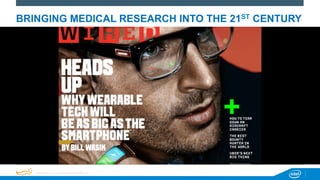
BRINGING MEDICAL RESEARCH INTO THE 21ST CENTURY
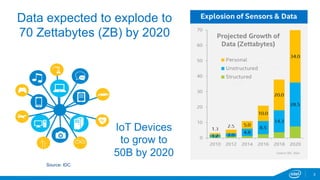
Data expected to explode to 
70 Zettabytes (ZB) by 2020 
3 
8:15 
Source: IDC 
IoT Devices 
to grow to 
50B by 2020
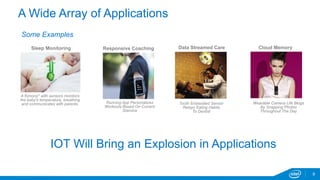
A Wide Array of Applications 
Data Streamed Care Cloud Memory 
Wearable Camera Life Blogs 
By Snapping Photos 
Throughout The Day 
Responsive Coaching 
Running App Personalizes 
Workouts Based On Current 
Stamina 
Tooth Embedded Sensor 
Relays Eating Habits 
To Dentist 
Some Examples 
Sleep Monitoring 
A Kimono* with sensors monitors 
the baby's temperature, breathing 
and communicates with parents. 
IOT Will Bring an Explosion in Applications 
4 8
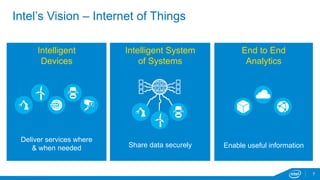
End to End 
Analytics 
Intel’s Vision – Internet of Things 
Intelligent 
Devices 
Intelligent System 
of Systems 
Deliver services where 
& when needed Share data securely Enable useful information 
5 7
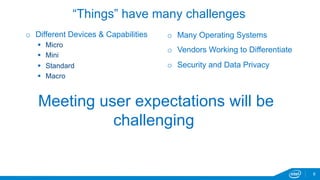
“Things” have many challenges 
o Different Devices & Capabilities 
§ Micro 
§ Mini 
§ Standard 
§ Macro 
o Many Operating Systems 
o Vendors Working to Differentiate 
o Security and Data Privacy 
Meeting user expectations will be 
challenging 
8
7 
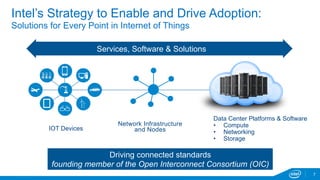
Intel’s Strategy to Enable and Drive Adoption: 
Solutions for Every Point in Internet of Things 
Services, Software & Solutions 
Network Infrastructure 
IOT Devices and Nodes 
Data Center Platforms & Software 
• Compute 
• Networking 
• Storage 
Driving connected standards 
founding member of the Open Interconnect Consortium (OIC)
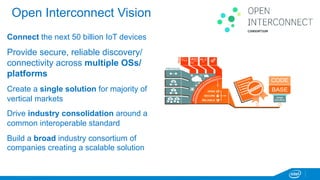
Open Interconnect Vision 
Connect the next 50 billion IoT devices 
Provide secure, reliable discovery/ 
connectivity across multiple OSs/ 
platforms 
Create a single solution for majority of 
vertical markets 
Drive industry consolidation around a 
common interoperable standard 
Build a broad industry consortium of 
companies creating a scalable solution
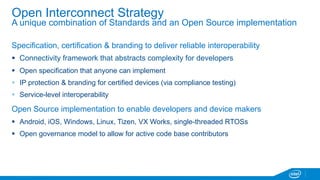
Open Interconnect Strategy 
A unique combination of Standards and an Open Source implementation 
Specification, certification & branding to deliver reliable interoperability 
§ Connectivity framework that abstracts complexity for developers 
§ Open specification that anyone can implement 
§ IP protection & branding for certified devices (via compliance testing) 
§ Service-level interoperability 
Open Source implementation to enable developers and device makers 
§ Android, iOS, Windows, Linux, Tizen, VX Works, single-threaded RTOSs 
§ Open governance model to allow for active code base contributors
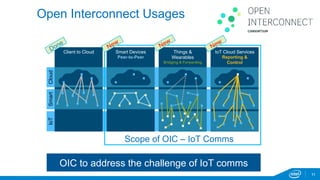
Open Interconnect Usages 
IoT Cloud Services 
Reporting & 
Control 
Things & 
Wearables 
Bridging & Forwarding 
Smart Devices 
Peer-to-Peer 
Scope of OIC – IoT Comms 
OIC to address the challenge of IoT comms 
IoT Smart Cloud 
Client to Cloud 
11
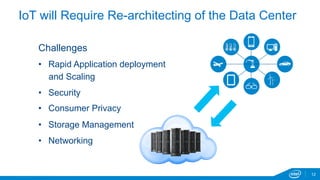
IoT will Require Re-architecting of the Data Center 
12 
Challenges 
• Rapid Application deployment 
and Scaling 
• Security 
• Consumer Privacy 
• Storage Management 
• Networking
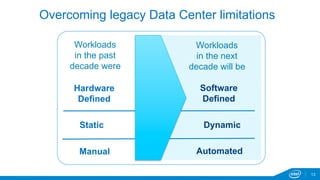
Overcoming legacy Data Center limitations 
Hardware 
Defined 
Static 
Software 
Defined 
Automated 
Workloads 
in the past 
decade were 
Workloads 
in the next 
decade will be 
Manual 
Dynamic 
13
13 
Preparing the Data Center for Internet of Things 
Re-architect the Data Center with Software Defined Infrastructure 
Transform Services Capability with Orchestration Software 
Use Data Analytics to extract Value and Insight 
1 
2 
3
14 
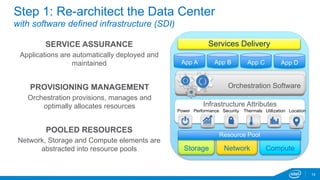
Step 1: Re-architect the Data Center 
with software defined infrastructure (SDI) 
SERVICE ASSURANCE 
Applications are automatically deployed and 
maintained 
PROVISIONING MANAGEMENT 
Orchestration provisions, manages and 
optimally allocates resources 
POOLED RESOURCES 
Network, Storage and Compute elements are 
abstracted into resource pools 
Services Delivery 
App A App B App C App D 
OOrcrhcheesstrtaratitoionn SSooffttwwaarree 
Infrastructure Attributes 
Power Performance Security Thermals Utilization Location 
Resource Pool 
Storage Network Compute
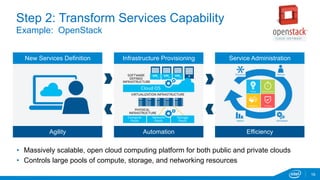
Step 2: Transform Services Capability 
Example: OpenStack 
Infrastructure Provisioning 
Automation 
Service Administration 
Efficiency 
New Services Definition 
Agility 
• Massively scalable, open cloud computing platform for both public and private clouds 
• Controls large pools of compute, storage, and networking resources 
16
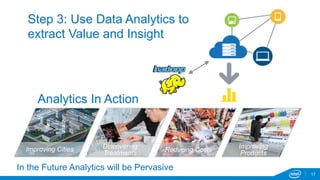
Step 3: Use Data Analytics to 
extract Value and Insight 
Analytics In Action 
Reducing Costs Products Discovering 
In the Future Analytics will be Pervasive 
17 
Improving 
Improving Cities Treatments
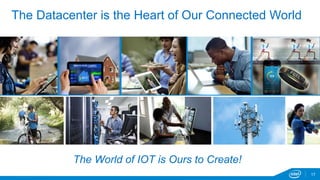
The Datacenter is the Heart of Our Connected World 
17 
The World of IOT is Ours to Create!
BACKUP 
19
Legal Disclaimers 
INFORMATION IN THIS DOCUMENT IS PROVIDED IN CONNECTION WITH INTEL PRODUCTS. NO LICENSE, EXPRESS OR IMPLIED, BY ESTOPPEL OR OTHERWISE, TO ANY 
INTELLECTUAL PROPERTY RIGHTS IS GRANTED BY THIS DOCUMENT. EXCEPT AS PROVIDED IN INTEL'S TERMS AND CONDITIONS OF SALE FOR SUCH PRODUCTS, INTEL 
ASSUMES NO LIABILITY WHATSOEVER AND INTEL DISCLAIMS ANY EXPRESS OR IMPLIED WARRANTY, RELATING TO SALE AND/OR USE OF INTEL PRODUCTS INCLUDING 
LIABILITY OR WARRANTIES RELATING TO FITNESS FOR A PARTICULAR PURPOSE, MERCHANTABILITY, OR INFRINGEMENT OF ANY PATENT, COPYRIGHT OR OTHER 
INTELLECTUAL PROPERTY RIGHT. 
A "Mission Critical Application" is any application in which failure of the Intel Product could result, directly or indirectly, in personal injury or death. SHOULD YOU PURCHASE OR USE 
INTEL'S PRODUCTS FOR ANY SUCH MISSION CRITICAL APPLICATION, YOU SHALL INDEMNIFY AND HOLD INTEL AND ITS SUBSIDIARIES, SUBCONTRACTORS AND 
AFFILIATES, AND THE DIRECTORS, OFFICERS, AND EMPLOYEES OF EACH, HARMLESS AGAINST ALL CLAIMS COSTS, DAMAGES, AND EXPENSES AND REASONABLE 
ATTORNEYS' FEES ARISING OUT OF, DIRECTLY OR INDIRECTLY, ANY CLAIM OF PRODUCT LIABILITY, PERSONAL INJURY, OR DEATH ARISING IN ANY WAY OUT OF SUCH 
MISSION CRITICAL APPLICATION, WHETHER OR NOT INTEL OR ITS SUBCONTRACTOR WAS NEGLIGENT IN THE DESIGN, MANUFACTURE, OR WARNING OF THE INTEL 
PRODUCT OR ANY OF ITS PARTS. 
Intel may make changes to specifications and product descriptions at any time, without notice. Designers must not rely on the absence or characteristics of any features or instructions 
marked "reserved" or "undefined". Intel reserves these for future definition and shall have no responsibility whatsoever for conflicts or incompatibilities arising from future changes to them. 
The information here is subject to change without notice. Do not finalize a design with this information. 
The products described in this document may contain design defects or errors known as errata which may cause the product to deviate from published specifications. Current characterized 
errata are available on request. 
Contact your local Intel sales office or your distributor to obtain the latest specifications and before placing your product order. 
Copies of documents which have an order number and are referenced in this document, or other Intel literature, may be obtained by calling 1-800-548-4725, or go to: http://www.intel.com/ 
design/literature.htm 
All products, computer systems, dates and figures specified are preliminary based on current expectations, and are subject to change without notice. 
The TCO or other cost reduction scenarios described in this document are intended to enable you to get a better understanding of how the purchase of a given Intel product, combined with 
a number of situation-specific variables, might affect your future cost and savings. Circumstances will vary and there may be unaccounted-for costs related to the use and deployment of a 
given product. Nothing in this document should be interpreted as either a promise of or contract for a given level of costs. 
Intel, the Intel logo, Xeon, the Xeon logo, Atom, the Atom logo, Core, the Core logo, Intel Cloud Technology, Intel Cloud Technology logo, are trademarks of Intel Corporation in the U.S. 
and/or other countries. 
*Other names and brands may be claimed as the property of others. 
Copyright © 2014 Intel Corporation. All rights reserved 
20
Technical Disclaimers 
Intel® Data Protection Technology -- Secure Key and Advanced Encryption Standard New Instructions {Intel® AES-NI}) 
No computer system can provide absolute security. Requires an enabled Intel® processor and software optimized for use of the technology. Consult your system manufacturer and/or 
software vendor for more information. 
Intel® Data Protection Technology -- Intel® Trusted Execution Technology (Intel® TXT) 
No computer system can provide absolute security. Requires an enabled Intel® processor, enabled chipset, firmware, software and may require a subscription with a capable service 
provider (may not be available in all countries). Intel assumes no liability for lost or stolen data and/or systems or any other damages resulting thereof. Consult your system or service 
provider for availability and functionality. 
Intel® Virtualization Technology – requires a computer system with an enabled Intel® processor, BIOS, and virtual machine monitor (VMM). Functionality, performance or other 
benefits will vary depending on hardware and software configurations. Software applications may not be compatible with all operating systems. Consult your PC manufacturer. For 
more information, visit http://www.intel.com/go/virtualization. 
Intel® Advanced Vector Extensions (Intel® AVX)* are designed to achieve higher throughput to certain integer and floating point operations. Due to varying processor power 
characteristics, utilizing AVX instructions may cause a) some parts to operate at less than the rated frequency and b) some parts with Intel® Turbo Boost Technology 2.0 to not achieve 
any or maximum turbo frequencies. Performance varies depending on hardware, software, and system configuration and you should consult your system manufacturer for more 
information. 
*Intel® Advanced Vector Extensions refers to Intel® AVX, Intel® AVX2 or Intel® AVX-512. For more information on Intel® Turbo Boost Technology 2.0, visit 
http://www.intel.com/go/turbo 
Intel® Turbo Boost Technology -- Requires a system with Intel® Turbo Boost Technology. Intel Turbo Boost Technology and Intel Turbo Boost Technology 2.0 are only available on 
select Intel® processors. Consult your system manufacturer. Performance varies depending on hardware, software, and system configuration. For more information, visit 
http://www.intel.com/go/turbo 
21
Optimization Notice 
Optimization Notice 
Intel's compilers may or may not optimize to the same degree for non-Intel microprocessors for optimizations 
that are not unique to Intel microprocessors. These optimizations include SSE2, SSE3, and SSE3 instruction 
sets and other optimizations. Intel does not guarantee the availability, functionality, or effectiveness of any 
optimization on microprocessors not manufactured by Intel. 
Microprocessor-dependent optimizations in this product are intended for use with Intel microprocessors. 
Certain optimizations not specific to Intel microarchitecture are reserved for Intel microprocessors. Please refer 
to the applicable product User and Reference Guides for more information regarding the specific instruction 
sets covered by this notice. 
Notice revision #20110804 
22

Preparing the Data Center for the Internet of Things

  • 1.
    Preparing the DataCenter for Internet of Things Mark Skarpness Director of Systems Engineering Intel Software and Services Group Nov 13 2014
  • 2.
    BRINGING MEDICAL RESEARCHINTO THE 21ST CENTURY
  • 3.
    Data expected toexplode to 70 Zettabytes (ZB) by 2020 3 8:15 Source: IDC IoT Devices to grow to 50B by 2020
  • 4.
    A Wide Arrayof Applications Data Streamed Care Cloud Memory Wearable Camera Life Blogs By Snapping Photos Throughout The Day Responsive Coaching Running App Personalizes Workouts Based On Current Stamina Tooth Embedded Sensor Relays Eating Habits To Dentist Some Examples Sleep Monitoring A Kimono* with sensors monitors the baby's temperature, breathing and communicates with parents. IOT Will Bring an Explosion in Applications 4 8
  • 5.
    End to End Analytics Intel’s Vision – Internet of Things Intelligent Devices Intelligent System of Systems Deliver services where & when needed Share data securely Enable useful information 5 7
  • 6.
    “Things” have manychallenges o Different Devices & Capabilities § Micro § Mini § Standard § Macro o Many Operating Systems o Vendors Working to Differentiate o Security and Data Privacy Meeting user expectations will be challenging 8
  • 7.
    7 Intel’s Strategyto Enable and Drive Adoption: Solutions for Every Point in Internet of Things Services, Software & Solutions Network Infrastructure IOT Devices and Nodes Data Center Platforms & Software • Compute • Networking • Storage Driving connected standards founding member of the Open Interconnect Consortium (OIC)
  • 8.
    Open Interconnect Vision Connect the next 50 billion IoT devices Provide secure, reliable discovery/ connectivity across multiple OSs/ platforms Create a single solution for majority of vertical markets Drive industry consolidation around a common interoperable standard Build a broad industry consortium of companies creating a scalable solution
  • 9.
    Open Interconnect Strategy A unique combination of Standards and an Open Source implementation Specification, certification & branding to deliver reliable interoperability § Connectivity framework that abstracts complexity for developers § Open specification that anyone can implement § IP protection & branding for certified devices (via compliance testing) § Service-level interoperability Open Source implementation to enable developers and device makers § Android, iOS, Windows, Linux, Tizen, VX Works, single-threaded RTOSs § Open governance model to allow for active code base contributors
  • 10.
    Open Interconnect Usages IoT Cloud Services Reporting & Control Things & Wearables Bridging & Forwarding Smart Devices Peer-to-Peer Scope of OIC – IoT Comms OIC to address the challenge of IoT comms IoT Smart Cloud Client to Cloud 11
  • 11.
    IoT will RequireRe-architecting of the Data Center 12 Challenges • Rapid Application deployment and Scaling • Security • Consumer Privacy • Storage Management • Networking
  • 12.
    Overcoming legacy DataCenter limitations Hardware Defined Static Software Defined Automated Workloads in the past decade were Workloads in the next decade will be Manual Dynamic 13
  • 13.
    13 Preparing theData Center for Internet of Things Re-architect the Data Center with Software Defined Infrastructure Transform Services Capability with Orchestration Software Use Data Analytics to extract Value and Insight 1 2 3
  • 14.
    14 Step 1:Re-architect the Data Center with software defined infrastructure (SDI) SERVICE ASSURANCE Applications are automatically deployed and maintained PROVISIONING MANAGEMENT Orchestration provisions, manages and optimally allocates resources POOLED RESOURCES Network, Storage and Compute elements are abstracted into resource pools Services Delivery App A App B App C App D OOrcrhcheesstrtaratitoionn SSooffttwwaarree Infrastructure Attributes Power Performance Security Thermals Utilization Location Resource Pool Storage Network Compute
  • 15.
    Step 2: TransformServices Capability Example: OpenStack Infrastructure Provisioning Automation Service Administration Efficiency New Services Definition Agility • Massively scalable, open cloud computing platform for both public and private clouds • Controls large pools of compute, storage, and networking resources 16
  • 16.
    Step 3: UseData Analytics to extract Value and Insight Analytics In Action Reducing Costs Products Discovering In the Future Analytics will be Pervasive 17 Improving Improving Cities Treatments
  • 17.
    The Datacenter isthe Heart of Our Connected World 17 The World of IOT is Ours to Create!
  • 19.
  • 20.
    Legal Disclaimers INFORMATIONIN THIS DOCUMENT IS PROVIDED IN CONNECTION WITH INTEL PRODUCTS. NO LICENSE, EXPRESS OR IMPLIED, BY ESTOPPEL OR OTHERWISE, TO ANY INTELLECTUAL PROPERTY RIGHTS IS GRANTED BY THIS DOCUMENT. EXCEPT AS PROVIDED IN INTEL'S TERMS AND CONDITIONS OF SALE FOR SUCH PRODUCTS, INTEL ASSUMES NO LIABILITY WHATSOEVER AND INTEL DISCLAIMS ANY EXPRESS OR IMPLIED WARRANTY, RELATING TO SALE AND/OR USE OF INTEL PRODUCTS INCLUDING LIABILITY OR WARRANTIES RELATING TO FITNESS FOR A PARTICULAR PURPOSE, MERCHANTABILITY, OR INFRINGEMENT OF ANY PATENT, COPYRIGHT OR OTHER INTELLECTUAL PROPERTY RIGHT. A "Mission Critical Application" is any application in which failure of the Intel Product could result, directly or indirectly, in personal injury or death. SHOULD YOU PURCHASE OR USE INTEL'S PRODUCTS FOR ANY SUCH MISSION CRITICAL APPLICATION, YOU SHALL INDEMNIFY AND HOLD INTEL AND ITS SUBSIDIARIES, SUBCONTRACTORS AND AFFILIATES, AND THE DIRECTORS, OFFICERS, AND EMPLOYEES OF EACH, HARMLESS AGAINST ALL CLAIMS COSTS, DAMAGES, AND EXPENSES AND REASONABLE ATTORNEYS' FEES ARISING OUT OF, DIRECTLY OR INDIRECTLY, ANY CLAIM OF PRODUCT LIABILITY, PERSONAL INJURY, OR DEATH ARISING IN ANY WAY OUT OF SUCH MISSION CRITICAL APPLICATION, WHETHER OR NOT INTEL OR ITS SUBCONTRACTOR WAS NEGLIGENT IN THE DESIGN, MANUFACTURE, OR WARNING OF THE INTEL PRODUCT OR ANY OF ITS PARTS. Intel may make changes to specifications and product descriptions at any time, without notice. Designers must not rely on the absence or characteristics of any features or instructions marked "reserved" or "undefined". Intel reserves these for future definition and shall have no responsibility whatsoever for conflicts or incompatibilities arising from future changes to them. The information here is subject to change without notice. Do not finalize a design with this information. The products described in this document may contain design defects or errors known as errata which may cause the product to deviate from published specifications. Current characterized errata are available on request. Contact your local Intel sales office or your distributor to obtain the latest specifications and before placing your product order. Copies of documents which have an order number and are referenced in this document, or other Intel literature, may be obtained by calling 1-800-548-4725, or go to: http://www.intel.com/ design/literature.htm All products, computer systems, dates and figures specified are preliminary based on current expectations, and are subject to change without notice. The TCO or other cost reduction scenarios described in this document are intended to enable you to get a better understanding of how the purchase of a given Intel product, combined with a number of situation-specific variables, might affect your future cost and savings. Circumstances will vary and there may be unaccounted-for costs related to the use and deployment of a given product. Nothing in this document should be interpreted as either a promise of or contract for a given level of costs. Intel, the Intel logo, Xeon, the Xeon logo, Atom, the Atom logo, Core, the Core logo, Intel Cloud Technology, Intel Cloud Technology logo, are trademarks of Intel Corporation in the U.S. and/or other countries. *Other names and brands may be claimed as the property of others. Copyright © 2014 Intel Corporation. All rights reserved 20
  • 21.
    Technical Disclaimers Intel®Data Protection Technology -- Secure Key and Advanced Encryption Standard New Instructions {Intel® AES-NI}) No computer system can provide absolute security. Requires an enabled Intel® processor and software optimized for use of the technology. Consult your system manufacturer and/or software vendor for more information. Intel® Data Protection Technology -- Intel® Trusted Execution Technology (Intel® TXT) No computer system can provide absolute security. Requires an enabled Intel® processor, enabled chipset, firmware, software and may require a subscription with a capable service provider (may not be available in all countries). Intel assumes no liability for lost or stolen data and/or systems or any other damages resulting thereof. Consult your system or service provider for availability and functionality. Intel® Virtualization Technology – requires a computer system with an enabled Intel® processor, BIOS, and virtual machine monitor (VMM). Functionality, performance or other benefits will vary depending on hardware and software configurations. Software applications may not be compatible with all operating systems. Consult your PC manufacturer. For more information, visit http://www.intel.com/go/virtualization. Intel® Advanced Vector Extensions (Intel® AVX)* are designed to achieve higher throughput to certain integer and floating point operations. Due to varying processor power characteristics, utilizing AVX instructions may cause a) some parts to operate at less than the rated frequency and b) some parts with Intel® Turbo Boost Technology 2.0 to not achieve any or maximum turbo frequencies. Performance varies depending on hardware, software, and system configuration and you should consult your system manufacturer for more information. *Intel® Advanced Vector Extensions refers to Intel® AVX, Intel® AVX2 or Intel® AVX-512. For more information on Intel® Turbo Boost Technology 2.0, visit http://www.intel.com/go/turbo Intel® Turbo Boost Technology -- Requires a system with Intel® Turbo Boost Technology. Intel Turbo Boost Technology and Intel Turbo Boost Technology 2.0 are only available on select Intel® processors. Consult your system manufacturer. Performance varies depending on hardware, software, and system configuration. For more information, visit http://www.intel.com/go/turbo 21
  • 22.
    Optimization Notice OptimizationNotice Intel's compilers may or may not optimize to the same degree for non-Intel microprocessors for optimizations that are not unique to Intel microprocessors. These optimizations include SSE2, SSE3, and SSE3 instruction sets and other optimizations. Intel does not guarantee the availability, functionality, or effectiveness of any optimization on microprocessors not manufactured by Intel. Microprocessor-dependent optimizations in this product are intended for use with Intel microprocessors. Certain optimizations not specific to Intel microarchitecture are reserved for Intel microprocessors. Please refer to the applicable product User and Reference Guides for more information regarding the specific instruction sets covered by this notice. Notice revision #20110804 22