H.N Sambo
Business studies Forms of
ownership
Choosing a form of ownership
 There's no best form of ownership.
 The best form of ownership depends on the entrepreneurs situation.
 Evaluation of the characteristics weighing pros and cons.
 Then deciding which form suits you as an owner.
Factors to consider
 Control of business
 Managerial ability
 Cost of formation
 Liability exposure
 Tax consideration
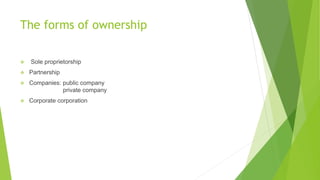
The forms of ownership
 Sole proprietorship
 Partnership
 Companies: public company
private company
 Corporate corporation
Characteristics of sole proprietorship
 One individual.
 Simple to start and end.
 Owner is liable for all the debts of the business.
 Capital provided by sole owner.
 Business managed by owner.
Sole Proprietorship
Advantages
 No restrictions limits to capital
 Quick decision making
 few legal requirements
 All profits belong to owner
Disadvantages
 No legal personality
 Feeling of isolation
 Unlimited liabilities
 Lack of continuity
Characteristics of Partnership
 Ownership 2 or more people
 Legal requirements
 Each partner must make a contribution to the Partnership.
 Life of the Partnership is not separate from the lives of the partners
 Partners are jointly and severally liable for debts on the business.
Types of partnerships
• General partnership: A partnership in which all
partners have unlimited personal liability and take
full responsibility for the management of the
business.
• Limited partnership: A partnership in which the
partners’ liability is limited to their investment.
• Joint venture: A partnership in which two
companies join to complete a specific project. The
partnership ends after a specified period of time.
• Strategic alliance: A partnership in which two
businesses work together for mutual benefit
Partnership
Advantages
 Combination of new skills and
ideas into a business.
 shared responsibilities for decision
making
 share profits and are therefore
motivated to work hard.
 Few legal requirements
Disadvantages
 Not a separate legal entity
 Liable for the actions of the other
partners
 Discussion between partners can
slow down decision making.
 Problems can arise if one or more
partners are lazy, inefficient or
even dishonest
Characteristics of companies
 A company is a legal person which has capacity and powers to act on its own
(i.e. the law sees a company in the
 same light as a natural person)
 The Companies Act 71 of 2008 took effect from 1 May 2011. The Act introduces
fundamental changes to South
 African company law and corporate actions. The companies are governed by
the Companies Act 71 of 2008 and
 they are incorporated in terms of the Memorandum of Incorporation (MOI).
 A company is incorporated by completing and filing a Memorandum of
Incorporation (MOI) and a Notice of
Continued
 The MOI represents the founding statement of a company under the Act. A
company becomes a
 juristic person from the date and time that its incorporation is registered, as
stated in its Registration Certificate. A
 person who is an incorporator, shareholder or director is not liable for the
obligations of the company except to
 the extent that the Act or the company’s MOI expressly provide otherwise.
 Registration of a company is effected by signature of the MOI by the requisite
number of persons and by filing it
 together with the prescribed Notice of Incorporation at CIPC, together with
payment of the prescribed fee.
Types of companies
 Profit Companies - A company incorporated for the purpose of financial gain
for its shareholders.
 Private company
 Public company
 Non-Profit Companies to be reflected as NPC
Characteristics of private company
 1 or more persons may incorporate a private company.
 one director (1 or more directors) or any other
 prohibited by MOI from offering its shares to the public and the transferability
of its
 shares is restricted.
 The name of a private company must end with the expression “Proprietary
Limited” or its abbreviation “(Pty) Ltd.”.
 unlimited number of shareholders and its life span is perpetual or it has
continual life span.
 has a separate legal personality. Shareholders have limited liability
Characteristics of public company
 No limit on number of shareholders
 Unlimited number of shareholders.
 Must have at least three directors. 3 or more for a public (Ltd) company
 Shares of the public company are freely transferable.
 Financial statement of a public company requires to be audited
 A separate legal personality
 Compelled to attend a annual general meeting (AGM).
Private company
Advantages
 Limited liabilities
 Directors not compelled to attend
(AGM)
 Audited financial statements are
optional.
 Information only available to
shareholders.
 Shareholders of a right of pre-
emption
Disadvantages
 The company is subjected to
double taxation
 Transferability of its shares is
restricted.
 Compelled to prepare annual
financial statements
 Many legal requirements
Public company
Advantages
 Separate legal entity
 Operated by only one shareholder
and 3 directors
 Easier to attract capital
investment
Disadvantages
 Complicated and expensive to
establish
 Shareholder may be allowed little
or no input
 Expensive procedures to comply
with reporting regulations.
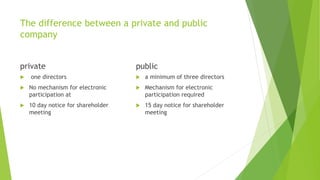
The difference between a private and public
company
private
 one directors
 No mechanism for electronic
participation at
 10 day notice for shareholder
meeting
public
 a minimum of three directors
 Mechanism for electronic
participation required
 15 day notice for shareholder
meeting
Characteristics of Corporate
Corporations
 A Close Corporation is subject to Close Corporations Act 69 of 1984 and the
Companies Act 71 of
 2008. Under the new Act, close corporations are treated a lot more like companies
 The name must end with the suffix CC.
 Amended founding statement CK2 is still in use.
 Liable in their personal capacity. It is a
 Separate entity that exists separately from its members
 Members of the CC both own and control the business
 Usually two or more members have to sign legal documentation
 Initial contributions are required to be made by members, but are usually nominal or
it does not have to
Types of corporations
• C-corporation: The most common form of
corporation. It protects the entrepreneur from being
personally sued for the actions and debts of the
corporation.
• Subchapter S corporation: A corporation that is
taxed like a sole proprietorship or partnership.
• Nonprofit corporation: Legal entities that make
money for reasons other than the owner’s profit.
• Limited Liability Company (LLC): A new form of
business ownership that provides limited liability
and tax advantages.
Corporate Corporations
Advantages
 All of advantages of a regular C
corporation
 Single taxation
 Avoids tax on appreciation of
asset sold
 Pay SSS for employees
 Different lines of businesses as
subsidiaries, simpler tax filing
Disadvantages
 Cost and time in incorporating
 Double taxation
 Potential for diminished
incentives
 Legal requirements and red tape
 Potential loss of control
Alternative approaches to starting a
business
• Buy an existing business.
• Enter a family business.
• Own a franchise business.
Advantages of buying an existing business
• Existing businesses already have
customers, suppliers, and procedures.
• Seller of the business may be willing to
train the new owner.
• There are existing financial records.
• Financial arrangements may be easier.
Disadvantages of buying an existing
business
• Business may be for sale because it is not
making a profit.
• Problems may be inherited with the
purchase of an existing business.
• Many entrepreneurs may not have the
capital needed to purchase an existing
business.
References
 Shah S. Forms of ownership. PowerPoint presentation
 Republic of South Africa BUSINESS STUDIES - FORMS OF OWNERSHIP Available
from:
file:///C:/Users/General/Downloads/BUSINESS%20STUDIES%20SELF%20STUDY-
GUIDE%20-%20FORMS%20OF%20OWNERSHIP.pdf. [Accessed: 3 march 2014]
 Walton, S. Forms of ownerships. PowerPoint presentation
 An overview of business. PowerPoint presentation [Accessed: 3march 2014]

economics management science

  • 1.
    H.N Sambo Business studiesForms of ownership
  • 2.
    Choosing a formof ownership  There's no best form of ownership.  The best form of ownership depends on the entrepreneurs situation.  Evaluation of the characteristics weighing pros and cons.  Then deciding which form suits you as an owner.
  • 3.
    Factors to consider Control of business  Managerial ability  Cost of formation  Liability exposure  Tax consideration
  • 4.
    The forms ofownership  Sole proprietorship  Partnership  Companies: public company private company  Corporate corporation
  • 5.
    Characteristics of soleproprietorship  One individual.  Simple to start and end.  Owner is liable for all the debts of the business.  Capital provided by sole owner.  Business managed by owner.
  • 6.
    Sole Proprietorship Advantages  Norestrictions limits to capital  Quick decision making  few legal requirements  All profits belong to owner Disadvantages  No legal personality  Feeling of isolation  Unlimited liabilities  Lack of continuity
  • 7.
    Characteristics of Partnership Ownership 2 or more people  Legal requirements  Each partner must make a contribution to the Partnership.  Life of the Partnership is not separate from the lives of the partners  Partners are jointly and severally liable for debts on the business.
  • 8.
    Types of partnerships •General partnership: A partnership in which all partners have unlimited personal liability and take full responsibility for the management of the business. • Limited partnership: A partnership in which the partners’ liability is limited to their investment. • Joint venture: A partnership in which two companies join to complete a specific project. The partnership ends after a specified period of time. • Strategic alliance: A partnership in which two businesses work together for mutual benefit
  • 9.
    Partnership Advantages  Combination ofnew skills and ideas into a business.  shared responsibilities for decision making  share profits and are therefore motivated to work hard.  Few legal requirements Disadvantages  Not a separate legal entity  Liable for the actions of the other partners  Discussion between partners can slow down decision making.  Problems can arise if one or more partners are lazy, inefficient or even dishonest
  • 10.
    Characteristics of companies A company is a legal person which has capacity and powers to act on its own (i.e. the law sees a company in the  same light as a natural person)  The Companies Act 71 of 2008 took effect from 1 May 2011. The Act introduces fundamental changes to South  African company law and corporate actions. The companies are governed by the Companies Act 71 of 2008 and  they are incorporated in terms of the Memorandum of Incorporation (MOI).  A company is incorporated by completing and filing a Memorandum of Incorporation (MOI) and a Notice of
  • 11.
    Continued  The MOIrepresents the founding statement of a company under the Act. A company becomes a  juristic person from the date and time that its incorporation is registered, as stated in its Registration Certificate. A  person who is an incorporator, shareholder or director is not liable for the obligations of the company except to  the extent that the Act or the company’s MOI expressly provide otherwise.  Registration of a company is effected by signature of the MOI by the requisite number of persons and by filing it  together with the prescribed Notice of Incorporation at CIPC, together with payment of the prescribed fee.
  • 12.
    Types of companies Profit Companies - A company incorporated for the purpose of financial gain for its shareholders.  Private company  Public company  Non-Profit Companies to be reflected as NPC
  • 13.
    Characteristics of privatecompany  1 or more persons may incorporate a private company.  one director (1 or more directors) or any other  prohibited by MOI from offering its shares to the public and the transferability of its  shares is restricted.  The name of a private company must end with the expression “Proprietary Limited” or its abbreviation “(Pty) Ltd.”.  unlimited number of shareholders and its life span is perpetual or it has continual life span.  has a separate legal personality. Shareholders have limited liability
  • 14.
    Characteristics of publiccompany  No limit on number of shareholders  Unlimited number of shareholders.  Must have at least three directors. 3 or more for a public (Ltd) company  Shares of the public company are freely transferable.  Financial statement of a public company requires to be audited  A separate legal personality  Compelled to attend a annual general meeting (AGM).
  • 15.
    Private company Advantages  Limitedliabilities  Directors not compelled to attend (AGM)  Audited financial statements are optional.  Information only available to shareholders.  Shareholders of a right of pre- emption Disadvantages  The company is subjected to double taxation  Transferability of its shares is restricted.  Compelled to prepare annual financial statements  Many legal requirements
  • 16.
    Public company Advantages  Separatelegal entity  Operated by only one shareholder and 3 directors  Easier to attract capital investment Disadvantages  Complicated and expensive to establish  Shareholder may be allowed little or no input  Expensive procedures to comply with reporting regulations.
  • 17.
    The difference betweena private and public company private  one directors  No mechanism for electronic participation at  10 day notice for shareholder meeting public  a minimum of three directors  Mechanism for electronic participation required  15 day notice for shareholder meeting
  • 18.
    Characteristics of Corporate Corporations A Close Corporation is subject to Close Corporations Act 69 of 1984 and the Companies Act 71 of  2008. Under the new Act, close corporations are treated a lot more like companies  The name must end with the suffix CC.  Amended founding statement CK2 is still in use.  Liable in their personal capacity. It is a  Separate entity that exists separately from its members  Members of the CC both own and control the business  Usually two or more members have to sign legal documentation  Initial contributions are required to be made by members, but are usually nominal or it does not have to
  • 19.
    Types of corporations •C-corporation: The most common form of corporation. It protects the entrepreneur from being personally sued for the actions and debts of the corporation. • Subchapter S corporation: A corporation that is taxed like a sole proprietorship or partnership. • Nonprofit corporation: Legal entities that make money for reasons other than the owner’s profit. • Limited Liability Company (LLC): A new form of business ownership that provides limited liability and tax advantages.
  • 20.
    Corporate Corporations Advantages  Allof advantages of a regular C corporation  Single taxation  Avoids tax on appreciation of asset sold  Pay SSS for employees  Different lines of businesses as subsidiaries, simpler tax filing Disadvantages  Cost and time in incorporating  Double taxation  Potential for diminished incentives  Legal requirements and red tape  Potential loss of control
  • 21.
    Alternative approaches tostarting a business • Buy an existing business. • Enter a family business. • Own a franchise business.
  • 22.
    Advantages of buyingan existing business • Existing businesses already have customers, suppliers, and procedures. • Seller of the business may be willing to train the new owner. • There are existing financial records. • Financial arrangements may be easier.
  • 23.
    Disadvantages of buyingan existing business • Business may be for sale because it is not making a profit. • Problems may be inherited with the purchase of an existing business. • Many entrepreneurs may not have the capital needed to purchase an existing business.
  • 24.
    References  Shah S.Forms of ownership. PowerPoint presentation  Republic of South Africa BUSINESS STUDIES - FORMS OF OWNERSHIP Available from: file:///C:/Users/General/Downloads/BUSINESS%20STUDIES%20SELF%20STUDY- GUIDE%20-%20FORMS%20OF%20OWNERSHIP.pdf. [Accessed: 3 march 2014]  Walton, S. Forms of ownerships. PowerPoint presentation  An overview of business. PowerPoint presentation [Accessed: 3march 2014]