


Learn How MySQL 5.6 Makes
  Query Optimization Easier
                       Jaime Crespo
          Percona Technical Webinars
                     March 15, 2013
About This Presentation
    • 5.6 from a pure technical view
      •   Only query tuning, not other optimization or profiling
          features
      •   Practical, simple examples but with real data (not
          “best cases”)
    • NOT benchmarks
      •   Only response time/query strategy, not extra
          CPU/memory/locking
      •   No comparisons with Percona Server or MariaDB
    • 5.6 optimizer has a lot of room for improvement,
      specially for query plan decision
      •   Some features are poorly documented
2                                                  www.percona.com
Agenda
    • MySQL 5.6 Optimizer New Features
      •   Filesort with short LIMIT
      •   ICP
      •   MRR
      •   BKA
      •   Index merge
      •   Other Subquery and JOIN Optimizations
    • MySQL 5.6 Query Plan Information
      •   EXPLAIN for DML
      •   Structured EXPLAIN and Query Plan Profiler
      •   Persistent Optimizer Statistics
      •   Duplicate Key Check
3                                              www.percona.com
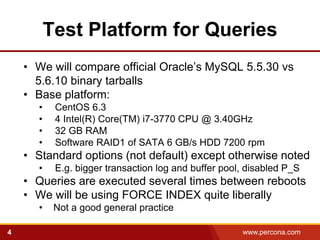
Test Platform for Queries
    • We will compare official Oracle’s MySQL 5.5.30 vs
      5.6.10 binary tarballs
    • Base platform:
      •    CentOS 6.3
      •    4 Intel(R) Core(TM) i7-3770 CPU @ 3.40GHz
      •    32 GB RAM
      •    Software RAID1 of SATA 6 GB/s HDD 7200 rpm
    • Standard options (not default) except otherwise noted
      •    E.g. bigger transaction log and buffer pool, disabled P_S
    • Queries are executed several times between reboots
    • We will be using FORCE INDEX quite liberally
      •    Not a good general practice

4                                                     www.percona.com
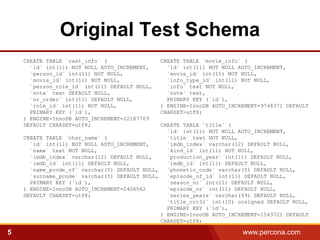
Original Test Schema
    CREATE TABLE `cast_info` (                 CREATE TABLE `movie_info` (
      `id` int(11) NOT NULL AUTO_INCREMENT,      `id` int(11) NOT NULL AUTO_INCREMENT,
      `person_id` int(11) NOT NULL,              `movie_id` int(11) NOT NULL,
      `movie_id` int(11) NOT NULL,               `info_type_id` int(11) NOT NULL,
      `person_role_id` int(11) DEFAULT NULL,     `info` text NOT NULL,
      `note` text DEFAULT NULL,                  `note` text,
      `nr_order` int(11) DEFAULT NULL,           PRIMARY KEY (`id`),
      `role_id` int(11) NOT NULL,              ) ENGINE=InnoDB AUTO_INCREMENT=9748371 DEFAULT
      PRIMARY KEY (`id`),                      CHARSET=utf8;
    ) ENGINE=InnoDB AUTO_INCREMENT=22187769
    DEFAULT CHARSET=utf8;                      CREATE TABLE `title` (
                                                 `id` int(11) NOT NULL AUTO_INCREMENT,
    CREATE TABLE `char_name` (                   `title` text NOT NULL,
      `id` int(11) NOT NULL AUTO_INCREMENT,      `imdb_index` varchar(12) DEFAULT NULL,
      `name` text NOT NULL,                      `kind_id` int(11) NOT NULL,
      `imdb_index` varchar(12) DEFAULT NULL,     `production_year` int(11) DEFAULT NULL,
      `imdb_id` int(11) DEFAULT NULL,            `imdb_id` int(11) DEFAULT NULL,
      `name_pcode_nf` varchar(5) DEFAULT NULL,   `phonetic_code` varchar(5) DEFAULT NULL,
      `surname_pcode` varchar(5) DEFAULT NULL,   `episode_of_id` int(11) DEFAULT NULL,
      PRIMARY KEY (`id`),                        `season_nr` int(11) DEFAULT NULL,
    ) ENGINE=InnoDB AUTO_INCREMENT=2406562       `episode_nr` int(11) DEFAULT NULL,
    DEFAULT CHARSET=utf8;                        `series_years` varchar(49) DEFAULT NULL,
                                                 `title_crc32` int(10) unsigned DEFAULT NULL,
                                                 PRIMARY KEY (`id`),
                                               ) ENGINE=InnoDB AUTO_INCREMENT=1543721 DEFAULT
                                               CHARSET=utf8;

5                                                                       www.percona.com
Learn How MySQL 5.6 Makes Query Optimization Easier


    OPTIMIZER NEW FEATURES

6                                                   www.percona.com   5
Filesort with Short LIMIT
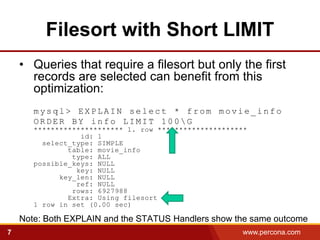
    • Queries that require a filesort but only the first
      records are selected can benefit from this
      optimization:
       mysql> EXPLAIN select * from movie_info
       ORDER BY info LIMIT 100G
       ********************* 1. row *********************
                  id: 1
         select_type: SIMPLE
               table: movie_info
                type: ALL
       possible_keys: NULL
                 key: NULL
             key_len: NULL
                 ref: NULL
                rows: 6927988
               Extra: Using filesort
       1 row in set (0.00 sec)

    Note: Both EXPLAIN and the STATUS Handlers show the same outcome
7                                                      www.percona.com   5
Filesort with Short LIMIT
                 (cont.)
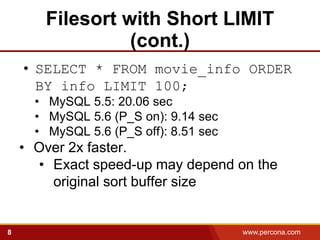
    • SELECT * FROM movie_info ORDER
      BY info LIMIT 100;
      • MySQL 5.5: 20.06 sec
      • MySQL 5.6 (P_S on): 9.14 sec
      • MySQL 5.6 (P_S off): 8.51 sec
    • Over 2x faster.
      • Exact speed-up may depend on the
        original sort buffer size


8                                       www.percona.com   5
Index Condition Pushdown
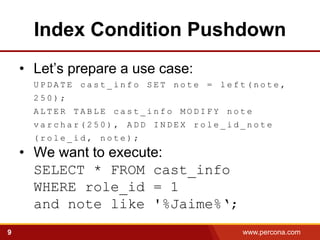
    • Let’s prepare a use case:
      UPDATE cast_info SET note = left(note,
      250);
      ALTER TABLE cast_info MODIFY note
      varchar(250), ADD INDEX role_id_note
      (role_id, note);
    • We want to execute:
      SELECT * FROM cast_info
      WHERE role_id = 1
      and note like '%Jaime%‘;
9                                    www.percona.com   5
Without ICP (5.5)
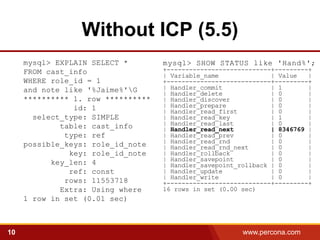
     mysql> EXPLAIN SELECT *        mysql> SHOW STATUS like 'Hand%';
     FROM cast_info                 +----------------------------+---------+
                                    | Variable_name              | Value   |
     WHERE role_id = 1              +----------------------------+---------+
     and note like '%Jaime%'G      | Handler_commit             | 1       |
                                    | Handler_delete             | 0       |
     ********** 1. row **********   | Handler_discover           | 0       |
                id: 1               | Handler_prepare            | 0       |
                                    | Handler_read_first         | 0       |
       select_type: SIMPLE          | Handler_read_key           | 1       |
             table: cast_info       | Handler_read_last          | 0       |
                                    | Handler_read_next          | 8346769 |
              type: ref             | Handler_read_prev          | 0       |
     possible_keys: role_id_note    | Handler_read_rnd           | 0       |
                                    | Handler_read_rnd_next      | 0       |
               key: role_id_note    | Handler_rollback           | 0       |
                                    | Handler_savepoint          | 0       |
           key_len: 4               | Handler_savepoint_rollback | 0       |
               ref: const           | Handler_update             | 0       |
                                    | Handler_write              | 0       |
              rows: 11553718        +----------------------------+---------+
             Extra: Using where     16 rows in set (0.00 sec)
     1 row in set (0.01 sec)


10                                                       www.percona.com       5
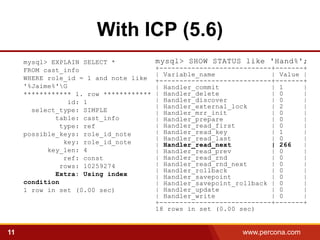
With ICP (5.6)
     mysql> EXPLAIN SELECT *            mysql> SHOW STATUS like 'Hand%';
     FROM cast_info                     +----------------------------+-------+
                                        | Variable_name              | Value |
     WHERE role_id = 1 and note like    +----------------------------+-------+
     '%Jaime%'G                        | Handler_commit             | 1     |
     ************ 1. row ************   | Handler_delete             | 0     |
                 id: 1                  | Handler_discover           | 0     |
                                        | Handler_external_lock      | 2     |
       select_type: SIMPLE              | Handler_mrr_init           | 0     |
             table: cast_info           | Handler_prepare            | 0     |
               type: ref                | Handler_read_first         | 0     |
     possible_keys: role_id_note        | Handler_read_key           | 1     |
                                        | Handler_read_last          | 0     |
                key: role_id_note       | Handler_read_next          | 266   |
           key_len: 4                   | Handler_read_prev          | 0     |
                ref: const              | Handler_read_rnd           | 0     |
               rows: 10259274           | Handler_read_rnd_next      | 0     |
                                        | Handler_rollback           | 0     |
             Extra: Using index         | Handler_savepoint          | 0     |
     condition                          | Handler_savepoint_rollback | 0     |
     1 row in set (0.00 sec)            | Handler_update             | 0     |
                                        | Handler_write              | 0     |
                                        +----------------------------+-------+
                                        18 rows in set (0.00 sec)


11                                                           www.percona.com     5
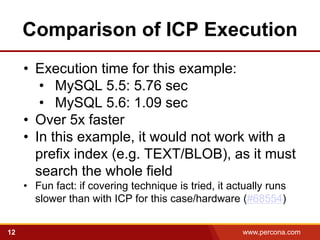
Comparison of ICP Execution
     • Execution time for this example:
        • MySQL 5.5: 5.76 sec
        • MySQL 5.6: 1.09 sec
     • Over 5x faster
     • In this example, it would not work with a
       prefix index (e.g. TEXT/BLOB), as it must
       search the whole field
     • Fun fact: if covering technique is tried, it actually runs
       slower than with ICP for this case/hardware (#68554)


12                                                     www.percona.com   5
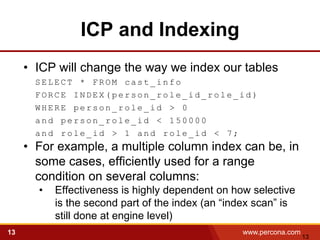
ICP and Indexing
     • ICP will change the way we index our tables
       SELECT * FROM cast_info
       FORCE INDEX(person_role_id_role_id)
       WHERE person_role_id > 0
       and person_role_id < 150000
       and role_id > 1 and role_id < 7;
     • For example, a multiple column index can be, in
       some cases, efficiently used for a range
       condition on several columns:
       •   Effectiveness is highly dependent on how selective
           is the second part of the index (an “index scan” is
           still done at engine level)
13                                                www.percona.com
                                                                    13
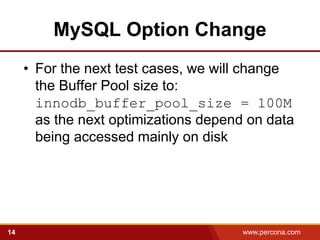
MySQL Option Change
     • For the next test cases, we will change
       the Buffer Pool size to:
       innodb_buffer_pool_size = 100M
       as the next optimizations depend on data
       being accessed mainly on disk


14                                     www.percona.com
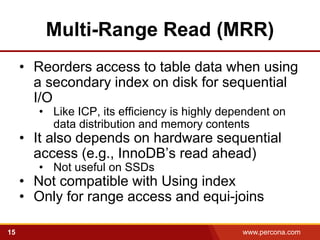
Multi-Range Read (MRR)
     • Reorders access to table data when using
       a secondary index on disk for sequential
       I/O
        • Like ICP, its efficiency is highly dependent on
          data distribution and memory contents
     • It also depends on hardware sequential
       access (e.g., InnoDB’s read ahead)
        • Not useful on SSDs
     • Not compatible with Using index
     • Only for range access and equi-joins

15                                              www.percona.com   5
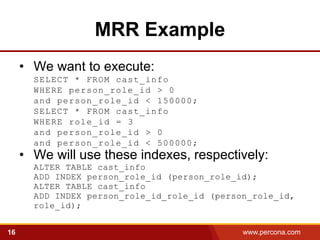
MRR Example
     • We want to execute:
       SELECT * FROM cast_info
       WHERE person_role_id > 0
       and person_role_id < 150000;
       SELECT * FROM cast_info
       WHERE role_id = 3
       and person_role_id > 0
       and person_role_id < 500000 ;
     • We will use these indexes, respectively:
       ALTER TABLE cast_info
       ADD INDEX person_role_id (person_role_id);
       ALTER TABLE cast_info
       ADD INDEX person_role_id_role_id (person_role_id,
       role_id);


16                                            www.percona.com   5
Without MRR (5.5)
     mysql> EXPLAIN SELECT * FROM     mysql> SHOW STATUS like 'Hand%';
                                      +----------------------------+---------+
     cast_info FORCE                  | Variable_name              | Value   |
     INDEX(person_role_id) WHERE      +----------------------------+---------+
                                      | Handler_commit             | 1       |
     person_role_id > 0 and           | Handler_delete             | 0       |
     person_role_id < 150000G        | Handler_discover           | 0       |
                                      | Handler_prepare            | 0       |
     *********** 1. row ***********   | Handler_read_first         | 0       |
                id: 1                 | Handler_read_key           | 1       |
                                      | Handler_read_last          | 0       |
       select_type: SIMPLE            | Handler_read_next          | 4654312 |
             table: cast_info         | Handler_read_prev          | 0       |
              type: range             | Handler_read_rnd           | 0       |
                                      | Handler_read_rnd_next      | 0       |
     possible_keys: person_role_id    | Handler_rollback           | 0       |
               key: person_role_id    | Handler_savepoint          | 0       |
           key_len: 5                 | Handler_savepoint_rollback | 0       |
                                      | Handler_update             | 0       |
               ref: NULL              | Handler_write              | 0       |
              rows: 8966490           +----------------------------+---------+
                                      16 rows in set (0.00 sec)
             Extra: Using where
     1 row in set (0.00 sec)


17                                                              www.percona.com   5
With MRR (5.6)
     mysql> EXPLAIN SELECT * FROM     mysql> SHOW STATUS like 'Hand%';
                                      +----------------------------+---------+
     cast_info FORCE                  | Variable_name              | Value   |
     INDEX(person_role_id) WHERE      +----------------------------+---------+
                                      | Handler_commit             | 1       |
     person_role_id > 0 and           | Handler_delete             | 0       |
     person_role_id < 150000G        | Handler_discover           | 0       |
                                      | Handler_external_lock      | 4       |
     *********** 1. row ***********   | Handler_mrr_init           | 0       |
                id: 1                 | Handler_prepare            | 0       |
                                      | Handler_read_first         | 0       |
       select_type: SIMPLE            | Handler_read_key           | 4654313 |
             table: cast_info         | Handler_read_last          | 0       |
              type: range             | Handler_read_next          | 4654312 |
                                      | Handler_read_prev          | 0       |
     possible_keys: person_role_id    | Handler_read_rnd           | 4654312 |
               key: person_role_id    | Handler_read_rnd_next      | 0       |
           key_len: 5                 | Handler_rollback           | 0       |
                                      | Handler_savepoint          | 0       |
               ref: NULL              | Handler_savepoint_rollback | 0       |
              rows: 8966490           | Handler_update             | 0       |
                                      | Handler_write              | 0       |
             Extra: Using index
                                      +----------------------------+---------+
     condition; Using MRR             18 rows in set (0.00 sec)
     1 row in set (0.00 sec)


18                                                              www.percona.com   5
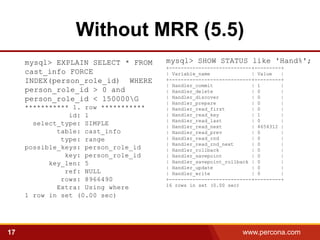
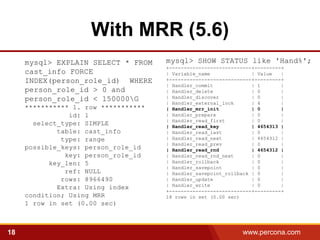
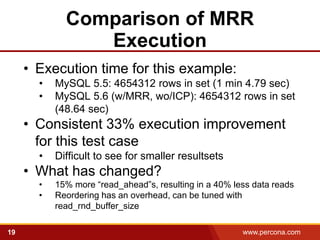
Comparison of MRR
                Execution
     • Execution time for this example:
       •   MySQL 5.5: 4654312 rows in set (1 min 4.79 sec)
       •   MySQL 5.6 (w/MRR, wo/ICP): 4654312 rows in set
           (48.64 sec)
     • Consistent 33% execution improvement
       for this test case
       •   Difficult to see for smaller resultsets
     • What has changed?
       •   15% more “read_ahead”s, resulting in a 40% less data reads
       •   Reordering has an overhead, can be tuned with
           read_rnd_buffer_size

19                                                      www.percona.com   5
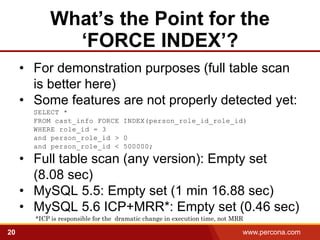
What’s the Point for the
             ‘FORCE INDEX’?
     • For demonstration purposes (full table scan
       is better here)
     • Some features are not properly detected yet:
       SELECT *
       FROM cast_info FORCE INDEX(person_role_id_role_id)
       WHERE role_id = 3
       and person_role_id > 0
       and person_role_id < 500000;

     • Full table scan (any version): Empty set
       (8.08 sec)
     • MySQL 5.5: Empty set (1 min 16.88 sec)
     • MySQL 5.6 ICP+MRR*: Empty set (0.46 sec)
       *ICP is responsible for the dramatic change in execution time, not MRR

20                                                                          www.percona.com
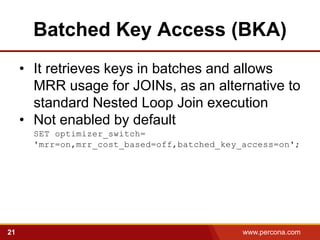
Batched Key Access (BKA)
     • It retrieves keys in batches and allows
       MRR usage for JOINs, as an alternative to
       standard Nested Loop Join execution
     • Not enabled by default
       SET optimizer_switch=
       'mrr=on,mrr_cost_based=off,batched_key_access=on';


21                                            www.percona.com
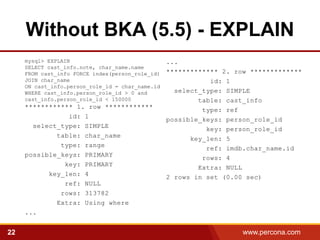
Without BKA (5.5) - EXPLAIN
     mysql> EXPLAIN                               ...
     SELECT cast_info.note, char_name.name
     FROM cast_info FORCE index(person_role_id)   ************* 2. row *************
     JOIN char_name                                          id: 1
     ON cast_info.person_role_id = char_name.id
     WHERE cast_info.person_role_id > 0 and         select_type: SIMPLE
     cast_info.person_role_id < 150000                    table: cast_info
     ************ 1. row ************                      type: ref
                id: 1                             possible_keys: person_role_id
       select_type: SIMPLE
                                                            key: person_role_id
             table: char_name                           key_len: 5
              type: range                                   ref: imdb.char_name.id
     possible_keys: PRIMARY                                rows: 4
               key: PRIMARY                               Extra: NULL
           key_len: 4
                                                  2 rows in set (0.00 sec)
               ref: NULL
              rows: 313782
             Extra: Using where
     ...


22                                                                   www.percona.com
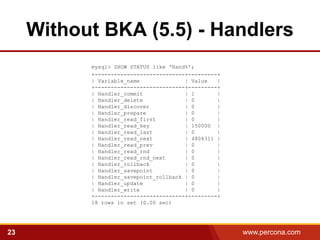
Without BKA (5.5) - Handlers
           mysql> SHOW STATUS like ‘Hand%’;
           +----------------------------+---------+
           | Variable_name              | Value   |
           +----------------------------+---------+
           | Handler_commit             | 1       |
           | Handler_delete             | 0       |
           | Handler_discover           | 0       |
           | Handler_prepare            | 0       |
           | Handler_read_first         | 0       |
           | Handler_read_key           | 150000 |
           | Handler_read_last          | 0       |
           | Handler_read_next          | 4804311 |
           | Handler_read_prev          | 0       |
           | Handler_read_rnd           | 0       |
           | Handler_read_rnd_next      | 0       |
           | Handler_rollback           | 0       |
           | Handler_savepoint          | 0       |
           | Handler_savepoint_rollback | 0       |
           | Handler_update             | 0       |
           | Handler_write              | 0       |
           +----------------------------+---------+
           18 rows in set (0.00 sec)


23                                                    www.percona.com
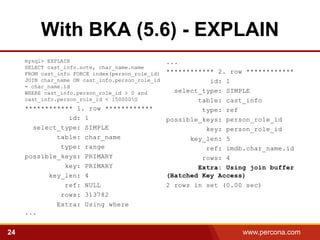
With BKA (5.6) - EXPLAIN
     mysql> EXPLAIN                               ...
     SELECT cast_info.note, char_name.name
     FROM cast_info FORCE index(person_role_id)   ************ 2. row ************
     JOIN char_name ON cast_info.person_role_id              id: 1
     = char_name.id
     WHERE cast_info.person_role_id > 0 and         select_type: SIMPLE
     cast_info.person_role_id < 150000G                  table: cast_info
     ************ 1. row ************                      type: ref
                id: 1                             possible_keys: person_role_id
       select_type: SIMPLE                                  key: person_role_id
             table: char_name                           key_len: 5
              type: range                                   ref: imdb.char_name.id
     possible_keys: PRIMARY                                rows: 4
               key: PRIMARY                               Extra: Using join buffer
           key_len: 4                             (Batched Key Access)
               ref: NULL                          2 rows in set (0.00 sec)
              rows: 313782
             Extra: Using where
     ...


24                                                                   www.percona.com
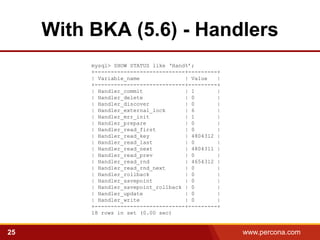
With BKA (5.6) - Handlers
          mysql> SHOW STATUS like ‘Hand%’;
          +----------------------------+---------+
          | Variable_name              | Value   |
          +----------------------------+---------+
          | Handler_commit             | 1       |
          | Handler_delete             | 0       |
          | Handler_discover           | 0       |
          | Handler_external_lock      | 6       |
          | Handler_mrr_init           | 1       |
          | Handler_prepare            | 0       |
          | Handler_read_first         | 0       |
          | Handler_read_key           | 4804312 |
          | Handler_read_last          | 0       |
          | Handler_read_next          | 4804311 |
          | Handler_read_prev          | 0       |
          | Handler_read_rnd           | 4654312 |
          | Handler_read_rnd_next      | 0       |
          | Handler_rollback           | 0       |
          | Handler_savepoint          | 0       |
          | Handler_savepoint_rollback | 0       |
          | Handler_update             | 0       |
          | Handler_write              | 0       |
          +----------------------------+---------+
          18 rows in set (0.00 sec)


25                                                   www.percona.com
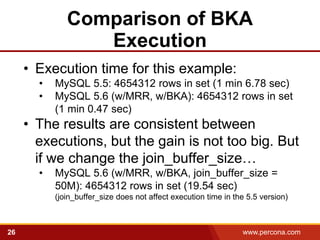
Comparison of BKA
                 Execution
     • Execution time for this example:
       •   MySQL 5.5: 4654312 rows in set (1 min 6.78 sec)
       •   MySQL 5.6 (w/MRR, w/BKA): 4654312 rows in set
           (1 min 0.47 sec)
     • The results are consistent between
       executions, but the gain is not too big. But
       if we change the join_buffer_size…
       •   MySQL 5.6 (w/MRR, w/BKA, join_buffer_size =
           50M): 4654312 rows in set (19.54 sec)
           (join_buffer_size does not affect execution time in the 5.5 version)


26                                                               www.percona.com   5
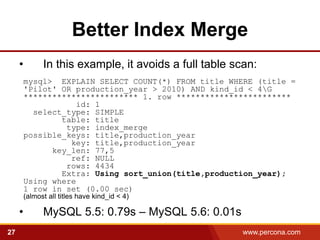
Better Index Merge
     •         In this example, it avoids a full table scan:
         mysql> EXPLAIN SELECT COUNT(*) FROM title WHERE (title =
         'Pilot' OR production_year > 2010) AND kind_id < 4G
         ************************ 1. row ************************
                    id: 1
           select_type: SIMPLE
                 table: title
                  type: index_merge
         possible_keys: title,production_year
                   key: title,production_year
               key_len: 77,5
                   ref: NULL
                  rows: 4434
                 Extra: Using sort_union(title,production_year);
         Using where
         1 row in set (0.00 sec)
         (almost all titles have kind_id < 4)

     •         MySQL 5.5: 0.79s – MySQL 5.6: 0.01s
27                                                       www.percona.com   5
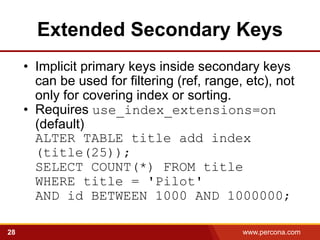
Extended Secondary Keys
     • Implicit primary keys inside secondary keys
       can be used for filtering (ref, range, etc), not
       only for covering index or sorting.
     • Requires use_index_extensions=on
       (default)
       ALTER TABLE title add index
       (title(25));
       SELECT COUNT(*) FROM title
       WHERE title = 'Pilot'
       AND id BETWEEN 1000 AND 1000000;

28                                           www.percona.com   5
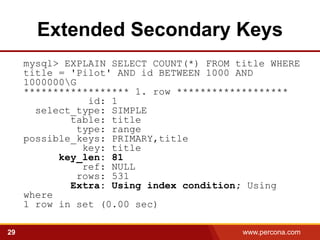
Extended Secondary Keys
     mysql> EXPLAIN SELECT COUNT(*) FROM title WHERE
     title = 'Pilot' AND id BETWEEN 1000 AND
     1000000G
     ****************** 1. row *******************
                 id: 1
       select_type: SIMPLE
             table: title
               type: range
     possible_keys: PRIMARY,title
                key: title
           key_len: 81
                ref: NULL
               rows: 531
             Extra: Using index condition; Using
     where
     1 row in set (0.00 sec)

29                                        www.percona.com   5
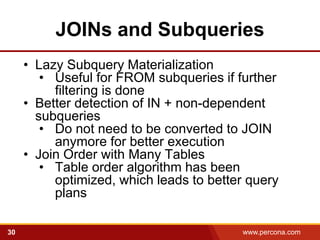
JOINs and Subqueries
     • Lazy Subquery Materialization
        • Useful for FROM subqueries if further
          filtering is done
     • Better detection of IN + non-dependent
       subqueries
        • Do not need to be converted to JOIN
          anymore for better execution
     • Join Order with Many Tables
        • Table order algorithm has been
          optimized, which leads to better query
          plans

30                                       www.percona.com   5
Learn How MySQL 5.6 Makes Query Optimization Easier


     OPTIMIZER PROFILING AND TOOLS

31                                                   www.percona.com   5
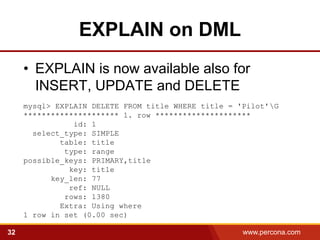
EXPLAIN on DML
     • EXPLAIN is now available also for
       INSERT, UPDATE and DELETE
     mysql> EXPLAIN DELETE FROM title WHERE title = 'Pilot'G
     ********************* 1. row *********************
                id: 1
       select_type: SIMPLE
             table: title
              type: range
     possible_keys: PRIMARY,title
               key: title
           key_len: 77
               ref: NULL
              rows: 1380
             Extra: Using where
     1 row in set (0.00 sec)

32                                                   www.percona.com   5
Structured EXPLAIN
     mysql> EXPLAIN FORMAT=JSON SELECT COUNT(*) FROM title
     WHERE (title = 'Pilot' OR production_year > 2010)
     AND kind_id < 4G
     *************************** 1. row ***************************
     EXPLAIN: {
       "query_block": {
         "select_id": 1,
         "table": {
           "table_name": "title",
           "access_type": "index_merge",
           "possible_keys": [
              "title",
              "production_year"
           ],
           "key": "sort_union(title,production_year)",
           "key_length": "77,5",
           "rows": 4434,
           "filtered": 100,
           "attached_condition": "(((`imdb`.`title`.`title` = 'Pilot') or
     (`imdb`.`title`.`production_year` > 2010)) and
     (`imdb`.`title`.`kind_id` < 4))"
         }
       }
     }


33                                                         www.percona.com   5
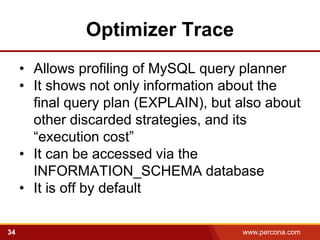
Optimizer Trace
     • Allows profiling of MySQL query planner
     • It shows not only information about the
       final query plan (EXPLAIN), but also about
       other discarded strategies, and its
       “execution cost”
     • It can be accessed via the
       INFORMATION_SCHEMA database
     • It is off by default

34                                     www.percona.com   5
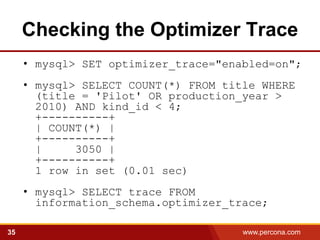
Checking the Optimizer Trace
     • mysql> SET optimizer_trace="enabled=on";
     • mysql> SELECT COUNT(*) FROM title WHERE
       (title = 'Pilot' OR production_year >
       2010) AND kind_id < 4;
       +----------+
       | COUNT(*) |
       +----------+
       |     3050 |
       +----------+
       1 row in set (0.01 sec)
     • mysql> SELECT trace FROM
       information_schema.optimizer_trace;

35                                    www.percona.com   5
Checking the Optimizer Trace
                (cont.)
               {
                   "range_scan_alternatives": [
                     {
                       "index": "production_year",
                       "ranges": [
                         "2010 < production_year"
                       ],
                       "index_dives_for_eq_ranges": true,
                       "rowid_ordered": false,
                       "using_mrr": false,
                       "index_only": true,
                       "rows": 3054,
                       "cost": 615.16,
                       "chosen": true
                     }
                   ],
                   "index_to_merge": "production_year",
                   "cumulated_cost": 905.69
               }
             ],
             "cost_of_reading_ranges": 905.69,
             "cost_sort_rowid_and_read_disk": 3672.8,
             "cost_duplicate_removal": 9467.6,
             "total_cost": 14046
            }
          ],
          "chosen_range_access_summary": {
            "range_access_plan": {
              "type": "index_merge",
              "index_merge_of": [


36                                                          www.percona.com   5
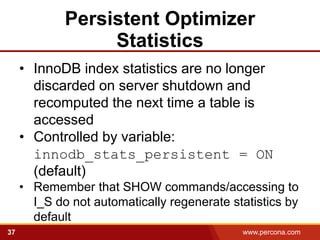
Persistent Optimizer
                  Statistics
     • InnoDB index statistics are no longer
       discarded on server shutdown and
       recomputed the next time a table is
       accessed
     • Controlled by variable:
       innodb_stats_persistent = ON
       (default)
     • Remember that SHOW commands/accessing to
       I_S do not automatically regenerate statistics by
       default
37                                           www.percona.com   5
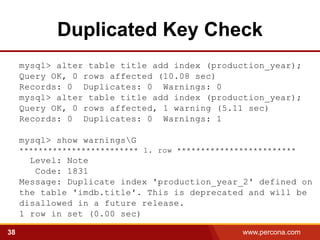
Duplicated Key Check
     mysql> alter table title add index (production_year);
     Query OK, 0 rows affected (10.08 sec)
     Records: 0 Duplicates: 0 Warnings: 0
     mysql> alter table title add index (production_year);
     Query OK, 0 rows affected, 1 warning (5.11 sec)
     Records: 0 Duplicates: 0 Warnings: 1

     mysql> show warningsG
     ************************* 1. row *************************
       Level: Note
        Code: 1831
     Message: Duplicate index 'production_year_2' defined on
     the table 'imdb.title'. This is deprecated and will be
     disallowed in a future release.
     1 row in set (0.00 sec)

38                                                 www.percona.com   5
Learn How MySQL 5.6 Makes Query Optimization Easier


     CONCLUSION

39                                                   www.percona.com   5
5.6 is a Great Release
     • Many optimizer changes that can
        potentially improve query execution time
     • Some of them are transparent, some
        others require tuning and understanding
     • Some old tricks and indexing strategies
        become obsolete in 5.6
      • pt-upgrade, from Percona Toolkit, and
        Percona Playback can be great tools to
        analyze improvements and regressions
40                                      www.percona.com
Where to Learn More ?
     • More query and server optimization
       techniques in our training courses
       (http://www.percona.com/training):
        • Chicago, begins Monday, April 8, 2013
        • London, begins Monday, April 8, 2013
        • 15% discount for April training with
           coupon code W15
     • Stay tuned for our new MySQL 5.6 course in
       May
     • http://www.mysqlperformanceblog.com

41                                      www.percona.com
Percona Live
          Conference and Expo


•   Use Discount Code: “PerWebinar1” to receive 15% discount
•   For more information and to register:
          Visit: http://www.percona.com/live/mysql-conference-2013/
Thank You!
            Jaime Crespo
     jaime.crespo@percona.com


43                              www.percona.com
                                 www.percona.com

56 Query Optimization

  • 1.
    Learn How MySQL5.6 Makes Query Optimization Easier Jaime Crespo Percona Technical Webinars March 15, 2013
  • 2.
    About This Presentation • 5.6 from a pure technical view • Only query tuning, not other optimization or profiling features • Practical, simple examples but with real data (not “best cases”) • NOT benchmarks • Only response time/query strategy, not extra CPU/memory/locking • No comparisons with Percona Server or MariaDB • 5.6 optimizer has a lot of room for improvement, specially for query plan decision • Some features are poorly documented 2 www.percona.com
  • 3.
    Agenda • MySQL 5.6 Optimizer New Features • Filesort with short LIMIT • ICP • MRR • BKA • Index merge • Other Subquery and JOIN Optimizations • MySQL 5.6 Query Plan Information • EXPLAIN for DML • Structured EXPLAIN and Query Plan Profiler • Persistent Optimizer Statistics • Duplicate Key Check 3 www.percona.com
  • 4.
    Test Platform forQueries • We will compare official Oracle’s MySQL 5.5.30 vs 5.6.10 binary tarballs • Base platform: • CentOS 6.3 • 4 Intel(R) Core(TM) i7-3770 CPU @ 3.40GHz • 32 GB RAM • Software RAID1 of SATA 6 GB/s HDD 7200 rpm • Standard options (not default) except otherwise noted • E.g. bigger transaction log and buffer pool, disabled P_S • Queries are executed several times between reboots • We will be using FORCE INDEX quite liberally • Not a good general practice 4 www.percona.com
  • 5.
    Original Test Schema CREATE TABLE `cast_info` ( CREATE TABLE `movie_info` ( `id` int(11) NOT NULL AUTO_INCREMENT, `id` int(11) NOT NULL AUTO_INCREMENT, `person_id` int(11) NOT NULL, `movie_id` int(11) NOT NULL, `movie_id` int(11) NOT NULL, `info_type_id` int(11) NOT NULL, `person_role_id` int(11) DEFAULT NULL, `info` text NOT NULL, `note` text DEFAULT NULL, `note` text, `nr_order` int(11) DEFAULT NULL, PRIMARY KEY (`id`), `role_id` int(11) NOT NULL, ) ENGINE=InnoDB AUTO_INCREMENT=9748371 DEFAULT PRIMARY KEY (`id`), CHARSET=utf8; ) ENGINE=InnoDB AUTO_INCREMENT=22187769 DEFAULT CHARSET=utf8; CREATE TABLE `title` ( `id` int(11) NOT NULL AUTO_INCREMENT, CREATE TABLE `char_name` ( `title` text NOT NULL, `id` int(11) NOT NULL AUTO_INCREMENT, `imdb_index` varchar(12) DEFAULT NULL, `name` text NOT NULL, `kind_id` int(11) NOT NULL, `imdb_index` varchar(12) DEFAULT NULL, `production_year` int(11) DEFAULT NULL, `imdb_id` int(11) DEFAULT NULL, `imdb_id` int(11) DEFAULT NULL, `name_pcode_nf` varchar(5) DEFAULT NULL, `phonetic_code` varchar(5) DEFAULT NULL, `surname_pcode` varchar(5) DEFAULT NULL, `episode_of_id` int(11) DEFAULT NULL, PRIMARY KEY (`id`), `season_nr` int(11) DEFAULT NULL, ) ENGINE=InnoDB AUTO_INCREMENT=2406562 `episode_nr` int(11) DEFAULT NULL, DEFAULT CHARSET=utf8; `series_years` varchar(49) DEFAULT NULL, `title_crc32` int(10) unsigned DEFAULT NULL, PRIMARY KEY (`id`), ) ENGINE=InnoDB AUTO_INCREMENT=1543721 DEFAULT CHARSET=utf8; 5 www.percona.com
  • 6.
    Learn How MySQL5.6 Makes Query Optimization Easier OPTIMIZER NEW FEATURES 6 www.percona.com 5
  • 7.
    Filesort with ShortLIMIT • Queries that require a filesort but only the first records are selected can benefit from this optimization: mysql> EXPLAIN select * from movie_info ORDER BY info LIMIT 100G ********************* 1. row ********************* id: 1 select_type: SIMPLE table: movie_info type: ALL possible_keys: NULL key: NULL key_len: NULL ref: NULL rows: 6927988 Extra: Using filesort 1 row in set (0.00 sec) Note: Both EXPLAIN and the STATUS Handlers show the same outcome 7 www.percona.com 5
  • 8.
    Filesort with ShortLIMIT (cont.) • SELECT * FROM movie_info ORDER BY info LIMIT 100; • MySQL 5.5: 20.06 sec • MySQL 5.6 (P_S on): 9.14 sec • MySQL 5.6 (P_S off): 8.51 sec • Over 2x faster. • Exact speed-up may depend on the original sort buffer size 8 www.percona.com 5
  • 9.
    Index Condition Pushdown • Let’s prepare a use case: UPDATE cast_info SET note = left(note, 250); ALTER TABLE cast_info MODIFY note varchar(250), ADD INDEX role_id_note (role_id, note); • We want to execute: SELECT * FROM cast_info WHERE role_id = 1 and note like '%Jaime%‘; 9 www.percona.com 5
  • 10.
    Without ICP (5.5) mysql> EXPLAIN SELECT * mysql> SHOW STATUS like 'Hand%'; FROM cast_info +----------------------------+---------+ | Variable_name | Value | WHERE role_id = 1 +----------------------------+---------+ and note like '%Jaime%'G | Handler_commit | 1 | | Handler_delete | 0 | ********** 1. row ********** | Handler_discover | 0 | id: 1 | Handler_prepare | 0 | | Handler_read_first | 0 | select_type: SIMPLE | Handler_read_key | 1 | table: cast_info | Handler_read_last | 0 | | Handler_read_next | 8346769 | type: ref | Handler_read_prev | 0 | possible_keys: role_id_note | Handler_read_rnd | 0 | | Handler_read_rnd_next | 0 | key: role_id_note | Handler_rollback | 0 | | Handler_savepoint | 0 | key_len: 4 | Handler_savepoint_rollback | 0 | ref: const | Handler_update | 0 | | Handler_write | 0 | rows: 11553718 +----------------------------+---------+ Extra: Using where 16 rows in set (0.00 sec) 1 row in set (0.01 sec) 10 www.percona.com 5
  • 11.
    With ICP (5.6) mysql> EXPLAIN SELECT * mysql> SHOW STATUS like 'Hand%'; FROM cast_info +----------------------------+-------+ | Variable_name | Value | WHERE role_id = 1 and note like +----------------------------+-------+ '%Jaime%'G | Handler_commit | 1 | ************ 1. row ************ | Handler_delete | 0 | id: 1 | Handler_discover | 0 | | Handler_external_lock | 2 | select_type: SIMPLE | Handler_mrr_init | 0 | table: cast_info | Handler_prepare | 0 | type: ref | Handler_read_first | 0 | possible_keys: role_id_note | Handler_read_key | 1 | | Handler_read_last | 0 | key: role_id_note | Handler_read_next | 266 | key_len: 4 | Handler_read_prev | 0 | ref: const | Handler_read_rnd | 0 | rows: 10259274 | Handler_read_rnd_next | 0 | | Handler_rollback | 0 | Extra: Using index | Handler_savepoint | 0 | condition | Handler_savepoint_rollback | 0 | 1 row in set (0.00 sec) | Handler_update | 0 | | Handler_write | 0 | +----------------------------+-------+ 18 rows in set (0.00 sec) 11 www.percona.com 5
  • 12.
    Comparison of ICPExecution • Execution time for this example: • MySQL 5.5: 5.76 sec • MySQL 5.6: 1.09 sec • Over 5x faster • In this example, it would not work with a prefix index (e.g. TEXT/BLOB), as it must search the whole field • Fun fact: if covering technique is tried, it actually runs slower than with ICP for this case/hardware (#68554) 12 www.percona.com 5
  • 13.
    ICP and Indexing • ICP will change the way we index our tables SELECT * FROM cast_info FORCE INDEX(person_role_id_role_id) WHERE person_role_id > 0 and person_role_id < 150000 and role_id > 1 and role_id < 7; • For example, a multiple column index can be, in some cases, efficiently used for a range condition on several columns: • Effectiveness is highly dependent on how selective is the second part of the index (an “index scan” is still done at engine level) 13 www.percona.com 13
  • 14.
    MySQL Option Change • For the next test cases, we will change the Buffer Pool size to: innodb_buffer_pool_size = 100M as the next optimizations depend on data being accessed mainly on disk 14 www.percona.com
  • 15.
    Multi-Range Read (MRR) • Reorders access to table data when using a secondary index on disk for sequential I/O • Like ICP, its efficiency is highly dependent on data distribution and memory contents • It also depends on hardware sequential access (e.g., InnoDB’s read ahead) • Not useful on SSDs • Not compatible with Using index • Only for range access and equi-joins 15 www.percona.com 5
  • 16.
    MRR Example • We want to execute: SELECT * FROM cast_info WHERE person_role_id > 0 and person_role_id < 150000; SELECT * FROM cast_info WHERE role_id = 3 and person_role_id > 0 and person_role_id < 500000 ; • We will use these indexes, respectively: ALTER TABLE cast_info ADD INDEX person_role_id (person_role_id); ALTER TABLE cast_info ADD INDEX person_role_id_role_id (person_role_id, role_id); 16 www.percona.com 5
  • 17.
    Without MRR (5.5) mysql> EXPLAIN SELECT * FROM mysql> SHOW STATUS like 'Hand%'; +----------------------------+---------+ cast_info FORCE | Variable_name | Value | INDEX(person_role_id) WHERE +----------------------------+---------+ | Handler_commit | 1 | person_role_id > 0 and | Handler_delete | 0 | person_role_id < 150000G | Handler_discover | 0 | | Handler_prepare | 0 | *********** 1. row *********** | Handler_read_first | 0 | id: 1 | Handler_read_key | 1 | | Handler_read_last | 0 | select_type: SIMPLE | Handler_read_next | 4654312 | table: cast_info | Handler_read_prev | 0 | type: range | Handler_read_rnd | 0 | | Handler_read_rnd_next | 0 | possible_keys: person_role_id | Handler_rollback | 0 | key: person_role_id | Handler_savepoint | 0 | key_len: 5 | Handler_savepoint_rollback | 0 | | Handler_update | 0 | ref: NULL | Handler_write | 0 | rows: 8966490 +----------------------------+---------+ 16 rows in set (0.00 sec) Extra: Using where 1 row in set (0.00 sec) 17 www.percona.com 5
  • 18.
    With MRR (5.6) mysql> EXPLAIN SELECT * FROM mysql> SHOW STATUS like 'Hand%'; +----------------------------+---------+ cast_info FORCE | Variable_name | Value | INDEX(person_role_id) WHERE +----------------------------+---------+ | Handler_commit | 1 | person_role_id > 0 and | Handler_delete | 0 | person_role_id < 150000G | Handler_discover | 0 | | Handler_external_lock | 4 | *********** 1. row *********** | Handler_mrr_init | 0 | id: 1 | Handler_prepare | 0 | | Handler_read_first | 0 | select_type: SIMPLE | Handler_read_key | 4654313 | table: cast_info | Handler_read_last | 0 | type: range | Handler_read_next | 4654312 | | Handler_read_prev | 0 | possible_keys: person_role_id | Handler_read_rnd | 4654312 | key: person_role_id | Handler_read_rnd_next | 0 | key_len: 5 | Handler_rollback | 0 | | Handler_savepoint | 0 | ref: NULL | Handler_savepoint_rollback | 0 | rows: 8966490 | Handler_update | 0 | | Handler_write | 0 | Extra: Using index +----------------------------+---------+ condition; Using MRR 18 rows in set (0.00 sec) 1 row in set (0.00 sec) 18 www.percona.com 5
  • 19.
    Comparison of MRR Execution • Execution time for this example: • MySQL 5.5: 4654312 rows in set (1 min 4.79 sec) • MySQL 5.6 (w/MRR, wo/ICP): 4654312 rows in set (48.64 sec) • Consistent 33% execution improvement for this test case • Difficult to see for smaller resultsets • What has changed? • 15% more “read_ahead”s, resulting in a 40% less data reads • Reordering has an overhead, can be tuned with read_rnd_buffer_size 19 www.percona.com 5
  • 20.
    What’s the Pointfor the ‘FORCE INDEX’? • For demonstration purposes (full table scan is better here) • Some features are not properly detected yet: SELECT * FROM cast_info FORCE INDEX(person_role_id_role_id) WHERE role_id = 3 and person_role_id > 0 and person_role_id < 500000; • Full table scan (any version): Empty set (8.08 sec) • MySQL 5.5: Empty set (1 min 16.88 sec) • MySQL 5.6 ICP+MRR*: Empty set (0.46 sec) *ICP is responsible for the dramatic change in execution time, not MRR 20 www.percona.com
  • 21.
    Batched Key Access(BKA) • It retrieves keys in batches and allows MRR usage for JOINs, as an alternative to standard Nested Loop Join execution • Not enabled by default SET optimizer_switch= 'mrr=on,mrr_cost_based=off,batched_key_access=on'; 21 www.percona.com
  • 22.
    Without BKA (5.5)- EXPLAIN mysql> EXPLAIN ... SELECT cast_info.note, char_name.name FROM cast_info FORCE index(person_role_id) ************* 2. row ************* JOIN char_name id: 1 ON cast_info.person_role_id = char_name.id WHERE cast_info.person_role_id > 0 and select_type: SIMPLE cast_info.person_role_id < 150000 table: cast_info ************ 1. row ************ type: ref id: 1 possible_keys: person_role_id select_type: SIMPLE key: person_role_id table: char_name key_len: 5 type: range ref: imdb.char_name.id possible_keys: PRIMARY rows: 4 key: PRIMARY Extra: NULL key_len: 4 2 rows in set (0.00 sec) ref: NULL rows: 313782 Extra: Using where ... 22 www.percona.com
  • 23.
    Without BKA (5.5)- Handlers mysql> SHOW STATUS like ‘Hand%’; +----------------------------+---------+ | Variable_name | Value | +----------------------------+---------+ | Handler_commit | 1 | | Handler_delete | 0 | | Handler_discover | 0 | | Handler_prepare | 0 | | Handler_read_first | 0 | | Handler_read_key | 150000 | | Handler_read_last | 0 | | Handler_read_next | 4804311 | | Handler_read_prev | 0 | | Handler_read_rnd | 0 | | Handler_read_rnd_next | 0 | | Handler_rollback | 0 | | Handler_savepoint | 0 | | Handler_savepoint_rollback | 0 | | Handler_update | 0 | | Handler_write | 0 | +----------------------------+---------+ 18 rows in set (0.00 sec) 23 www.percona.com
  • 24.
    With BKA (5.6)- EXPLAIN mysql> EXPLAIN ... SELECT cast_info.note, char_name.name FROM cast_info FORCE index(person_role_id) ************ 2. row ************ JOIN char_name ON cast_info.person_role_id id: 1 = char_name.id WHERE cast_info.person_role_id > 0 and select_type: SIMPLE cast_info.person_role_id < 150000G table: cast_info ************ 1. row ************ type: ref id: 1 possible_keys: person_role_id select_type: SIMPLE key: person_role_id table: char_name key_len: 5 type: range ref: imdb.char_name.id possible_keys: PRIMARY rows: 4 key: PRIMARY Extra: Using join buffer key_len: 4 (Batched Key Access) ref: NULL 2 rows in set (0.00 sec) rows: 313782 Extra: Using where ... 24 www.percona.com
  • 25.
    With BKA (5.6)- Handlers mysql> SHOW STATUS like ‘Hand%’; +----------------------------+---------+ | Variable_name | Value | +----------------------------+---------+ | Handler_commit | 1 | | Handler_delete | 0 | | Handler_discover | 0 | | Handler_external_lock | 6 | | Handler_mrr_init | 1 | | Handler_prepare | 0 | | Handler_read_first | 0 | | Handler_read_key | 4804312 | | Handler_read_last | 0 | | Handler_read_next | 4804311 | | Handler_read_prev | 0 | | Handler_read_rnd | 4654312 | | Handler_read_rnd_next | 0 | | Handler_rollback | 0 | | Handler_savepoint | 0 | | Handler_savepoint_rollback | 0 | | Handler_update | 0 | | Handler_write | 0 | +----------------------------+---------+ 18 rows in set (0.00 sec) 25 www.percona.com
  • 26.
    Comparison of BKA Execution • Execution time for this example: • MySQL 5.5: 4654312 rows in set (1 min 6.78 sec) • MySQL 5.6 (w/MRR, w/BKA): 4654312 rows in set (1 min 0.47 sec) • The results are consistent between executions, but the gain is not too big. But if we change the join_buffer_size… • MySQL 5.6 (w/MRR, w/BKA, join_buffer_size = 50M): 4654312 rows in set (19.54 sec) (join_buffer_size does not affect execution time in the 5.5 version) 26 www.percona.com 5
  • 27.
    Better Index Merge • In this example, it avoids a full table scan: mysql> EXPLAIN SELECT COUNT(*) FROM title WHERE (title = 'Pilot' OR production_year > 2010) AND kind_id < 4G ************************ 1. row ************************ id: 1 select_type: SIMPLE table: title type: index_merge possible_keys: title,production_year key: title,production_year key_len: 77,5 ref: NULL rows: 4434 Extra: Using sort_union(title,production_year); Using where 1 row in set (0.00 sec) (almost all titles have kind_id < 4) • MySQL 5.5: 0.79s – MySQL 5.6: 0.01s 27 www.percona.com 5
  • 28.
    Extended Secondary Keys • Implicit primary keys inside secondary keys can be used for filtering (ref, range, etc), not only for covering index or sorting. • Requires use_index_extensions=on (default) ALTER TABLE title add index (title(25)); SELECT COUNT(*) FROM title WHERE title = 'Pilot' AND id BETWEEN 1000 AND 1000000; 28 www.percona.com 5
  • 29.
    Extended Secondary Keys mysql> EXPLAIN SELECT COUNT(*) FROM title WHERE title = 'Pilot' AND id BETWEEN 1000 AND 1000000G ****************** 1. row ******************* id: 1 select_type: SIMPLE table: title type: range possible_keys: PRIMARY,title key: title key_len: 81 ref: NULL rows: 531 Extra: Using index condition; Using where 1 row in set (0.00 sec) 29 www.percona.com 5
  • 30.
    JOINs and Subqueries • Lazy Subquery Materialization • Useful for FROM subqueries if further filtering is done • Better detection of IN + non-dependent subqueries • Do not need to be converted to JOIN anymore for better execution • Join Order with Many Tables • Table order algorithm has been optimized, which leads to better query plans 30 www.percona.com 5
  • 31.
    Learn How MySQL5.6 Makes Query Optimization Easier OPTIMIZER PROFILING AND TOOLS 31 www.percona.com 5
  • 32.
    EXPLAIN on DML • EXPLAIN is now available also for INSERT, UPDATE and DELETE mysql> EXPLAIN DELETE FROM title WHERE title = 'Pilot'G ********************* 1. row ********************* id: 1 select_type: SIMPLE table: title type: range possible_keys: PRIMARY,title key: title key_len: 77 ref: NULL rows: 1380 Extra: Using where 1 row in set (0.00 sec) 32 www.percona.com 5
  • 33.
    Structured EXPLAIN mysql> EXPLAIN FORMAT=JSON SELECT COUNT(*) FROM title WHERE (title = 'Pilot' OR production_year > 2010) AND kind_id < 4G *************************** 1. row *************************** EXPLAIN: { "query_block": { "select_id": 1, "table": { "table_name": "title", "access_type": "index_merge", "possible_keys": [ "title", "production_year" ], "key": "sort_union(title,production_year)", "key_length": "77,5", "rows": 4434, "filtered": 100, "attached_condition": "(((`imdb`.`title`.`title` = 'Pilot') or (`imdb`.`title`.`production_year` > 2010)) and (`imdb`.`title`.`kind_id` < 4))" } } } 33 www.percona.com 5
  • 34.
    Optimizer Trace • Allows profiling of MySQL query planner • It shows not only information about the final query plan (EXPLAIN), but also about other discarded strategies, and its “execution cost” • It can be accessed via the INFORMATION_SCHEMA database • It is off by default 34 www.percona.com 5
  • 35.
    Checking the OptimizerTrace • mysql> SET optimizer_trace="enabled=on"; • mysql> SELECT COUNT(*) FROM title WHERE (title = 'Pilot' OR production_year > 2010) AND kind_id < 4; +----------+ | COUNT(*) | +----------+ | 3050 | +----------+ 1 row in set (0.01 sec) • mysql> SELECT trace FROM information_schema.optimizer_trace; 35 www.percona.com 5
  • 36.
    Checking the OptimizerTrace (cont.) { "range_scan_alternatives": [ { "index": "production_year", "ranges": [ "2010 < production_year" ], "index_dives_for_eq_ranges": true, "rowid_ordered": false, "using_mrr": false, "index_only": true, "rows": 3054, "cost": 615.16, "chosen": true } ], "index_to_merge": "production_year", "cumulated_cost": 905.69 } ], "cost_of_reading_ranges": 905.69, "cost_sort_rowid_and_read_disk": 3672.8, "cost_duplicate_removal": 9467.6, "total_cost": 14046 } ], "chosen_range_access_summary": { "range_access_plan": { "type": "index_merge", "index_merge_of": [ 36 www.percona.com 5
  • 37.
    Persistent Optimizer Statistics • InnoDB index statistics are no longer discarded on server shutdown and recomputed the next time a table is accessed • Controlled by variable: innodb_stats_persistent = ON (default) • Remember that SHOW commands/accessing to I_S do not automatically regenerate statistics by default 37 www.percona.com 5
  • 38.
    Duplicated Key Check mysql> alter table title add index (production_year); Query OK, 0 rows affected (10.08 sec) Records: 0 Duplicates: 0 Warnings: 0 mysql> alter table title add index (production_year); Query OK, 0 rows affected, 1 warning (5.11 sec) Records: 0 Duplicates: 0 Warnings: 1 mysql> show warningsG ************************* 1. row ************************* Level: Note Code: 1831 Message: Duplicate index 'production_year_2' defined on the table 'imdb.title'. This is deprecated and will be disallowed in a future release. 1 row in set (0.00 sec) 38 www.percona.com 5
  • 39.
    Learn How MySQL5.6 Makes Query Optimization Easier CONCLUSION 39 www.percona.com 5
  • 40.
    5.6 is aGreat Release • Many optimizer changes that can potentially improve query execution time • Some of them are transparent, some others require tuning and understanding • Some old tricks and indexing strategies become obsolete in 5.6 • pt-upgrade, from Percona Toolkit, and Percona Playback can be great tools to analyze improvements and regressions 40 www.percona.com
  • 41.
    Where to LearnMore ? • More query and server optimization techniques in our training courses (http://www.percona.com/training): • Chicago, begins Monday, April 8, 2013 • London, begins Monday, April 8, 2013 • 15% discount for April training with coupon code W15 • Stay tuned for our new MySQL 5.6 course in May • http://www.mysqlperformanceblog.com 41 www.percona.com
  • 42.
    Percona Live Conference and Expo • Use Discount Code: “PerWebinar1” to receive 15% discount • For more information and to register: Visit: http://www.percona.com/live/mysql-conference-2013/
  • 43.
    Thank You! Jaime Crespo jaime.crespo@percona.com 43 www.percona.com www.percona.com