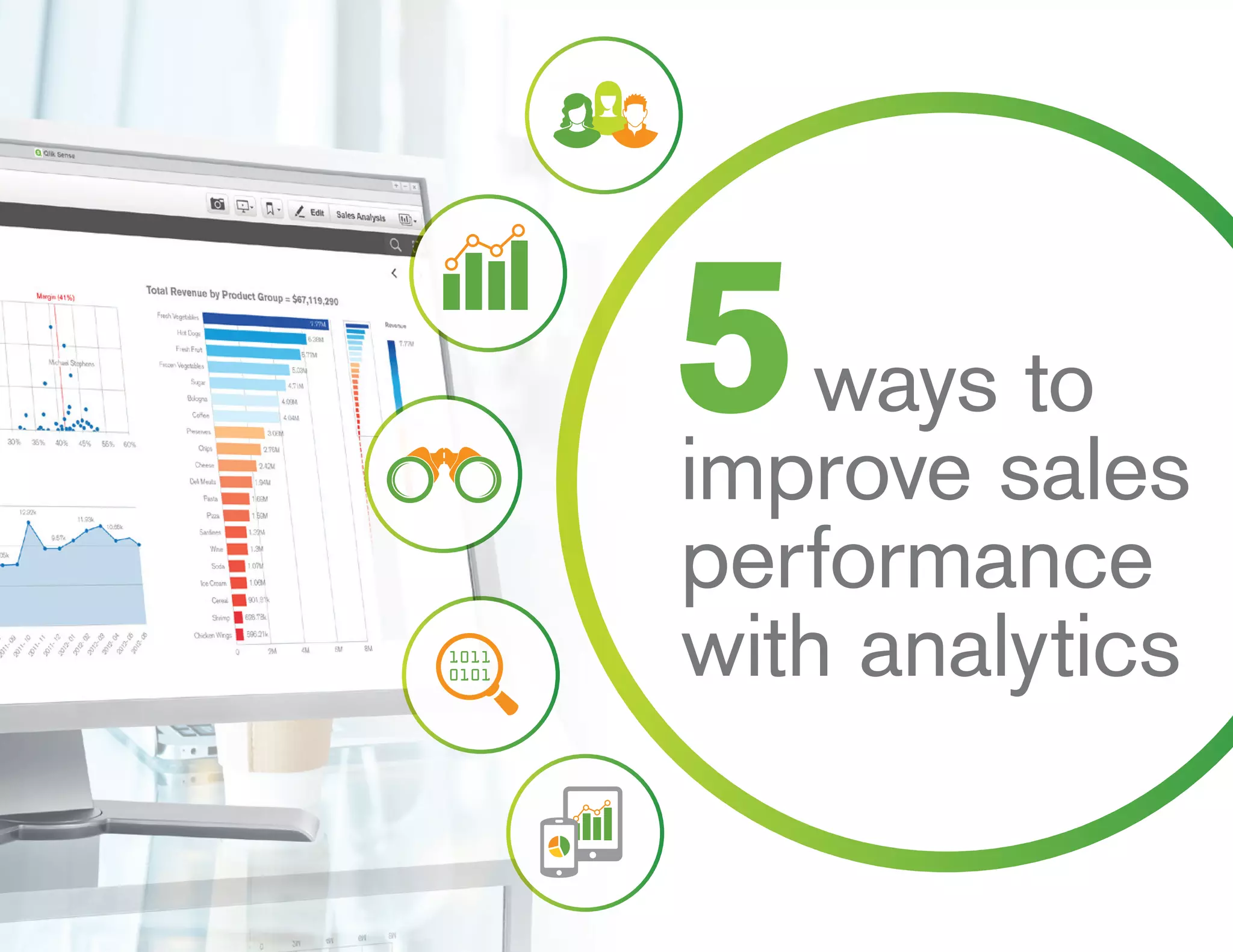
ways to
improve sales
performance
with analytics
“Sales organizations that roll their eyes at the mention
of better analytical tools are likely to see thinner pipelines
and lighter commission checks, and there’s definitely
nothing funny about that.”
Aberdeen Group, “Sales Analytics: Data Driven Forecasting for Better Quota Attainment”, April 2014.
What are sales leaders saying
about their performance—and
that of their team?
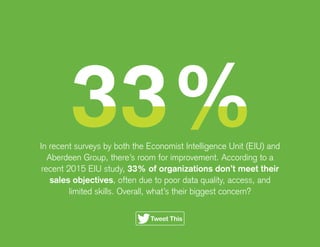
In recent surveys by both the Economist Intelligence Unit (EIU) and
Aberdeen Group, there’s room for improvement. According to a
recent 2015 EIU study, 33% of organizations don’t meet their
sales objectives, often due to poor data quality, access, and
limited skills. Overall, what’s their biggest concern?
Tweet This
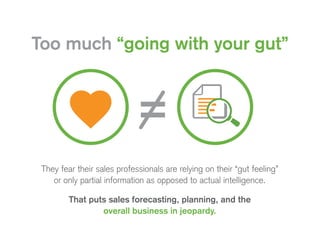
Too much “going with your gut”
They fear their sales professionals are relying on their “gut feeling”
or only partial information as opposed to actual intelligence.
That puts sales forecasting, planning, and the
overall business in jeopardy.
In this e-book, we’ll look at some
trends in the use of analytics by
sales—including what’s working
and what’s not—then look at
5 ways to improve sales
performance with analytics.
They have data, don’t they?
With the current focus on Business Intelligence (BI) and “big data,”
sales forecasting should be easier, right?
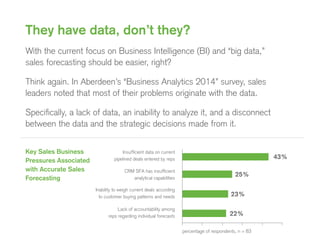
Think again. In Aberdeen’s “Business Analytics 2014” survey, sales
leaders noted that most of their problems originate with the data.
Specifically, a lack of data, an inability to analyze it, and a disconnect
between the data and the strategic decisions made from it.
Key Sales Business
Pressures Associated
with Accurate Sales
Forecasting
Insufficient data on current
pipelined deals entered by reps
CRM SFA has insufficient
analytical capabilities
Inability to weigh current deals according
to customer buying patterns and needs
Lack of accountability among
reps regarding individual forecasts
43%
percentage of respondents, n = 83
25%
23%
22%
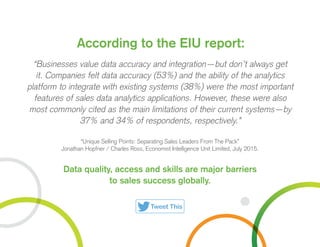
According to the EIU report:
“Businesses value data accuracy and integration—but don’t always get
it. Companies felt data accuracy (53%) and the ability of the analytics
platform to integrate with existing systems (38%) were the most important
features of sales data analytics applications. However, these were also
most commonly cited as the main limitations of their current systems—by
37% and 34% of respondents, respectively.”
Data quality, access and skills are major barriers
to sales success globally.
Tweet This
“Unique Selling Points: Separating Sales Leaders From The Pack”
Jonathan Hopfner / Charles Ross, Economist Intelligence Unit Limited, July 2015.
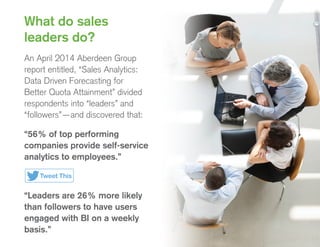
What do sales
leaders do?
An April 2014 Aberdeen Group
report entitled, “Sales Analytics:
Data Driven Forecasting for
Better Quota Attainment” divided
respondents into “leaders” and
“followers”—and discovered that:
“56% of top performing
companies provide self-service
analytics to employees.”
“Leaders are 26% more likely
than followers to have users
engaged with BI on a weekly
basis.”
Tweet This
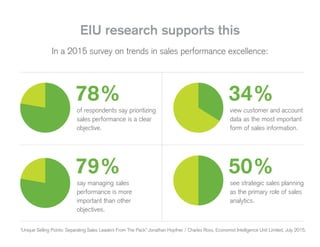
EIU research supports this
In a 2015 survey on trends in sales performance excellence:
of respondents say prioritizing
sales performance is a clear
objective.
say managing sales
performance is more
important than other
objectives.
view customer and account
data as the most important
form of sales information.
see strategic sales planning
as the primary role of sales
analytics.
78%
79%
34%
50%
“Unique Selling Points: Separating Sales Leaders From The Pack” Jonathan Hopfner / Charles Ross, Economist Intelligence Unit Limited, July 2015.
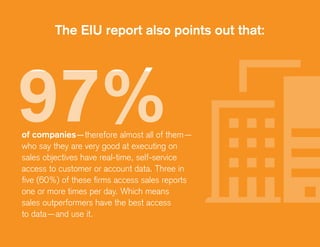
The EIU report also points out that:
of companies—therefore almost all of them—
who say they are very good at executing on
sales objectives have real-time, self-service
access to customer or account data. Three in
five (60%) of these firms access sales reports
one or more times per day. Which means
sales outperformers have the best access
to data—and use it.
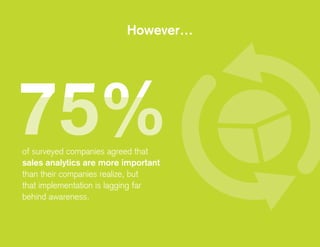
However…
of surveyed companies agreed that
sales analytics are more important
than their companies realize, but
that implementation is lagging far
behind awareness.
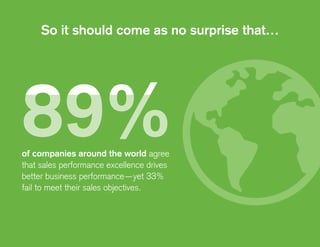
So it should come as no surprise that…
of companies around the world agree
that sales performance excellence drives
better business performance—yet 33%
fail to meet their sales objectives.
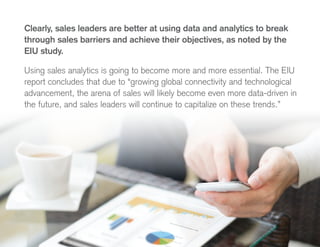
Clearly, sales leaders are better
at using data and analytics to break
through sales barriers and achieve their objectives, as noted by the
EIU study.
Using sales analytics is going to become more and more essential. The EIU
report concludes that due to “growing global connectivity and technological
advancement, the arena of sales will likely become even more data-driven in
the future, and sales leaders will continue to capitalize on these trends.”
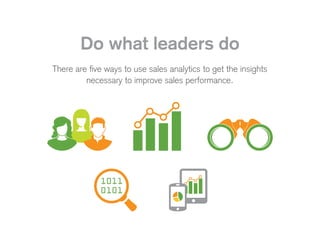
Do what leaders do
There are five ways to use sales analytics to get the insights
necessary to improve sales performance.
1.	Get an enhanced
view of customers
Sales analytics go beyond CRM data
on leads, contacts and accounts to
seek out relevant and historical data
from a variety of internal and external
data sources. This provides a view of
the customer’s behavior in real time
to determine:
•	 Which are the best products to offer this
customer or prospect?
•	 Are there similar customers that have
the same buying behavior?
•	 What is the potential revenue impact
of a specific deal?
•	 How can I grow the deal?
•	 What is the estimated sales cycle for this
deal based on historical information?
Tweet This
2. Use historical trending
to determine the best
customers—and best deals
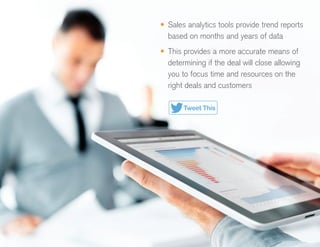
•	 Sales analytics tools provide trend reports
based on months and years of data
•	 This provides a more accurate means of
determining if the deal will close allowing
you to focus time and resources on the
right deals and customers
Tweet This
3. Trust analysis to discover
patterns and forecast
accurately
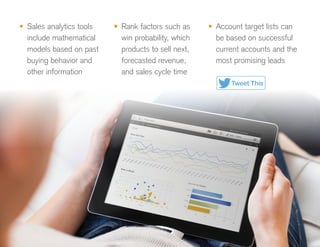
•	 Sales analytics tools
include mathematical
models based on past
buying behavior and
other information
•	 Rank factors such as
win probability, which
products to sell next,
forecasted revenue,
and sales cycle time
•	 Account target lists can
be based on successful
current accounts and the
most promising leads
Tweet This
4. See data in clearer,
more applicable ways
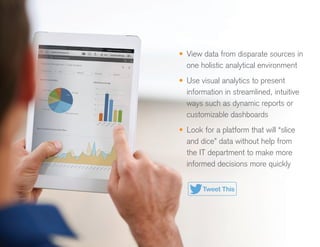
•	 View data from disparate sources in
one holistic analytical environment
•	 Use visual analytics to present
information in streamlined, intuitive
ways such as dynamic reports or
customizable dashboards
•	 Look for a platform that will “slice
and dice” data without help from
the IT department to make more
informed decisions more quickly
Tweet This
5. Get it to go
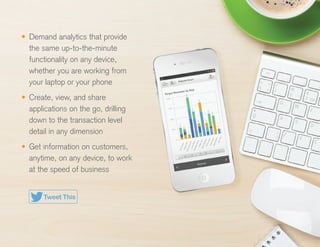
•	 Demand analytics that provide
the same up-to-the-minute
functionality on any device,
whether you are working from
your laptop or your phone
•	 Create, view, and share
applications on the go, drilling
down to the transaction level
detail in any dimension
•	 Get information on customers,
anytime, on any device, to work
at the speed of business
Tweet This
The point is…
Leading organizations rely on sales analytics to provide the
insights they need to make the right deals with the right
customers at the right price—and base revenue and quotas on
real intelligence, not gut feeling.
Sales analytics improve sales performance—and that
contributes to better business performance.
© 2015 QlikTech International AB. All rights reserved. Qlik®
, Qlik Sense®
, QlikView®
, QlikTech®
, Qlik®
Cloud, Qlik®
DataMarket, Qlik®
Analytics Platform and the QlikTech logos are
trademarks of QlikTech International AB which have been registered in multiple countries. Other marks and logos mentioned herein are trademarks or registered trademarks of their
respective owners.
qlik.com
About Qlik®
Qlik (NASDAQ: QLIK) is a leader in data discovery delivering intuitive solutions for self-service data
visualization and guided analytics. Approximately 36,000 customers rely on Qlik solutions to gain
meaning out of information from varied sources, exploring the hidden relationships within data that
lead to insights that ignite good ideas.
Discover the whole story that lives within your data with Qlik.
For more information, visit www.qlik.com/salessolutions.

5 Ways to Improve Sales Performance with Analytics

  • 1.
  • 2.
    “Sales organizations thatroll their eyes at the mention of better analytical tools are likely to see thinner pipelines and lighter commission checks, and there’s definitely nothing funny about that.” Aberdeen Group, “Sales Analytics: Data Driven Forecasting for Better Quota Attainment”, April 2014.
  • 3.
    What are salesleaders saying about their performance—and that of their team?
  • 4.
    In recent surveysby both the Economist Intelligence Unit (EIU) and Aberdeen Group, there’s room for improvement. According to a recent 2015 EIU study, 33% of organizations don’t meet their sales objectives, often due to poor data quality, access, and limited skills. Overall, what’s their biggest concern? Tweet This
  • 5.
    Too much “goingwith your gut” They fear their sales professionals are relying on their “gut feeling” or only partial information as opposed to actual intelligence. That puts sales forecasting, planning, and the overall business in jeopardy.
  • 6.
    In this e-book,we’ll look at some trends in the use of analytics by sales—including what’s working and what’s not—then look at 5 ways to improve sales performance with analytics.
  • 7.
    They have data,don’t they? With the current focus on Business Intelligence (BI) and “big data,” sales forecasting should be easier, right? Think again. In Aberdeen’s “Business Analytics 2014” survey, sales leaders noted that most of their problems originate with the data. Specifically, a lack of data, an inability to analyze it, and a disconnect between the data and the strategic decisions made from it. Key Sales Business Pressures Associated with Accurate Sales Forecasting Insufficient data on current pipelined deals entered by reps CRM SFA has insufficient analytical capabilities Inability to weigh current deals according to customer buying patterns and needs Lack of accountability among reps regarding individual forecasts 43% percentage of respondents, n = 83 25% 23% 22%
  • 8.
    According to theEIU report: “Businesses value data accuracy and integration—but don’t always get it. Companies felt data accuracy (53%) and the ability of the analytics platform to integrate with existing systems (38%) were the most important features of sales data analytics applications. However, these were also most commonly cited as the main limitations of their current systems—by 37% and 34% of respondents, respectively.” Data quality, access and skills are major barriers to sales success globally. Tweet This “Unique Selling Points: Separating Sales Leaders From The Pack” Jonathan Hopfner / Charles Ross, Economist Intelligence Unit Limited, July 2015.
  • 9.
    What do sales leadersdo? An April 2014 Aberdeen Group report entitled, “Sales Analytics: Data Driven Forecasting for Better Quota Attainment” divided respondents into “leaders” and “followers”—and discovered that: “56% of top performing companies provide self-service analytics to employees.” “Leaders are 26% more likely than followers to have users engaged with BI on a weekly basis.” Tweet This
  • 10.
    EIU research supportsthis In a 2015 survey on trends in sales performance excellence: of respondents say prioritizing sales performance is a clear objective. say managing sales performance is more important than other objectives. view customer and account data as the most important form of sales information. see strategic sales planning as the primary role of sales analytics. 78% 79% 34% 50% “Unique Selling Points: Separating Sales Leaders From The Pack” Jonathan Hopfner / Charles Ross, Economist Intelligence Unit Limited, July 2015.
  • 11.
    The EIU reportalso points out that: of companies—therefore almost all of them— who say they are very good at executing on sales objectives have real-time, self-service access to customer or account data. Three in five (60%) of these firms access sales reports one or more times per day. Which means sales outperformers have the best access to data—and use it.
  • 12.
    However… of surveyed companiesagreed that sales analytics are more important than their companies realize, but that implementation is lagging far behind awareness.
  • 13.
    So it shouldcome as no surprise that… of companies around the world agree that sales performance excellence drives better business performance—yet 33% fail to meet their sales objectives.
  • 14.
    Clearly, sales leadersare better
at using data and analytics to break through sales barriers and achieve their objectives, as noted by the EIU study. Using sales analytics is going to become more and more essential. The EIU report concludes that due to “growing global connectivity and technological advancement, the arena of sales will likely become even more data-driven in the future, and sales leaders will continue to capitalize on these trends.”
  • 15.
    Do what leadersdo There are five ways to use sales analytics to get the insights necessary to improve sales performance.
  • 16.
  • 17.
    Sales analytics gobeyond CRM data on leads, contacts and accounts to seek out relevant and historical data from a variety of internal and external data sources. This provides a view of the customer’s behavior in real time to determine: • Which are the best products to offer this customer or prospect? • Are there similar customers that have the same buying behavior? • What is the potential revenue impact of a specific deal? • How can I grow the deal? • What is the estimated sales cycle for this deal based on historical information? Tweet This
  • 18.
    2. Use historicaltrending to determine the best customers—and best deals
  • 19.
    • Sales analyticstools provide trend reports based on months and years of data • This provides a more accurate means of determining if the deal will close allowing you to focus time and resources on the right deals and customers Tweet This
  • 20.
    3. Trust analysisto discover patterns and forecast accurately
  • 21.
    • Sales analyticstools include mathematical models based on past buying behavior and other information • Rank factors such as win probability, which products to sell next, forecasted revenue, and sales cycle time • Account target lists can be based on successful current accounts and the most promising leads Tweet This
  • 22.
    4. See datain clearer, more applicable ways
  • 23.
    • View datafrom disparate sources in one holistic analytical environment • Use visual analytics to present information in streamlined, intuitive ways such as dynamic reports or customizable dashboards • Look for a platform that will “slice and dice” data without help from the IT department to make more informed decisions more quickly Tweet This
  • 24.
    5. Get itto go
  • 25.
    • Demand analyticsthat provide the same up-to-the-minute functionality on any device, whether you are working from your laptop or your phone • Create, view, and share applications on the go, drilling down to the transaction level detail in any dimension • Get information on customers, anytime, on any device, to work at the speed of business Tweet This
  • 26.
    The point is… Leadingorganizations rely on sales analytics to provide the insights they need to make the right deals with the right customers at the right price—and base revenue and quotas on real intelligence, not gut feeling. Sales analytics improve sales performance—and that contributes to better business performance.
  • 27.
    © 2015 QlikTechInternational AB. All rights reserved. Qlik® , Qlik Sense® , QlikView® , QlikTech® , Qlik® Cloud, Qlik® DataMarket, Qlik® Analytics Platform and the QlikTech logos are trademarks of QlikTech International AB which have been registered in multiple countries. Other marks and logos mentioned herein are trademarks or registered trademarks of their respective owners. qlik.com About Qlik® Qlik (NASDAQ: QLIK) is a leader in data discovery delivering intuitive solutions for self-service data visualization and guided analytics. Approximately 36,000 customers rely on Qlik solutions to gain meaning out of information from varied sources, exploring the hidden relationships within data that lead to insights that ignite good ideas. Discover the whole story that lives within your data with Qlik. For more information, visit www.qlik.com/salessolutions.