 Critical insights & contextual analysis of the current
policies and practices of public and private sectors
that affect smallholders - including rain-fed rice
farmers - in attaining sustainable livelihoods,
productivity and profitability while facing the
pressure of climate change.
 Research findings and recommendations for policy
advocacy work to inform the policy advocacy and
communication activities supported by the SEMIL-SRI-
LMB.
2
 Small holder Farmers (Women)
 Overall Policy Framework which has
implication on smallholder farmers
 Transitioning agriculture (affecting smallholders)
 Farmers’ choice (all 4)
 Rural finance (all 4)
 Rural industries or processing (all 4)
 Access to inputs – including labor (all 4)
 Access to markets (all 4)
 Private sector partnerships (all 4)
 Access to Land and the Rule of Law (Cambodia, Lao PDR, Vietnam)
 Irrigation (Cambodia, Lao PDR)
 Farmers’ groups (Lao PDR, Vietnam)
 Contract farming: Thailand
 Women representation ( all 4)
5
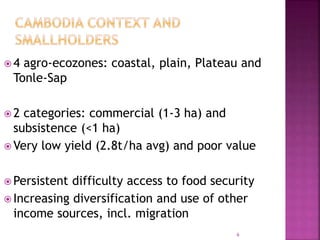
 4 agro-ecozones: coastal, plain, Plateau and
Tonle-Sap
 2 categories: commercial (1-3 ha) and
subsistence (<1 ha)
 Very low yield (2.8t/ha avg) and poor value
 Persistent difficulty access to food security
 Increasing diversification and use of other
income sources, incl. migration
6
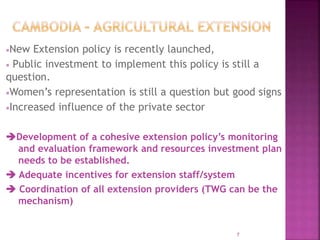
New Extension policy is recently launched,
 Public investment to implement this policy is still a
question.
Women’s representation is still a question but good signs
Increased influence of the private sector
Development of a cohesive extension policy’s monitoring
and evaluation framework and resources investment plan
needs to be established.
 Adequate incentives for extension staff/system
 Coordination of all extension providers (TWG can be the
mechanism)
7
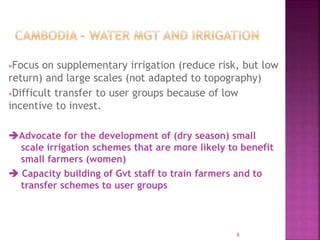
Focus on supplementary irrigation (reduce risk, but low
return) and large scales (not adapted to topography)
Difficult transfer to user groups because of low
incentive to invest.
Advocate for the development of (dry season) small
scale irrigation schemes that are more likely to benefit
small farmers (women)
 Capacity building of Gvt staff to train farmers and to
transfer schemes to user groups
8
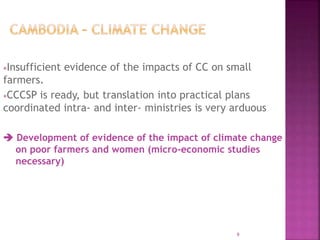
Insufficient evidence of the impacts of CC on small
farmers.
CCCSP is ready, but translation into practical plans
coordinated intra- and inter- ministries is very arduous
 Development of evidence of the impact of climate change
on poor farmers and women (micro-economic studies
necessary)
9
 Key rice producing area: 7 plains.
 2 distinct small farmers: plain (about 3.5 T/h)
and upland (about 1.9 T/ha)
 92 % glutinous rice
 Plain farmers are increasingly commercial
 Upland farmers are switching to cash crops
10
Industrialization of the agricultural sector
Use of natural resources to generate income (“turning
land into capital”)
Little coordination between ministries with opposite
goals.
 MAF decided to transform from service provider to
facilitator  good opportunities.
 New Law -Farmers cooperative/Association will bring
a good opportunity to SEMIL project.
11
Schemes are under-performing because:
 poor non-participatory designs
 lack of investment (most channels are earthen) / mismatch design vs
resources
Disconnection between irrigation schemes and markets (input and
output)
Positive move towards reinforcing user groups.
Guidelines for co-management between user groups and gvt
 Participatory design of irrigation scheme with focus on small-
scale and sustainability. Balance between supplementary and
dry irrigation.
12
Very positive development
MAF transitions from service provider to facilitator
commercial farmers cooperatives are created.
Strengthen enabling environment for farmers cooperatives to
ensure that they do not become a relay for political
structures, but serve their members.
 Women in extension services
Provide networking opportunities for farmers cooperatives.
Advocate for direct provision of seed fund to cooperatives.
13
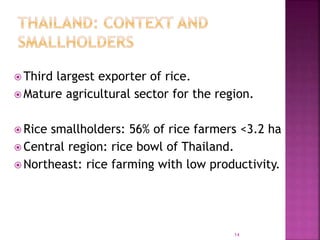
 Third largest exporter of rice.
 Mature agricultural sector for the region.
 Rice smallholders: 56% of rice farmers <3.2 ha
 Central region: rice bowl of Thailand.
 Northeast: rice farming with low productivity.
14
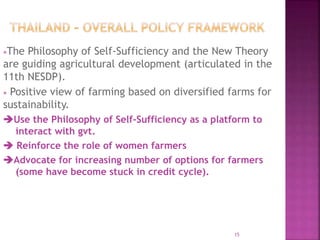
The Philosophy of Self-Sufficiency and the New Theory
are guiding agricultural development (articulated in the
11th NESDP).
 Positive view of farming based on diversified farms for
sustainability.
Use the Philosophy of Self-Sufficiency as a platform to
interact with gvt.
 Reinforce the role of women farmers
Advocate for increasing number of options for farmers
(some have become stuck in credit cycle).
15
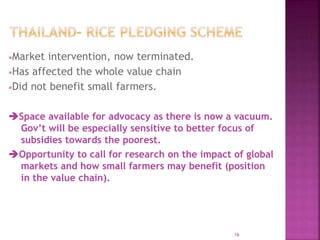
Market intervention, now terminated.
Has affected the whole value chain
Did not benefit small farmers.
Space available for advocacy as there is now a vacuum.
Gov’t will be especially sensitive to better focus of
subsidies towards the poorest.
Opportunity to call for research on the impact of global
markets and how small farmers may benefit (position
in the value chain).
16
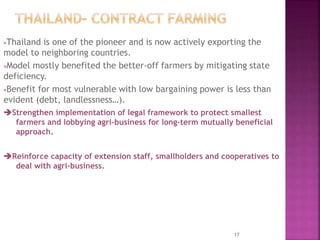
Thailand is one of the pioneer and is now actively exporting the
model to neighboring countries.
Model mostly benefited the better-off farmers by mitigating state
deficiency.
Benefit for most vulnerable with low bargaining power is less than
evident (debt, landlessness…).
Strengthen implementation of legal framework to protect smallest
farmers and lobbying agri-business for long-term mutually beneficial
approach.
Reinforce capacity of extension staff, smallholders and cooperatives to
deal with agri-business.
17
Successful promotion by Thai government
Slow uptake as organic certification is too expensive for
smallholders or cooperatives.
Reinforce attractiveness for farmers by raising profile of
Thai organic rice /or SRI rice on domestic and
international markets and by awareness campaign on the
benefits (fits with the New Philosophy)
18
 Doi Moi in 1986.
 Increased yield and diversification into non-
farm activities.
 Smallholders <
 0.5 ha with fragmented land.
 30-35% of rural population poor or near poor.
 Smallholders mainly live in disadvantaged
areas: North and central highlands. Rice is not
as important for them as for others. 19
Continues to guide Gvt policy intervention with - results in low-
quality high-volume.
Gvt’s strong interventionism in export and less focus on domestic
rice market
Focus on rice quality for policy intervention on domestic
market and ensure this is enshrined in next SEDP (drafting is
starting)
20
95% of farmers have a land use certificate.
 Farmers’ opportunities to diversify into other areas and increase
incomes are limited by factors like water consumption, labor use,
carbon emissions.
 The designated rice land policy and difficulties in land-use
transformation (Decree No. 42/2012/NĐ-CP dated 11 May 2012
requires the Prime Minister's approval for any change of land-use
purpose from designated rice land to non-farm usage).
 Review the new agriculture restructuring re potential benefit
to smallholder farmers.
Constructive dialogue with Provincial govt/ Farmer Union for
possible way to promote/strengthen small holder farmers to
gain more benefit from rice production policy.
21
Various services are offered, including technical trainings, field
demonstration workshops, on-site consultation, and provision of
market information.
However extension services is mostly to response to govt’s
objectives (not really focus on demand-driven), with insufficient
budget and not wider reaching to the poor.
Recent positive evolutions have seen increased budget for extension.
Emphasis on the quality of services and women as the audience.
 Incentives for private or farmer-led extension services
(including transparent input registration…)
Facilitation of contract farming arrangements with
development of regulations and mechanisms to protect the
poorest
22
 The Philosophy of Self-Sufficiency and The New Theory
in Thailand
 Lao PDR’s focus on farmers’ cooperatives and on public
extension as a facilitator
 Rice Production Policy- support to reduce input cost in
Viet Nam
 Thailand experiment with precision farming and support
to organic agriculture.
 New Extension policy ‘s monitoring and implementing
and monitoring resource allocation for extension in
ASDP2014-2018 for Cambodia
23
24

Learnings from policy baseline research of SRI-LMB - Mr. Brian Lund

  • 2.
     Critical insights& contextual analysis of the current policies and practices of public and private sectors that affect smallholders - including rain-fed rice farmers - in attaining sustainable livelihoods, productivity and profitability while facing the pressure of climate change.  Research findings and recommendations for policy advocacy work to inform the policy advocacy and communication activities supported by the SEMIL-SRI- LMB. 2
  • 3.
     Small holderFarmers (Women)  Overall Policy Framework which has implication on smallholder farmers
  • 5.
     Transitioning agriculture(affecting smallholders)  Farmers’ choice (all 4)  Rural finance (all 4)  Rural industries or processing (all 4)  Access to inputs – including labor (all 4)  Access to markets (all 4)  Private sector partnerships (all 4)  Access to Land and the Rule of Law (Cambodia, Lao PDR, Vietnam)  Irrigation (Cambodia, Lao PDR)  Farmers’ groups (Lao PDR, Vietnam)  Contract farming: Thailand  Women representation ( all 4) 5
  • 6.
     4 agro-ecozones:coastal, plain, Plateau and Tonle-Sap  2 categories: commercial (1-3 ha) and subsistence (<1 ha)  Very low yield (2.8t/ha avg) and poor value  Persistent difficulty access to food security  Increasing diversification and use of other income sources, incl. migration 6
  • 7.
    New Extension policyis recently launched,  Public investment to implement this policy is still a question. Women’s representation is still a question but good signs Increased influence of the private sector Development of a cohesive extension policy’s monitoring and evaluation framework and resources investment plan needs to be established.  Adequate incentives for extension staff/system  Coordination of all extension providers (TWG can be the mechanism) 7
  • 8.
    Focus on supplementaryirrigation (reduce risk, but low return) and large scales (not adapted to topography) Difficult transfer to user groups because of low incentive to invest. Advocate for the development of (dry season) small scale irrigation schemes that are more likely to benefit small farmers (women)  Capacity building of Gvt staff to train farmers and to transfer schemes to user groups 8
  • 9.
    Insufficient evidence ofthe impacts of CC on small farmers. CCCSP is ready, but translation into practical plans coordinated intra- and inter- ministries is very arduous  Development of evidence of the impact of climate change on poor farmers and women (micro-economic studies necessary) 9
  • 10.
     Key riceproducing area: 7 plains.  2 distinct small farmers: plain (about 3.5 T/h) and upland (about 1.9 T/ha)  92 % glutinous rice  Plain farmers are increasingly commercial  Upland farmers are switching to cash crops 10
  • 11.
    Industrialization of theagricultural sector Use of natural resources to generate income (“turning land into capital”) Little coordination between ministries with opposite goals.  MAF decided to transform from service provider to facilitator  good opportunities.  New Law -Farmers cooperative/Association will bring a good opportunity to SEMIL project. 11
  • 12.
    Schemes are under-performingbecause:  poor non-participatory designs  lack of investment (most channels are earthen) / mismatch design vs resources Disconnection between irrigation schemes and markets (input and output) Positive move towards reinforcing user groups. Guidelines for co-management between user groups and gvt  Participatory design of irrigation scheme with focus on small- scale and sustainability. Balance between supplementary and dry irrigation. 12
  • 13.
    Very positive development MAFtransitions from service provider to facilitator commercial farmers cooperatives are created. Strengthen enabling environment for farmers cooperatives to ensure that they do not become a relay for political structures, but serve their members.  Women in extension services Provide networking opportunities for farmers cooperatives. Advocate for direct provision of seed fund to cooperatives. 13
  • 14.
     Third largestexporter of rice.  Mature agricultural sector for the region.  Rice smallholders: 56% of rice farmers <3.2 ha  Central region: rice bowl of Thailand.  Northeast: rice farming with low productivity. 14
  • 15.
    The Philosophy ofSelf-Sufficiency and the New Theory are guiding agricultural development (articulated in the 11th NESDP).  Positive view of farming based on diversified farms for sustainability. Use the Philosophy of Self-Sufficiency as a platform to interact with gvt.  Reinforce the role of women farmers Advocate for increasing number of options for farmers (some have become stuck in credit cycle). 15
  • 16.
    Market intervention, nowterminated. Has affected the whole value chain Did not benefit small farmers. Space available for advocacy as there is now a vacuum. Gov’t will be especially sensitive to better focus of subsidies towards the poorest. Opportunity to call for research on the impact of global markets and how small farmers may benefit (position in the value chain). 16
  • 17.
    Thailand is oneof the pioneer and is now actively exporting the model to neighboring countries. Model mostly benefited the better-off farmers by mitigating state deficiency. Benefit for most vulnerable with low bargaining power is less than evident (debt, landlessness…). Strengthen implementation of legal framework to protect smallest farmers and lobbying agri-business for long-term mutually beneficial approach. Reinforce capacity of extension staff, smallholders and cooperatives to deal with agri-business. 17
  • 18.
    Successful promotion byThai government Slow uptake as organic certification is too expensive for smallholders or cooperatives. Reinforce attractiveness for farmers by raising profile of Thai organic rice /or SRI rice on domestic and international markets and by awareness campaign on the benefits (fits with the New Philosophy) 18
  • 19.
     Doi Moiin 1986.  Increased yield and diversification into non- farm activities.  Smallholders <  0.5 ha with fragmented land.  30-35% of rural population poor or near poor.  Smallholders mainly live in disadvantaged areas: North and central highlands. Rice is not as important for them as for others. 19
  • 20.
    Continues to guideGvt policy intervention with - results in low- quality high-volume. Gvt’s strong interventionism in export and less focus on domestic rice market Focus on rice quality for policy intervention on domestic market and ensure this is enshrined in next SEDP (drafting is starting) 20
  • 21.
    95% of farmershave a land use certificate.  Farmers’ opportunities to diversify into other areas and increase incomes are limited by factors like water consumption, labor use, carbon emissions.  The designated rice land policy and difficulties in land-use transformation (Decree No. 42/2012/NĐ-CP dated 11 May 2012 requires the Prime Minister's approval for any change of land-use purpose from designated rice land to non-farm usage).  Review the new agriculture restructuring re potential benefit to smallholder farmers. Constructive dialogue with Provincial govt/ Farmer Union for possible way to promote/strengthen small holder farmers to gain more benefit from rice production policy. 21
  • 22.
    Various services areoffered, including technical trainings, field demonstration workshops, on-site consultation, and provision of market information. However extension services is mostly to response to govt’s objectives (not really focus on demand-driven), with insufficient budget and not wider reaching to the poor. Recent positive evolutions have seen increased budget for extension. Emphasis on the quality of services and women as the audience.  Incentives for private or farmer-led extension services (including transparent input registration…) Facilitation of contract farming arrangements with development of regulations and mechanisms to protect the poorest 22
  • 23.
     The Philosophyof Self-Sufficiency and The New Theory in Thailand  Lao PDR’s focus on farmers’ cooperatives and on public extension as a facilitator  Rice Production Policy- support to reduce input cost in Viet Nam  Thailand experiment with precision farming and support to organic agriculture.  New Extension policy ‘s monitoring and implementing and monitoring resource allocation for extension in ASDP2014-2018 for Cambodia 23
  • 24.

Editor's Notes

  • #6 Rule of law: Cambodia, Lao and Vietnam in land issues Agronomy: Abha: important to see how these policies are linked to regional policies. Regional policy recommendation: should discuss on the context of food security, at this stage is was very generic. GSPS: Chris: Q the methodology that you use: the ranking, then you miss something: Key themes for synery: key theme should conten wide rank rather than number. Rank.
  • #7 Labour becomes an issue in Cambodia
  • #10 Found very little evidence of impact of CC on smallholder farmers: haven’ts seen details research on the impact of CC on smallholders (this is something the project should do Abha: the project review “climate change adaptation - to “prepare for” instead of “copping with”. And the project is willing to look at the impact (??) Intra-ministries: sometime it is difficult Abha: can you narrow down the “policy recommendation” to “policy option”  how to make this is project’s policy recommendations to be in line with. Go to interview the personal Abha: Highlight the activity/indicators in each policy of the government. Review many policy documents what strongly support the
  • #12 Maf decided to transform from servide provider to facilitator  good opportunities. Farmers cooperative: - SEMIL can work.
  • #15 The most mature country in term of rice cultivation 2008: middle income country The philosophy of self sufficiency and the new theory are guiding Thailand: New Theo Small farmer: need to be diversify, “reuse the language of the kind in the new theory!”
  • #17 Government Disappointing for farmers: compare paddy rice at farme gate (18 bath/kg  8bth/kg) most of the farmers. SRI rice or organic rice?
  • #18 Thailand is leading country in this
  • #20 Rice co Policy influencing ntrol
  • #25 L