1
BASIC SHIP HYDROSTATICS
PART I
Prepared By : A.CHANDA, IMU Kolkata
2
DENSITY
• DENSITY OF A SUBSTANCE IS THE MASS OF AN UNIT VOLUME
OF THE SUBSTANCE AND MAY BE EXPRESSED IN GRAMMES
PER MILLILITRE (G/ML), KILOGRAMMES PER CUBIC METRE
(KG/M3) OR TONNES PER CUBICMETRE (T/M3). THE
NUMERICAL VALUES OF G/ML ARE THE SAME AS T/M3.
• THE DENSITY OF FRESH WATER MAY BE TAKEN AS 1.000 T/M3
OR 1000 KG/M3.
• THE DENSITY OF SEA WATER MAY BE TAKEN AS 1.025 T/M3
OR 1025 KG/M3.
3
RELATIVE DENSITY
• RELATIVE DENSITY (or SPECIFIC GRAVITY) OF A SUBSTANCE IS
THE DENSITY OF THE SUBSTANCE DIVIDED BY THE DENSITY OF
FRESH WATER. IE, THE RATIO OF THE MASS OF ANY VOLUME OF
THE SUBSTANCE TO THE MASS OF THE SAME VOLUME OF FRESH
WATER.
• THUS THE RELATIVE DENSITY OF FRESH WATER IS 1.000 AND THE
RELATIVE DENSITY OF SEA WATER IS 1025/1000 = 1.025
• IT IS USEFUL TO KNOW THAT THE DESNITY OF A SUBSTANCE
EXPRESSED IN T/M3 IS NUMERICALLY THE SAME AS RELATIVE
DENSITY OF THE SUBSTANCE.
• EXAMPLE : SP. GR. OF STEEL = 7.85,
• SP. GR. OF ALUMINIUM = 2.7
4
Numerical Problem No. 1
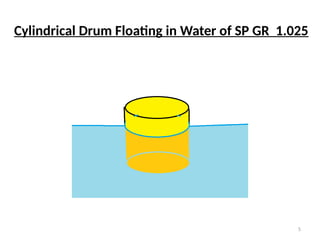
• A cylindrical drum 1.5 m long and 60 cm in dia has a mass of 20 KG when
empty. Find its draught in water of density 1025 Kg per M3 (Sp gr 1.025), if
it contains 200 lits of parafin with r.d. 0.6 (sp gr 0.6) and is floating with its
axis perpendicular to the waterline.
• SOLUTION :Weight of 200 lit of parafin =0.6 X1000 Kg/m3 X
200/1000
• = 120 Kg
• Therefore Total Weight of System = 20 +120 = 140 Kg
5
Cylindrical Drum Floating in Water of SP GR 1.025
6
Solution to Problem 1 contd.
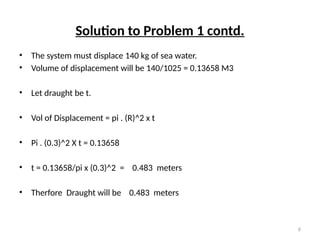
• The system must displace 140 kg of sea water.
• Volume of displacement will be 140/1025 = 0.13658 M3
• Let draught be t.
• Vol of Displacement = pi . (R)^2 x t
• Pi . (0.3)^2 X t = 0.13658
• t = 0.13658/pi x (0.3)^2 = 0.483 meters
• Therfore Draught will be 0.483 meters
7
PRESSURE EXERTED BY A LIQUID
• LIQUID PRESSURE IS THE LOAD PER UNIT AREA
EXERTED BY THE LIQUID.
• THE PRESSURE ACTS UNIFORMLY IN ALL DIRECTIONS
AND PERPENDICULAR TO THE SURFACE OF ANY
IMMERSED PLANE.
• THE LIQUID PRESSURE AT ANY POINT IN THE LIQIUID
DEPENDS ON THE DENSITY OF THE LIQUID ρ, AND
THE VERTICAL DISTANCE h FROM THE POINT TO THE
SURFACE OF THE LIQUID. The distance h is known as
the head of the liquid.
8
PRESSURE EXERTED BY A LIQUID
• Thus the pressure at any point is given by
• Pressure = ρ. g. h
• Where ρ is the density of the liquid
• “g” is acceleration due to gravity
• “h” is the vertical height to the surface of the
water.
9
PRESSURE EXERTED BY A LIQUID
10
PRESSURE EXERTED BY A LIQUID
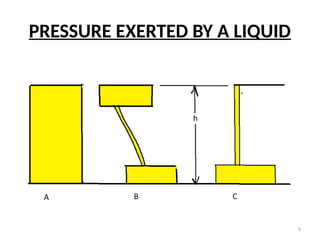
• THE PRESSURE AT THE BASE OF EACH OF THE CONTAINERS IN THE
PREVIOUS SLIDE IS ρ.g.h , ALTHOUGH IT MAY BE SEEN THAT THE
TOTAL MASS OF LIQUID IS DIFFERENT IN EACH CASE.
• CONTAINER B COULD REPRESENT A HEADER TANK AND SUPPLY TANK IN A
DOMESTIC WATER SUPPLY SYSTEM. THE PRESSURE AT THE SUPPLY TANK
DEPENDS ON THE HEIGHT OF THE HEADER TANK.
• CONTAINER C COULD REPRESENT A DOUBLE BOTTOM TANK IN A SHIP
HAVING A VERTICAL OVERFLOW PIPE. THE PRESSURE IN THE TANK
DEPENDS ON THE HEIGHT TO WHICH THE WATER RISES IN THE OVERFLOW
PIPE.
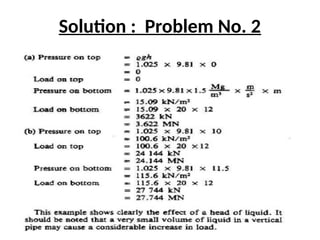
• THE TOTAL LOAD EXERTED BY THE LIQUID ON A HORIZONTAL PLANE IS
THE PRODUCT OF THE PRESSURE AND THE AREA OF THE THE HORIZONTAL
PLANE. LOAD = PRESSURE X AREA
11
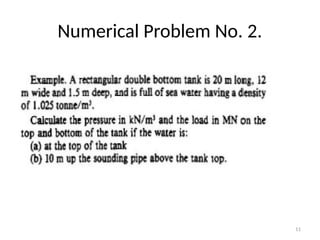
Numerical Problem No. 2.
12
Solution : Problem No. 2
13
ARCHIMEDES PRINCIPLE
• WHEN A BODY IS IMMERSED EITHER
WHOLLY OR PARTLY IN A FLUID AT REST,
IT APPEARS TO LOSE A PART OF ITS
WEIGHT, WHICH IS EQUAL TO THE
WEIGHT OF THE FLUID DISPLACED.
14
ARCHIMEDES PRINCIPLE
15
ARCHIMEDES PRINCIPLE
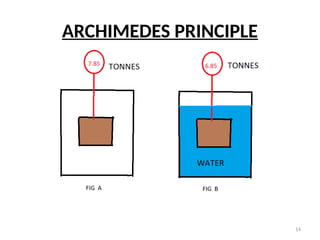
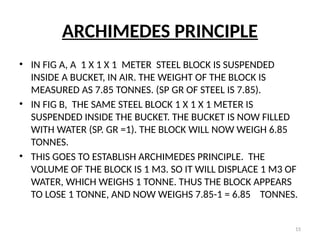
• IN FIG A, A 1 X 1 X 1 METER STEEL BLOCK IS SUSPENDED
INSIDE A BUCKET, IN AIR. THE WEIGHT OF THE BLOCK IS
MEASURED AS 7.85 TONNES. (SP GR OF STEEL IS 7.85).
• IN FIG B, THE SAME STEEL BLOCK 1 X 1 X 1 METER IS
SUSPENDED INSIDE THE BUCKET. THE BUCKET IS NOW FILLED
WITH WATER (SP. GR =1). THE BLOCK WILL NOW WEIGH 6.85
TONNES.
• THIS GOES TO ESTABLISH ARCHIMEDES PRINCIPLE. THE
VOLUME OF THE BLOCK IS 1 M3. SO IT WILL DISPLACE 1 M3 OF
WATER, WHICH WEIGHS 1 TONNE. THUS THE BLOCK APPEARS
TO LOSE 1 TONNE, AND NOW WEIGHS 7.85-1 = 6.85 TONNES.
16
BUOYANCY
• BUOYANCY is the term given to the upthrust
exerted by the water on the ship.
• If the ship floats freely, the buoyancy is equal
to the weight of the ship.
• The force of BUOYANCY acts at the centre of
Buoyancy, which is the centroid of the under
water volume of the ship.
17
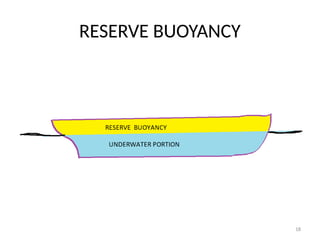
RESERVE BUOYANCY
• A floating vessel displaces its own weight of water. Therefore
it is the submerged portion of the floating vessel which
provides the buoyancy. The volume of the enclosed spaces
above the waterline are not providing buoyancy but are being
held in reserve.
• If extra weights are loaded to increase the displacement ,
these spaces above the waterline are there to provide the
extra buoyancy required.
• Thus RESERVE BUOYANCY may be defined as the volume of
the enclosed spaces above the waterline. It may be expressed
as a volume or as a percentage of the total volume of the
ship.
18
RESERVE BUOYANCY
19
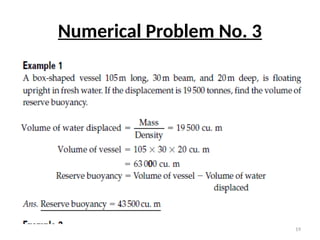
Numerical Problem No. 3
20
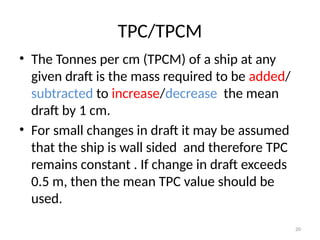
TPC/TPCM
• The Tonnes per cm (TPCM) of a ship at any
given draft is the mass required to be added/
subtracted to increase/decrease the mean
draft by 1 cm.
• For small changes in draft it may be assumed
that the ship is wall sided and therefore TPC
remains constant . If change in draft exceeds
0.5 m, then the mean TPC value should be
used.
21
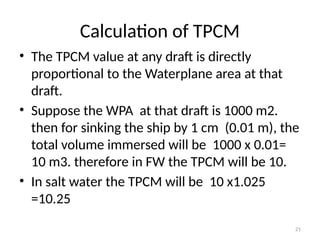
Calculation of TPCM
• The TPCM value at any draft is directly
proportional to the Waterplane area at that
draft.
• Suppose the WPA at that draft is 1000 m2.
then for sinking the ship by 1 cm (0.01 m), the
total volume immersed will be 1000 x 0.01=
10 m3. therefore in FW the TPCM will be 10.
• In salt water the TPCM will be 10 x1.025
=10.25
22
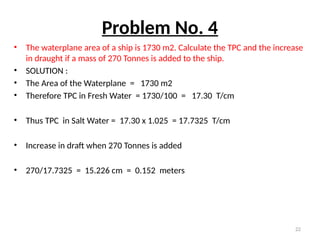
Problem No. 4
• The waterplane area of a ship is 1730 m2. Calculate the TPC and the increase
in draught if a mass of 270 Tonnes is added to the ship.
• SOLUTION :
• The Area of the Waterplane = 1730 m2
• Therefore TPC in Fresh Water = 1730/100 = 17.30 T/cm
• Thus TPC in Salt Water = 17.30 x 1.025 = 17.7325 T/cm
• Increase in draft when 270 Tonnes is added
• 270/17.7325 = 15.226 cm = 0.152 meters
23
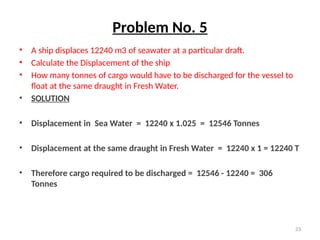
Problem No. 5
• A ship displaces 12240 m3 of seawater at a particular draft.
• Calculate the Displacement of the ship
• How many tonnes of cargo would have to be discharged for the vessel to
float at the same draught in Fresh Water.
• SOLUTION
• Displacement in Sea Water = 12240 x 1.025 = 12546 Tonnes
• Displacement at the same draught in Fresh Water = 12240 x 1 = 12240 T
• Therefore cargo required to be discharged = 12546 - 12240 = 306
Tonnes
24
END OF PART I

BASIC SHIP HYDROSTATICS details PART I.pptx

  • 1.
    1 BASIC SHIP HYDROSTATICS PARTI Prepared By : A.CHANDA, IMU Kolkata
  • 2.
    2 DENSITY • DENSITY OFA SUBSTANCE IS THE MASS OF AN UNIT VOLUME OF THE SUBSTANCE AND MAY BE EXPRESSED IN GRAMMES PER MILLILITRE (G/ML), KILOGRAMMES PER CUBIC METRE (KG/M3) OR TONNES PER CUBICMETRE (T/M3). THE NUMERICAL VALUES OF G/ML ARE THE SAME AS T/M3. • THE DENSITY OF FRESH WATER MAY BE TAKEN AS 1.000 T/M3 OR 1000 KG/M3. • THE DENSITY OF SEA WATER MAY BE TAKEN AS 1.025 T/M3 OR 1025 KG/M3.
  • 3.
    3 RELATIVE DENSITY • RELATIVEDENSITY (or SPECIFIC GRAVITY) OF A SUBSTANCE IS THE DENSITY OF THE SUBSTANCE DIVIDED BY THE DENSITY OF FRESH WATER. IE, THE RATIO OF THE MASS OF ANY VOLUME OF THE SUBSTANCE TO THE MASS OF THE SAME VOLUME OF FRESH WATER. • THUS THE RELATIVE DENSITY OF FRESH WATER IS 1.000 AND THE RELATIVE DENSITY OF SEA WATER IS 1025/1000 = 1.025 • IT IS USEFUL TO KNOW THAT THE DESNITY OF A SUBSTANCE EXPRESSED IN T/M3 IS NUMERICALLY THE SAME AS RELATIVE DENSITY OF THE SUBSTANCE. • EXAMPLE : SP. GR. OF STEEL = 7.85, • SP. GR. OF ALUMINIUM = 2.7
  • 4.
    4 Numerical Problem No.1 • A cylindrical drum 1.5 m long and 60 cm in dia has a mass of 20 KG when empty. Find its draught in water of density 1025 Kg per M3 (Sp gr 1.025), if it contains 200 lits of parafin with r.d. 0.6 (sp gr 0.6) and is floating with its axis perpendicular to the waterline. • SOLUTION :Weight of 200 lit of parafin =0.6 X1000 Kg/m3 X 200/1000 • = 120 Kg • Therefore Total Weight of System = 20 +120 = 140 Kg
  • 5.
    5 Cylindrical Drum Floatingin Water of SP GR 1.025
  • 6.
    6 Solution to Problem1 contd. • The system must displace 140 kg of sea water. • Volume of displacement will be 140/1025 = 0.13658 M3 • Let draught be t. • Vol of Displacement = pi . (R)^2 x t • Pi . (0.3)^2 X t = 0.13658 • t = 0.13658/pi x (0.3)^2 = 0.483 meters • Therfore Draught will be 0.483 meters
  • 7.
    7 PRESSURE EXERTED BYA LIQUID • LIQUID PRESSURE IS THE LOAD PER UNIT AREA EXERTED BY THE LIQUID. • THE PRESSURE ACTS UNIFORMLY IN ALL DIRECTIONS AND PERPENDICULAR TO THE SURFACE OF ANY IMMERSED PLANE. • THE LIQUID PRESSURE AT ANY POINT IN THE LIQIUID DEPENDS ON THE DENSITY OF THE LIQUID ρ, AND THE VERTICAL DISTANCE h FROM THE POINT TO THE SURFACE OF THE LIQUID. The distance h is known as the head of the liquid.
  • 8.
    8 PRESSURE EXERTED BYA LIQUID • Thus the pressure at any point is given by • Pressure = ρ. g. h • Where ρ is the density of the liquid • “g” is acceleration due to gravity • “h” is the vertical height to the surface of the water.
  • 9.
  • 10.
    10 PRESSURE EXERTED BYA LIQUID • THE PRESSURE AT THE BASE OF EACH OF THE CONTAINERS IN THE PREVIOUS SLIDE IS ρ.g.h , ALTHOUGH IT MAY BE SEEN THAT THE TOTAL MASS OF LIQUID IS DIFFERENT IN EACH CASE. • CONTAINER B COULD REPRESENT A HEADER TANK AND SUPPLY TANK IN A DOMESTIC WATER SUPPLY SYSTEM. THE PRESSURE AT THE SUPPLY TANK DEPENDS ON THE HEIGHT OF THE HEADER TANK. • CONTAINER C COULD REPRESENT A DOUBLE BOTTOM TANK IN A SHIP HAVING A VERTICAL OVERFLOW PIPE. THE PRESSURE IN THE TANK DEPENDS ON THE HEIGHT TO WHICH THE WATER RISES IN THE OVERFLOW PIPE. • THE TOTAL LOAD EXERTED BY THE LIQUID ON A HORIZONTAL PLANE IS THE PRODUCT OF THE PRESSURE AND THE AREA OF THE THE HORIZONTAL PLANE. LOAD = PRESSURE X AREA
  • 11.
  • 12.
  • 13.
    13 ARCHIMEDES PRINCIPLE • WHENA BODY IS IMMERSED EITHER WHOLLY OR PARTLY IN A FLUID AT REST, IT APPEARS TO LOSE A PART OF ITS WEIGHT, WHICH IS EQUAL TO THE WEIGHT OF THE FLUID DISPLACED.
  • 14.
  • 15.
    15 ARCHIMEDES PRINCIPLE • INFIG A, A 1 X 1 X 1 METER STEEL BLOCK IS SUSPENDED INSIDE A BUCKET, IN AIR. THE WEIGHT OF THE BLOCK IS MEASURED AS 7.85 TONNES. (SP GR OF STEEL IS 7.85). • IN FIG B, THE SAME STEEL BLOCK 1 X 1 X 1 METER IS SUSPENDED INSIDE THE BUCKET. THE BUCKET IS NOW FILLED WITH WATER (SP. GR =1). THE BLOCK WILL NOW WEIGH 6.85 TONNES. • THIS GOES TO ESTABLISH ARCHIMEDES PRINCIPLE. THE VOLUME OF THE BLOCK IS 1 M3. SO IT WILL DISPLACE 1 M3 OF WATER, WHICH WEIGHS 1 TONNE. THUS THE BLOCK APPEARS TO LOSE 1 TONNE, AND NOW WEIGHS 7.85-1 = 6.85 TONNES.
  • 16.
    16 BUOYANCY • BUOYANCY isthe term given to the upthrust exerted by the water on the ship. • If the ship floats freely, the buoyancy is equal to the weight of the ship. • The force of BUOYANCY acts at the centre of Buoyancy, which is the centroid of the under water volume of the ship.
  • 17.
    17 RESERVE BUOYANCY • Afloating vessel displaces its own weight of water. Therefore it is the submerged portion of the floating vessel which provides the buoyancy. The volume of the enclosed spaces above the waterline are not providing buoyancy but are being held in reserve. • If extra weights are loaded to increase the displacement , these spaces above the waterline are there to provide the extra buoyancy required. • Thus RESERVE BUOYANCY may be defined as the volume of the enclosed spaces above the waterline. It may be expressed as a volume or as a percentage of the total volume of the ship.
  • 18.
  • 19.
  • 20.
    20 TPC/TPCM • The Tonnesper cm (TPCM) of a ship at any given draft is the mass required to be added/ subtracted to increase/decrease the mean draft by 1 cm. • For small changes in draft it may be assumed that the ship is wall sided and therefore TPC remains constant . If change in draft exceeds 0.5 m, then the mean TPC value should be used.
  • 21.
    21 Calculation of TPCM •The TPCM value at any draft is directly proportional to the Waterplane area at that draft. • Suppose the WPA at that draft is 1000 m2. then for sinking the ship by 1 cm (0.01 m), the total volume immersed will be 1000 x 0.01= 10 m3. therefore in FW the TPCM will be 10. • In salt water the TPCM will be 10 x1.025 =10.25
  • 22.
    22 Problem No. 4 •The waterplane area of a ship is 1730 m2. Calculate the TPC and the increase in draught if a mass of 270 Tonnes is added to the ship. • SOLUTION : • The Area of the Waterplane = 1730 m2 • Therefore TPC in Fresh Water = 1730/100 = 17.30 T/cm • Thus TPC in Salt Water = 17.30 x 1.025 = 17.7325 T/cm • Increase in draft when 270 Tonnes is added • 270/17.7325 = 15.226 cm = 0.152 meters
  • 23.
    23 Problem No. 5 •A ship displaces 12240 m3 of seawater at a particular draft. • Calculate the Displacement of the ship • How many tonnes of cargo would have to be discharged for the vessel to float at the same draught in Fresh Water. • SOLUTION • Displacement in Sea Water = 12240 x 1.025 = 12546 Tonnes • Displacement at the same draught in Fresh Water = 12240 x 1 = 12240 T • Therefore cargo required to be discharged = 12546 - 12240 = 306 Tonnes
  • 24.