Communication Law &
Ethics
RU COMS 400 Unit 5
Privacy
Prof. Bill Kovarik, PhD
wkovarik@radford.edu
Class web site:
revolutionsincommunication.com/law
On Track: Fifth week
 Read the rest of Section 4-5 on web
site
 Assignment 5 – privacy hypothetical
 Take quiz 5
Structure of this section:
 Four privacy torts,
 intentional infliction,
 hypotheticals
Privacy torts
1. False light (similar to libel)
2. Publication of Private Facts
3. Intrusion (trespassing)
4. Misappropriation
(ex: Ads w/out permission)
and in some states:
5. Intentional infliction of emotional
distress
(ex: Flynt v Falwell)
Defenses in privacy
lawsuits
 Newsworthiness, or public interest (for
editorial content, mostly in
misappropriation and false light cases)
 Public record, a Constitutional defense
similar to privilege (especially in regard
to revealing names of private people in
court cases)
 Consent of private individual involved
(eg, signed release of a model to appear
in an advertisement)
Ethical issues re privacy &
media
 Learn professional ethical standards
◦ Society of Professional Journalists code
◦ or American Advertising Federation code
 Victims, minors and witnesses to
crime are not usually ID’d in news
articles.
 Informed consent is important dealing
with minors and private people
 Seek the truth, Minimize harm, Act
independently, be transparent
1. False light
In 2010 Shirley Sherrod gave a speech on
her experiences working for the USDA
in rural development to a regional NAACP
chapter.
A video clip of the speech became the
subject of a national controversy because it
seemed to show racism by African
Americans against European Americans. In
the video, Sherrod talked about a moment
when she was tempted to exclude a few
white farmers from USDA benefits. That is
the only part of the video clip that was
distributed by Andrew Brietbart.
Breitbart apologized and settled in
October, 2015 for an undisclosed
amount.
False light
Similar to Defamation but …
• Often involves photos &
captions
• Not false but still misleading
• Highly offensive
• Not recognized in some states
• Violation of a Constitutional right
of privacy, so there may be no
statute of limitations
Braun v Flynt, 1984, false
light
Braun (cont)
Jeanne Braun, an entertainer, had an
act with a swimming pig. Through
deception, a company associated with
Hustler Magazine bought her picture
with the pig and placed it within the
lewd magazine. She sued for
defamation and false light, and won
both. Courts however said she could
only win one, and that the personal
humiliation, pain and suffering was a
better fit with false light than
2 Publication of private facts
 Publication of Private
Facts or unreasonable
revelation of private facts
that may be true but
nevertheless
embarrassing to private
people.Bolea v Gawker, 2017 When Gawker magazine posted sex videos of
Hulk Hogan (Bollea) with a friend’s wife, Bollea filed suit in a Florida
state court for invasion of privacy (intrusion, publication of private facts
and misappropriation) along with intentional infliction of emotional
distress. To win, Bollea had to show that this was truthful information,
that a reasonable person would find it highly offensive, and that it did
not involve a legitimate public concern.
Going ‘too far’ – PPF
 Public disclosure of private and
embarrassing facts
 Details about sexual conduct, physical
or mental condition, educational
records
 Private, intimate, highly offensive to a
reasonable person
 Truth is not a defense; newsworthy-
ness and consent are main defenses
Elements of PPF suits
 1. Public Disclosure: Published, broadcast,
or disseminated in some way.
2. Private Fact: The facts disclosed must be
private and not generally known. It usually
can’t involve facts that have already been
made public.
3. Offensive to a Reasonable Person: The
facts must be offensive to a reasonable
person of ordinary sensibilities. Just a photo
of a person slipping on a banana peel on a
sidewalk might be a little embarrassing, but it
is not enough.
4. Not Newsworthy
Publication of private facts
 Melvin v Reid, 1931 (“Red Kimono”
case)
◦ Prostitute reformed, won state lawsuit
 Cox v Cohn, 1975
◦ Sexual assault victim ID’d on cable news
 Smith v. Daily Mail, 1979
◦ Minor ID’d in W.Va. newspaper
 Howard v Des Moines Register, 1979
◦ Sterilized woman ID’d in newspaper
 Sipple v. Chronicle Publishing, 1984
◦ Gay hero ID’d in newspaper
Red Kimono case
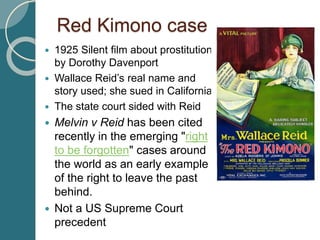
 1925 Silent film about prostitution
by Dorothy Davenport
 Wallace Reid’s real name and
story used; she sued in California
 The state court sided with Reid
 Melvin v Reid has been cited
recently in the emerging "right
to be forgotten" cases around
the world as an early example
of the right to leave the past
behind.
 Not a US Supreme Court
precedent
Cox v Cohn, 1975
 Cox Broadcasting sued by Melvin Cohn (father
of dead sexual assault victim)
 Georgia state supreme court rules that
identifying victim violates common law privacy
 US Supreme Court reverses. ”Freedom of the
press [is] of critical importance to our type of
government in which the citizenry is the final
judge of the proper conduct of public business.
In preserving that form of government, the First
and Fourteenth Amendments command
nothing less than that the States may not
impose sanctions on the publication of truthful
information contained in official court records
open to public inspection.”
 Proper conduct / professional ethics: Crime
victims should not be identified without their
own approval.
Smith v Daily Mail,
Howard v Des Moines Register
 Two 1979 cases reinforced Cox v Cohn
 In Smith, the name of a minor charged
with murder was printed in a newspaper,
contrary to a state law
 In Howard, the name of a woman
sterilized involuntarily was printed in the
Des Moines Register.
 Since the identities were obtained legally
in both cases, there was no violation of
privacy.
 Both cases raise ethical questions
Sipple v Chronicle, 1984
 On September 23, 1975,
Oliver Sipple happened
to be in the right place at
the right time and
stopped an assassination
attempt on President
Gerald Ford (not in the
photo).• The next day, the Los Angeles Times reported: “A
husky ex-marine who was a hero in the attempted
assassination of President Ford emerged
Wednesday as a prominent figure in the gay
community.
• Sipple sued the San Francisco Chronicle, the LA
Times and other newspapers for revealing his
secret life, but lost because he had become a public
“Right to be forgotten”
 European laws allow some criminal
charges to be removed from public
view in order to prevent lifelong
stigmatization
 US laws do not require removal on
demand
 About half of states forbid charging
money for removal of arrest photos on
internet / web sites
3 Intrusion
 Intrusion on a person’s right to
seclusion and personal privacy; Media
cases usually involve physical intrusion
by news media, often with cameras or
recording devices, into the lives of
celebrities and private people.
 Galella v. Onassis, 1973 — Jackie
Kennedy Onassis obtained a court
injunction against New York
photographer Ron Galella, forcing him to
stay 25 feet away from her and even
further away from the children
Intrusion
 Wilson v Layne, 1999 – Case that
banned ride-alongs and videos of
home searches
 Dietman v Time, 1971 – “Quackery”
case
◦ “The First Amendment has never been
construed to accord newsmen immunity
from torts or crimes committed during the
course of newsgathering. The First
Amendment is not a license to trespass,
to steal, or to intrude by electronic means
into the precincts of another's home or
office,
Intrusion
 Usually newsgathering
 Publication not essential for suit
 Trespass – entering private property
without consent or getting too close
with cameras
 Secret surveillance – bugging,
hidden cameras, hacking
 Misrepresentation and undercover
reporting – ABC v Food Lion, 1997
4 Misappropriation
/ Right of publicity
 Loss caused by appropriation of
personal likeness for commercial
exploitation
 A person's exclusive rights to control
his or her name and likeness to
prevent others from exploiting without
permission is protected in similar
manner to a trademark
Misappropriatio
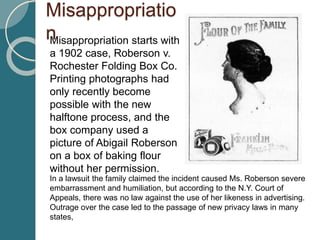
nMisappropriation starts with
a 1902 case, Roberson v.
Rochester Folding Box Co.
Printing photographs had
only recently become
possible with the new
halftone process, and the
box company used a
picture of Abigail Roberson
on a box of baking flour
without her permission.
In a lawsuit the family claimed the incident caused Ms. Roberson severe
embarrassment and humiliation, but according to the N.Y. Court of
Appeals, there was no law against the use of her likeness in advertising.
Outrage over the case led to the passage of new privacy laws in many
states,
Misappropriation / Right of
publicity
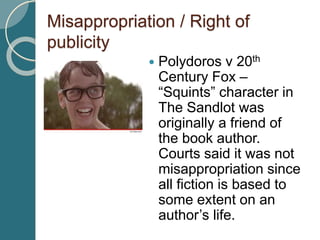
 Polydoros v 20th
Century Fox –
“Squints” character in
The Sandlot was
originally a friend of
the book author.
Courts said it was not
misappropriation since
all fiction is based to
some extent on an
author’s life.
Velvet Elvis
 Elvis Presley
Enterprises sued
owners of the
Velvet Elvis bar in
Houston in 1996.
The bar owners
said it was parody,
but Presley
Enterprises won in
the end. The
parody was not of
Elvis himself, the
court said.
Misappropriation / Virginia law
 § 8.01-40. Unauthorized use of name or picture of any
person; punitive damages; statute of limitations.
 A. Any person whose name, portrait, or picture is used
without having first obtained the written consent of
such person, or if dead, of the surviving consort and if
none, of the next of kin, or if a minor, the written
consent of his or her parent or guardian, for advertising
purposes or for the purposes of trade, such persons
may maintain a suit in equity against the person, firm,
or corporation so using such person's name, portrait, or
picture to prevent and restrain the use thereof; and may
also sue and recover damages for any injuries
sustained by reason of such use. And if the defendant
shall have knowingly used such person's name, portrait
or picture in such manner as is forbidden or declared to
be unlawful by this chapter, the jury, in its discretion,
may award punitive damages.
 B. No action shall be commenced under this section
more than 20 years after the death of such person.
5
Intentional
Infliction of
Emotional
Distress
Intentional Infliction of
Emotional Distress
 In some states, such as Virginia
“intentional infliction of emotional
distress,” is used in place of false
light, intrusion and publication of
private facts. (Virginia still has a
misappropriate statute) As the courts
noted in Flynt v Falwell, IIED is not a
substitute for defamation.
IIED – Womack v Eldridge,
1974
 Rosalie Eldridge pretended to be a reporter
to get a photo of Danny Womack, who was
a skating coach at a rink where Richard
Seifert was arrested
 Showed photo to two boys who had been
molested as a way to shake up their
testimony against Seifert. The boys did not
recognize Womack.
 Womack was repeatedly questioned and
investigated by police and suffered
emotional distress.
Hypothetical privacy analysis
 Are any of the four types of invasion of privacy
present? Intrusion; Misappropriation; False Light; and
Publication of Private Facts. Or, in Virginia Intentional
Infliction of Emotional Distress?
 Can any of the main privacy defenses be applied?
(Newsworthyness, Public Record; Consent)
 If the allegation is Publication of Private Facts, are the
facts so intimate and embarrassing that they would be
offensive to the average person?
 Case law — What similar cases are there that can help
guide your decision making process?
 Professional codes & ethics — What do your
professional ethical codes tell you? (AdFed, PRSA, SPJ,
RTNDA).
 Mitigation — If you have made a mistake, what can you
do to mitigate damages?
 Dismiss — If you are in a strong position, should you ask
the court to dismiss the case before it goes to trial?
Hypothetical privacy 1
 Someone in your university’s public affairs
department takes pictures of students and puts
up a billboard to advertise the school.
However, they did not get permission, much
less a signed “model release,” from the
students. Can the students sue and recover
damages? Under which privacy tort?
 You’re writing a story about a sexual assault,
and you have the victim’s name from a police
report. Do you print the name? Why or why
not?
 Let’s say you do print a sexual assault victim’s
name accurately from a police report, and he
feels like his rights to privacy were violated and
he sues you for invasion of privacy. Does he
Hypothetical privacy 2
 You’re working on an ad campaign for a new
gated community development, and learn that
a famous rock star has already bought a
lakefront lot. The star does not want to
endorse the development, but you know that
sales will skyrocket if you somehow work him
into the ad. Should you do it?
 A student running for SGA president has
AIDs. You know this for a fact, and you check
with the student, and she confirms it but does
NOT want that information out there. What do
you do?
 You obtain a video of a married celebrity film
star having a romantic moment with someone
who is not her spouse. The video seems to
show passion and even has some nudity. This
is really going to get your show
Thank you

5. privacy

  • 1.
    Communication Law & Ethics RUCOMS 400 Unit 5 Privacy Prof. Bill Kovarik, PhD wkovarik@radford.edu Class web site: revolutionsincommunication.com/law
  • 2.
    On Track: Fifthweek  Read the rest of Section 4-5 on web site  Assignment 5 – privacy hypothetical  Take quiz 5 Structure of this section:  Four privacy torts,  intentional infliction,  hypotheticals
  • 3.
    Privacy torts 1. Falselight (similar to libel) 2. Publication of Private Facts 3. Intrusion (trespassing) 4. Misappropriation (ex: Ads w/out permission) and in some states: 5. Intentional infliction of emotional distress (ex: Flynt v Falwell)
  • 4.
    Defenses in privacy lawsuits Newsworthiness, or public interest (for editorial content, mostly in misappropriation and false light cases)  Public record, a Constitutional defense similar to privilege (especially in regard to revealing names of private people in court cases)  Consent of private individual involved (eg, signed release of a model to appear in an advertisement)
  • 5.
    Ethical issues reprivacy & media  Learn professional ethical standards ◦ Society of Professional Journalists code ◦ or American Advertising Federation code  Victims, minors and witnesses to crime are not usually ID’d in news articles.  Informed consent is important dealing with minors and private people  Seek the truth, Minimize harm, Act independently, be transparent
  • 6.
    1. False light In2010 Shirley Sherrod gave a speech on her experiences working for the USDA in rural development to a regional NAACP chapter. A video clip of the speech became the subject of a national controversy because it seemed to show racism by African Americans against European Americans. In the video, Sherrod talked about a moment when she was tempted to exclude a few white farmers from USDA benefits. That is the only part of the video clip that was distributed by Andrew Brietbart. Breitbart apologized and settled in October, 2015 for an undisclosed amount.
  • 7.
    False light Similar toDefamation but … • Often involves photos & captions • Not false but still misleading • Highly offensive • Not recognized in some states • Violation of a Constitutional right of privacy, so there may be no statute of limitations
  • 8.
    Braun v Flynt,1984, false light
  • 9.
    Braun (cont) Jeanne Braun,an entertainer, had an act with a swimming pig. Through deception, a company associated with Hustler Magazine bought her picture with the pig and placed it within the lewd magazine. She sued for defamation and false light, and won both. Courts however said she could only win one, and that the personal humiliation, pain and suffering was a better fit with false light than
  • 10.
    2 Publication ofprivate facts  Publication of Private Facts or unreasonable revelation of private facts that may be true but nevertheless embarrassing to private people.Bolea v Gawker, 2017 When Gawker magazine posted sex videos of Hulk Hogan (Bollea) with a friend’s wife, Bollea filed suit in a Florida state court for invasion of privacy (intrusion, publication of private facts and misappropriation) along with intentional infliction of emotional distress. To win, Bollea had to show that this was truthful information, that a reasonable person would find it highly offensive, and that it did not involve a legitimate public concern.
  • 11.
    Going ‘too far’– PPF  Public disclosure of private and embarrassing facts  Details about sexual conduct, physical or mental condition, educational records  Private, intimate, highly offensive to a reasonable person  Truth is not a defense; newsworthy- ness and consent are main defenses
  • 12.
    Elements of PPFsuits  1. Public Disclosure: Published, broadcast, or disseminated in some way. 2. Private Fact: The facts disclosed must be private and not generally known. It usually can’t involve facts that have already been made public. 3. Offensive to a Reasonable Person: The facts must be offensive to a reasonable person of ordinary sensibilities. Just a photo of a person slipping on a banana peel on a sidewalk might be a little embarrassing, but it is not enough. 4. Not Newsworthy
  • 13.
    Publication of privatefacts  Melvin v Reid, 1931 (“Red Kimono” case) ◦ Prostitute reformed, won state lawsuit  Cox v Cohn, 1975 ◦ Sexual assault victim ID’d on cable news  Smith v. Daily Mail, 1979 ◦ Minor ID’d in W.Va. newspaper  Howard v Des Moines Register, 1979 ◦ Sterilized woman ID’d in newspaper  Sipple v. Chronicle Publishing, 1984 ◦ Gay hero ID’d in newspaper
  • 14.
    Red Kimono case 1925 Silent film about prostitution by Dorothy Davenport  Wallace Reid’s real name and story used; she sued in California  The state court sided with Reid  Melvin v Reid has been cited recently in the emerging "right to be forgotten" cases around the world as an early example of the right to leave the past behind.  Not a US Supreme Court precedent
  • 15.
    Cox v Cohn,1975  Cox Broadcasting sued by Melvin Cohn (father of dead sexual assault victim)  Georgia state supreme court rules that identifying victim violates common law privacy  US Supreme Court reverses. ”Freedom of the press [is] of critical importance to our type of government in which the citizenry is the final judge of the proper conduct of public business. In preserving that form of government, the First and Fourteenth Amendments command nothing less than that the States may not impose sanctions on the publication of truthful information contained in official court records open to public inspection.”  Proper conduct / professional ethics: Crime victims should not be identified without their own approval.
  • 16.
    Smith v DailyMail, Howard v Des Moines Register  Two 1979 cases reinforced Cox v Cohn  In Smith, the name of a minor charged with murder was printed in a newspaper, contrary to a state law  In Howard, the name of a woman sterilized involuntarily was printed in the Des Moines Register.  Since the identities were obtained legally in both cases, there was no violation of privacy.  Both cases raise ethical questions
  • 17.
    Sipple v Chronicle,1984  On September 23, 1975, Oliver Sipple happened to be in the right place at the right time and stopped an assassination attempt on President Gerald Ford (not in the photo).• The next day, the Los Angeles Times reported: “A husky ex-marine who was a hero in the attempted assassination of President Ford emerged Wednesday as a prominent figure in the gay community. • Sipple sued the San Francisco Chronicle, the LA Times and other newspapers for revealing his secret life, but lost because he had become a public
  • 18.
    “Right to beforgotten”  European laws allow some criminal charges to be removed from public view in order to prevent lifelong stigmatization  US laws do not require removal on demand  About half of states forbid charging money for removal of arrest photos on internet / web sites
  • 19.
    3 Intrusion  Intrusionon a person’s right to seclusion and personal privacy; Media cases usually involve physical intrusion by news media, often with cameras or recording devices, into the lives of celebrities and private people.  Galella v. Onassis, 1973 — Jackie Kennedy Onassis obtained a court injunction against New York photographer Ron Galella, forcing him to stay 25 feet away from her and even further away from the children
  • 20.
    Intrusion  Wilson vLayne, 1999 – Case that banned ride-alongs and videos of home searches  Dietman v Time, 1971 – “Quackery” case ◦ “The First Amendment has never been construed to accord newsmen immunity from torts or crimes committed during the course of newsgathering. The First Amendment is not a license to trespass, to steal, or to intrude by electronic means into the precincts of another's home or office,
  • 21.
    Intrusion  Usually newsgathering Publication not essential for suit  Trespass – entering private property without consent or getting too close with cameras  Secret surveillance – bugging, hidden cameras, hacking  Misrepresentation and undercover reporting – ABC v Food Lion, 1997
  • 22.
    4 Misappropriation / Rightof publicity  Loss caused by appropriation of personal likeness for commercial exploitation  A person's exclusive rights to control his or her name and likeness to prevent others from exploiting without permission is protected in similar manner to a trademark
  • 23.
    Misappropriatio nMisappropriation starts with a1902 case, Roberson v. Rochester Folding Box Co. Printing photographs had only recently become possible with the new halftone process, and the box company used a picture of Abigail Roberson on a box of baking flour without her permission. In a lawsuit the family claimed the incident caused Ms. Roberson severe embarrassment and humiliation, but according to the N.Y. Court of Appeals, there was no law against the use of her likeness in advertising. Outrage over the case led to the passage of new privacy laws in many states,
  • 24.
    Misappropriation / Rightof publicity  Polydoros v 20th Century Fox – “Squints” character in The Sandlot was originally a friend of the book author. Courts said it was not misappropriation since all fiction is based to some extent on an author’s life.
  • 25.
    Velvet Elvis  ElvisPresley Enterprises sued owners of the Velvet Elvis bar in Houston in 1996. The bar owners said it was parody, but Presley Enterprises won in the end. The parody was not of Elvis himself, the court said.
  • 26.
    Misappropriation / Virginialaw  § 8.01-40. Unauthorized use of name or picture of any person; punitive damages; statute of limitations.  A. Any person whose name, portrait, or picture is used without having first obtained the written consent of such person, or if dead, of the surviving consort and if none, of the next of kin, or if a minor, the written consent of his or her parent or guardian, for advertising purposes or for the purposes of trade, such persons may maintain a suit in equity against the person, firm, or corporation so using such person's name, portrait, or picture to prevent and restrain the use thereof; and may also sue and recover damages for any injuries sustained by reason of such use. And if the defendant shall have knowingly used such person's name, portrait or picture in such manner as is forbidden or declared to be unlawful by this chapter, the jury, in its discretion, may award punitive damages.  B. No action shall be commenced under this section more than 20 years after the death of such person.
  • 27.
  • 28.
    Intentional Infliction of EmotionalDistress  In some states, such as Virginia “intentional infliction of emotional distress,” is used in place of false light, intrusion and publication of private facts. (Virginia still has a misappropriate statute) As the courts noted in Flynt v Falwell, IIED is not a substitute for defamation.
  • 29.
    IIED – Womackv Eldridge, 1974  Rosalie Eldridge pretended to be a reporter to get a photo of Danny Womack, who was a skating coach at a rink where Richard Seifert was arrested  Showed photo to two boys who had been molested as a way to shake up their testimony against Seifert. The boys did not recognize Womack.  Womack was repeatedly questioned and investigated by police and suffered emotional distress.
  • 30.
    Hypothetical privacy analysis Are any of the four types of invasion of privacy present? Intrusion; Misappropriation; False Light; and Publication of Private Facts. Or, in Virginia Intentional Infliction of Emotional Distress?  Can any of the main privacy defenses be applied? (Newsworthyness, Public Record; Consent)  If the allegation is Publication of Private Facts, are the facts so intimate and embarrassing that they would be offensive to the average person?  Case law — What similar cases are there that can help guide your decision making process?  Professional codes & ethics — What do your professional ethical codes tell you? (AdFed, PRSA, SPJ, RTNDA).  Mitigation — If you have made a mistake, what can you do to mitigate damages?  Dismiss — If you are in a strong position, should you ask the court to dismiss the case before it goes to trial?
  • 31.
    Hypothetical privacy 1 Someone in your university’s public affairs department takes pictures of students and puts up a billboard to advertise the school. However, they did not get permission, much less a signed “model release,” from the students. Can the students sue and recover damages? Under which privacy tort?  You’re writing a story about a sexual assault, and you have the victim’s name from a police report. Do you print the name? Why or why not?  Let’s say you do print a sexual assault victim’s name accurately from a police report, and he feels like his rights to privacy were violated and he sues you for invasion of privacy. Does he
  • 32.
    Hypothetical privacy 2 You’re working on an ad campaign for a new gated community development, and learn that a famous rock star has already bought a lakefront lot. The star does not want to endorse the development, but you know that sales will skyrocket if you somehow work him into the ad. Should you do it?  A student running for SGA president has AIDs. You know this for a fact, and you check with the student, and she confirms it but does NOT want that information out there. What do you do?  You obtain a video of a married celebrity film star having a romantic moment with someone who is not her spouse. The video seems to show passion and even has some nudity. This is really going to get your show
  • 33.

Editor's Notes

  • #8 
  • #10 
  • #19 https://www.ncsl.org/research/telecommunications-and-information-technology/mug-shots-and-booking-photo-websites.aspx. (Va. 2015 SB 720)
  • #26 https://www.chicagotribune.com/news/ct-xpm-1996-12-01-9612010189-story.html Citing other rulings including Hormel Food Corp.'s unsuccessful challenge of a Muppets character named "Spa'am," Milloy said it is unlikely consumers would be confused into thinking the Velvet Elvis is associated with the late singer. Citing other rulings including Hormel Food Corp.'s unsuccessful challenge of a Muppets character named "Spa'am," Milloy said it is unlikely consumers would be confused into thinking the Velvet Elvis is associated with the late singer.