LET US PRAY!
VOW OUR HEAD AND FEEL
THE PRESENCE OF THE LORD
THE LORDS PRAYER
Our father, who art in heaven, hallowed
be thy name, thy kingdom come; thy will
be done on earth as it is in heaven. Give
us this day our daily bread and forgive
those trespasses as we forgive those
who trespass against us; and lead us not
to the temptation but deliver us from evil.
AMEN
Quote of the day
Here are the RULES in our
Online Class.
1.Mute if you are not speaking.
2.Use the raise hand button if you want to
answer.
(Speak politely)
3. The teacher shall acknowledge the
student before speaking.
4. RESPECT and LISTEN to the teacher
5. Be ATTENTIVE to the class.
Things we need in this Subject:
•
- MAPEH note book orange
- Pencil
Lesson 2 –
Music of the
Renaissance
period
(1400-1600)
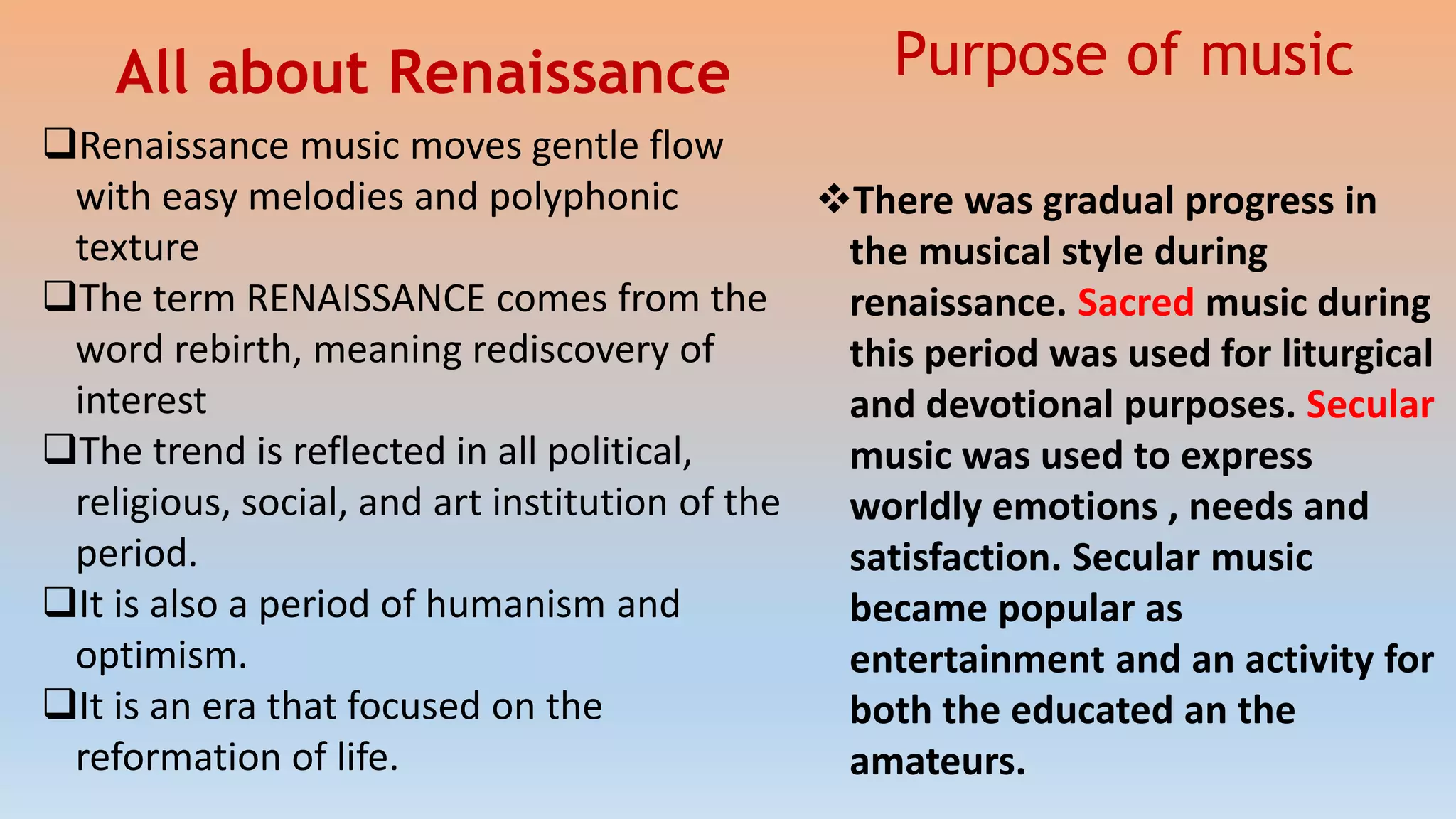
All about Renaissance
Renaissance music moves gentle flow
with easy melodies and polyphonic
texture
The term RENAISSANCE comes from the
word rebirth, meaning rediscovery of
interest
The trend is reflected in all political,
religious, social, and art institution of the
period.
It is also a period of humanism and
optimism.
It is an era that focused on the
reformation of life.
Purpose of music
There was gradual progress in
the musical style during
renaissance. Sacred music during
this period was used for liturgical
and devotional purposes. Secular
music was used to express
worldly emotions , needs and
satisfaction. Secular music
became popular as
entertainment and an activity for
both the educated an the
amateurs.
Vocal music
Renaissance is known as
the “golden age
polyphony”
Imitation among voices are
common.
Vocal music are more
important than
instrumental
There is a balance of
extreme contrast in
dynamics, tone color, or
rhythm.
This period is also known
as the “ Golden Age of A
Capella Music” in Italian it
means in chapel style.
A. Sacred
Music
1. Mass – The primary daily service of the catholic
church is the mass.
Characteristic of the mass:
• Polyphonic
• May be sing in a Capella or with accompaniment
• Text may be syllabic, neumetic , or melismatic
The important parts of the mass was know as the
Ordinary of the Mass
Five sections of the MASS:
1. Kyrie – Lord, have Mercy
2. Gloria – Glory to God High
3. Credo – I believe in one God, the Father Almighty
4. Sanctus & Benidictus – Holy, Holy… blessed is He
that cometh in the name of the Lord.
5. Agnus Dei – Lamb of God that tales away the sins
of the world, have mercy on us
2 .
MOTET
It is the latin religious
choral composition
Sometimes considered a
secular music for soloist
and instrumental
accompaniment, with or
without a choir in any
language.
Example of MOTET “Ave
Maria” by Josquin des
Prez.
3.
CHORALE
A chorale has a hymn tune and their
four part chordal setting are adopted
in the protestant church by Martin
Luther.
It is the set in the German text and
the songs are usually in binary form
with a repeated first section.
Melodic line are often seen in the
upper voice with slow tempo and is
mark by strong cadences.
B. Secular Music
1. MADRIGAL
 These are secular, vocal
composition for numerous
unaccompanied voices that
originated from Italy.
 Three main kinds of madrigal
• Ayre
• Ballet
• Madrigal proper
 Characteristic of a Madrigal
are polyphonic, Sung in a
Capella, Through Composed ,
Normally in three to six voices.
Instrument During
the RENAISSANCE
 Lute – String instrument
Composers
His main focus was to compose sacred music to satisfy the
desires of the church.
He received training and spent the majority of his career in
Rome, including Pope's chapel. His music has an elegant melodic
lines in all vocal parts.
His most refined writing is found in his masses written in various
different ways.
He composed more than 100 masses with the Pope Marcellus
Mass published in 1567 as the best.
Giovanni Pierluigi da Palestrina (1525-
1594)
The greatest master of Renaissance Catholic church
was born on February 3, 1525
in Palestrina, Rome.
 Morley had the chance to study composition with William Byrd
and organ under Sebastian Westcote.
 He graduated Bachelor of Music from Oxford University in 1588
and later got the position as organist at St. Giles Crip plegate.
 In 1591, he became the organist at St. Paul's and join the Chapel
Royal after a year.
 He was an English composer of madrigals and ballet. The Triumph
of Oriana was the title of one of the madrigals
 He composed in honor of Queen Elizabeth I.
 Morley was also the author of the first thesis on music in England
called A Plain and Easy Introduction to Practical Music.
Thomas Morley (1557-1602)
He died on October 1602.
QUESTIONS?
ACTIVITY TIME!
Direction: Answer the following. Fill in the
blanks. Write the question and answer to your
Music Notebook.
1. The term RENAISSANCE comes from the word _________, meaning
rediscovery of interest.
2. Renaissance music moves gentle flow with easy ______ and _________.
3. Renaissance is known as the ___________.
4. This period is also known as the ___________ in Italian it means in chapel
style.
5. ________ music became popular as entertainment and an activity for
both the educated an the amateurs.
That is all for Today!
Lesson 2
Activity # 2 :
A. Give the 5 section of Mass
B. 3 main kinds of Madrigal
C. Give the 2 musical style during the renaissance
period.
PETA
DAY!
Lesson 2
PETA # 1
Choose one composition of Palestrina and Morley.
Compare them according to:
a. Melody
b. Rhythm
C. Texture Criteria
Content – 25 pts
Explanations – 15 pts
Grammar – 10 pts
Total – 50 pts

Renaissance period Grd 9.pptx

  • 1.
    LET US PRAY! VOWOUR HEAD AND FEEL THE PRESENCE OF THE LORD
  • 2.
    THE LORDS PRAYER Ourfather, who art in heaven, hallowed be thy name, thy kingdom come; thy will be done on earth as it is in heaven. Give us this day our daily bread and forgive those trespasses as we forgive those who trespass against us; and lead us not to the temptation but deliver us from evil. AMEN
  • 3.
  • 5.
    Here are theRULES in our Online Class. 1.Mute if you are not speaking. 2.Use the raise hand button if you want to answer. (Speak politely) 3. The teacher shall acknowledge the student before speaking. 4. RESPECT and LISTEN to the teacher 5. Be ATTENTIVE to the class.
  • 6.
    Things we needin this Subject: • - MAPEH note book orange - Pencil
  • 7.
    Lesson 2 – Musicof the Renaissance period (1400-1600)
  • 8.
    All about Renaissance Renaissancemusic moves gentle flow with easy melodies and polyphonic texture The term RENAISSANCE comes from the word rebirth, meaning rediscovery of interest The trend is reflected in all political, religious, social, and art institution of the period. It is also a period of humanism and optimism. It is an era that focused on the reformation of life. Purpose of music There was gradual progress in the musical style during renaissance. Sacred music during this period was used for liturgical and devotional purposes. Secular music was used to express worldly emotions , needs and satisfaction. Secular music became popular as entertainment and an activity for both the educated an the amateurs.
  • 9.
    Vocal music Renaissance isknown as the “golden age polyphony” Imitation among voices are common. Vocal music are more important than instrumental There is a balance of extreme contrast in dynamics, tone color, or rhythm. This period is also known as the “ Golden Age of A Capella Music” in Italian it means in chapel style. A. Sacred Music 1. Mass – The primary daily service of the catholic church is the mass. Characteristic of the mass: • Polyphonic • May be sing in a Capella or with accompaniment • Text may be syllabic, neumetic , or melismatic The important parts of the mass was know as the Ordinary of the Mass Five sections of the MASS: 1. Kyrie – Lord, have Mercy 2. Gloria – Glory to God High 3. Credo – I believe in one God, the Father Almighty 4. Sanctus & Benidictus – Holy, Holy… blessed is He that cometh in the name of the Lord. 5. Agnus Dei – Lamb of God that tales away the sins of the world, have mercy on us
  • 10.
    2 . MOTET It isthe latin religious choral composition Sometimes considered a secular music for soloist and instrumental accompaniment, with or without a choir in any language. Example of MOTET “Ave Maria” by Josquin des Prez. 3. CHORALE A chorale has a hymn tune and their four part chordal setting are adopted in the protestant church by Martin Luther. It is the set in the German text and the songs are usually in binary form with a repeated first section. Melodic line are often seen in the upper voice with slow tempo and is mark by strong cadences.
  • 11.
    B. Secular Music 1.MADRIGAL  These are secular, vocal composition for numerous unaccompanied voices that originated from Italy.  Three main kinds of madrigal • Ayre • Ballet • Madrigal proper  Characteristic of a Madrigal are polyphonic, Sung in a Capella, Through Composed , Normally in three to six voices. Instrument During the RENAISSANCE  Lute – String instrument
  • 12.
    Composers His main focuswas to compose sacred music to satisfy the desires of the church. He received training and spent the majority of his career in Rome, including Pope's chapel. His music has an elegant melodic lines in all vocal parts. His most refined writing is found in his masses written in various different ways. He composed more than 100 masses with the Pope Marcellus Mass published in 1567 as the best. Giovanni Pierluigi da Palestrina (1525- 1594) The greatest master of Renaissance Catholic church was born on February 3, 1525 in Palestrina, Rome.
  • 13.
     Morley hadthe chance to study composition with William Byrd and organ under Sebastian Westcote.  He graduated Bachelor of Music from Oxford University in 1588 and later got the position as organist at St. Giles Crip plegate.  In 1591, he became the organist at St. Paul's and join the Chapel Royal after a year.  He was an English composer of madrigals and ballet. The Triumph of Oriana was the title of one of the madrigals  He composed in honor of Queen Elizabeth I.  Morley was also the author of the first thesis on music in England called A Plain and Easy Introduction to Practical Music. Thomas Morley (1557-1602) He died on October 1602.
  • 14.
  • 15.
  • 16.
    Direction: Answer thefollowing. Fill in the blanks. Write the question and answer to your Music Notebook. 1. The term RENAISSANCE comes from the word _________, meaning rediscovery of interest. 2. Renaissance music moves gentle flow with easy ______ and _________. 3. Renaissance is known as the ___________. 4. This period is also known as the ___________ in Italian it means in chapel style. 5. ________ music became popular as entertainment and an activity for both the educated an the amateurs.
  • 17.
    That is allfor Today!
  • 19.
    Lesson 2 Activity #2 : A. Give the 5 section of Mass B. 3 main kinds of Madrigal C. Give the 2 musical style during the renaissance period.
  • 20.
  • 21.
    Lesson 2 PETA #1 Choose one composition of Palestrina and Morley. Compare them according to: a. Melody b. Rhythm C. Texture Criteria Content – 25 pts Explanations – 15 pts Grammar – 10 pts Total – 50 pts