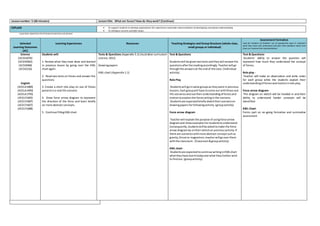
Lesson number: 5 (60 minutes) Lesson title: What are forces? How do they work? (Continue) 
EXPLAIN  To support students to develop explanations for experiences and make representations of developing conceptual understanding. 
 To introduce current scientific views. 
Inspiration taken from the Primary Connections unit planner 
Selected 
Learning Outcomes 
(AC) 
Learning Experiences 
Resources 
Teaching Strategies and Group Structure (whole class, 
small groups or individual) 
Assessment Formative 
Look for evidence of students’ use of appropriate ways to represent 
what they know and understand and give them feedback about how 
they can improve their representations. 
Science 
(ACSSU076) 
(ACSHE062) 
(ACSIS068) 
(ACSIS216) 
English 
(ACELA1489) 
(ACELA1490) 
(ACELA1793) 
(ACELY1692) 
(ACELY1687) 
(ACELT1607) 
(ACELY1688) 
Students will: 
1. Review what they have done and learned 
in previous lesson by going over the KWL 
chart again. 
2. Read two texts on forces and answer the 
questions 
3. Create a short role play on use of forces 
present in a real life scenario 
4. Draw force arrow diagram to represent 
the direction of the force and learn briefly 
on more abstract concepts. 
5. Continue filling KWL chart 
Texts & Questions (Appendix 5.1) (Australian curriculum 
science, 2011) 
Drawing papers 
KWL chart (Appendix 1.1) 
Text & Questions 
Students will be given two texts and they will answer the 
questions after the reading accordingly. Teacher will go 
through the answers at the end of the class. (Individual 
activity) 
Role Play 
Students will go in same groups as they were in previous 
lessons. Each group will have to come out with three real 
life scenarios and use their understanding of forces and 
motion to explain the forces acting in the scenario. 
Students are expected briefly sketch their scenario on 
drawing papers for following activity. (group activity) 
Force arrow diagram 
Teacher will explain the purpose of using force arrow 
diagram and show examples for students to understand. 
Consequently, students will be asked to make the force 
arrow diagram by on their sketch on previous activity. If 
there are scenarios with more abstract concept such as 
gravity, thrust or magnetism, teacher will go over them 
with the classroom. (Classroom & group activity) 
KWL chart- 
Students are expected to continue writing in KWL chart 
what they have learnt today and what they further wish 
to find out. (group activity) 
Text & Questions- 
Students’ ability to answer the question will 
represent how much they understood the concept 
of forces. 
Role play - 
Teacher will make an observation and write notes 
for each group while the students explain their 
understanding of forces and motion in role play. 
Force arrow diagram- 
The diagram on sketch will be handed in and their 
ability to understand harder concepts will be 
identified. 
KWL Chart- 
Forms part on on-going formative and summative 
assessment
5 e model explain

5 e model explain

  • 1.
    Lesson number: 5(60 minutes) Lesson title: What are forces? How do they work? (Continue) EXPLAIN  To support students to develop explanations for experiences and make representations of developing conceptual understanding.  To introduce current scientific views. Inspiration taken from the Primary Connections unit planner Selected Learning Outcomes (AC) Learning Experiences Resources Teaching Strategies and Group Structure (whole class, small groups or individual) Assessment Formative Look for evidence of students’ use of appropriate ways to represent what they know and understand and give them feedback about how they can improve their representations. Science (ACSSU076) (ACSHE062) (ACSIS068) (ACSIS216) English (ACELA1489) (ACELA1490) (ACELA1793) (ACELY1692) (ACELY1687) (ACELT1607) (ACELY1688) Students will: 1. Review what they have done and learned in previous lesson by going over the KWL chart again. 2. Read two texts on forces and answer the questions 3. Create a short role play on use of forces present in a real life scenario 4. Draw force arrow diagram to represent the direction of the force and learn briefly on more abstract concepts. 5. Continue filling KWL chart Texts & Questions (Appendix 5.1) (Australian curriculum science, 2011) Drawing papers KWL chart (Appendix 1.1) Text & Questions Students will be given two texts and they will answer the questions after the reading accordingly. Teacher will go through the answers at the end of the class. (Individual activity) Role Play Students will go in same groups as they were in previous lessons. Each group will have to come out with three real life scenarios and use their understanding of forces and motion to explain the forces acting in the scenario. Students are expected briefly sketch their scenario on drawing papers for following activity. (group activity) Force arrow diagram Teacher will explain the purpose of using force arrow diagram and show examples for students to understand. Consequently, students will be asked to make the force arrow diagram by on their sketch on previous activity. If there are scenarios with more abstract concept such as gravity, thrust or magnetism, teacher will go over them with the classroom. (Classroom & group activity) KWL chart- Students are expected to continue writing in KWL chart what they have learnt today and what they further wish to find out. (group activity) Text & Questions- Students’ ability to answer the question will represent how much they understood the concept of forces. Role play - Teacher will make an observation and write notes for each group while the students explain their understanding of forces and motion in role play. Force arrow diagram- The diagram on sketch will be handed in and their ability to understand harder concepts will be identified. KWL Chart- Forms part on on-going formative and summative assessment