What is “Big Data”?
A MECE approach to de-jargon the
jargon
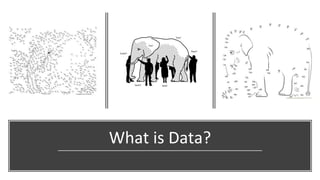
What is Data?
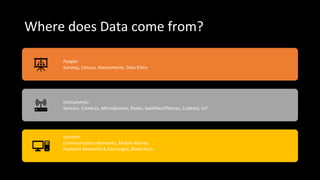
Where does Data come from?
People:
Surveys, Census, Assessments, Data Entry
Instruments:
Sensors, Cameras, Microphones, Radar, Satellites/Phones, CubeSat, IoT
Systems:
Communication Networks, Mobile Money
Payment Networks & Exchanges, Blockchain
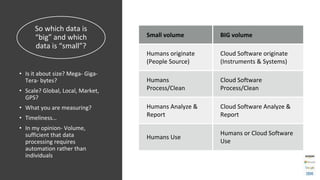
So which data is
“big” and which
data is “small”?
• Is it about size? Mega- Giga-
Tera- bytes?
• Scale? Global, Local, Market,
GPS?
• What you are measuring?
• Timeliness…
• In my opinion- Volume,
sufficient that data
processing requires
automation rather than
individuals
Small volume BIG volume
Humans originate
(People Source)
Cloud Software originate
(Instruments & Systems)
Humans
Process/Clean
Cloud Software
Process/Clean
Humans Analyze &
Report
Cloud Software Analyze &
Report
Humans Use
Humans or Cloud Software
Use
Analyzing Data?
• Traditional Statistical Analysis – analysts
• Actuarial Risk Tables – 1 Phd preferred + analyst
• Market or System Models – 1 Phd + IT engineer & analysts
• Randomized Controlled Trials – Team of Phds + analysts
• Bayesian Statistics – 1 Phd preferred + analyst
• Machine Learning – 1 Phd preferred + IT engineer or analyst
• Deep Learning (AI) – Team of Phds + IT engineer & analysts
Where is Big Data?
Brief Insight on Costs of Big Data
• “Gmail is Free, it doesn’t cost them anything to give it to us” – Anonymous Prime Minister not
understanding Google Partnership
• Rough Estimates from around the Web for the Big 3:
• Revenue from Cloud ~ $70B/year
• Cost of Cloud…
• Hard Drives: $10 B
• Electricity for Cooling: $10 B
• People to code, fix code, secure data from attacks, turn computers on/off: $10 B
• So by some estimates a Gmail account costs about $3/user/year
• But AdWords Revenue for Google is about $7/user/year
• Reflection 1: a “bad year” for google shareholders is when annual profits drop below $10B ☹
• Reflection 2: all that money comes from Adwords. Google is Madmen 2.0.
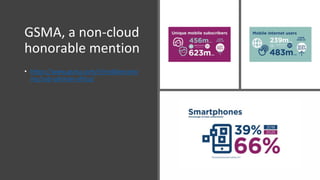
GSMA, a non-cloud
honorable mention
• https://www.gsma.com/r/mobileecono
my/sub-saharan-africa/
OK, Now I’m a Big Data Industry Expert, so
what?
• What is BigData good for?
• In MBA terms: market-channels (own consumer transaction last mile)
• In Economics: Oligopoly with Network Effects (NYU STERN LINK)
• How do you make money?
• Deliver Services with Radical Efficiency compared to traditional service
providers (eat their lunch)
• Precise Market Segmentation
• What does it have to do with Agriculture and the Food System?
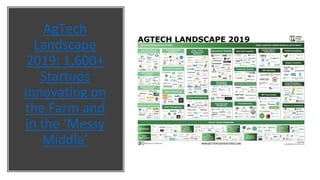
AgTech
Landscape
2019: 1,600+
Startups
Innovating on
the Farm and
in the ‘Messy
Middle’
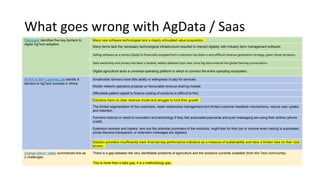
What goes wrong with AgData / Saas
Rabobank identifies five key barriers to
digital AgTech adoption
Many new software technologies lack a clearly articulated value proposition.
Many farms lack the necessary technological infrastructure required to interact digitally with industry farm management software.
Selling software as a service (SaaS) to financially strapped farm customers has been a very difficult revenue generation strategy, given these dynamics.
Data ownership and privacy has been a heated, widely debated topic ever since big data entered the global farming conversation.
Digital agriculture lacks a universal operating platform in which to connect the entire operating ecosystem.
AGRA & RAF-Learning Lab identify 8
barriers to AgTech success in Africa
Smallholder farmers have little ability or willingness to pay for services.
Mobile network operators propose un-favourable revenue sharing models.
Affordable patient capital to finance scaling of solutions is difficult to find.
Solutions have no clear revenue model and struggle to fund their growth.
The limited segmentation of the customers, weak relationship management and limited customer feedback mechanisms, reduce user uptake
and retention.
Farmers mistrust or resist to innovation and technology if they feel automated payments and push messaging are using their airtime (phone
credit)
Extension workers and traders, who are the potential promoters of the solutions, might fear for their job or income when trading is automated,
prices become transparent, or extension messages are digitized.
Solution providers insufficiently track financial key performance indicators as a measure of sustainability and have a limited view on their cost
drivers.
Orange-Silicon Valley summarizes this as
2 challenges:
There is a gap between the very identifiable problems of agriculture and the solutions currently available (from the Tech community).
This is more than a data gap, it is a methodology gap.
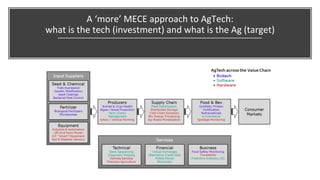
A ‘more’ MECE approach to AgTech:
what is the tech (investment) and what is the Ag (target)
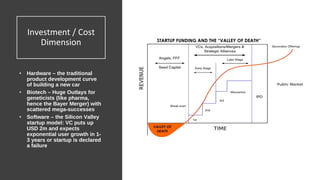
Investment / Cost
Dimension
• Hardware – the traditional
product development curve
of building a new car
• Biotech – Huge Outlays for
geneticists (like pharma,
hence the Bayer Merger) with
scattered mega-successes
• Software – the Silicon Valley
startup model: VC puts up
USD 2m and expects
exponential user growth in 1-
3 years or startup is declared
a failure
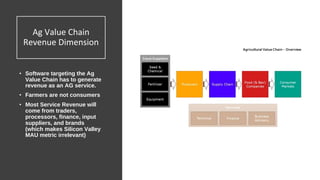
Ag Value Chain
Revenue Dimension
• Software targeting the Ag
Value Chain has to generate
revenue as an AG service.
• Farmers are not consumers
• Most Service Revenue will
come from traders,
processors, finance, input
suppliers, and brands
(which makes Silicon Valley
MAU metric irrelevant)
“The Farm Progress Show is where farmers
with $3 corn look at all the ways they could
produce corn if it was $5.”
• There are a set of expensive high-tech solutions designed to increase profits at the
margin of already highly developed production systems, such as internet
connected weather sensors, self-driving combiners, laser land levelling and other
precisions agriculture technologies that can move a farm from producing 28,000KG
of maize/Ha to 29,000KG of maize/Ha. But these will never be particularly relevant
for smallholder producers due to their costs & their context.
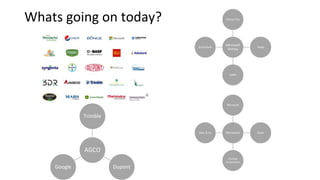
Whats going on today?
Monsanto
Microsoft
Bayer
Climate
Corporation
Deer & Co
AGCO
Trimble
Dupont
Google
Microsoft
4Afrika
Virtual City
Twiga
AGRA
SunCulture
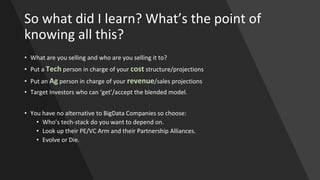
So what did I learn? What’s the point of
knowing all this?
• What are you selling and who are you selling it to?
• Put a Tech person in charge of your cost structure/projections
• Put an Ag person in charge of your revenue/sales projections
• Target Investors who can ‘get’/accept the blended model.
• You have no alternative to BigData Companies so choose:
• Who’s tech-stack do you want to depend on.
• Look up their PE/VC Arm and their Partnership Alliances.
• Evolve or Die.

Big Data for Ag (2019)

  • 1.
    What is “BigData”? A MECE approach to de-jargon the jargon
  • 2.
  • 3.
    Where does Datacome from? People: Surveys, Census, Assessments, Data Entry Instruments: Sensors, Cameras, Microphones, Radar, Satellites/Phones, CubeSat, IoT Systems: Communication Networks, Mobile Money Payment Networks & Exchanges, Blockchain
  • 4.
    So which datais “big” and which data is “small”? • Is it about size? Mega- Giga- Tera- bytes? • Scale? Global, Local, Market, GPS? • What you are measuring? • Timeliness… • In my opinion- Volume, sufficient that data processing requires automation rather than individuals Small volume BIG volume Humans originate (People Source) Cloud Software originate (Instruments & Systems) Humans Process/Clean Cloud Software Process/Clean Humans Analyze & Report Cloud Software Analyze & Report Humans Use Humans or Cloud Software Use
  • 5.
    Analyzing Data? • TraditionalStatistical Analysis – analysts • Actuarial Risk Tables – 1 Phd preferred + analyst • Market or System Models – 1 Phd + IT engineer & analysts • Randomized Controlled Trials – Team of Phds + analysts • Bayesian Statistics – 1 Phd preferred + analyst • Machine Learning – 1 Phd preferred + IT engineer or analyst • Deep Learning (AI) – Team of Phds + IT engineer & analysts
  • 6.
  • 7.
    Brief Insight onCosts of Big Data • “Gmail is Free, it doesn’t cost them anything to give it to us” – Anonymous Prime Minister not understanding Google Partnership • Rough Estimates from around the Web for the Big 3: • Revenue from Cloud ~ $70B/year • Cost of Cloud… • Hard Drives: $10 B • Electricity for Cooling: $10 B • People to code, fix code, secure data from attacks, turn computers on/off: $10 B • So by some estimates a Gmail account costs about $3/user/year • But AdWords Revenue for Google is about $7/user/year • Reflection 1: a “bad year” for google shareholders is when annual profits drop below $10B ☹ • Reflection 2: all that money comes from Adwords. Google is Madmen 2.0.
  • 8.
    GSMA, a non-cloud honorablemention • https://www.gsma.com/r/mobileecono my/sub-saharan-africa/
  • 9.
    OK, Now I’ma Big Data Industry Expert, so what? • What is BigData good for? • In MBA terms: market-channels (own consumer transaction last mile) • In Economics: Oligopoly with Network Effects (NYU STERN LINK) • How do you make money? • Deliver Services with Radical Efficiency compared to traditional service providers (eat their lunch) • Precise Market Segmentation • What does it have to do with Agriculture and the Food System?
  • 10.
  • 11.
    What goes wrongwith AgData / Saas Rabobank identifies five key barriers to digital AgTech adoption Many new software technologies lack a clearly articulated value proposition. Many farms lack the necessary technological infrastructure required to interact digitally with industry farm management software. Selling software as a service (SaaS) to financially strapped farm customers has been a very difficult revenue generation strategy, given these dynamics. Data ownership and privacy has been a heated, widely debated topic ever since big data entered the global farming conversation. Digital agriculture lacks a universal operating platform in which to connect the entire operating ecosystem. AGRA & RAF-Learning Lab identify 8 barriers to AgTech success in Africa Smallholder farmers have little ability or willingness to pay for services. Mobile network operators propose un-favourable revenue sharing models. Affordable patient capital to finance scaling of solutions is difficult to find. Solutions have no clear revenue model and struggle to fund their growth. The limited segmentation of the customers, weak relationship management and limited customer feedback mechanisms, reduce user uptake and retention. Farmers mistrust or resist to innovation and technology if they feel automated payments and push messaging are using their airtime (phone credit) Extension workers and traders, who are the potential promoters of the solutions, might fear for their job or income when trading is automated, prices become transparent, or extension messages are digitized. Solution providers insufficiently track financial key performance indicators as a measure of sustainability and have a limited view on their cost drivers. Orange-Silicon Valley summarizes this as 2 challenges: There is a gap between the very identifiable problems of agriculture and the solutions currently available (from the Tech community). This is more than a data gap, it is a methodology gap.
  • 12.
    A ‘more’ MECEapproach to AgTech: what is the tech (investment) and what is the Ag (target)
  • 13.
    Investment / Cost Dimension •Hardware – the traditional product development curve of building a new car • Biotech – Huge Outlays for geneticists (like pharma, hence the Bayer Merger) with scattered mega-successes • Software – the Silicon Valley startup model: VC puts up USD 2m and expects exponential user growth in 1- 3 years or startup is declared a failure
  • 14.
    Ag Value Chain RevenueDimension • Software targeting the Ag Value Chain has to generate revenue as an AG service. • Farmers are not consumers • Most Service Revenue will come from traders, processors, finance, input suppliers, and brands (which makes Silicon Valley MAU metric irrelevant)
  • 15.
    “The Farm ProgressShow is where farmers with $3 corn look at all the ways they could produce corn if it was $5.” • There are a set of expensive high-tech solutions designed to increase profits at the margin of already highly developed production systems, such as internet connected weather sensors, self-driving combiners, laser land levelling and other precisions agriculture technologies that can move a farm from producing 28,000KG of maize/Ha to 29,000KG of maize/Ha. But these will never be particularly relevant for smallholder producers due to their costs & their context.
  • 16.
    Whats going ontoday? Monsanto Microsoft Bayer Climate Corporation Deer & Co AGCO Trimble Dupont Google Microsoft 4Afrika Virtual City Twiga AGRA SunCulture
  • 17.
    So what didI learn? What’s the point of knowing all this? • What are you selling and who are you selling it to? • Put a Tech person in charge of your cost structure/projections • Put an Ag person in charge of your revenue/sales projections • Target Investors who can ‘get’/accept the blended model. • You have no alternative to BigData Companies so choose: • Who’s tech-stack do you want to depend on. • Look up their PE/VC Arm and their Partnership Alliances. • Evolve or Die.