Presented By ::
Ripon Barua
(12012101200489)
&
Md. Fakrul Hasan
(12012101200464)
Supervised By ::
Mr. Asif Md. Siddiqee
Lecturer, DEEE,PUC
Presentation on
• Introduction
• Literature view
• Block diagram
• Methodology
• Conclusion
• References
Dept. of EEE, Premier University 2
Wireless charging ( also known as “Inductive charging”) uses
electromagnetic field to transfer energy between two objects.
This is usually done with a charging station.
Energy is sent through an inductive coupling to an electrical
device, which can use that energy to charge batteries or run
the device.
Dept. of EEE, Premier University 3
• In 1890,Sir Nikola Tesla proposed a method Wireless Power
Transmission.
• Tesla enlightened 200 lamps at the distance of 40km. But only
15% efficiency was achieved.
• In 2007,a group of engineers at MIT came up with the idea to
use resonant induction to transmit power wirelessly.
• MIT powered 60watt light bulb from 2 meters (7 ft) at 40%
efficiency.
Dept. of EEE, Premier University 4
Dept. of EEE, Premier University 5
Dept. of EEE, Premier University 6
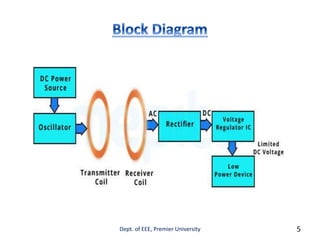
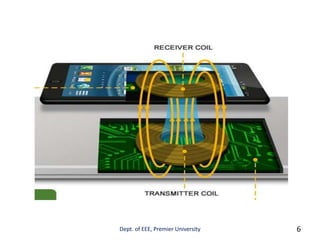
• Wireless systems use inductive coupling between two planar
coils to transfer power from power transmitter to power
receiver.
• Coil assemblies for the transmitter and receiver are a
combination of coil, shield and magnet/attractor.
• The transmitter side coil design allows consistent field
strength to be applied to the receiver coil. It enables reliable
operation over a number of interoperable devices.
Dept. of EEE, Premier University 7
• Wireless power systems are constantly evolving as more and
more practical options for charging smart phone and other
mobile devices.
• No need of separate mobile phone charger.
• Easy to operate and it is environmentally friendly.
• It is very useful for EVs (Electric Vehicles).
Dept. of EEE, Premier University 8
• https://www.mepits.com/project/171/Wireless/-Wireless-
Power-Transmission-Mobile-Charger-Circuit-Using-Inductive-
Coupling
• http://powerbyproxi.com/wireless-charging
Dept. of EEE, Premier University 9
Dept. of EEE, Premier University 10

464 & 489

  • 1.
    Presented By :: RiponBarua (12012101200489) & Md. Fakrul Hasan (12012101200464) Supervised By :: Mr. Asif Md. Siddiqee Lecturer, DEEE,PUC Presentation on
  • 2.
    • Introduction • Literatureview • Block diagram • Methodology • Conclusion • References Dept. of EEE, Premier University 2
  • 3.
    Wireless charging (also known as “Inductive charging”) uses electromagnetic field to transfer energy between two objects. This is usually done with a charging station. Energy is sent through an inductive coupling to an electrical device, which can use that energy to charge batteries or run the device. Dept. of EEE, Premier University 3
  • 4.
    • In 1890,SirNikola Tesla proposed a method Wireless Power Transmission. • Tesla enlightened 200 lamps at the distance of 40km. But only 15% efficiency was achieved. • In 2007,a group of engineers at MIT came up with the idea to use resonant induction to transmit power wirelessly. • MIT powered 60watt light bulb from 2 meters (7 ft) at 40% efficiency. Dept. of EEE, Premier University 4
  • 5.
    Dept. of EEE,Premier University 5
  • 6.
    Dept. of EEE,Premier University 6
  • 7.
    • Wireless systemsuse inductive coupling between two planar coils to transfer power from power transmitter to power receiver. • Coil assemblies for the transmitter and receiver are a combination of coil, shield and magnet/attractor. • The transmitter side coil design allows consistent field strength to be applied to the receiver coil. It enables reliable operation over a number of interoperable devices. Dept. of EEE, Premier University 7
  • 8.
    • Wireless powersystems are constantly evolving as more and more practical options for charging smart phone and other mobile devices. • No need of separate mobile phone charger. • Easy to operate and it is environmentally friendly. • It is very useful for EVs (Electric Vehicles). Dept. of EEE, Premier University 8
  • 9.
  • 10.
    Dept. of EEE,Premier University 10