Exploitation notes on CVE-2014-0160
© 2014 MDSec Consulting Ltd. All rights reserved.
Exploitation notes on CVE-2014-0160
Heartbleed <3
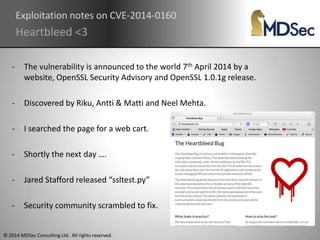
- The vulnerability is announced to the world 7th April 2014 by a
website, OpenSSL Security Advisory and OpenSSL 1.0.1g release.
- Discovered by Riku, Antti & Matti and Neel Mehta.
- I searched the page for a web cart.
- Shortly the next day ….
- Jared Stafford released “ssltest.py”
- Security community scrambled to fix.
© 2014 MDSec Consulting Ltd. All rights reserved.
Exploitation notes on CVE-2014-0160
RFC-6520 Heartbeat Extension
Bug introduced to the world NYE
2011 during implementation of
RFC-6520 in OpenSSL 1.0.1
Enabled by default in OpenSSL
1.0.1
Fixed in OpenSSL 1.0.1g & OpenSSL
1.0.2-beta1 still vulnerable – (git
has fix.)
If you run beta code on production
servers…
© 2014 MDSec Consulting Ltd. All rights reserved.
Exploitation notes on CVE-2014-0160
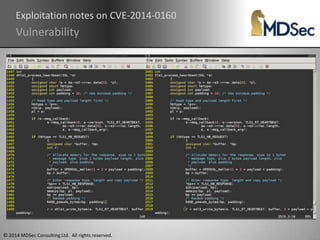
Vulnerability
© 2014 MDSec Consulting Ltd. All rights reserved.
Exploitation notes on CVE-2014-0160
How does it work?
© 2014 MDSec Consulting Ltd. All rights reserved.
Exploitation notes on CVE-2014-0160
How does it work?
© 2014 MDSec Consulting Ltd. All rights reserved.
Exploitation notes on CVE-2014-0160
Let the games commence.
Sites ranging from the FBI, Russian Standard Bank, Yahoo!, OpenSSL, Belgian
Intelligence Service and many more shown as leaking data.
- Screen shots of “ssltest.py” dumping 16384 bytes of heap memory began to
appear on social media sites. The content’s of the memory were alarming.
- IDS/IPS and Security vendors began to release detection signatures & scanners.
- Media frenzy ensued spreading confusing information e.g. #HeartbleedVirus
- The vulnerability was still not fully realized. Misconceptions abound.
© 2014 MDSec Consulting Ltd. All rights reserved.
Exploitation notes on CVE-2014-0160
On The Wire
• This is an unencrypted heartbleed attack transmitted on the wire.
• The response is returned in unencrypted packets.
© 2014 MDSec Consulting Ltd. All rights reserved.
Exploitation notes on CVE-2014-0160
Attack SSL, Encrypt with SSL!
• I wrote a stand-alone exploit in C using OpenSSL library to transmit the
Heartbeat request in encrypted packet.
• This was intentionally to bypass IPS/IDS signatures – it worked!
• Encrypting attacks on OpenSSL with OpenSSL makes it difficult to detect….
• IDS/IPS vendors began to develop alternative detection signatures.
© 2014 MDSec Consulting Ltd. All rights reserved.
Exploitation notes on CVE-2014-0160
On The Wire
• This is an encrypted heartbleed attack transmitted on the wire.
• The response is returned in encrypted packets.
© 2014 MDSec Consulting Ltd. All rights reserved.
Exploitation notes on CVE-2014-0160
Exploit Fails & Lessons
• I continued to push updates during the exploit
development process.
• I learnt not to commit code changes late at
night without review and testing… No, I am
not *THAT* OpenSSL developer!
• Internet is awesome, people began to submit
compile instructions for different Linux
platforms. Builds on most Linux/OS-X.
• Ayman Sagy added needed DTLS support.
• Re-use the code! Patches are welcome!
© 2014 MDSec Consulting Ltd. All rights reserved.
Exploitation notes on CVE-2014-0160
RSA Private Key Recovery
• Cloudflare announce secret key challenge for heartbleed.
• Provide nginx-1.5.13 web server linked against OpenSSL 1.0.1.f on Ubuntu
13.10 x86_64.
• Fedor Indutny solved the challenge first, others quickly followed.
• “include/openssl/rsa.h:struct rsa_st” holds RSA variables (p & q) in memory.
• RSA n := pq. We can use n to calculate if prime in memory is valid.
• Search for key size primes in memory leak and use to determine remaining
prime from modulo n (q % n == 0) – with p & q we generate RSA private key.
© 2014 MDSec Consulting Ltd. All rights reserved.
Exploitation notes on CVE-2014-0160
RSA Private Key Recovery
• Obtain certificate “openssl s_client -connect 192.168.11.23:443 < http-
get.txt | grep BEGIN –A n > out.pem”
• Improved “keyscan.py” by Einar Otto Stangvik to produce valid RSA private
keys instead of counting primes.
• Run “keyscan.py” on a memory dump to test possible values against the
certificate modulus n to identify if modulo is 0. The value and its division
result by n are checked and if primes we have p & q.
• We then generate the RSA private key from the prime values.
• Metasploit module also supports dumping private keys.
© 2014 MDSec Consulting Ltd. All rights reserved.
Exploitation notes on CVE-2014-0160
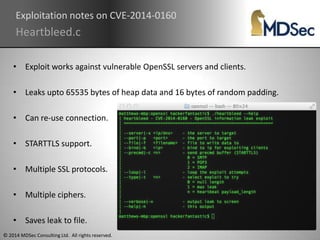
Heartbleed.c
• Exploit works against vulnerable OpenSSL servers and clients.
• Leaks upto 65535 bytes of heap data and 16 bytes of random padding.
• Can re-use connection.
• STARTTLS support.
• Multiple SSL protocols.
• Multiple ciphers.
• Saves leak to file.
© 2014 MDSec Consulting Ltd. All rights reserved.
Exploitation notes on CVE-2014-0160
Demo
Demo.
© 2014 MDSec Consulting Ltd. All rights reserved.
Exploitation notes on CVE-2014-0160
Conclusions
• CVE-2014-0160 will exist in appliances & infrastructure for some time.
• Affected servers and devices should be considered compromised.
• Your IDS/IPS cannot always save you.
• Enable Perfect Forward Secrecy.
• Enable Two-Factor Authentication (e.g. X.509).
E-mail: matthew@mdsec.co.uk
Twitter: @HackerFantastic
https://github.com/hackerfantastic/public

44cafe heart bleed

  • 1.
    Exploitation notes onCVE-2014-0160
  • 2.
    © 2014 MDSecConsulting Ltd. All rights reserved. Exploitation notes on CVE-2014-0160 Heartbleed <3 - The vulnerability is announced to the world 7th April 2014 by a website, OpenSSL Security Advisory and OpenSSL 1.0.1g release. - Discovered by Riku, Antti & Matti and Neel Mehta. - I searched the page for a web cart. - Shortly the next day …. - Jared Stafford released “ssltest.py” - Security community scrambled to fix.
  • 3.
    © 2014 MDSecConsulting Ltd. All rights reserved. Exploitation notes on CVE-2014-0160 RFC-6520 Heartbeat Extension Bug introduced to the world NYE 2011 during implementation of RFC-6520 in OpenSSL 1.0.1 Enabled by default in OpenSSL 1.0.1 Fixed in OpenSSL 1.0.1g & OpenSSL 1.0.2-beta1 still vulnerable – (git has fix.) If you run beta code on production servers…
  • 4.
    © 2014 MDSecConsulting Ltd. All rights reserved. Exploitation notes on CVE-2014-0160 Vulnerability
  • 5.
    © 2014 MDSecConsulting Ltd. All rights reserved. Exploitation notes on CVE-2014-0160 How does it work?
  • 6.
    © 2014 MDSecConsulting Ltd. All rights reserved. Exploitation notes on CVE-2014-0160 How does it work?
  • 7.
    © 2014 MDSecConsulting Ltd. All rights reserved. Exploitation notes on CVE-2014-0160 Let the games commence. Sites ranging from the FBI, Russian Standard Bank, Yahoo!, OpenSSL, Belgian Intelligence Service and many more shown as leaking data. - Screen shots of “ssltest.py” dumping 16384 bytes of heap memory began to appear on social media sites. The content’s of the memory were alarming. - IDS/IPS and Security vendors began to release detection signatures & scanners. - Media frenzy ensued spreading confusing information e.g. #HeartbleedVirus - The vulnerability was still not fully realized. Misconceptions abound.
  • 8.
    © 2014 MDSecConsulting Ltd. All rights reserved. Exploitation notes on CVE-2014-0160 On The Wire • This is an unencrypted heartbleed attack transmitted on the wire. • The response is returned in unencrypted packets.
  • 9.
    © 2014 MDSecConsulting Ltd. All rights reserved. Exploitation notes on CVE-2014-0160 Attack SSL, Encrypt with SSL! • I wrote a stand-alone exploit in C using OpenSSL library to transmit the Heartbeat request in encrypted packet. • This was intentionally to bypass IPS/IDS signatures – it worked! • Encrypting attacks on OpenSSL with OpenSSL makes it difficult to detect…. • IDS/IPS vendors began to develop alternative detection signatures.
  • 10.
    © 2014 MDSecConsulting Ltd. All rights reserved. Exploitation notes on CVE-2014-0160 On The Wire • This is an encrypted heartbleed attack transmitted on the wire. • The response is returned in encrypted packets.
  • 11.
    © 2014 MDSecConsulting Ltd. All rights reserved. Exploitation notes on CVE-2014-0160 Exploit Fails & Lessons • I continued to push updates during the exploit development process. • I learnt not to commit code changes late at night without review and testing… No, I am not *THAT* OpenSSL developer! • Internet is awesome, people began to submit compile instructions for different Linux platforms. Builds on most Linux/OS-X. • Ayman Sagy added needed DTLS support. • Re-use the code! Patches are welcome!
  • 12.
    © 2014 MDSecConsulting Ltd. All rights reserved. Exploitation notes on CVE-2014-0160 RSA Private Key Recovery • Cloudflare announce secret key challenge for heartbleed. • Provide nginx-1.5.13 web server linked against OpenSSL 1.0.1.f on Ubuntu 13.10 x86_64. • Fedor Indutny solved the challenge first, others quickly followed. • “include/openssl/rsa.h:struct rsa_st” holds RSA variables (p & q) in memory. • RSA n := pq. We can use n to calculate if prime in memory is valid. • Search for key size primes in memory leak and use to determine remaining prime from modulo n (q % n == 0) – with p & q we generate RSA private key.
  • 13.
    © 2014 MDSecConsulting Ltd. All rights reserved. Exploitation notes on CVE-2014-0160 RSA Private Key Recovery • Obtain certificate “openssl s_client -connect 192.168.11.23:443 < http- get.txt | grep BEGIN –A n > out.pem” • Improved “keyscan.py” by Einar Otto Stangvik to produce valid RSA private keys instead of counting primes. • Run “keyscan.py” on a memory dump to test possible values against the certificate modulus n to identify if modulo is 0. The value and its division result by n are checked and if primes we have p & q. • We then generate the RSA private key from the prime values. • Metasploit module also supports dumping private keys.
  • 14.
    © 2014 MDSecConsulting Ltd. All rights reserved. Exploitation notes on CVE-2014-0160 Heartbleed.c • Exploit works against vulnerable OpenSSL servers and clients. • Leaks upto 65535 bytes of heap data and 16 bytes of random padding. • Can re-use connection. • STARTTLS support. • Multiple SSL protocols. • Multiple ciphers. • Saves leak to file.
  • 15.
    © 2014 MDSecConsulting Ltd. All rights reserved. Exploitation notes on CVE-2014-0160 Demo Demo.
  • 16.
    © 2014 MDSecConsulting Ltd. All rights reserved. Exploitation notes on CVE-2014-0160 Conclusions • CVE-2014-0160 will exist in appliances & infrastructure for some time. • Affected servers and devices should be considered compromised. • Your IDS/IPS cannot always save you. • Enable Perfect Forward Secrecy. • Enable Two-Factor Authentication (e.g. X.509). E-mail: matthew@mdsec.co.uk Twitter: @HackerFantastic https://github.com/hackerfantastic/public