010010101010100101100101010011111001001001010001010
010010101010100101100101010011111001001001010001010
010010101010100101100101010011111001001001010001010
010010101010100101100101010011111001001001010001010
010010101010100101100101010011111001001001010001010
010010101010100101100101010011111001001001010001010
010010101010100101100101010011111001001001010001010
010010101010100101100101010011111001001001010001010
010010101010100101100101010011111001001001010001010
010010101010100101100101010011111001001001010001010
010010101010100101100101010011111001001001010001010
010010101010100101100101010011111001001001010001010
010010101010100101100101010011111001001001010001010
010010101010100101100101010011111001001001010001010
010010101010100101100101010011111001001001010001010
010010101010100101100101010011111001001001010001010
Epidemic
what
is
the
Heartbleed
Brought to you by:
PASS IT ON
Click this button to share information on each slide.
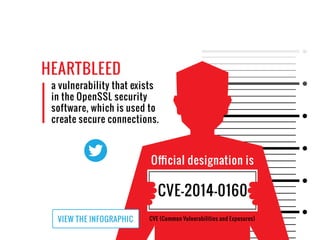
CVE-2014-0160
Official designation is
CVE (Common Vulnerabilities and Exposures)
a vulnerability that exists
in the OpenSSL security
software, which is used to
create secure connections.
HEARTBLEED
VIEW THE INFOGRAPHIC
This vulnerability existed for 2 years
before it was caught!
VIEW THE INFOGRAPHIC
01001010101010010110010101001111100100100101000101
01001010101010010110010101001111100100100101000101
01001010101010010110010101001111100100100101000101
01001010101010010110010101001111100100100101000101
01001010101010010110010101001111100100100101000101
01001010101010010110010101001111100100100101000101
01001010101010010110010101001111100100100101000101
01001010101010010110010101001111100100100101000101
01001010101010010110010101001111100100100101000101
01001010101010010110010101001111100100100101000101
01001010101010010110010101001111100100100101000101
01001010101010010110010101001111100100100101000101
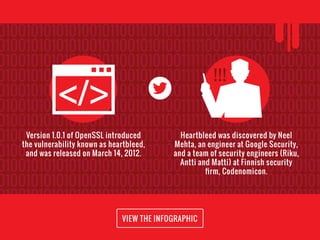
Version 1.0.1 of OpenSSL introduced
the vulnerability known as heartbleed,
and was released on March 14, 2012.
Heartbleed was discovered by Neel
Mehta, an engineer at Google Security,
and a team of security engineers (Riku,
Antti and Matti) at Finnish security
firm, Codenomicon.
!!!
VIEW THE INFOGRAPHIC
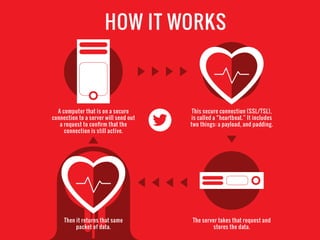
A computer that is on a secure
connection to a server will send out
a request to confirm that the
connection is still active.
The server takes that request and
stores the data.
Then it returns that same
packet of data.
This secure connection (SSL/TSL),
is called a “heartbeat.” It includes
two things: a payload, and padding.
HOW IT WORKS
VIEW THE INFOGRAPHIC
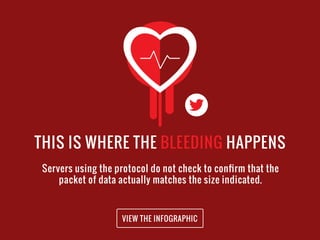
THIS IS WHERE THE BLEEDING HAPPENS
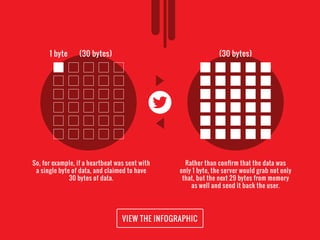
Servers using the protocol do not check to confirm that the
packet of data actually matches the size indicated.
So, for example, if a heartbeat was sent with
a single byte of data, and claimed to have
30 bytes of data.
Rather than confirm that the data was
only 1 byte, the server would grab not only
that, but the next 29 bytes from memory
as well and send it back the user.
VIEW THE INFOGRAPHIC
1 byte (30 bytes) (30 bytes)
VIEW THE INFOGRAPHIC
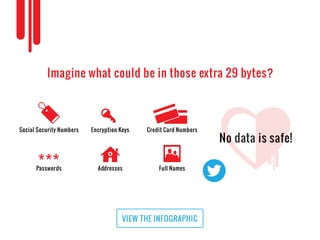
Imagine what could be in those extra 29 bytes?
No data is safe!
Passwords Addresses Full Names
Credit Card NumbersEncryption Keys
***
Social Security Numbers
VIEW THE INFOGRAPHIC
Not only that,
A malicious user could make as many heartbeat requests
as they’d like. With NO TRACE being left behind.
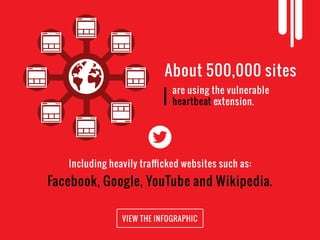
Including heavily trafficked websites such as:
Facebook, Google, YouTube and Wikipedia.
VIEW THE INFOGRAPHIC
are using the vulnerable
heartbeat extension.
About 500,000 sites
By automatically detecting, blocking and logging attempted
Heartbleed attacks, Blue Coat’s SSL Visibility Appliance provides
enterprises with the security assurance they require.
PROTECT & PREVENT
START NOW
Brought to you by:
VIEW THE INFOGRAPHIC
SOURCES:
http://heartbleed.com
http://vimeo.com/91425662
http://www.pewinternet.org/2014/04/30/heartbleeds-impact/
http://readwrite.com/2014/04/13/heartbleed-security-codenomicon-discovery#awesm=~oE3W6PSiCIxWOz
http://www.digitaltrends.com/mobile/heartbleed-bug-apps-affected-list/#!MOLoi

What is Heartbleed?