1
ECEN 4413 - Automatic Control Systems
Matlab Lecture 1
Introduction and Control Basics
Presented by Moayed Daneshyari
OKLAHOMA STATE UNIVERSITY
2
What is Matlab?
• Invented by Cleve Moler in late 1970s to give
students access to LINPACK and EISPACK
without having to learn Fortran.
• Together with Jack Little and Steve Bangert
they founded Mathworks in 1984 and created
Matlab.
• The current version is 7.
• Interpreted-code based system in which the
fundamental element is a matrix.
3
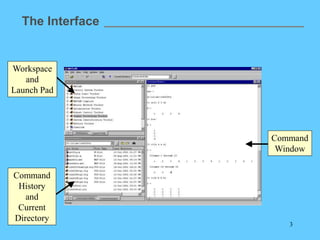
The Interface
Workspace
and
Launch Pad
Command
History
and
Current
Directory
Command
Window
4
 
  
 
1 2
m
3 4
Variable assignment
• Scalar: a = 4
• Vector: v = [3 5 1]
v(2) = 8
t = [0:0.1:5]
• Matrix: m = [1 2 ; 3 4]
m(1,2)=0
 

v 3 5 1
 

v 3 8 1
 

t 0 0.1 0.2 4.9 5
 
  
 
1 0
m
3 4
5
Basic Operations
• Scalar expressions
b = 10 / ( sqrt(a) + 3 )
c = cos (b * pi)
• Matrix expressions
n = m * [1 0]’


10
b
a 3
     
 
     
     
1 0 1 1
n
3 4 0 3


c cos(b )
6
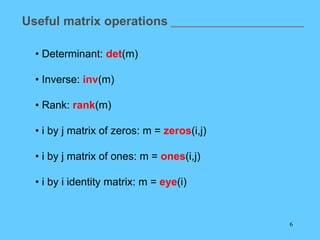
Useful matrix operations
• Determinant: det(m)
• Inverse: inv(m)
• Rank: rank(m)
• i by j matrix of zeros: m = zeros(i,j)
• i by j matrix of ones: m = ones(i,j)
• i by i identity matrix: m = eye(i)
7
Example
• Generate and plot a cosine function
x = [0:0.01:2*pi];
y = cos(x);
plot(x,y)
8
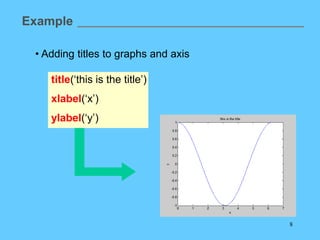
Example
• Adding titles to graphs and axis
title(‘this is the title’)
xlabel(‘x’)
ylabel(‘y’)
9
Adding graphs to reports
• Three options:
1) Print the figure directly
2) Save it to a JPG / BMP / TIFF file and add to the
report (File → Export…)
3) Copy to clipboard and paste to the report
(Edit → Copy Figure) *
* The background is copied too! By default it is gray. To change the
background color use:
set(gcf,’color’,’white’)
10
The .m files
• Programming in Matlab is done by creating “.m” files.
File → New → M-File
• Useful for storing a sequence of commands or creating
new functions.
• Call the program by writing the name of the file where it
is saved (check the “current directory”)
• “%” can be used for commenting.
11
Other useful information
• help <function name> displays the help for the function
ex.: help plot
• helpdesk brings up a GUI for browsing very
comprehensive help documents
• save <filename> saves everything in the workspace (all
variables) to <filename>.mat.
• load <filename> loads the file.
12
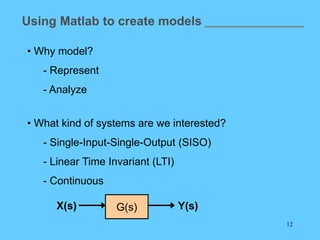
Using Matlab to create models
• Why model?
- Represent
- Analyze
• What kind of systems are we interested?
- Single-Input-Single-Output (SISO)
- Linear Time Invariant (LTI)
- Continuous
G(s) Y(s)
X(s)
13
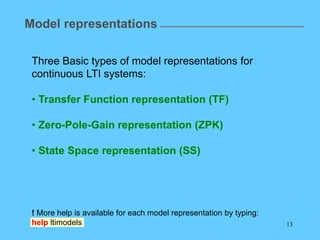
Model representations
Three Basic types of model representations for
continuous LTI systems:
• Transfer Function representation (TF)
• Zero-Pole-Gain representation (ZPK)
• State Space representation (SS)
! More help is available for each model representation by typing:
help ltimodels
14
Transfer Function representation
Given:  
 
2
( ) 25
( )
( ) 4 25
Y s
G s
U s s s
num = [0 0 25];
den = [1 4 25];
G = tf(num,den)
Method (a) Method (b)
s = tf('s');
G = 25/(s^2 +4*s +25)
Matlab function: tf
15
Zero-Pole-Gain representation
Given:

 
   
( ) 3( 1)
( )
( ) ( 2 )( 2 )
Y s s
H s
U s s i s i
zeros = [1];
poles = [2-i 2+i];
gain = 3;
H = zpk(zeros,poles,gain)
Matlab function: zpk
16
State Space representation
Given: ,
 


 

x Ax Bu
y Cx Du
Matlab function: ss
   
   
 
   

   
  
1 0 1
2 1 0
3 2 0
A B
C D
A = [1 0 ; -2 1];
B = [1 0]’;
C = [3 -2];
D = [0];
sys = ss(A,B,C,D)
17
System analysis
• Once a model has been introduced in Matlab, we can
use a series of functions to analyze the system.
• Key analyses at our disposal:
1) Stability analysis
e.g. pole placement
2) Time domain analysis
e.g. response to different inputs
3) Frequency domain analysis
e.g. bode plot
18
Is the system stable?
Recall: All poles of the system must be on the right
hand side of the S plain for continuous LTI systems to
be stable.
Manually: Poles are the roots for the denominator
of transfer functions or eigen values of matrix A
for state space representations
In Matlab: pole(sys)
Stability analysis
19
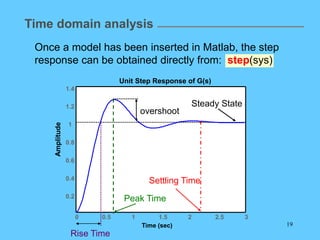
Once a model has been inserted in Matlab, the step
response can be obtained directly from: step(sys)
Time domain analysis
Unit Step Response of G(s)
Time (sec)
Amplitude
0 0.5 1 1.5 2 2.5 3
0.2
0.4
0.6
0.8
1
1.2
1.4
Peak Time
Rise Time
Steady State
Settling Time
overshoot
20
Time domain analysis
• Impulse response
impulse(sys)
• Response to an arbitrary input
e.g.
t = [0:0.01:10];
u = cos(t);
lsim(sys,u,t)
Matlab also caries other useful functions for time domain
analysis:
! It is also possible to assign a variable to those functions to obtain a
vector with the output. For example: y = impulse(sys);
21
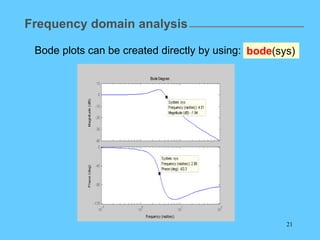
Bode plots can be created directly by using: bode(sys)
Frequency domain analysis
22
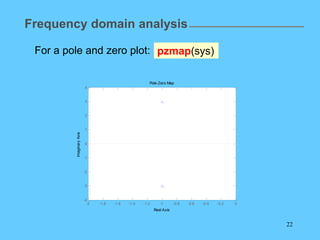
For a pole and zero plot: pzmap(sys)
Frequency domain analysis
-2 -1.8 -1.6 -1.4 -1.2 -1 -0.8 -0.6 -0.4 -0.2 0
-4
-3
-2
-1
0
1
2
3
4
Pole-Zero Map
Real Axis
Imaginary
Axis
23
Extra: partial fraction expansion
num=[2 3 2];
den=[1 3 2];
[r,p,k] = residue(num,den)
r =
-4
1
p =
-2
-1
k =
2
Answer:
)
1
(
1
)
2
(
4
2
)
(
)
(
)
1
(
)
1
(
)
(
)
(
0














s
s
s
n
p
s
n
r
p
s
r
s
k
s
G 

2
3
2
3
2
)
( 2
2





s
s
s
s
s
G
Given:

4413-lecture-09 Introduction Matlab lecture .ppt

  • 1.
    1 ECEN 4413 -Automatic Control Systems Matlab Lecture 1 Introduction and Control Basics Presented by Moayed Daneshyari OKLAHOMA STATE UNIVERSITY
  • 2.
    2 What is Matlab? •Invented by Cleve Moler in late 1970s to give students access to LINPACK and EISPACK without having to learn Fortran. • Together with Jack Little and Steve Bangert they founded Mathworks in 1984 and created Matlab. • The current version is 7. • Interpreted-code based system in which the fundamental element is a matrix.
  • 3.
  • 4.
    4       1 2 m 3 4 Variable assignment • Scalar: a = 4 • Vector: v = [3 5 1] v(2) = 8 t = [0:0.1:5] • Matrix: m = [1 2 ; 3 4] m(1,2)=0    v 3 5 1    v 3 8 1    t 0 0.1 0.2 4.9 5        1 0 m 3 4
  • 5.
    5 Basic Operations • Scalarexpressions b = 10 / ( sqrt(a) + 3 ) c = cos (b * pi) • Matrix expressions n = m * [1 0]’   10 b a 3                     1 0 1 1 n 3 4 0 3   c cos(b )
  • 6.
    6 Useful matrix operations •Determinant: det(m) • Inverse: inv(m) • Rank: rank(m) • i by j matrix of zeros: m = zeros(i,j) • i by j matrix of ones: m = ones(i,j) • i by i identity matrix: m = eye(i)
  • 7.
    7 Example • Generate andplot a cosine function x = [0:0.01:2*pi]; y = cos(x); plot(x,y)
  • 8.
    8 Example • Adding titlesto graphs and axis title(‘this is the title’) xlabel(‘x’) ylabel(‘y’)
  • 9.
    9 Adding graphs toreports • Three options: 1) Print the figure directly 2) Save it to a JPG / BMP / TIFF file and add to the report (File → Export…) 3) Copy to clipboard and paste to the report (Edit → Copy Figure) * * The background is copied too! By default it is gray. To change the background color use: set(gcf,’color’,’white’)
  • 10.
    10 The .m files •Programming in Matlab is done by creating “.m” files. File → New → M-File • Useful for storing a sequence of commands or creating new functions. • Call the program by writing the name of the file where it is saved (check the “current directory”) • “%” can be used for commenting.
  • 11.
    11 Other useful information •help <function name> displays the help for the function ex.: help plot • helpdesk brings up a GUI for browsing very comprehensive help documents • save <filename> saves everything in the workspace (all variables) to <filename>.mat. • load <filename> loads the file.
  • 12.
    12 Using Matlab tocreate models • Why model? - Represent - Analyze • What kind of systems are we interested? - Single-Input-Single-Output (SISO) - Linear Time Invariant (LTI) - Continuous G(s) Y(s) X(s)
  • 13.
    13 Model representations Three Basictypes of model representations for continuous LTI systems: • Transfer Function representation (TF) • Zero-Pole-Gain representation (ZPK) • State Space representation (SS) ! More help is available for each model representation by typing: help ltimodels
  • 14.
    14 Transfer Function representation Given:    2 ( ) 25 ( ) ( ) 4 25 Y s G s U s s s num = [0 0 25]; den = [1 4 25]; G = tf(num,den) Method (a) Method (b) s = tf('s'); G = 25/(s^2 +4*s +25) Matlab function: tf
  • 15.
    15 Zero-Pole-Gain representation Given:       ( ) 3( 1) ( ) ( ) ( 2 )( 2 ) Y s s H s U s s i s i zeros = [1]; poles = [2-i 2+i]; gain = 3; H = zpk(zeros,poles,gain) Matlab function: zpk
  • 16.
    16 State Space representation Given:,        x Ax Bu y Cx Du Matlab function: ss                       1 0 1 2 1 0 3 2 0 A B C D A = [1 0 ; -2 1]; B = [1 0]’; C = [3 -2]; D = [0]; sys = ss(A,B,C,D)
  • 17.
    17 System analysis • Oncea model has been introduced in Matlab, we can use a series of functions to analyze the system. • Key analyses at our disposal: 1) Stability analysis e.g. pole placement 2) Time domain analysis e.g. response to different inputs 3) Frequency domain analysis e.g. bode plot
  • 18.
    18 Is the systemstable? Recall: All poles of the system must be on the right hand side of the S plain for continuous LTI systems to be stable. Manually: Poles are the roots for the denominator of transfer functions or eigen values of matrix A for state space representations In Matlab: pole(sys) Stability analysis
  • 19.
    19 Once a modelhas been inserted in Matlab, the step response can be obtained directly from: step(sys) Time domain analysis Unit Step Response of G(s) Time (sec) Amplitude 0 0.5 1 1.5 2 2.5 3 0.2 0.4 0.6 0.8 1 1.2 1.4 Peak Time Rise Time Steady State Settling Time overshoot
  • 20.
    20 Time domain analysis •Impulse response impulse(sys) • Response to an arbitrary input e.g. t = [0:0.01:10]; u = cos(t); lsim(sys,u,t) Matlab also caries other useful functions for time domain analysis: ! It is also possible to assign a variable to those functions to obtain a vector with the output. For example: y = impulse(sys);
  • 21.
    21 Bode plots canbe created directly by using: bode(sys) Frequency domain analysis
  • 22.
    22 For a poleand zero plot: pzmap(sys) Frequency domain analysis -2 -1.8 -1.6 -1.4 -1.2 -1 -0.8 -0.6 -0.4 -0.2 0 -4 -3 -2 -1 0 1 2 3 4 Pole-Zero Map Real Axis Imaginary Axis
  • 23.
    23 Extra: partial fractionexpansion num=[2 3 2]; den=[1 3 2]; [r,p,k] = residue(num,den) r = -4 1 p = -2 -1 k = 2 Answer: ) 1 ( 1 ) 2 ( 4 2 ) ( ) ( ) 1 ( ) 1 ( ) ( ) ( 0               s s s n p s n r p s r s k s G   2 3 2 3 2 ) ( 2 2      s s s s s G Given: