Cohesive Devices
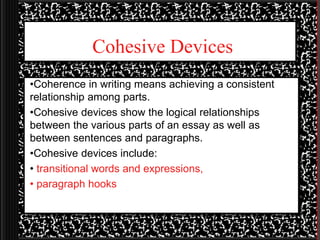
•Coherence in writing means achieving a consistent
relationship among parts.
•Cohesive devices show the logical relationships
between the various parts of an essay as well as
between sentences and paragraphs.
•Cohesive devices include:
• transitional words and expressions,
• paragraph hooks
What are they?
• cohesive devices are like bridges
between parts of your paper
• They are cues that help the reader to
interpret ideas in the way that you, as a
writer, want them to understand
What do they do?
• cohesive devices help you carry over a
thought from one sentence to another, from
one idea to another, or from one paragraph to
another with words or phrases.
• cohesive devices link your sentences and
paragraphs together smoothly so that there
are no abrupt jumps or breaks between
ideas.
Why do you use them?
• cohesive words and phrases are used to link
sentences and paragraphs, to show which
direction your thought patterns are going, to
help the reader accurately follow your train of
thought.
• They signal the relationships among the
various parts of your subject.
Types:
• There are several types of cohesive devices,
and each category leads your reader to make
certain connections or assumptions about the
areas you are connecting.
• Some lead your reader forward and imply the
"building" of an idea or thought,
• while others make your reader compare ideas
or draw conclusions from the preceding
thoughts.
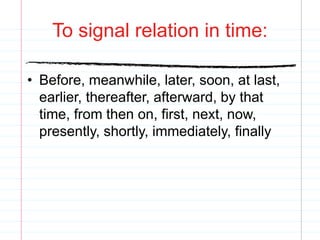
To signal relation in time:
• Before, meanwhile, later, soon, at last,
earlier, thereafter, afterward, by that
time, from then on, first, next, now,
presently, shortly, immediately, finally
To signal similarity:
• Likewise, similarly, once again, once
more
To signal difference:
• But, yet, however, although, whereas,
though, even so, nonetheless, still, on
the other hand, on the contrary
To signal consequences:
• As a result, consequently, therefore,
hence, for this reason
Example:
• I knew my dieting had gotten out of hand, but
when I could actually see the movement of
my heart beating beneath my clothes, I knew
that I was in trouble. At first, the family doctor
reassured my parents that my rapid weight
loss was a “temporary phase among teenage
girls.” However, when I, at fourteen years old
and five feet tall, weighed in at 63 pounds, my
doctor…
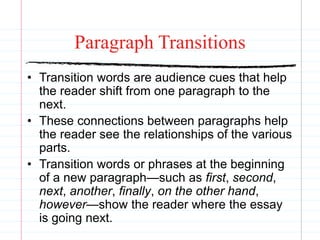
Paragraph Transitions
• Transition words are audience cues that help
the reader shift from one paragraph to the
next.
• These connections between paragraphs help
the reader see the relationships of the various
parts.
• Transition words or phrases at the beginning
of a new paragraph—such as first, second,
next, another, finally, on the other hand,
however—show the reader where the essay
is going next.
Commonly Used Transitions
• See pp. 114-15 of your Handbook
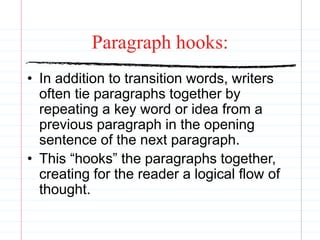
Paragraph hooks:
• In addition to transition words, writers
often tie paragraphs together by
repeating a key word or idea from a
previous paragraph in the opening
sentence of the next paragraph.
• This “hooks” the paragraphs together,
creating for the reader a logical flow of
thought.
For example:
4226533.ppt

4226533.ppt

  • 1.
    Cohesive Devices •Coherence inwriting means achieving a consistent relationship among parts. •Cohesive devices show the logical relationships between the various parts of an essay as well as between sentences and paragraphs. •Cohesive devices include: • transitional words and expressions, • paragraph hooks
  • 2.
    What are they? •cohesive devices are like bridges between parts of your paper • They are cues that help the reader to interpret ideas in the way that you, as a writer, want them to understand
  • 3.
    What do theydo? • cohesive devices help you carry over a thought from one sentence to another, from one idea to another, or from one paragraph to another with words or phrases. • cohesive devices link your sentences and paragraphs together smoothly so that there are no abrupt jumps or breaks between ideas.
  • 4.
    Why do youuse them? • cohesive words and phrases are used to link sentences and paragraphs, to show which direction your thought patterns are going, to help the reader accurately follow your train of thought. • They signal the relationships among the various parts of your subject.
  • 5.
    Types: • There areseveral types of cohesive devices, and each category leads your reader to make certain connections or assumptions about the areas you are connecting. • Some lead your reader forward and imply the "building" of an idea or thought, • while others make your reader compare ideas or draw conclusions from the preceding thoughts.
  • 6.
    To signal relationin time: • Before, meanwhile, later, soon, at last, earlier, thereafter, afterward, by that time, from then on, first, next, now, presently, shortly, immediately, finally
  • 7.
    To signal similarity: •Likewise, similarly, once again, once more
  • 8.
    To signal difference: •But, yet, however, although, whereas, though, even so, nonetheless, still, on the other hand, on the contrary
  • 9.
    To signal consequences: •As a result, consequently, therefore, hence, for this reason
  • 10.
    Example: • I knewmy dieting had gotten out of hand, but when I could actually see the movement of my heart beating beneath my clothes, I knew that I was in trouble. At first, the family doctor reassured my parents that my rapid weight loss was a “temporary phase among teenage girls.” However, when I, at fourteen years old and five feet tall, weighed in at 63 pounds, my doctor…
  • 11.
    Paragraph Transitions • Transitionwords are audience cues that help the reader shift from one paragraph to the next. • These connections between paragraphs help the reader see the relationships of the various parts. • Transition words or phrases at the beginning of a new paragraph—such as first, second, next, another, finally, on the other hand, however—show the reader where the essay is going next.
  • 12.
    Commonly Used Transitions •See pp. 114-15 of your Handbook
  • 13.
    Paragraph hooks: • Inaddition to transition words, writers often tie paragraphs together by repeating a key word or idea from a previous paragraph in the opening sentence of the next paragraph. • This “hooks” the paragraphs together, creating for the reader a logical flow of thought.
  • 14.