Transitional Words
LINKING WORDS OR CONNECTIVE DEVICES
Lesson Outline
• Transitional Words
• Types of Transition
• Time Element in Narratives
• Practice
Recognize different transitional
words and their major functions
Use appropriate and varied transitions
to link ideas in a story
Improve text organization through
transitional words
Today, we'll
learn to:
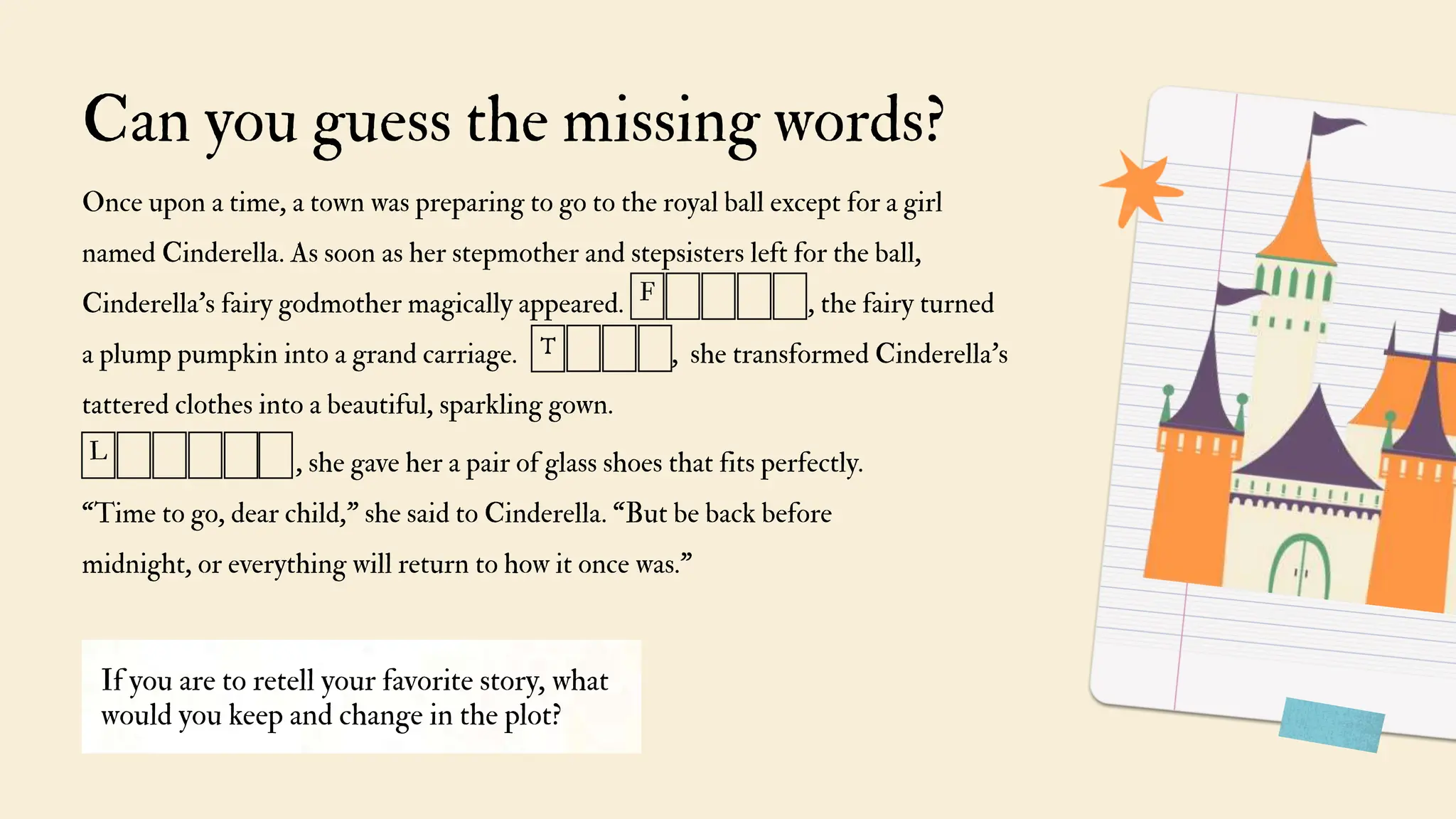
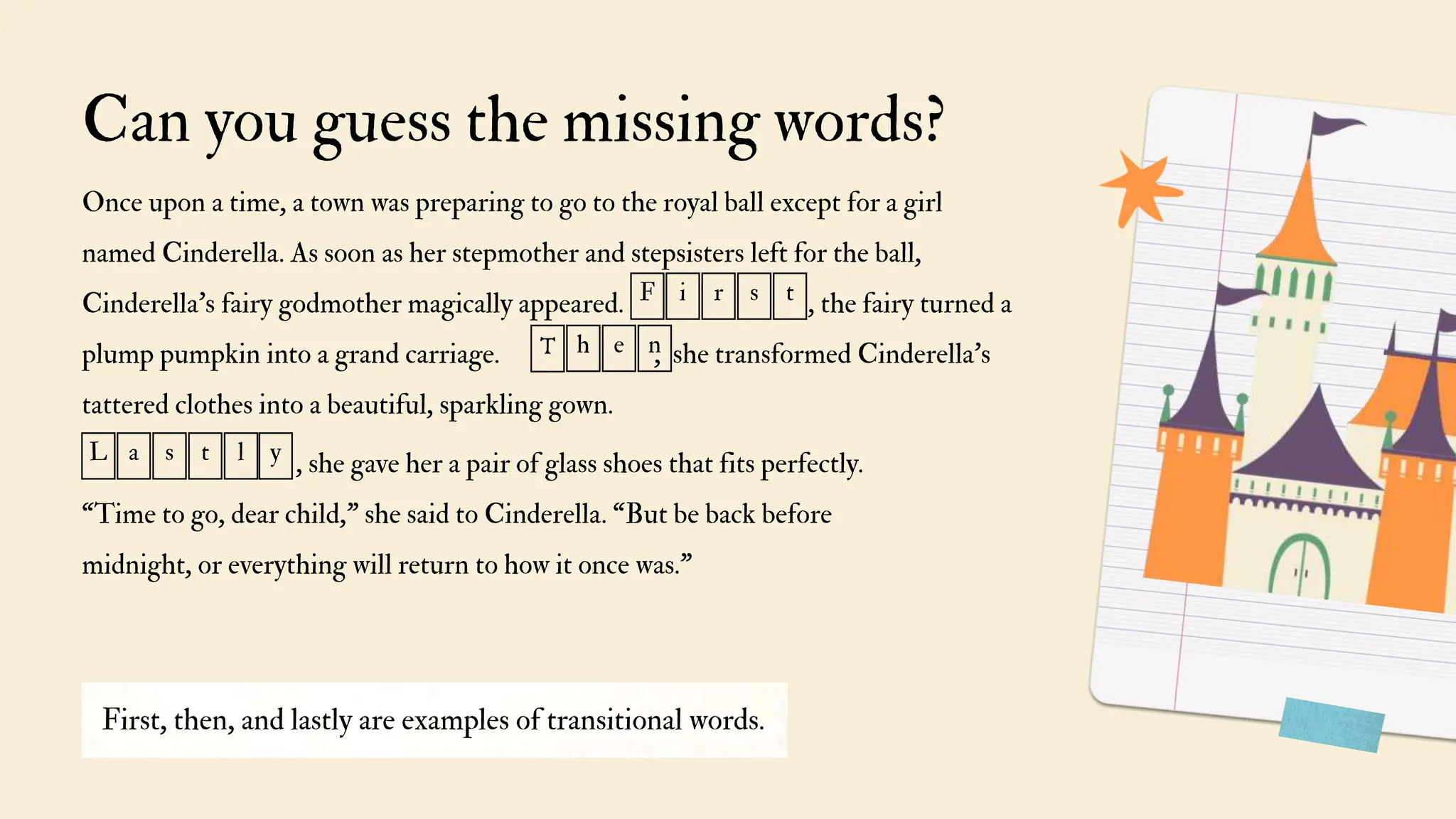
Can you guess the missing words?
Once upon a time, a town was preparing to go to the royal ball except for a girl
named Cinderella. As soon as her stepmother and stepsisters left for the ball,
Cinderella's fairy godmother magically appeared. , the fairy turned
a plump pumpkin into a grand carriage. , she transformed Cinderella's
tattered clothes into a beautiful, sparkling gown.
F i r s t
T h e n
, she gave her a pair of glass shoes that fits perfectly.
“Time to go, dear child," she said to Cinderella. “But be back before
midnight, or everything will return to how it once was."
L a s t l y
If you are to retell your favorite story, what
would you keep and change in the plot?
Can you guess the missing words?
First, then, and lastly are examples of transitional words.
Once upon a time, a town was preparing to go to the royal ball except for a girl
named Cinderella. As soon as her stepmother and stepsisters left for the ball,
Cinderella's fairy godmother magically appeared. , the fairy turned a
plump pumpkin into a grand carriage. , she transformed Cinderella's
tattered clothes into a beautiful, sparkling gown.
F i r s t
T h e n
, she gave her a pair of glass shoes that fits perfectly.
“Time to go, dear child," she said to Cinderella. “But be back before
midnight, or everything will return to how it once was."
L a s t l y
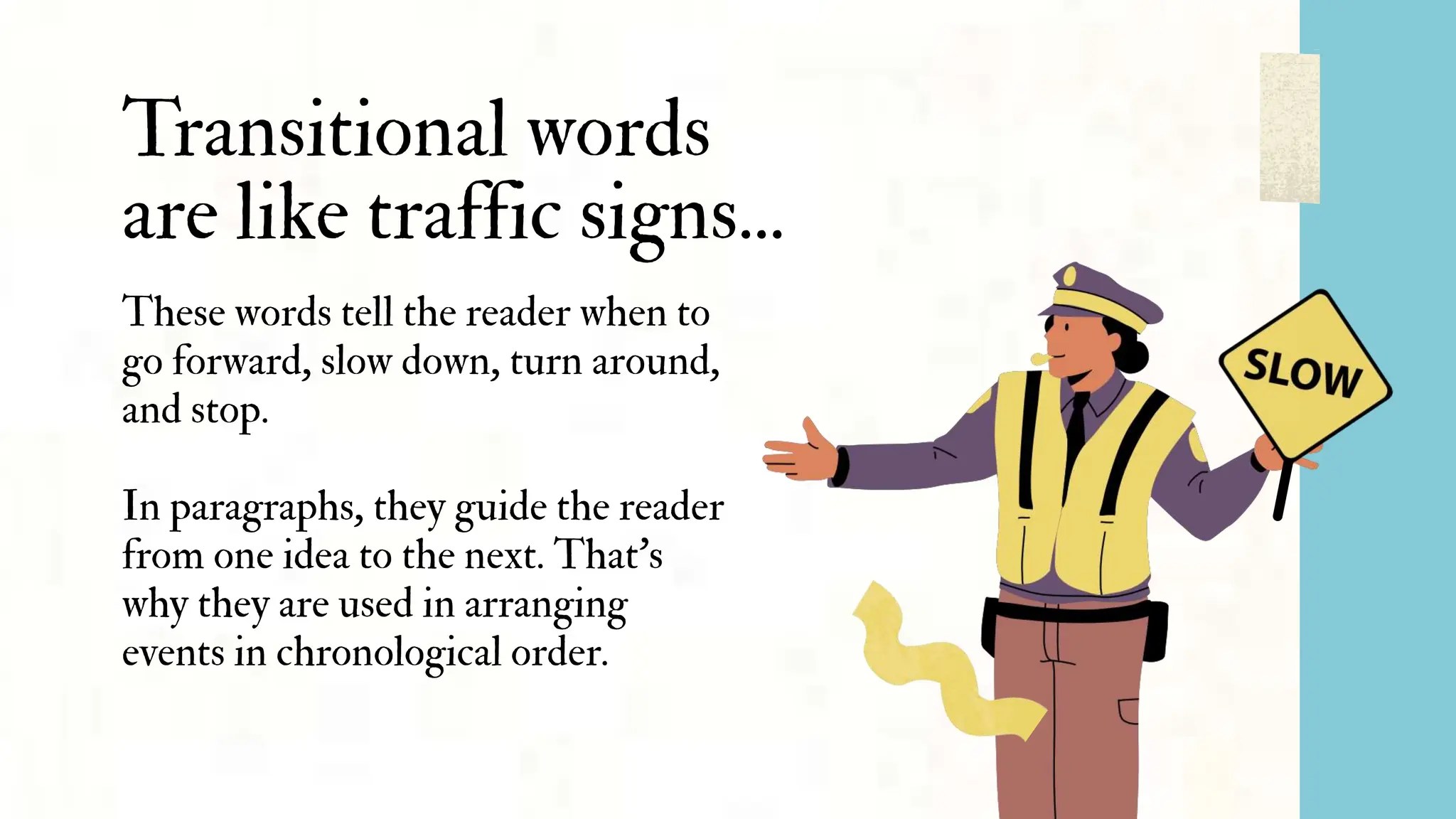
Transitional words
are like traffic signs...
These words tell the reader when to
go forward, slow down, turn around,
and stop.
In paragraphs, they guide the reader
from one idea to the next. That's
why they are used in arranging
events in chronological order.
...and act
like bridges
They connect one idea to
another, moving from
one point to the next
discussion, or from one
paragraph to another.
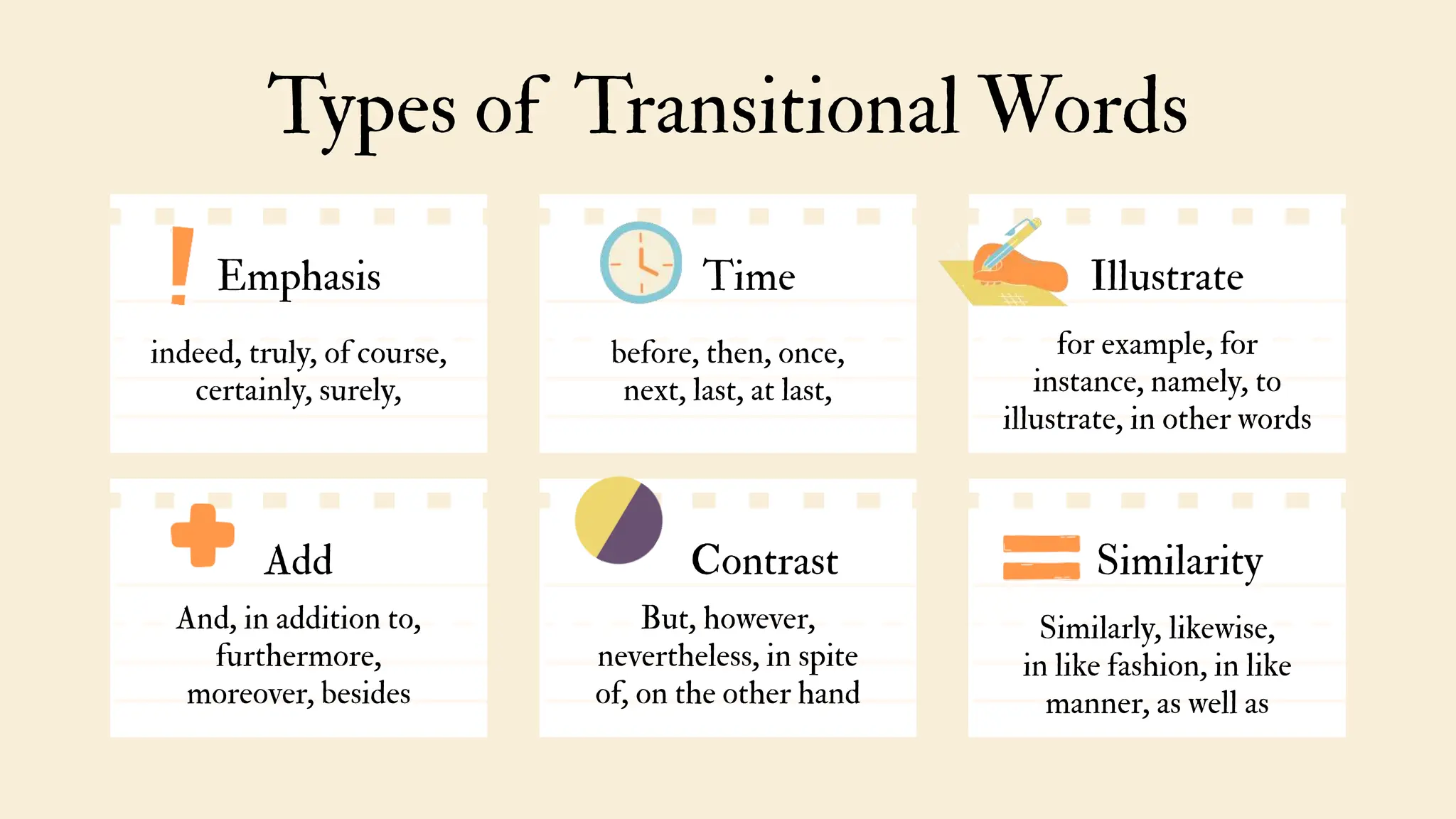
Types of Transitional Words
Illustrate
Similarity
for example, for
instance, namely, to
illustrate, in other words
Similarly, likewise,
in like fashion, in like
manner, as well as
Emphasis
Add
Time
Contrast
indeed, truly, of course,
certainly, surely,
And, in addition to,
furthermore,
moreover, besides
before, then, once,
next, last, at last,
But, however,
nevertheless, in spite
of, on the other hand
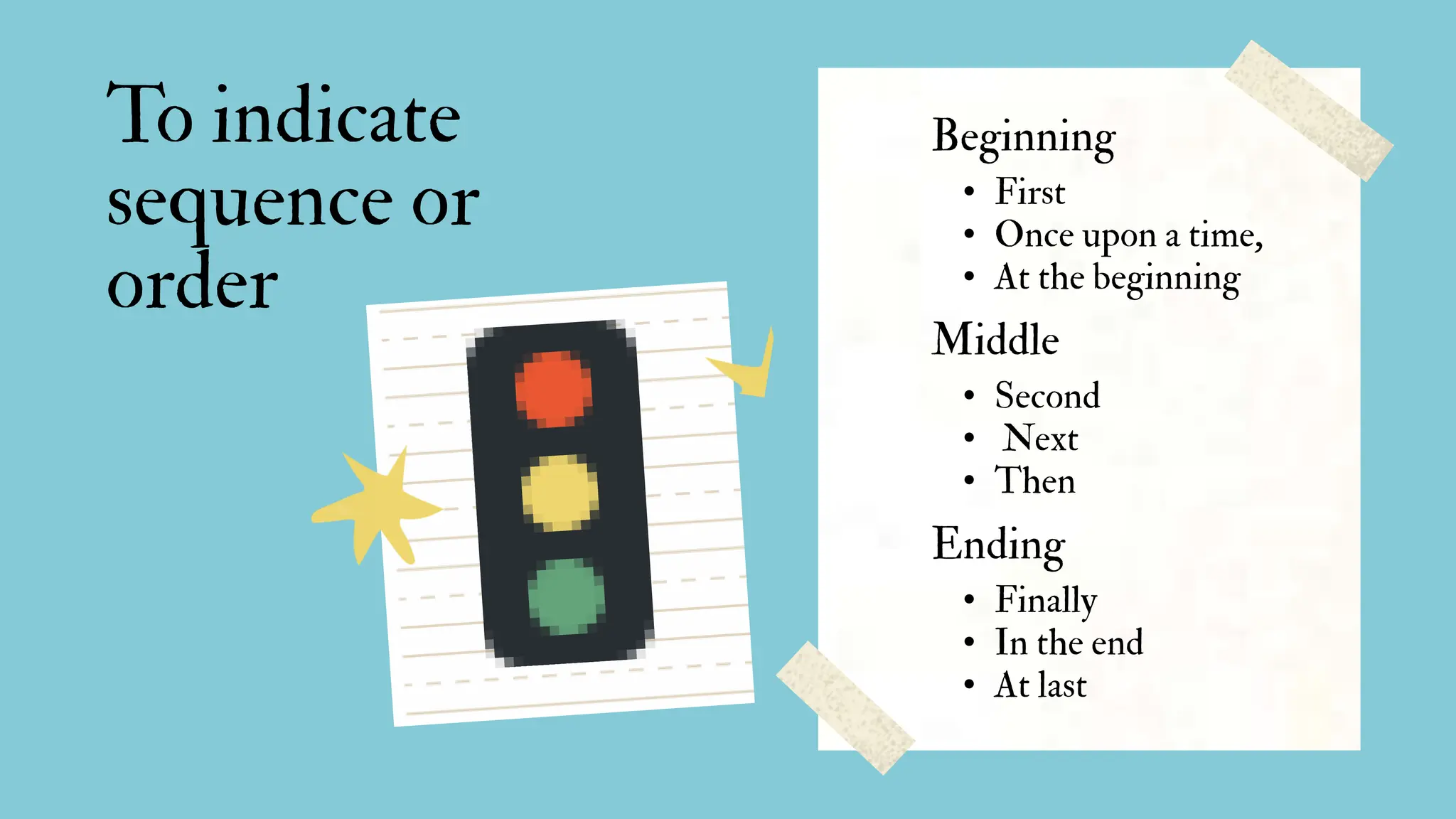
• First
• Once upon a time,
• At the beginning
Beginning
To indicate
sequence or
order
• Second
• Next
• Then
Middle
• Finally
• In the end
• At last
Ending
The Hare and the Tortoise
Read the story and study how the underlined transitional words were used.
And so they
challenged each other
to a race. Confident
that the hare will not
lose, he took a nap
while the tortoise
continued slowly but
steadily. Later on, the
tortoise overtook him
and won.
In the forest, a hare
and tortoise live.
First, they did not
like each other
because of their
differences.
One is proud of his
speed, while the
other takes things
slowly.
The Hare and the Tortoise
How did the underlined words help you understand the story?
In the end, they
decided to race again.
But this time, they
helped each other.
The tortoise helped
the hare cross the river
while the hare carried
the tortoise. Together,
they reached the finish
line.
Feeling
disappointed, the
hare challenged
the hare again and
began to run fast
without stopping.
Soon, the hare
outperformed the
tortoise.
Something
to “Pun"der
What would a clock be if it didn’t
have any numbers? Timeless!
Transitional words are used
commonly in stories to add
meaning to the time element of
the story.
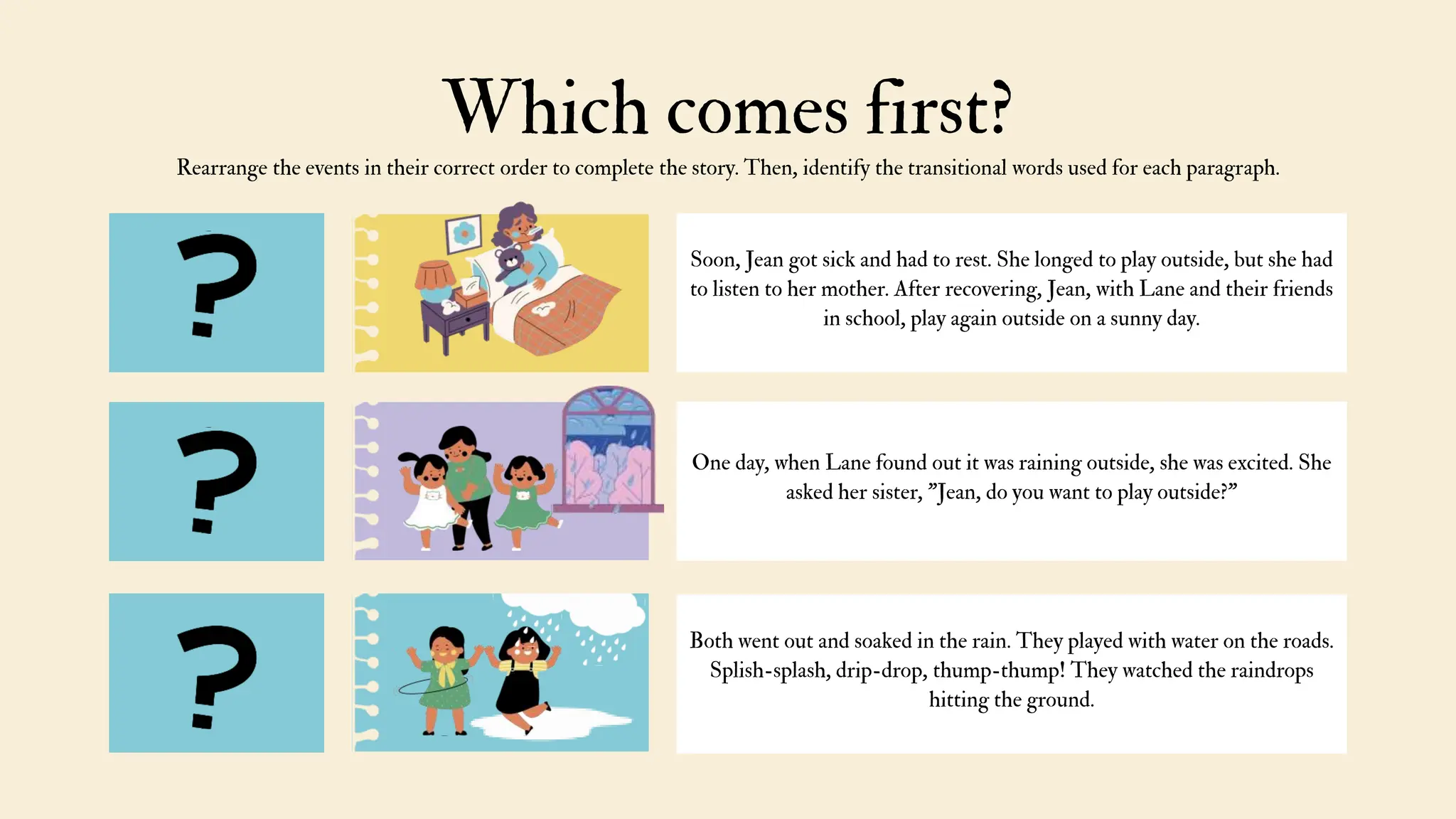
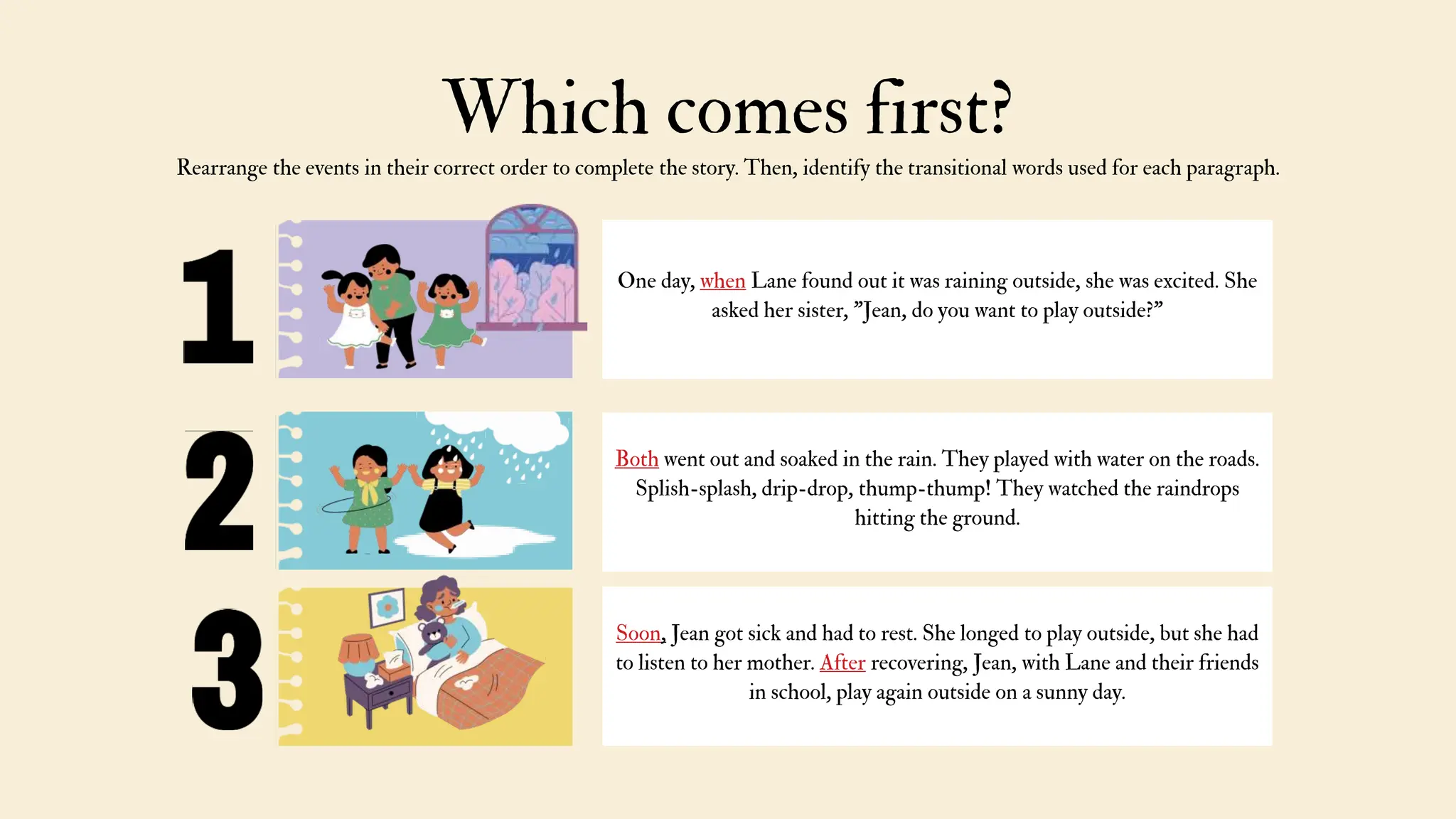
Soon, Jean got sick and had to rest. She longed to play outside, but she had
to listen to her mother. After recovering, Jean, with Lane and their friends
in school, play again outside on a sunny day.
One day, when Lane found out it was raining outside, she was excited. She
asked her sister, "Jean, do you want to play outside?"
Both went out and soaked in the rain. They played with water on the roads.
Splish-splash, drip-drop, thump-thump! They watched the raindrops
hitting the ground.
Which comes first?
Which comes first?
Rearrange the events in their correct order to complete the story. Then, identify the transitional words used for each paragraph.
Soon, Jean got sick and had to rest. She longed to play outside, but she had
to listen to her mother. After recovering, Jean, with Lane and their friends
in school, play again outside on a sunny day.
One day, when Lane found out it was raining outside, she was excited. She
asked her sister, "Jean, do you want to play outside?"
Both went out and soaked in the rain. They played with water on the roads.
Splish-splash, drip-drop, thump-thump! They watched the raindrops
hitting the ground.
Which comes first?
Rearrange the events in their correct order to complete the story. Then, identify the transitional words used for each paragraph.
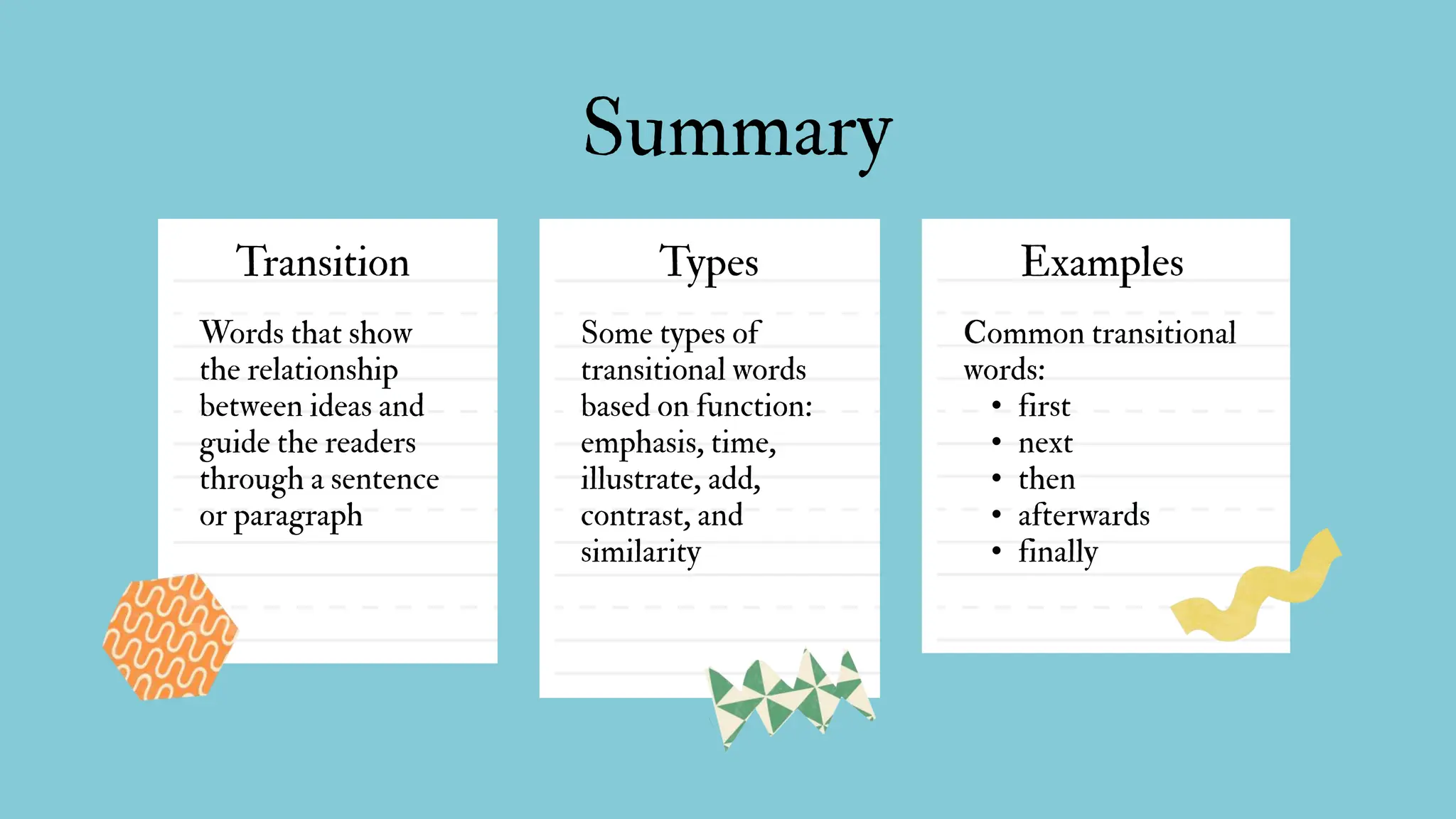
Transition Types Examples
Words that show
the relationship
between ideas and
guide the readers
through a sentence
or paragraph
Some types of
transitional words
based on function:
emphasis, time,
illustrate, add,
contrast, and
similarity
Common transitional
words:
• first
• next
• then
• afterwards
• finally
Summary
A strange creature just crashed
and landed in your backyard.
What happens next? Complete
your story using appropriate
transitional words.
Writing Wizard

How to Use Transitional Words Presentation.pptx

  • 1.
    Transitional Words LINKING WORDSOR CONNECTIVE DEVICES
  • 2.
    Lesson Outline • TransitionalWords • Types of Transition • Time Element in Narratives • Practice
  • 3.
    Recognize different transitional wordsand their major functions Use appropriate and varied transitions to link ideas in a story Improve text organization through transitional words Today, we'll learn to:
  • 4.
    Can you guessthe missing words? Once upon a time, a town was preparing to go to the royal ball except for a girl named Cinderella. As soon as her stepmother and stepsisters left for the ball, Cinderella's fairy godmother magically appeared. , the fairy turned a plump pumpkin into a grand carriage. , she transformed Cinderella's tattered clothes into a beautiful, sparkling gown. F i r s t T h e n , she gave her a pair of glass shoes that fits perfectly. “Time to go, dear child," she said to Cinderella. “But be back before midnight, or everything will return to how it once was." L a s t l y If you are to retell your favorite story, what would you keep and change in the plot?
  • 5.
    Can you guessthe missing words? First, then, and lastly are examples of transitional words. Once upon a time, a town was preparing to go to the royal ball except for a girl named Cinderella. As soon as her stepmother and stepsisters left for the ball, Cinderella's fairy godmother magically appeared. , the fairy turned a plump pumpkin into a grand carriage. , she transformed Cinderella's tattered clothes into a beautiful, sparkling gown. F i r s t T h e n , she gave her a pair of glass shoes that fits perfectly. “Time to go, dear child," she said to Cinderella. “But be back before midnight, or everything will return to how it once was." L a s t l y
  • 6.
    Transitional words are liketraffic signs... These words tell the reader when to go forward, slow down, turn around, and stop. In paragraphs, they guide the reader from one idea to the next. That's why they are used in arranging events in chronological order.
  • 7.
    ...and act like bridges Theyconnect one idea to another, moving from one point to the next discussion, or from one paragraph to another.
  • 8.
    Types of TransitionalWords Illustrate Similarity for example, for instance, namely, to illustrate, in other words Similarly, likewise, in like fashion, in like manner, as well as Emphasis Add Time Contrast indeed, truly, of course, certainly, surely, And, in addition to, furthermore, moreover, besides before, then, once, next, last, at last, But, however, nevertheless, in spite of, on the other hand
  • 9.
    • First • Onceupon a time, • At the beginning Beginning To indicate sequence or order • Second • Next • Then Middle • Finally • In the end • At last Ending
  • 10.
    The Hare andthe Tortoise Read the story and study how the underlined transitional words were used. And so they challenged each other to a race. Confident that the hare will not lose, he took a nap while the tortoise continued slowly but steadily. Later on, the tortoise overtook him and won. In the forest, a hare and tortoise live. First, they did not like each other because of their differences. One is proud of his speed, while the other takes things slowly.
  • 11.
    The Hare andthe Tortoise How did the underlined words help you understand the story? In the end, they decided to race again. But this time, they helped each other. The tortoise helped the hare cross the river while the hare carried the tortoise. Together, they reached the finish line. Feeling disappointed, the hare challenged the hare again and began to run fast without stopping. Soon, the hare outperformed the tortoise.
  • 12.
    Something to “Pun"der What woulda clock be if it didn’t have any numbers? Timeless! Transitional words are used commonly in stories to add meaning to the time element of the story.
  • 13.
    Soon, Jean gotsick and had to rest. She longed to play outside, but she had to listen to her mother. After recovering, Jean, with Lane and their friends in school, play again outside on a sunny day. One day, when Lane found out it was raining outside, she was excited. She asked her sister, "Jean, do you want to play outside?" Both went out and soaked in the rain. They played with water on the roads. Splish-splash, drip-drop, thump-thump! They watched the raindrops hitting the ground. Which comes first? Which comes first? Rearrange the events in their correct order to complete the story. Then, identify the transitional words used for each paragraph.
  • 14.
    Soon, Jean gotsick and had to rest. She longed to play outside, but she had to listen to her mother. After recovering, Jean, with Lane and their friends in school, play again outside on a sunny day. One day, when Lane found out it was raining outside, she was excited. She asked her sister, "Jean, do you want to play outside?" Both went out and soaked in the rain. They played with water on the roads. Splish-splash, drip-drop, thump-thump! They watched the raindrops hitting the ground. Which comes first? Rearrange the events in their correct order to complete the story. Then, identify the transitional words used for each paragraph.
  • 15.
    Transition Types Examples Wordsthat show the relationship between ideas and guide the readers through a sentence or paragraph Some types of transitional words based on function: emphasis, time, illustrate, add, contrast, and similarity Common transitional words: • first • next • then • afterwards • finally Summary
  • 16.
    A strange creaturejust crashed and landed in your backyard. What happens next? Complete your story using appropriate transitional words. Writing Wizard