1
Pulmonary Drug Delivery
Dr Mohammad Issa
2
Pulmonary Drug Delivery
 Anatomy and Physiology of the
Respiratory System
 Advantages of Pulmonary Delivery
 Lung epithelium at different sites within
the lungs
 Pulmonary absorptive surfaces
 Systemic delivery of:
 Small hydrophobic drugs
 Small hydrophilic drugs
 Macromolecules drugs
 Pulmonary Drug Delivery Devices
3
Anatomy and Physiology of the
Respiratory System
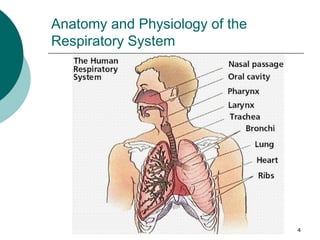
 The human respiratory system is divided into
upper and lower respiratory tracts
 The upper respiratory system consists of the
nose, nasal cavities, nasopharynx, and
oropharynx
 The lower respiratory tract consists of the
larynx, trachea, bronchi, and alveoli, which
are composed of respiratory tissues
 The left and right lungs are unequal in size.
The right lung is composed of three lobes:
the superior, middle, and inferior lobes. The
smaller left lung has two lobes
4
Anatomy and Physiology of the
Respiratory System
5
Anatomy and Physiology of the
Respiratory System
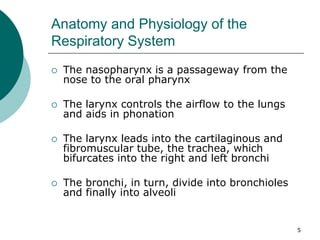
 The nasopharynx is a passageway from the
nose to the oral pharynx
 The larynx controls the airflow to the lungs
and aids in phonation
 The larynx leads into the cartilaginous and
fibromuscular tube, the trachea, which
bifurcates into the right and left bronchi
 The bronchi, in turn, divide into bronchioles
and finally into alveoli
6
Anatomy and Physiology of the
Respiratory System
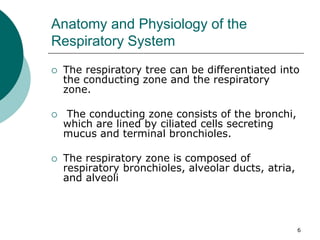
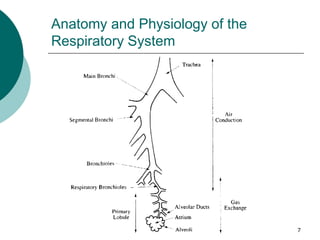
 The respiratory tree can be differentiated into
the conducting zone and the respiratory
zone.
 The conducting zone consists of the bronchi,
which are lined by ciliated cells secreting
mucus and terminal bronchioles.
 The respiratory zone is composed of
respiratory bronchioles, alveolar ducts, atria,
and alveoli
7
Anatomy and Physiology of the
Respiratory System
8
Anatomy and Physiology of the
Respiratory System
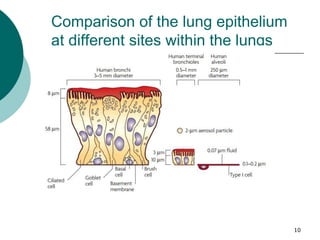
 The epithelium in the conducting zone gets
thinner as it changes from pseudostratified
columnar to columnar epithelium and finally
to cuboidal epithelium in the terminal
bronchioles
 The upper part of the conducting zone (from
the trachea to the bronchi) consists of ciliated
and goblet cells (which secrete mucus)
 These cells are absent in the bronchioles.
Alveoli are covered predominantly with a
monolayer of squamous epithelial cells (type
I cells) overlying a thin basal lamina
9
Anatomy and Physiology of the
Respiratory System
 Cuboidal type II cells present at the junctions
of alveoli secrete a fluid containing a surfactant
(dipalmitoylphosphatidylcholine), apoproteins,
and calcium ions
 The lungs are covered extensively by a vast
network of blood vessels, and almost all the
blood in circulation flows through the lungs.
Deoxygenated blood is supplied to the lungs by
the pulmonary artery
 The pulmonary veins are similar to the arteries
in branching, and their tissue structure is
similar to that of systemic circulation. The total
blood volume of the lungs is about 450 mL,
which is about 10 percent of total body blood
volume
10
Comparison of the lung epithelium
at different sites within the lungs
11
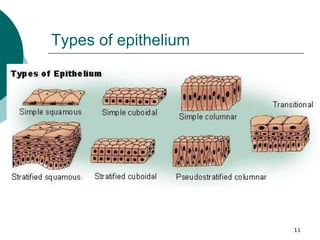
Types of epithelium
12
Advantages of Pulmonary Delivery of
Drugs To Treat Respiratory Disease
 Deliver high drug concentrations directly to the
disease site
 Minimizes risk of systemic side effects
 Rapid clinical response
 Bypass the barriers to therapeutic efficacy, such
as poor gastrointestinal absorption and first-pass
metabolism in the liver
 Achieve a similar or superior therapeutic effect at
a fraction of the systemic dose, (for example, oral
salbutamol 2–4 mg is therapeutically equivalent
to 100–200 μg by metered dose inhaler)
13
Advantages of Pulmonary Delivery of
Drugs To Treat Systemic Disease
 A non-invasive, needle-free delivery system
 Suitable for a wide range of substances from
small molecules to very large proteins
 Enormous absorptive surface area (140 m2)
and a highly permeable membrane (0.2–0.7
μm thickness) in the alveolar region
 Large molecules with very low absorption
rates can be absorbed in significant
quantities; the slow mucociliary clearance in
the lung periphery results in prolonged
residency in the lung
14
Advantages of Pulmonary Delivery of
Drugs To Treat Systemic Disease
 A less harsh, low enzymatic environment
 Avoids first-pass metabolism
 Reproducible absorption kinetics
 Pulmonary delivery is independent of dietary
complications, extracellular enzymes, and
inter-patient metabolic differences that affect
gastrointestinal absorption
15
Pulmonary absorptive surfaces
 The airways (the trachea, bronchi and
bronchioles) are composed of a gradually
thinning columnar epithelium populated by
many mucus and ciliated cells that
collectively form the mucociliary escalator
 The airways bifurcate roughly 16–17 times
before the alveoli are reached
 Inhaled insoluble particles that deposit in the
airways are efficiently swept up and out of
the lungs in moving patches of mucus, and
for those deposited in the deepest airways
this can be over a time period of about 24
hour
16
Pulmonary absorptive surfaces
 The monolayer that makes up the alveolar
epithelium is completely different. The tall
columnar mucus and cilia cells are replaced
primarily (>95% of surface) by the very broad
and extremely thin (<0.1 µm in places) type 1
cells
 Distributed in the corners of the alveolar sacs
are also the progenitor cells for the type 1 cells
and the producers of lung surfactant, the type
2 cells
 The air-side surface of each of the 500 million
alveoli in human lungs is routinely 'patrolled' by
12–14 alveolar macrophages, which engulf and
try to digest any insoluble particles that deposit
in the alveoli
17
Pulmonary absorptive surfaces
 An excess of 90% of alveolar macrophages
are located at or near alveolar septal
junctional zones
 Insoluble, non-digestible particles that
deposit in the alveoli can reside in the lungs
for years, usually sequestered within
macrophages
 Molecules such as insulin are formulated
either as liquids or in highly water-soluble
aerosol particles that dissolve rapidly in the
lungs and thereby largely avoid macrophage
degradation
18
Pulmonary absorptive surfaces
 Protein therapeutics that are taken up by
macrophages can be rapidly destroyed in the
lysosomal 'guts' of the phagocytic cells
19
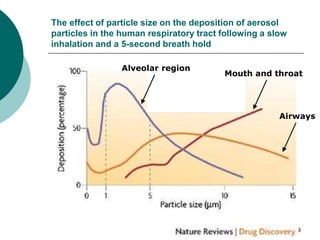
The effect of particle size on the deposition of aerosol
particles in the human respiratory tract following a slow
inhalation and a 5-second breath hold
Mouth and throat
Alveolar region
Airways
20
Systemic delivery of small
hydrophobic molecules
 Small, mildly hydrophobic molecules can show
extremely rapid absorption kinetics from the
lungs
 However, as hydrophobicity increases, molecules
can become too insoluble for rapid absorption and
can persist in the lungs for hours, days or weeks
 Typical drug molecules with log octanol–water
partition coefficients greater than 1 can be
expected to be absorbed, with absorption half-
lives (the time it takes half of the molecules
deposited into the lungs to disappear from the
tissue) of approximately 1 minute or so;
decreasing the log octanol–water partition
coefficient to –1 or lower can increase the half-life
to around 60 minutes
21
Systemic delivery of small
hydrophobic molecules
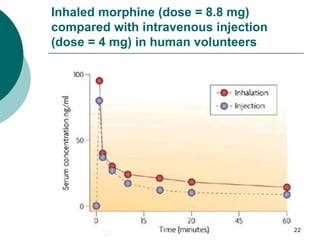
 Examples of rapidly absorbed inhaled hydrophobic
drugs include nicotine, 9-tetrahydrocannabinol
(THC), morphine and fentanyl
22
Inhaled morphine (dose = 8.8 mg)
compared with intravenous injection
(dose = 4 mg) in human volunteers
23
Systemic delivery of small
hydrophilic molecules
 In general, neutral or negatively charged
hydrophilic small molecules are absorbed
rapidly and with high bioavailabilities from
the lungs
 This class of molecules has an average
absorption half-life of about 60 minutes, in
contrast to some of the lipophilic molecules
that are absorbed in seconds to minutes
24
25
Systemic delivery of
macromolecules
 The use of the lungs for the delivery of
peptides and proteins, which otherwise must
be injected, is one of the most exciting new
areas in pulmonary delivery
 For reasons that are not completely
understood, the lungs provide higher
bioavailabilities for macromolecules than any
other non-invasive route of delivery
 However, unlike the situation with small
molecules, for which lung metabolism is
minimal, enzymatic hydrolysis of small
natural peptides can be very high unless they
are chemically engineered (blocked) to inhibit
peptidases
26
Systemic delivery of
macromolecules
 Small natural peptides make poor drugs by
any route of delivery because of peptidase
sensitivity, whereas blocked peptides show
high pulmonary bioavailabilities
 As molecular mass increases and peptides
become proteins with greater tertiary and
quaternary structure, peptidase hydrolysis is
inhibited or even eliminated and
bioavailabilities of natural proteins can be
high
 Insulin can be considered to be a large
peptide (or small protein), with enough size
to avoid much of the metabolism seen with
smaller peptides
27
Systemic delivery of
macromolecules
 The rate of macromolecule absorption is
primarily dictated by size — the larger the
size the slower the absorption
 Molecules such as insulin, growth hormone
and many cytokines typically peak in blood
following aerosol inhalation in 30–90
minutes, whereas smaller blocked peptides
can be absorbed faster
 After a 15-year development effort, inhaled
human insulin (IHI) applied regularly at meal
time has been approved both in the US and
the European Union for the treatment of
adults with diabetes (Exubera)
28
Systemic delivery of
macromolecules
 Conjugation of molecules such as interferons,
follicle stimulating hormone (FSH) and
erythropoietin (EPO) to the constant (Fc) region
of antibodies has been shown to prolong the
systemic duration
 Interestingly, the optimal pulmonary site of
absorption of these conjugates seems to be the
conducting airways, in contrast to the major
site for insulin, which is in the deep lung
 The airways are enriched with antibody
transcytosis receptor mechanisms. Fc
conjugates of proteins have serum half-lives >1
day and are believed to be absorbed with high
bioavailabilities (20–50%) from the lungs
29
Pulmonary Drug Delivery Devices
 Dry Powder Inhalation (DPI) Devices
 The Pressurized Metered-Dose Inhalation
(pMDI) Device
 Nebulizers
30
Dry Powder Inhalation (DPI)
Devices
 DPIs are used to treat respiratory diseases
such as asthma and COPD, systemic
disorders such as diabetes, cancer,
neurological diseases (including pain), and
other pulmonary diseases such as cystic
fibrosis and pulmonary infectious diseases
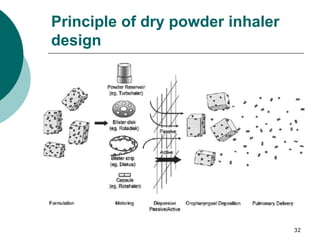
 Devices requiring the patient's inspiration
effort to aerosolize the powder aliquot are
called passive devices because as they do not
provide an internal energy source
 Active devices provide different kinds of
energy for aerosolization: kinetic energy by a
loaded spring and compressed air or electric
energy by a battery
31
Dry Powder Inhalation (DPI)
Devices
 Most DPIs contain micronized drug blended
with larger carrier particles, which prevents
aggregation and promotes flow
32
Principle of dry powder inhaler
design
33
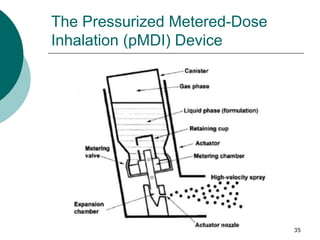
The Pressurized Metered-Dose
Inhalation (pMDI) Device
 The pressurized metered-dose inhalation
(pMDI) device was introduced to deliver asthma
medications in a convenient and reliable multi-
dose presentation
 The key components of the pMDI device are:
container, propellants, formulation, metering
valve, and actuator
 The pMDI container must withstand high
pressure generated by the propellant. Stainless
steel has been used as a pMDI container
material. Aluminum is now preferred because,
compared to glass, it is lighter, more compact,
less fragile, and light-proof
34
The Pressurized Metered-Dose
Inhalation (pMDI) Device
 Coatings on the internal container surfaces
may be useful to prevent adhesion of drug
particles and chemical degradation of drug
 Propellants in pMDIs are liquefied,
compressed gases that are in the gaseous
phase at atmospheric pressure but form
liquids when compressed
 They are required to be nontoxic,
nonflammable, compatible with drugs
formulated either as suspensions or
solutions, and to have appropriate boiling
points and densities
35
The Pressurized Metered-Dose
Inhalation (pMDI) Device
36
Nebulizers
 A nebulizer is a device used to administer
medication to patient in the form of a mist inhaled
into the lungs
 It is commonly used in treating cystic fibrosis,
asthma, and other respiratory diseases
 There are two basic types of nebulizers:
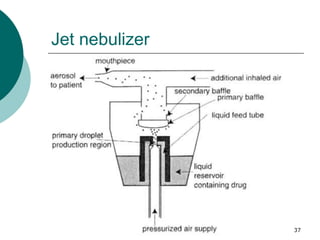
 The jet nebulizer functions by the Bernoulli principle by
which compressed gas (air or oxygen) passes through
a narrow orifice, creating an area of low pressure at
the outlet of the adjacent liquid feed tube. This results
in the drug solution being drawn up from the fluid
reservoir and shattering into droplets in the gas
stream
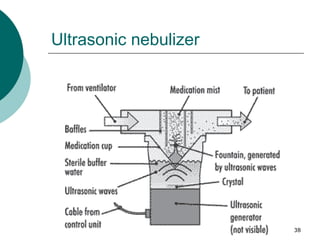
 The ultrasonic nebulizer uses a piezoelectric crystal,
vibrating at a high frequency (usually 1–3 MHz), to
generate a fountain of liquid in the nebulizer chamber;
the higher the frequency, the smaller the droplets
produced
37
Jet nebulizer
38
Ultrasonic nebulizer
39

4_2020_11_15!12_15_01_PM.ppt

  • 1.
  • 2.
    2 Pulmonary Drug Delivery Anatomy and Physiology of the Respiratory System  Advantages of Pulmonary Delivery  Lung epithelium at different sites within the lungs  Pulmonary absorptive surfaces  Systemic delivery of:  Small hydrophobic drugs  Small hydrophilic drugs  Macromolecules drugs  Pulmonary Drug Delivery Devices
  • 3.
    3 Anatomy and Physiologyof the Respiratory System  The human respiratory system is divided into upper and lower respiratory tracts  The upper respiratory system consists of the nose, nasal cavities, nasopharynx, and oropharynx  The lower respiratory tract consists of the larynx, trachea, bronchi, and alveoli, which are composed of respiratory tissues  The left and right lungs are unequal in size. The right lung is composed of three lobes: the superior, middle, and inferior lobes. The smaller left lung has two lobes
  • 4.
    4 Anatomy and Physiologyof the Respiratory System
  • 5.
    5 Anatomy and Physiologyof the Respiratory System  The nasopharynx is a passageway from the nose to the oral pharynx  The larynx controls the airflow to the lungs and aids in phonation  The larynx leads into the cartilaginous and fibromuscular tube, the trachea, which bifurcates into the right and left bronchi  The bronchi, in turn, divide into bronchioles and finally into alveoli
  • 6.
    6 Anatomy and Physiologyof the Respiratory System  The respiratory tree can be differentiated into the conducting zone and the respiratory zone.  The conducting zone consists of the bronchi, which are lined by ciliated cells secreting mucus and terminal bronchioles.  The respiratory zone is composed of respiratory bronchioles, alveolar ducts, atria, and alveoli
  • 7.
    7 Anatomy and Physiologyof the Respiratory System
  • 8.
    8 Anatomy and Physiologyof the Respiratory System  The epithelium in the conducting zone gets thinner as it changes from pseudostratified columnar to columnar epithelium and finally to cuboidal epithelium in the terminal bronchioles  The upper part of the conducting zone (from the trachea to the bronchi) consists of ciliated and goblet cells (which secrete mucus)  These cells are absent in the bronchioles. Alveoli are covered predominantly with a monolayer of squamous epithelial cells (type I cells) overlying a thin basal lamina
  • 9.
    9 Anatomy and Physiologyof the Respiratory System  Cuboidal type II cells present at the junctions of alveoli secrete a fluid containing a surfactant (dipalmitoylphosphatidylcholine), apoproteins, and calcium ions  The lungs are covered extensively by a vast network of blood vessels, and almost all the blood in circulation flows through the lungs. Deoxygenated blood is supplied to the lungs by the pulmonary artery  The pulmonary veins are similar to the arteries in branching, and their tissue structure is similar to that of systemic circulation. The total blood volume of the lungs is about 450 mL, which is about 10 percent of total body blood volume
  • 10.
    10 Comparison of thelung epithelium at different sites within the lungs
  • 11.
  • 12.
    12 Advantages of PulmonaryDelivery of Drugs To Treat Respiratory Disease  Deliver high drug concentrations directly to the disease site  Minimizes risk of systemic side effects  Rapid clinical response  Bypass the barriers to therapeutic efficacy, such as poor gastrointestinal absorption and first-pass metabolism in the liver  Achieve a similar or superior therapeutic effect at a fraction of the systemic dose, (for example, oral salbutamol 2–4 mg is therapeutically equivalent to 100–200 μg by metered dose inhaler)
  • 13.
    13 Advantages of PulmonaryDelivery of Drugs To Treat Systemic Disease  A non-invasive, needle-free delivery system  Suitable for a wide range of substances from small molecules to very large proteins  Enormous absorptive surface area (140 m2) and a highly permeable membrane (0.2–0.7 μm thickness) in the alveolar region  Large molecules with very low absorption rates can be absorbed in significant quantities; the slow mucociliary clearance in the lung periphery results in prolonged residency in the lung
  • 14.
    14 Advantages of PulmonaryDelivery of Drugs To Treat Systemic Disease  A less harsh, low enzymatic environment  Avoids first-pass metabolism  Reproducible absorption kinetics  Pulmonary delivery is independent of dietary complications, extracellular enzymes, and inter-patient metabolic differences that affect gastrointestinal absorption
  • 15.
    15 Pulmonary absorptive surfaces The airways (the trachea, bronchi and bronchioles) are composed of a gradually thinning columnar epithelium populated by many mucus and ciliated cells that collectively form the mucociliary escalator  The airways bifurcate roughly 16–17 times before the alveoli are reached  Inhaled insoluble particles that deposit in the airways are efficiently swept up and out of the lungs in moving patches of mucus, and for those deposited in the deepest airways this can be over a time period of about 24 hour
  • 16.
    16 Pulmonary absorptive surfaces The monolayer that makes up the alveolar epithelium is completely different. The tall columnar mucus and cilia cells are replaced primarily (>95% of surface) by the very broad and extremely thin (<0.1 µm in places) type 1 cells  Distributed in the corners of the alveolar sacs are also the progenitor cells for the type 1 cells and the producers of lung surfactant, the type 2 cells  The air-side surface of each of the 500 million alveoli in human lungs is routinely 'patrolled' by 12–14 alveolar macrophages, which engulf and try to digest any insoluble particles that deposit in the alveoli
  • 17.
    17 Pulmonary absorptive surfaces An excess of 90% of alveolar macrophages are located at or near alveolar septal junctional zones  Insoluble, non-digestible particles that deposit in the alveoli can reside in the lungs for years, usually sequestered within macrophages  Molecules such as insulin are formulated either as liquids or in highly water-soluble aerosol particles that dissolve rapidly in the lungs and thereby largely avoid macrophage degradation
  • 18.
    18 Pulmonary absorptive surfaces Protein therapeutics that are taken up by macrophages can be rapidly destroyed in the lysosomal 'guts' of the phagocytic cells
  • 19.
    19 The effect ofparticle size on the deposition of aerosol particles in the human respiratory tract following a slow inhalation and a 5-second breath hold Mouth and throat Alveolar region Airways
  • 20.
    20 Systemic delivery ofsmall hydrophobic molecules  Small, mildly hydrophobic molecules can show extremely rapid absorption kinetics from the lungs  However, as hydrophobicity increases, molecules can become too insoluble for rapid absorption and can persist in the lungs for hours, days or weeks  Typical drug molecules with log octanol–water partition coefficients greater than 1 can be expected to be absorbed, with absorption half- lives (the time it takes half of the molecules deposited into the lungs to disappear from the tissue) of approximately 1 minute or so; decreasing the log octanol–water partition coefficient to –1 or lower can increase the half-life to around 60 minutes
  • 21.
    21 Systemic delivery ofsmall hydrophobic molecules  Examples of rapidly absorbed inhaled hydrophobic drugs include nicotine, 9-tetrahydrocannabinol (THC), morphine and fentanyl
  • 22.
    22 Inhaled morphine (dose= 8.8 mg) compared with intravenous injection (dose = 4 mg) in human volunteers
  • 23.
    23 Systemic delivery ofsmall hydrophilic molecules  In general, neutral or negatively charged hydrophilic small molecules are absorbed rapidly and with high bioavailabilities from the lungs  This class of molecules has an average absorption half-life of about 60 minutes, in contrast to some of the lipophilic molecules that are absorbed in seconds to minutes
  • 24.
  • 25.
    25 Systemic delivery of macromolecules The use of the lungs for the delivery of peptides and proteins, which otherwise must be injected, is one of the most exciting new areas in pulmonary delivery  For reasons that are not completely understood, the lungs provide higher bioavailabilities for macromolecules than any other non-invasive route of delivery  However, unlike the situation with small molecules, for which lung metabolism is minimal, enzymatic hydrolysis of small natural peptides can be very high unless they are chemically engineered (blocked) to inhibit peptidases
  • 26.
    26 Systemic delivery of macromolecules Small natural peptides make poor drugs by any route of delivery because of peptidase sensitivity, whereas blocked peptides show high pulmonary bioavailabilities  As molecular mass increases and peptides become proteins with greater tertiary and quaternary structure, peptidase hydrolysis is inhibited or even eliminated and bioavailabilities of natural proteins can be high  Insulin can be considered to be a large peptide (or small protein), with enough size to avoid much of the metabolism seen with smaller peptides
  • 27.
    27 Systemic delivery of macromolecules The rate of macromolecule absorption is primarily dictated by size — the larger the size the slower the absorption  Molecules such as insulin, growth hormone and many cytokines typically peak in blood following aerosol inhalation in 30–90 minutes, whereas smaller blocked peptides can be absorbed faster  After a 15-year development effort, inhaled human insulin (IHI) applied regularly at meal time has been approved both in the US and the European Union for the treatment of adults with diabetes (Exubera)
  • 28.
    28 Systemic delivery of macromolecules Conjugation of molecules such as interferons, follicle stimulating hormone (FSH) and erythropoietin (EPO) to the constant (Fc) region of antibodies has been shown to prolong the systemic duration  Interestingly, the optimal pulmonary site of absorption of these conjugates seems to be the conducting airways, in contrast to the major site for insulin, which is in the deep lung  The airways are enriched with antibody transcytosis receptor mechanisms. Fc conjugates of proteins have serum half-lives >1 day and are believed to be absorbed with high bioavailabilities (20–50%) from the lungs
  • 29.
    29 Pulmonary Drug DeliveryDevices  Dry Powder Inhalation (DPI) Devices  The Pressurized Metered-Dose Inhalation (pMDI) Device  Nebulizers
  • 30.
    30 Dry Powder Inhalation(DPI) Devices  DPIs are used to treat respiratory diseases such as asthma and COPD, systemic disorders such as diabetes, cancer, neurological diseases (including pain), and other pulmonary diseases such as cystic fibrosis and pulmonary infectious diseases  Devices requiring the patient's inspiration effort to aerosolize the powder aliquot are called passive devices because as they do not provide an internal energy source  Active devices provide different kinds of energy for aerosolization: kinetic energy by a loaded spring and compressed air or electric energy by a battery
  • 31.
    31 Dry Powder Inhalation(DPI) Devices  Most DPIs contain micronized drug blended with larger carrier particles, which prevents aggregation and promotes flow
  • 32.
    32 Principle of drypowder inhaler design
  • 33.
    33 The Pressurized Metered-Dose Inhalation(pMDI) Device  The pressurized metered-dose inhalation (pMDI) device was introduced to deliver asthma medications in a convenient and reliable multi- dose presentation  The key components of the pMDI device are: container, propellants, formulation, metering valve, and actuator  The pMDI container must withstand high pressure generated by the propellant. Stainless steel has been used as a pMDI container material. Aluminum is now preferred because, compared to glass, it is lighter, more compact, less fragile, and light-proof
  • 34.
    34 The Pressurized Metered-Dose Inhalation(pMDI) Device  Coatings on the internal container surfaces may be useful to prevent adhesion of drug particles and chemical degradation of drug  Propellants in pMDIs are liquefied, compressed gases that are in the gaseous phase at atmospheric pressure but form liquids when compressed  They are required to be nontoxic, nonflammable, compatible with drugs formulated either as suspensions or solutions, and to have appropriate boiling points and densities
  • 35.
  • 36.
    36 Nebulizers  A nebulizeris a device used to administer medication to patient in the form of a mist inhaled into the lungs  It is commonly used in treating cystic fibrosis, asthma, and other respiratory diseases  There are two basic types of nebulizers:  The jet nebulizer functions by the Bernoulli principle by which compressed gas (air or oxygen) passes through a narrow orifice, creating an area of low pressure at the outlet of the adjacent liquid feed tube. This results in the drug solution being drawn up from the fluid reservoir and shattering into droplets in the gas stream  The ultrasonic nebulizer uses a piezoelectric crystal, vibrating at a high frequency (usually 1–3 MHz), to generate a fountain of liquid in the nebulizer chamber; the higher the frequency, the smaller the droplets produced
  • 37.
  • 38.
  • 39.