










THE UNBREAKABLE BONDThe Theory and Practice of Continuing BondsLauren Schneider, LCSWClinical Director  Child & Adolescent Programs  OUR HOUSE Grief Support Center
History & Mission of OUR HOUSE Grief Support CenterFounded in 1993 by Jo-Ann Lautman
Largest Non-profit Grief Support Center serving Los Angeles County
Mission: To provide our community with grief support services, education, resources, and hope
This year provided grief support in over 50 locations
Services available in English and Spanish for AdultsServices include:Support groups for Children ages 4-18 and for Adults across the lifespan
School-based support groups in 5 districts in Los Angeles County
Professional education for mental health clinicians, medical students, clergy and educators
Post-crises grief interventions
Referrals & resources AgendaThe Evolution of the Theory of Continuing BondsHelping Children Maintain Connection with their person who died Interventions which promote Continuing Bonds
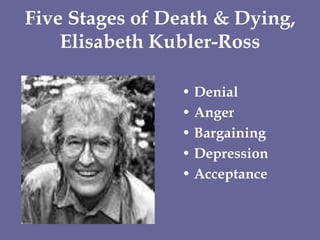
Five Stages of Death & Dying,Elisabeth Kubler-RossDenial AngerBargainingDepressionAcceptance
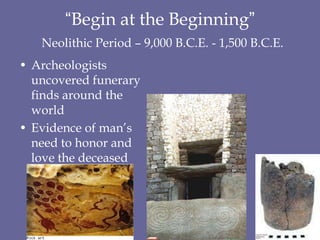
“Begin at the Beginning”Neolithic Period – 9,000 B.C.E. - 1,500 B.C.E.Archeologists uncovered funerary finds around the worldEvidence of man’s need to honor and love the deceased
EGYPTIAN PYRAMIDS:massive monuments to the dead
Taj Mahal - 1632
Romanticist Period: 19th Century
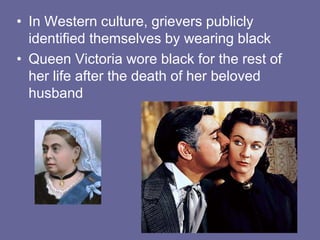
In Western culture, grievers publicly identified themselves by wearing blackQueen Victoria wore black for the rest of her life after the death of her beloved husband
Core BeliefsIntensity of the grief is an indicator of the strength of the bond with the deceasedTo dissolve the bond would render the relationship insignificant
We look before and after, And pine for what is not. Our sincerest laughter With some pain is fraught. Our sweetest songs are those that tell of saddest thought.  ~~ Percy Bysshe Shelley
In the popular film “Ghost”, the widow, played by Demi Moore, experiences the presence and communicates with the spirit of her deceased husband.
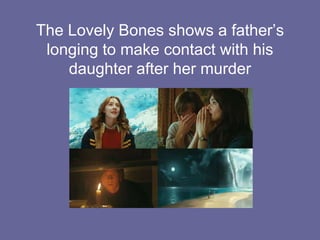
The Lovely Bones shows a father’s longing to make contact with his daughter after her murder
Is it magical thinking, mental illness or something else?
Different styles of grieving are shown following the sudden death of George
The 20th Century & ModernismGrief theory evolved along with modern psychological theoriesWestern world view valued autonomy & individuation over dependency & connection
Modernist perspective arose out of the writings of Sigmund FreudPsychoanalytic school believed in the importance of breaking bonds with the deceasedThey viewed grief as a “bothersome interruption” that must be “worked through”Reflected in statements such as: “move on” or “get over it”
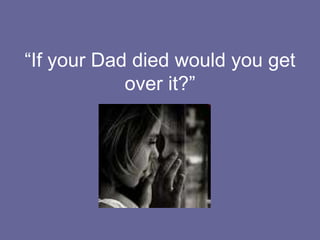
“If your Dad died would you get over it?”
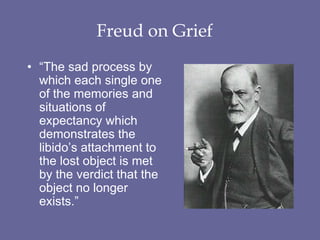
Freud on Grief“The sad process by which each single one of the memories and situations of expectancy which demonstrates the libido’s attachment to the lost object is met by the verdict that the object no longer exists.”
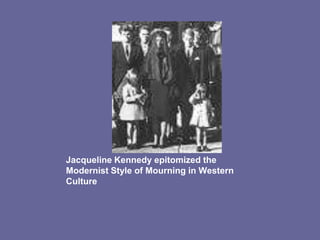
Jacqueline Kennedy epitomized the Modernist Style of Mourning in Western Culture
Freud on Grief (continued)The libidinal energy remained attached to the thoughts and memories of the deceased  Since energy is limited, cathexis to the lost object must be withdrawn in order for the person to have full access to the source of energyThose who fail to withdraw that energy, or hyper-cathect ,were viewed by the psychoanalysts as emotionally stunted
Freud on Grief(continued)Grief serves the function of freeing the ego from the attachment to the deceased When the work of mourning is completed the ego becomes free and uninhibited againThe severing of the bond frees the libidinal energy allowing the person to form new bonds
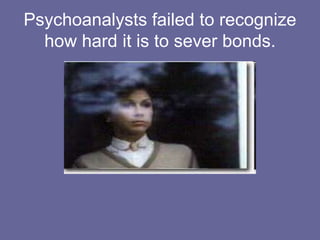
Psychoanalysts failed to recognize how hard it is to sever bonds.
“It is the only way of perpetuating that love that we don’t want to relinquish it”Freud on Grief (continued)
Freud’s LegacyThe primary goal of grieving is seen as the cutting of the bond with the person who died so that new attachments can be formed.
Application of Freud’s Oedipal Theory to Grief WorkAn internalization of the lost object allows for a continuing attachment to the deceasedThe mourner identifies with aspects of the deceased, assuming certain characteristicsResult: An ego that has been enriched
Erick Lindemann - 1942Three Tasks of GriefworkEmancipation from the bond to the deceasedReadjustment to the environment in which the deceased is missing3.  Formation of new relationships
Lindemann (continued)Grief ends when the person is able to “let go”
Erick Erickson on Grief	Viewed dependence as “bad”Felt that the survivor must relinquish the bond with the deceased so that new bond can be formed	The adoption movement of the 20th Century embraced this theory.   Birth parents must relinquish the bond to their newborn and carry on as if the baby did not exist.
John Bowlby - 1969Attachment Theory of Grief Purpose of grief: to sever the bond with the deceasedViewed grief as a type of separation anxietyAttempts to be reunited with the deceased seen as nonfunctionalThe yearning and searching behavior is extinguished gradually over time
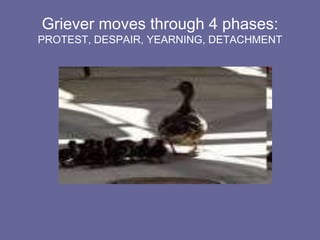
Griever moves through 4 phases: PROTEST, DESPAIR, YEARNING, DETACHMENT
Eventually the griever gives up hope that the person will ever return
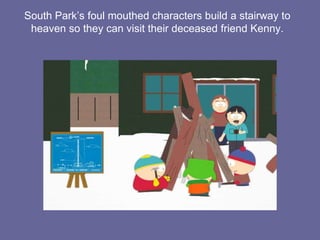
South Park’s foul mouthed characters build a stairway to heaven so they can visit their deceased friend Kenny.
Dr. Collin Murray Parkes :Grief is “a preprogrammed series of behaviors aided by specific environmental stimulus”“Getting through the grief” means breaking the attachment to the deceased
Monica McGoldrickFive Therapeutic Goals for Grieving Families1.	Shared acknowledgment of the reality of the death2.	Shared experience of the loss3.	Revising the family narrative to include the death4.	Reorganizing the family system5. Reinvesting in other relationships
McGoldrick & Walsh (1991)Roles are reassigned rather than internalized.The mourner who holds on to the bond is in dangerViews visits to the gravesite as compulsive repetitions tying up family energy
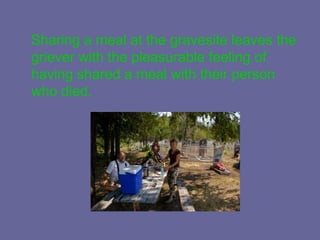
Sharing a meal at the gravesite leaves the griever with the pleasurable feeling of having shared a meal with their person who died.
Therese Rando: 1992	“In all forms of complicated mourning there are attempts to do two thingsdeny, repress, avoid aspects of the loss, it's pain and the full realization of the implications for the mourner2.	to hold onto, and avoid relinquishing the lost loved one”
J William Worden: “Grief Counseling and Grief Therapy”	Original Version of Task 4:“To reinvest in new relationships”Revised Version of Task 4 (2009)“To Find an Enduring Connection with the Deceased in the Midst of Embarking on a New Life”
POST MODERNIST PERSPECTIVEInterdependence is sustained even in the absence of one of the partiesGrievers construct an inner representation of the deceased as part of the normal grieving process
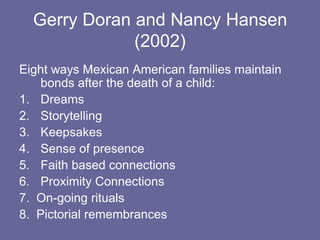
Gerry Doran and Nancy Hansen  (2002)Eight ways Mexican American families maintain bonds after the death of a child:Dreams		Storytelling	Keepsakes		Sense of presenceFaith based connectionsProximity Connections7.  On-going rituals8.  Pictorial remembrances
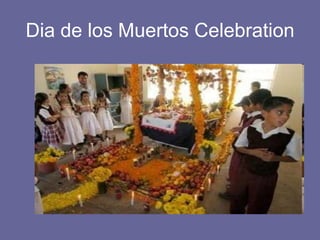
Dia de los Muertos Celebration
Doran & Hansen (continued)Maintaining bonds helped families:Cope2. Gave them comfort and support3.	Enabled them to transition from the past to the future
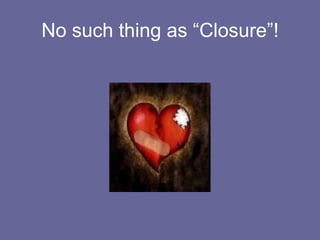
No such thing as “Closure”!
HELPING CHILDREN MAINTAIN A CONNECTION WITH THEIR PERSON WHO DIED
“Death ends a life, not a relationship”Robert Benchly
Psychoanalysts:1.  Recognized that child maintained a connection or inner representation with the deceased parent2.	Allows the child to keep the deceased with them3.  Aids in understanding and accepting the reality of the death3.  Viewed inner representation as static and unchanging
Harvard Child Bereavement StudyJ William Worden, PhD & Phyllis Silverman, PhDStudied Parentally Bereaved Children aged 6-17Boston areaSilverman: Cross Cultural Perspective	Studied Children in Israel
Children Maintained a Connection with the Parent who Died
COPING INVOLVED PROCESS OF ADAPTATION & CHANGETwo Aspects to the Process1.  children learn to rememberfind ways to maintain a connection“CONSTRUCTIONS”Memories, feelings and behaviors that help them remain close with the deceased”Not static but changes as child matures
Administered the Child’s Understanding of Death questionnaireResponses suggested that efforts to connect were due to a lack of understanding of the finality of deathFound instead that bereaved children understand younger than non-bereaved children
5 TYPES OF ACTIVITIES THAT ENABLED CHILDREN TO MAINTAIN BONDS1.  Locating the Deceased2.  Experiencing the Deceased3.  Reaching Out4.  Waking Memories5.  Linking Objects
LOCATING THE DECEASED“Where is your parent now?”“What can they do there?”
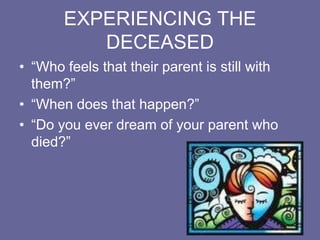
EXPERIENCING THE DECEASED“Who feels that their parent is still with them?”“When does that happen?”“Do you ever dream of your parent who died?”
REACHING OUT	“Where do you go to feel close to your parent who died?”“Have you been back to the cemetery or scattering site”“When do you talk to your parent?” “What would your parent say about that__- if they were alive? “Can you still hear your parent’s voice and what do they say to you?”

404 c Schneider presentation

  • 1.
    THE UNBREAKABLE BONDTheTheory and Practice of Continuing BondsLauren Schneider, LCSWClinical Director Child & Adolescent Programs OUR HOUSE Grief Support Center
  • 2.
    History & Missionof OUR HOUSE Grief Support CenterFounded in 1993 by Jo-Ann Lautman
  • 3.
    Largest Non-profit GriefSupport Center serving Los Angeles County
  • 4.
    Mission: To provideour community with grief support services, education, resources, and hope
  • 5.
    This year providedgrief support in over 50 locations
  • 6.
    Services available inEnglish and Spanish for AdultsServices include:Support groups for Children ages 4-18 and for Adults across the lifespan
  • 7.
    School-based support groupsin 5 districts in Los Angeles County
  • 8.
    Professional education formental health clinicians, medical students, clergy and educators
  • 9.
  • 10.
    Referrals & resourcesAgendaThe Evolution of the Theory of Continuing BondsHelping Children Maintain Connection with their person who died Interventions which promote Continuing Bonds
  • 11.
    Five Stages ofDeath & Dying,Elisabeth Kubler-RossDenial AngerBargainingDepressionAcceptance
  • 12.
    “Begin at theBeginning”Neolithic Period – 9,000 B.C.E. - 1,500 B.C.E.Archeologists uncovered funerary finds around the worldEvidence of man’s need to honor and love the deceased
  • 13.
  • 14.
  • 15.
  • 16.
    In Western culture,grievers publicly identified themselves by wearing blackQueen Victoria wore black for the rest of her life after the death of her beloved husband
  • 17.
    Core BeliefsIntensity ofthe grief is an indicator of the strength of the bond with the deceasedTo dissolve the bond would render the relationship insignificant
  • 18.
    We look beforeand after, And pine for what is not. Our sincerest laughter With some pain is fraught. Our sweetest songs are those that tell of saddest thought.  ~~ Percy Bysshe Shelley
  • 19.
    In the popularfilm “Ghost”, the widow, played by Demi Moore, experiences the presence and communicates with the spirit of her deceased husband.
  • 20.
    The Lovely Bonesshows a father’s longing to make contact with his daughter after her murder
  • 21.
    Is it magicalthinking, mental illness or something else?
  • 22.
    Different styles ofgrieving are shown following the sudden death of George
  • 23.
    The 20th Century& ModernismGrief theory evolved along with modern psychological theoriesWestern world view valued autonomy & individuation over dependency & connection
  • 24.
    Modernist perspective aroseout of the writings of Sigmund FreudPsychoanalytic school believed in the importance of breaking bonds with the deceasedThey viewed grief as a “bothersome interruption” that must be “worked through”Reflected in statements such as: “move on” or “get over it”
  • 25.
    “If your Daddied would you get over it?”
  • 26.
    Freud on Grief“Thesad process by which each single one of the memories and situations of expectancy which demonstrates the libido’s attachment to the lost object is met by the verdict that the object no longer exists.”
  • 27.
    Jacqueline Kennedy epitomizedthe Modernist Style of Mourning in Western Culture
  • 28.
    Freud on Grief(continued)The libidinal energy remained attached to the thoughts and memories of the deceased Since energy is limited, cathexis to the lost object must be withdrawn in order for the person to have full access to the source of energyThose who fail to withdraw that energy, or hyper-cathect ,were viewed by the psychoanalysts as emotionally stunted
  • 29.
    Freud on Grief(continued)Griefserves the function of freeing the ego from the attachment to the deceased When the work of mourning is completed the ego becomes free and uninhibited againThe severing of the bond frees the libidinal energy allowing the person to form new bonds
  • 30.
    Psychoanalysts failed torecognize how hard it is to sever bonds.
  • 31.
    “It is theonly way of perpetuating that love that we don’t want to relinquish it”Freud on Grief (continued)
  • 32.
    Freud’s LegacyThe primarygoal of grieving is seen as the cutting of the bond with the person who died so that new attachments can be formed.
  • 33.
    Application of Freud’sOedipal Theory to Grief WorkAn internalization of the lost object allows for a continuing attachment to the deceasedThe mourner identifies with aspects of the deceased, assuming certain characteristicsResult: An ego that has been enriched
  • 34.
    Erick Lindemann -1942Three Tasks of GriefworkEmancipation from the bond to the deceasedReadjustment to the environment in which the deceased is missing3. Formation of new relationships
  • 35.
    Lindemann (continued)Grief endswhen the person is able to “let go”
  • 36.
    Erick Erickson onGrief Viewed dependence as “bad”Felt that the survivor must relinquish the bond with the deceased so that new bond can be formed The adoption movement of the 20th Century embraced this theory. Birth parents must relinquish the bond to their newborn and carry on as if the baby did not exist.
  • 37.
    John Bowlby -1969Attachment Theory of Grief Purpose of grief: to sever the bond with the deceasedViewed grief as a type of separation anxietyAttempts to be reunited with the deceased seen as nonfunctionalThe yearning and searching behavior is extinguished gradually over time
  • 38.
    Griever moves through4 phases: PROTEST, DESPAIR, YEARNING, DETACHMENT
  • 39.
    Eventually the grievergives up hope that the person will ever return
  • 40.
    South Park’s foulmouthed characters build a stairway to heaven so they can visit their deceased friend Kenny.
  • 41.
    Dr. Collin MurrayParkes :Grief is “a preprogrammed series of behaviors aided by specific environmental stimulus”“Getting through the grief” means breaking the attachment to the deceased
  • 42.
    Monica McGoldrickFive TherapeuticGoals for Grieving Families1. Shared acknowledgment of the reality of the death2. Shared experience of the loss3. Revising the family narrative to include the death4. Reorganizing the family system5. Reinvesting in other relationships
  • 43.
    McGoldrick & Walsh(1991)Roles are reassigned rather than internalized.The mourner who holds on to the bond is in dangerViews visits to the gravesite as compulsive repetitions tying up family energy
  • 44.
    Sharing a mealat the gravesite leaves the griever with the pleasurable feeling of having shared a meal with their person who died.
  • 45.
    Therese Rando: 1992 “Inall forms of complicated mourning there are attempts to do two thingsdeny, repress, avoid aspects of the loss, it's pain and the full realization of the implications for the mourner2. to hold onto, and avoid relinquishing the lost loved one”
  • 46.
    J William Worden:“Grief Counseling and Grief Therapy” Original Version of Task 4:“To reinvest in new relationships”Revised Version of Task 4 (2009)“To Find an Enduring Connection with the Deceased in the Midst of Embarking on a New Life”
  • 47.
    POST MODERNIST PERSPECTIVEInterdependenceis sustained even in the absence of one of the partiesGrievers construct an inner representation of the deceased as part of the normal grieving process
  • 48.
    Gerry Doran andNancy Hansen (2002)Eight ways Mexican American families maintain bonds after the death of a child:Dreams Storytelling Keepsakes Sense of presenceFaith based connectionsProximity Connections7. On-going rituals8. Pictorial remembrances
  • 49.
    Dia de losMuertos Celebration
  • 50.
    Doran & Hansen(continued)Maintaining bonds helped families:Cope2. Gave them comfort and support3. Enabled them to transition from the past to the future
  • 51.
    No such thingas “Closure”!
  • 52.
    HELPING CHILDREN MAINTAINA CONNECTION WITH THEIR PERSON WHO DIED
  • 53.
    “Death ends alife, not a relationship”Robert Benchly
  • 54.
    Psychoanalysts:1. Recognizedthat child maintained a connection or inner representation with the deceased parent2. Allows the child to keep the deceased with them3. Aids in understanding and accepting the reality of the death3. Viewed inner representation as static and unchanging
  • 55.
    Harvard Child BereavementStudyJ William Worden, PhD & Phyllis Silverman, PhDStudied Parentally Bereaved Children aged 6-17Boston areaSilverman: Cross Cultural Perspective Studied Children in Israel
  • 56.
    Children Maintained aConnection with the Parent who Died
  • 57.
    COPING INVOLVED PROCESSOF ADAPTATION & CHANGETwo Aspects to the Process1. children learn to rememberfind ways to maintain a connection“CONSTRUCTIONS”Memories, feelings and behaviors that help them remain close with the deceased”Not static but changes as child matures
  • 58.
    Administered the Child’sUnderstanding of Death questionnaireResponses suggested that efforts to connect were due to a lack of understanding of the finality of deathFound instead that bereaved children understand younger than non-bereaved children
  • 59.
    5 TYPES OFACTIVITIES THAT ENABLED CHILDREN TO MAINTAIN BONDS1. Locating the Deceased2. Experiencing the Deceased3. Reaching Out4. Waking Memories5. Linking Objects
  • 60.
    LOCATING THE DECEASED“Whereis your parent now?”“What can they do there?”
  • 61.
    EXPERIENCING THE DECEASED“Whofeels that their parent is still with them?”“When does that happen?”“Do you ever dream of your parent who died?”
  • 62.
    REACHING OUT “Where doyou go to feel close to your parent who died?”“Have you been back to the cemetery or scattering site”“When do you talk to your parent?” “What would your parent say about that__- if they were alive? “Can you still hear your parent’s voice and what do they say to you?”