OLYMPUS SCIENTIFIC SOLUTIONS / HAMBURG
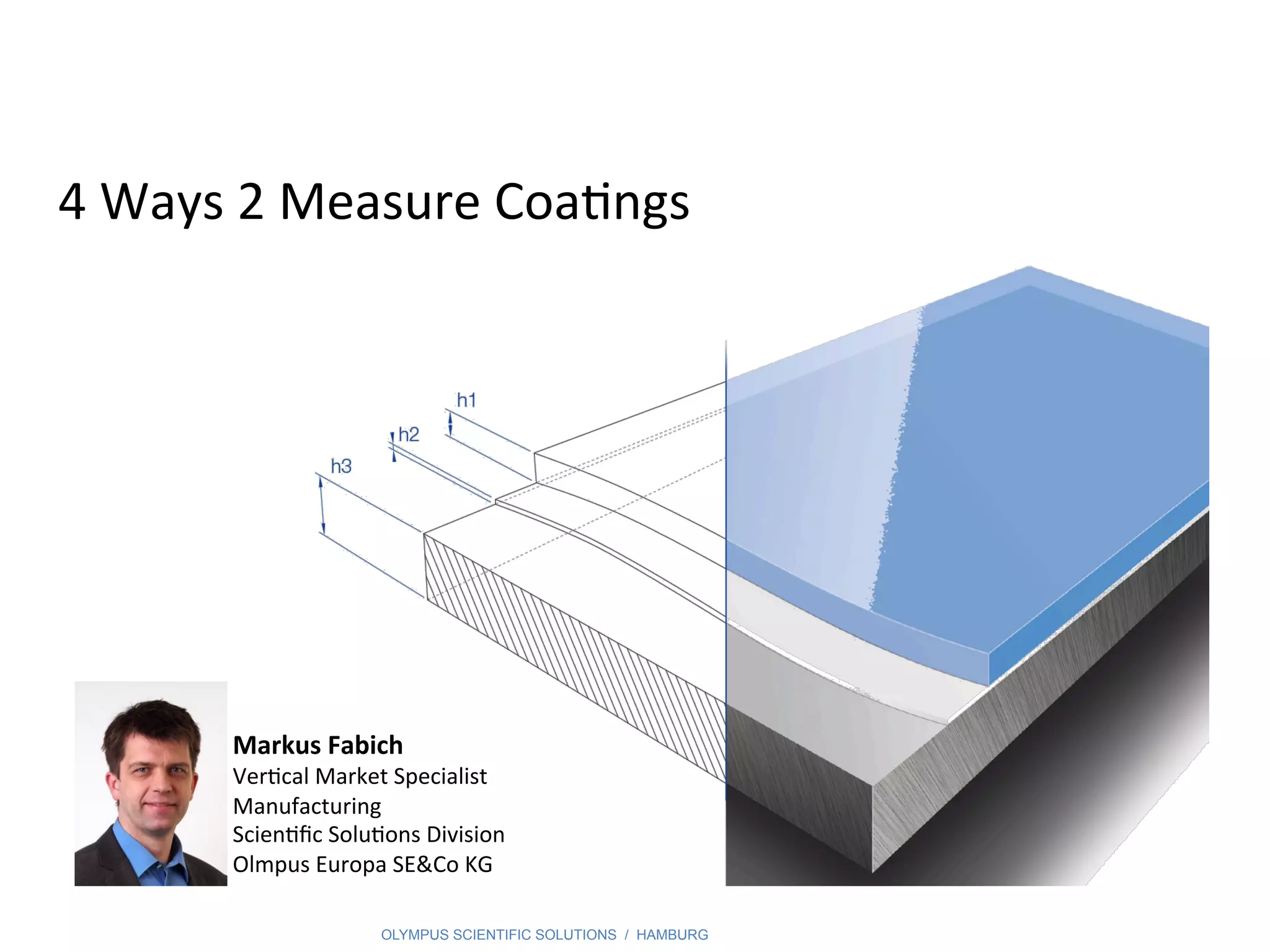
4	Ways	to	Measure	Coa.ngs	
Markus	Fabich	
Ver.cal	Market	Specialist		
Manufacturing	
Scien.fic	Solu.ons	Division	
Olympus	Europa	SE	&	Co.	KG
This session is about how to pick the
right technology to measure a
coating thickness
Agenda
OLYMPUS EUROPA SE & Co. KG Page 3
Introduction to the Topic: Coatings and Layers
Technology List Up
Comparison Tables
Summary and Q&A
OLYMPUS Scientific Solutions
•  What is a coating?
•  Why is it relevant?
•  Why measure the thickness?
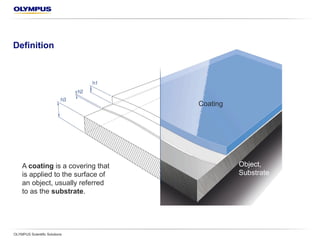
Definition
OLYMPUS Scientific Solutions
Object,
Substrate
Coating
A coating is a covering that
is applied to the surface of
an object, usually referred
to as the substrate.
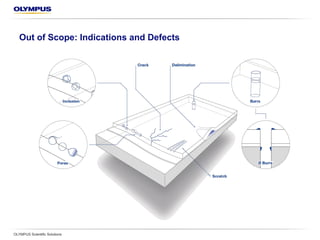
Out of Scope: Indications and Defects
OLYMPUS Scientific Solutions
Relevance of Coatings — Why Do Coatings Exist?
OLYMPUS Scientific Solutions
The purpose of applying the coating may be decorative,
functional, or both.
Example: an oil tank
àOut of scope today: the decorative painting
àIn scope today: the corrosion preventive coating
Why Measure the Thickness of a Coating?
OLYMPUS Scientific Solutions
Your reason may differ from mine,
but these are just a few examples.
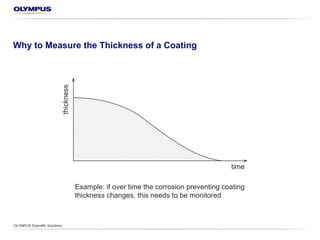
Why Measure the Thickness of a Coating?
OLYMPUS Scientific Solutions
time
thickness
Example: if over time the corrosion preventing coating
thickness changes, this needs to be monitored
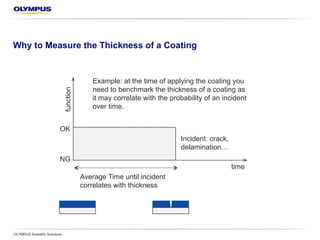
Why Measure the Thickness of a Coating?
OLYMPUS Scientific Solutions
function
OK
NG
Incident: crack,
delamination…
Example: at the time of applying the coating you
need to benchmark the thickness of a coating as
it may correlate with the probability of an incident
over time.
Average Time until incident
correlates with thickness
time
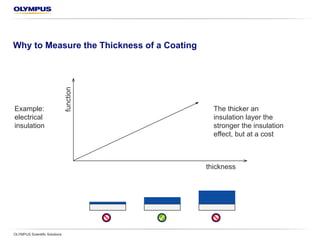
Why Measure the Thickness of a Coating?
OLYMPUS Scientific Solutions
thickness
Example:
electrical
insulation
The thicker an
insulation layer, the
stronger the insulation
effect, but at a cost
function
Methods
OLYMPUS Scientific Solutions
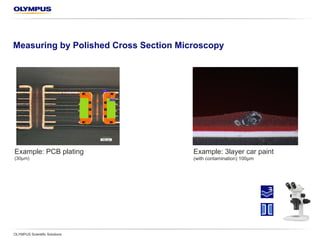
Measuring by Polished Cross Section Microscopy
OLYMPUS Scientific Solutions
Example: PCB plating (30 µm) Example: 3 layer car paint
(with contamination) 100 µm
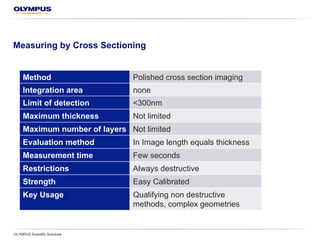
Measuring by Cross Sectioning
OLYMPUS Scientific Solutions
Method Polished cross section imaging
Integration area None
Limit of detection < 300 nm
Maximum thickness Not limited
Maximum number of layers Not limited
Evaluation method In image; length equals thickness
Measurement time Few seconds
Restrictions Always destructive
Strength Easy to calibrate
Key usage Qualifying nondestructive methods,
complex geometries
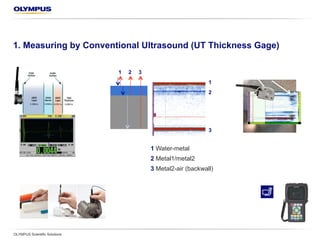
1. Measuring by Conventional Ultrasound (UT Thickness Gage)
OLYMPUS Scientific Solutions
1 Water-metal
2 Metal 1/metal 2
3 Metal 2-air (backwall)
21 3
2
1
3
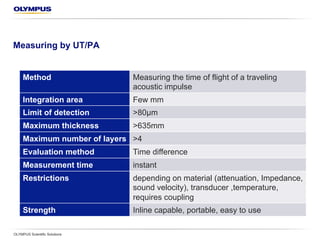
Measuring by UT/PA
OLYMPUS Scientific Solutions
Method Measuring the time of flight of a traveling
acoustic impulse
Integration area Few mm
Limit of detection > 80 µm
Maximum thickness > 635 mm
Maximum number of layers > 4
Evaluation method Time difference
Measurement time Instant
Restrictions Depending on material (attenuation,
impedance, sound velocity), transducer,
temperature, requires coupling
Strengths In-line capable, portable, easy to use
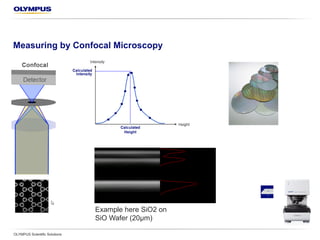
Measuring by Confocal Microscopy
OLYMPUS Scientific Solutions
Example: SiO2 on SiO wafer (20 µm)
Measuring by Confocal Microscopy
OLYMPUS Scientific Solutions
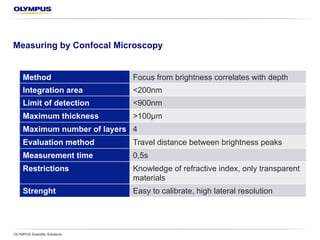
Method Focus from brightness correlates with depth
Integration area < 200 nm
Limit of detection < 900 nm
Maximum thickness > 100 µm
Maximum number of layers 4
Evaluation method Travel distance between brightness peaks
Measurement time 0.5 s
Restrictions Knowledge of refractive index, only transparent
materials
Strengths Easy to calibrate, high lateral resolution
Measuring by the Calotest Microscopy
OLYMPUS Scientific Solutions
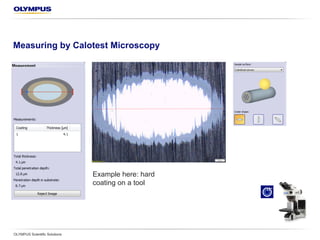
Example: hard coating on a tool
Measuring by the Calotest Microscopy
OLYMPUS Scientific Solutions
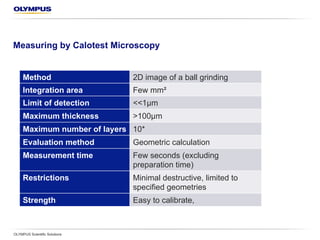
Method 2D image of a ball grinding
Integration area Few mm²
Limit of detection << 1 µm
Maximum thickness > 100 µm
Maximum number of layers 10*
Evaluation method Geometric calculation
Measurement time Few seconds (excluding
preparation time)
Restrictions Minimally destructive, limited to
specified geometries
Strength Easy to calibrate
Measuring by Direct Step Measurement and High-Resolution
Microscopy
OLYMPUS Scientific Solutions
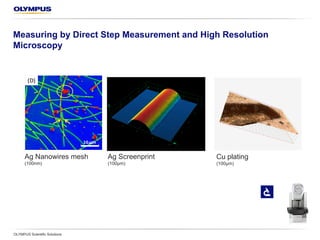
Ag nanowire mesh
(100 nm)
Ag screenprint
(100 µm)
Cu plating
(100 µm)
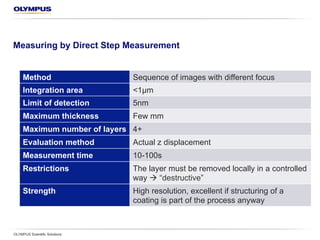
Measuring by Direct Step Measurement
OLYMPUS Scientific Solutions
Method Sequence of images with different focus
Integration area < 1 µm
Limit of detection 5 nm
Maximum thickness Few mm
Maximum number of layers 4+
Evaluation method Actual z displacement
Measurement time 10–100 s
Restrictions The layer must be removed locally in a controlled
way à “destructive”
Strength High resolution, excellent if structuring a coating
is part of the process anyway
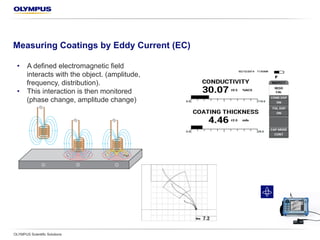
Measuring Coatings by Eddy Current (EC)
OLYMPUS Scientific Solutions
•  A defined electromagnetic field
interacts with the object (amplitude,
frequency, distribution)
•  This interaction is then monitored
(phase change, amplitude change)
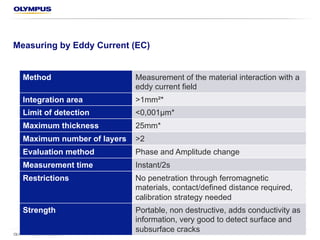
Measuring by Eddy Current (EC)
OLYMPUS Scientific Solutions
Method Measurement of the material interaction with
an eddy current field
Integration area > 1 mm²*
Limit of detection < 0.001 µm*
Maximum thickness 25 mm*
Maximum number of layers > 2
Evaluation method Phase and amplitude change
Measurement time Instant / 2 s
Restrictions No penetration through ferromagnetic
materials, contact/defined distance required,
calibration strategy needed
Strengths Portable, nondestructive, adds conductivity as
information, detects surface and subsurface
cracks
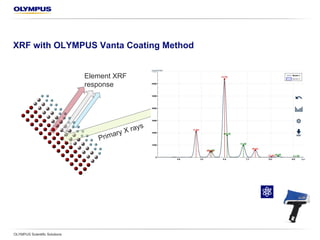
XRF with Olympus’ VantaTM Analyzer Coating Method
OLYMPUS Scientific Solutions
Primary X-rays
Element XRF
response
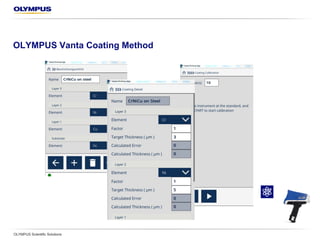
VantaTM Analyzer Coating Method
OLYMPUS Scientific Solutions
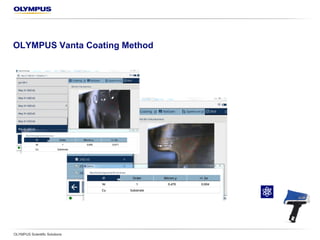
VantaTM Analyzer Coating Method
OLYMPUS Scientific Solutions
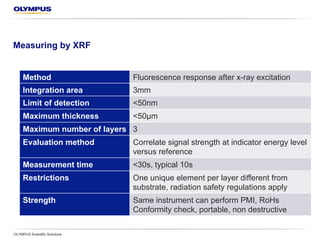
Measuring by XRF
OLYMPUS Scientific Solutions
Method Fluorescence response after X-ray excitation
Integration area 3 mm
Limit of detection < 50 nm
Maximum thickness < 50 µm
Maximum number of layers 3
Evaluation method Correlate signal strength at indicator energy level
versus reference
Measurement time < 30 s, typically 10 s
Restrictions One unique element per layer different from
substrate, radiation safety regulations apply
Strengths Same instrument can perform PMI, RoHS
conformity check, portable, nondestructive
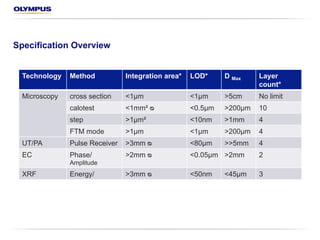
Technology Method Integration
area*
LOD* D Max Layer
count*
Microscopy Cross section < 1 µm < 1 µm > 5 cm No limit
Calotest < 1 mm² ᴓ < 0.5 µm > 200 µm 10
Step > 1 µm² < 10 nm > 1 mm 4
FTM mode > 1 µm < 1 µm > 200 µm 4
UT/PA Pulse Receiver > 3 mm ᴓ < 80 µm >> 5 mm 4
EC Phase/
Amplitude
> 2 mm ᴓ < 0.05 µm > 2 mm 2
XRF Energy > 3 mm ᴓ < 50 nm < 45 µm 3
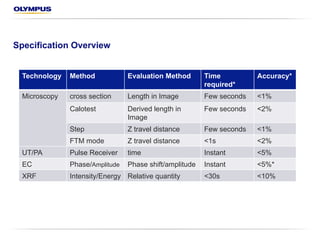
Specification Overview
Technology Method Evaluation method Time
required*
Accuracy*
Microscopy Cross section Length in image Few seconds < 1%
Calotest Derived length in
Image
Few seconds < 2%
Step Z travel distance Few seconds < 1%
FTM mode Z travel distance < 1 s < 2%
UT/PA Pulse receiver Time Instant < 5%
EC Phase/Amplitude Phase shift/amplitude Instant < 5%*
XRF Intensity/Energy Relative quantity < 30 s < 10%
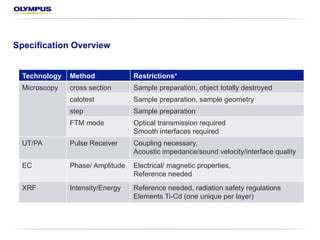
Specification Overview
Technology Method Restrictions*
Microscopy Cross section Sample preparation, object totally destroyed
Calotest Sample preparation, sample geometry
Step Sample preparation
FTM mode Optical transmission and smooth interfaces required
UT/PA Pulse receiver Coupling necessary, acoustic impedance/sound
velocity/interface quality
EC Phase/Amplitude Electrical/ magnetic properties, reference needed
XRF Intensity/Energy Reference needed, radiation safety regulations,
elements Ti-Cd (one unique per layer)
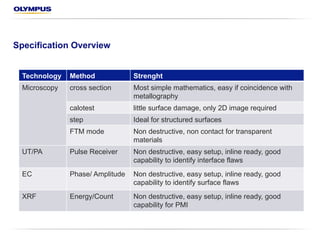
Specification Overview
Technology Method Strength
Microscopy Cross section Simple mathematics, with metallography
Calotest Minimal surface damage, only 2D image required
Step Ideal for structured surfaces
FTM mode Nondestructive, non-contact for transparent
materials
UT/PA Pulse receiver Nondestructive, easy setup, in-line ready, good
capability to identify interface flaws
EC Phase/Amplitude Nondestructive, easy setup, in-line ready, good
capability to identify surface flaws
XRF Energy/Count Nondestructive, easy setup, in-line ready, good
capability for PMI
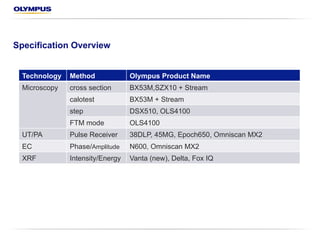
Specification Overview
Technology Method Olympus Product Name
Microscopy Cross section BX53M microscope,SZX10 microscope, and
OLYMPUS Stream® software
Calotest BX53M microscope and OLYMPUS Stream
software
Step DSX510 digital microscope, OLS4100 microscope
FTM mode OLS4100 microscope
UT/PA Pulse receiver 38DLP and 45MG thickness gages, EPOCH® 650
flaw detector, OmniScan® MX2 flaw detector
EC Phase/Amplitude NORTEC® 600 EC flaw detector, OmniScan MX2
flaw detector
XRF Intensity/Energy Vanta™ analyzer, DELTA® analyzer, FOX-IQ®
system
Disclaimer
OLYMPUS Scientific Solutions
There are many more technologies available to measure
coatings. The above mentioned methods have one thing
in common:
You will get fast, accurate measurements, safe to
interpret and assisted by user guidance and expert
consultation from Olympus.
*All shown numerical values are not necessarily exact. More effort in calibration or
specific task circumstances can change these values either positively or negatively.
Thank you
OLYMPUS Scientific Solutions
Contributors:
Jakob Mallmann (Microscopy)
Thomas Sauer (XRF)
Florin Turcu (UT)
Patric Cabanis (EC)
Questions?
OLYMPUS Scientific Solutions
Learn more at
www.olympus-ims.com
Sign up for our newsletter for technology
and application advice.
Olympus, OLYMPUS Stream, EPOCH, OmniScan, NORTEC, DELTA, and FOX-
IQ are registered trademarks and Vanta is a trademark of Olympus Corporation.

4 Ways to Measure Coatings

  • 1.
    OLYMPUS SCIENTIFIC SOLUTIONS/ HAMBURG 4 Ways to Measure Coa.ngs Markus Fabich Ver.cal Market Specialist Manufacturing Scien.fic Solu.ons Division Olympus Europa SE & Co. KG
  • 2.
    This session isabout how to pick the right technology to measure a coating thickness
  • 3.
    Agenda OLYMPUS EUROPA SE& Co. KG Page 3 Introduction to the Topic: Coatings and Layers Technology List Up Comparison Tables Summary and Q&A
  • 4.
    OLYMPUS Scientific Solutions • What is a coating? •  Why is it relevant? •  Why measure the thickness?
  • 5.
    Definition OLYMPUS Scientific Solutions Object, Substrate Coating Acoating is a covering that is applied to the surface of an object, usually referred to as the substrate.
  • 6.
    Out of Scope:Indications and Defects OLYMPUS Scientific Solutions
  • 7.
    Relevance of Coatings— Why Do Coatings Exist? OLYMPUS Scientific Solutions The purpose of applying the coating may be decorative, functional, or both. Example: an oil tank àOut of scope today: the decorative painting àIn scope today: the corrosion preventive coating
  • 8.
    Why Measure theThickness of a Coating? OLYMPUS Scientific Solutions Your reason may differ from mine, but these are just a few examples.
  • 9.
    Why Measure theThickness of a Coating? OLYMPUS Scientific Solutions time thickness Example: if over time the corrosion preventing coating thickness changes, this needs to be monitored
  • 10.
    Why Measure theThickness of a Coating? OLYMPUS Scientific Solutions function OK NG Incident: crack, delamination… Example: at the time of applying the coating you need to benchmark the thickness of a coating as it may correlate with the probability of an incident over time. Average Time until incident correlates with thickness time
  • 11.
    Why Measure theThickness of a Coating? OLYMPUS Scientific Solutions thickness Example: electrical insulation The thicker an insulation layer, the stronger the insulation effect, but at a cost function
  • 12.
  • 13.
    Measuring by PolishedCross Section Microscopy OLYMPUS Scientific Solutions Example: PCB plating (30 µm) Example: 3 layer car paint (with contamination) 100 µm
  • 14.
    Measuring by CrossSectioning OLYMPUS Scientific Solutions Method Polished cross section imaging Integration area None Limit of detection < 300 nm Maximum thickness Not limited Maximum number of layers Not limited Evaluation method In image; length equals thickness Measurement time Few seconds Restrictions Always destructive Strength Easy to calibrate Key usage Qualifying nondestructive methods, complex geometries
  • 15.
    1. Measuring byConventional Ultrasound (UT Thickness Gage) OLYMPUS Scientific Solutions 1 Water-metal 2 Metal 1/metal 2 3 Metal 2-air (backwall) 21 3 2 1 3
  • 16.
    Measuring by UT/PA OLYMPUSScientific Solutions Method Measuring the time of flight of a traveling acoustic impulse Integration area Few mm Limit of detection > 80 µm Maximum thickness > 635 mm Maximum number of layers > 4 Evaluation method Time difference Measurement time Instant Restrictions Depending on material (attenuation, impedance, sound velocity), transducer, temperature, requires coupling Strengths In-line capable, portable, easy to use
  • 17.
    Measuring by ConfocalMicroscopy OLYMPUS Scientific Solutions Example: SiO2 on SiO wafer (20 µm)
  • 18.
    Measuring by ConfocalMicroscopy OLYMPUS Scientific Solutions Method Focus from brightness correlates with depth Integration area < 200 nm Limit of detection < 900 nm Maximum thickness > 100 µm Maximum number of layers 4 Evaluation method Travel distance between brightness peaks Measurement time 0.5 s Restrictions Knowledge of refractive index, only transparent materials Strengths Easy to calibrate, high lateral resolution
  • 19.
    Measuring by theCalotest Microscopy OLYMPUS Scientific Solutions Example: hard coating on a tool
  • 20.
    Measuring by theCalotest Microscopy OLYMPUS Scientific Solutions Method 2D image of a ball grinding Integration area Few mm² Limit of detection << 1 µm Maximum thickness > 100 µm Maximum number of layers 10* Evaluation method Geometric calculation Measurement time Few seconds (excluding preparation time) Restrictions Minimally destructive, limited to specified geometries Strength Easy to calibrate
  • 21.
    Measuring by DirectStep Measurement and High-Resolution Microscopy OLYMPUS Scientific Solutions Ag nanowire mesh (100 nm) Ag screenprint (100 µm) Cu plating (100 µm)
  • 22.
    Measuring by DirectStep Measurement OLYMPUS Scientific Solutions Method Sequence of images with different focus Integration area < 1 µm Limit of detection 5 nm Maximum thickness Few mm Maximum number of layers 4+ Evaluation method Actual z displacement Measurement time 10–100 s Restrictions The layer must be removed locally in a controlled way à “destructive” Strength High resolution, excellent if structuring a coating is part of the process anyway
  • 23.
    Measuring Coatings byEddy Current (EC) OLYMPUS Scientific Solutions •  A defined electromagnetic field interacts with the object (amplitude, frequency, distribution) •  This interaction is then monitored (phase change, amplitude change)
  • 24.
    Measuring by EddyCurrent (EC) OLYMPUS Scientific Solutions Method Measurement of the material interaction with an eddy current field Integration area > 1 mm²* Limit of detection < 0.001 µm* Maximum thickness 25 mm* Maximum number of layers > 2 Evaluation method Phase and amplitude change Measurement time Instant / 2 s Restrictions No penetration through ferromagnetic materials, contact/defined distance required, calibration strategy needed Strengths Portable, nondestructive, adds conductivity as information, detects surface and subsurface cracks
  • 25.
    XRF with Olympus’VantaTM Analyzer Coating Method OLYMPUS Scientific Solutions Primary X-rays Element XRF response
  • 26.
    VantaTM Analyzer CoatingMethod OLYMPUS Scientific Solutions
  • 27.
    VantaTM Analyzer CoatingMethod OLYMPUS Scientific Solutions
  • 28.
    Measuring by XRF OLYMPUSScientific Solutions Method Fluorescence response after X-ray excitation Integration area 3 mm Limit of detection < 50 nm Maximum thickness < 50 µm Maximum number of layers 3 Evaluation method Correlate signal strength at indicator energy level versus reference Measurement time < 30 s, typically 10 s Restrictions One unique element per layer different from substrate, radiation safety regulations apply Strengths Same instrument can perform PMI, RoHS conformity check, portable, nondestructive
  • 29.
    Technology Method Integration area* LOD*D Max Layer count* Microscopy Cross section < 1 µm < 1 µm > 5 cm No limit Calotest < 1 mm² ᴓ < 0.5 µm > 200 µm 10 Step > 1 µm² < 10 nm > 1 mm 4 FTM mode > 1 µm < 1 µm > 200 µm 4 UT/PA Pulse Receiver > 3 mm ᴓ < 80 µm >> 5 mm 4 EC Phase/ Amplitude > 2 mm ᴓ < 0.05 µm > 2 mm 2 XRF Energy > 3 mm ᴓ < 50 nm < 45 µm 3 Specification Overview
  • 30.
    Specification Overview Technology MethodEvaluation method Time required* Accuracy* Microscopy Cross section Length in image Few seconds < 1% Calotest Derived length in Image Few seconds < 2% Step Z travel distance Few seconds < 1% FTM mode Z travel distance < 1 s < 2% UT/PA Pulse receiver Time Instant < 5% EC Phase/Amplitude Phase shift/amplitude Instant < 5%* XRF Intensity/Energy Relative quantity < 30 s < 10%
  • 31.
    Specification Overview Technology MethodRestrictions* Microscopy Cross section Sample preparation, object totally destroyed Calotest Sample preparation, sample geometry Step Sample preparation FTM mode Optical transmission and smooth interfaces required UT/PA Pulse receiver Coupling necessary, acoustic impedance/sound velocity/interface quality EC Phase/Amplitude Electrical/ magnetic properties, reference needed XRF Intensity/Energy Reference needed, radiation safety regulations, elements Ti-Cd (one unique per layer)
  • 32.
    Specification Overview Technology MethodStrength Microscopy Cross section Simple mathematics, with metallography Calotest Minimal surface damage, only 2D image required Step Ideal for structured surfaces FTM mode Nondestructive, non-contact for transparent materials UT/PA Pulse receiver Nondestructive, easy setup, in-line ready, good capability to identify interface flaws EC Phase/Amplitude Nondestructive, easy setup, in-line ready, good capability to identify surface flaws XRF Energy/Count Nondestructive, easy setup, in-line ready, good capability for PMI
  • 33.
    Specification Overview Technology MethodOlympus Product Name Microscopy Cross section BX53M microscope,SZX10 microscope, and OLYMPUS Stream® software Calotest BX53M microscope and OLYMPUS Stream software Step DSX510 digital microscope, OLS4100 microscope FTM mode OLS4100 microscope UT/PA Pulse receiver 38DLP and 45MG thickness gages, EPOCH® 650 flaw detector, OmniScan® MX2 flaw detector EC Phase/Amplitude NORTEC® 600 EC flaw detector, OmniScan MX2 flaw detector XRF Intensity/Energy Vanta™ analyzer, DELTA® analyzer, FOX-IQ® system
  • 34.
    Disclaimer OLYMPUS Scientific Solutions Thereare many more technologies available to measure coatings. The above mentioned methods have one thing in common: You will get fast, accurate measurements, safe to interpret and assisted by user guidance and expert consultation from Olympus. *All shown numerical values are not necessarily exact. More effort in calibration or specific task circumstances can change these values either positively or negatively.
  • 35.
    Thank you OLYMPUS ScientificSolutions Contributors: Jakob Mallmann (Microscopy) Thomas Sauer (XRF) Florin Turcu (UT) Patric Cabanis (EC)
  • 36.
    Questions? OLYMPUS Scientific Solutions Learnmore at www.olympus-ims.com Sign up for our newsletter for technology and application advice. Olympus, OLYMPUS Stream, EPOCH, OmniScan, NORTEC, DELTA, and FOX- IQ are registered trademarks and Vanta is a trademark of Olympus Corporation.