1 | February 22, 2018 | © 2018 Curtiss-Wright
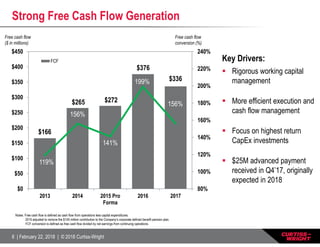
4Q and FY 2017 Earnings
Conference Call
February 22, 2018
NYSE: CW
2 | February 22, 2018 | © 2018 Curtiss-Wright
Safe Harbor Statement
Please note that the information provided in this presentation is accurate as of the date of the original
presentation. The presentation will remain posted on this website from one to twelve months following the initial
presentation, but content will not be updated to reflect new information that may become available after the
original presentation posting. The presentation contains forward-looking statements including, among other
things, management's estimates of future performance, revenue and earnings, our management's growth
objectives, our management’s ability to integrate our acquisition, and our management's ability to produce
consistent operating improvements. These forward-looking statements are based on expectations as of the time
the statements were made only, and are subject to a number of risks and uncertainties which could cause us to
fail to achieve our then-current financial projections and other expectations. This presentation also includes
certain non-GAAP financial measures with reconciliations being made available in the earnings release that is
posted to our website and furnished with the SEC. We undertake no duty to update this information. More
information about potential factors that could affect our business and financial results is included in our filings
with the Securities and Exchange Commission, including our Annual Reports on Form 10-K and Quarterly
Reports on Form 10-Q, including, among other sections, under the captions, "Risk Factors" and "Management's
Discussion and Analysis of Financial Condition and Results of Operations," which is on file with the SEC and
available at the SEC's website at www.sec.gov.
3 | February 22, 2018 | © 2018 Curtiss-Wright
Full-Year 2017 Highlights and 2018 Business Outlook
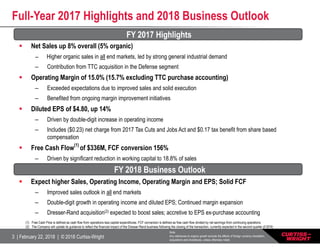
 Net Sales up 8% overall (5% organic)
– Higher organic sales in all end markets, led by strong general industrial demand
– Contribution from TTC acquisition in the Defense segment
 Operating Margin of 15.0% (15.7% excluding TTC purchase accounting)
– Exceeded expectations due to improved sales and solid execution
– Benefited from ongoing margin improvement initiatives
 Diluted EPS of $4.80, up 14%
– Driven by double-digit increase in operating income
– Includes ($0.23) net charge from 2017 Tax Cuts and Jobs Act and $0.17 tax benefit from share based
compensation
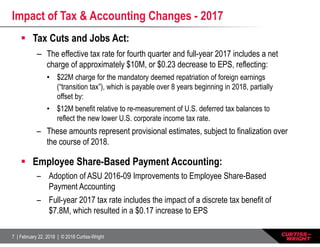
 Free Cash Flow
(1)
of $336M, FCF conversion 156%
– Driven by significant reduction in working capital to 18.8% of sales
FY 2017 Highlights
FY 2018 Business Outlook
 Expect higher Sales, Operating Income, Operating Margin and EPS; Solid FCF
– Improved sales outlook in all end markets
– Double-digit growth in operating income and diluted EPS; Continued margin expansion
– Dresser-Rand acquisition(2) expected to boost sales; accretive to EPS ex-purchase accounting
Note:
Any references to organic growth exclude the effects of foreign currency translation,
acquisitions and divestitures, unless otherwise noted.
(1) Free Cash Flow is defined as cash flow from operations less capital expenditures. FCF conversion is defined as free cash flow divided by net earnings from continuing operations.
(2) The Company will update its guidance to reflect the financial impact of the Dresser-Rand business following the closing of the transaction, currently expected in the second quarter of 2018.
4 | February 22, 2018 | © 2018 Curtiss-Wright
Fourth Quarter 2017 Highlights
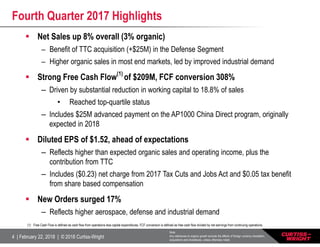
 Net Sales up 8% overall (3% organic)
– Benefit of TTC acquisition (+$25M) in the Defense Segment
– Higher organic sales in most end markets, led by improved industrial demand
 Strong Free Cash Flow(1)
of $209M, FCF conversion 308%
– Driven by substantial reduction in working capital to 18.8% of sales
• Reached top-quartile status
– Includes $25M advanced payment on the AP1000 China Direct program, originally
expected in 2018
 Diluted EPS of $1.52, ahead of expectations
– Reflects higher than expected organic sales and operating income, plus the
contribution from TTC
– Includes ($0.23) net charge from 2017 Tax Cuts and Jobs Act and $0.05 tax benefit
from share based compensation
 New Orders surged 17%
– Reflects higher aerospace, defense and industrial demand
(1) Free Cash Flow is defined as cash flow from operations less capital expenditures. FCF conversion is defined as free cash flow divided by net earnings from continuing operations.
Note:
Any references to organic growth exclude the effects of foreign currency translation,
acquisitions and divestitures, unless otherwise noted.
5 | February 22, 2018 | © 2018 Curtiss-Wright
Rigorous Working Capital Management
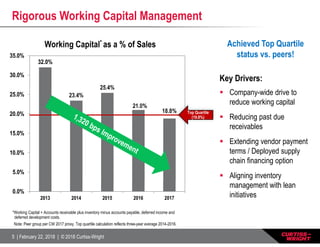
32.0%
23.4%
25.4%
21.0%
18.8%
0.0%
5.0%
10.0%
15.0%
20.0%
25.0%
30.0%
35.0%
2013 2014 2015 2016 2017
Working Capital*
as a % of Sales
*Working Capital = Accounts receivable plus inventory minus accounts payable, deferred income and
deferred development costs.
Note: Peer group per CW 2017 proxy. Top quartile calculation reflects three-year average 2014-2016.
Achieved Top Quartile
status vs. peers!
Key Drivers:
 Company-wide drive to
reduce working capital
 Reducing past due
receivables
 Extending vendor payment
terms / Deployed supply
chain financing option
 Aligning inventory
management with lean
initiatives
Top Quartile
(19.8%)
6 | February 22, 2018 | © 2018 Curtiss-Wright
Strong Free Cash Flow Generation
$166
$265 $272
$336
119%
156%
141%
199%
156%
80%
100%
120%
140%
160%
180%
200%
220%
240%
$0
$50
$100
$150
$200
$250
$300
$350
$400
$450
2013 2014 2015 Pro
Forma
2016 2017
FCF
$376
Notes: Free cash flow is defined as cash flow from operations less capital expenditures.
2015 adjusted to remove the $145 million contribution to the Company’s corporate defined benefit pension plan.
FCF conversion is defined as free cash flow divided by net earnings from continuing operations.
Free cash flow
($ in millions)
Free cash flow
conversion (%)
Key Drivers:
 Rigorous working capital
management
 More efficient execution and
cash flow management
 Focus on highest return
CapEx investments
 $25M advanced payment
received in Q4’17, originally
expected in 2018
7 | February 22, 2018 | © 2018 Curtiss-Wright
Impact of Tax & Accounting Changes - 2017
 Tax Cuts and Jobs Act:
– The effective tax rate for fourth quarter and full-year 2017 includes a net
charge of approximately $10M, or $0.23 decrease to EPS, reflecting:
• $22M charge for the mandatory deemed repatriation of foreign earnings
(“transition tax”), which is payable over 8 years beginning in 2018, partially
offset by:
• $12M benefit relative to re-measurement of U.S. deferred tax balances to
reflect the new lower U.S. corporate income tax rate.
– These amounts represent provisional estimates, subject to finalization over
the course of 2018.
 Employee Share-Based Payment Accounting:
– Adoption of ASU 2016-09 Improvements to Employee Share-Based
Payment Accounting
– Full-year 2017 tax rate includes the impact of a discrete tax benefit of
$7.8M, which resulted in a $0.17 increase to EPS
8 | February 22, 2018 | © 2018 Curtiss-Wright
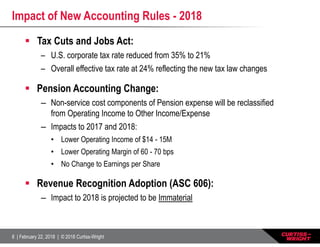
Impact of New Accounting Rules - 2018
 Tax Cuts and Jobs Act:
– U.S. corporate tax rate reduced from 35% to 21%
– Overall effective tax rate at 24% reflecting the new tax law changes
 Pension Accounting Change:
– Non-service cost components of Pension expense will be reclassified
from Operating Income to Other Income/Expense
– Impacts to 2017 and 2018:
• Lower Operating Income of $14 - 15M
• Lower Operating Margin of 60 - 70 bps
• No Change to Earnings per Share
 Revenue Recognition Adoption (ASC 606):
– Impact to 2018 is projected to be Immaterial
9 | February 22, 2018 | © 2018 Curtiss-Wright
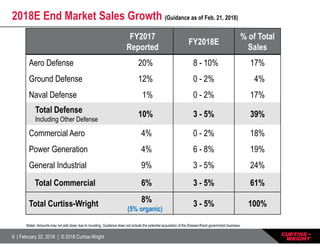
2018E End Market Sales Growth (Guidance as of Feb. 21, 2018)
FY2017
Reported
FY2018E
% of Total
Sales
Aero Defense 20% 8 - 10% 17%
Ground Defense 12% 0 - 2% 4%
Naval Defense 1% 0 - 2% 17%
Total Defense
Including Other Defense
10% 3 - 5% 39%
Commercial Aero 4% 0 - 2% 18%
Power Generation 4% 6 - 8% 19%
General Industrial 9% 3 - 5% 24%
Total Commercial 6% 3 - 5% 61%
Total Curtiss-Wright 8%
(5% organic)
3 - 5% 100%
Notes: Amounts may not add down due to rounding. Guidance does not include the potential acquisition of the Dresser-Rand government business.
10 | February 22, 2018 | © 2018 Curtiss-Wright
Notes: Amounts may not add down due to rounding. Guidance does not include the potential acquisition of the Dresser-Rand government business.
($ in millions, except EPS)
FY2017
Reported
FY2017
Adj. for
Pension
Reclass(1)
FY2018E
(Unadjusted)
Pension
Re-class
FY2018E
Adj. for
Pension
Reclass(1)
FY2018E
% Change
vs 2017
Adjusted(1)
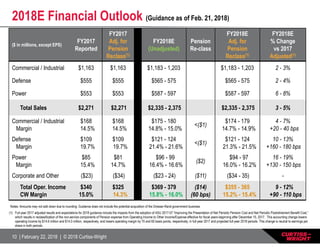
Commercial / Industrial $1,163 $1,163 $1,183 - 1,203 $1,183 - 1,203 2 - 3%
Defense $555 $555 $565 - 575 $565 - 575 2 - 4%
Power $553 $553 $587 - 597 $587 - 597 6 - 8%
Total Sales $2,271 $2,271 $2,335 - 2,375 $2,335 - 2,375 3 - 5%
Commercial / Industrial
Margin
$168
14.5%
$168
14.5%
$175 - 180
14.8% - 15.0%
<($1)
$174 - 179
14.7% - 14.9%
4 - 7%
+20 - 40 bps
Defense
Margin
$109
19.7%
$109
19.7%
$121 - 124
21.4% - 21.6%
<($1)
$121 - 124
21.3% - 21.5%
10 - 13%
+160 - 180 bps
Power
Margin
$85
15.4%
$81
14.7%
$96 - 99
16.4% - 16.6%
($2)
$94 - 97
16.0% - 16.2%
16 - 19%
+130 - 150 bps
Corporate and Other ($23) ($34) ($23 - 24) ($11) ($34 - 35) -
Total Oper. Income
CW Margin
$340
15.0%
$325
14.3%
$369 - 379
15.8% - 16.0%
($14)
(60 bps)
$355 - 365
15.2% - 15.4%
9 - 12%
+90 - 110 bps
2018E Financial Outlook (Guidance as of Feb. 21, 2018)
(1) Full-year 2017 adjusted results and expectations for 2018 guidance include the impacts from the adoption of ASU 2017-07 “Improving the Presentation of Net Periodic Pension Cost and Net Periodic Postretirement Benefit Cost,”
which results in reclassification of the non-service components of Pension expense from Operating Income to Other Income/Expense effective for fiscal years beginning after December 15, 2017. This accounting change lowers
operating income by $14.6 million and $14.0 million, respectively, and lowers operating margin by 70 and 60 basis points, respectively, in full-year 2017 and projected full-year 2018 periods. This change is neutral to earnings per
share in both periods.
11 | February 22, 2018 | © 2018 Curtiss-Wright
($ in millions, except EPS)
FY2017
Reported
FY2017
Adj. for
Pension
Reclass(1)
FY2018E
(Unadjusted)
Pension
Re-class
FY2018E
Adj. for
Pension
Reclass(1)
FY2018E
% Change
vs 2017
Adjusted(1)
Total Operating
Income
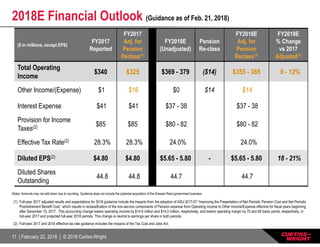
$340 $325 $369 - 379 ($14) $355 - 365 9 - 12%
Other Income/(Expense) $1 $16 $0 $14 $14
Interest Expense $41 $41 $37 - 38 $37 - 38
Provision for Income
Taxes(2) $85 $85 $80 - 82 $80 - 82
Effective Tax Rate(2) 28.3% 28.3% 24.0% 24.0%
Diluted EPS(2) $4.80 $4.80 $5.65 - 5.80 - $5.65 - 5.80 18 - 21%
Diluted Shares
Outstanding
44.8 44.8 44.7 44.7
2018E Financial Outlook (Guidance as of Feb. 21, 2018)
(1) Full-year 2017 adjusted results and expectations for 2018 guidance include the impacts from the adoption of ASU 2017-07 “Improving the Presentation of Net Periodic Pension Cost and Net Periodic
Postretirement Benefit Cost,” which results in reclassification of the non-service components of Pension expense from Operating Income to Other Income/Expense effective for fiscal years beginning
after December 15, 2017. This accounting change lowers operating income by $14.6 million and $14.0 million, respectively, and lowers operating margin by 70 and 60 basis points, respectively, in
full-year 2017 and projected full-year 2018 periods. This change is neutral to earnings per share in both periods.
(2) Full-year 2017 and 2018 effective tax rate guidance includes the impacts of the Tax Cuts and Jobs Act.
Notes: Amounts may not add down due to rounding. Guidance does not include the potential acquisition of the Dresser-Rand government business.
12 | February 22, 2018 | © 2018 Curtiss-Wright
Notes:
(1) Free Cash Flow is defined as cash flow from operations less capital expenditures.
(2) Adjusted Free Cash Flow excludes a voluntary contribution to the Company’s corporate defined benefit pension plan of $50 million in 2018.
(3) Free Cash Flow Conversion is calculated as free cash flow divided by net earnings from continuing operations.
(4) Adjusted free Cash Flow Conversion is calculated as adjusted free cash flow divided by net earnings from continuing operations.
(5) 2017 Free Cash Flow includes $25M advanced payment on China Direct AP1000 program originally expected in 2018.
2018E Financial Outlook (Guidance as of Feb. 21, 2018)
($ in millions)
FY2017A FY2018E
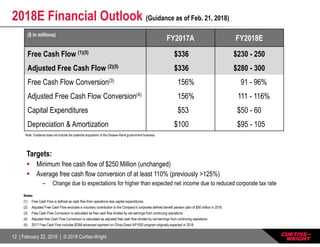
Free Cash Flow (1)(5) $336 $230 - 250
Adjusted Free Cash Flow (2)(5) $336 $280 - 300
Free Cash Flow Conversion(3) 156% 91 - 96%
Adjusted Free Cash Flow Conversion(4) 156% 111 - 116%
Capital Expenditures $53 $50 - 60
Depreciation & Amortization $100 $95 - 105
Targets:
 Minimum free cash flow of $250 Million (unchanged)
 Average free cash flow conversion of at least 110% (previously >125%)
– Change due to expectations for higher than expected net income due to reduced corporate tax rate
Note: Guidance does not include the potential acquisition of the Dresser-Rand government business.
13 | February 22, 2018 | © 2018 Curtiss-Wright
Acquisition of Dresser-Rand Government Business(1)
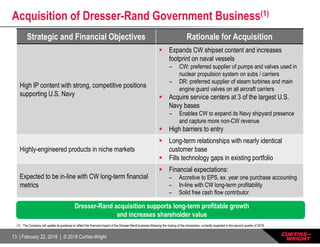
Strategic and Financial Objectives Rationale for Acquisition
High IP content with strong, competitive positions
supporting U.S. Navy
 Expands CW shipset content and increases
footprint on naval vessels
– CW: preferred supplier of pumps and valves used in
nuclear propulsion system on subs / carriers
– DR: preferred supplier of steam turbines and main
engine guard valves on all aircraft carriers
 Acquire service centers at 3 of the largest U.S.
Navy bases
– Enables CW to expand its Navy shipyard presence
and capture more non-CW revenue
 High barriers to entry
Highly-engineered products in niche markets
 Long-term relationships with nearly identical
customer base
 Fills technology gaps in existing portfolio
Expected to be in-line with CW long-term financial
metrics
 Financial expectations:
– Accretive to EPS, ex. year one purchase accounting
– In-line with CW long-term profitability
– Solid free cash flow contributor
Dresser-Rand acquisition supports long-term profitable growth
and increases shareholder value
(1) The Company will update its guidance to reflect the financial impact of the Dresser-Rand business following the closing of the transaction, currently expected in the second quarter of 2018.
14 | February 22, 2018 | © 2018 Curtiss-Wright
Positioned to Deliver Strong 2018 Results
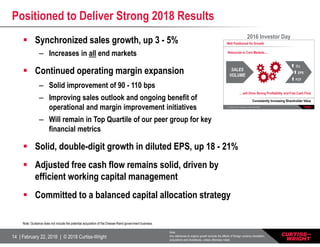
 Synchronized sales growth, up 3 - 5%
– Increases in all end markets
 Continued operating margin expansion
– Solid improvement of 90 - 110 bps
– Improving sales outlook and ongoing benefit of
operational and margin improvement initiatives
– Will remain in Top Quartile of our peer group for key
financial metrics
 Solid, double-digit growth in diluted EPS, up 18 - 21%
 Adjusted free cash flow remains solid, driven by
efficient working capital management
 Committed to a balanced capital allocation strategy
Note:
Any references to organic growth exclude the effects of foreign currency translation,
acquisitions and divestitures, unless otherwise noted.
2016 Investor Day
Note: Guidance does not include the potential acquisition of the Dresser-Rand government business.
15 | February 22, 2018 | © 2018 Curtiss-Wright
Appendix
16 | February 22, 2018 | © 2018 Curtiss-Wright
Non-GAAP Reconciliation
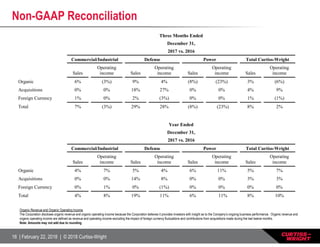
Organic Revenue and Organic Operating Income
The Corporation discloses organic revenue and organic operating income because the Corporation believes it provides investors with insight as to the Company’s ongoing business performance. Organic revenue and
organic operating income are defined as revenue and operating income excluding the impact of foreign currency fluctuations and contributions from acquisitions made during the last twelve months.
Note: Amounts may not add due to rounding
Three Months Ended
December 31,
2017 vs. 2016
Commercial/Industrial Defense Power Total Curtiss-Wright
Sales
Operating
income Sales
Operating
income Sales
Operating
income Sales
Operating
income
Organic 6% (3%) 9% 4% (8%) (23%) 3% (6%)
Acquisitions 0% 0% 18% 27% 0% 0% 4% 9%
Foreign Currency 1% 0% 2% (3%) 0% 0% 1% (1%)
Total 7% (3%) 29% 28% (8%) (23%) 8% 2%
Year Ended
December 31,
2017 vs. 2016
Commercial/Industrial Defense Power Total Curtiss-Wright
Sales
Operating
income Sales
Operating
income Sales
Operating
income Sales
Operating
income
Organic 4% 7% 5% 4% 6% 11% 5% 7%
Acquisitions 0% 0% 14% 8% 0% 0% 3% 3%
Foreign Currency 0% 1% 0% (1%) 0% 0% 0% 0%
Total 4% 8% 19% 11% 6% 11% 8% 10%
17 | February 22, 2018 | © 2018 Curtiss-Wright
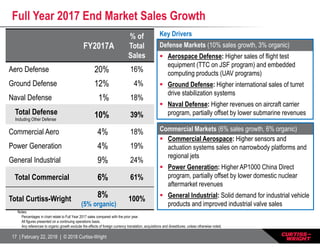
Key Drivers
Defense Markets (10% sales growth, 3% organic)
 Aerospace Defense: Higher sales of flight test
equipment (TTC on JSF program) and embedded
computing products (UAV programs)
 Ground Defense: Higher international sales of turret
drive stabilization systems
 Naval Defense: Higher revenues on aircraft carrier
program, partially offset by lower submarine revenues
Full Year 2017 End Market Sales Growth
Notes:
Percentages in chart relate to Full Year 2017 sales compared with the prior year.
All figures presented on a continuing operations basis.
Any references to organic growth exclude the effects of foreign currency translation, acquisitions and divestitures, unless otherwise noted.
FY2017A
% of
Total
Sales
Aero Defense 20% 16%
Ground Defense 12% 4%
Naval Defense 1% 18%
Total Defense
Including Other Defense
10% 39%
Commercial Aero 4% 18%
Power Generation 4% 19%
General Industrial 9% 24%
Total Commercial 6% 61%
Total Curtiss-Wright 8%
(5% organic)
100%
Commercial Markets (6% sales growth, 6% organic)
 Commercial Aerospace: Higher sensors and
actuation systems sales on narrowbody platforms and
regional jets
 Power Generation: Higher AP1000 China Direct
program, partially offset by lower domestic nuclear
aftermarket revenues
 General Industrial: Solid demand for industrial vehicle
products and improved industrial valve sales
18 | February 22, 2018 | © 2018 Curtiss-Wright
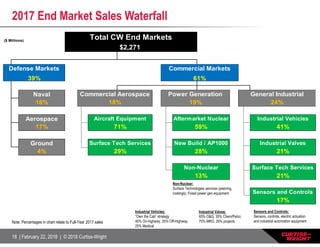
2017 End Market Sales Waterfall
Note: Percentages in chart relate to Full-Year 2017 sales
($ Millions)
Naval
Aerospace Industrial Vehicles
Ground Industrial Valves
Surface Tech Services
Sensors and Controls
13%
Commercial Markets
Aftermarket Nuclear
59%
New Build / AP1000
General Industrial
24%19%
61%
28%
Non-Nuclear
17%
21%
21%
17%
Power Generation
4%
18%
Aircraft Equipment
71%
Surface Tech Services
29%
18%
39%
Defense Markets
Total CW End Markets
$2,271
41%
Commercial Aerospace
Sensors and Controls:
Sensors, controls, electric actuation
and industrial automation equipment
Industrial Vehicles:
“Own the Cab” strategy
40% On-highway, 35% Off-Highway,
25% Medical
Industrial Valves:
65% O&G, 35% Chem/Petro;
75% MRO, 25% projects
Non-Nuclear:
Surface Technologies services (peening,
coatings); Fossil power gen equipment
19 | February 22, 2018 | © 2018 Curtiss-Wright
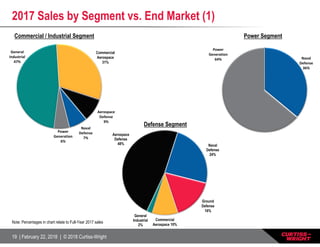
2017 Sales by Segment vs. End Market (1)
Naval 
Defense
36%
Power 
Generation
64%
Defense Segment
Power SegmentCommercial / Industrial Segment
Aerospace 
Defense
9%
Naval 
Defense
7%
Power 
Generation
6%
General 
Industrial
47%
Commercial
Aerospace
31%
Aerospace
Defense
48% Naval
Defense
24%
General
Industrial
2%
Commercial
Aerospace 10%
Ground
Defense
16%
Note: Percentages in chart relate to Full-Year 2017 sales
20 | February 22, 2018 | © 2018 Curtiss-Wright
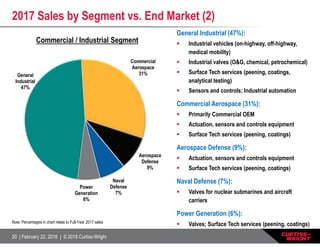
2017 Sales by Segment vs. End Market (2)
Commercial / Industrial Segment
General Industrial (47%):
 Industrial vehicles (on-highway, off-highway,
medical mobility)
 Industrial valves (O&G, chemical, petrochemical)
 Surface Tech services (peening, coatings,
analytical testing)
 Sensors and controls; Industrial automation
Commercial Aerospace (31%):
 Primarily Commercial OEM
 Actuation, sensors and controls equipment
 Surface Tech services (peening, coatings)
Aerospace Defense (9%):
 Actuation, sensors and controls equipment
 Surface Tech services (peening, coatings)
Naval Defense (7%):
 Valves for nuclear submarines and aircraft
carriers
Power Generation (6%):
 Valves; Surface Tech services (peening, coatings)
Aerospace
Defense
9%
Naval
Defense
7%
Power
Generation
6%
General
Industrial
47%
Commercial
Aerospace
31%
Note: Percentages in chart relate to Full-Year 2017 sales
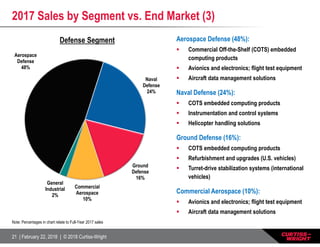
21 | February 22, 2018 | © 2018 Curtiss-Wright
Aerospace
Defense
48%
Naval
Defense
24%
Ground
Defense
16%
Commercial
Aerospace
10%
General
Industrial
2%
2017 Sales by Segment vs. End Market (3)
Defense Segment Aerospace Defense (48%):
 Commercial Off-the-Shelf (COTS) embedded
computing products
 Avionics and electronics; flight test equipment
 Aircraft data management solutions
Naval Defense (24%):
 COTS embedded computing products
 Instrumentation and control systems
 Helicopter handling solutions
Ground Defense (16%):
 COTS embedded computing products
 Refurbishment and upgrades (U.S. vehicles)
 Turret-drive stabilization systems (international
vehicles)
Commercial Aerospace (10%):
 Avionics and electronics; flight test equipment
 Aircraft data management solutions
Note: Percentages in chart relate to Full-Year 2017 sales
22 | February 22, 2018 | © 2018 Curtiss-Wright
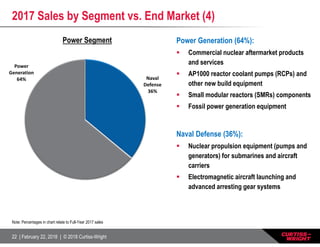
Naval 
Defense
36%
Power 
Generation
64%
2017 Sales by Segment vs. End Market (4)
Power Segment Power Generation (64%):
 Commercial nuclear aftermarket products
and services
 AP1000 reactor coolant pumps (RCPs) and
other new build equipment
 Small modular reactors (SMRs) components
 Fossil power generation equipment
Naval Defense (36%):
 Nuclear propulsion equipment (pumps and
generators) for submarines and aircraft
carriers
 Electromagnetic aircraft launching and
advanced arresting gear systems
Note: Percentages in chart relate to Full-Year 2017 sales
23 | February 22, 2018 | © 2018 Curtiss-Wright
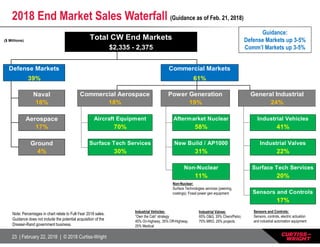
2018 End Market Sales Waterfall (Guidance as of Feb. 21, 2018)
Note: Percentages in chart relate to Full-Year 2018 sales.
Guidance does not include the potential acquisition of the
Dresser-Rand government business.
($ Millions)
Naval
Aerospace Industrial Vehicles
Ground Industrial Valves
Surface Tech Services
Sensors and Controls
39%
Defense Markets
Total CW End Markets
$2,335 - 2,375
41%
Commercial Aerospace
4%
18%
Aircraft Equipment
70%
Surface Tech Services
30%
18% 19%
61%
31%
Non-Nuclear
17%
20%
22%
17%
Power Generation
11%
Commercial Markets
Aftermarket Nuclear
58%
New Build / AP1000
General Industrial
24%
Guidance:
Defense Markets up 3-5%
Comm’l Markets up 3-5%
Sensors and Controls:
Sensors, controls, electric actuation
and industrial automation equipment
Industrial Vehicles:
“Own the Cab” strategy
45% On-highway, 35% Off-Highway,
25% Medical
Industrial Valves:
65% O&G, 35% Chem/Petro;
75% MRO, 25% projects
Non-Nuclear:
Surface Technologies services (peening,
coatings); Fossil power gen equipment

4 q'17 earnings presentation final

  • 1.
    1 | February22, 2018 | © 2018 Curtiss-Wright 4Q and FY 2017 Earnings Conference Call February 22, 2018 NYSE: CW
  • 2.
    2 | February22, 2018 | © 2018 Curtiss-Wright Safe Harbor Statement Please note that the information provided in this presentation is accurate as of the date of the original presentation. The presentation will remain posted on this website from one to twelve months following the initial presentation, but content will not be updated to reflect new information that may become available after the original presentation posting. The presentation contains forward-looking statements including, among other things, management's estimates of future performance, revenue and earnings, our management's growth objectives, our management’s ability to integrate our acquisition, and our management's ability to produce consistent operating improvements. These forward-looking statements are based on expectations as of the time the statements were made only, and are subject to a number of risks and uncertainties which could cause us to fail to achieve our then-current financial projections and other expectations. This presentation also includes certain non-GAAP financial measures with reconciliations being made available in the earnings release that is posted to our website and furnished with the SEC. We undertake no duty to update this information. More information about potential factors that could affect our business and financial results is included in our filings with the Securities and Exchange Commission, including our Annual Reports on Form 10-K and Quarterly Reports on Form 10-Q, including, among other sections, under the captions, "Risk Factors" and "Management's Discussion and Analysis of Financial Condition and Results of Operations," which is on file with the SEC and available at the SEC's website at www.sec.gov.
  • 3.
    3 | February22, 2018 | © 2018 Curtiss-Wright Full-Year 2017 Highlights and 2018 Business Outlook  Net Sales up 8% overall (5% organic) – Higher organic sales in all end markets, led by strong general industrial demand – Contribution from TTC acquisition in the Defense segment  Operating Margin of 15.0% (15.7% excluding TTC purchase accounting) – Exceeded expectations due to improved sales and solid execution – Benefited from ongoing margin improvement initiatives  Diluted EPS of $4.80, up 14% – Driven by double-digit increase in operating income – Includes ($0.23) net charge from 2017 Tax Cuts and Jobs Act and $0.17 tax benefit from share based compensation  Free Cash Flow (1) of $336M, FCF conversion 156% – Driven by significant reduction in working capital to 18.8% of sales FY 2017 Highlights FY 2018 Business Outlook  Expect higher Sales, Operating Income, Operating Margin and EPS; Solid FCF – Improved sales outlook in all end markets – Double-digit growth in operating income and diluted EPS; Continued margin expansion – Dresser-Rand acquisition(2) expected to boost sales; accretive to EPS ex-purchase accounting Note: Any references to organic growth exclude the effects of foreign currency translation, acquisitions and divestitures, unless otherwise noted. (1) Free Cash Flow is defined as cash flow from operations less capital expenditures. FCF conversion is defined as free cash flow divided by net earnings from continuing operations. (2) The Company will update its guidance to reflect the financial impact of the Dresser-Rand business following the closing of the transaction, currently expected in the second quarter of 2018.
  • 4.
    4 | February22, 2018 | © 2018 Curtiss-Wright Fourth Quarter 2017 Highlights  Net Sales up 8% overall (3% organic) – Benefit of TTC acquisition (+$25M) in the Defense Segment – Higher organic sales in most end markets, led by improved industrial demand  Strong Free Cash Flow(1) of $209M, FCF conversion 308% – Driven by substantial reduction in working capital to 18.8% of sales • Reached top-quartile status – Includes $25M advanced payment on the AP1000 China Direct program, originally expected in 2018  Diluted EPS of $1.52, ahead of expectations – Reflects higher than expected organic sales and operating income, plus the contribution from TTC – Includes ($0.23) net charge from 2017 Tax Cuts and Jobs Act and $0.05 tax benefit from share based compensation  New Orders surged 17% – Reflects higher aerospace, defense and industrial demand (1) Free Cash Flow is defined as cash flow from operations less capital expenditures. FCF conversion is defined as free cash flow divided by net earnings from continuing operations. Note: Any references to organic growth exclude the effects of foreign currency translation, acquisitions and divestitures, unless otherwise noted.
  • 5.
    5 | February22, 2018 | © 2018 Curtiss-Wright Rigorous Working Capital Management 32.0% 23.4% 25.4% 21.0% 18.8% 0.0% 5.0% 10.0% 15.0% 20.0% 25.0% 30.0% 35.0% 2013 2014 2015 2016 2017 Working Capital* as a % of Sales *Working Capital = Accounts receivable plus inventory minus accounts payable, deferred income and deferred development costs. Note: Peer group per CW 2017 proxy. Top quartile calculation reflects three-year average 2014-2016. Achieved Top Quartile status vs. peers! Key Drivers:  Company-wide drive to reduce working capital  Reducing past due receivables  Extending vendor payment terms / Deployed supply chain financing option  Aligning inventory management with lean initiatives Top Quartile (19.8%)
  • 6.
    6 | February22, 2018 | © 2018 Curtiss-Wright Strong Free Cash Flow Generation $166 $265 $272 $336 119% 156% 141% 199% 156% 80% 100% 120% 140% 160% 180% 200% 220% 240% $0 $50 $100 $150 $200 $250 $300 $350 $400 $450 2013 2014 2015 Pro Forma 2016 2017 FCF $376 Notes: Free cash flow is defined as cash flow from operations less capital expenditures. 2015 adjusted to remove the $145 million contribution to the Company’s corporate defined benefit pension plan. FCF conversion is defined as free cash flow divided by net earnings from continuing operations. Free cash flow ($ in millions) Free cash flow conversion (%) Key Drivers:  Rigorous working capital management  More efficient execution and cash flow management  Focus on highest return CapEx investments  $25M advanced payment received in Q4’17, originally expected in 2018
  • 7.
    7 | February22, 2018 | © 2018 Curtiss-Wright Impact of Tax & Accounting Changes - 2017  Tax Cuts and Jobs Act: – The effective tax rate for fourth quarter and full-year 2017 includes a net charge of approximately $10M, or $0.23 decrease to EPS, reflecting: • $22M charge for the mandatory deemed repatriation of foreign earnings (“transition tax”), which is payable over 8 years beginning in 2018, partially offset by: • $12M benefit relative to re-measurement of U.S. deferred tax balances to reflect the new lower U.S. corporate income tax rate. – These amounts represent provisional estimates, subject to finalization over the course of 2018.  Employee Share-Based Payment Accounting: – Adoption of ASU 2016-09 Improvements to Employee Share-Based Payment Accounting – Full-year 2017 tax rate includes the impact of a discrete tax benefit of $7.8M, which resulted in a $0.17 increase to EPS
  • 8.
    8 | February22, 2018 | © 2018 Curtiss-Wright Impact of New Accounting Rules - 2018  Tax Cuts and Jobs Act: – U.S. corporate tax rate reduced from 35% to 21% – Overall effective tax rate at 24% reflecting the new tax law changes  Pension Accounting Change: – Non-service cost components of Pension expense will be reclassified from Operating Income to Other Income/Expense – Impacts to 2017 and 2018: • Lower Operating Income of $14 - 15M • Lower Operating Margin of 60 - 70 bps • No Change to Earnings per Share  Revenue Recognition Adoption (ASC 606): – Impact to 2018 is projected to be Immaterial
  • 9.
    9 | February22, 2018 | © 2018 Curtiss-Wright 2018E End Market Sales Growth (Guidance as of Feb. 21, 2018) FY2017 Reported FY2018E % of Total Sales Aero Defense 20% 8 - 10% 17% Ground Defense 12% 0 - 2% 4% Naval Defense 1% 0 - 2% 17% Total Defense Including Other Defense 10% 3 - 5% 39% Commercial Aero 4% 0 - 2% 18% Power Generation 4% 6 - 8% 19% General Industrial 9% 3 - 5% 24% Total Commercial 6% 3 - 5% 61% Total Curtiss-Wright 8% (5% organic) 3 - 5% 100% Notes: Amounts may not add down due to rounding. Guidance does not include the potential acquisition of the Dresser-Rand government business.
  • 10.
    10 | February22, 2018 | © 2018 Curtiss-Wright Notes: Amounts may not add down due to rounding. Guidance does not include the potential acquisition of the Dresser-Rand government business. ($ in millions, except EPS) FY2017 Reported FY2017 Adj. for Pension Reclass(1) FY2018E (Unadjusted) Pension Re-class FY2018E Adj. for Pension Reclass(1) FY2018E % Change vs 2017 Adjusted(1) Commercial / Industrial $1,163 $1,163 $1,183 - 1,203 $1,183 - 1,203 2 - 3% Defense $555 $555 $565 - 575 $565 - 575 2 - 4% Power $553 $553 $587 - 597 $587 - 597 6 - 8% Total Sales $2,271 $2,271 $2,335 - 2,375 $2,335 - 2,375 3 - 5% Commercial / Industrial Margin $168 14.5% $168 14.5% $175 - 180 14.8% - 15.0% <($1) $174 - 179 14.7% - 14.9% 4 - 7% +20 - 40 bps Defense Margin $109 19.7% $109 19.7% $121 - 124 21.4% - 21.6% <($1) $121 - 124 21.3% - 21.5% 10 - 13% +160 - 180 bps Power Margin $85 15.4% $81 14.7% $96 - 99 16.4% - 16.6% ($2) $94 - 97 16.0% - 16.2% 16 - 19% +130 - 150 bps Corporate and Other ($23) ($34) ($23 - 24) ($11) ($34 - 35) - Total Oper. Income CW Margin $340 15.0% $325 14.3% $369 - 379 15.8% - 16.0% ($14) (60 bps) $355 - 365 15.2% - 15.4% 9 - 12% +90 - 110 bps 2018E Financial Outlook (Guidance as of Feb. 21, 2018) (1) Full-year 2017 adjusted results and expectations for 2018 guidance include the impacts from the adoption of ASU 2017-07 “Improving the Presentation of Net Periodic Pension Cost and Net Periodic Postretirement Benefit Cost,” which results in reclassification of the non-service components of Pension expense from Operating Income to Other Income/Expense effective for fiscal years beginning after December 15, 2017. This accounting change lowers operating income by $14.6 million and $14.0 million, respectively, and lowers operating margin by 70 and 60 basis points, respectively, in full-year 2017 and projected full-year 2018 periods. This change is neutral to earnings per share in both periods.
  • 11.
    11 | February22, 2018 | © 2018 Curtiss-Wright ($ in millions, except EPS) FY2017 Reported FY2017 Adj. for Pension Reclass(1) FY2018E (Unadjusted) Pension Re-class FY2018E Adj. for Pension Reclass(1) FY2018E % Change vs 2017 Adjusted(1) Total Operating Income $340 $325 $369 - 379 ($14) $355 - 365 9 - 12% Other Income/(Expense) $1 $16 $0 $14 $14 Interest Expense $41 $41 $37 - 38 $37 - 38 Provision for Income Taxes(2) $85 $85 $80 - 82 $80 - 82 Effective Tax Rate(2) 28.3% 28.3% 24.0% 24.0% Diluted EPS(2) $4.80 $4.80 $5.65 - 5.80 - $5.65 - 5.80 18 - 21% Diluted Shares Outstanding 44.8 44.8 44.7 44.7 2018E Financial Outlook (Guidance as of Feb. 21, 2018) (1) Full-year 2017 adjusted results and expectations for 2018 guidance include the impacts from the adoption of ASU 2017-07 “Improving the Presentation of Net Periodic Pension Cost and Net Periodic Postretirement Benefit Cost,” which results in reclassification of the non-service components of Pension expense from Operating Income to Other Income/Expense effective for fiscal years beginning after December 15, 2017. This accounting change lowers operating income by $14.6 million and $14.0 million, respectively, and lowers operating margin by 70 and 60 basis points, respectively, in full-year 2017 and projected full-year 2018 periods. This change is neutral to earnings per share in both periods. (2) Full-year 2017 and 2018 effective tax rate guidance includes the impacts of the Tax Cuts and Jobs Act. Notes: Amounts may not add down due to rounding. Guidance does not include the potential acquisition of the Dresser-Rand government business.
  • 12.
    12 | February22, 2018 | © 2018 Curtiss-Wright Notes: (1) Free Cash Flow is defined as cash flow from operations less capital expenditures. (2) Adjusted Free Cash Flow excludes a voluntary contribution to the Company’s corporate defined benefit pension plan of $50 million in 2018. (3) Free Cash Flow Conversion is calculated as free cash flow divided by net earnings from continuing operations. (4) Adjusted free Cash Flow Conversion is calculated as adjusted free cash flow divided by net earnings from continuing operations. (5) 2017 Free Cash Flow includes $25M advanced payment on China Direct AP1000 program originally expected in 2018. 2018E Financial Outlook (Guidance as of Feb. 21, 2018) ($ in millions) FY2017A FY2018E Free Cash Flow (1)(5) $336 $230 - 250 Adjusted Free Cash Flow (2)(5) $336 $280 - 300 Free Cash Flow Conversion(3) 156% 91 - 96% Adjusted Free Cash Flow Conversion(4) 156% 111 - 116% Capital Expenditures $53 $50 - 60 Depreciation & Amortization $100 $95 - 105 Targets:  Minimum free cash flow of $250 Million (unchanged)  Average free cash flow conversion of at least 110% (previously >125%) – Change due to expectations for higher than expected net income due to reduced corporate tax rate Note: Guidance does not include the potential acquisition of the Dresser-Rand government business.
  • 13.
    13 | February22, 2018 | © 2018 Curtiss-Wright Acquisition of Dresser-Rand Government Business(1) Strategic and Financial Objectives Rationale for Acquisition High IP content with strong, competitive positions supporting U.S. Navy  Expands CW shipset content and increases footprint on naval vessels – CW: preferred supplier of pumps and valves used in nuclear propulsion system on subs / carriers – DR: preferred supplier of steam turbines and main engine guard valves on all aircraft carriers  Acquire service centers at 3 of the largest U.S. Navy bases – Enables CW to expand its Navy shipyard presence and capture more non-CW revenue  High barriers to entry Highly-engineered products in niche markets  Long-term relationships with nearly identical customer base  Fills technology gaps in existing portfolio Expected to be in-line with CW long-term financial metrics  Financial expectations: – Accretive to EPS, ex. year one purchase accounting – In-line with CW long-term profitability – Solid free cash flow contributor Dresser-Rand acquisition supports long-term profitable growth and increases shareholder value (1) The Company will update its guidance to reflect the financial impact of the Dresser-Rand business following the closing of the transaction, currently expected in the second quarter of 2018.
  • 14.
    14 | February22, 2018 | © 2018 Curtiss-Wright Positioned to Deliver Strong 2018 Results  Synchronized sales growth, up 3 - 5% – Increases in all end markets  Continued operating margin expansion – Solid improvement of 90 - 110 bps – Improving sales outlook and ongoing benefit of operational and margin improvement initiatives – Will remain in Top Quartile of our peer group for key financial metrics  Solid, double-digit growth in diluted EPS, up 18 - 21%  Adjusted free cash flow remains solid, driven by efficient working capital management  Committed to a balanced capital allocation strategy Note: Any references to organic growth exclude the effects of foreign currency translation, acquisitions and divestitures, unless otherwise noted. 2016 Investor Day Note: Guidance does not include the potential acquisition of the Dresser-Rand government business.
  • 15.
    15 | February22, 2018 | © 2018 Curtiss-Wright Appendix
  • 16.
    16 | February22, 2018 | © 2018 Curtiss-Wright Non-GAAP Reconciliation Organic Revenue and Organic Operating Income The Corporation discloses organic revenue and organic operating income because the Corporation believes it provides investors with insight as to the Company’s ongoing business performance. Organic revenue and organic operating income are defined as revenue and operating income excluding the impact of foreign currency fluctuations and contributions from acquisitions made during the last twelve months. Note: Amounts may not add due to rounding Three Months Ended December 31, 2017 vs. 2016 Commercial/Industrial Defense Power Total Curtiss-Wright Sales Operating income Sales Operating income Sales Operating income Sales Operating income Organic 6% (3%) 9% 4% (8%) (23%) 3% (6%) Acquisitions 0% 0% 18% 27% 0% 0% 4% 9% Foreign Currency 1% 0% 2% (3%) 0% 0% 1% (1%) Total 7% (3%) 29% 28% (8%) (23%) 8% 2% Year Ended December 31, 2017 vs. 2016 Commercial/Industrial Defense Power Total Curtiss-Wright Sales Operating income Sales Operating income Sales Operating income Sales Operating income Organic 4% 7% 5% 4% 6% 11% 5% 7% Acquisitions 0% 0% 14% 8% 0% 0% 3% 3% Foreign Currency 0% 1% 0% (1%) 0% 0% 0% 0% Total 4% 8% 19% 11% 6% 11% 8% 10%
  • 17.
    17 | February22, 2018 | © 2018 Curtiss-Wright Key Drivers Defense Markets (10% sales growth, 3% organic)  Aerospace Defense: Higher sales of flight test equipment (TTC on JSF program) and embedded computing products (UAV programs)  Ground Defense: Higher international sales of turret drive stabilization systems  Naval Defense: Higher revenues on aircraft carrier program, partially offset by lower submarine revenues Full Year 2017 End Market Sales Growth Notes: Percentages in chart relate to Full Year 2017 sales compared with the prior year. All figures presented on a continuing operations basis. Any references to organic growth exclude the effects of foreign currency translation, acquisitions and divestitures, unless otherwise noted. FY2017A % of Total Sales Aero Defense 20% 16% Ground Defense 12% 4% Naval Defense 1% 18% Total Defense Including Other Defense 10% 39% Commercial Aero 4% 18% Power Generation 4% 19% General Industrial 9% 24% Total Commercial 6% 61% Total Curtiss-Wright 8% (5% organic) 100% Commercial Markets (6% sales growth, 6% organic)  Commercial Aerospace: Higher sensors and actuation systems sales on narrowbody platforms and regional jets  Power Generation: Higher AP1000 China Direct program, partially offset by lower domestic nuclear aftermarket revenues  General Industrial: Solid demand for industrial vehicle products and improved industrial valve sales
  • 18.
    18 | February22, 2018 | © 2018 Curtiss-Wright 2017 End Market Sales Waterfall Note: Percentages in chart relate to Full-Year 2017 sales ($ Millions) Naval Aerospace Industrial Vehicles Ground Industrial Valves Surface Tech Services Sensors and Controls 13% Commercial Markets Aftermarket Nuclear 59% New Build / AP1000 General Industrial 24%19% 61% 28% Non-Nuclear 17% 21% 21% 17% Power Generation 4% 18% Aircraft Equipment 71% Surface Tech Services 29% 18% 39% Defense Markets Total CW End Markets $2,271 41% Commercial Aerospace Sensors and Controls: Sensors, controls, electric actuation and industrial automation equipment Industrial Vehicles: “Own the Cab” strategy 40% On-highway, 35% Off-Highway, 25% Medical Industrial Valves: 65% O&G, 35% Chem/Petro; 75% MRO, 25% projects Non-Nuclear: Surface Technologies services (peening, coatings); Fossil power gen equipment
  • 19.
    19 | February22, 2018 | © 2018 Curtiss-Wright 2017 Sales by Segment vs. End Market (1) Naval  Defense 36% Power  Generation 64% Defense Segment Power SegmentCommercial / Industrial Segment Aerospace  Defense 9% Naval  Defense 7% Power  Generation 6% General  Industrial 47% Commercial Aerospace 31% Aerospace Defense 48% Naval Defense 24% General Industrial 2% Commercial Aerospace 10% Ground Defense 16% Note: Percentages in chart relate to Full-Year 2017 sales
  • 20.
    20 | February22, 2018 | © 2018 Curtiss-Wright 2017 Sales by Segment vs. End Market (2) Commercial / Industrial Segment General Industrial (47%):  Industrial vehicles (on-highway, off-highway, medical mobility)  Industrial valves (O&G, chemical, petrochemical)  Surface Tech services (peening, coatings, analytical testing)  Sensors and controls; Industrial automation Commercial Aerospace (31%):  Primarily Commercial OEM  Actuation, sensors and controls equipment  Surface Tech services (peening, coatings) Aerospace Defense (9%):  Actuation, sensors and controls equipment  Surface Tech services (peening, coatings) Naval Defense (7%):  Valves for nuclear submarines and aircraft carriers Power Generation (6%):  Valves; Surface Tech services (peening, coatings) Aerospace Defense 9% Naval Defense 7% Power Generation 6% General Industrial 47% Commercial Aerospace 31% Note: Percentages in chart relate to Full-Year 2017 sales
  • 21.
    21 | February22, 2018 | © 2018 Curtiss-Wright Aerospace Defense 48% Naval Defense 24% Ground Defense 16% Commercial Aerospace 10% General Industrial 2% 2017 Sales by Segment vs. End Market (3) Defense Segment Aerospace Defense (48%):  Commercial Off-the-Shelf (COTS) embedded computing products  Avionics and electronics; flight test equipment  Aircraft data management solutions Naval Defense (24%):  COTS embedded computing products  Instrumentation and control systems  Helicopter handling solutions Ground Defense (16%):  COTS embedded computing products  Refurbishment and upgrades (U.S. vehicles)  Turret-drive stabilization systems (international vehicles) Commercial Aerospace (10%):  Avionics and electronics; flight test equipment  Aircraft data management solutions Note: Percentages in chart relate to Full-Year 2017 sales
  • 22.
    22 | February22, 2018 | © 2018 Curtiss-Wright Naval  Defense 36% Power  Generation 64% 2017 Sales by Segment vs. End Market (4) Power Segment Power Generation (64%):  Commercial nuclear aftermarket products and services  AP1000 reactor coolant pumps (RCPs) and other new build equipment  Small modular reactors (SMRs) components  Fossil power generation equipment Naval Defense (36%):  Nuclear propulsion equipment (pumps and generators) for submarines and aircraft carriers  Electromagnetic aircraft launching and advanced arresting gear systems Note: Percentages in chart relate to Full-Year 2017 sales
  • 23.
    23 | February22, 2018 | © 2018 Curtiss-Wright 2018 End Market Sales Waterfall (Guidance as of Feb. 21, 2018) Note: Percentages in chart relate to Full-Year 2018 sales. Guidance does not include the potential acquisition of the Dresser-Rand government business. ($ Millions) Naval Aerospace Industrial Vehicles Ground Industrial Valves Surface Tech Services Sensors and Controls 39% Defense Markets Total CW End Markets $2,335 - 2,375 41% Commercial Aerospace 4% 18% Aircraft Equipment 70% Surface Tech Services 30% 18% 19% 61% 31% Non-Nuclear 17% 20% 22% 17% Power Generation 11% Commercial Markets Aftermarket Nuclear 58% New Build / AP1000 General Industrial 24% Guidance: Defense Markets up 3-5% Comm’l Markets up 3-5% Sensors and Controls: Sensors, controls, electric actuation and industrial automation equipment Industrial Vehicles: “Own the Cab” strategy 45% On-highway, 35% Off-Highway, 25% Medical Industrial Valves: 65% O&G, 35% Chem/Petro; 75% MRO, 25% projects Non-Nuclear: Surface Technologies services (peening, coatings); Fossil power gen equipment