Solving the BYOD Problem with Open Standards 
Session 4: 
Hosted by John Drolet 
March 10, 2013 / Bentley Univesity / Boston MA
Session Title & Abstract; 
Solving the BYOD Problem with Open Standards 
Effective adoption of a BYOD policy is driven by an open system and open 
standards. We will talk about each along with the human element of the BYOD 
challenge. 
2
Let’s define the BYOD dilemma and the opportunity 
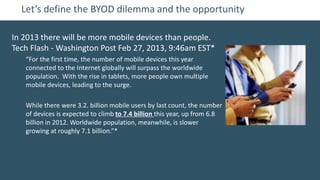
In 2013 there will be more mobile devices than people. 
Tech Flash - Washington Post Feb 27, 2013, 9:46am EST* 
“For the first time, the number of mobile devices this year 
connected to the Internet globally will surpass the worldwide 
population. With the rise in tablets, more people own multiple 
mobile devices, leading to the surge. 
While there were 3.2. billion mobile users by last count, the number 
of devices is expected to climb to 7.4 billion this year, up from 6.8 
billion in 2012. Worldwide population, meanwhile, is slower 
growing at roughly 7.1 billion.”*
Some of the BYOD Driving Factors 
• Single number reach and efficiency 
• Unified applications push integration 
– Single log on 
– One voicemail box 
– Click to dial regardless of device being used 
– Aps should be portal and connect into the Enterprise work flow. 
• Need to be cautious that cellular providers don’t silo the offer. 
• Executing on the promise of interoperability 
– Hardware should migrate 
• Intellectual property issues surrounding use of personal cell phones in the 
enterprise. 
– Case study published featuring major drug company
sipXecs is built for the BYOD reality 
• sipXecs allows the enterprise or institution to 
– We believe… 
– …in building an enterprise on standards like SIP/XMPP/WebRTC 
– …with the backbone SIP/XMPP based applications and end user devices and clients can 
interface easily. 
– …in and will participate in the enormous innovation at the client level, especially on 
mobile and tablet devices. Enter webRTC. 
• We don’t believe, there is a good excuse to not follow the 
standards
sipXecs is built for the BYOD reality 
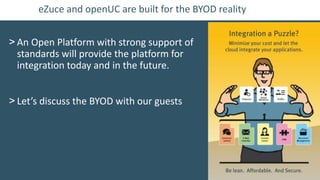
> An Open Platform with strong support of 
standards will provide the platform for 
integration today and in the future. 
> Let’s discuss the BYOD with our guests
Panel Discussion 
Ernesto Calderon – North America Support Manager, Grandstream 
Steve Johnson President - Ingate
GXP1100/1105 
• Single SIP account 
• 4 XML programmable soft 
keys 
• HD audio 
• Single network port 
• Integrated PoE (GXP1105 only) 
Grandstream Networks, Inc.
• 4 lines keys and 4 SIP accounts 
• 24 + 4 BLF hard keys 
• 5-way conferencing 
• HD Audio 
• Electronic Hook Switch Support 
for Plantronics headsets 
• 2 x 10M/100M/1000M 
Ethernet ports with integrated 
PoE, RJ9 headset jack 
Grandstream Networks, Inc. 
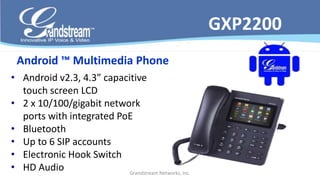
GXP2124v2
• Android v2.3, 4.3” capacitive 
touch screen LCD 
• 2 x 10/100/gigabit network 
ports with integrated PoE 
• Bluetooth 
• Up to 6 SIP accounts 
• Electronic Hook Switch 
• HD Audio 
Grandstream Networks, Inc. 
GXP2200 
Android ™ Multimedia Phone
Grandstream Networks, 
Inc. 
VoIP Product Lines
The SIP trunking enabler 
Solutions for SIP 
We enable SIP communication for business
The State of SIP 
 210 IETF RFCs govern SIP 
 SIP Forum is establishing profiles 
 SIP Trunking – SIPConnect 1.1 
 Video Relay Services 
 User Agents 
 SIP is stable, but 
 Vendors and service providers can still choose how to 
support SIP Trunks 
 Commonality will come in time 
 For now Session Border Controllers can help resolve 
differences
Why does the Enterprise need an SBC 
Interoperability Security Other 
 Normalization of SIP 
 Back to Back User Agent 
allows the SBC to normalize 
signalling 
 Far End NAT Traversal 
 Disaster recovery 
 Quality of Service 
 Encryption 
 Demarcation Point 
 To monitor call quality with MOS 
scores 
 Diagnostics 
 Logging and Wire Shark traces 
 NAT and Firewall traversal 
 To enable placement of the PBX behind the 
firewall 
 Security through deep packet 
inspection 
 To keep the PBX secure 
 Intrusion Detection / Prevention 
 To prevent Denial of Service Attacks 
 Authentication 
 To prevent toll fraud 
The E-SBC puts the enterprise in control of its SIP implementation
Network Installation Options 
16
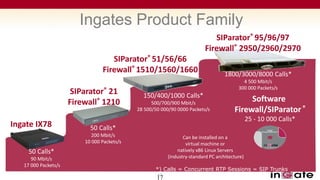
Ingates Product Family 
SIParator® 51/56/66 
Firewall® 1510/1560/1660 
150/400/1000 Calls* 
500/700/900 Mbit/s 
28 500/50 000/90 0000 Packets/s 
*) Calls = Concurrent RTP Sessions = SIP Trunks 
1177 
50 Calls* 
200 Mbit/s 
10 000 Packets/s 
SIParator® 95/96/97 
Firewall® 2950/2960/2970 
1800/3000/8000 Calls* 
4 500 Mbit/s 
300 000 Packets/s 
Software 
Firewall/SIParator ® 
25 - 10 000 Calls* 
Can be installed on a 
virtual machine or 
natively x86 Linux Servers 
(industry-standard PC architecture) 
Ingate IX78 
SIParator® 21 
Firewall® 1210 
50 Calls* 
90 Mbit/s 
17 000 Packets/s
Please contact me at any time: 
Steve Johnson 
President 
Mail & SIP: steve@ingate.com 
Direct: 1-603-883-6569
Panel Discussion 
Questions and answers 
Question 1: A call is being set up between a Grandstream phone and running through an 
Ingate SBC. How does the SIP standard insure that the call will be crystal clear? 
Question 2: Ingate; How easy is it to qualify a SIP trunking provider working with Ingate 
equipment? 
Question 3: Grandstream; Does the Android operating system being built into your phone 
indicate the war is lost and the desk phone is going away? Or is it a complimentary 
evolution? 
Question 4: Audience?
SIPfoundry CoLab 2013 - Solving the Bring Your Own Device BYOD problem with open standards

SIPfoundry CoLab 2013 - Solving the Bring Your Own Device BYOD problem with open standards

  • 1.
    Solving the BYODProblem with Open Standards Session 4: Hosted by John Drolet March 10, 2013 / Bentley Univesity / Boston MA
  • 2.
    Session Title &Abstract; Solving the BYOD Problem with Open Standards Effective adoption of a BYOD policy is driven by an open system and open standards. We will talk about each along with the human element of the BYOD challenge. 2
  • 3.
    Let’s define theBYOD dilemma and the opportunity In 2013 there will be more mobile devices than people. Tech Flash - Washington Post Feb 27, 2013, 9:46am EST* “For the first time, the number of mobile devices this year connected to the Internet globally will surpass the worldwide population. With the rise in tablets, more people own multiple mobile devices, leading to the surge. While there were 3.2. billion mobile users by last count, the number of devices is expected to climb to 7.4 billion this year, up from 6.8 billion in 2012. Worldwide population, meanwhile, is slower growing at roughly 7.1 billion.”*
  • 4.
    Some of theBYOD Driving Factors • Single number reach and efficiency • Unified applications push integration – Single log on – One voicemail box – Click to dial regardless of device being used – Aps should be portal and connect into the Enterprise work flow. • Need to be cautious that cellular providers don’t silo the offer. • Executing on the promise of interoperability – Hardware should migrate • Intellectual property issues surrounding use of personal cell phones in the enterprise. – Case study published featuring major drug company
  • 5.
    sipXecs is builtfor the BYOD reality • sipXecs allows the enterprise or institution to – We believe… – …in building an enterprise on standards like SIP/XMPP/WebRTC – …with the backbone SIP/XMPP based applications and end user devices and clients can interface easily. – …in and will participate in the enormous innovation at the client level, especially on mobile and tablet devices. Enter webRTC. • We don’t believe, there is a good excuse to not follow the standards
  • 6.
    sipXecs is builtfor the BYOD reality > An Open Platform with strong support of standards will provide the platform for integration today and in the future. > Let’s discuss the BYOD with our guests
  • 7.
    Panel Discussion ErnestoCalderon – North America Support Manager, Grandstream Steve Johnson President - Ingate
  • 9.
    GXP1100/1105 • SingleSIP account • 4 XML programmable soft keys • HD audio • Single network port • Integrated PoE (GXP1105 only) Grandstream Networks, Inc.
  • 10.
    • 4 lineskeys and 4 SIP accounts • 24 + 4 BLF hard keys • 5-way conferencing • HD Audio • Electronic Hook Switch Support for Plantronics headsets • 2 x 10M/100M/1000M Ethernet ports with integrated PoE, RJ9 headset jack Grandstream Networks, Inc. GXP2124v2
  • 11.
    • Android v2.3,4.3” capacitive touch screen LCD • 2 x 10/100/gigabit network ports with integrated PoE • Bluetooth • Up to 6 SIP accounts • Electronic Hook Switch • HD Audio Grandstream Networks, Inc. GXP2200 Android ™ Multimedia Phone
  • 12.
    Grandstream Networks, Inc. VoIP Product Lines
  • 13.
    The SIP trunkingenabler Solutions for SIP We enable SIP communication for business
  • 14.
    The State ofSIP  210 IETF RFCs govern SIP  SIP Forum is establishing profiles  SIP Trunking – SIPConnect 1.1  Video Relay Services  User Agents  SIP is stable, but  Vendors and service providers can still choose how to support SIP Trunks  Commonality will come in time  For now Session Border Controllers can help resolve differences
  • 15.
    Why does theEnterprise need an SBC Interoperability Security Other  Normalization of SIP  Back to Back User Agent allows the SBC to normalize signalling  Far End NAT Traversal  Disaster recovery  Quality of Service  Encryption  Demarcation Point  To monitor call quality with MOS scores  Diagnostics  Logging and Wire Shark traces  NAT and Firewall traversal  To enable placement of the PBX behind the firewall  Security through deep packet inspection  To keep the PBX secure  Intrusion Detection / Prevention  To prevent Denial of Service Attacks  Authentication  To prevent toll fraud The E-SBC puts the enterprise in control of its SIP implementation
  • 16.
  • 17.
    Ingates Product Family SIParator® 51/56/66 Firewall® 1510/1560/1660 150/400/1000 Calls* 500/700/900 Mbit/s 28 500/50 000/90 0000 Packets/s *) Calls = Concurrent RTP Sessions = SIP Trunks 1177 50 Calls* 200 Mbit/s 10 000 Packets/s SIParator® 95/96/97 Firewall® 2950/2960/2970 1800/3000/8000 Calls* 4 500 Mbit/s 300 000 Packets/s Software Firewall/SIParator ® 25 - 10 000 Calls* Can be installed on a virtual machine or natively x86 Linux Servers (industry-standard PC architecture) Ingate IX78 SIParator® 21 Firewall® 1210 50 Calls* 90 Mbit/s 17 000 Packets/s
  • 18.
    Please contact meat any time: Steve Johnson President Mail & SIP: steve@ingate.com Direct: 1-603-883-6569
  • 19.
    Panel Discussion Questionsand answers Question 1: A call is being set up between a Grandstream phone and running through an Ingate SBC. How does the SIP standard insure that the call will be crystal clear? Question 2: Ingate; How easy is it to qualify a SIP trunking provider working with Ingate equipment? Question 3: Grandstream; Does the Android operating system being built into your phone indicate the war is lost and the desk phone is going away? Or is it a complimentary evolution? Question 4: Audience?