Kostas Kalogirou CE.R.T.H./Hellenic Institute of Transport Greece Java User Interface Libraries for Developing Mobile Applications
Rapid development of mobile devices Many and different target groups use mobile devices Many Java User Interface libraries exist User interaction Accessibility issues Motivation, Problem area
AEGIS target groups: Visual impairment users   Motor impairment users Cognitive impairment users   Hearing impairment users Speech / Communication impairment users AEGIS target groups
Paper objectives: To present these tools and give tips to the development community  Whether it is possible to use, modify, extend or adapt some of the capabilities and features of these Java libraries.  Keep in mind:  Accessibility and Assistive Technology support How these libraries may be used to support accessibility to any type of new applications. Describe the specifications of existing different type of mobile user interface libraries and take into account sound, graphics and specific OS features such as memory and CPU speed.  Objectives
Divided into: Open source and GPL/LGPL libraries   Third part libraries   JSRs and other UI libraries   Java U.I. libraries
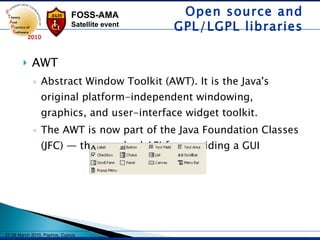
AWT Abstract Window Toolkit (AWT). It is the Java's original platform-independent windowing, graphics, and user-interface widget toolkit.  The AWT is now part of the Java Foundation Classes (JFC) — the standard API for providing a GUI Open source and GPL/LGPL libraries
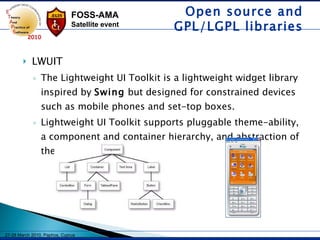
LWUIT The Lightweight UI Toolkit is a lightweight widget library inspired by  Swing  but designed for constrained devices such as mobile phones and set-top boxes.  Lightweight UI Toolkit supports pluggable theme-ability, a component and container hierarchy, and abstraction of the underlying GUI toolkit.   Open source and GPL/LGPL libraries
LwVCL JSE LwVCL: for desktop JME Personal Profile (Personal Java) LwVCL: for PDAs. .NET LwVCL: This version has the same JSE LwVCL capabilities. SWT LwVCL JME MIDP LwVCL Use it for the resources limited devices. This version is under development now.  Open source and GPL/LGPL libraries
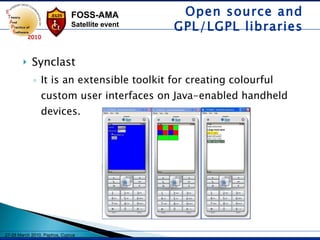
Synclast It is an extensible toolkit for creating colourful custom user interfaces on Java-enabled handheld devices.   Open source and GPL/LGPL libraries
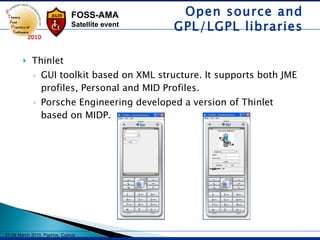
Thinlet GUI toolkit based on XML structure. It supports both JME profiles, Personal and MID Profiles.  Porsche Engineering developed a version of Thinlet based on MIDP. Open source and GPL/LGPL libraries
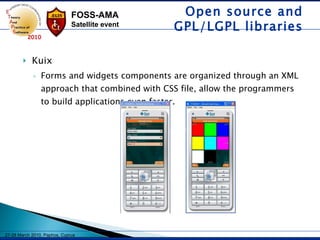
Kuix Forms and widgets components are organized through an XML approach that combined with CSS file, allow the programmers to build applications even faster.  Open source and GPL/LGPL libraries
MWT (Micro Window Toolkit) It is inspired by its UI big brothers as AWT, Swing and SWT, MWT comes into the scene providing an UI framework designed and optimized for small devices.  Swing ME   A Java ME  implementation of Swing GUI, with Layouts, Borders, Renderers and lots of components including inline TextField, Buttons, Window, TabbedPane and many others. Open source and GPL/LGPL libraries
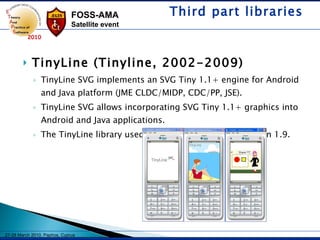
TinyLine (Tinyline, 2002-2009) TinyLine SVG implements an SVG Tiny 1.1+ engine for Android and Java platform (JME CLDC/MIDP, CDC/PP, JSE).  TinyLine SVG allows incorporating SVG Tiny 1.1+ graphics into Android and Java applications. The TinyLine library used to be free for JME until version 1.9.  Third part libraries
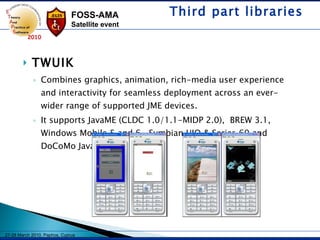
TWUIK Combines graphics, animation, rich-media user experience and interactivity for seamless deployment across an ever-wider range of supported JME devices.  It supports JavaME (CLDC 1.0/1.1-MIDP 2.0),  BREW 3.1, Windows Mobile 5 and 6 , Symbian UIQ & Series 60 and DoCoMo Java 4.x & 5.x. Third part libraries
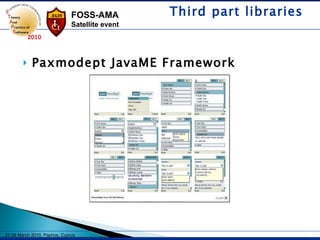
Paxmodept JavaME Framework Third part libraries
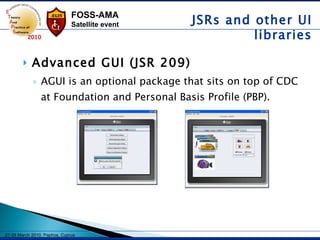
Advanced GUI (JSR 209) AGUI is an optional package that sits on top of CDC at Foundation and Personal Basis Profile (PBP).  JSRs and other UI libraries
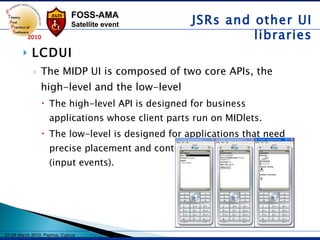
LCDUI The MIDP UI is composed of two core APIs, the high-level and the low-level   The high-level API is designed for business applications whose client parts run on MIDlets.  The low-level is designed for applications that need precise placement and control of graphic elements (input events). JSRs and other UI libraries
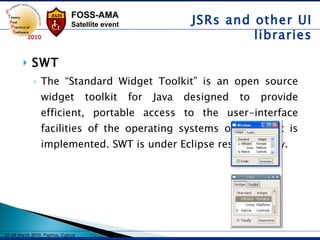
SWT The “Standard Widget Toolkit” is an open source widget toolkit for Java designed to provide efficient, portable access to the user-interface facilities of the operating systems on which it is implemented. SWT is under Eclipse responsibility.  JSRs and other UI libraries
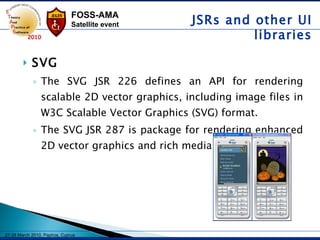
SVG The SVG JSR 226 defines an API for rendering scalable 2D vector graphics, including image files in W3C Scalable Vector Graphics (SVG) format.  The SVG JSR 287 is package for rendering enhanced 2D vector graphics and rich media content JSRs and other UI libraries
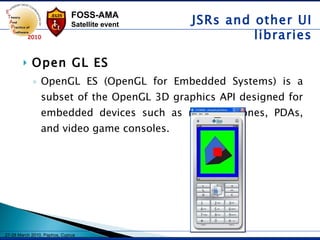
Open GL ES OpenGL ES (OpenGL for Embedded Systems) is a subset of the OpenGL 3D graphics API designed for embedded devices such as mobile phones, PDAs, and video game consoles. JSRs and other UI libraries
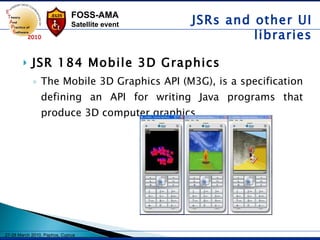
JSR 184 Mobile 3D Graphics The Mobile 3D Graphics API (M3G), is a specification defining an API for writing Java programs that produce 3D computer graphics.   JSRs and other UI libraries
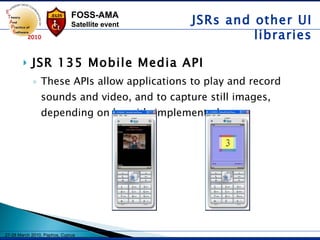
JSR 135 Mobile Media API These APIs allow applications to play and record sounds and video, and to capture still images, depending on how it's implemented.  JSRs and other UI libraries
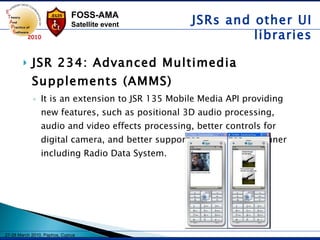
JSR 234: Advanced Multimedia Supplements (AMMS) It is an extension to JSR 135 Mobile Media API providing new features, such as positional 3D audio processing, audio and video effects processing, better controls for digital camera, and better support for analog radio tuner including Radio Data System.   JSRs and other UI libraries
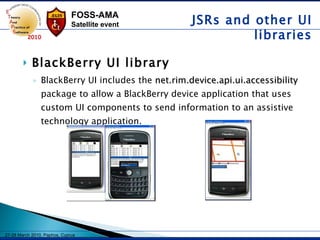
BlackBerry UI library BlackBerry UI includes the  net.rim.device.api.ui.accessibility  package to allow a BlackBerry device application that uses custom UI components to send information to an assistive technology application.  JSRs and other UI libraries
Java Speech API 2.0 (JSR 113) The Java Speech API allows you to incorporate speech technology into user interfaces for your applets and applications based on Java technology   Third part implementations FreeTTS  JSRs and other UI libraries
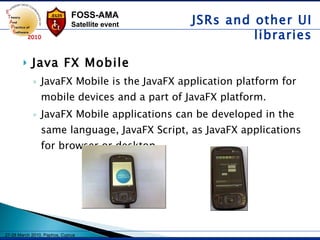
Java FX Mobile JavaFX Mobile is the JavaFX application platform for mobile devices and a part of JavaFX platform.  JavaFX Mobile applications can be developed in the same language, JavaFX Script, as JavaFX applications for browser or desktop,  JSRs and other UI libraries
Conclusions Analysis of existing UI libraries for JME platform including both CLDC and CDC configurations.   The specifications JME different type of mobile user interface libraries and take into account sound, graphics and specific OS features such as memory and CPU speed.  They should be examined further in order to provide accessibility to AEGIS user target groups. Conclusions

11 Java User Interface Libraries for Developing Mobile Applications

  • 1.
    Kostas Kalogirou CE.R.T.H./HellenicInstitute of Transport Greece Java User Interface Libraries for Developing Mobile Applications
  • 2.
    Rapid development ofmobile devices Many and different target groups use mobile devices Many Java User Interface libraries exist User interaction Accessibility issues Motivation, Problem area
  • 3.
    AEGIS target groups:Visual impairment users Motor impairment users Cognitive impairment users Hearing impairment users Speech / Communication impairment users AEGIS target groups
  • 4.
    Paper objectives: Topresent these tools and give tips to the development community Whether it is possible to use, modify, extend or adapt some of the capabilities and features of these Java libraries. Keep in mind: Accessibility and Assistive Technology support How these libraries may be used to support accessibility to any type of new applications. Describe the specifications of existing different type of mobile user interface libraries and take into account sound, graphics and specific OS features such as memory and CPU speed. Objectives
  • 5.
    Divided into: Opensource and GPL/LGPL libraries Third part libraries JSRs and other UI libraries Java U.I. libraries
  • 6.
    AWT Abstract WindowToolkit (AWT). It is the Java's original platform-independent windowing, graphics, and user-interface widget toolkit. The AWT is now part of the Java Foundation Classes (JFC) — the standard API for providing a GUI Open source and GPL/LGPL libraries
  • 7.
    LWUIT The LightweightUI Toolkit is a lightweight widget library inspired by Swing but designed for constrained devices such as mobile phones and set-top boxes. Lightweight UI Toolkit supports pluggable theme-ability, a component and container hierarchy, and abstraction of the underlying GUI toolkit. Open source and GPL/LGPL libraries
  • 8.
    LwVCL JSE LwVCL:for desktop JME Personal Profile (Personal Java) LwVCL: for PDAs. .NET LwVCL: This version has the same JSE LwVCL capabilities. SWT LwVCL JME MIDP LwVCL Use it for the resources limited devices. This version is under development now. Open source and GPL/LGPL libraries
  • 9.
    Synclast It isan extensible toolkit for creating colourful custom user interfaces on Java-enabled handheld devices. Open source and GPL/LGPL libraries
  • 10.
    Thinlet GUI toolkitbased on XML structure. It supports both JME profiles, Personal and MID Profiles. Porsche Engineering developed a version of Thinlet based on MIDP. Open source and GPL/LGPL libraries
  • 11.
    Kuix Forms andwidgets components are organized through an XML approach that combined with CSS file, allow the programmers to build applications even faster. Open source and GPL/LGPL libraries
  • 12.
    MWT (Micro WindowToolkit) It is inspired by its UI big brothers as AWT, Swing and SWT, MWT comes into the scene providing an UI framework designed and optimized for small devices. Swing ME A Java ME implementation of Swing GUI, with Layouts, Borders, Renderers and lots of components including inline TextField, Buttons, Window, TabbedPane and many others. Open source and GPL/LGPL libraries
  • 13.
    TinyLine (Tinyline, 2002-2009)TinyLine SVG implements an SVG Tiny 1.1+ engine for Android and Java platform (JME CLDC/MIDP, CDC/PP, JSE). TinyLine SVG allows incorporating SVG Tiny 1.1+ graphics into Android and Java applications. The TinyLine library used to be free for JME until version 1.9. Third part libraries
  • 14.
    TWUIK Combines graphics,animation, rich-media user experience and interactivity for seamless deployment across an ever-wider range of supported JME devices. It supports JavaME (CLDC 1.0/1.1-MIDP 2.0), BREW 3.1, Windows Mobile 5 and 6 , Symbian UIQ & Series 60 and DoCoMo Java 4.x & 5.x. Third part libraries
  • 15.
    Paxmodept JavaME FrameworkThird part libraries
  • 16.
    Advanced GUI (JSR209) AGUI is an optional package that sits on top of CDC at Foundation and Personal Basis Profile (PBP). JSRs and other UI libraries
  • 17.
    LCDUI The MIDPUI is composed of two core APIs, the high-level and the low-level The high-level API is designed for business applications whose client parts run on MIDlets. The low-level is designed for applications that need precise placement and control of graphic elements (input events). JSRs and other UI libraries
  • 18.
    SWT The “StandardWidget Toolkit” is an open source widget toolkit for Java designed to provide efficient, portable access to the user-interface facilities of the operating systems on which it is implemented. SWT is under Eclipse responsibility. JSRs and other UI libraries
  • 19.
    SVG The SVGJSR 226 defines an API for rendering scalable 2D vector graphics, including image files in W3C Scalable Vector Graphics (SVG) format. The SVG JSR 287 is package for rendering enhanced 2D vector graphics and rich media content JSRs and other UI libraries
  • 20.
    Open GL ESOpenGL ES (OpenGL for Embedded Systems) is a subset of the OpenGL 3D graphics API designed for embedded devices such as mobile phones, PDAs, and video game consoles. JSRs and other UI libraries
  • 21.
    JSR 184 Mobile3D Graphics The Mobile 3D Graphics API (M3G), is a specification defining an API for writing Java programs that produce 3D computer graphics. JSRs and other UI libraries
  • 22.
    JSR 135 MobileMedia API These APIs allow applications to play and record sounds and video, and to capture still images, depending on how it's implemented. JSRs and other UI libraries
  • 23.
    JSR 234: AdvancedMultimedia Supplements (AMMS) It is an extension to JSR 135 Mobile Media API providing new features, such as positional 3D audio processing, audio and video effects processing, better controls for digital camera, and better support for analog radio tuner including Radio Data System. JSRs and other UI libraries
  • 24.
    BlackBerry UI libraryBlackBerry UI includes the net.rim.device.api.ui.accessibility package to allow a BlackBerry device application that uses custom UI components to send information to an assistive technology application. JSRs and other UI libraries
  • 25.
    Java Speech API2.0 (JSR 113) The Java Speech API allows you to incorporate speech technology into user interfaces for your applets and applications based on Java technology Third part implementations FreeTTS JSRs and other UI libraries
  • 26.
    Java FX MobileJavaFX Mobile is the JavaFX application platform for mobile devices and a part of JavaFX platform. JavaFX Mobile applications can be developed in the same language, JavaFX Script, as JavaFX applications for browser or desktop, JSRs and other UI libraries
  • 27.
    Conclusions Analysis ofexisting UI libraries for JME platform including both CLDC and CDC configurations. The specifications JME different type of mobile user interface libraries and take into account sound, graphics and specific OS features such as memory and CPU speed. They should be examined further in order to provide accessibility to AEGIS user target groups. Conclusions