REPAIR
By
Shatha al sulh
Repair by regeneration
• Replacement of the damaged tissue by tissues of the same
type.
• Cells capable of regeneration: labile & stable ( not the
permanent ).
• Examples of regeneration::
of epidermis:
• Abrasion: superficial injury complete
regeneration.
• Skin wound: injury of epid. & dermis
epidermal regeneration but dermal fibrosis.
Of mucous membranes of GIT & UT.
Healing of bone fracture
• Healing of bone (≥ 4w) may be so perfect
that the fracture site may not be identified.
• Michanism:
• Stage 1: hematoma.
• Stage 2: inflammatory exudate (traumatic
inflammation).
• Stage 3: demolition (phagocytosis by
macrophages & osteoclast with gradual
removal of damaged bone fragments, blood
& inflammatory cells & release of GF).
• Stage 4: granulation tissue formation
(procallus ): consists of capillary loops &
msenchymal cells.
Fracture bone hematoma
Healing of bone fracture (cont.)
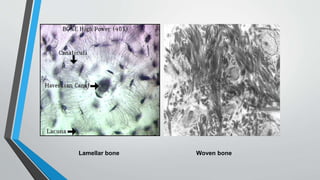
• Stage 5:woven bone & cartilage (provisional callus):
• Chondroblast cartilage islands.
• Osteoblast osteoid tissue (bone matrix+collagen) lacking calcification.
• Gradual loss of capillaries.
• Gradual calcification of osteoid tissue (by ALP) woven bone.
• Stage 6:formation of lamellar bone (permanent callus): cartilage desentigration
& woven bone replacement by lamellar bone ( osteoclasts) Haversian
system formation.
• Stage 7:remodeling of callus:
• Removal of internal & external callus (by osteoclasts).
• Adjustment of intermediate callus (size, strength & lamellar property) by
osteoblasts & osteoclasts , in response to mechanical stress along lines of wt.
bearing.
• BM regenerates inside the medullary canal.
Woven boneLamellar bone
Causes of defective bone healing
(nonunion,weak union or pseudoarthrosis)
• Local factors:
• Inadequate immobilization.
• Malalignment.
• Pathological fracture.
• Soft tissue interposition.
• Ischemia.
• Infection.
• General factors:
• Old age.
• Nutritional deficiencies.
• Glucocorticoid therapy.
• DM.
Healing of damage to nervous system:
Injury of perepheral nerve:
• regenerated as the nerve cells are preserved.
• Michanism of regeneration of PN cut:
• Nerve injury leads to :
• Axonal degeneration of nerve cells (swollen, eccentric neuclei & loss Nissel
granules)
• Wallarian degeneration: disintegration of myelin & axis cylinder (proximal &
distal).
• Schwann cells:
• Resist injury, phagocytosis of Wallarian degeneration products (with
macrophages), proliferate (distal & proximal) integrated neurilemmal
tube.
Healing of damage to nervous system (
cont.):
• Growth of axis cylinders (secreated by alive nerve cells)inside
integrated neurilemmal tube (1mm/d),
• Myelin sheath formation around the growing axons (final stage)
Traumatic neuroma:
• Complication of nerve healing.
• Painful mass.
• If the 2 ends of the nerve are not opposite each other or if the nerve is severed
(absent distal segment).
• Proliferating Schwann cells & neurofilaments mix.
Healing of damage to nervous system (
cont.):
Damage of CNS:
• Damage of nerve cells (in brain & spinal cord).
• Can never be regenerated (nerve cells can not divide).
• Repair:
• Phagocytosis of dead tissue (macrophages & microglia
cells).
• Lay down special type of CT by astrocytes (gliosis).

4 2-repair 2nd

  • 1.
  • 2.
    Repair by regeneration •Replacement of the damaged tissue by tissues of the same type. • Cells capable of regeneration: labile & stable ( not the permanent ). • Examples of regeneration:: of epidermis: • Abrasion: superficial injury complete regeneration. • Skin wound: injury of epid. & dermis epidermal regeneration but dermal fibrosis. Of mucous membranes of GIT & UT.
  • 3.
    Healing of bonefracture • Healing of bone (≥ 4w) may be so perfect that the fracture site may not be identified. • Michanism: • Stage 1: hematoma. • Stage 2: inflammatory exudate (traumatic inflammation). • Stage 3: demolition (phagocytosis by macrophages & osteoclast with gradual removal of damaged bone fragments, blood & inflammatory cells & release of GF). • Stage 4: granulation tissue formation (procallus ): consists of capillary loops & msenchymal cells. Fracture bone hematoma
  • 4.
    Healing of bonefracture (cont.) • Stage 5:woven bone & cartilage (provisional callus): • Chondroblast cartilage islands. • Osteoblast osteoid tissue (bone matrix+collagen) lacking calcification. • Gradual loss of capillaries. • Gradual calcification of osteoid tissue (by ALP) woven bone. • Stage 6:formation of lamellar bone (permanent callus): cartilage desentigration & woven bone replacement by lamellar bone ( osteoclasts) Haversian system formation. • Stage 7:remodeling of callus: • Removal of internal & external callus (by osteoclasts). • Adjustment of intermediate callus (size, strength & lamellar property) by osteoblasts & osteoclasts , in response to mechanical stress along lines of wt. bearing. • BM regenerates inside the medullary canal.
  • 5.
  • 6.
    Causes of defectivebone healing (nonunion,weak union or pseudoarthrosis) • Local factors: • Inadequate immobilization. • Malalignment. • Pathological fracture. • Soft tissue interposition. • Ischemia. • Infection. • General factors: • Old age. • Nutritional deficiencies. • Glucocorticoid therapy. • DM.
  • 7.
    Healing of damageto nervous system: Injury of perepheral nerve: • regenerated as the nerve cells are preserved. • Michanism of regeneration of PN cut: • Nerve injury leads to : • Axonal degeneration of nerve cells (swollen, eccentric neuclei & loss Nissel granules) • Wallarian degeneration: disintegration of myelin & axis cylinder (proximal & distal). • Schwann cells: • Resist injury, phagocytosis of Wallarian degeneration products (with macrophages), proliferate (distal & proximal) integrated neurilemmal tube.
  • 8.
    Healing of damageto nervous system ( cont.): • Growth of axis cylinders (secreated by alive nerve cells)inside integrated neurilemmal tube (1mm/d), • Myelin sheath formation around the growing axons (final stage) Traumatic neuroma: • Complication of nerve healing. • Painful mass. • If the 2 ends of the nerve are not opposite each other or if the nerve is severed (absent distal segment). • Proliferating Schwann cells & neurofilaments mix.
  • 10.
    Healing of damageto nervous system ( cont.): Damage of CNS: • Damage of nerve cells (in brain & spinal cord). • Can never be regenerated (nerve cells can not divide). • Repair: • Phagocytosis of dead tissue (macrophages & microglia cells). • Lay down special type of CT by astrocytes (gliosis).