“...The period of humanity’s manhood will, I
doubt not, be a scientific period—a period
that will witness the gradual extension of
scientific method to all the interests of
mankind—a period in which man will
discover the essential nature of man and
establish, at length, the science and art of
directing human energies and human
capacities to the advancement of human weal
in accordance with the laws of human
nature.”
— Manhood of Humanity, pp. 44-45
Bucky Fuller Utopia &
Oblivion
H.G. Wells
Humanity is in a race
between education and
catastrophe
“Our rulers: politicians, ‘diplomats', bankers, priests of every
description, economists, lawyers, etc., and the majority of teachers
remain at present largely or entirely ignorant of modern science,
scientific methods,...of 1933, and they also lack an essential historical
and anthropological background, without which a sane orientation is
impossible. This ignorance is often willful as they mostly refuse, with
various excuses, to read modern works dealing with such problems. As a
result a conflict is created and maintained between the advance of
science affecting conditions of actual life and the orientations of our
rulers, which often remain antiquated by centuries, or one or two
thousand years. The present world conditions are in chaos; psycho-
logically there exists a state of helplessness—hopelessness, often
resulting in the feelings of insecurity, bitterness, etc ., and we have lately
witnessed psychopathological mass outbursts, similar to those of the
dark ages. Few of us at present realize that, as long as such ignorance of
our rulers prevails, no solution of our human problems is possible.”
— Alfred Korzybski, “Preface to the First Edition”, Science and Sanity
(1933)
“Science is the active and creative engagement
of our minds with nature in an attempt to
understand. ...”
— Gregory N. Derry
If we and our own
activities,
including science,
are part of nature,
then we can also
engage our minds
scientifically in an
attempt to
understand science.
Exactly what AK was interested in
studying science
Advances in physico-mathematical
sciences, basic and applied
(exemplary time-binding)
held a key,
key to understanding the basic
mechanism of time-binding
Understand that t-b mech more
clearly could be applied
to develop teachable evaluational
tools—heuristics—allowing us to
better time-bind in other areas of
life besides the traditional one of
‘science’
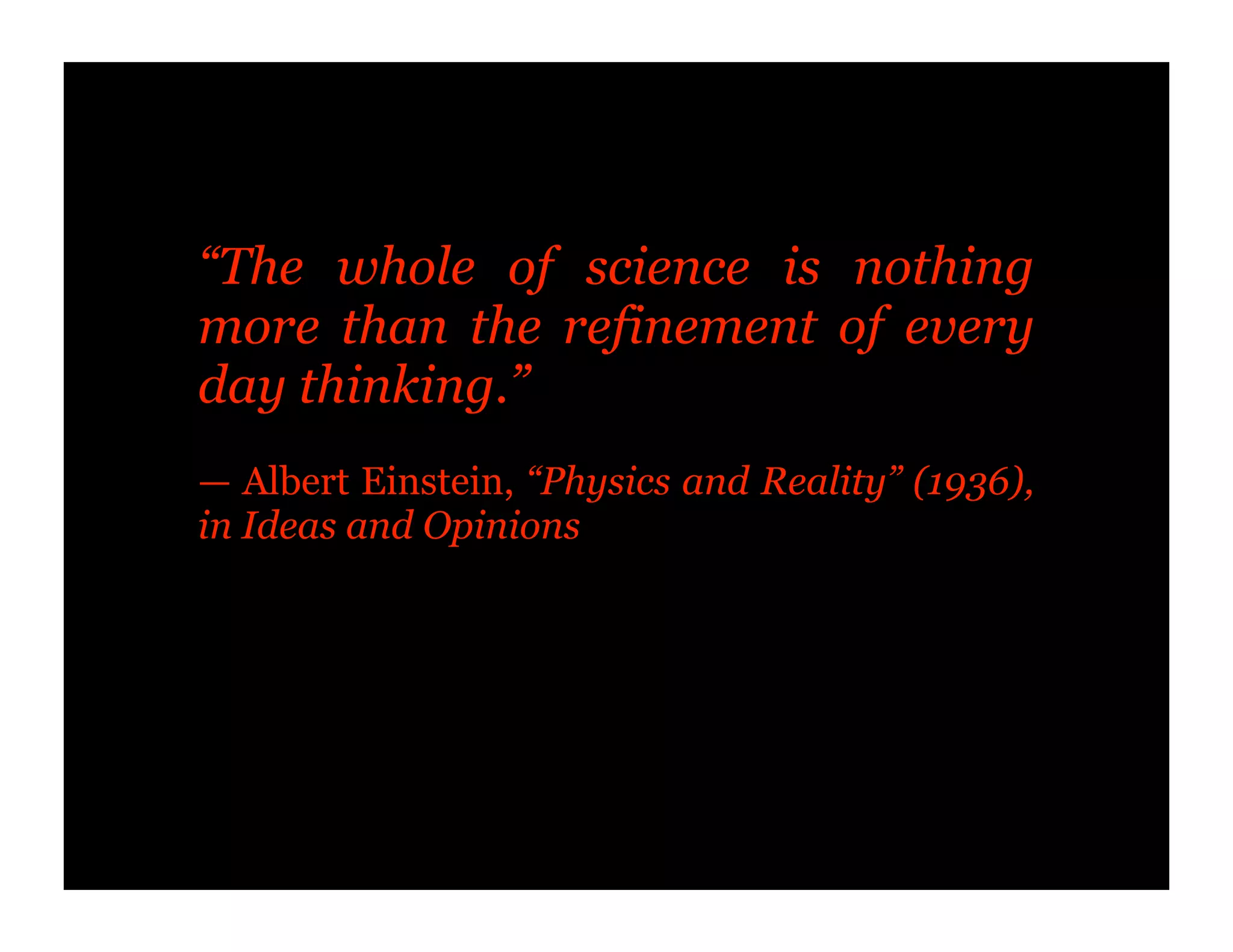
“The whole of science is nothing
more than the refinement of every
day thinking.”
— Albert Einstein, “Physics and Reality” (1936),
in Ideas and Opinions
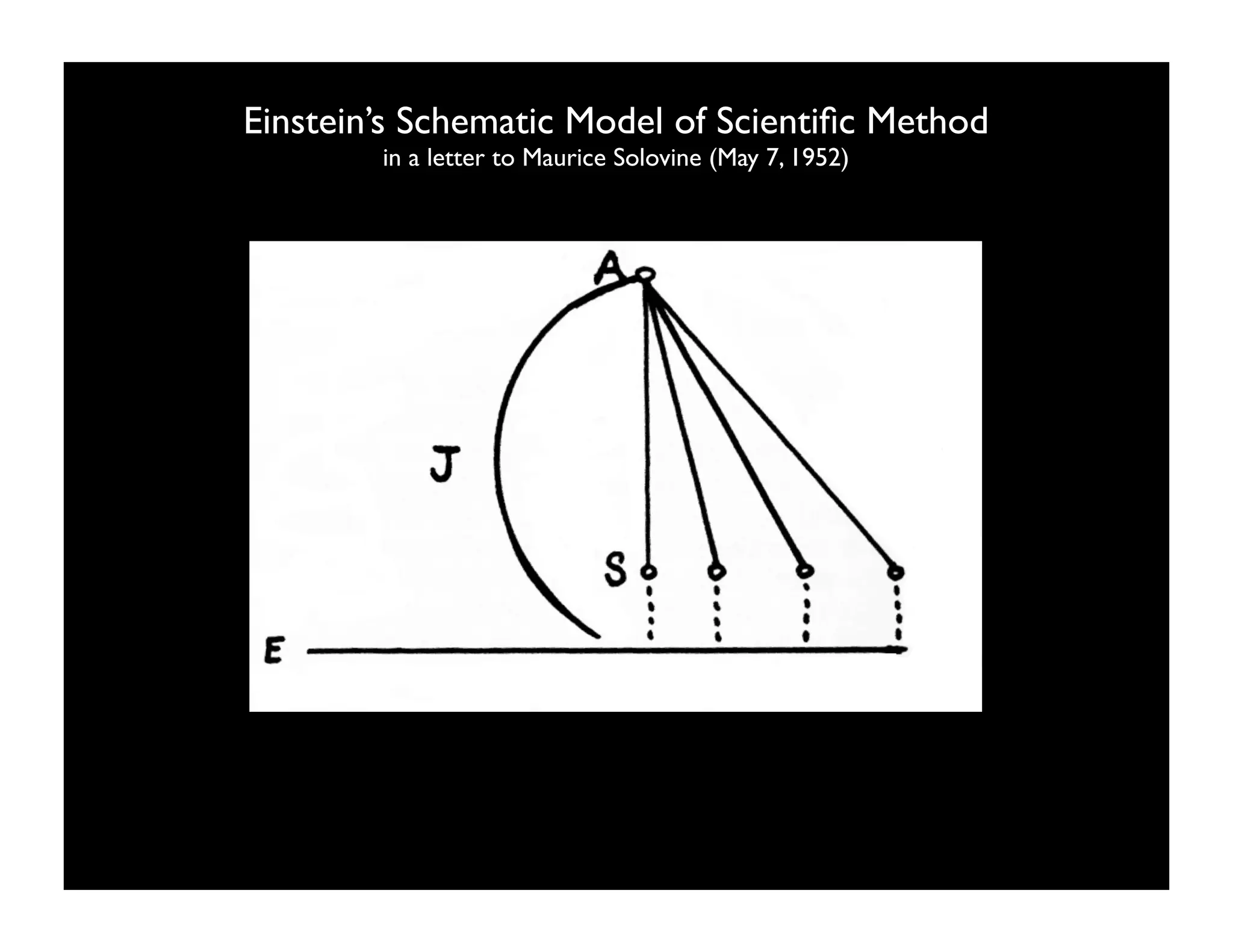
Einstein’s Schematic Model of Scientific Method
in a letter to Maurice Solovine (May 7, 1952)
in modern scientific methods we can find
“...in modern scientific methods we can
find factors of sanity, to be tested
empirically.”
—Alfred Korzybski, “Introduction to the Second Edition,
1941”, Science and Sanity
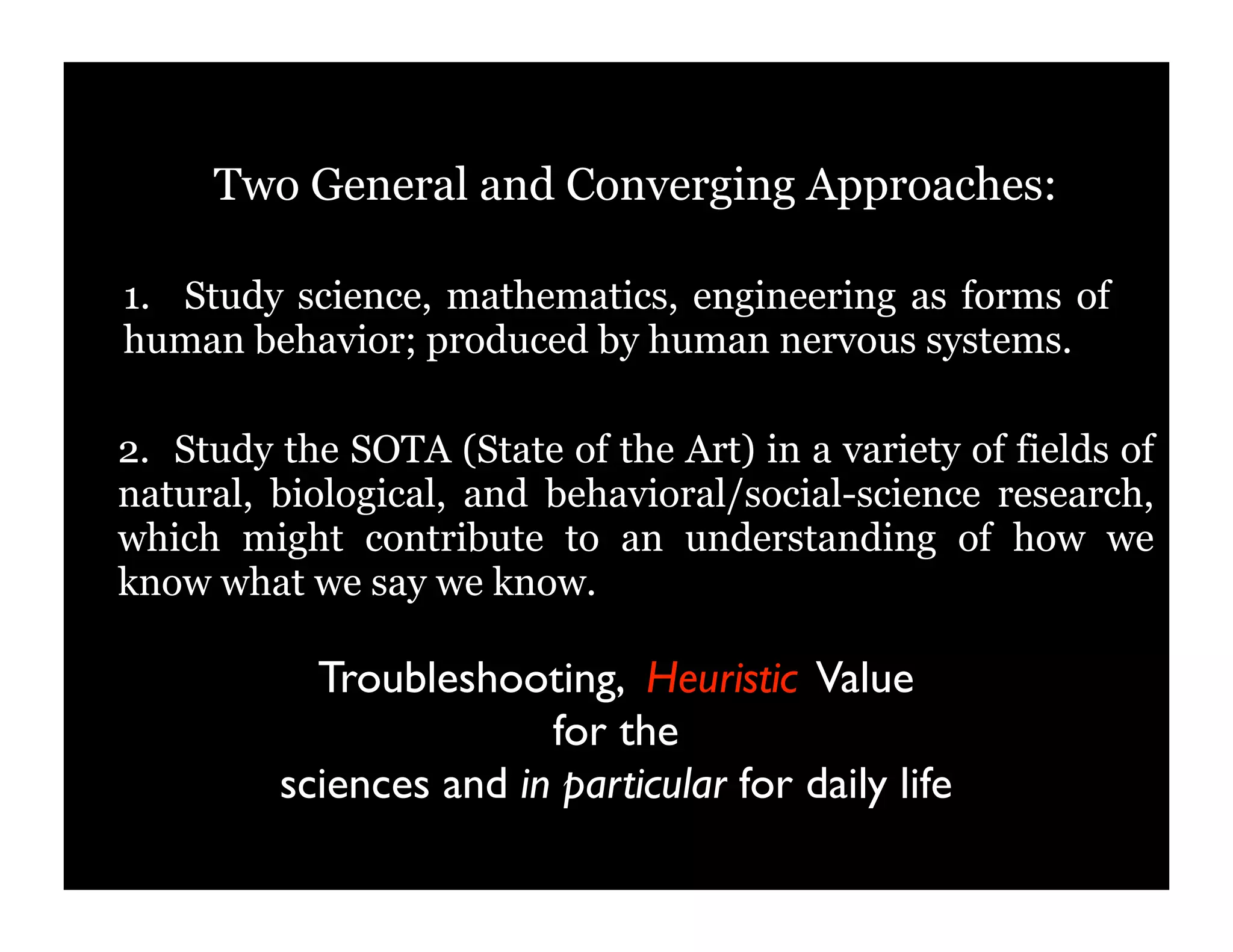
Two General and Converging Approaches:
2. Study the SOTA (State of the Art) in a variety of fields of
natural, biological, and behavioral/social-science research,
which might contribute to an understanding of how we
know what we say we know.
1. Study science, mathematics, engineering as forms of
human behavior; produced by human nervous systems.
Troubleshooting, Heuristic Value
for the
sciences and in particular for daily life
“...anything that provides a plausible aid or direction in the solution
of a problem but is in the final analysis...potentially fallible.” *
Heuristic
“rule of thumb”
“intuition”
“technique”
“hint”
“rule of craft”
“guiding thread”
“working basis”
“guiding principles”
etc.**
* BillyVaughn Koen - Discussion of the Method, p. 28,
** Ibid, p. 32
Method
“[T]he engineering method, is the use of heuristics
to cause the best change in a poorly understood
situation within the available resources.”
— BillyVaughn Koen
“All is heuristic.”
*BillyVaughn Koen - Discussion of the Method (2003), pp. 7, 111
“To be human is to be an engineer.”
“[General Semantics] is based on a new world outlook...We
have made a methodological summary of what we know
practically in every field, without going into details of it. I had
to extract the method and ‘all’ I teach you is scientific
method...It takes infernal work to do so, and without time-
binding...I could not have produced general semantics,
which is method, method, and nothing but.”
— Alfred Korzybski,
Winter Intensive Seminar (1948-1949)
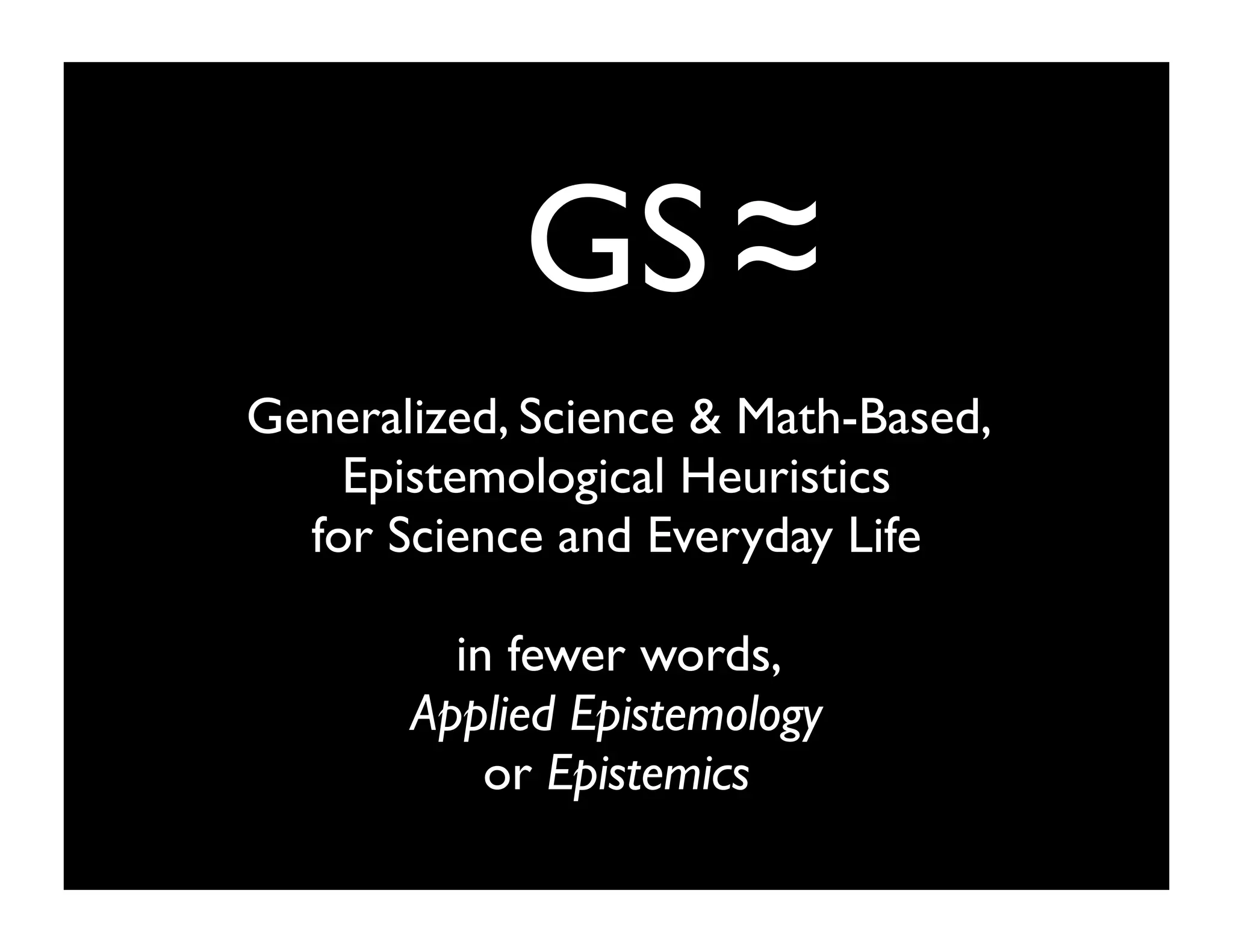
GS
Generalized, Science & Math-Based,
Epistemological Heuristics
for Science and Everyday Life
in fewer words,
Applied Epistemology
or Epistemics
~
~
Two major heuristics that
Korzybski used as he began his
survey of science (optimal time-
binding) to improve and clarify
scientific methods for broader
use:
Observer – Observed
Relation
Logical Fate
To study and improve methods
(heuristics), you need some
methods (heuristics) to start with.
Cassius J. Keyser
“Logical Fate”
“Logical Fate”
...it is in the world of ideas and only there that
human beings as human may find principles or bases for
rational theories and rational conduct of life, whether
individual life or community life; choices differ but some
choice of principle we must make if we are to be really human
—if, that is, we are to be rational— and when we have made it,
we are at once bound by a destiny of consequences beyond
the power of passion or will to control or modify; another
choice of principles is but the election of another destiny.
The world of ideas is, you see, the empire of Fate.
Mathematical Philosophy: A Study of Fate and Freedom (1922), p. 5
Korzybski’s 1922 Diagram of “Logical Destiny”
‘Logical’ Fate*
* Psycho-logical Fate
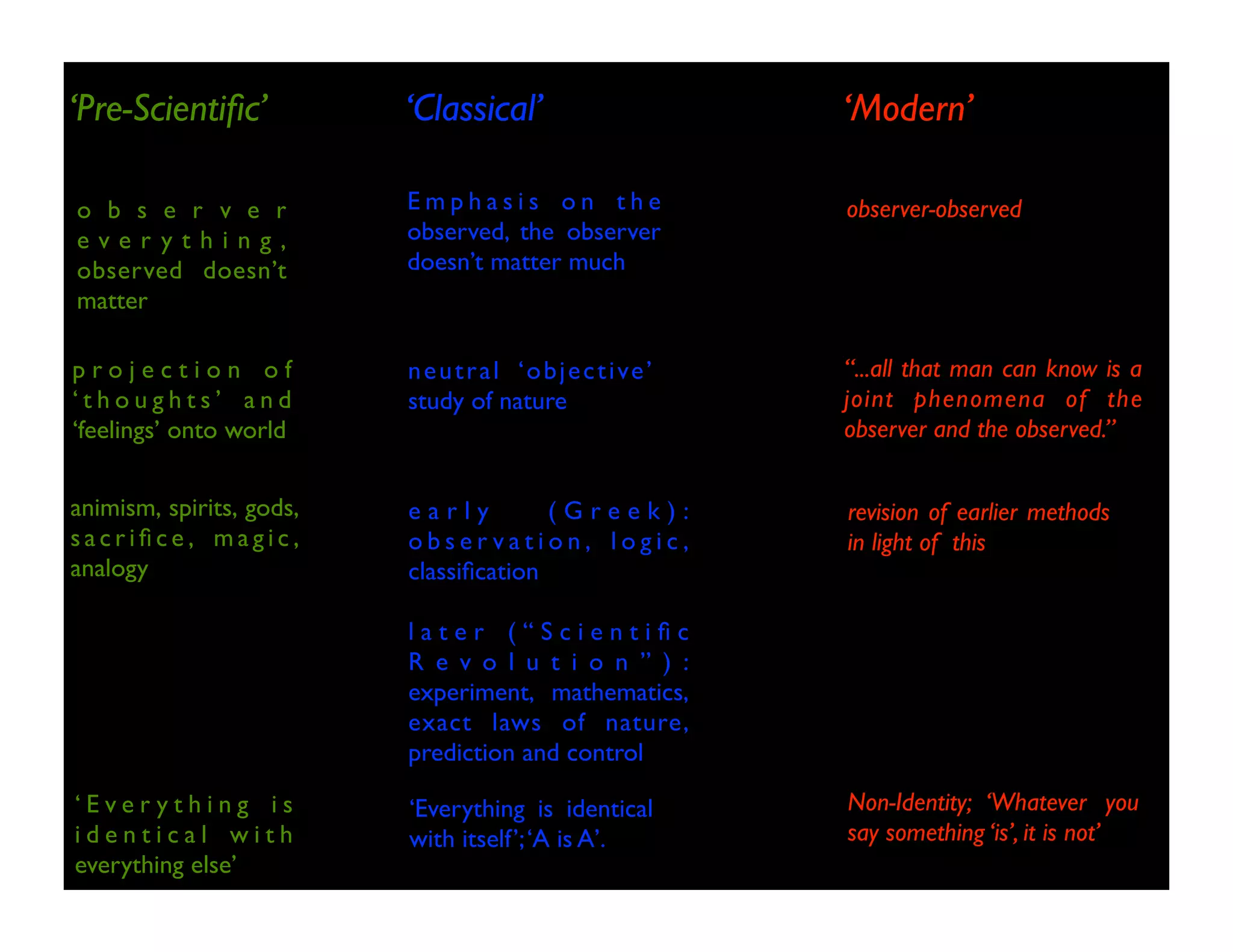
“...all that man can know is a joint phenomena of
the observer and the observed.”
‘Pre-Scientific’
o b s e r v e r
e v e r y t h i n g ,
observed doesn’t
matter
p r o j e c t i o n o f
‘ t h o u g h t s ’ a n d
‘feelings’ onto world
animism, spirits, gods,
s a c r i fi c e , m a g i c ,
analogy
‘Classical’
E m p h a s i s o n t h e
observed, the observer
doesn’t matter much
neutral ‘objective’
study of nature
e a r l y ( G r e e k ) :
o b s e r v a t i o n , l o g i c ,
classification
l a t e r ( “ S c i e n t i fi c
R e v o l u t i o n ” ) :
experiment, mathematics,
exact laws of nature,
prediction and control
‘Modern’
observer-observed
“...all that man can know is a
joint phenomena of the
observer and the observed.”
revision of earlier methods
in light of this
‘ E v e r y t h i n g i s
i d e n t i c a l w i t h
everything else’
‘Everything is identical
with itself’;‘A is A’.
Non-Identity; ‘Whatever you
say something ‘is’, it is not’
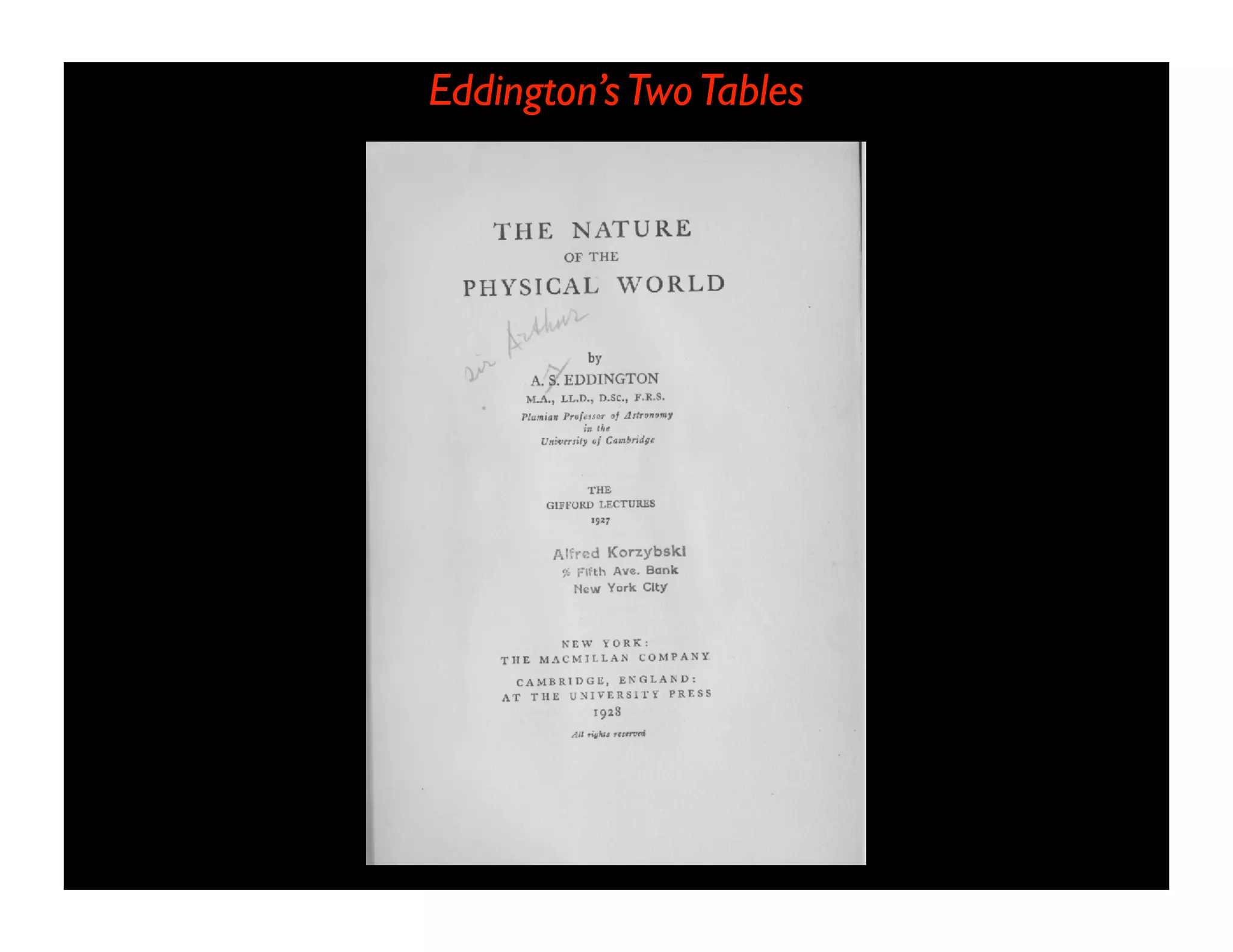
Eddington’sTwoTables
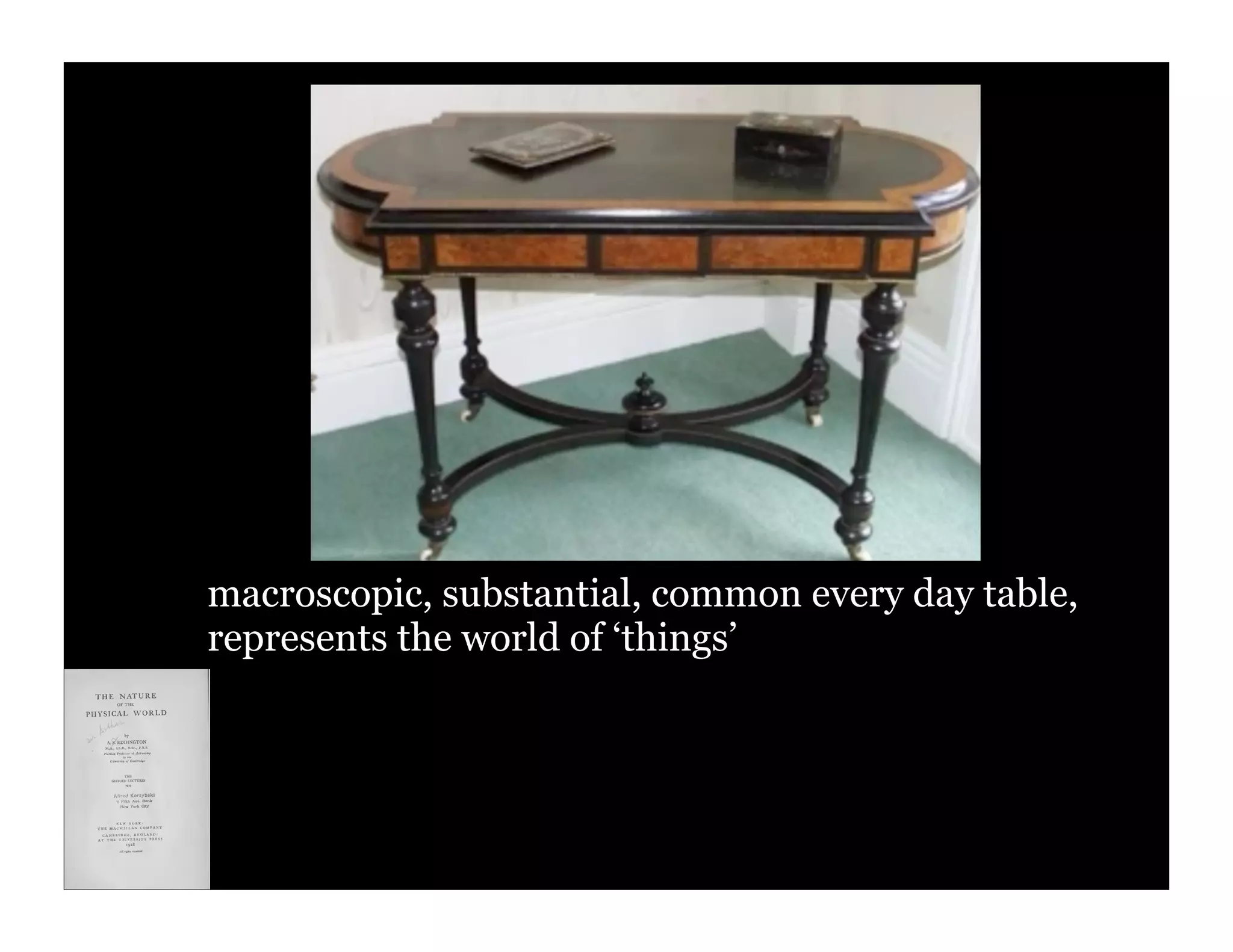
macroscopic, substantial, common every day table,
represents the world of ‘things’
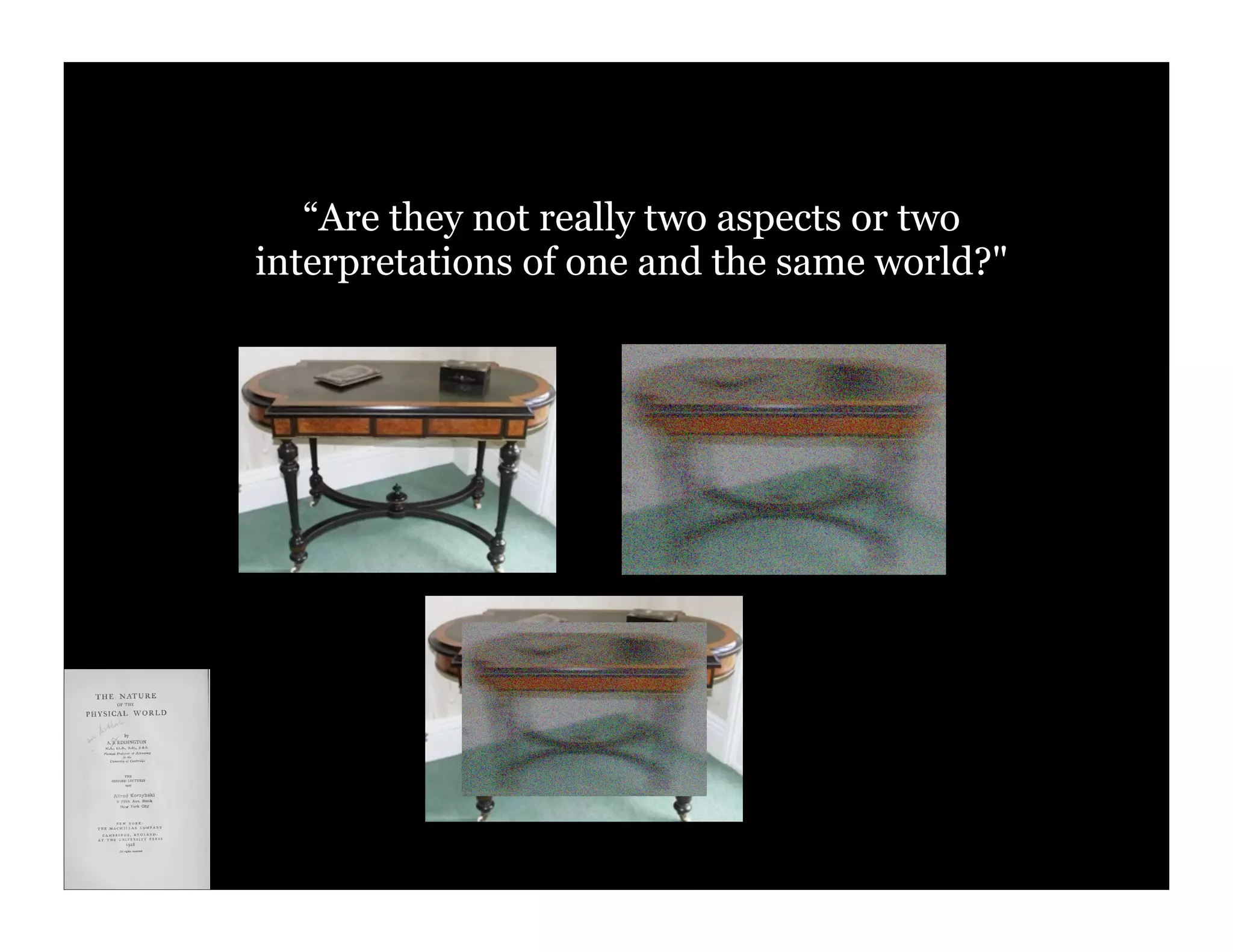
sub-microscopic, insubstantial
scientific table “nearly all empty
space...pervaded...by fields of
force...assigned to the category of
“influences”, not of things.” ”
“Are they not really two aspects or two
interpretations of one and the same world?"
“Yes, no doubt they are ultimately to be identified after
some fashion. But the process by which the external
world of physics is transformed into a world of familiar
acquaintance in human consciousness is outside the
scope of physics. ...It is true that the whole scientific
inquiry starts from the familiar world; but the part of
the journey over which the physicist has charge is in
foreign territory.”
— A. S. Eddington
Korzybski Margin
Notes:
“Ignorance of the
workings of the human
nervous system”
PS1
BS1
OS1
PS1 - Personal System, Individual’s Personal ‘Philosophy’
BS1 - Organized Belief Systems, Doctrines, “CEWT” (Culturally
Expected Ways of Thinking)
OS1 - Orientation System (General, Overarching)
from ‘Idols’ to Heuristics
Bacon Koen
‘Absolutistic’ ‘Relativistic’
‘Unconscious’
Heuristics
‘Conscious’
Heuristics
‘Aristotelian’ ‘Non-Aristotelian’
‘substances’ (‘absolute entities) with
‘properties’; belief that subject-predicate
form of representation adequate for science
and life
disregard of nervous system, primary
reliance on sense data
“A is A.” Law of Identity, absolute sameness
exists in this world, focus on similarities,
classification based on similarity
process world of dynamic relations—”Not things
changing, but change ‘thinging’”; necessity for
functional, relational language exemplified by
mathematics
t w o - v a l u e d , e i t h e r - o r
orientation; leading to rigid,
elementalism (verbally separating
what does not exist as separated
in non-verbal world)
multi-valued, probabilistic degree orientation;
non-elementalism
disregard of structure of language structure of language has automatic influence on
our orientation; implicatory structure
Et Cetera...
experience of things and their qualities a function of
human nervous systems; reliance on inferential
knowledge derived from up-to-date science
non-identity: whatever you say something ‘is’, it is
not; no two things absolutely the same in all
respects; differences in similarities & similarities in
differences
A Theory of Sanity
in modern scientific methods we can find
“...in modern scientific methods we can
find factors of sanity, to be tested
empirically.”
—Alfred Korzybski, “Introduction to the Second Edition,
1941”, Science and Sanity
GS-
‘On One Foot’
“If I can only convey to you as the net result
of the whole seminar, if you can only learn how
to ‘think’ in terms of ‘facts’ instead of
definitions, we will have achieved what we
want to achieve. It’s one of the most difficult
things to do. It will take you a long ‘time’ to
do it.”
— Alfred Korzybski,
1948-49 “Flood” Seminar
Extensional v. Intensional Orientation
a distinction formulated by Korzybski, based on a contrast between different kinds of definitions
3.scientific attitude & non-aristotelian revision

3.scientific attitude & non-aristotelian revision

  • 1.
    “...The period ofhumanity’s manhood will, I doubt not, be a scientific period—a period that will witness the gradual extension of scientific method to all the interests of mankind—a period in which man will discover the essential nature of man and establish, at length, the science and art of directing human energies and human capacities to the advancement of human weal in accordance with the laws of human nature.” — Manhood of Humanity, pp. 44-45 Bucky Fuller Utopia & Oblivion H.G. Wells Humanity is in a race between education and catastrophe
  • 2.
    “Our rulers: politicians,‘diplomats', bankers, priests of every description, economists, lawyers, etc., and the majority of teachers remain at present largely or entirely ignorant of modern science, scientific methods,...of 1933, and they also lack an essential historical and anthropological background, without which a sane orientation is impossible. This ignorance is often willful as they mostly refuse, with various excuses, to read modern works dealing with such problems. As a result a conflict is created and maintained between the advance of science affecting conditions of actual life and the orientations of our rulers, which often remain antiquated by centuries, or one or two thousand years. The present world conditions are in chaos; psycho- logically there exists a state of helplessness—hopelessness, often resulting in the feelings of insecurity, bitterness, etc ., and we have lately witnessed psychopathological mass outbursts, similar to those of the dark ages. Few of us at present realize that, as long as such ignorance of our rulers prevails, no solution of our human problems is possible.” — Alfred Korzybski, “Preface to the First Edition”, Science and Sanity (1933)
  • 3.
    “Science is theactive and creative engagement of our minds with nature in an attempt to understand. ...” — Gregory N. Derry If we and our own activities, including science, are part of nature, then we can also engage our minds scientifically in an attempt to understand science. Exactly what AK was interested in studying science Advances in physico-mathematical sciences, basic and applied (exemplary time-binding) held a key, key to understanding the basic mechanism of time-binding Understand that t-b mech more clearly could be applied to develop teachable evaluational tools—heuristics—allowing us to better time-bind in other areas of life besides the traditional one of ‘science’
  • 4.
    “The whole ofscience is nothing more than the refinement of every day thinking.” — Albert Einstein, “Physics and Reality” (1936), in Ideas and Opinions
  • 5.
    Einstein’s Schematic Modelof Scientific Method in a letter to Maurice Solovine (May 7, 1952)
  • 6.
    in modern scientificmethods we can find “...in modern scientific methods we can find factors of sanity, to be tested empirically.” —Alfred Korzybski, “Introduction to the Second Edition, 1941”, Science and Sanity
  • 7.
    Two General andConverging Approaches: 2. Study the SOTA (State of the Art) in a variety of fields of natural, biological, and behavioral/social-science research, which might contribute to an understanding of how we know what we say we know. 1. Study science, mathematics, engineering as forms of human behavior; produced by human nervous systems. Troubleshooting, Heuristic Value for the sciences and in particular for daily life
  • 8.
    “...anything that providesa plausible aid or direction in the solution of a problem but is in the final analysis...potentially fallible.” * Heuristic “rule of thumb” “intuition” “technique” “hint” “rule of craft” “guiding thread” “working basis” “guiding principles” etc.** * BillyVaughn Koen - Discussion of the Method, p. 28, ** Ibid, p. 32 Method
  • 9.
    “[T]he engineering method,is the use of heuristics to cause the best change in a poorly understood situation within the available resources.” — BillyVaughn Koen
  • 10.
    “All is heuristic.” *BillyVaughnKoen - Discussion of the Method (2003), pp. 7, 111 “To be human is to be an engineer.”
  • 11.
    “[General Semantics] isbased on a new world outlook...We have made a methodological summary of what we know practically in every field, without going into details of it. I had to extract the method and ‘all’ I teach you is scientific method...It takes infernal work to do so, and without time- binding...I could not have produced general semantics, which is method, method, and nothing but.” — Alfred Korzybski, Winter Intensive Seminar (1948-1949)
  • 12.
    GS Generalized, Science &Math-Based, Epistemological Heuristics for Science and Everyday Life in fewer words, Applied Epistemology or Epistemics ~ ~
  • 13.
    Two major heuristicsthat Korzybski used as he began his survey of science (optimal time- binding) to improve and clarify scientific methods for broader use: Observer – Observed Relation Logical Fate To study and improve methods (heuristics), you need some methods (heuristics) to start with.
  • 14.
  • 15.
    “Logical Fate” ...it isin the world of ideas and only there that human beings as human may find principles or bases for rational theories and rational conduct of life, whether individual life or community life; choices differ but some choice of principle we must make if we are to be really human —if, that is, we are to be rational— and when we have made it, we are at once bound by a destiny of consequences beyond the power of passion or will to control or modify; another choice of principles is but the election of another destiny. The world of ideas is, you see, the empire of Fate. Mathematical Philosophy: A Study of Fate and Freedom (1922), p. 5
  • 16.
    Korzybski’s 1922 Diagramof “Logical Destiny”
  • 17.
  • 18.
    “...all that mancan know is a joint phenomena of the observer and the observed.”
  • 19.
    ‘Pre-Scientific’ o b se r v e r e v e r y t h i n g , observed doesn’t matter p r o j e c t i o n o f ‘ t h o u g h t s ’ a n d ‘feelings’ onto world animism, spirits, gods, s a c r i fi c e , m a g i c , analogy ‘Classical’ E m p h a s i s o n t h e observed, the observer doesn’t matter much neutral ‘objective’ study of nature e a r l y ( G r e e k ) : o b s e r v a t i o n , l o g i c , classification l a t e r ( “ S c i e n t i fi c R e v o l u t i o n ” ) : experiment, mathematics, exact laws of nature, prediction and control ‘Modern’ observer-observed “...all that man can know is a joint phenomena of the observer and the observed.” revision of earlier methods in light of this ‘ E v e r y t h i n g i s i d e n t i c a l w i t h everything else’ ‘Everything is identical with itself’;‘A is A’. Non-Identity; ‘Whatever you say something ‘is’, it is not’
  • 20.
  • 21.
    macroscopic, substantial, commonevery day table, represents the world of ‘things’
  • 22.
    sub-microscopic, insubstantial scientific table“nearly all empty space...pervaded...by fields of force...assigned to the category of “influences”, not of things.” ”
  • 23.
    “Are they notreally two aspects or two interpretations of one and the same world?"
  • 24.
    “Yes, no doubtthey are ultimately to be identified after some fashion. But the process by which the external world of physics is transformed into a world of familiar acquaintance in human consciousness is outside the scope of physics. ...It is true that the whole scientific inquiry starts from the familiar world; but the part of the journey over which the physicist has charge is in foreign territory.” — A. S. Eddington Korzybski Margin Notes: “Ignorance of the workings of the human nervous system”
  • 25.
    PS1 BS1 OS1 PS1 - PersonalSystem, Individual’s Personal ‘Philosophy’ BS1 - Organized Belief Systems, Doctrines, “CEWT” (Culturally Expected Ways of Thinking) OS1 - Orientation System (General, Overarching) from ‘Idols’ to Heuristics Bacon Koen ‘Absolutistic’ ‘Relativistic’ ‘Unconscious’ Heuristics ‘Conscious’ Heuristics
  • 26.
    ‘Aristotelian’ ‘Non-Aristotelian’ ‘substances’ (‘absoluteentities) with ‘properties’; belief that subject-predicate form of representation adequate for science and life disregard of nervous system, primary reliance on sense data “A is A.” Law of Identity, absolute sameness exists in this world, focus on similarities, classification based on similarity process world of dynamic relations—”Not things changing, but change ‘thinging’”; necessity for functional, relational language exemplified by mathematics t w o - v a l u e d , e i t h e r - o r orientation; leading to rigid, elementalism (verbally separating what does not exist as separated in non-verbal world) multi-valued, probabilistic degree orientation; non-elementalism disregard of structure of language structure of language has automatic influence on our orientation; implicatory structure Et Cetera... experience of things and their qualities a function of human nervous systems; reliance on inferential knowledge derived from up-to-date science non-identity: whatever you say something ‘is’, it is not; no two things absolutely the same in all respects; differences in similarities & similarities in differences
  • 27.
    A Theory ofSanity in modern scientific methods we can find “...in modern scientific methods we can find factors of sanity, to be tested empirically.” —Alfred Korzybski, “Introduction to the Second Edition, 1941”, Science and Sanity
  • 29.
    GS- ‘On One Foot’ “IfI can only convey to you as the net result of the whole seminar, if you can only learn how to ‘think’ in terms of ‘facts’ instead of definitions, we will have achieved what we want to achieve. It’s one of the most difficult things to do. It will take you a long ‘time’ to do it.” — Alfred Korzybski, 1948-49 “Flood” Seminar
  • 30.
    Extensional v. IntensionalOrientation a distinction formulated by Korzybski, based on a contrast between different kinds of definitions