Zetes GroupSolutions for hospitals« Think Smart »Pascal.durdu@zetes.com
e-Healthe-Health is the combined use of electronic communication and information technology in the health sector.Quality(information, patient oriented…)Efficiency(costreduction, flexibility,…)Safety(avoidhigh impact mistakes)06/12/20102
Major e-healthtopicsClinical information systemNon-Clinical systemTelemedecineIntegratedhealth network06/12/20103
Innovation in e-healthSharing experience and get to learn real business need !!!!Avoidtechnology pushRe-use of what’sexistingsomewhereelse, getinspired ….Adaptexisting technologies in a smart way06/12/20104
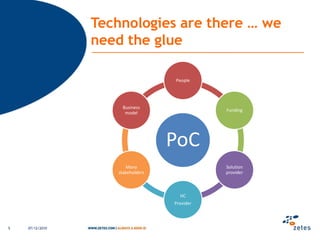
Technologies are there … weneed the glue06/12/20105
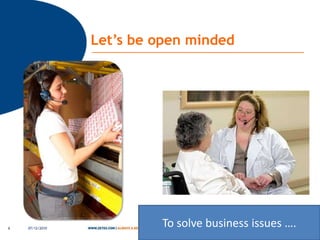
Let’sbe open minded06/12/20106To solve business issues ….
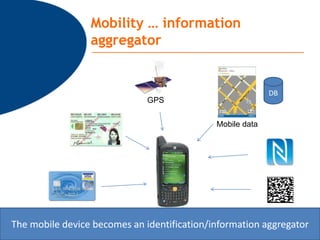
Mobility … information aggregator06/12/20107DBGPSMobile dataThe mobile devicebecomes an identification/information aggregator
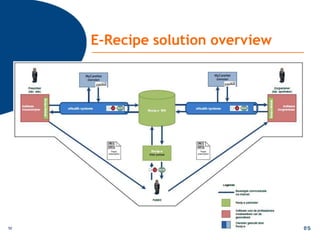
Mobility ….e-recipe …   en  Mobilité ….Attestation ….PaiementRecommendationGénérixPre-commande pour les pharmaciesFindnearestpharmacyCampagne de vaccinationSerialisation06/12/20108
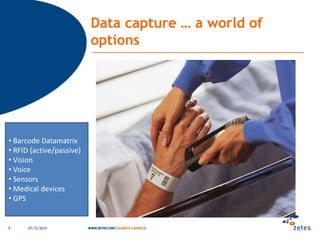
Data capture … a world of options06/12/20109Barcode Datamatrix
 RFID (active/passive)
 Vision
 Voice
Sensors
Medicaldevices
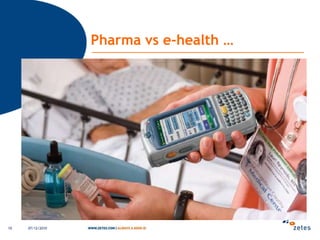
 GPSPharma vs e-health …06/12/201010
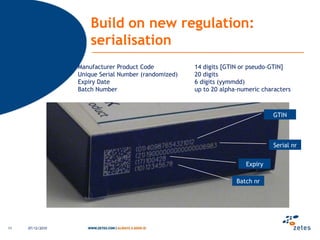
Build on new regulation: serialisation06/12/201011Manufacturer Product Code		14 digits [GTIN or pseudo-GTIN]Unique Serial Number (randomized)		20 digitsExpiry Date  		6 digits (yymmdd)Batch Number		up to 20 alpha-numeric charactersGTINSerial nrExpiryBatch nr
Thanks06/12/201012
Exchange best practice and business issue.06/12/201013
LearnfromothersectorsMedicine identification & serialisationCold chainEfficiency of distribution & supplychain06/12/201014
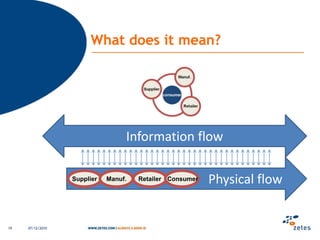
What does it mean?Need to improve & optimise Information flow
Physical flow
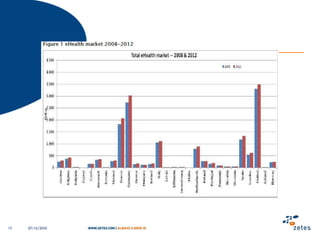
 Cash flowHowever, between 2008 and 2012 the situation is to evolve, with a major shift from Secondary Usage Systems to Clinical Information Systems (SUCIS). This suggests that eHealth systems are targeted more towards supporting the operational processes of healthcare professionals.06/12/201016
06/12/201017
eHealth services can play an important role for the current and current and future delivery challenges to be faced by healthcare services in Europe. They can provide responses to the socio-economic challenges faced by European healthcare systems in the near and long term. Industry is expected to continue to be involved in the development of these services, as eHealth represents a considerable market for European and international industry players. However, in order to tap into this potential, it is necessary for eHealth services to be devised in such a way as to respond directly to the specific operational needs of the healthcare delivery stakeholders towards whom they are targeted. Essentially, eHealth services have to create value for all stakeholders by devising appropriate supporting business models. Failing to do so will just create a situation where healthcare professionals and institutions would lose trust in these solutions and, as a consequence, refrain from exploiting the positive externalities brought about by these eHealth systems and solutions.06/12/201018
What does it mean?06/12/201019Information flowPhysical flowSupplierManuf.Retailer Consumer
                       Introduction06/12/201020ReportAssetMgtSafetyPatient TrackingProductivity
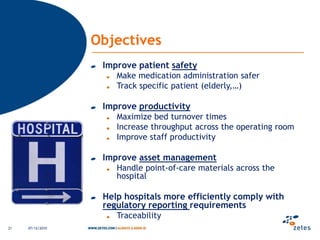
ObjectivesImprove patient safetyMake medication administration saferTrackspecific patient (elderly,…)Improve productivityMaximize bed turnover timesIncrease throughput across the operating roomImprove staff productivityImprove asset managementHandle point-of-care materials across the hospitalHelp hospitals more efficiently comply with regulatory reporting requirementsTraceability06/12/201021
Hospitals solution by ZetesVoice nursingAssettrackingPatient TrackingGoodstransferbetweenHosptals building06/12/201022
Voice nursing06/12/201023
IntroductionNurses are and willbemissing.Nurses are getingcompany car in Vilvoorde Hospital (Belgium)IncreaseefficiencyRemovepainfulladministativetask06/12/201024
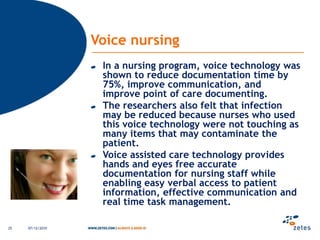
Voice nursingIn a nursing program, voice technology was shown to reduce documentation time by 75%, improve communication, and improve point of care documenting. The researchers also felt that infection may be reduced because nurses who used this voice technology were not touching as many items that may contaminate the patient. Voice assisted care technology provides hands and eyes free accurate documentation for nursing staff while enabling easy verbal access to patient information, effective communication and real time task management. 06/12/201025
ConceptWithvoice nursing , the purposeis to use voicecommandsinstead of existingpaperbased or handheld solution.Instead of printing tasks or showingthem on a screen, theywillbevoiced to the caregiver.06/12/201026
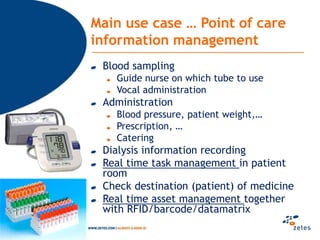
Main use case … Point of care information managementBlood samplingGuide nurse on which tube to useVocal administrationAdministrationBlood pressure, patient weight,…Prescription, …CateringDialysis information recordingReal time task management in patient roomCheck destination (patient) of medicineReal time asset management togetherwith RFID/barcode/datamatrix06/12/201027
IdentificationStaff VerificationIndividual RFID tagsDifficult to duplicateEnsuring secure automatic clinician login, speeding processPatient IDIndividual RFID tagsScanned without line off sightRequiring fewer physical touches, speeding process and reducing chances of nosocomial infectionsMedication VerificationIndividually labeled medication doses correctly matched with physician order, caregiver and patient ID06/12/201028
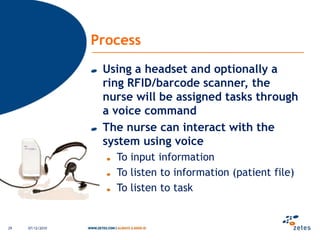
ProcessUsing a headset and optionally a ring RFID/barcode scanner, the nurse willbeassignedtasksthrough a voice commandThe nurse caninteractwith the system usingvoiceTo input informationTo listen to information (patient file)To listen to task06/12/201029
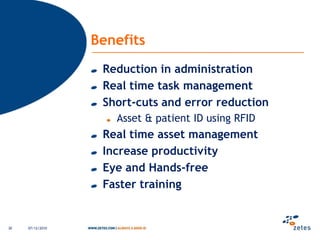
BenefitsReduction in administrationReal time task managementShort-cuts and errorreductionAsset & patient ID using RFIDReal time asset managementIncreaseproductivityEye and Hands-freeFaster training06/12/201030
Assettracking06/12/201031
AssettrackingHow much valuable time and resources were wasted due to low visibility of equipment, patients and staff …. “they could spend hours looking for the equipment. The only way we could resolve the problem was to buy more equipment so that it was available on each floor, which increased our operational costs.”06/12/201032
Why Asset Management?Createaccountability for assetbeingused in HospitalsLocation, maintenance history, availabilityPerform an efficient « assetfleet » management5-15% of hospital inventory is written off each year since it can no longer be located or more importantly servicedEnsurehighlevel of availability and usageEquipment moving from patient to patient without going through decontamination in between could become a significant issue
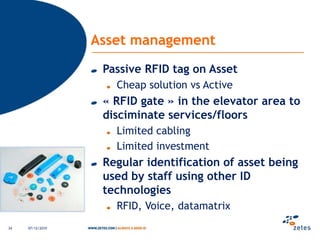
Asset management Passive RFID tag on AssetCheap solution vs Active« RFID gate » in the elevator area to disciminate services/floorsLimited cablingLimited investmentRegular identification of assetbeingused by staff usingother ID technologiesRFID, Voice, datamatrix06/12/201034
The processStaff must identifyassetevery time they use it (Voice & RFID)Patient ID isknownDurationcanbeassessedRoom ID is know… sowe know about utilisation and last location and time of use … RFID preventing short-cuts and mis-use.Whenasset are moving out of services / floor, RFID antennasatelevatorwilldetect the movement and update « assetinventory » accordingly.06/12/201035
AssetinventoryEvery service/department as an inventory of assetAs soon as an assetistaking the elevators, inventorywillbeupdatedaccordingly.If an asset shows up somewhereelse (read by staff), inventorywillbeupdatedWhenassetisbrought for maintenance, inventorywillbeupdatedaccordingly06/12/201036
ReportingiskeyAn assetis not used (read) since 2 weeksCheck service whereit has been used lastBroken, go to repairIf disappeared, itwillbewriten-off to a specificdepartment, if it shows up back afterwards, write-off willbecanceled and investigation willtake place.Working, sothisassetmightbe in excessThe utilisation of a type of assetistoolow,… thenassetmightbe in excess06/12/201037
People tracking06/12/201038
People trackingBased on the same infrastructure as assettracking, whenalzheimer / elderly people isleaving the « service ».The service manager isalertedThe service manager receives a message telling in which service/department/zone he has been seen last time06/12/201039
RFID wristbandsScanned without line off sight, thereis no need to manipulate the patient to read the informationPlacing the tag on the foot wouldallow a betterreadingRequiring fewer physical touches, speeding process and reducing chances of nosocomial infections06/12/201040
GatesExtra « gates » willbeinstalledatEntrance/exit of hospitalsIn critical zonesSomeproductscouldbetagged as well to getalertedwhenthey enter a specific room.06/12/201041
	Point of care solution usingvoicetogetherwith Passive UHF tags and readersatelevetorsgenerate an affordable and flexible solution thatshould help hospitals in the day to day job06/12/201042
Goodstransfer43
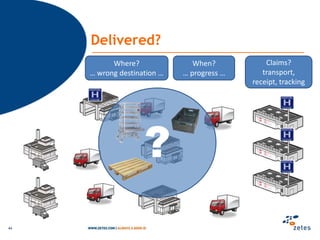
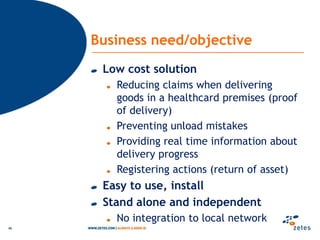
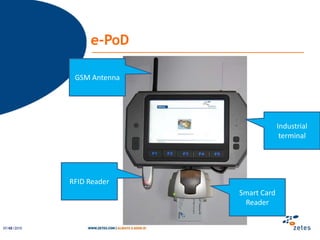
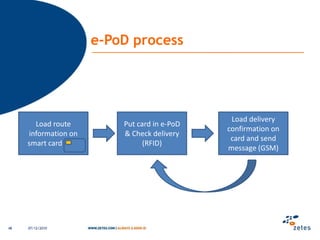
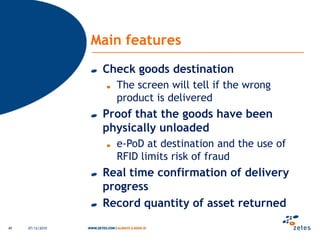
Delivered?  When?… progress …Where?… wrong destination …Claims?transport,  receipt, tracking?44

smart solutions healthcare MIC

  • 1.
    Zetes GroupSolutions forhospitals« Think Smart »Pascal.durdu@zetes.com
  • 2.
    e-Healthe-Health is thecombined use of electronic communication and information technology in the health sector.Quality(information, patient oriented…)Efficiency(costreduction, flexibility,…)Safety(avoidhigh impact mistakes)06/12/20102
  • 3.
    Major e-healthtopicsClinical informationsystemNon-Clinical systemTelemedecineIntegratedhealth network06/12/20103
  • 4.
    Innovation in e-healthSharingexperience and get to learn real business need !!!!Avoidtechnology pushRe-use of what’sexistingsomewhereelse, getinspired ….Adaptexisting technologies in a smart way06/12/20104
  • 5.
    Technologies are there… weneed the glue06/12/20105
  • 6.
    Let’sbe open minded06/12/20106Tosolve business issues ….
  • 7.
    Mobility … informationaggregator06/12/20107DBGPSMobile dataThe mobile devicebecomes an identification/information aggregator
  • 8.
    Mobility ….e-recipe … en Mobilité ….Attestation ….PaiementRecommendationGénérixPre-commande pour les pharmaciesFindnearestpharmacyCampagne de vaccinationSerialisation06/12/20108
  • 9.
    Data capture …a world of options06/12/20109Barcode Datamatrix
  • 10.
  • 11.
  • 12.
  • 13.
  • 14.
  • 15.
    GPSPharma vse-health …06/12/201010
  • 16.
    Build on newregulation: serialisation06/12/201011Manufacturer Product Code 14 digits [GTIN or pseudo-GTIN]Unique Serial Number (randomized) 20 digitsExpiry Date 6 digits (yymmdd)Batch Number up to 20 alpha-numeric charactersGTINSerial nrExpiryBatch nr
  • 17.
  • 18.
    Exchange best practiceand business issue.06/12/201013
  • 19.
    LearnfromothersectorsMedicine identification &serialisationCold chainEfficiency of distribution & supplychain06/12/201014
  • 20.
    What does itmean?Need to improve & optimise Information flow
  • 21.
  • 22.
    Cash flowHowever,between 2008 and 2012 the situation is to evolve, with a major shift from Secondary Usage Systems to Clinical Information Systems (SUCIS). This suggests that eHealth systems are targeted more towards supporting the operational processes of healthcare professionals.06/12/201016
  • 23.
  • 24.
    eHealth services canplay an important role for the current and current and future delivery challenges to be faced by healthcare services in Europe. They can provide responses to the socio-economic challenges faced by European healthcare systems in the near and long term. Industry is expected to continue to be involved in the development of these services, as eHealth represents a considerable market for European and international industry players. However, in order to tap into this potential, it is necessary for eHealth services to be devised in such a way as to respond directly to the specific operational needs of the healthcare delivery stakeholders towards whom they are targeted. Essentially, eHealth services have to create value for all stakeholders by devising appropriate supporting business models. Failing to do so will just create a situation where healthcare professionals and institutions would lose trust in these solutions and, as a consequence, refrain from exploiting the positive externalities brought about by these eHealth systems and solutions.06/12/201018
  • 25.
    What does itmean?06/12/201019Information flowPhysical flowSupplierManuf.Retailer Consumer
  • 26.
    Introduction06/12/201020ReportAssetMgtSafetyPatient TrackingProductivity
  • 27.
    ObjectivesImprove patient safetyMakemedication administration saferTrackspecific patient (elderly,…)Improve productivityMaximize bed turnover timesIncrease throughput across the operating roomImprove staff productivityImprove asset managementHandle point-of-care materials across the hospitalHelp hospitals more efficiently comply with regulatory reporting requirementsTraceability06/12/201021
  • 28.
    Hospitals solution byZetesVoice nursingAssettrackingPatient TrackingGoodstransferbetweenHosptals building06/12/201022
  • 29.
  • 30.
    IntroductionNurses are andwillbemissing.Nurses are getingcompany car in Vilvoorde Hospital (Belgium)IncreaseefficiencyRemovepainfulladministativetask06/12/201024
  • 31.
    Voice nursingIn anursing program, voice technology was shown to reduce documentation time by 75%, improve communication, and improve point of care documenting. The researchers also felt that infection may be reduced because nurses who used this voice technology were not touching as many items that may contaminate the patient. Voice assisted care technology provides hands and eyes free accurate documentation for nursing staff while enabling easy verbal access to patient information, effective communication and real time task management. 06/12/201025
  • 32.
    ConceptWithvoice nursing ,the purposeis to use voicecommandsinstead of existingpaperbased or handheld solution.Instead of printing tasks or showingthem on a screen, theywillbevoiced to the caregiver.06/12/201026
  • 33.
    Main use case… Point of care information managementBlood samplingGuide nurse on which tube to useVocal administrationAdministrationBlood pressure, patient weight,…Prescription, …CateringDialysis information recordingReal time task management in patient roomCheck destination (patient) of medicineReal time asset management togetherwith RFID/barcode/datamatrix06/12/201027
  • 34.
    IdentificationStaff VerificationIndividual RFIDtagsDifficult to duplicateEnsuring secure automatic clinician login, speeding processPatient IDIndividual RFID tagsScanned without line off sightRequiring fewer physical touches, speeding process and reducing chances of nosocomial infectionsMedication VerificationIndividually labeled medication doses correctly matched with physician order, caregiver and patient ID06/12/201028
  • 35.
    ProcessUsing a headsetand optionally a ring RFID/barcode scanner, the nurse willbeassignedtasksthrough a voice commandThe nurse caninteractwith the system usingvoiceTo input informationTo listen to information (patient file)To listen to task06/12/201029
  • 36.
    BenefitsReduction in administrationRealtime task managementShort-cuts and errorreductionAsset & patient ID using RFIDReal time asset managementIncreaseproductivityEye and Hands-freeFaster training06/12/201030
  • 37.
  • 38.
    AssettrackingHow much valuabletime and resources were wasted due to low visibility of equipment, patients and staff …. “they could spend hours looking for the equipment. The only way we could resolve the problem was to buy more equipment so that it was available on each floor, which increased our operational costs.”06/12/201032
  • 39.
    Why Asset Management?Createaccountabilityfor assetbeingused in HospitalsLocation, maintenance history, availabilityPerform an efficient « assetfleet » management5-15% of hospital inventory is written off each year since it can no longer be located or more importantly servicedEnsurehighlevel of availability and usageEquipment moving from patient to patient without going through decontamination in between could become a significant issue
  • 40.
    Asset management PassiveRFID tag on AssetCheap solution vs Active« RFID gate » in the elevator area to disciminate services/floorsLimited cablingLimited investmentRegular identification of assetbeingused by staff usingother ID technologiesRFID, Voice, datamatrix06/12/201034
  • 41.
    The processStaff mustidentifyassetevery time they use it (Voice & RFID)Patient ID isknownDurationcanbeassessedRoom ID is know… sowe know about utilisation and last location and time of use … RFID preventing short-cuts and mis-use.Whenasset are moving out of services / floor, RFID antennasatelevatorwilldetect the movement and update « assetinventory » accordingly.06/12/201035
  • 42.
    AssetinventoryEvery service/department asan inventory of assetAs soon as an assetistaking the elevators, inventorywillbeupdatedaccordingly.If an asset shows up somewhereelse (read by staff), inventorywillbeupdatedWhenassetisbrought for maintenance, inventorywillbeupdatedaccordingly06/12/201036
  • 43.
    ReportingiskeyAn assetis notused (read) since 2 weeksCheck service whereit has been used lastBroken, go to repairIf disappeared, itwillbewriten-off to a specificdepartment, if it shows up back afterwards, write-off willbecanceled and investigation willtake place.Working, sothisassetmightbe in excessThe utilisation of a type of assetistoolow,… thenassetmightbe in excess06/12/201037
  • 44.
  • 45.
    People trackingBased onthe same infrastructure as assettracking, whenalzheimer / elderly people isleaving the « service ».The service manager isalertedThe service manager receives a message telling in which service/department/zone he has been seen last time06/12/201039
  • 46.
    RFID wristbandsScanned withoutline off sight, thereis no need to manipulate the patient to read the informationPlacing the tag on the foot wouldallow a betterreadingRequiring fewer physical touches, speeding process and reducing chances of nosocomial infections06/12/201040
  • 47.
    GatesExtra « gates » willbeinstalledatEntrance/exitof hospitalsIn critical zonesSomeproductscouldbetagged as well to getalertedwhenthey enter a specific room.06/12/201041
  • 48.
    Point of caresolution usingvoicetogetherwith Passive UHF tags and readersatelevetorsgenerate an affordable and flexible solution thatshould help hospitals in the day to day job06/12/201042
  • 49.
  • 50.
    Delivered? When?…progress …Where?… wrong destination …Claims?transport, receipt, tracking?44

Editor's Notes

  • #3 http://ec.europa.eu/information_society/activities/health/whatis_ehealth/index_en.htm
  • #17 Clinical Information System(CIS)(a) Specialised tools for health professionals within healthcareinstitutions (e.g. hospitals). Examples are radiology informationsystems, nursing information systems, medical imaging,computer-assisted diagnosis, surgery training and planningsystems;(b) Tools for primary care and/or for outside care institutions,such as general practitioner (GP) and pharmacy informationsystems.Secondary Usage Non-clinicalSystems (SUNCS)This category includes:(a) systems for health education and health promotion ofpatients/citizens, such as health portals or online healthinformation services;(b) specialised systems for researchers and public health datacollection and analysis, such as biostatistical programs forinfectious diseases, drug development, and outcomes analysis;(c) Support systems such as supply chain management,scheduling systems, billing systems, administrative andmanagement systems, which support clinical processes but arenot used directly by patients or healthcare professionals.Telemedicine Personalised health systems and services, such as diseasemanagement services, remote patient monitoring (e.g. athome), teleconsultation, telecare, telemedicine andteleradiology.Integrated Health ClinicalInformation Network (IHCIN)Distributed electronic health record systems and associatedservices, such as e-prescriptions or e-referrals.
  • #18 http://ec.europa.eu/information_society/activities/health/docs/studies/business_model/business_models_eHealth_report.pdf
  • #45 Are the goodsdelivered?Are the goodsdelivered to the right shop?When have the goods been delivered?Whoisresponsible for the goodsnow?Where are the goods?
  • #51 https://www.ehealth.fgov.be/binaries/website/en/Recip-e_Integration-Specification_Draft.pdf