Mabo Case Study
VIS
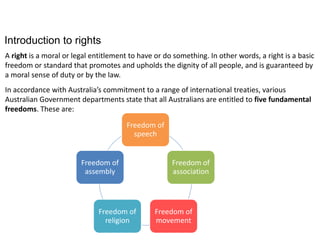
Introduction to rights
A right is a moral or legal entitlement to have or do something. In other words, a right is a basic
freedom or standard that promotes and upholds the dignity of all people, and is guaranteed by
a moral sense of duty or by the law.
In accordance with Australia’s commitment to a range of international treaties, various
Australian Government departments state that all Australians are entitled to five fundamental
freedoms. These are:
Freedom of
speech
Freedom of
association
Freedom of
movement
Freedom of
religion
Freedom of
assembly
Introduction to rights
How are the rights of Australians protected?
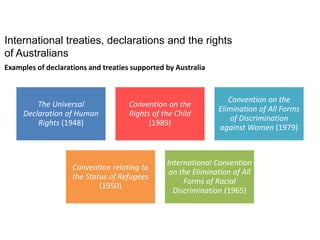
International treaties, declarations and the rights
of Australians
Examples of declarations and treaties supported by Australia
The Universal
Declaration of Human
Rights (1948)
Convention on the
Rights of the Child
(1989)
Convention on the
Elimination of All Forms
of Discrimination
against Women (1979)
Convention relating to
the Status of Refugees
(1950)
International Convention
on the Elimination of All
Forms of Racial
Discrimination (1965)
International treaties, declarations and the rights
of Australians
Enforcement of international treaties
Name of the body What it does
International Court
of Justice
Established by the United Nations to resolve legal disputes between nations that are
members of the United Nations
Office of the
High Commissioner
for Human Rights
Encourages nations to uphold their commitments under various human rights treaties
by offering education and assistance to member nations
International human
rights committees
Many of the main international human rights treaties include terms that establish
committees to monitor nations’ compliance with treaties, and to encourage nations that
may be breaching a treaty to implement changes and comply with it
Australian governments The Commonwealth, state and territory governments have committed to providing
a range of organisations and systems to enforce human rights legislation and to resolve
alleged breaches of human rights.
International human
rights organisations
International human rights organisations can place pressure on nations to enforce
legally protected human rights – for example, Amnesty International.
Page 522
Human Rights Watch
highlights human rights
issues in Australia
Australian prison conditions –
a human rights issue
Brough v Australia (2006)
Communication No. 1184/2003
(27 April 2006)
Possible reforms to the protection of rights in Australia
One other possible reform to improve the protection of rights in Australia is to amend existing
legislation to improve legal processes, government policy, and the provision of services in a range
of areas.
While Australia protects a vast range of rights, in recent years, the Australian Government
has come under pressure to implement changes to improve the protection of rights for:
Indigenous
Australians
Asylum seekers
People accused
of terror-
related crimes
People with
a disability
Providing increased statutory protection for minority groups
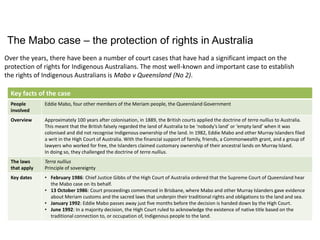
The Mabo case – the protection of rights in Australia
Over the years, there have been a number of court cases that have had a significant impact on the
protection of rights for Indigenous Australians. The most well-known and important case to establish
the rights of Indigenous Australians is Mabo v Queensland (No 2).
Key facts of the case
People
involved
Eddie Mabo, four other members of the Meriam people, the Queensland Government
Overview Approximately 100 years after colonisation, in 1889, the British courts applied the doctrine of terra nullius to Australia.
This meant that the British falsely regarded the land of Australia to be ‘nobody’s land’ or ‘empty land’ when it was
colonised and did not recognise Indigenous ownership of the land. In 1982, Eddie Mabo and other Murray Islanders filed
a writ in the High Court of Australia. With the financial support of family, friends, a Commonwealth grant, and a group of
lawyers who worked for free, the Islanders claimed customary ownership of their ancestral lands on Murray Island.
In doing so, they challenged the doctrine of terra nullius.
The laws
that apply
Terra nullius
Principle of sovereignty
Key dates • February 1986: Chief Justice Gibbs of the High Court of Australia ordered that the Supreme Court of Queensland hear
the Mabo case on its behalf.
• 13 October 1986: Court proceedings commenced in Brisbane, where Mabo and other Murray Islanders gave evidence
about Meriam customs and the sacred laws that underpin their traditional rights and obligations to the land and sea.
• January 1992: Eddie Mabo passes away just five months before the decision is handed down by the High Court.
• June 1992: In a majority decision, the High Court ruled to acknowledge the existence of native title based on the
traditional connection to, or occupation of, Indigenous people to the land.
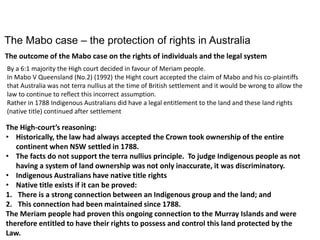
The Mabo case – the protection of rights in Australia
By a 6:1 majority the High court decided in favour of Meriam people.
In Mabo V Queensland (No.2) (1992) the Hight court accepted the claim of Mabo and his co-plaintiffs
that Australia was not terra nullius at the time of British settlement and it would be wrong to allow the
law to continue to reflect this incorrect assumption.
Rather in 1788 Indigenous Australians did have a legal entitlement to the land and these land rights
(native title) continued after settlement
The High-court’s reasoning:
• Historically, the law had always accepted the Crown took ownership of the entire
continent when NSW settled in 1788.
• The facts do not support the terra nullius principle. To judge Indigenous people as not
having a system of land ownership was not only inaccurate, it was discriminatory.
• Indigenous Australians have native title rights
• Native title exists if it can be proved:
1. There is a strong connection between an Indigenous group and the land; and
2. This connection had been maintained since 1788.
The Meriam people had proven this ongoing connection to the Murray Islands and were
therefore entitled to have their rights to possess and control this land protected by the
Law.
The outcome of the Mabo case on the rights of individuals and the legal system
The Mabo case – the protection of rights in Australia
According to Justice Michael Kirby (a former High Court justice), the basic principles of the Mabo
decision are:
• our system of real property law accommodates native title
• native title may be extinguished
• native title may be extinguished in a number of ways by either the Crown or by Indigenous people
• where native title has been extinguished, there may (or may not) be a right to compensation.
The post-Mabo laws in Australia
In 1993, after the Mabo decision, the Commonwealth Parliament passed the Native Title Act 1993
(Cth), which confirmed the High Court’s decision and established the Native Title Tribunal.
The Native Title Act:
• provides for the recognition and protection of native title, and sets down some basic principles
in relation to native title
• establishes ways in which future dealings affecting native title could proceed and be protected, and
• establishes a mechanism for determining claims to native title.
Over time, changes have been made to the Native Title Act
to improve its effectiveness and to make it fairer for
Indigenous Australians.
The Timber Creek case
Northern Territory v Griffiths
(deceased) & Jones on behalf
of the Ngaliwurru & Nungali
Peoples [2019] HCA 7
(13 March 2019)
The impact of the Mabo case on the rights of individuals and the legal system
Watch the video
• https://clickv.ie/w/HQxt

Mabo Case Study.pptx

  • 1.
  • 2.
    Introduction to rights Aright is a moral or legal entitlement to have or do something. In other words, a right is a basic freedom or standard that promotes and upholds the dignity of all people, and is guaranteed by a moral sense of duty or by the law. In accordance with Australia’s commitment to a range of international treaties, various Australian Government departments state that all Australians are entitled to five fundamental freedoms. These are: Freedom of speech Freedom of association Freedom of movement Freedom of religion Freedom of assembly
  • 3.
    Introduction to rights Howare the rights of Australians protected?
  • 4.
    International treaties, declarationsand the rights of Australians Examples of declarations and treaties supported by Australia The Universal Declaration of Human Rights (1948) Convention on the Rights of the Child (1989) Convention on the Elimination of All Forms of Discrimination against Women (1979) Convention relating to the Status of Refugees (1950) International Convention on the Elimination of All Forms of Racial Discrimination (1965)
  • 5.
    International treaties, declarationsand the rights of Australians Enforcement of international treaties Name of the body What it does International Court of Justice Established by the United Nations to resolve legal disputes between nations that are members of the United Nations Office of the High Commissioner for Human Rights Encourages nations to uphold their commitments under various human rights treaties by offering education and assistance to member nations International human rights committees Many of the main international human rights treaties include terms that establish committees to monitor nations’ compliance with treaties, and to encourage nations that may be breaching a treaty to implement changes and comply with it Australian governments The Commonwealth, state and territory governments have committed to providing a range of organisations and systems to enforce human rights legislation and to resolve alleged breaches of human rights. International human rights organisations International human rights organisations can place pressure on nations to enforce legally protected human rights – for example, Amnesty International. Page 522 Human Rights Watch highlights human rights issues in Australia Australian prison conditions – a human rights issue Brough v Australia (2006) Communication No. 1184/2003 (27 April 2006)
  • 6.
    Possible reforms tothe protection of rights in Australia One other possible reform to improve the protection of rights in Australia is to amend existing legislation to improve legal processes, government policy, and the provision of services in a range of areas. While Australia protects a vast range of rights, in recent years, the Australian Government has come under pressure to implement changes to improve the protection of rights for: Indigenous Australians Asylum seekers People accused of terror- related crimes People with a disability Providing increased statutory protection for minority groups
  • 7.
    The Mabo case– the protection of rights in Australia Over the years, there have been a number of court cases that have had a significant impact on the protection of rights for Indigenous Australians. The most well-known and important case to establish the rights of Indigenous Australians is Mabo v Queensland (No 2). Key facts of the case People involved Eddie Mabo, four other members of the Meriam people, the Queensland Government Overview Approximately 100 years after colonisation, in 1889, the British courts applied the doctrine of terra nullius to Australia. This meant that the British falsely regarded the land of Australia to be ‘nobody’s land’ or ‘empty land’ when it was colonised and did not recognise Indigenous ownership of the land. In 1982, Eddie Mabo and other Murray Islanders filed a writ in the High Court of Australia. With the financial support of family, friends, a Commonwealth grant, and a group of lawyers who worked for free, the Islanders claimed customary ownership of their ancestral lands on Murray Island. In doing so, they challenged the doctrine of terra nullius. The laws that apply Terra nullius Principle of sovereignty Key dates • February 1986: Chief Justice Gibbs of the High Court of Australia ordered that the Supreme Court of Queensland hear the Mabo case on its behalf. • 13 October 1986: Court proceedings commenced in Brisbane, where Mabo and other Murray Islanders gave evidence about Meriam customs and the sacred laws that underpin their traditional rights and obligations to the land and sea. • January 1992: Eddie Mabo passes away just five months before the decision is handed down by the High Court. • June 1992: In a majority decision, the High Court ruled to acknowledge the existence of native title based on the traditional connection to, or occupation of, Indigenous people to the land.
  • 8.
    The Mabo case– the protection of rights in Australia By a 6:1 majority the High court decided in favour of Meriam people. In Mabo V Queensland (No.2) (1992) the Hight court accepted the claim of Mabo and his co-plaintiffs that Australia was not terra nullius at the time of British settlement and it would be wrong to allow the law to continue to reflect this incorrect assumption. Rather in 1788 Indigenous Australians did have a legal entitlement to the land and these land rights (native title) continued after settlement The High-court’s reasoning: • Historically, the law had always accepted the Crown took ownership of the entire continent when NSW settled in 1788. • The facts do not support the terra nullius principle. To judge Indigenous people as not having a system of land ownership was not only inaccurate, it was discriminatory. • Indigenous Australians have native title rights • Native title exists if it can be proved: 1. There is a strong connection between an Indigenous group and the land; and 2. This connection had been maintained since 1788. The Meriam people had proven this ongoing connection to the Murray Islands and were therefore entitled to have their rights to possess and control this land protected by the Law. The outcome of the Mabo case on the rights of individuals and the legal system
  • 9.
    The Mabo case– the protection of rights in Australia According to Justice Michael Kirby (a former High Court justice), the basic principles of the Mabo decision are: • our system of real property law accommodates native title • native title may be extinguished • native title may be extinguished in a number of ways by either the Crown or by Indigenous people • where native title has been extinguished, there may (or may not) be a right to compensation. The post-Mabo laws in Australia In 1993, after the Mabo decision, the Commonwealth Parliament passed the Native Title Act 1993 (Cth), which confirmed the High Court’s decision and established the Native Title Tribunal. The Native Title Act: • provides for the recognition and protection of native title, and sets down some basic principles in relation to native title • establishes ways in which future dealings affecting native title could proceed and be protected, and • establishes a mechanism for determining claims to native title. Over time, changes have been made to the Native Title Act to improve its effectiveness and to make it fairer for Indigenous Australians. The Timber Creek case Northern Territory v Griffiths (deceased) & Jones on behalf of the Ngaliwurru & Nungali Peoples [2019] HCA 7 (13 March 2019) The impact of the Mabo case on the rights of individuals and the legal system
  • 10.
    Watch the video •https://clickv.ie/w/HQxt