Introduction :
Utility is the basis of demand.
Utility may generate a desire or a need to have a
particular commodity, but utility on its own cannot
generate demand for the commodity.
This chapter is an effort to analyse
the concept of demand. Demand
analysis is concerned with
consumer behaviour.
Demand = + willingness to
purchase + Ability to pay.
Meaning of Demand :
In ordinary language, demand means
a desire.
Desire means an urge to have
something.
In Economics,
demand means a desire which is backed by
willingness and ability to pay.
For example, if a person has the desire to
purchase a television set but does not have
the adequate purchasing power then it will be
simply a desire and not a demand.
Thus, demand is an effective desire. All
desires are not demand.
Definition of Demand :
According to Benham,
“the demand for anything at a given price is the amount of it,
which will be bought per unit of time at that price.”
Thus, following are the features of demand :
1) Demand is a relative concept.
2) Demand is essentially expressed with reference to time and price.
Demand Schedule :
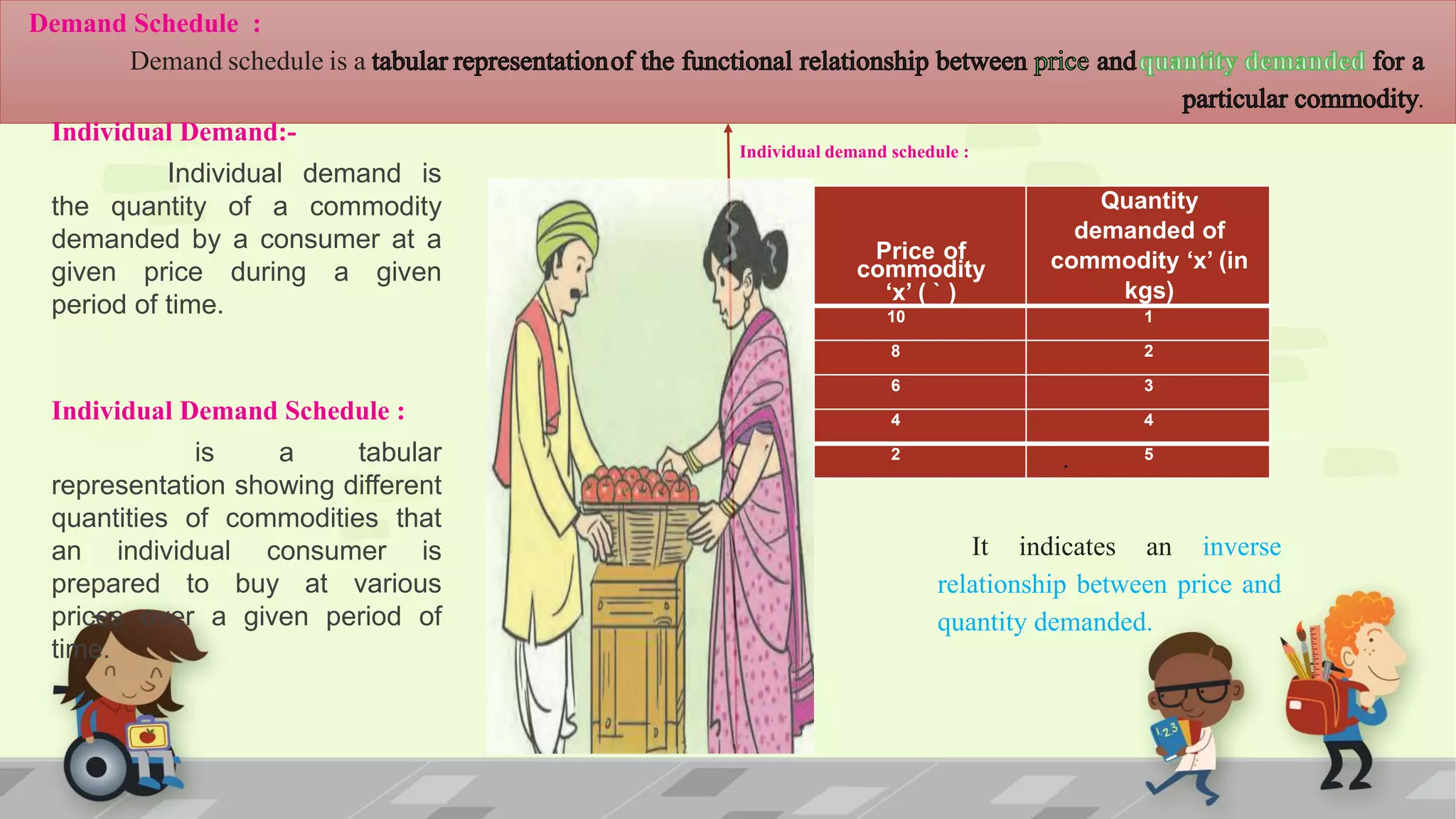
Demand schedule is a
.
Individual Demand:-
Individual demand is
the quantity of a commodity
demanded by a consumer at a
given price during a given
period of time.
Individual Demand Schedule :
is a tabular
representation showing different
quantities of commodities that
an individual consumer is
prepared to buy at various
prices over a given period of
time.
Individual demand schedule :
Price of
commodity
‘x’ ( ` )
Quantity
demanded of
commodity ‘x’ (in
kgs)
10 1
8 2
6 3
4 4
2 5
.
It indicates an inverse
relationship between price and
quantity demanded.
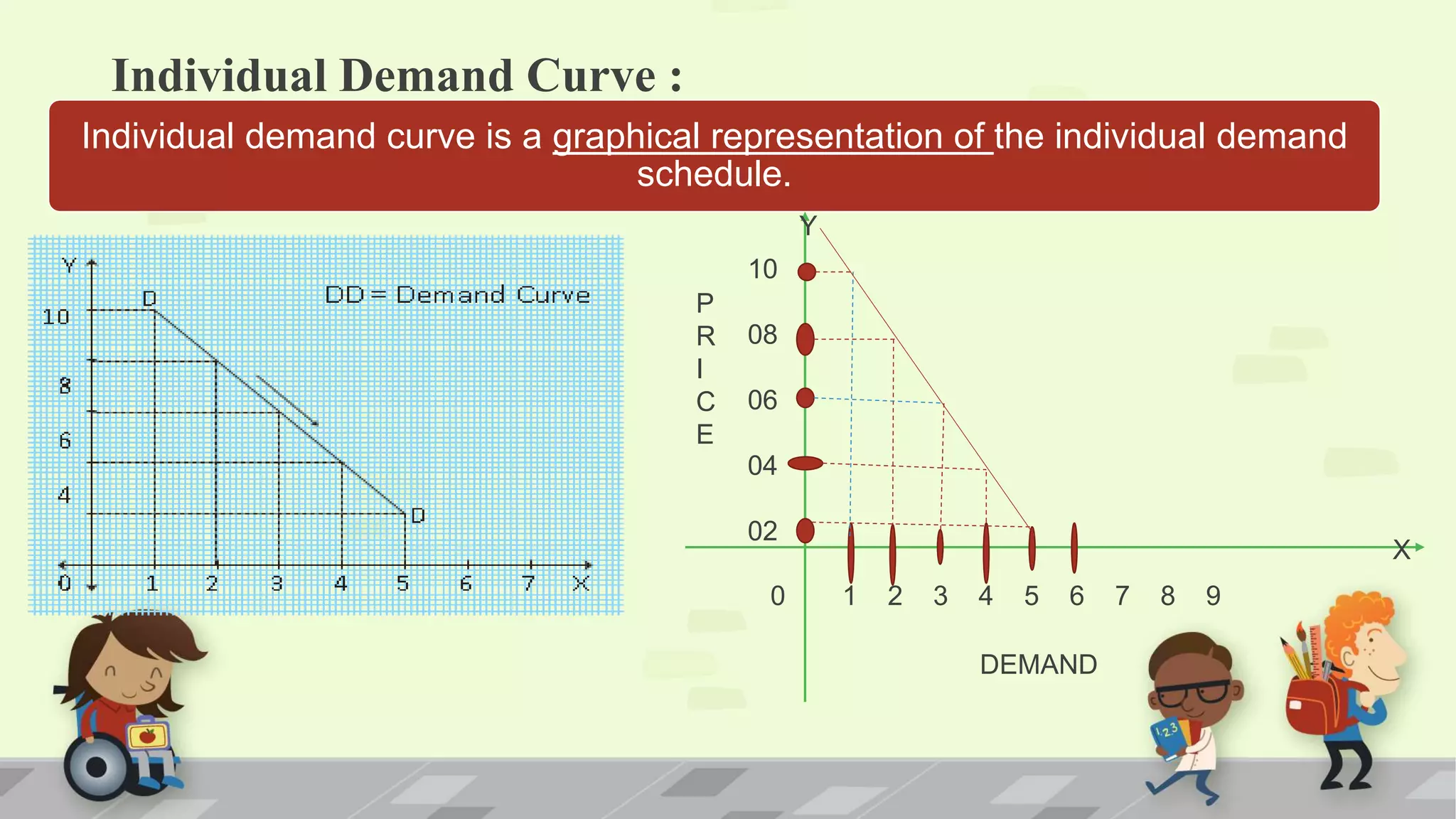
Individual Demand Curve :
Individual demand curve is a graphical representation of the individual demand
schedule.
0 1 2 3 4 5 6 7 8 9
10
08
06
04
02
Y
X
P
R
I
C
E
DEMAND
Market Demand :
Market
demand is total demand for a
commodity from all the
consumers at a given price
during a given period of time.
Market demand schedule is a tabular representation
showing different quantities of commodity which all
consumers are prepared to buy at various prices over a
given period of time.
Price of
commodity
Quantity of ‘x’demanded
Kgs.
Market
demand
‘x’( ` ) Con-
sumer
Con-
sumer
Con-
sumer
A + B + C
A B C
10 5 10 15 30
8 10 15 20 45
6 15 20 25 60
4 20 25 30 75
2 25 30 35 90
there is an inverse relationship between
price and quantity demanded.
Market Demand:-
Market demand is total demand for a commodity from all the consumers at a given price
during a given period of time.
Market Demand Schedule :
Market demand schedule is a tabular
representation showing different quantities of commodity which all
consumers are prepared to buy at various prices over a given
period of time.
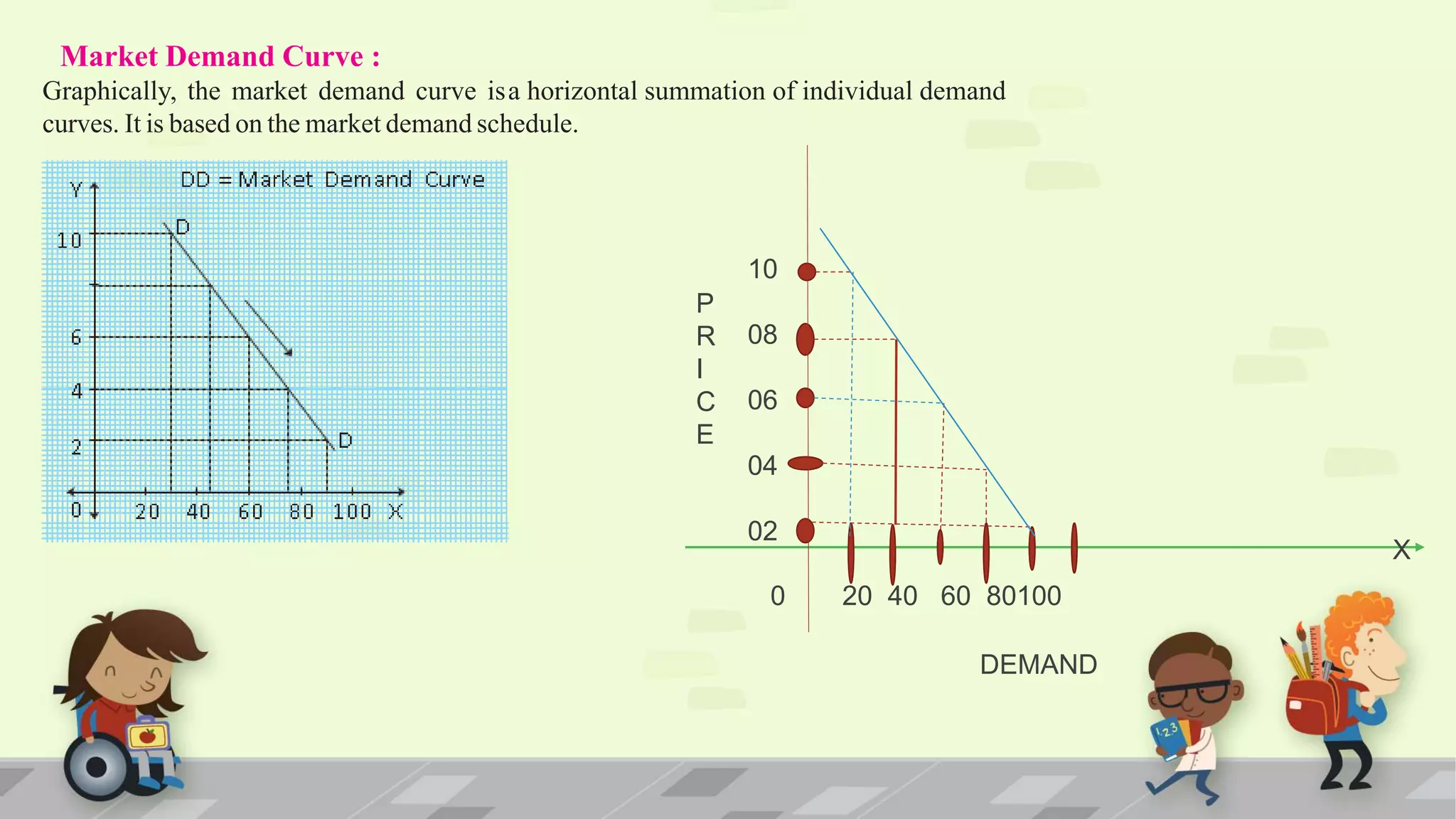
Market Demand Curve :
Graphically, the market demand curve isa horizontal summation of individual demand
curves. It is based on the market demand schedule.
0 20 40 60 80100
10
08
06
04
02
X
P
R
I
C
E
DEMAND
Reasons justifying downward sloping demandcurve are as follows :
Law of Diminishing Marginal Utility
Income effect
Substitution effect :
Multi-purpose uses
New Consumers
Types of Demand
Types of
Demand
•Direct demand
•Indirect demand
•Complementary/ Joint demand
•Composite demand
•Competitive demand
Determinants of Demand:-
Price
Income:
Prices of Substitute Goods
Price of Complementary Goods :
Nature of product
Size of population
Expectations about future prices
Advertisement:
Tastes, Habits and Fashions
Level of Taxation
Other factors :
Climatic conditions
Changes in technology
Government policy
Customs and traditions etc
Law of Demand :
Introduction :
The law of demand was introduced by Prof. Alfred Marshall in his
book, ‘Principles of Economics’, which was published in 1890. The law
explains the functional relationship between price and quantity
demanded.
Statement of the Law :
According to Prof. Alfred Marshall, “Other things being equal, higher
the price of a commodity, smaller is the quantity demanded and lower the
price of a commodity, larger is thequantity demanded.”
there is an inverse
relationship
between price and
quantity
demanded.
Symbolically, the functional
relationship between
demand and price is
expressed as
Dx = f (Px)
D = Demand for a
commodity.
x = Commodity
f = Function
Px = Price of a commodity
Demand schedule :
Price of
commodity ‘x’ (`)
Quantity demanded of
commodity ‘x’ (in kgs.)
50 1
40 2
30 3
20 4
10 5
P
R
I
C
E
D E M A N D
0 1 2 3 4 5
50
40
30
20
10
P
R
I
C
E
DEMAND
Assumptions :
Constant level of income :
No change in size of population
Prices of substitute goods remain constant
Prices of complementary goods remain constant :
No expectations about future changes in prices
No change in tastes, habits, preferences, fashions etc.
No change in taxation policy :
Exceptions to the Law of Demand :
under exceptional circumstances, consumer buys more when the price of commodity
rises and buys less when price of commodity falls.
In such cases, demandcurve slopes upwards from left to right.
i.e. the demand curve has a positive slope
Exceptional
Demand Curve
P
R
I
C
E
D E M A N D
Following are the exceptions to the law ofdemand:
Giffen's paradox :
Prestige goods
Speculation :
Price illusion :
Ignorance :
Habitual goods
Variations in Demand :
When the demand for a commodity falls or rises due to a change in price alone and other factors remain
constant, it is called variations in demand.
Expansion of demand:
Expansion of demand refers to rise in quantity
demanded due to fall in price alone while other factors like
tastes, income of the consumer, size of population etc. remain
unchanged.
EXPANSION
OF DEMAND
P
R
I
C
E
D E M A N D
Demand moves in
downward direction on the
same demand curve.
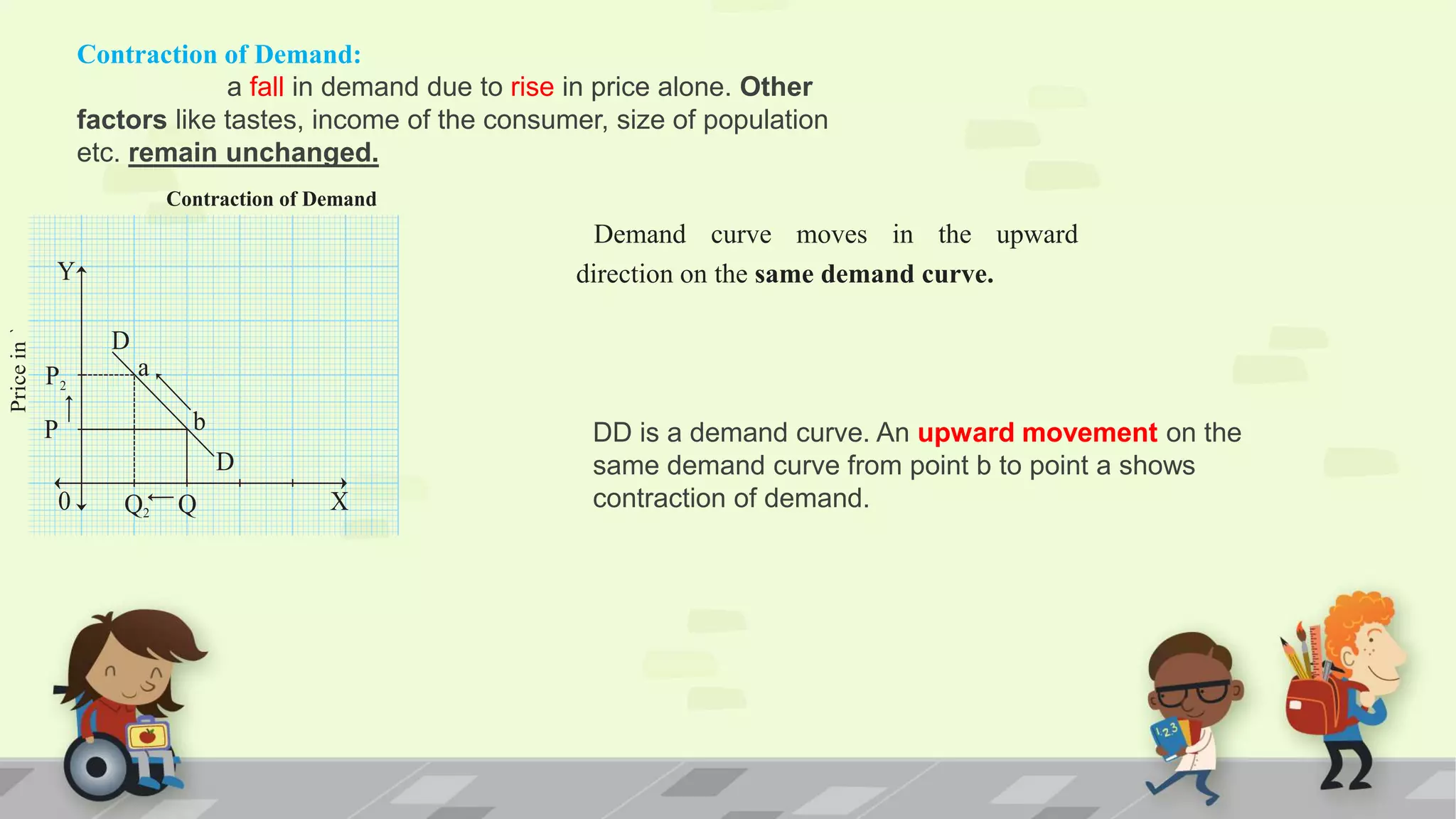
Contraction of Demand:
a fall in demand due to rise in price alone. Other
factors like tastes, income of the consumer, size of population
etc. remain unchanged.
Contraction of Demand
Y
D
P
P
2
a
b
D
0 Q2 Q X
Price
in
`
Demand curve moves in the upward
direction on the same demand curve.
DD is a demand curve. An upward movement on the
same demand curve from point b to point a shows
contraction of demand.
P
P1
Q
1
Q
0
D
D
0
P
Q
P1
Q2
D
D
0
P
Q
P1
Q
1
P2
Q2
D
D
CONTRACTION
OF DEMAND
EXPANSION OF
DEMAND
VARIATION IN
DEMAND
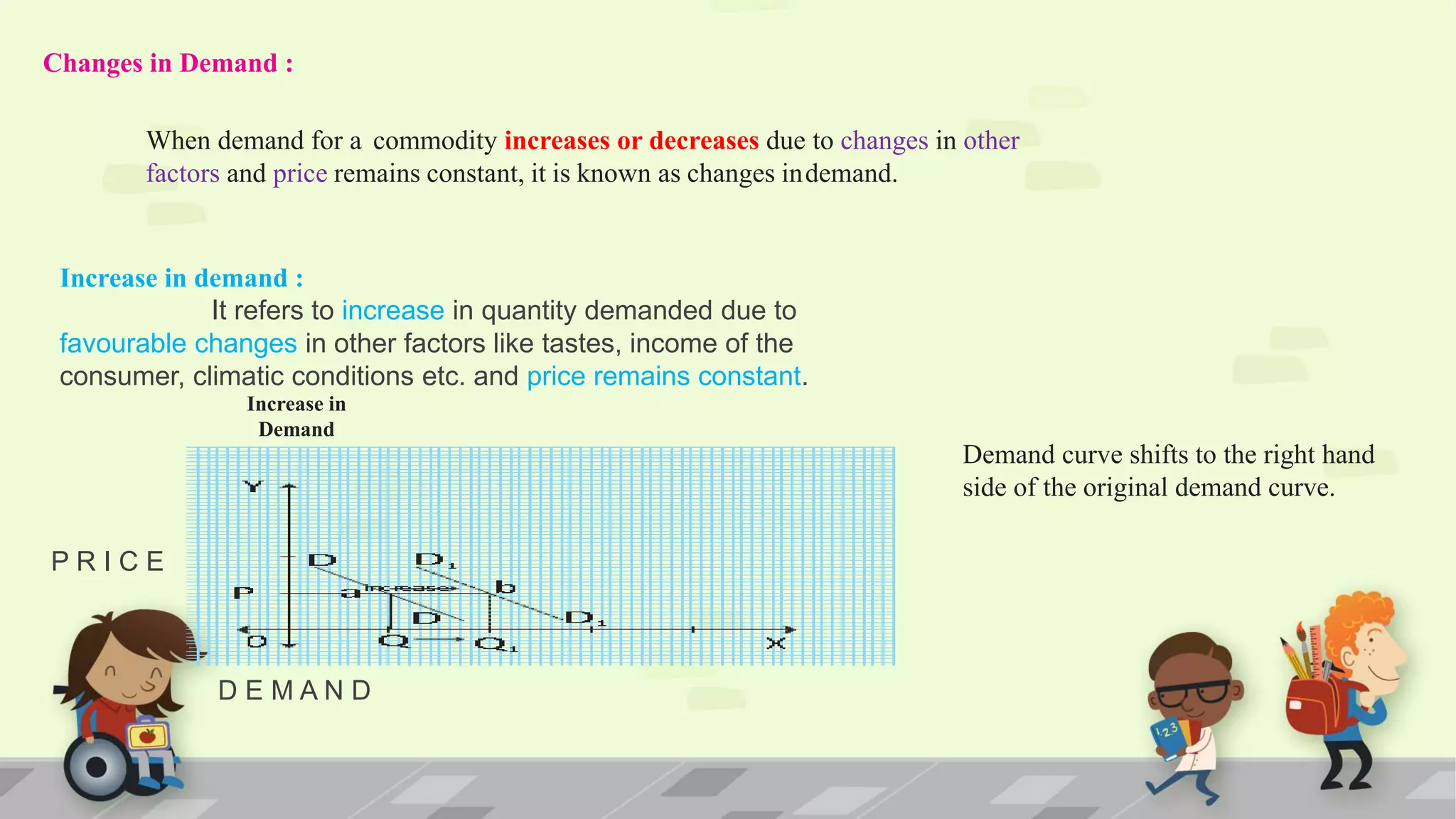
Changes in Demand :
When demand for a commodity increases or decreases due to changes in other
factors and price remains constant, it is known as changes indemand.
Increase in demand :
It refers to increase in quantity demanded due to
favourable changes in other factors like tastes, income of the
consumer, climatic conditions etc. and price remains constant.
Increase in
Demand
D E M A N D
P R I C E
Demand curve shifts to the right hand
side of the original demand curve.
Decrease in demand :
It refers to decrease in quantity demanded due to
unfavorable changes in other factors like tastes, income of the consumer,
climatic conditions etc.and price remains constant.
Demand curve shifts to left hand side of the
original demand curve.
DD is the original demand curve. It shifts inward
to the left from DD to D2D2 which indicates
decrease in demand.
O
Y
X
P
Oty. Demanded
PRICE
Q Q1
Q2
Change in Demand

3A Demand Analysis.pptx

  • 1.
  • 2.
    Utility is thebasis of demand. Utility may generate a desire or a need to have a particular commodity, but utility on its own cannot generate demand for the commodity. This chapter is an effort to analyse the concept of demand. Demand analysis is concerned with consumer behaviour. Demand = + willingness to purchase + Ability to pay.
  • 3.
    Meaning of Demand: In ordinary language, demand means a desire. Desire means an urge to have something. In Economics, demand means a desire which is backed by willingness and ability to pay. For example, if a person has the desire to purchase a television set but does not have the adequate purchasing power then it will be simply a desire and not a demand. Thus, demand is an effective desire. All desires are not demand.
  • 4.
    Definition of Demand: According to Benham, “the demand for anything at a given price is the amount of it, which will be bought per unit of time at that price.” Thus, following are the features of demand : 1) Demand is a relative concept. 2) Demand is essentially expressed with reference to time and price.
  • 5.
    Demand Schedule : Demandschedule is a . Individual Demand:- Individual demand is the quantity of a commodity demanded by a consumer at a given price during a given period of time. Individual Demand Schedule : is a tabular representation showing different quantities of commodities that an individual consumer is prepared to buy at various prices over a given period of time. Individual demand schedule : Price of commodity ‘x’ ( ` ) Quantity demanded of commodity ‘x’ (in kgs) 10 1 8 2 6 3 4 4 2 5 . It indicates an inverse relationship between price and quantity demanded.
  • 6.
    Individual Demand Curve: Individual demand curve is a graphical representation of the individual demand schedule. 0 1 2 3 4 5 6 7 8 9 10 08 06 04 02 Y X P R I C E DEMAND
  • 7.
    Market Demand : Market demandis total demand for a commodity from all the consumers at a given price during a given period of time. Market demand schedule is a tabular representation showing different quantities of commodity which all consumers are prepared to buy at various prices over a given period of time. Price of commodity Quantity of ‘x’demanded Kgs. Market demand ‘x’( ` ) Con- sumer Con- sumer Con- sumer A + B + C A B C 10 5 10 15 30 8 10 15 20 45 6 15 20 25 60 4 20 25 30 75 2 25 30 35 90 there is an inverse relationship between price and quantity demanded.
  • 8.
    Market Demand:- Market demandis total demand for a commodity from all the consumers at a given price during a given period of time. Market Demand Schedule : Market demand schedule is a tabular representation showing different quantities of commodity which all consumers are prepared to buy at various prices over a given period of time.
  • 9.
    Market Demand Curve: Graphically, the market demand curve isa horizontal summation of individual demand curves. It is based on the market demand schedule. 0 20 40 60 80100 10 08 06 04 02 X P R I C E DEMAND
  • 10.
    Reasons justifying downwardsloping demandcurve are as follows : Law of Diminishing Marginal Utility Income effect Substitution effect : Multi-purpose uses New Consumers Types of Demand Types of Demand •Direct demand •Indirect demand •Complementary/ Joint demand •Composite demand •Competitive demand
  • 11.
    Determinants of Demand:- Price Income: Pricesof Substitute Goods Price of Complementary Goods : Nature of product Size of population Expectations about future prices Advertisement: Tastes, Habits and Fashions Level of Taxation Other factors : Climatic conditions Changes in technology Government policy Customs and traditions etc
  • 12.
    Law of Demand: Introduction : The law of demand was introduced by Prof. Alfred Marshall in his book, ‘Principles of Economics’, which was published in 1890. The law explains the functional relationship between price and quantity demanded. Statement of the Law : According to Prof. Alfred Marshall, “Other things being equal, higher the price of a commodity, smaller is the quantity demanded and lower the price of a commodity, larger is thequantity demanded.” there is an inverse relationship between price and quantity demanded. Symbolically, the functional relationship between demand and price is expressed as Dx = f (Px) D = Demand for a commodity. x = Commodity f = Function Px = Price of a commodity
  • 13.
    Demand schedule : Priceof commodity ‘x’ (`) Quantity demanded of commodity ‘x’ (in kgs.) 50 1 40 2 30 3 20 4 10 5 P R I C E D E M A N D 0 1 2 3 4 5 50 40 30 20 10 P R I C E DEMAND
  • 14.
    Assumptions : Constant levelof income : No change in size of population Prices of substitute goods remain constant Prices of complementary goods remain constant : No expectations about future changes in prices No change in tastes, habits, preferences, fashions etc. No change in taxation policy :
  • 15.
    Exceptions to theLaw of Demand : under exceptional circumstances, consumer buys more when the price of commodity rises and buys less when price of commodity falls. In such cases, demandcurve slopes upwards from left to right. i.e. the demand curve has a positive slope Exceptional Demand Curve P R I C E D E M A N D
  • 16.
    Following are theexceptions to the law ofdemand: Giffen's paradox : Prestige goods Speculation : Price illusion : Ignorance : Habitual goods
  • 17.
    Variations in Demand: When the demand for a commodity falls or rises due to a change in price alone and other factors remain constant, it is called variations in demand. Expansion of demand: Expansion of demand refers to rise in quantity demanded due to fall in price alone while other factors like tastes, income of the consumer, size of population etc. remain unchanged. EXPANSION OF DEMAND P R I C E D E M A N D Demand moves in downward direction on the same demand curve.
  • 18.
    Contraction of Demand: afall in demand due to rise in price alone. Other factors like tastes, income of the consumer, size of population etc. remain unchanged. Contraction of Demand Y D P P 2 a b D 0 Q2 Q X Price in ` Demand curve moves in the upward direction on the same demand curve. DD is a demand curve. An upward movement on the same demand curve from point b to point a shows contraction of demand.
  • 19.
  • 20.
    Changes in Demand: When demand for a commodity increases or decreases due to changes in other factors and price remains constant, it is known as changes indemand. Increase in demand : It refers to increase in quantity demanded due to favourable changes in other factors like tastes, income of the consumer, climatic conditions etc. and price remains constant. Increase in Demand D E M A N D P R I C E Demand curve shifts to the right hand side of the original demand curve.
  • 21.
    Decrease in demand: It refers to decrease in quantity demanded due to unfavorable changes in other factors like tastes, income of the consumer, climatic conditions etc.and price remains constant. Demand curve shifts to left hand side of the original demand curve. DD is the original demand curve. It shifts inward to the left from DD to D2D2 which indicates decrease in demand.
  • 22.

Editor's Notes

  • #3 NOTE: To change images on this slide, select a picture and delete it. Then click the Insert Picture icon in the placeholder to insert your own image.