HOLY FAMILY COLLEGE OF NURSING
LESSON PLAN
ON:
NEW BORN CARE & IMMUNIZATION SCHEDULE
{HEALTH TALK}
SUBMITTED TO:
SUBMITTEDBY:
MS. THRESIAMMA GEORGE NIDHI SHARMA
ASSISTANTPROFESSOR M.Sc. NURSING 1STYEAR
EVALUATION
LEARNING ACTIVITY
& AV AIDS
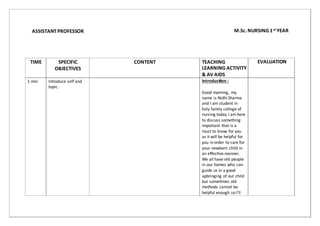
Introducton :
TIME SPECIFIC
OBJECTIVES
CONTENT TEACHING
1 min Introduce self and
topic.
Good morning, my
name is Nidhi Sharma
and I am student in
holy family college of
nursing today I am here
to discuss something
important that is a
must to know for you
as it will be helpful for
you in order to care for
your newborn child in
an e๏ฌ€ectve manner.
We all have old people
in our homes who can
guide us in a good
upbringing of our child
but sometmes old
methods cannot be
helpful enough so Iโ€™ll
TIME SPECIFIC
OBJECTIVES
CONTENT TEACHING
LEARNING ACTIVITY
& AV AIDS
EVALUATION
telling you about all the
aspects of newborn
care as well as
immunizaton schedule.
Describe the
Student teacher
disclosed the
importance of newborn
care and immunizaton
by using lecture
method.
importance of
newborn care and
immunizaton.
ยฝ min Describe the
importance of
newborn care and
immunizaton.
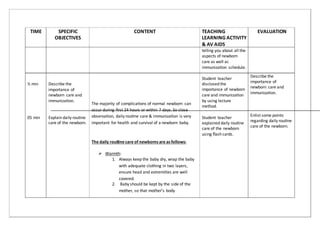
The majority of complicatons of normal newborn can
occur during ๏ฌrst 24 hours or within 7 days. So close
observaton, daily routne care & immunizaton is very Enlist some points
regarding daily routne
care of the newborn.
05 min Explain daily routne Student teacher
care of the newborn. important for health and survival of a newborn baby. explained daily routne
care of the newborn
using ๏ฌ‚ash cards.
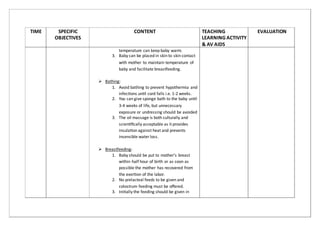
The daily routne care of newborns are as follows:
๏ƒ˜ Warmth:
1. Always keep the baby dry, wrap the baby
with adequate clothing in two layers,
ensure head and extremites are well
covered.
2. Baby should be kept by the side of the
mother, so that motherโ€™s body
TIME SPECIFIC
OBJECTIVES
CONTENT TEACHING
LEARNING ACTIVITY
& AV AIDS
EVALUATION
temperature can keep baby warm.
3. Baby can be placed in skin to skin contact
with mother to maintain temperature of
baby and facilitate breasteeding.
๏ƒ˜ Bathing:
1. Avoid bathing to prevent hypothermia and
infectons untl cord falls i.e. 1-2 weeks.
2. You can give sponge bath to the baby untl
3-4 weeks of life, but unnecessary
exposure or undressing should be avoided
3. The oil massage is both culturally and
scient๏ฌcally acceptable as it provides
insulaton against heat and prevents
insensible water loss.
๏ƒ˜ Breasteeding:
1. Baby should be put to motherโ€™s breast
within half hour of birth or as soon as
possible the mother has recovered from
the exerton of the labor.
2. No prelacteal feeds to be given and
colostrum feeding must be o๏ฌ€ered.
3. Initally the feeding should be given in
TIME SPECIFIC
OBJECTIVES
CONTENT TEACHING
LEARNING ACTIVITY
& AV AIDS
EVALUATION
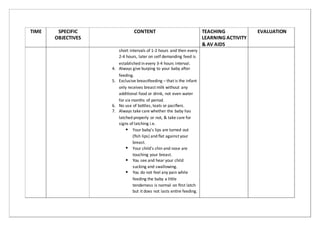
short intervals of 1-2 hours and then every
2-4 hours, later on self demanding feed is
established in every 3-4 hours interval.
4. Always give burping to your baby afer
feeding.
5. Exclusive breasteeding โ€“ that is the infant
only receives breast milk without any
additonal food or drink, not even water
for six months of period.
6. No use of botles, teats or paci๏ฌers.
7. Always take care whether the baby has
latched properly or not, & take care for
signs of latching i.e.
Your baby's lips are turned out
(๏ฌsh lips) and ๏ฌ‚at against your
breast.
Your child's chin and nose are
touching your breast.
You see and hear your child
sucking and swallowing.
You do not feel any pain while
feeding the baby a litle
tenderness is normal on ๏ฌrst latch
but it does not lasts entre feeding.
TIME SPECIFIC
OBJECTIVES
CONTENT TEACHING
LEARNING ACTIVITY
& AV AIDS
EVALUATION
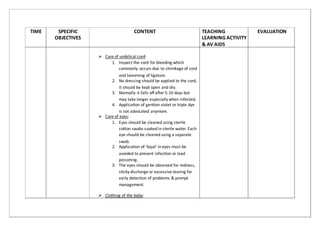
๏ƒ˜ Care of umbilical cord:
1. Inspect the cord for bleeding which
commonly occurs due to shrinkage of cord
and loosening of ligature.
2. No dressing should be applied to the cord,
it should be kept open and dry.
3. Normally it falls o๏ฌ€ afer5-10 days but
may take longer especially when infected.
4. Applicaton of genton violet or triple dye
is not advocated anymore.
๏ƒ˜ Care of eyes:
1. Eyes should be cleaned using sterile
coton swabs soaked in sterile water. Each
eye should be cleaned using a separate
swab.
2. Applicaton of โ€˜kajalโ€™ in eyes must be
avoided to prevent infecton or lead
poisoning.
3. The eyes should be observed for redness,
stcky discharge or excessive tearing for
early detecton of problems & prompt
management.
๏ƒ˜ Clothing of the baby:
TIME SPECIFIC
OBJECTIVES
CONTENT TEACHING
LEARNING ACTIVITY
& AV AIDS
EVALUATION
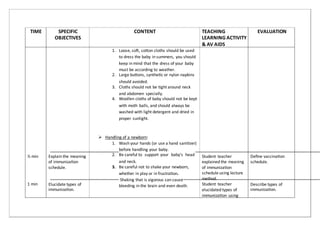
1. Loose, sof, coton cloths should be used
to dress the baby in summers, you should
keep in mind that the dress of your baby
must be according to weather.
2. Large butons, synthetc or nylon napkins
should avoided.
3. Cloths should not be tght around neck
and abdomen specially.
4. Woollen cloths of baby should not be kept
with moth balls, and should always be
washed with light detergent and dried in
proper sunlight.
๏ƒ˜ Handling of a newborn:
1. Wash your hands (or use a hand sanitzer)
before handling your baby.
2. Be careful to support your baby's head
ยฝ min
1 min
Explain the meaning
of immunizaton
schedule.
Student teacher
explained the meaning schedule.
of immunizaton
schedule using lecture
method.
Student teacher
elucidated types of
immunizaton using
De๏ฌne vaccinaton
and neck.
3. Be careful not to shake your newborn,
whether in play or in frustraton.
Shaking that is vigorous can cause
bleeding in the brain and even death.
Elucidate types of
immunizaton.
Describe types of
immunizaton.
TIME SPECIFIC
OBJECTIVES
CONTENT TEACHING EVALUATION
LEARNING ACTIVITY
& AV AIDS
lecture cum discussion
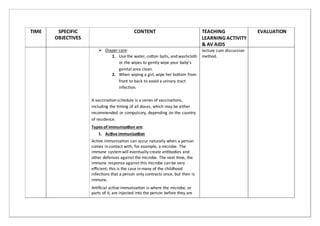
๏ƒ˜ Diaper care:
1. Use the water, coton balls, and washcloth method.
or the wipes to gently wipe your baby's
genital area clean.
2. When wiping a girl, wipe her botom from
front to back to avoid a urinary tract
infecton.
A vaccinaton schedule is a series of vaccinatons,
including the tming of all doses, which may be either
recommended or compulsory, depending on the country
of residence.
Types of immunizaton are:
1. Actve immunizaton
Actve immunizaton can occur naturally when a person
comes in contact with, for example, a microbe. The
immune systemwill eventually create antbodies and
other defenses against the microbe. The next tme, the
immune response against this microbe can be very
e๏ฌƒcient; this is the case in many of the childhood
infectons that a person only contracts once, but then is
immune.
Art๏ฌcial actve immunizaton is where the microbe, or
parts of it, are injected into the person before they are
TIME SPECIFIC
OBJECTIVES
CONTENT TEACHING
LEARNING ACTIVITY
& AV AIDS
EVALUATION
able to take it in naturally. If whole microbes are used,
they are pre-treated.
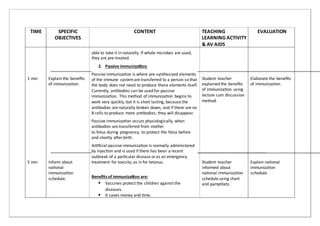
2. Passive immunizaton
Passive immunizaton is where pre-synthesized elements
of the immune systemare transferred to a person so that
the body does not need to produce these elements itself.
Currently, antbodies can be used for passive
immunizaton. This method of immunizaton begins to
work very quickly, but it is short lastng, because the
antbodies are naturally broken down, and if there are no
B cells to produce more antbodies, they will disappear.
1 min Explain the bene๏ฌts
of immunizaton.
Student teacher Elaborate the bene๏ฌts
of immunizaton.
explained the bene๏ฌts
of immunizaton using
lecture cum discussion
method.
Passive immunizaton occurs physiologically, when
antbodies are transferred from mother
to fetus during pregnancy, to protect the fetus before
and shortly aferbirth.
Art๏ฌcial passive immunizaton is normally administered
by injecton and is used if there has been a recent
outbreak of a partcular disease oras an emergency
treatment for toxicity, as in for tetanus.
5 min Inform about
natonal
immunizaton
schedule.
Student teacher
informed about
natonal immunizaton
schedule using chart
and pamphlets.
Explain natonal
immunizaton
schedule.
Bene๏ฌts of immunizaton are:
Vaccines protect the children against the
diseases.
It saves money and tme.
TIME SPECIFIC
OBJECTIVES
CONTENT TEACHING
LEARNING ACTIVITY
& AV AIDS
EVALUATION
Vaccines are safe and e๏ฌ€ectve; all vaccines are
carefully reviewed by doctors, scientsts and
federal government to make sure they are safe.
A vaccine not only protects your child from
diseases but also the others whom you care for.
Sometmes a vaccinated child may get a disease
but it may of less severe sign and symptoms as
compared to a non vaccinated child, therefore it
can be cured.
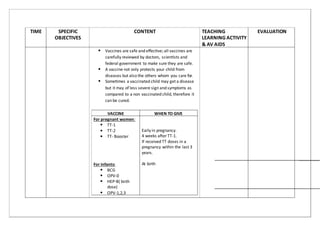
VACCINE
For pregnant women:
WHEN TO GIVE
TT-1
TT-2 Early in pregnancy.
4 weeks aferTT-1.
If received TT doses in a
pregnancy within the last 3
years.
TT- Booster
For infants: At birth
BCG
OPV-0
HEP-B( birth
dose)
OPV-1,2,3
TIME SPECIFIC
OBJECTIVES
CONTENT TEACHING
LEARNING ACTIVITY
& AV AIDS
EVALUATION
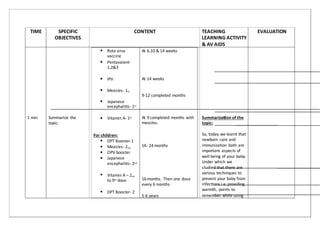
Rota virus
vaccine
At 6,10 & 14 weeks
Pentavalent-
1,2&3
IPV At 14 weeks
Measles- 1st
9-12 completed months
Japanese
encephalits- 1st
1 min Summarize the
topic.
At 9 completed months with
measles.
Summarizaton of the
topic:
Vitamin A- 1st
So, today we learnt that
newborn care and
immunizaton both are
important aspects of
well being of your baby.
Under which we
For children:
DPT Booster-1
16- 24 months
Measles- 2nd
OPV booster
Japanese
encephalits- 2nd
studied that there are
various techniques to
prevent your baby from
infectons i.e. providing
warmth, points to
Vitamin A โ€“ 2nd
to 9th dose 16months. Then one dose
every 6 months
DPT Booster- 2
5-6 years remember while using
TIME SPECIFIC
OBJECTIVES
CONTENT TEACHING
LEARNING ACTIVITY
& AV AIDS
EVALUATION
diapers on baby,
breasteeding and its
techniques, umbilical
cord care, basics of
bathing etc. Then
๏ฌnally we all learnt
about immunizaton
schedule.
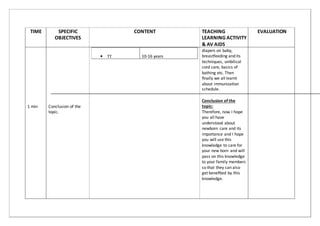
TT 10-16 years
Conclusion of the
topic:
Therefore, now I hope
you all have
1 min Conclusion of the
topic.
understood about
newborn care and its
importance and I hope
you will use this
knowledge to care for
your new born and will
pass on this knowledge
to your family members
so that they can also
get bene๏ฌted by this
knowledge.
TIME SPECIFIC
OBJECTIVES
CONTENT TEACHING
LEARNING ACTIVITY
& AV AIDS
EVALUATION
TIME SPECIFIC
OBJECTIVES
CONTENT TEACHING
LEARNING ACTIVITY
& AV AIDS
EVALUATION
Bibliography
Data Parul. Pediatric Nursing 2009; 2nd
editon. New Delhi; Jaypee publishers/: Pp
68-75
Jacob Annamma. A comprehensive
textbook of midwifery 2008; 2nd editon.
New Delhi; Jaypee publishers/: Pp 487-
495
www.wekipedia.com
www.slideshare.net

383371366-newborn-care-and-current-immunization-schedule.pdf.docx

  • 1.
    HOLY FAMILY COLLEGEOF NURSING LESSON PLAN ON: NEW BORN CARE & IMMUNIZATION SCHEDULE {HEALTH TALK} SUBMITTED TO: SUBMITTEDBY: MS. THRESIAMMA GEORGE NIDHI SHARMA
  • 2.
    ASSISTANTPROFESSOR M.Sc. NURSING1STYEAR EVALUATION LEARNING ACTIVITY & AV AIDS Introducton : TIME SPECIFIC OBJECTIVES CONTENT TEACHING 1 min Introduce self and topic. Good morning, my name is Nidhi Sharma and I am student in holy family college of nursing today I am here to discuss something important that is a must to know for you as it will be helpful for you in order to care for your newborn child in an e๏ฌ€ectve manner. We all have old people in our homes who can guide us in a good upbringing of our child but sometmes old methods cannot be helpful enough so Iโ€™ll
  • 3.
    TIME SPECIFIC OBJECTIVES CONTENT TEACHING LEARNINGACTIVITY & AV AIDS EVALUATION telling you about all the aspects of newborn care as well as immunizaton schedule. Describe the Student teacher disclosed the importance of newborn care and immunizaton by using lecture method. importance of newborn care and immunizaton. ยฝ min Describe the importance of newborn care and immunizaton. The majority of complicatons of normal newborn can occur during ๏ฌrst 24 hours or within 7 days. So close observaton, daily routne care & immunizaton is very Enlist some points regarding daily routne care of the newborn. 05 min Explain daily routne Student teacher care of the newborn. important for health and survival of a newborn baby. explained daily routne care of the newborn using ๏ฌ‚ash cards. The daily routne care of newborns are as follows: ๏ƒ˜ Warmth: 1. Always keep the baby dry, wrap the baby with adequate clothing in two layers, ensure head and extremites are well covered. 2. Baby should be kept by the side of the mother, so that motherโ€™s body
  • 4.
    TIME SPECIFIC OBJECTIVES CONTENT TEACHING LEARNINGACTIVITY & AV AIDS EVALUATION temperature can keep baby warm. 3. Baby can be placed in skin to skin contact with mother to maintain temperature of baby and facilitate breasteeding. ๏ƒ˜ Bathing: 1. Avoid bathing to prevent hypothermia and infectons untl cord falls i.e. 1-2 weeks. 2. You can give sponge bath to the baby untl 3-4 weeks of life, but unnecessary exposure or undressing should be avoided 3. The oil massage is both culturally and scient๏ฌcally acceptable as it provides insulaton against heat and prevents insensible water loss. ๏ƒ˜ Breasteeding: 1. Baby should be put to motherโ€™s breast within half hour of birth or as soon as possible the mother has recovered from the exerton of the labor. 2. No prelacteal feeds to be given and colostrum feeding must be o๏ฌ€ered. 3. Initally the feeding should be given in
  • 5.
    TIME SPECIFIC OBJECTIVES CONTENT TEACHING LEARNINGACTIVITY & AV AIDS EVALUATION short intervals of 1-2 hours and then every 2-4 hours, later on self demanding feed is established in every 3-4 hours interval. 4. Always give burping to your baby afer feeding. 5. Exclusive breasteeding โ€“ that is the infant only receives breast milk without any additonal food or drink, not even water for six months of period. 6. No use of botles, teats or paci๏ฌers. 7. Always take care whether the baby has latched properly or not, & take care for signs of latching i.e. Your baby's lips are turned out (๏ฌsh lips) and ๏ฌ‚at against your breast. Your child's chin and nose are touching your breast. You see and hear your child sucking and swallowing. You do not feel any pain while feeding the baby a litle tenderness is normal on ๏ฌrst latch but it does not lasts entre feeding.
  • 6.
    TIME SPECIFIC OBJECTIVES CONTENT TEACHING LEARNINGACTIVITY & AV AIDS EVALUATION ๏ƒ˜ Care of umbilical cord: 1. Inspect the cord for bleeding which commonly occurs due to shrinkage of cord and loosening of ligature. 2. No dressing should be applied to the cord, it should be kept open and dry. 3. Normally it falls o๏ฌ€ afer5-10 days but may take longer especially when infected. 4. Applicaton of genton violet or triple dye is not advocated anymore. ๏ƒ˜ Care of eyes: 1. Eyes should be cleaned using sterile coton swabs soaked in sterile water. Each eye should be cleaned using a separate swab. 2. Applicaton of โ€˜kajalโ€™ in eyes must be avoided to prevent infecton or lead poisoning. 3. The eyes should be observed for redness, stcky discharge or excessive tearing for early detecton of problems & prompt management. ๏ƒ˜ Clothing of the baby:
  • 7.
    TIME SPECIFIC OBJECTIVES CONTENT TEACHING LEARNINGACTIVITY & AV AIDS EVALUATION 1. Loose, sof, coton cloths should be used to dress the baby in summers, you should keep in mind that the dress of your baby must be according to weather. 2. Large butons, synthetc or nylon napkins should avoided. 3. Cloths should not be tght around neck and abdomen specially. 4. Woollen cloths of baby should not be kept with moth balls, and should always be washed with light detergent and dried in proper sunlight. ๏ƒ˜ Handling of a newborn: 1. Wash your hands (or use a hand sanitzer) before handling your baby. 2. Be careful to support your baby's head ยฝ min 1 min Explain the meaning of immunizaton schedule. Student teacher explained the meaning schedule. of immunizaton schedule using lecture method. Student teacher elucidated types of immunizaton using De๏ฌne vaccinaton and neck. 3. Be careful not to shake your newborn, whether in play or in frustraton. Shaking that is vigorous can cause bleeding in the brain and even death. Elucidate types of immunizaton. Describe types of immunizaton.
  • 8.
    TIME SPECIFIC OBJECTIVES CONTENT TEACHINGEVALUATION LEARNING ACTIVITY & AV AIDS lecture cum discussion ๏ƒ˜ Diaper care: 1. Use the water, coton balls, and washcloth method. or the wipes to gently wipe your baby's genital area clean. 2. When wiping a girl, wipe her botom from front to back to avoid a urinary tract infecton. A vaccinaton schedule is a series of vaccinatons, including the tming of all doses, which may be either recommended or compulsory, depending on the country of residence. Types of immunizaton are: 1. Actve immunizaton Actve immunizaton can occur naturally when a person comes in contact with, for example, a microbe. The immune systemwill eventually create antbodies and other defenses against the microbe. The next tme, the immune response against this microbe can be very e๏ฌƒcient; this is the case in many of the childhood infectons that a person only contracts once, but then is immune. Art๏ฌcial actve immunizaton is where the microbe, or parts of it, are injected into the person before they are
  • 9.
    TIME SPECIFIC OBJECTIVES CONTENT TEACHING LEARNINGACTIVITY & AV AIDS EVALUATION able to take it in naturally. If whole microbes are used, they are pre-treated. 2. Passive immunizaton Passive immunizaton is where pre-synthesized elements of the immune systemare transferred to a person so that the body does not need to produce these elements itself. Currently, antbodies can be used for passive immunizaton. This method of immunizaton begins to work very quickly, but it is short lastng, because the antbodies are naturally broken down, and if there are no B cells to produce more antbodies, they will disappear. 1 min Explain the bene๏ฌts of immunizaton. Student teacher Elaborate the bene๏ฌts of immunizaton. explained the bene๏ฌts of immunizaton using lecture cum discussion method. Passive immunizaton occurs physiologically, when antbodies are transferred from mother to fetus during pregnancy, to protect the fetus before and shortly aferbirth. Art๏ฌcial passive immunizaton is normally administered by injecton and is used if there has been a recent outbreak of a partcular disease oras an emergency treatment for toxicity, as in for tetanus. 5 min Inform about natonal immunizaton schedule. Student teacher informed about natonal immunizaton schedule using chart and pamphlets. Explain natonal immunizaton schedule. Bene๏ฌts of immunizaton are: Vaccines protect the children against the diseases. It saves money and tme.
  • 10.
    TIME SPECIFIC OBJECTIVES CONTENT TEACHING LEARNINGACTIVITY & AV AIDS EVALUATION Vaccines are safe and e๏ฌ€ectve; all vaccines are carefully reviewed by doctors, scientsts and federal government to make sure they are safe. A vaccine not only protects your child from diseases but also the others whom you care for. Sometmes a vaccinated child may get a disease but it may of less severe sign and symptoms as compared to a non vaccinated child, therefore it can be cured. VACCINE For pregnant women: WHEN TO GIVE TT-1 TT-2 Early in pregnancy. 4 weeks aferTT-1. If received TT doses in a pregnancy within the last 3 years. TT- Booster For infants: At birth BCG OPV-0 HEP-B( birth dose) OPV-1,2,3
  • 11.
    TIME SPECIFIC OBJECTIVES CONTENT TEACHING LEARNINGACTIVITY & AV AIDS EVALUATION Rota virus vaccine At 6,10 & 14 weeks Pentavalent- 1,2&3 IPV At 14 weeks Measles- 1st 9-12 completed months Japanese encephalits- 1st 1 min Summarize the topic. At 9 completed months with measles. Summarizaton of the topic: Vitamin A- 1st So, today we learnt that newborn care and immunizaton both are important aspects of well being of your baby. Under which we For children: DPT Booster-1 16- 24 months Measles- 2nd OPV booster Japanese encephalits- 2nd studied that there are various techniques to prevent your baby from infectons i.e. providing warmth, points to Vitamin A โ€“ 2nd to 9th dose 16months. Then one dose every 6 months DPT Booster- 2 5-6 years remember while using
  • 12.
    TIME SPECIFIC OBJECTIVES CONTENT TEACHING LEARNINGACTIVITY & AV AIDS EVALUATION diapers on baby, breasteeding and its techniques, umbilical cord care, basics of bathing etc. Then ๏ฌnally we all learnt about immunizaton schedule. TT 10-16 years Conclusion of the topic: Therefore, now I hope you all have 1 min Conclusion of the topic. understood about newborn care and its importance and I hope you will use this knowledge to care for your new born and will pass on this knowledge to your family members so that they can also get bene๏ฌted by this knowledge.
  • 13.
  • 14.
    TIME SPECIFIC OBJECTIVES CONTENT TEACHING LEARNINGACTIVITY & AV AIDS EVALUATION Bibliography Data Parul. Pediatric Nursing 2009; 2nd editon. New Delhi; Jaypee publishers/: Pp 68-75 Jacob Annamma. A comprehensive textbook of midwifery 2008; 2nd editon. New Delhi; Jaypee publishers/: Pp 487- 495 www.wekipedia.com www.slideshare.net