By: Momina
Click for More >>>

      Need to Protect            Data Protection
    Confidentiality of Data        Legislation

                                 Social and Ethical
           Shop Security       Implications of Access
                              to Personal Information

           Online Banking        Online Shopping


Back to
Contents
Need to protect confidentiality
               of data
  • This means that data should only be
    seen by people who are authorised to
    see it.
  What is the main technique used into ICT
     to ensure the confidentiality of data in
                 online systems?
                   Encryption


Back to
              What is encryption?
Contents
Encryption
  • This is a process by which ordinary data is
    converted into a secret code. This is done so
    that anyone unauthorised to see the data
    doesn‟t.
  • However, they do have the ability to delete
    the information that they intercept.
  • On the receiving on of the encrypted data it
    is decrypted using a secret key.

                                              Note:
                                     Unencrypted data
                                     is called plain text
                                     Encrypted data is
                                     referred to as cipher
Back to
                                     text
Contents
Shop Security
 There are two types of encryption keys:
 1. Public encryption key
 2. Private encryption key
 People have a public encryption key they can tell
    everyone about. And they have a private
    encryption key, which only they know about.

                     So what?


Back to
Contents
So…
   • If you know a persons public encryption key; you
      can encrypt a message and send it to them. But
       ONLY that individual can decrypt the message
                   using their private key.
  • For example: When John wants to send a secure
    message to Jane, he uses Jane's public key to
    encrypt the message. Jane then uses her private
    key to decrypt it.


             What is a public key system?


Back to
Contents
Public Key System
             “This is used to encrypt data
             that is transmitted using the
           Internet for payment purposes”

       Keep in mind that when we use the
      Internet to make a payment; all these
        tasks of encrypting and decrypting
        happens in the background (so we
                    don’t see it)
Back to
Contents
Online Banking
              “Online banking uses secure
           sites and all the data transferred
           using the Internet including your
                password, is encrypted.”

  • Encryption does not prevent hackers from
    accessing your PC. These hackers could use a key
    logging software. This allows them to detect the
    keys you are pressing on the keyboard. (this may
    also allow them to discover your password)

Back to        Additional Methods of Security
Contents
Additional Methods of Security
    1- Use Transaction numbers (TANs): these are passwords that can only
    be used once. This could be sent to you via a text message from the
    bank. They are only valid for a few minutes thus reducing the time for
                       a hacker to intercept and use it.

      2- Ask the user to type in only part of the password. Every time the
     user logs in they are asked for the part of the password in a different
      combination (i.e. 2nd character, 3rd character, and 6th character)


      3- Providing the customer with a handheld chip and PIN device. This
       device generates single-use passwords. Several things are required
          by the user to access their account, it includes the following:
     • debit card
                                      A customer enters the card into the
     •PIN number                      device and enters their PIN number.
     •Online security number          They are then issued with an 8-digit
     •Chip and PIN itself             code. Using this they can then log in.
Back to
Contents
Online Shopping
  • It is the customers responsibility that they
    use a reputable, secure online store.
    How do you know if data is being
    transmitted in a secure way?
  1.   The „https‟ prefix in
       the URL compared
                                 Protocols used in the
       to the normal „http‟      encryption of
  2.   The secure socket         messages between a
       layer (SSL)- the pad-     client computer and
       lock sign at the bottom   server
       of the screen.
                                       Few Important
Back to                                    Points
Contents
Important Points
  × The customer MUST check the contact details of the company
    to ensure reliability.
  × The store MUST have a privacy policy and the customer MUST
    read this. If the store does not have one, or the customer is
    unsure about some parts of it, they shouldn‟t trust the online
    store.
  × The customer must know exactly what they are buying. “Both
    description and what to do in the event that they are not
    satisfied should be clear.”
  × A customer must always print out the details from the
    transaction they make in case of future disputes.


Back to
Contents
Data Protection Legislation
  What does it do?
  It keeps data private as well as confidential.
  For example:
  The UK Data Protection Act states
  • Personal data shall be processed fairly and lawfully.
  • Personal data shall be obtained only for a lawful
      purpose.
  • Personal data shall be accurate and will be kept up-to-
      date.
  • Appropriate measures will be taken against
      unauthorised processing of personal data

            Punishment for breaking ANY rules listed in the
                 UK Protection Act is a very large fine.
Back to
Contents
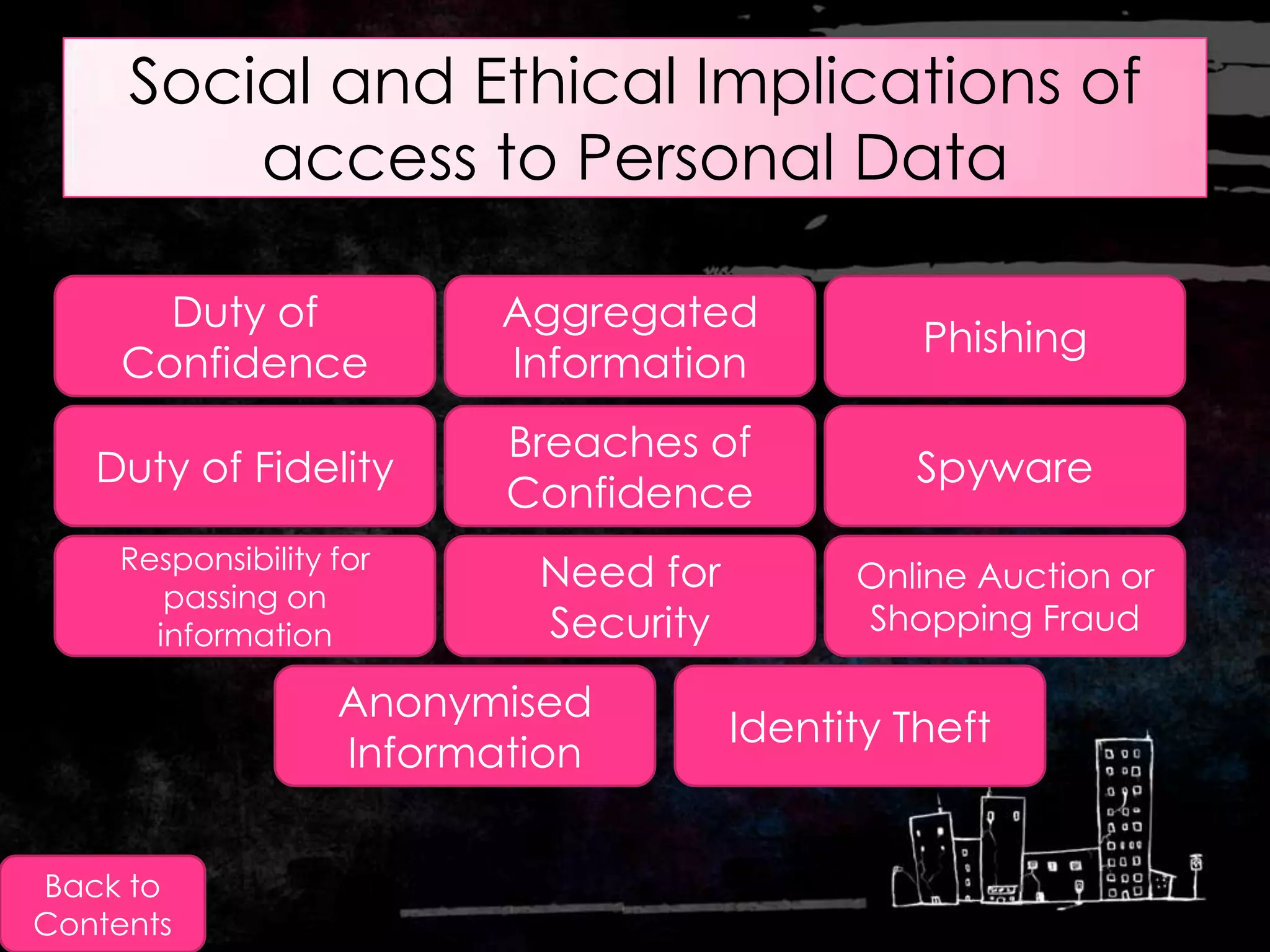
Social and Ethical Implications of
         access to Personal Data

       Duty of             Aggregated
                                                 Phishing
     Confidence            Information
                           Breaches of
   Duty of Fidelity                              Spyware
                           Confidence
     Responsibility for
                            Need for         Online Auction or
        passing on
       information          Security         Shopping Fraud

                    Anonymised
                                       Identity Theft
                    Information


Back to
Contents
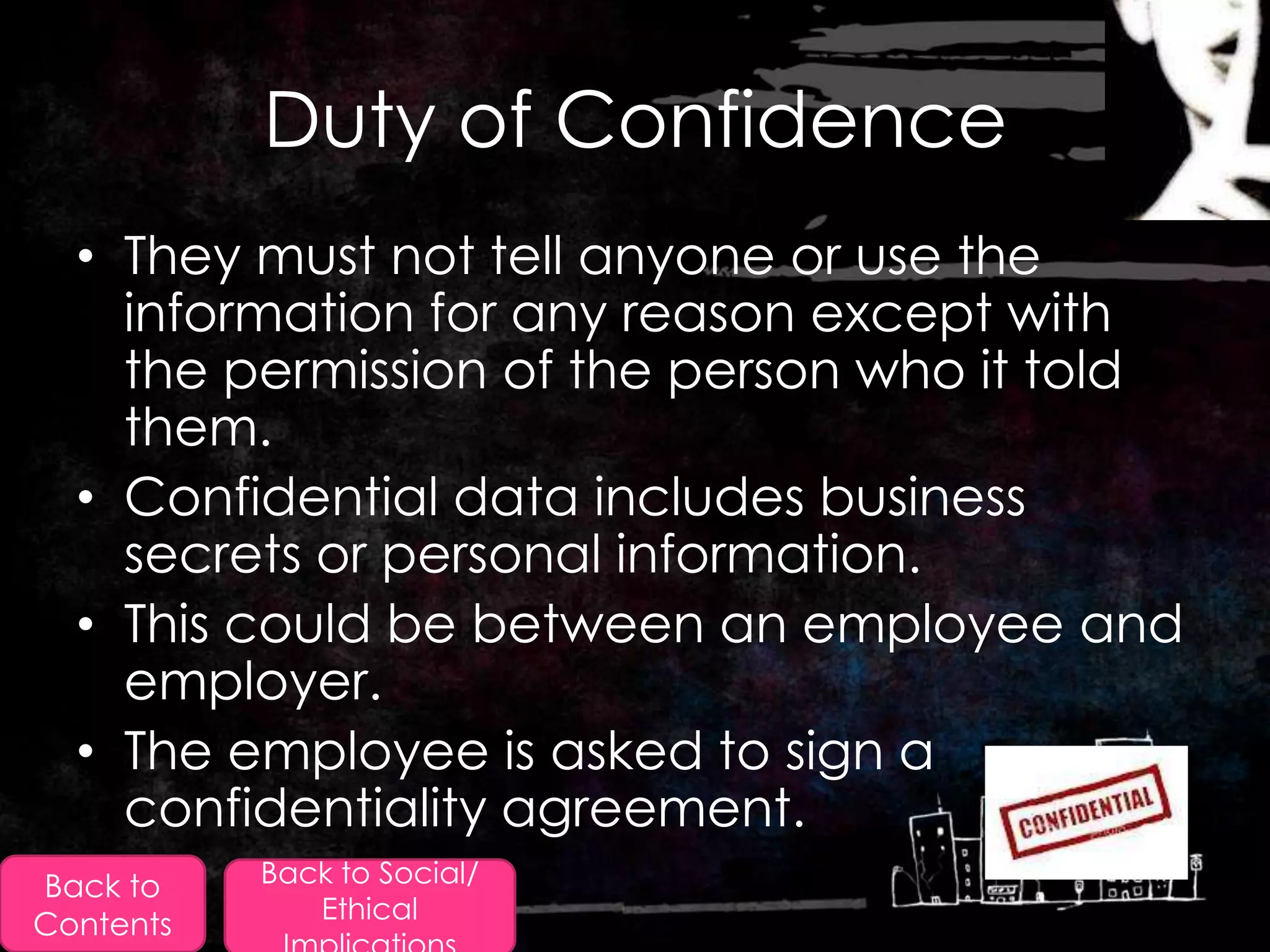
Duty of Confidence
  • They must not tell anyone or use the
    information for any reason except with
    the permission of the person who it told
    them.
  • Confidential data includes business
    secrets or personal information.
  • This could be between an employee and
    employer.
  • The employee is asked to sign a
    confidentiality agreement.
Back to    Back to Social/
              Ethical
Contents
Duty of Fidelity
  • This is when an employee must remain
    loyal to their employer.
  • They must not tell any of the rival
    companies about their work.
  • However, once an employee leaves a
    company they have the free liberty of
    using their skills and knowledge that
    they acquired from the company.
Back to    Back to Social/
              Ethical
Contents
Responsibility for passing on
              information

  • When a company passes on information about any
    individual they must ensure that the least amount of
    information that could identify the individual is used.
  • Things like online banking or online shopping require
    you to give them your personal information. It MUST
    be ensured that information is not passed from
    organisation to organisation without authorisation
    from the individual.


Back to    Back to Social/
              Ethical
Contents
Anonymised Information
  • This is when information about an
    individual is passed on without the
    mention of their name.
  • Companies should always omit any
    personal details wherever possible.


Back to      Back to Social/
                Ethical
Contents
Aggregated Information
  • It is a summary of personal information without
    naming the person.
                      For example:
    All the people who are above the age of 60
                   and have diabetes.
           This way no one can be identified.

            However, there is a downside to this. There might be
           only one person in the whole hospital so identification
           of the person will be easy and may be embarrassing
                              for the individual.


Back to        Back to Social/
                  Ethical
Contents
Breaches of Confidence
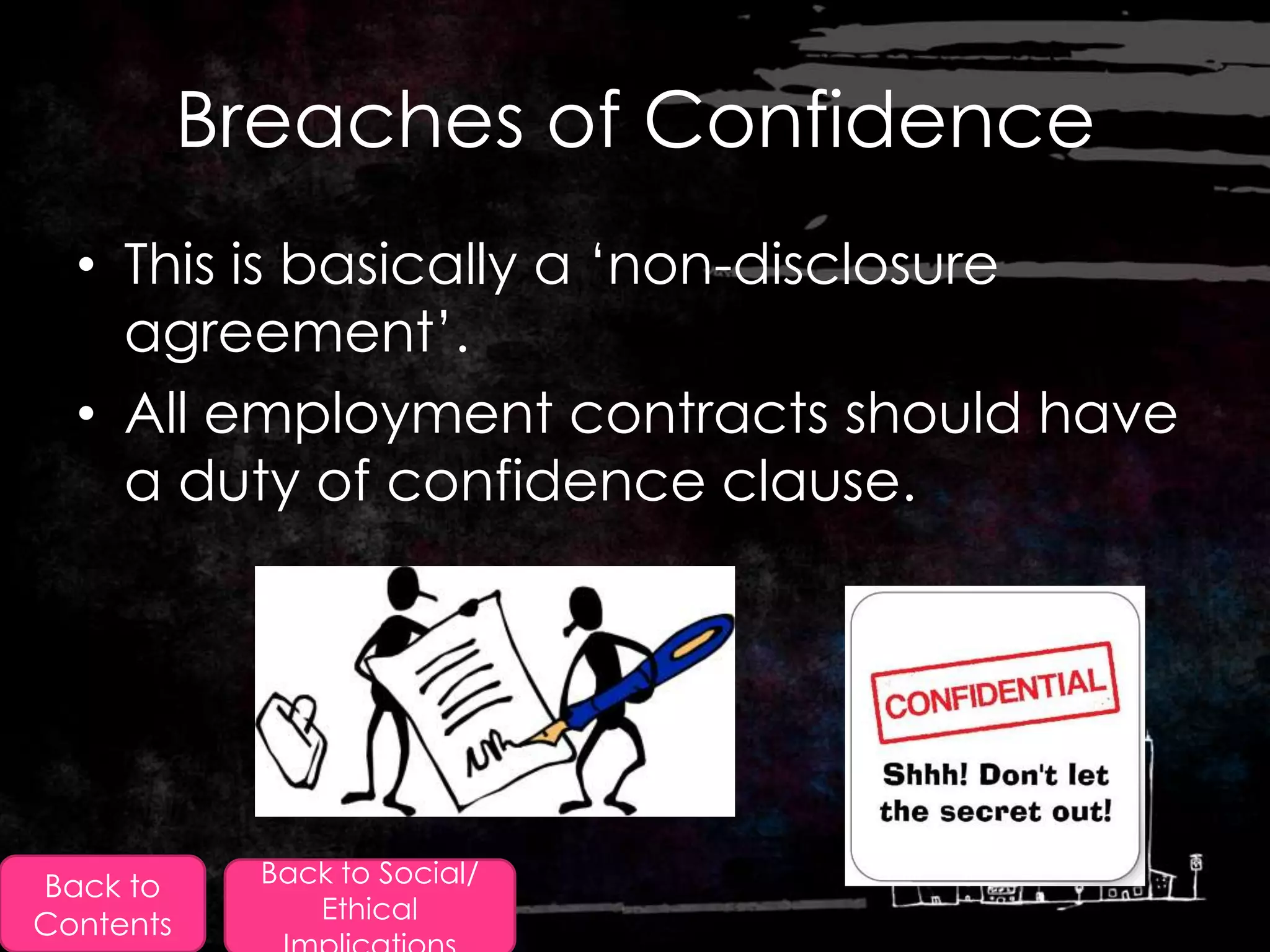
  • This is basically a „non-disclosure
    agreement‟.
  • All employment contracts should have
    a duty of confidence clause.


Back to      Back to Social/
                Ethical
Contents
Need for Security
  • All organisations need to protect they
    computerized information.
  • Many people don‟t use online banking
    because they are scared that people
    will defraud them.


Back to    Back to Social/
              Ethical
Contents
Identity Theft
  • It starts off by stolen credit card details.
  So when does it all go wrong?
    Scenario: Purchase is made at a restaurant;
     the customer lets the waiter take their credit
                   card out of their sight.
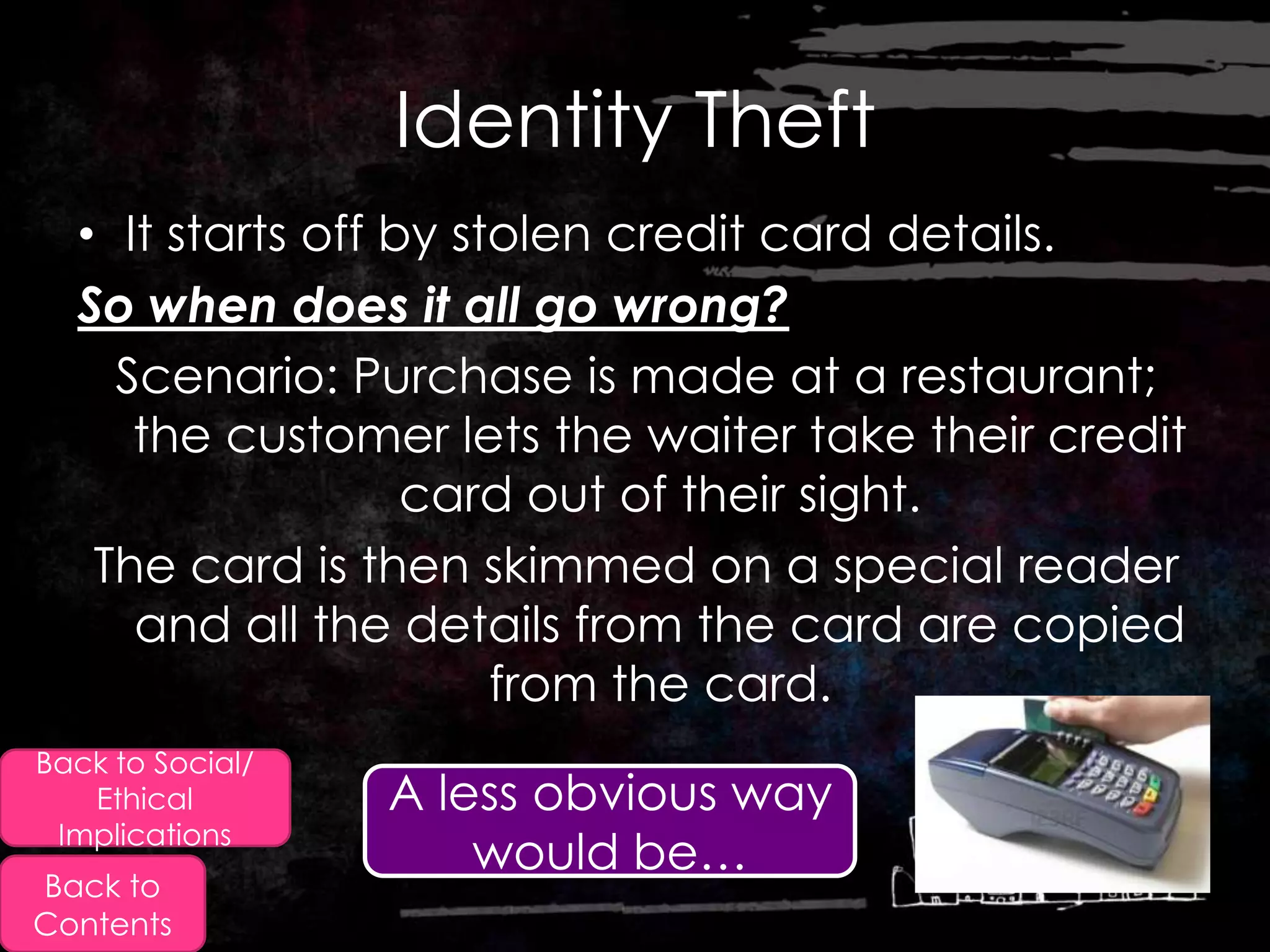
   The card is then skimmed on a special reader
     and all the details from the card are copied
                       from the card.
Back to Social/
   Ethical        A less obvious way
 Implications
                      would be…
Back to
Contents
Identity Theft
  • Sometimes the machine is below the cash till
    and the customer hardly notices that it has
    been skimmed as well as swiped for the
    transaction.
  Another Method:
  Retail outlets’ databases are hacked into and
    all the customer data is copied for illegal use.

       When data is encrypted, it at some point does
        need to be decrypted and at that point the
         information becomes vulnerable to theft.

Back to    Back to Social/
              Ethical
Contents
Phishing
  • This is when a fraudulent email is sent to a
    person. It will seem as if the email is sent
    by the bank however in reality it isn‟t.
  • The email will request the person to give
    their password, card or account number
    and other security details.
      What the phishers do is that they include the website
   address for the customer to go on to. And this website looks
                                legit.
    This fake website is set up PURELY to get customer details.

                                What is pharming?
Back to     Back to Social/
               Ethical
Contents
Pharming

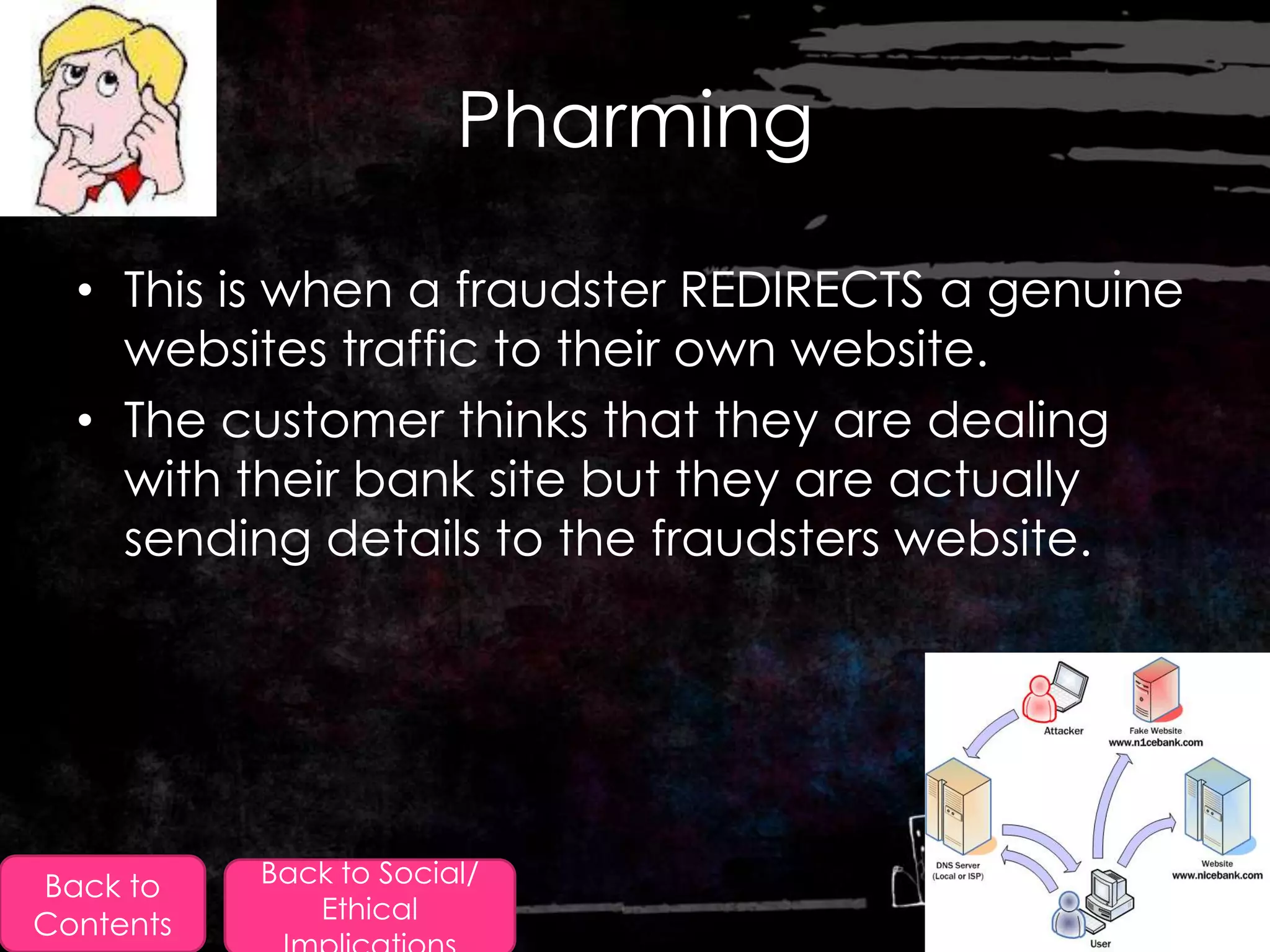
  • This is when a fraudster REDIRECTS a genuine
    websites traffic to their own website.
  • The customer thinks that they are dealing
    with their bank site but they are actually
    sending details to the fraudsters website.


Back to    Back to Social/
              Ethical
Contents
Spyware
  • This is a software that customers unknowingly
    download.
  • It usually is attached to a software which the
    computer user downloads.
  • The fraudster has attached spyware to gather
    personal details of the user.
  • They do this by using a key logging software when
    the user logs on to their bank account of online
    shopping.


Back to    Back to Social/
              Ethical
Contents
Online Auction or Shopping
                 Fraud
  • This is when somebody sets up a
    genuine site and puts up expensive
    items for sale and then they don‟t
    deliver it or they send a cheap
    imitation.
  • They take the money but never deliver
    the goods.


Back to    Back to Social/
              Ethical
Contents

3.5 Online Services and Security and Privacy of Data

  • 1.
  • 2.
    Click for More>>> Need to Protect Data Protection Confidentiality of Data Legislation Social and Ethical Shop Security Implications of Access to Personal Information Online Banking Online Shopping Back to Contents
  • 3.
    Need to protectconfidentiality of data • This means that data should only be seen by people who are authorised to see it. What is the main technique used into ICT to ensure the confidentiality of data in online systems? Encryption Back to What is encryption? Contents
  • 4.
    Encryption •This is a process by which ordinary data is converted into a secret code. This is done so that anyone unauthorised to see the data doesn‟t. • However, they do have the ability to delete the information that they intercept. • On the receiving on of the encrypted data it is decrypted using a secret key. Note: Unencrypted data is called plain text Encrypted data is referred to as cipher Back to text Contents
  • 5.
    Shop Security Thereare two types of encryption keys: 1. Public encryption key 2. Private encryption key People have a public encryption key they can tell everyone about. And they have a private encryption key, which only they know about. So what? Back to Contents
  • 6.
    So… • If you know a persons public encryption key; you can encrypt a message and send it to them. But ONLY that individual can decrypt the message using their private key. • For example: When John wants to send a secure message to Jane, he uses Jane's public key to encrypt the message. Jane then uses her private key to decrypt it. What is a public key system? Back to Contents
  • 7.
    Public Key System “This is used to encrypt data that is transmitted using the Internet for payment purposes” Keep in mind that when we use the Internet to make a payment; all these tasks of encrypting and decrypting happens in the background (so we don’t see it) Back to Contents
  • 8.
    Online Banking “Online banking uses secure sites and all the data transferred using the Internet including your password, is encrypted.” • Encryption does not prevent hackers from accessing your PC. These hackers could use a key logging software. This allows them to detect the keys you are pressing on the keyboard. (this may also allow them to discover your password) Back to Additional Methods of Security Contents
  • 9.
    Additional Methods ofSecurity 1- Use Transaction numbers (TANs): these are passwords that can only be used once. This could be sent to you via a text message from the bank. They are only valid for a few minutes thus reducing the time for a hacker to intercept and use it. 2- Ask the user to type in only part of the password. Every time the user logs in they are asked for the part of the password in a different combination (i.e. 2nd character, 3rd character, and 6th character) 3- Providing the customer with a handheld chip and PIN device. This device generates single-use passwords. Several things are required by the user to access their account, it includes the following: • debit card A customer enters the card into the •PIN number device and enters their PIN number. •Online security number They are then issued with an 8-digit •Chip and PIN itself code. Using this they can then log in. Back to Contents
  • 10.
    Online Shopping • It is the customers responsibility that they use a reputable, secure online store. How do you know if data is being transmitted in a secure way? 1. The „https‟ prefix in the URL compared Protocols used in the to the normal „http‟ encryption of 2. The secure socket messages between a layer (SSL)- the pad- client computer and lock sign at the bottom server of the screen. Few Important Back to Points Contents
  • 11.
    Important Points × The customer MUST check the contact details of the company to ensure reliability. × The store MUST have a privacy policy and the customer MUST read this. If the store does not have one, or the customer is unsure about some parts of it, they shouldn‟t trust the online store. × The customer must know exactly what they are buying. “Both description and what to do in the event that they are not satisfied should be clear.” × A customer must always print out the details from the transaction they make in case of future disputes. Back to Contents
  • 12.
    Data Protection Legislation What does it do? It keeps data private as well as confidential. For example: The UK Data Protection Act states • Personal data shall be processed fairly and lawfully. • Personal data shall be obtained only for a lawful purpose. • Personal data shall be accurate and will be kept up-to- date. • Appropriate measures will be taken against unauthorised processing of personal data Punishment for breaking ANY rules listed in the UK Protection Act is a very large fine. Back to Contents
  • 13.
    Social and EthicalImplications of access to Personal Data Duty of Aggregated Phishing Confidence Information Breaches of Duty of Fidelity Spyware Confidence Responsibility for Need for Online Auction or passing on information Security Shopping Fraud Anonymised Identity Theft Information Back to Contents
  • 14.
    Duty of Confidence • They must not tell anyone or use the information for any reason except with the permission of the person who it told them. • Confidential data includes business secrets or personal information. • This could be between an employee and employer. • The employee is asked to sign a confidentiality agreement. Back to Back to Social/ Ethical Contents
  • 15.
    Duty of Fidelity • This is when an employee must remain loyal to their employer. • They must not tell any of the rival companies about their work. • However, once an employee leaves a company they have the free liberty of using their skills and knowledge that they acquired from the company. Back to Back to Social/ Ethical Contents
  • 16.
    Responsibility for passingon information • When a company passes on information about any individual they must ensure that the least amount of information that could identify the individual is used. • Things like online banking or online shopping require you to give them your personal information. It MUST be ensured that information is not passed from organisation to organisation without authorisation from the individual. Back to Back to Social/ Ethical Contents
  • 17.
    Anonymised Information • This is when information about an individual is passed on without the mention of their name. • Companies should always omit any personal details wherever possible. Back to Back to Social/ Ethical Contents
  • 18.
    Aggregated Information • It is a summary of personal information without naming the person. For example: All the people who are above the age of 60 and have diabetes. This way no one can be identified. However, there is a downside to this. There might be only one person in the whole hospital so identification of the person will be easy and may be embarrassing for the individual. Back to Back to Social/ Ethical Contents
  • 19.
    Breaches of Confidence • This is basically a „non-disclosure agreement‟. • All employment contracts should have a duty of confidence clause. Back to Back to Social/ Ethical Contents
  • 20.
    Need for Security • All organisations need to protect they computerized information. • Many people don‟t use online banking because they are scared that people will defraud them. Back to Back to Social/ Ethical Contents
  • 21.
    Identity Theft • It starts off by stolen credit card details. So when does it all go wrong? Scenario: Purchase is made at a restaurant; the customer lets the waiter take their credit card out of their sight. The card is then skimmed on a special reader and all the details from the card are copied from the card. Back to Social/ Ethical A less obvious way Implications would be… Back to Contents
  • 22.
    Identity Theft • Sometimes the machine is below the cash till and the customer hardly notices that it has been skimmed as well as swiped for the transaction. Another Method: Retail outlets’ databases are hacked into and all the customer data is copied for illegal use. When data is encrypted, it at some point does need to be decrypted and at that point the information becomes vulnerable to theft. Back to Back to Social/ Ethical Contents
  • 23.
    Phishing •This is when a fraudulent email is sent to a person. It will seem as if the email is sent by the bank however in reality it isn‟t. • The email will request the person to give their password, card or account number and other security details. What the phishers do is that they include the website address for the customer to go on to. And this website looks legit. This fake website is set up PURELY to get customer details. What is pharming? Back to Back to Social/ Ethical Contents
  • 24.
    Pharming •This is when a fraudster REDIRECTS a genuine websites traffic to their own website. • The customer thinks that they are dealing with their bank site but they are actually sending details to the fraudsters website. Back to Back to Social/ Ethical Contents
  • 25.
    Spyware •This is a software that customers unknowingly download. • It usually is attached to a software which the computer user downloads. • The fraudster has attached spyware to gather personal details of the user. • They do this by using a key logging software when the user logs on to their bank account of online shopping. Back to Back to Social/ Ethical Contents
  • 26.
    Online Auction orShopping Fraud • This is when somebody sets up a genuine site and puts up expensive items for sale and then they don‟t deliver it or they send a cheap imitation. • They take the money but never deliver the goods. Back to Back to Social/ Ethical Contents