DENTAL
PRODUCTS
By: Dr. Kiran B. Dhamak
Dental products: These are the products which employed in the treatment of dentistry or dental
caries. The dental caries is due to the action of acids mostly lactic acid produced from oral bacterial
metabolism of dietary carbohydrate.
A wide variety of inorganic compounds are used in dentistry and in dental products. These includes
mainly
(a) Anticaries agents
(b) Cleaning agents
(c) Polishing agents.
(d) Desensiting agents
 Anticarries Agent : These are the agents which are used to prevent dental
carries and to maintain clean and healthy teeth.
 e.g. Use of ammoniated tooth paste and urea ammonia powder.
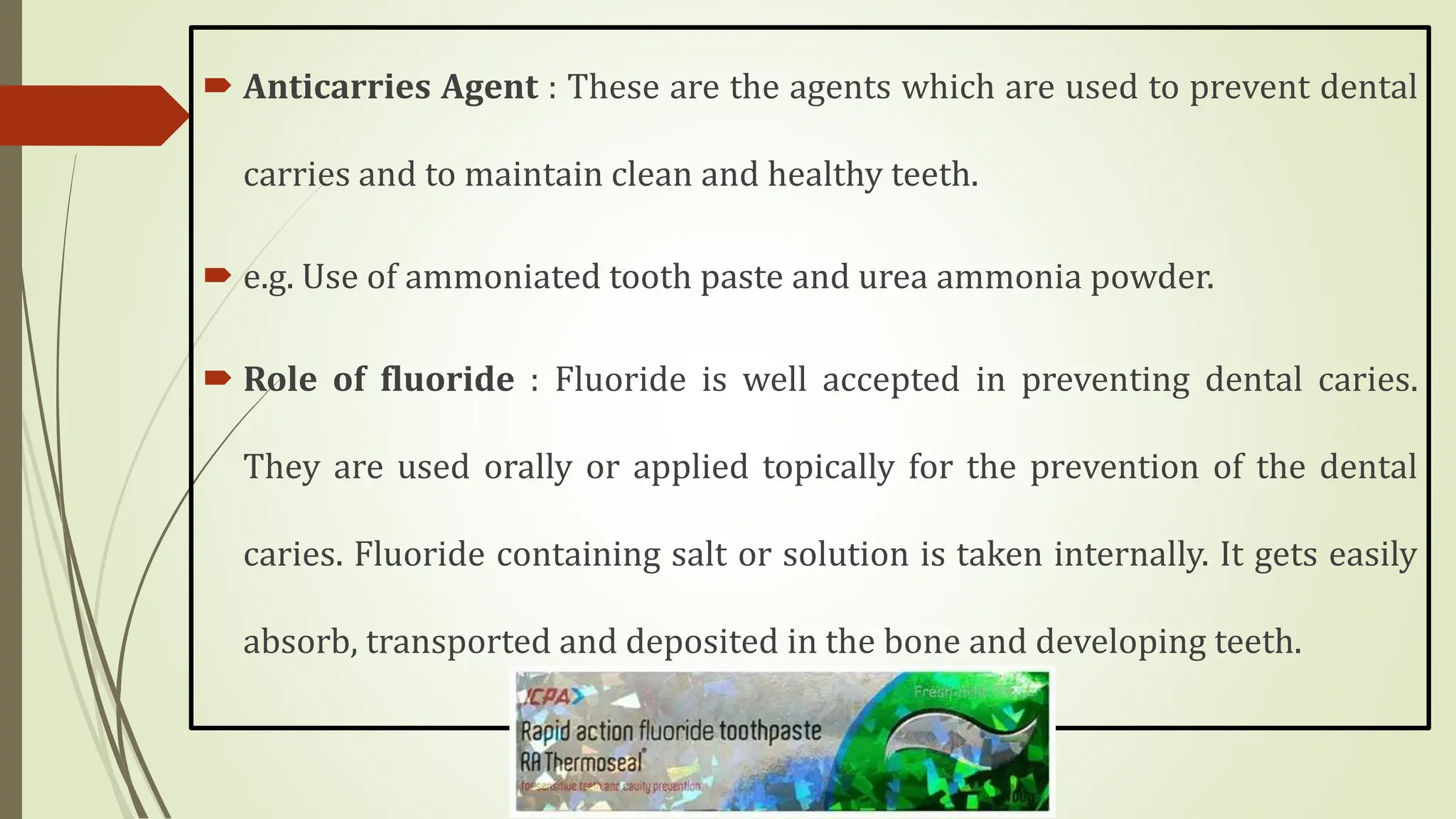
 Role of fluoride : Fluoride is well accepted in preventing dental caries.
They are used orally or applied topically for the prevention of the dental
caries. Fluoride containing salt or solution is taken internally. It gets easily
absorb, transported and deposited in the bone and developing teeth.
 Cleaning agent : Cleaning agents must remove the stain from the teeth. They are
generally have course to fine particle size and satisfactory abrasive property.
 e.g. calcium phosphate dibasic and tribasic, sodium metaphosphate are
commonly used in toothpaste and tooth powders.
 Polishing agent : They are used to give effective whiteness of the teeth. Besides
having a polishing effect some desensitizing agents are added in dental product to
reduce the sensitivity.
 E.g. Sodium fluoride.
 Desensitizing agent : these are the agent which are used to reduce sensitivity of
teeth to heat and cold.
 E.g. Strontium chloride
Calcium carbonate( CaCo3 )
It is also known as precipitated chalk.
Properties :-
It is fine white microcrystalline water
It is odourless and tasteless.
It is stable in air
It is insoluble in water and alcohol
Uses :-
It is used as an antacid
It relives the pain of gastric and duodenal ulcer.
It is used in the treatment of diarrhea.
It is also used as polishing agent in tooth powders.
Storage :- It is stored in well closed container.
Pharmaceutical Formulations:- Tablets, Capsules, Oral Suspensions
Market Preparations:- Caltrate, Calbomin D3, Alfrix
Sodium Fluoride (NaF) :-
Properties : 1) It occurs as colourless, odourless, crystals or white powder.
2) It is soluble in water but insoluble in alcohol.
Uses : 1) It is used for the treatment of dental caries.
2) Its 2% aqueous solution is used topically on teeth as anticaries agent.
3) It is also used as a polishing agent in dental formulations.
Storage : It is should be kept in well closed container.
 Pharmaceutical Formulations:- Tablets, Drops,
 Market Preparations:- NuNaf, NaF, OTOFLOUR
 Denture Cleaners-
When dentures are removed from the mouth, a denture cleaner (Cleanser) is used to clean
them.
 The main purpose is to prevent denture related stomatitis (a condition that causes painful swelling
and sores inside the mouth) by controlling the growth of bacteria on the dentures, particularly
candida albicans. When dentures are worn in the mouth, a biofilm forms that looks and feels like
dental plaque (Sticky film of bacteria that form on teeth).
 Dental Cleansers are used to remove stains and other debris generated by a variety of factors such
as diet, tobacco usage, coffee, tea and other beverages.
 Chemical Denture cleansers are available in the form of cream, liquid, powder, paste , tablets etc.
Chemical dentures cleaners can be effervescent of non-effervescent.
Denture brushes and ultrasonic denture cleaners are mechanical denture cleaners that use ultrasonic
cleaning, some of which are combined with UV radiation.
Ingredients-
1. Dil. Sodium hypochlorite- bleaching agent
2. Sodium bicarbonate- alkalizing agent that clean denture
3. Citric acid- remove spots
4. Potassium monopersulfate-Cleaning and bleaching ahent
 Denture Adhesives:-
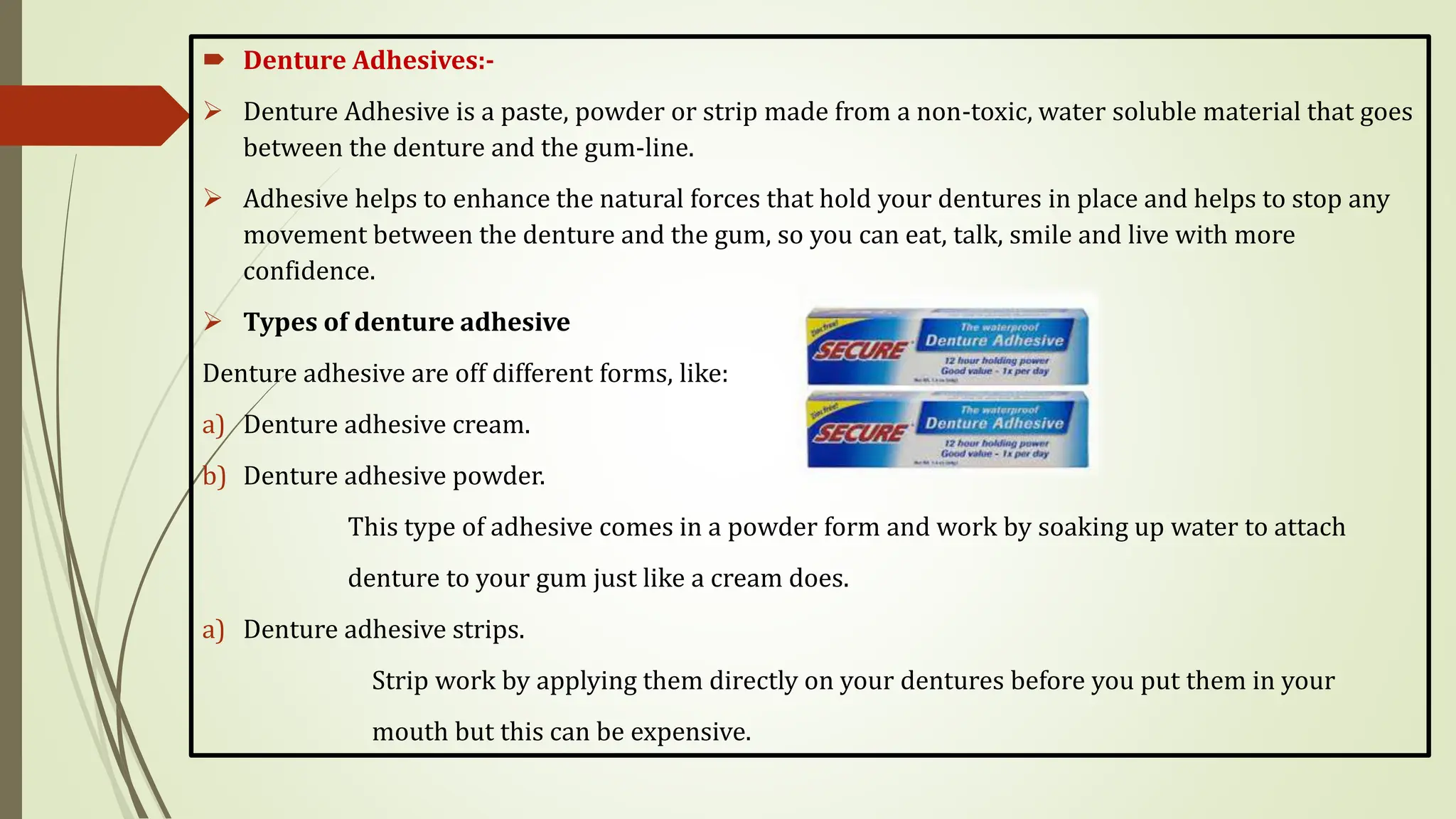
 Denture Adhesive is a paste, powder or strip made from a non-toxic, water soluble material that goes
between the denture and the gum-line.
 Adhesive helps to enhance the natural forces that hold your dentures in place and helps to stop any
movement between the denture and the gum, so you can eat, talk, smile and live with more
confidence.
 Types of denture adhesive
Denture adhesive are off different forms, like:
a) Denture adhesive cream.
b) Denture adhesive powder.
This type of adhesive comes in a powder form and work by soaking up water to attach
denture to your gum just like a cream does.
a) Denture adhesive strips.
Strip work by applying them directly on your dentures before you put them in your
mouth but this can be expensive.
 Composition
The composition of denture adhesives are as follows-
a) Zinc- this mineral helps adhesive to create that grip you needed.
b) Mineral oil- this ingredient deliver the right denture cream consistency.
c) Cellulose gum- this ingredient helps the dentures to stick in place.
d) Silica- It also works to help for creating the right consistency.
e) Red 27 Lake- this ingredient gives colour to adhesives.
Mechanism
Denture adhesives work by ‘gluing’ the denture to the tissue through the saliva. Your mouth’s natural
moisture transforms the adhesive into an elastic like membrane that sticks to both the gum and the
denture . Hence, denture adhesive hold your dentures tight and improves the natural retention you have
from a well-fitting denture. The saliva between the denture and the gum tissue also resists being pulled
apart, and the adhesive helps to strengthen that force.
USES:-
 Dentures are used by people who have had all or some of their teeth removed.
 Although the suction force on the denture should be enough to keep it in place, you can add
denture adhesive if you want to bite into crunchy, sticky or tough to chew food.
 Another time to use denture adhesive is if your gums are sensitive and you want to avoid getting
denture sores.
Mouth washes
 Antiseptic and antiplaque mouth rinse claims to kill the germs that cause plaque, gingivitis and
bad breath.
 Ingredients:-
 Solvent
Water-Distilled water
Ethanol-Good solubilizer and freshness effects
 Flavours- Pepermint
 Phenolics- Thymol, eucalyptus, menthol
 Solubilizer- poloxamer, polysorbates
 Antimicrobial-Cetyl pyridinium chloride(CPC),
Chlorhexidine

3.4 Dental products.pptx

  • 1.
  • 2.
    Dental products: Theseare the products which employed in the treatment of dentistry or dental caries. The dental caries is due to the action of acids mostly lactic acid produced from oral bacterial metabolism of dietary carbohydrate. A wide variety of inorganic compounds are used in dentistry and in dental products. These includes mainly (a) Anticaries agents (b) Cleaning agents (c) Polishing agents. (d) Desensiting agents
  • 3.
     Anticarries Agent: These are the agents which are used to prevent dental carries and to maintain clean and healthy teeth.  e.g. Use of ammoniated tooth paste and urea ammonia powder.  Role of fluoride : Fluoride is well accepted in preventing dental caries. They are used orally or applied topically for the prevention of the dental caries. Fluoride containing salt or solution is taken internally. It gets easily absorb, transported and deposited in the bone and developing teeth.
  • 4.
     Cleaning agent: Cleaning agents must remove the stain from the teeth. They are generally have course to fine particle size and satisfactory abrasive property.  e.g. calcium phosphate dibasic and tribasic, sodium metaphosphate are commonly used in toothpaste and tooth powders.  Polishing agent : They are used to give effective whiteness of the teeth. Besides having a polishing effect some desensitizing agents are added in dental product to reduce the sensitivity.  E.g. Sodium fluoride.  Desensitizing agent : these are the agent which are used to reduce sensitivity of teeth to heat and cold.  E.g. Strontium chloride
  • 5.
    Calcium carbonate( CaCo3) It is also known as precipitated chalk. Properties :- It is fine white microcrystalline water It is odourless and tasteless. It is stable in air It is insoluble in water and alcohol Uses :- It is used as an antacid It relives the pain of gastric and duodenal ulcer. It is used in the treatment of diarrhea. It is also used as polishing agent in tooth powders. Storage :- It is stored in well closed container. Pharmaceutical Formulations:- Tablets, Capsules, Oral Suspensions Market Preparations:- Caltrate, Calbomin D3, Alfrix
  • 6.
    Sodium Fluoride (NaF):- Properties : 1) It occurs as colourless, odourless, crystals or white powder. 2) It is soluble in water but insoluble in alcohol. Uses : 1) It is used for the treatment of dental caries. 2) Its 2% aqueous solution is used topically on teeth as anticaries agent. 3) It is also used as a polishing agent in dental formulations. Storage : It is should be kept in well closed container.  Pharmaceutical Formulations:- Tablets, Drops,  Market Preparations:- NuNaf, NaF, OTOFLOUR
  • 7.
     Denture Cleaners- Whendentures are removed from the mouth, a denture cleaner (Cleanser) is used to clean them.  The main purpose is to prevent denture related stomatitis (a condition that causes painful swelling and sores inside the mouth) by controlling the growth of bacteria on the dentures, particularly candida albicans. When dentures are worn in the mouth, a biofilm forms that looks and feels like dental plaque (Sticky film of bacteria that form on teeth).  Dental Cleansers are used to remove stains and other debris generated by a variety of factors such as diet, tobacco usage, coffee, tea and other beverages.  Chemical Denture cleansers are available in the form of cream, liquid, powder, paste , tablets etc.
  • 8.
    Chemical dentures cleanerscan be effervescent of non-effervescent. Denture brushes and ultrasonic denture cleaners are mechanical denture cleaners that use ultrasonic cleaning, some of which are combined with UV radiation. Ingredients- 1. Dil. Sodium hypochlorite- bleaching agent 2. Sodium bicarbonate- alkalizing agent that clean denture 3. Citric acid- remove spots 4. Potassium monopersulfate-Cleaning and bleaching ahent
  • 9.
     Denture Adhesives:- Denture Adhesive is a paste, powder or strip made from a non-toxic, water soluble material that goes between the denture and the gum-line.  Adhesive helps to enhance the natural forces that hold your dentures in place and helps to stop any movement between the denture and the gum, so you can eat, talk, smile and live with more confidence.  Types of denture adhesive Denture adhesive are off different forms, like: a) Denture adhesive cream. b) Denture adhesive powder. This type of adhesive comes in a powder form and work by soaking up water to attach denture to your gum just like a cream does. a) Denture adhesive strips. Strip work by applying them directly on your dentures before you put them in your mouth but this can be expensive.
  • 10.
     Composition The compositionof denture adhesives are as follows- a) Zinc- this mineral helps adhesive to create that grip you needed. b) Mineral oil- this ingredient deliver the right denture cream consistency. c) Cellulose gum- this ingredient helps the dentures to stick in place. d) Silica- It also works to help for creating the right consistency. e) Red 27 Lake- this ingredient gives colour to adhesives. Mechanism Denture adhesives work by ‘gluing’ the denture to the tissue through the saliva. Your mouth’s natural moisture transforms the adhesive into an elastic like membrane that sticks to both the gum and the denture . Hence, denture adhesive hold your dentures tight and improves the natural retention you have from a well-fitting denture. The saliva between the denture and the gum tissue also resists being pulled apart, and the adhesive helps to strengthen that force.
  • 11.
    USES:-  Dentures areused by people who have had all or some of their teeth removed.  Although the suction force on the denture should be enough to keep it in place, you can add denture adhesive if you want to bite into crunchy, sticky or tough to chew food.  Another time to use denture adhesive is if your gums are sensitive and you want to avoid getting denture sores.
  • 12.
    Mouth washes  Antisepticand antiplaque mouth rinse claims to kill the germs that cause plaque, gingivitis and bad breath.  Ingredients:-  Solvent Water-Distilled water Ethanol-Good solubilizer and freshness effects  Flavours- Pepermint  Phenolics- Thymol, eucalyptus, menthol  Solubilizer- poloxamer, polysorbates  Antimicrobial-Cetyl pyridinium chloride(CPC), Chlorhexidine